Disclosure: airfryerkitchensupply.com is reader-supported. When you buy through links on our site, we may earn an affiliate commission at no extra cost to you.
Where to buy
The fastest way to buy best digital instant read meat thermometers is through Amazon, where every pick below that carries a verified listing can be checked for current availability in a couple of clicks. Picks with a link have been cross-checked against Amazon’s own catalogue data before this guide was published, so the link lands on the exact model reviewed, not a look-alike. Where a pick is described without a link, it is an unlinked recommendation: use the full product name in Amazon search and match the details in its review section before you order. Prices move constantly on measuring tools, small appliances and footwear alike, so this guide never prints a fixed price — use the check-price links to see today’s figure.
- ThermoWorks Thermapen ONE, Cayenne Pepper Red (Best Overall) — Check the current price on Amazon
- TempPro TempSwift TP19H Instant Read Meat Thermometer (Best Fast Value) — Check the current price on Amazon
- Lavatools Javelin PRO Classic Digital Instant Read Thermometer (Best Compact Professional) — Check the current price on Amazon
- Taylor Digital Instant Read Waterproof Meat Thermometer with Backlight (Best Budget) — Check the current price on Amazon
- Alpha Grillers Meat Thermometer Digital (Best for Grillers) — Check the current price on Amazon
- ThermoWorks ThermoPop 2, Cayenne Pepper Red (Best Simple and Sturdy) — Check the current price on Amazon
The best digital instant read meat thermometers do one job with no excuses: they tell you the true internal temperature of meat in a few seconds, in numbers you can trust, while your other hand holds the tongs. This guide compares six verified digital models across the category’s real divides — professional-grade speed and accuracy, budget reliability, waterproof builds for messy cooks, backlit displays for night grilling, and compact designs for travel and small kitchens.
Instant read is a discipline, not a marketing phrase. A genuine instant-read thermometer uses a fast thermistor or thermocouple sensor in a thin probe tip, reads in roughly two to five seconds, and is used to check and remove — not left in the meat during cooking. Leave-in probes and wireless thermometers are different tools with their own guides in this cluster; everything here is a handheld digital spot-checker, bought to answer one question at the grill, in the oven doorway or at the carving board: is it done, exactly?
After the reviews, the buying guide explains sensor types, accuracy tolerances and temperature ranges, and the how-to section teaches probing technique: where to insert, what to avoid, and how to read carryover like a professional.
In this guide
Quick Picks
If you only read one section, make it this one. These six best digital instant read meat thermometers earned their places for different reasons, and the badge on each pick in this list is the same badge used at the top of its full review further down, so you can jump straight from the shortlist to the detail that matters to you.
- ThermoWorks Thermapen ONE, Cayenne Pepper Red — Best Overall. The professional benchmark of the category: ThermoWorks’ flagship instant-read, the thermometer competition cooks and serious grillers measure every other model against. — check price on Amazon
- TempPro TempSwift TP19H Instant Read Meat Thermometer — Best Fast Value. A one-second-class reading (maker’s specification) with an auto-rotating backlit display, motion activation and waterproofing — flagship manners at a mid-tier position. — check price on Amazon
- Lavatools Javelin PRO Classic Digital Instant Read Thermometer — Best Compact Professional. A professional two-second thermometer in a compact folding body — NSF certified, IP65 water resistant, with an auto-rotating backlit display. — check price on Amazon
- Taylor Digital Instant Read Waterproof Meat Thermometer with Backlight — Best Budget. The budget anchor from America’s thermometer institution: waterproof, folding probe, blue backlight, a −40 to 450°F range and batteries in the box. — check price on Amazon
- Alpha Grillers Meat Thermometer Digital — Best for Grillers. A grilling-first thermometer: maker-rated 1–2 second response, bright backlit display and full IP67 waterproofing, pre-calibrated and ready from the box. — check price on Amazon
- ThermoWorks ThermoPop 2, Cayenne Pepper Red — Best Simple and Sturdy. ThermoWorks’ value line in a rotating-display, pocketable format — the specialist maker’s quality at the household tier, billed by its maker as its best-value instant read. — check price on Amazon
How These Picks Were Chosen
Candidates had to be handheld digital instant-read thermometers in the strict sense: a folding or fixed thin probe, a digital display, and a read time measured in seconds. Analogue dial thermometers, leave-in probe systems and wireless app thermometers were excluded regardless of quality, because they answer different questions — those categories have their own guides in this cluster, linked at the end of this article.
Within the field, picks were verified one by one against the catalogue data and spread across the roles buyers actually shop for: the professional benchmark, the budget staple, the waterproof workhorse, the night-grilling display, the compact traveller and the all-round household choice. Sensor claims were treated as claims: where a maker states a read time or accuracy, the review attributes it as the maker’s specification rather than this guide’s measurement.
Badges follow those roles rather than a single ladder, because the best thermometer for a competition pitmaster and the best for a weeknight chicken cook differ in price far more than in correctness. The comparison table lines the six up by their key specifications so the speed, range and build differences are visible at a glance before the detail sections explain what they mean in practice.
The 6 Best Digital Instant Read Meat Thermometers

ThermoWorks Thermapen ONE, Cayenne Pepper Red — Best Overall
Every category has a reference product, and in instant-read thermometers it is the Thermapen. The ONE is ThermoWorks’ flagship: a folding-probe digital thermometer built around professional speed and accuracy, carried by competition barbecue teams, restaurant kitchens and serious home cooks who decided to buy the category once. Its listing’s own billing — the number one recommended instant-read thermometer — reflects a decade of that reputation rather than a season’s marketing.
What the flagship money buys is pace and trust: readings that settle almost as fast as you can position the probe, a build that tolerates commercial kitchens, and a maker whose entire business is temperature measurement. For cooks who probe constantly — multiple steaks, a brisket’s several zones, a fryer, a roast — those seconds and that trust compound into the product’s real value.
Strengths
- Professional-grade speed and accuracy — the category benchmark
- Folding probe, serious build quality from a temperature specialist
- The buy-once choice; support and calibration pedigree
Trade-offs
- Premium price, several times the budget picks
- Its talents are wasted on occasional, single-probe cooking
- No leave-in function — it is a spot-check instrument only
| Maker | ThermoWorks |
| Model | Thermapen ONE |
| Colour | Cayenne Pepper Red |
| Type | Folding probe, digital instant read |
Buy the Thermapen ONE if temperature is a serious variable in your cooking — barbecue competition, precision roasting, brewing-adjacent tasks, or simply a refusal to guess ever again. It is the pick against which this guide’s value options are measured, and its presence at the top is not brand worship: in a category where the product is a number you stake dinner on, the specialist maker’s flagship earns its premium in the only currency that matters, which is readings you stop second-guessing.
Best for: serious grillers, competitors and buy-once buyers / Not suited for: occasional cooks who probe twice a month
Check on Amazon — check the current price on Amazon before you decide, and confirm the size, colour or configuration in the review above is the one selected on the listing.

TempPro TempSwift TP19H Instant Read Meat Thermometer — Best Fast Value
The TP19H is the pick that makes the premium tier justify itself. TempPro specifies a one-second instant read, wraps it in a waterproof body, and adds the two display features grillers actually use: auto-rotation, so the numbers read upright from either hand and any angle, and a backlight for dark patios. Motion activation wakes it as you pick it up, which sounds minor until a cookout’s tenth probe.
Its stated territory runs beyond meat — the listing names BBQ, grilling and candy among its duties — reflecting the wide temperature usefulness that makes a good instant-read a general kitchen instrument. For the home cook who wants speed without the flagship bill, this is the guide’s sweet spot: the features that change daily use, at the tier most kitchens should buy.
Strengths
- Maker-specified 1-second read — fastest class here
- Auto-rotating backlit display suits night grilling
- Waterproof body; motion-activated wake
Trade-offs
- Brand pedigree is younger than ThermoWorks or Taylor
- One-second claims are best-case; thick roasts settle slower
- Feature-rich design has more to go wrong than basic models
| Model | TempPro TempSwift TP19H |
| Display | Auto-rotating, backlit |
| Body | Waterproof |
| Extras | Motion-activated |
Choose the TP19H if you grill after dark, cook for crowds, or simply hate waiting on a display. Its combination — speed class, rotating backlit numbers, waterproofing — is the exact feature set experienced cooks list when asked what they would upgrade to, delivered without the professional tier’s price. Ice-test it on arrival, as this guide advises for every thermometer, and it will serve as the household’s default instrument for years.
Best for: night grillers and value buyers who want flagship features / Not suited for: minimalists who want the simplest possible tool
Check on Amazon — check the current price on Amazon before you decide, and confirm the size, colour or configuration in the review above is the one selected on the listing.

Lavatools Javelin PRO Classic Digital Instant Read Thermometer — Best Compact Professional
The Javelin PRO is the professional’s pocket knife of thermometers: compact enough for an apron pocket, specified by Lavatools at a two-second read, and certified to NSF standards, which matters in commercial kitchens and reassures in domestic ones. Its IP65 water resistance shrugs off the splashes and weather that kill lesser electronics at a grill station.
Lavatools built its name on exactly this product class, and the PRO’s details show it: an auto-rotating backlit display for either hand and low light, a folding format that protects the probe and the pocket alike, and a size that makes ‘always carry it’ a realistic habit rather than an aspiration. A thermometer in the drawer checks nothing; the Javelin’s compactness is a genuine accuracy feature.
Strengths
- Maker-specified 2-second professional read
- NSF certified; IP65 water resistant
- Compact folding body lives in an apron pocket
Trade-offs
- Compact probe suits spot checks over deep roasts
- Premium-mid pricing above the budget tier
- Water resistant, not fully submersible — wash with care
| Model | Lavatools Javelin PRO Classic |
| Rating | IP65 water resistant |
| Certification | NSF certified |
| Display | Auto-rotating backlit |
Buy the Javelin PRO if you cook in motion — catering, food trucks, competition rounds, busy family grill sessions — anywhere a thermometer must be on your person and instant. It is also the traveller’s pick: the one that goes to holiday rentals, campsites and other people’s kitchens, restoring certainty wherever the cooking happens. Between the flagship’s ultimate pace and this one’s portability, many professionals own the Javelin as the daily carry and keep the flagship for home base.
Best for: mobile cooks, competitors and apron-pocket carriers / Not suited for: cooks who want the longest probe for very large roasts
Check on Amazon — check the current price on Amazon before you decide, and confirm the size, colour or configuration in the review above is the one selected on the listing.
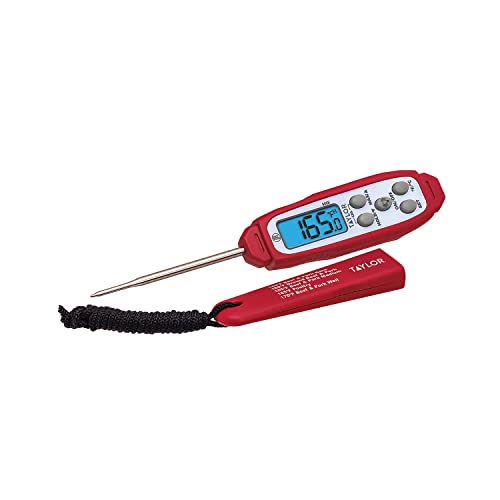
Taylor Digital Instant Read Waterproof Meat Thermometer with Backlight — Best Budget
Taylor has made thermometers longer than most brands have existed, and this digital instant-read is its budget standard-bearer: a folding probe, waterproof construction, a blue backlight for evening cooking, and a stated range from −40 to 450 degrees Fahrenheit that covers everything from freezer checks to searing. Batteries are included, a small courtesy budget rivals sometimes skip.
It will not match the flagship’s pace, and it does not pretend to. What it offers is the essential transformation — from guessing to knowing — at the category’s friendliest tier, from the maker whose analogue thermometers fill this site’s companion guide. For a first digital thermometer, a second thermometer for the caravan or tackle box, or a gift that quietly upgrades someone’s cooking, it is the rational purchase.
Strengths
- Trusted thermometer specialist at a budget tier
- Waterproof with folding probe and backlight
- Wide stated range: −40 to 450°F; batteries included
Trade-offs
- Slower settling than thermocouple-class picks
- Basic display versus auto-rotating rivals
- Budget build feel next to the premium models
| Maker | Taylor |
| Range | −40 to 450°F (per listing) |
| Probe | Folding |
| Body | Waterproof, backlit |
Choose the Taylor when the budget is real or the use is occasional — and understand that ‘budget’ here still buys a proper digital instrument that will outperform every dial thermometer and every colour test ever devised. It is also the guide’s recommendation for equipping secondary kitchens: the holiday home, the camper, the barbecue box that lives in the shed. A known number in those places beats a flagship left at home.
Best for: first-time buyers, second kitchens and budget households / Not suited for: cooks who probe constantly and feel every second
Check on Amazon — check the current price on Amazon before you decide, and confirm the size, colour or configuration in the review above is the one selected on the listing.

Alpha Grillers Meat Thermometer Digital — Best for Grillers
Alpha Grillers builds for the barbecue crowd specifically, and this thermometer’s specification reads like their checklist: a stated one-to-two-second response, a bright backlit display for dusk cookouts, and IP67 waterproofing — the strongest water rating in this guide — so the tool can be washed under the tap and used in the rain without ceremony. It arrives pre-calibrated and ready to use.
The brand’s gifting pitch is prominent in its listing, and unusually, the product underneath the pitch is sound: this is a legitimately specified grilling thermometer, not a novelty. For the household whose thermometer lives at the grill rather than the oven, the IP67 rating and the display brightness are the features that decide satisfaction across a summer of evenings.
Strengths
- IP67 — the guide’s strongest waterproofing
- Maker-rated 1–2 second response
- Bright backlit display; pre-calibrated from the box
Trade-offs
- Grilling-first design; less refined for delicate kitchen work
- Gift-market branding may undersell its real specification
- Speed claim is the maker’s best case, as with all rivals
| Maker | Alpha Grillers |
| Rating | IP67 waterproof |
| Display | Bright backlit |
| Calibration | Pre-calibrated |
Buy the Alpha Grillers if your thermometer’s home is the grill station and its enemies are weather, sauce and darkness. The IP67 rating changes behaviour: you stop protecting the tool and start using it, washing it under the tap like a utensil. It is also the guide’s easiest gift recommendation for a grilling man — a real instrument with a real specification, in a category full of gift-shaped disappointments.
Best for: outdoor grillers in all weathers and gift buyers / Not suited for: precision-focused cooks who want the flagship’s pedigree
Check on Amazon — check the current price on Amazon before you decide, and confirm the size, colour or configuration in the review above is the one selected on the listing.
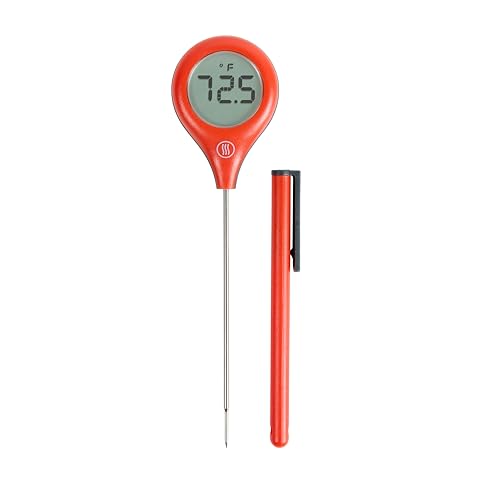
ThermoWorks ThermoPop 2, Cayenne Pepper Red — Best Simple and Sturdy
The ThermoPop 2 answers the obvious question: what does the flagship’s maker offer the rest of us? A compact instant-read with the rotating display that made the original ThermoPop a cult favourite — the numbers turn to face you whichever hand holds it — in a splash-resistant pocketable body, positioned by ThermoWorks itself as its best-value instant-read thermometer.
It trades the flagship’s ultimate pace and build for simplicity and price, keeping the two things that matter most: a trustworthy sensor from a temperature specialist, and a display you can actually read at the grill. For households that probe a few times a week rather than a few hundred times a service, the ThermoPop’s balance is arguably the most rational in this entire guide.
Strengths
- ThermoWorks sensor quality at a value position
- Rotating display reads from any angle or hand
- Compact, pocketable, splash-tolerant everyday build
Trade-offs
- Slower than the Thermapen ONE flagship
- Simpler feature set — no folding probe mechanism
- Value is relative: budget brands undercut it
| Maker | ThermoWorks |
| Model | ThermoPop 2 |
| Colour | Cayenne Pepper Red |
| Display | Rotating |
Choose the ThermoPop 2 if you want the specialist’s name on the tool without the specialist’s invoice — the household that cooks seriously but not professionally, and values a display that always faces them. It is the pick this guide expects to satisfy the widest range of buyers over the longest time, because it makes no extreme promise and keeps all of its ordinary ones, from a maker whose ordinary is the industry’s benchmark.
Best for: serious home cooks wanting specialist quality at a household tier / Not suited for: buyers chasing the absolute lowest price or fastest read
Check on Amazon — check the current price on Amazon before you decide, and confirm the size, colour or configuration in the review above is the one selected on the listing.
Comparison Table
| Pick | Badge | Key spec | Best for |
|---|---|---|---|
| ThermoWorks Thermapen ONE, Cayenne Pepper Red | Best Overall | Thermocouple-class flagship, folding probe | serious grillers, competitors and buy-once buyers |
| TempPro TempSwift TP19H Instant Read Meat Thermometer | Best Fast Value | 1-sec class, auto-rotating backlit, waterproof | night grillers and value buyers who want flagship features |
| Lavatools Javelin PRO Classic Digital Instant Read Thermometer | Best Compact Professional | 2-sec pro read, NSF, IP65, compact folding | mobile cooks, competitors and apron-pocket carriers |
| Taylor Digital Instant Read Waterproof Meat Thermometer with Backlight | Best Budget | Budget, waterproof, −40–450°F range | first-time buyers, second kitchens and budget households |
| Alpha Grillers Meat Thermometer Digital | Best for Grillers | IP67 waterproof, 1–2 sec class, backlit | outdoor grillers in all weathers and gift buyers |
| ThermoWorks ThermoPop 2, Cayenne Pepper Red | Best Simple and Sturdy | Rotating display, ThermoWorks value line | serious home cooks wanting specialist quality at a household tier |
Read the table as a map, not a verdict. The right best digital instant read meat thermometers pick depends on how you actually cook, brew, grind or live day to day, and the sections after the table explain the trade-offs behind each row in plain language.
How to Choose a Digital Instant Read Meat Thermometer
Start with the sensor, because it decides speed and price. Thermocouple sensors — the professional technology — read fastest, typically in a few seconds, and shrug off the drift that ages lesser sensors; they power the premium end of this guide. Thermistor sensors read a little slower, cost much less, and are entirely sufficient for home cooking, where a four-second read and a two-second read produce the same dinner. What matters more than the technology label is the probe tip: the sensor sits near the tip, so a thin, stepped-down tip reaches temperature faster and leaves a smaller hole in the meat.
Accuracy is the second specification, and it deserves a sceptical eye. A tolerance around one degree either way is the working standard for good home thermometers and professional ones alike; claims dramatically tighter than that at budget prices should be read as marketing. More useful than the headline tolerance is calibration: models that can be checked in ice water — and adjusted if their makers allow — stay honest for years, while sealed units that drift simply become liars with displays. The ice-water test in the how-to section is your referee for any thermometer you own.
Range and build complete the picture. A range covering fridge-to-sear temperatures lets one thermometer check oil, candy-adjacent tasks and frozen storage as well as roasts; most meat-focused models cover the span that matters. Waterproofing divides the category practically: sealed, washable thermometers survive sinks, rain and sauce; splash-resistant ones survive kitchens that treat them kindly. Backlit, rotating or large displays are night-grilling and low-light features whose value you will know immediately if you have ever squinted at a grey LCD over a dark grill.
Budget tiers in this category are unusually legible. The budget tier buys an honest thermistor tool that will transform a guessing kitchen. The mid tier buys speed, waterproofing and display quality. The professional tier buys thermocouple pace, build that tolerates commercial abuse, and calibration support measured in years. Because a thermometer is a safety instrument as much as a quality one, this is a category where buying once, at the tier your cooking justifies, beats upgrading in steps.
Display design, the specification nobody lists first, decides real-world usability more than a half-second of sensor pace. Auto-rotating displays — fitted to the TempPro, the Javelin PRO and in rotating form the ThermoPop in this guide — keep numbers upright for left-handed probing and awkward angles over a grill. Backlights decide whether a December cookout’s final brisket check is a reading or a squint. If your grilling happens at dusk, weight these features as heavily as speed; a fast thermometer you cannot read is a slow thermometer wearing a costume.
Temperatures That Matter: A Working Reference for Meat Doneness
An instant-read thermometer is only as useful as the temperatures its owner aims at, so here is the working set — stated as widely used food-safety and quality reference points, not as this guide’s invention. Poultry is the non-negotiable: chicken and turkey are served at the temperature food-safety authorities set for them, verified at the thickest part of the thigh and breast, because poultry’s risk profile forgives nothing. Ground meats follow their own safety temperatures for the same reason: grinding distributes surface bacteria through the meat, so the centre must reach the safe figure, not merely look browned.
Whole cuts are where quality enters. Beef and lamb steaks and roasts are pulled at the cook’s chosen doneness — rare through well done spans a known ladder of temperatures — remembering that resting adds carryover heat, so the thermometer reading at the grill is deliberately a few degrees below the target on the plate. Pork sits in its modern position: a safe temperature with a blush of pink and a rest, far from the grey dryness older advice produced. Fish is the briefest cook: pulled when it flakes and its centre reaches the figure seafood guidance gives, because fish carries over fast and forgives least.
Two disciplines make these numbers real. First, probe correctly — the technique section below covers placement, bone avoidance and thin-cut strategy — because a perfect thermometer in the wrong spot returns a confident lie. Second, rest meat and re-check: the temperature at rest’s end is the temperature you serve, and the instant-read’s speed makes verifying it a five-second habit. Cooks who internalise those two disciplines stop cutting into meat to ‘check the colour’, and their results change visibly within one Sunday roast.
A note on leftovers and reheating, the thermometer’s unglamorous second career: reheated meats should return to serving-safe temperatures throughout, not merely feel hot at the edges, and the instant-read verifies that in the same five seconds it verifies a roast. In a kitchen that cooks in batches — as most family kitchens now do — the thermometer’s weekday value may exceed its Sunday value, quietly policing the meals nobody writes guides about.
Thermometer Care, Batteries and When to Replace
An instant-read thermometer is a measuring instrument, and it asks for instrument manners. Store it folded or sleeved, probe protected, away from the drawer chaos that bends tips and cracks displays; several picks here are pocketable precisely so they can live in an apron or a case instead. Keep it out of sustained heat — the check-and-remove rule protects the meat’s reading and the tool’s electronics alike — and never use the probe as a lever, a skewer or an ice pick, the three improvisations that end more thermometer lives than wear ever will.
Batteries are the quiet maintenance item. A dimming display or a reading that wanders as the probe moves is often a tired battery reporting for duty, not a dying sensor; replace the battery before condemning the tool, and keep a spare with the storage case. Models with motion activation or auto-wake spend their batteries on readiness, which is a fair trade for cooks who probe constantly and a reason occasional cooks may prefer a manual on-off design.
Replacement, when it comes, should be evidence-based like everything else in this guide: a thermometer that fails the ice-water test beyond its maker’s recalibration, a probe bent at the tip where the sensor lives, or a display that can no longer be read in grill light. Until one of those is true, a good digital thermometer — even the budget Taylor in this guide — is a years-long instrument, and the correct maintenance budget is a battery, a wash and a dry storage spot.
Digital vs Analogue: Why This Guide Excludes Dial Thermometers
The analogue dial thermometer is not a bad tool — this site’s companion guide recommends good ones for oven duty — but it fails the instant-read brief on physics. A dial’s bimetal coil needs fifteen to thirty seconds in the meat to settle, its face resolves temperature in coarse increments, and parallax makes two cooks read the same dial differently. Held in a roast for half a minute with the oven door open, it is measuring a cooling piece of meat by the time it answers. Digital sensors exist precisely to close that gap: seconds, a number, no interpretation.
Dial thermometers keep one honest advantage — they can stay in a roast in the oven, within their ratings, as leave-in gauges — and one economic one. But for the spot-check discipline this article teaches, where the reading’s value decays with every second the door is open or the steak sits off the grill, digital is not an upgrade path; it is the correct instrument category. Buyers cross-shopping the two should decide by job: monitoring belongs to leave-in tools of either era, verification belongs to digital instant read.
There is also a calibration asymmetry worth knowing. A dial thermometer is typically adjusted by turning its nut against an ice-water reference — doable, but coarse. Digital models either hold factory calibration for years, as the specialist makers’ units are built to do, or offer electronic recalibration. In both technologies the ice-water test is the referee; the digital simply reports the verdict in numbers nobody can misread through steam glasses at midnight, which is where most home grilling actually happens.
How to Use an Instant Read Thermometer: Placement, Depth and the Ice-Water Test
Technique decides whether a good thermometer tells the truth. This sequence works for every pick in this guide.
- Probe the thickest part of the meat, from the side on steaks, chops and burgers, so the probe’s tip travels through the centre rather than down toward the pan. The sensor sits near the tip; the tip’s location is the temperature you are reading.
- Aim for the geometric centre and avoid bone, gristle pockets and large fat seams. Bone conducts heat differently from meat and a tip resting on it reads the bone’s story, not the roast’s — pull back a fraction and re-read if a reading seems suspiciously advanced.
- Insert to the depth the probe’s dimple or step indicates where marked, hold still, and wait for the display to settle fully — instant read means seconds, and snatching the probe at the first number undershoots the truth.
- Check more than one spot on large or irregular pieces: both ends of a roast, the thigh and the breast of a bird, the centre burger of a batch. The coldest reading is the one that decides doneness; the average is a story you tell yourself.
- Pull meat a few degrees before its serving target and rest it, tented, then verify once more before carving. Carryover heat finishes the job, and the re-check converts a rule of thumb into a certainty for that specific piece of meat.
- Calibrate your confidence monthly with the ice-water test: a glass of crushed ice and water, stirred, should read at freezing point on any honest thermometer. Note any offset on a label on the storage case, and follow the maker’s recalibration steps if your model allows them.
Two habits separate thermometer owners from thermometer users: probing every cook rather than only anxious ones, so the readings build a personal map of your grill and oven; and cleaning the probe after every use, because a thermometer crosses between raw and cooked food constantly. Wash or sanitise the probe, fold it away dry, and the tool stays what it was bought to be — the one instrument in the kitchen that never guesses.
Common Buying Mistakes
Judging doneness by colour or juices. Colour lies in both directions — browned meat can be raw inside, pink meat can be perfectly safe — and juice colour is folklore. The thermometer exists because eyes fail this specific test; use it and retire the guesswork.
Probing too shallow, or onto bone. A tip near the surface reads the surface’s temperature; a tip on bone reads the bone’s. Centre placement, from the side on thin cuts, is the entire technique — thirty seconds of care for a reading worth trusting.
Leaving an instant-read thermometer in the oven or grill. These are check-and-remove instruments; their housings and displays are not built for sustained cooking heat. Leave-in duty belongs to probe-and-cable or wireless systems, which have their own guides in this cluster.
Trusting a thermometer that has never been ice-tested. Displays feel authoritative even when sensors drift. The ice-water check takes a minute and converts faith into knowledge; a thermometer that fails it needs recalibration or replacement, not continued trust.
Checking once, in one spot, on a whole bird. Poultry is the highest-stakes probe in the kitchen and the most irregular shape. Thigh and breast, both sides on a large bird — the coldest reading decides, every time.
Probing through the meat into the pan or grill grate. A tip that touches metal reads the metal. On thin cuts especially, angle the probe so its tip stays inside the meat’s centre — side entry, slight tilt — and if a reading looks impossibly advanced for the cooking time, suspect contact and re-probe before you trust it.
Final Recommendation
The right instant-read thermometer is the one whose speed and build match your cooking’s tempo: professionals and impatient grillers should buy thermocouple pace, home cooks should buy the honest mid-tier, and everyone should ice-test whatever they buy within its first week. The badges above map the six verified picks to those roles; the technique sections turn whichever you choose into accurate readings from its first roast.
If your cooking also needs monitoring during the cook — smokers, long roasts, rotisserie — pair the instant-read with a leave-in or wireless system from the companion guides rather than asking one tool to do both jobs. Spot-check and surveillance are different disciplines, and the best-equipped kitchens in this programme’s readership run one of each.
One last encouragement: the first cook with a verified instant-read is usually a small revelation — a chicken that is juicy because it was pulled on evidence, a steak that lands on its intended doneness instead of near it. That experience, repeated weekly, is what the six picks above are really selling, at six different tempos and tiers. Pick yours, ice-test it, and probe everything for a month. Guessing will not survive the habit.
Know the number, trust the number — and let dinner be the proof, one properly probed roast at a time, all year long.
The three picks most readers end up choosing between are ThermoWorks Thermapen ONE, Cayenne Pepper Red, TempPro TempSwift TP19H Instant Read Meat Thermometer, Lavatools Javelin PRO Classic Digital Instant Read Thermometer — check price on Amazon for each, compare the configurations against the reviews above, and buy the one whose badge matches your kitchen.
Keep exploring the cluster before you check out — these companion guides cover the neighbouring questions buyers in this category usually ask next:
- Best Meat Thermometers
- Best Analog Meat Thermometers
- Best Bluetooth Smoker Meat Thermometers
- Best Wireless Meat Thermometers
- Best Leave In Meat Thermometers
Frequently Asked Questions
How fast is ‘instant’ in an instant read thermometer?
In practice, a settled reading in roughly two to five seconds, depending on sensor type and how far the meat’s temperature is from the probe’s starting temperature. Thermocouple models sit at the fast end; good thermistor models a second or two behind. Anything that needs fifteen seconds of holding still is a dial-era experience wearing a digital display.
Can I leave an instant read thermometer in meat while it cooks?
No. Instant-read models are check-and-remove tools; sustained oven or grill heat damages their housings, displays and batteries. For monitoring during cooking, use a leave-in probe or wireless thermometer — the companion guides in this cluster cover those categories in depth.
How accurate does a meat thermometer need to be?
A tolerance of about one degree is the working standard for reliable home and professional models, and it is enough: doneness bands are several degrees wide, and probing placement introduces more variation than a good sensor does. Calibration honesty — passing the ice-water test — matters more than a tighter headline figure.
Where exactly should I probe a chicken?
The thickest part of the thigh, without touching bone, and the thickest part of the breast. Take both readings; the lower one decides. Juices and colour are not safety evidence — the thigh reading at the food-safety temperature is.
What is carryover cooking, and how much should I allow?
Meat’s temperature keeps rising after it leaves the heat, as surface heat migrates inward — a few degrees on a steak, more on a large roast. Pull meat that much below its serving target, rest it, and verify with the thermometer before carving. The rest also redistributes juices, which is why the habit improves texture as well as accuracy.
How do I clean an instant read thermometer?
Wash the probe with hot soapy water or wipe it with a sanitising wipe after every use — it travels between raw and cooked food constantly. Follow the maker’s guidance for the body: waterproof models tolerate a full wash, splash-resistant ones want a damp cloth. Never soak a model that is not rated for it.
Are expensive instant read thermometers worth it?
For cooks who probe constantly, yes: the premium buys speed, build and calibration support that compound over hundreds of uses, and the flagship in this guide is the category’s reference for a reason. For occasional cooks, the honest answer is that a verified budget or mid-tier model delivers the same correct dinners — the money scales with tempo and abuse, not with the truth of the number.
Can one instant read thermometer also check oil, sugar and freezers?
Usually yes, within its stated range — the Taylor in this guide spans −40 to 450°F per its listing, covering freezer checks through frying oil. Respect the probe’s immersion limits, keep the housing away from sustained heat and flame, and wipe the probe between tasks. It becomes the kitchen’s general temperature instrument, which is another reason the verified mid-tier earns its place.
What temperature should I pull a steak off the grill?
A few degrees below your target serving doneness, to allow for carryover during the rest — the exact pull figure depends on the doneness you intend and the steak’s thickness, with thicker cuts carrying over more. Probe from the side into the centre, pull on the number, rest, and verify before serving until your own grill’s pattern is familiar.