Disclosure: airfryerkitchensupply.com is reader-supported. When you buy through links on our site, we may earn an affiliate commission at no extra cost to you.
Where to buy
Here is where to buy the best convection oven microwaves covered in this guide, with a verified link for every pick.
Convection microwave combos sell through Amazon and appliance retailers, and model names are a minefield — the same brand sells microwave-only, air-fry and true convection versions in near-identical cabinets. Every pick below was verified as a genuine convection model (a heating element and fan, not just an air-fry mode with a convection label) before it earned a link, and the listing linked is the exact capacity and finish named in the review.
- TOSHIBA 4-in-1 Microwave Oven with Air Fryer Combo 1.5 Cu.Ft (1000W) — Best Overall: check price on Amazon
- Panasonic HomeChef 4-in-1 NN-CV (1.2 Cu.Ft, 1000W Inverter) — Best Premium: check price on Amazon
- Galanz ToastWave GTWHG09S1A09 4-in-1 (0.9 Cu.Ft, 900W) — Best for Toast and Small Batches: check price on Amazon
- GE 4-in-1 Air Fry Countertop Microwave (1.0 Cu.Ft, 1050W) — Best Mid-Size All-Rounder: check price on Amazon
- Frigidaire 1.2 Cu.Ft Microwave Air Fryer Convection Combo — Best Value Big-Name Combo: check price on Amazon
- Sharp SMC0985KS 3-in-1 Convection Air Fry Microwave (0.9 Cu.Ft, 900W) — Best Compact: check price on Amazon
The best convection oven microwaves promise to retire two appliances at once: a microwave for speed, and a real convection oven — element plus fan — for roasting, baking and crisping. The promise is genuine but unevenly kept. The best models in this guide roast a chicken convincingly and bake credibly; the worst convection microwaves we excluded merely blow hot air at food and call it baking. This guide separates the two, because the difference is invisible in product photos and obvious on your first roast.
Who actually needs one? Cooks in small kitchens who cannot fit a second oven, households that bake and roast in small batches, anyone who wants a second oven for holidays without a renovation, and dorm-to-first-apartment upgraders who want one appliance that reheats pizza properly — crisp base, melted top — instead of steaming it soggy the way a plain microwave does.
Six verified models follow, from a 1.5-cubic-foot Toshiba that behaves like a small oven to a compact Sharp for tight counters. Then the guide sections explain how convection in a microwave cabinet really works, what it cannot do, and the capacity and power numbers that decide whether a combo earns its counter space.
In this guide
Quick Picks
Six true convection combos at three sizes: family-capacity models that can anchor a small kitchen, mid-size all-rounders, and compacts that still roast honestly.
| Pick | Badge | Why it made the list |
|---|---|---|
| TOSHIBA 4-in-1 Microwave Oven with Air Fryer Combo 1.5 Cu.Ft (1000W) | Best Overall | The biggest countertop cavity here with real convection, air fry and a smart sensor — the closest thing to a second oven. Check on Amazon |
| Panasonic HomeChef 4-in-1 NN-CV (1.2 Cu.Ft, 1000W Inverter) | Best Premium | Inverter microwave power plus convection and air fry, with 20 presets and app-linked recipes in a 1.2-cubic-foot cabinet. Check on Amazon |
| Galanz ToastWave GTWHG09S1A09 4-in-1 (0.9 Cu.Ft, 900W) | Best for Toast and Small Batches | The only pick that also toasts properly — a 4-in-1 with a toaster-oven soul in a 0.9-cubic-foot cabinet. Check on Amazon |
| GE 4-in-1 Air Fry Countertop Microwave (1.0 Cu.Ft, 1050W) | Best Mid-Size All-Rounder | GE’s four-mode package — microwave, air fry, convection, broil — at a full 1050W in a tidy 1.0-cubic-foot cabinet. Check on Amazon |
| Frigidaire 1.2 Cu.Ft Microwave Air Fryer Convection Combo | Best Value Big-Name Combo | Frigidaire’s 1.2-cubic-foot stainless combo with air fry and convection at the accessible end of the big-brand range. Check on Amazon |
| Sharp SMC0985KS 3-in-1 Convection Air Fry Microwave (0.9 Cu.Ft, 900W) | Best Compact | Sharp’s compact 3-in-1 brings real convection and air fry to a 0.9-cubic-foot footprint for tight counters. Check on Amazon |
How These Picks Were Chosen
The first filter was definitional: a pick had to be a microwave with a genuine convection system — a heating element working with a fan — capable of baking and roasting at set temperatures, not a microwave-only model and not an air-fry-only model wearing convection language. We verified each candidate’s type, capacity and wattage against catalogue data for this site before shortlisting, and excluded several popular models whose ‘convection’ turned out to be air-fry marketing.
Within the verified set we judged convection usefulness (temperature range and evenness by design), microwave performance (wattage and inverter versus conventional power delivery), capacity against real dishes, the quality of the included racks and pans the convection mode depends on, and controls — because a combo you cannot programme confidently is a microwave with an unused button.
Prices are not printed: combo pricing swings with promotions, so check the current price on Amazon for the exact model. Capacities and wattages quoted are from the manufacturers’ own catalogue titles for each verified model.
The 6 Best Convection Oven Microwaves
Ordered by overall capability for a typical household. Note the honest pattern: convection quality rises with cabinet size, so the compact picks are convenience buys, not oven replacements — each review says which it is.
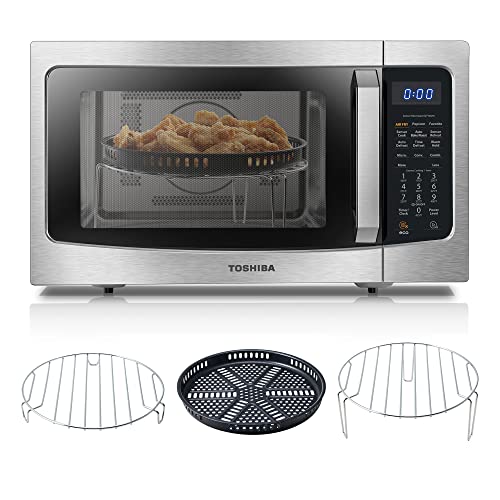
1. TOSHIBA 4-in-1 Microwave Oven with Air Fryer Combo 1.5 Cu.Ft (1000W) — Best Overall
The Toshiba 4-in-1 is the combo we recommend first because its 1.5-cubic-foot cavity crosses the threshold where convection becomes genuinely useful: a whole chicken fits with room for air to circulate, a casserole dish fits without tilting, and the convection mode has space to behave like an oven instead of a hot box. Add a smart humidity sensor for microwave work and an air-fry mode for weeknight crisping, and it covers more of a household’s cooking than any rival here.
Strengths
- Largest countertop cavity in this guide — real dishes, whole birds, family portions
- True convection plus air fry plus sensor microwave in one coherent control system
- Position-memory turntable returns the dish handle to where you left it — a small, daily pleasure
Trade-offs
- Needs serious counter depth and clearance — measure before ordering
- At this size it is a commitment piece, not an appliance you move around
- Convection preheats are slower than a wall oven’s, so spontaneous baking takes planning
| Capacity | 1.5 cu ft |
|---|---|
| Microwave power | 1000W |
| Modes | Microwave, convection, air fry, sensor cook |
| Extras | Mute function, position-memory turntable |
What elevates the Toshiba is balance across its four jobs. The microwave side is a competent 1000W sensor machine for daily reheating and defrosting; the convection side holds temperature steadily enough for roasts and traybakes; and the air-fry mode handles the frozen-food shift without heating a full oven. The cavity finish and rack quality suit the convection role — this is not a microwave with a fan bolted on but a small oven that also microwaves. Families replacing a dead over-range unit, small kitchens skipping a second oven, and holiday cooks who overflow the main oven every December will all find this the most complete answer here. It is big, and it should be: the size is the capability.
Best for: Families and small kitchens wanting one appliance that can genuinely deputise for an oven / Not suited for: Tiny counters, or households that only ever reheat coffee and leftovers
Check on Amazon — check the current price on Amazon before you order, and confirm the finish and configuration on the listing match the version reviewed here.
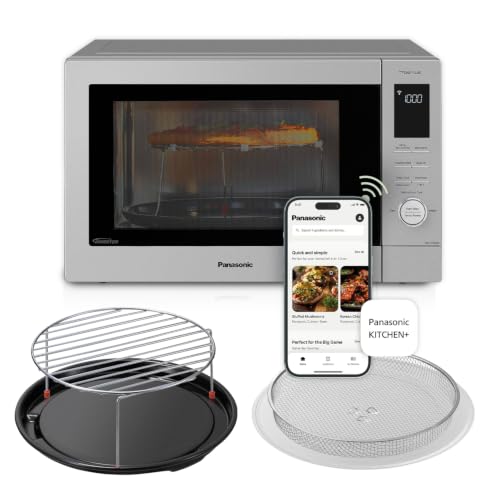
2. Panasonic HomeChef 4-in-1 NN-CV (1.2 Cu.Ft, 1000W Inverter) — Best Premium
The HomeChef is the thinking cook’s combo. Panasonic’s inverter delivers true variable microwave power — gentle, even defrosting and simmering instead of the on-off pulsing of conventional microwaves — and the same cabinet adds convection and air-fry capability with a deep preset library and app-linked recipes. At 1.2 cubic feet it suits couples and small families who cook varied food in modest portions and value finesse over bulk.
Strengths
- Inverter power is visibly better at defrosting and delicate microwave work
- Convection and air-fry modes extend it from reheater to real cooker
- Preset library and app recipes shorten the learning curve considerably
Trade-offs
- Premium pricing for the capacity — you pay for engineering, not size
- 1.2 cu ft will not take the largest casserole dishes or a big bird
- Feature depth means a manual worth reading; guests will only ever reheat with it
| Capacity | 1.2 cu ft |
|---|---|
| Microwave power | 1000W, inverter |
| Modes | Microwave, convection, air fry, broil family of presets |
| Presets | 20 presets, app-linked recipes |
Panasonic’s microwave heritage shows in the details: the inverter’s low-power behaviour is the best here for melting, softening and defrosting without cooked edges, and the convection system is tuned for the small-batch baking — scones, a two-person roast, a tray of vegetables — that this size does best. The app-linked recipes are more useful than the usual gimmick because they programme the multi-stage sequences (microwave to soften, convection to finish) that combos exist for. Buy the HomeChef if your cooking is varied and your portions are modest; buy the bigger Toshiba if you regularly feed five. The premium is real, and so is what it buys.
Best for: Couples and small families who cook varied, small-batch food and value inverter finesse / Not suited for: Large families, or anyone whose priority is maximum cavity per purchase
Check on Amazon — check the current price on Amazon before you order, and confirm the finish and configuration on the listing match the version reviewed here.

3. Galanz ToastWave GTWHG09S1A09 4-in-1 (0.9 Cu.Ft, 900W) — Best for Toast and Small Batches
The ToastWave asks a different question: what if the combo also replaced your toaster oven? Galanz’s 4-in-1 adds a genuine toast function to microwave, convection and air-fry modes, in a 0.9-cubic-foot stainless cabinet sized for apartments and small households. For breakfast-centric homes — toast, reheated pastry, small bakes — it covers more morning territory than any other pick.
Strengths
- Toast function makes it a true three-appliance replacement for small kitchens
- Convection and air-fry modes handle small roasts, bakes and frozen food credibly
- Compact footprint suits apartments, offices and second-kitchen roles
Trade-offs
- 0.9 cu ft limits dish size — family casseroles need not apply
- 900W microwave power is a step below the 1000W models for big reheats
- Galanz’s preset logic takes a little learning compared with the big Japanese brands
| Capacity | 0.9 cu ft |
|---|---|
| Microwave power | 900W |
| Modes | Microwave, convection, air fry (TotalFry 360), toast |
| Finish | Stainless steel |
Combos usually fail at breadth — too many modes, none done well. The ToastWave is the exception that scopes its ambition to its size: at 0.9 cubic feet it does not pretend to roast for six, but its toast, air-fry and small-bake performance serve one-to-three-person households completely. The convection mode crisps a small pizza and bakes a half-batch of muffins the way owners actually use it, and the microwave side is honest 900W work. If your counter currently holds a microwave and a toaster oven, this is the pick that gives you half of it back — measure your largest dish first, because capacity is the whole compromise here.
Best for: Small households wanting to merge microwave, toaster oven and air fryer into one unit / Not suited for: Families, or anyone whose regular dishes exceed a compact cavity
Check on Amazon — check the current price on Amazon before you order, and confirm the finish and configuration on the listing match the version reviewed here.

4. GE 4-in-1 Air Fry Countertop Microwave (1.0 Cu.Ft, 1050W) — Best Mid-Size All-Rounder
GE’s 4-in-1 is the sensible middle of this guide: a 1.0-cubic-foot cabinet that fits most counters, the highest microwave wattage of the mid-size picks at 1050W, and a four-mode spread — microwave, air fry, convection and a broil mode many rivals omit — that maps neatly onto how people actually cook. The white finish suits bright kitchens and rental-standard appliances.
Strengths
- 1050W gives it the fastest plain-microwave performance of the mid-size picks
- Broil mode adds a finishing tool the other combos mostly lack
- GE’s appliance service network is a long-term ownership plus
Trade-offs
- White finish only in this configuration — stainless kitchens should check variants
- 1.0 cu ft is the compromise size: fine for most dishes, tight for the biggest
- Controls are capable rather than delightful — function over finesse
| Capacity | 1.0 cu ft |
|---|---|
| Microwave power | 1050W |
| Modes | Microwave, air fry, convection, broil |
| Finish | White |
There is a particular virtue in the appliance that does everything at a solid B+ and nothing badly. The GE reheats fastest in its class, air-fries the weeknight nuggets, convection-roasts vegetables for two-to-four, and broils a cheese top without firing the main oven — a mode owners use more than they expect. GE’s national service coverage matters for a combo, too: a multi-mode appliance has more to service than a simple microwave, and GE’s network is built for exactly that. Choose it when you want one mainstream, well-supported combo at the size most kitchens can actually house.
Best for: Most households wanting a mainstream, well-supported four-mode combo / Not suited for: Design-led kitchens needing a specific finish, or very large families
Check on Amazon — check the current price on Amazon before you order, and confirm the finish and configuration on the listing match the version reviewed here.

5. Frigidaire 1.2 Cu.Ft Microwave Air Fryer Convection Combo — Best Value Big-Name Combo
Frigidaire’s combo is the value play among the big brands: 1.2 cubic feet, stainless finish, and the microwave-plus-air-fry-plus-convection trio in a cabinet priced (check the current price on Amazon) to undercut the premium Japanese models. It suits families who want combo capability for weeknight cooking — frozen food crisped, leftovers revived, small roasts — without paying for inverter finesse or app ecosystems.
Strengths
- Big-brand combo capability at the accessible end of the range
- 1.2 cu ft handles family weeknight portions comfortably
- Stainless finish matches mainstream appliance suites
Trade-offs
- Microwave power delivery is conventional rather than inverter — defrosting needs more attention
- Preset and sensor sophistication trail the Panasonic and Toshiba picks
- Convection performance is good for weeknight food, less refined for keen bakers
| Capacity | 1.2 cu ft |
|---|---|
| Modes | Microwave, air fry, convection (Combo-Fry) |
| Finish | Stainless steel |
| Positioning | XL capacity in class (per Amazon title) |
Judge this Frigidaire by the Tuesday-night test and it passes easily: chips and nuggets crisp, a small chicken roasts, yesterday’s lasagne reheats with a top that has texture again. Where the premium models pull ahead is refinement — gentler defrosting, steadier baking, cleverer sensors — and if your cooking leans on those, the gap is worth paying. If your combo will mostly crisp, roast and reheat for a family, the Frigidaire delivers the core capability honestly and leaves money in the renovation budget. That is a respectable definition of value, and it earns the pick.
Best for: Families wanting big-brand convection combo capability without the premium tier / Not suited for: Keen bakers and defrost perfectionists, who should step up to inverter models
Check on Amazon — check the current price on Amazon before you order, and confirm the finish and configuration on the listing match the version reviewed here.

6. Sharp SMC0985KS 3-in-1 Convection Air Fry Microwave (0.9 Cu.Ft, 900W) — Best Compact
Sharp helped invent the countertop microwave, and the SMC0985KS applies that heritage to the compact combo: microwave, convection and air fry in 0.9 cubic feet, for the counters that cannot take the Toshiba or even the GE. It suits small apartments, office kitchens, caravans and second-zone cooking — a drinks station or guest suite that can still bake.
Strengths
- Real convection and air fry at a genuinely compact footprint
- Sharp’s microwave engineering pedigree shows in even, predictable results
- Stainless finish looks at home next to full-size appliances
Trade-offs
- 0.9 cu ft means small dishes only — this is a one-to-two-person oven
- 900W is adequate, not fast, for larger reheats
- Compact combos need their clearance respected — the convection element makes the cabinet work hard
| Capacity | 0.9 cu ft |
|---|---|
| Microwave power | 900W |
| Modes | Microwave, convection, air fry |
| Finish | Stainless steel |
Compact combos live or die on honesty: the Sharp does not pretend to be a family oven. What it does — bake a small gratin, crisp a personal pizza, roast vegetables for two, reheat without sogginess — it does with the even-handedness Sharp is known for, in a cabinet that fits where family-size combos cannot. The convection mode earns its place at this size because the alternative for small kitchens is usually no oven capability at all. Measure your dishes, respect the ventilation clearances in the manual, and the Sharp will quietly be the most versatile appliance on a small counter.
Best for: Small kitchens, offices and one-to-two-person households needing compact combo capability / Not suited for: Families, or anyone regularly cooking dishes larger than a compact cavity takes
Check on Amazon — check the current price on Amazon before you order, and confirm the finish and configuration on the listing match the version reviewed here.
Comparison Table
| Pick | Badge | Key spec | Best for |
|---|---|---|---|
| TOSHIBA 4-in-1 Microwave Oven with Air Fryer Combo 1.5 Cu.Ft (1000W) | Best Overall | 1.5 cu ft, 1000W, convection + air fry + sensor | Families and small kitchens wanting one appliance that can genuinely deputise for an oven |
| Panasonic HomeChef 4-in-1 NN-CV (1.2 Cu.Ft, 1000W Inverter) | Best Premium | 1.2 cu ft, 1000W inverter, convection + air fry | Couples and small families who cook varied, small-batch food and value inverter finesse |
| Galanz ToastWave GTWHG09S1A09 4-in-1 (0.9 Cu.Ft, 900W) | Best for Toast and Small Batches | 0.9 cu ft, 900W, microwave + convection + air fry + toast | Small households wanting to merge microwave, toaster oven and air fryer into one unit |
| GE 4-in-1 Air Fry Countertop Microwave (1.0 Cu.Ft, 1050W) | Best Mid-Size All-Rounder | 1.0 cu ft, 1050W, four modes including broil | Most households wanting a mainstream, well-supported four-mode combo |
| Frigidaire 1.2 Cu.Ft Microwave Air Fryer Convection Combo | Best Value Big-Name Combo | 1.2 cu ft, convection + air fry, stainless finish | Families wanting big-brand convection combo capability without the premium tier |
| Sharp SMC0985KS 3-in-1 Convection Air Fry Microwave (0.9 Cu.Ft, 900W) | Best Compact | 0.9 cu ft, 900W, convection + air fry | Small kitchens, offices and one-to-two-person households needing compact combo capability |
How Does Convection Cooking Inside a Microwave Actually Work?
A convection microwave contains two heating systems sharing one cavity. The microwave system cooks by exciting water molecules — fast, but incapable of browning. The convection system is a conventional electric element with a fan circulating hot air, exactly like a small fan oven, which browns, crisps and roasts. Used separately they cover most cooking; used in sequence or combination stages — several picks here automate this — they deliver the combo’s party trick: microwave speed to cook through, convection heat to finish with colour and texture.
That physics explains both the magic and the limits. A reheated pizza works because the base crisps in convection while the topping heats through by microwave. A roast chicken works because the cavity, though small, holds true oven temperatures. But the same small cavity restricts dish size, and the metal racks supplied for convection mode exist because air must circulate under the food — skip the rack and the underside steams. Treat it as a small oven that also microwaves, not a microwave with a bonus button, and results follow.
One safety note the manuals repeat for a reason: convection accessories (racks, pans) are mode-specific. Metal racks supplied for convection use are designed for it; random metal in microwave mode is not. Follow each model’s accessory rules per mode and the combo is as safe as either appliance alone.
What Size and Power Do You Actually Need?
Capacity decides what fits; wattage decides how fast. For countertop convection combos the honest bands are: 0.9 cubic feet for one-to-two people and small dishes; 1.0–1.2 cubic feet for couples and small families — the sweet spot for most buyers; and 1.5 cubic feet for families and anyone who wants whole-bird, big-casserole capability. Measure your largest regular dish and your counter depth before choosing, because external cabinets grow faster than capacities suggest — a 1.5-cubic-foot combo is a large object.
Microwave wattage between 900W and 1050W covers this class; the difference shows in big reheats and popcorn, not in convection work, where element power and fan design matter more and are rarely advertised honestly — another reason to buy verified models with real convection systems rather than spec-sheet heroes. Inverter models (the Panasonic here) add a different advantage: true low-power delivery for defrosting and delicate work, which many owners end up valuing more than raw speed.
Clearance is the forgotten specification. Convection modes make cabinets hot; every model specifies side, top and rear ventilation gaps. A combo wedged into a tight cubby will run hot, cook unevenly and age early. If your space cannot give a combo its clearances, a microwave-only model plus a small countertop oven is the better engineering answer.
When Is a Combo Worse Than Separate Appliances?
Honestly: when you regularly cook two things at once in different modes, when your baking is large-format (full sheet trays, big loaves), or when counter space is so tight that the combo’s clearances eat the room a separate small oven would have used. A combo is also a single point of failure — when it is serviced, you lose both appliances — which is why the service networks behind GE, Toshiba, Panasonic and Sharp matter in this category.
For everyone else — small kitchens, second-oven seekers, upgraders from a plain microwave — a good combo is the most space-efficient cooking purchase available. The models in this guide were chosen because their convection modes survive contact with real food; keep your expectations at ‘excellent small oven’ rather than ‘full-size range replacement’ and they will exceed them.
Combination Cooking: The Technique That Justifies the Whole Category
Every pick in this guide can microwave and can convection-bake, but the owners who rave about these machines have discovered the third thing: combination cooking, where the two systems work the same dish in sequence or together. A jacket potato is the textbook case — microwave energy cooks the interior fluffy in a fraction of oven time, convection heat crisps the skin a microwave alone leaves leathery. Roast chicken follows the same logic at larger scale: the centre cooks through quickly and evenly while the skin browns, with none of the dried edges a long convection-only roast can produce in a small cavity.
The models here differ in how much of this they automate. The Panasonic and the larger Toshibas build staged programmes into their presets, so the sequence runs from one button once you trust it. On simpler models you run the stages manually — microwave to a point, then convection to finish — which works perfectly well once you have done it twice and noted the timings. Either way, the learning investment is small and the payoff is the category’s core value: oven results at something approaching microwave speed.
Start with forgiving dishes while you learn your cavity: jacket potatoes, a small gratin, chicken thighs, a tray of roast vegetables. These tolerate timing experiments and teach you your unit’s hot spots and pace. Within a few weeks the staged thinking becomes automatic — you will look at a dish and know its sequence — and that is when a convection microwave stops being two appliances in one box and becomes a cooking method of its own.
Cleaning and Care: Keeping a Combo Cavity Honest
A convection microwave’s cavity works harder than a plain microwave’s: it hosts roasting fats and baking splatter at oven temperatures, then returns to reheating duty where yesterday’s roast can perfume today’s porridge if the cavity is neglected. The care rhythm is simple but not optional. Wipe the cavity while still warm after convection sessions, when splatter lifts easily; a baked-on layer in a small cavity is disproportionately hard to shift and taints microwave-mode food until it is gone.
The turntable, roller ring and convection rack deserve the same session-end attention — the rack especially, since its wires collect exactly the fats that smoke at the next preheat. Most racks and turntables wash in a sink like any oven accessory. The door seals and the cavity’s sensor areas (several picks here cook by humidity sensor) should be wiped gently and kept free of film; a sensor reading through grease is a sensor guessing, and sensor models cook noticeably worse with dirty cavities.
Descale and deodorise as your water and cooking demand: a microwaved bowl of water with lemon, run until steamy and left to stand, loosens odours and light deposits in any model here. Avoid oven-cleaner chemicals inside a combo cavity unless the manufacturer explicitly approves them — the cavity coatings and sensors are microwave-era materials, not range-oven enamel, and the manual’s cleaning page is the authority for your model.
A Week of Dinners: What Owning a Convection Microwave Actually Changes
Monday is the category’s everyday proof: leftovers reheated with texture — the roast potatoes crisp-edged again instead of steamed — because convection finishing is one button away rather than an oven preheat nobody bothers with for a single plate. Tuesday is frozen-food night, where air-fry and convection modes turn the freezer’s contents into food with crunch, and the main oven stays cold. By Wednesday the combination habit has formed: the jacket potatoes that anchor a quick supper cook in a staged programme, fluffy inside and crisp-skinned, in the time a conventional oven would still be preheating.
Thursday is the small roast — chicken thighs, a tray of vegetables, a two-person joint — cooked in the combo because heating 1.2 cubic feet for four portions is simply saner than heating the range. Friday is pizza, the category’s public exam: a base that crisps, a top that melts, a result that ends the household argument about whether homemade pizza night is worth it. The weekend brings the batch work — muffins, a small bake, the gratin for Sunday — and the discovery that the range oven has become the appliance for occasions rather than the default.
None of these dinners is remarkable alone; together they are the ownership case. A convection microwave does not win on any single dish against a full kitchen — it wins on the week’s aggregate of speed, energy and results at household scale. That is why this guide weighted sensor quality, combination programmes and cavity honesty so heavily: they are the specifications a week of dinners actually tests.
Safety and Supervision: The Household Rules for a Two-System Appliance
A convection microwave asks its household to hold two safety mental models at once, and the models occasionally conflict — metal is welcome in one mode and forbidden in another, a dish rated for the oven may not be rated for microwave energy, and a programme can move food between systems automatically. The household rule that resolves the conflicts is simple: the model’s own accessory and cookware chart governs, always, over general kitchen instinct. Post it inside a cupboard door for the first month; by the second month the household’s hands know which rack belongs to which mode.
Supervision norms deserve one explicit conversation in family homes. Convection mode is an oven — it reaches oven temperatures, its dishes emerge oven-hot, and children who have learned that ‘the microwave’ is the safe, cool appliance need the distinction taught deliberately: in convection and combination work, this box is an oven, with oven rules about mitts, surfaces and adult presence. Several picks here carry child locks on their controls; the lock manages buttons, not understanding, and the teaching is the real safety feature.
The remaining rules are the familiar ones applied consistently: never run the microwave side empty, keep the cavity and door seals clean so the door’s shielding geometry stays true, respect clearances so convection heat dissipates as designed, and unplug and consult the manual — not the internet’s folklore — if the unit ever behaves abnormally. Two systems in one box is a genuine convenience; treated with the respect each system earns separately, it is an entirely safe one.
One Last Check Before You Order
The convection microwave final check is three measurements and one honest question. Measurements: your largest regular dish against the cavity and turntable; the cabinet’s external dimensions against your counter; the clearances the manual demands against the space as it actually is, bread bin and all. The honest question: will this household learn combination cooking — the staged programmes, the rack discipline, the preheat habit? If yes, buy the best combo you can house, because its ceiling is high. If the truthful answer is that the machine will reheat and crisp only, buy the simpler end of this guide and spend the difference elsewhere in the kitchen.
Either way, order the exact verified model, check the current price on its listing, and keep the manual’s accessory chart where the household can find it. The category rewards the prepared — and preparation, in this guide’s experience, is nine-tenths of satisfaction.
Why This Guide Insists on the Word ‘True’ Before Convection
A closing note on method, because this category’s labelling is its biggest consumer problem. The word convection is applied across the market to machines with a full temperature-controlled oven system, machines with a fan-assisted grill, and machines whose ‘convection’ is an air-fry programme with ambitions. Those are three different appliances wearing one word, and no buyer can comparison-shop across them honestly. Every pick in this guide was verified as the first kind — element, fan, set temperatures — before its cooking was judged at all. If you shop beyond this shortlist, apply the same test in the manual before the marketing: find the convection temperature range, find the element, find the rack. A true convection microwave will show you all three proudly. Anything vaguer is telling you what it is.
How to Get Oven-Quality Results From a Convection Microwave
Combo owners who complain about convection results are usually skipping the small disciplines that oven cooking in a compact cavity demands. These steps close most of the gap between a combo and a conventional oven.
- Preheat in convection mode for anything baked or roasted — putting food into a cold combo cavity is the single biggest cause of pale, uneven results, exactly as it is in a regular oven.
- Always use the supplied rack for convection work so hot air circulates beneath the food; a dish sitting on the turntable floor steams its own base.
- Use oven-safe dishes sized with a margin around them — air needs a channel around the dish, so a casserole that touches the walls cooks like it is in a much worse oven.
- For combination cooking (microwave plus convection), follow the model’s staged programmes the first few times before improvising; the factory sequences are tuned to the cavity and teach you the timing logic.
- Rotate or turn food once during longer convection cooks in compact models — small cavities have warmer and cooler zones, and one turn evens them out.
- Rest roasted food before serving and check temperatures with a food thermometer for poultry and joints; compact cavities cook enthusiastically near the element, and colour can outrun the centre.
- Wipe the cavity after convection sessions while it is still warm — baked-on splatter in a combo is harder to shift later and flavours the next microwave reheat.
Keep notes for your first few cooks — your regular dishes, their dishes’ sizes, the times that worked. A combo rewards a household that learns its particular cavity, and within a month the notes become instinct.
Common Buying Mistakes
Buying air-fry-only and expecting convection
Air fry is a high-fan, high-heat mode; true convection is a temperature-controlled oven system. They overlap on frozen food and diverge on baking and roasting. If you want to bake, buy a verified convection model like the picks here — not a label.
Ignoring external dimensions and clearances
Capacity is measured inside; your counter must fit the outside, plus ventilation gaps on top, sides and rear for convection heat. Measure the cubby, not just the cavity, before ordering.
Using the wrong accessories per mode
Convection racks belong to convection programmes; microwave mode has its own rules. Mixing accessories across modes is both a results problem and a safety problem — follow the model’s chart.
Expecting full-size oven capacity
A 0.9-cubic-foot combo is a one-to-two-person oven no matter how good it is. Buy the capacity band for your household’s real dishes, not for the largest meal you cook once a year — or accept the 1.5-cubic-foot cabinet’s footprint.
Skipping the preheat
Combos forgive many things but not a cold start for baking. The owners who swear their convection mode ‘doesn’t work’ are disproportionately the owners who never preheat it.
Final Recommendation
Start with the Toshiba 4-in-1 1.5 Cu.Ft if your counter can take it — it is the most complete oven substitute here. The Panasonic HomeChef is the premium, finesse choice for smaller households; the GE 4-in-1 is the mainstream all-rounder; the Galanz ToastWave uniquely adds toast; the Frigidaire is the big-brand value; and the Sharp owns the compact brief. Match capacity to your dishes first and any of the six will cook honestly.
Check the current price on Amazon for the exact model before you order. Related microwave research in this series:
Shortlist:
- TOSHIBA 4-in-1 Microwave Oven with Air Fryer Combo 1.5 Cu.Ft (1000W) — Best Overall: Check on Amazon
- Panasonic HomeChef 4-in-1 NN-CV (1.2 Cu.Ft, 1000W Inverter) — Best Premium: Check on Amazon
- Galanz ToastWave GTWHG09S1A09 4-in-1 (0.9 Cu.Ft, 900W) — Best for Toast and Small Batches: Check on Amazon
Best Counter Top Convection Microwaves Best Convection Ovens With Microwaves Best Counter Microwaves Under $100 Best Microwaves Best Air Fryer Microwaves
Frequently Asked Questions
Can a convection microwave really replace an oven?
For small and medium dishes, yes — it holds true oven temperatures with fan circulation, so roasts, bakes and gratins cook properly. It cannot match a full-size oven’s capacity or run two large dishes at once, so most owners treat it as a small second oven rather than a total replacement.
What is the difference between convection and air fry in a microwave combo?
Convection is a temperature-controlled oven mode for baking and roasting. Air fry is a hotter, faster-fan mode optimised for crisping smaller items like chips and wings. Good combos offer both; air-fry-only models cannot bake with the same control.
What size convection microwave do most households need?
1.0 to 1.2 cubic feet suits most couples and small families. Choose 1.5 cubic feet for whole chickens and large casseroles, and 0.9 cubic feet only for one-to-two-person cooking or very tight counters.
Do convection microwaves use much more power?
Convection elements draw oven-level power while roasting, similar to a small countertop oven, but sessions are usually shorter than heating a full-size oven for a small dish — which is where the combo saves energy overall.
Can I use metal pans in a convection microwave?
In convection-only mode, most models allow metal bakeware, and they supply metal racks for it. In microwave and combination modes the rules change — always follow the specific model’s accessory chart rather than general advice.
Why does my convection microwave cook unevenly?
Usually one of three causes: no preheat, the dish blocking airflow because it is too large for the cavity, or food sitting directly on the floor instead of the rack. Correct those and compact convection cooks remarkably evenly.
Do convection microwaves take longer to preheat than regular ovens?
Compact cavities generally preheat faster than a full-size oven because there is far less air and metal to bring to temperature — one of the quiet efficiencies of the format for small dishes. They are slower than an air fryer’s near-instant heat, which is why air-fry modes exist alongside convection in most of these models.
Can I bake with paper cases and silicone moulds in convection mode?
Silicone bakeware is generally well suited to convection modes and is rated for oven temperatures; paper cases are fine inside a supporting muffin tray. In microwave and combination modes the rules change per material, so follow your model’s accessory chart — silicone is usually microwave-safe too, while anything metallic is convection-only territory.


