Disclosure: airfryerkitchensupply.com is reader-supported. When you buy through links on our site, we may earn an affiliate commission at no extra cost to you.
Where to buy
Here is where to buy the best counter top convection microwaves covered in this guide, with a verified link for every pick.
Countertop convection microwaves are sold by every appliance brand on Amazon, under names that blur microwave, air fryer and convection into one another. Buy on the verified model: every pick below was confirmed as a true countertop convection unit — element, fan and temperature control, in a cabinet designed to live on a counter with proper clearances — before it earned a link to the exact capacity named.
- TOSHIBA OptiChef Basic 0.9 Cu.Ft (Origin Inverter) — Best Overall Countertop Pick: check price on Amazon
- TOSHIBA 4-in-1 Microwave Oven with Air Fryer Combo 1.5 Cu.Ft (1000W) — Best for Families: check price on Amazon
- Panasonic HomeChef 4-in-1 NN-CV (1.2 Cu.Ft, 1000W Inverter) — Best Premium Countertop: check price on Amazon
- Galanz ToastWave GTWHG09S1A09 4-in-1 (0.9 Cu.Ft, 900W) — Best Toast-Plus Combo for Counters: check price on Amazon
- GE 4-in-1 Air Fry Countertop Microwave (1.0 Cu.Ft, 1050W) — Best Mainstream Countertop: check price on Amazon
- Sharp SMC0985KS 3-in-1 Convection Air Fry Microwave (0.9 Cu.Ft, 900W) — Best True Compact: check price on Amazon
The best counter top convection microwaves solve a specific kitchen geometry problem: you want oven capability, you have counter space rather than wall space, and you would rather one appliance did the microwave’s work too. This guide is written for that buyer — renters who cannot renovate, small kitchens without a second oven, and households adding a capable cooking station to the counter they already own. Placement, clearance and countertop practicality run through every judgement here, alongside the cooking itself.
Countertop placement changes what ‘best’ means. A built-in can hide its heat and bulk in cabinetry; a countertop unit lives in the open — its footprint competes with your prep space, its ventilation clearances are your responsibility, its door swing crosses your worktop, and you will look at it every day. The six verified models below were chosen with those realities in view: sizes from a true-compact 0.9 cubic feet to a family 1.5, footprints and finishes a counter can live with, and convection systems that justify the space they take.
If you are still deciding whether the category itself fits your kitchen, the guide sections cover countertop-specific questions — how much clearance convection really needs, how to measure a counter run for a combo, and when a separate small oven beats a combo on the same counter. Start with the picks if you have already decided; start with the guides if the counter itself is the question.
In this guide
Quick Picks
Six countertop convection units chosen for life on a counter: flagship versatility, family capacity, inverter finesse and two genuine compacts — each with its footprint honestly flagged.
| Pick | Badge | Why it made the list |
|---|---|---|
| TOSHIBA OptiChef Basic 0.9 Cu.Ft (Origin Inverter) | Best Overall Countertop Pick | Inverter delivery and 27 auto menus in a genuinely counter-friendly 0.9-cubic-foot black stainless cabinet. Check on Amazon |
| TOSHIBA 4-in-1 Microwave Oven with Air Fryer Combo 1.5 Cu.Ft (1000W) | Best for Families | The family-size countertop: 1.5 cubic feet of convection, air fry and sensor microwave, if your counter can host it. Check on Amazon |
| Panasonic HomeChef 4-in-1 NN-CV (1.2 Cu.Ft, 1000W Inverter) | Best Premium Countertop | Inverter finesse and app-linked combination cooking at the countertop sweet spot of 1.2 cubic feet. Check on Amazon |
| Galanz ToastWave GTWHG09S1A09 4-in-1 (0.9 Cu.Ft, 900W) | Best Toast-Plus Combo for Counters | Replaces three countertop appliances at once: microwave, convection combo and a genuine toaster oven function. Check on Amazon |
| GE 4-in-1 Air Fry Countertop Microwave (1.0 Cu.Ft, 1050W) | Best Mainstream Countertop | GE’s four-mode countertop — including the broil mode rivals omit — at the fastest microwave wattage of the mid-size class. Check on Amazon |
| Sharp SMC0985KS 3-in-1 Convection Air Fry Microwave (0.9 Cu.Ft, 900W) | Best True Compact | Sharp’s microwave heritage in the smallest full-convection package here — for counters where every centimetre is argued over. Check on Amazon |
How These Picks Were Chosen
Candidates had to satisfy three countertop-specific tests beyond being genuine convection combos (verified against catalogue data for this site, as in our other microwave guides): a cabinet designed for counter use with stated clearances a real counter can provide; a door and control layout that work at counter height in daily service; and a capacity-to-footprint ratio that respects the space a countertop appliance consumes.
Cooking judgement followed the established criteria for this category: convection evenness and temperature control, combination programmes, microwave delivery (inverter where offered), sensor quality, and the included racks the convection mode depends on. Brand service networks were weighted as they always are for complex appliances — a countertop combo is serviced, not built-in and forgotten, so support access matters.
Capacities and wattages are the manufacturers’ own from the verified listings. Prices are not printed; check the current price on Amazon for the exact model, and measure your counter against the model’s full dimensions plus clearances before ordering — the guide’s most repeated advice, because it is the category’s most common failure.
The 6 Best Counter Top Convection Microwaves
Ordered for the countertop buyer, with footprint and clearance called out in every trade-offs list. A model that cooks beautifully but eats your only prep surface is a bad countertop buy, and none of these should be chosen blind on cooking alone.

1. TOSHIBA OptiChef Basic 0.9 Cu.Ft (Origin Inverter) — Best Overall Countertop Pick
The OptiChef Basic earns the countertop crown by respecting the counter: at 0.9 cubic feet it fits the runs and corners the family-size combos cannot, yet it carries Toshiba’s Origin Inverter microwave delivery, convection bake and broil modes, air fry and a deep 27-menu library in a black stainless cabinet that looks deliberate rather than apologetic on the worktop. It suits smaller kitchens and discerning one-to-three-person households that want flagship technology at an honest countertop scale.
Strengths
- Inverter microwave delivery at a compact countertop size is a rare and valuable combination
- Convection bake plus broil covers the oven work small households actually do
- Black stainless finish and compact cabinet sit well on visible counters
Trade-offs
- 0.9 cu ft means small dishes — this is not the family-casserole model
- 27 menus reward an owner who learns them; casual users will use six
- Black stainless needs correct care to keep its tone even
| Capacity | 0.9 cu ft |
|---|---|
| Microwave tech | Origin Inverter |
| Modes | Convection bake and broil, air fry, microwave |
| Menus | 27 auto menus |
Most compact combos cut technology to cut size; the OptiChef Basic cuts size and keeps the technology, which is the right way round for a countertop appliance you will use daily for years. The inverter transforms its microwave manners — defrosting and reheating with an evenness conventional compacts cannot match — while the convection and broil modes handle the small roasts, bakes and gratins of small-household cooking. On the counter it behaves: a footprint that leaves prep room, a finish that suits modern kitchens, and clearances a normal counter run can honour. If your kitchen is small and your standards are not, this is your model.
Best for: Small kitchens and one-to-three-person households wanting flagship tech at counter scale / Not suited for: Families, whose dishes need the 1.3–1.5 cubic foot models
Check on Amazon — check the current price on Amazon before you order, and confirm the finish and configuration on the listing match the version reviewed here.
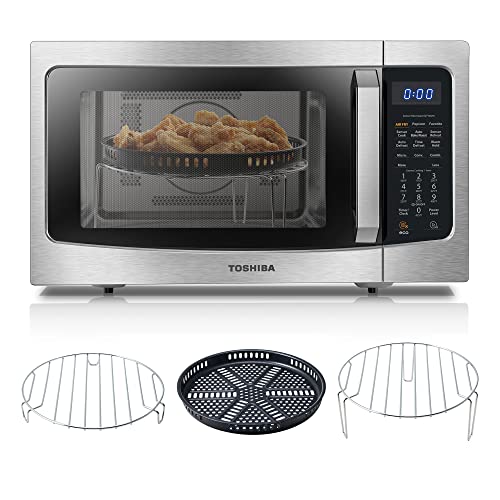
2. TOSHIBA 4-in-1 Microwave Oven with Air Fryer Combo 1.5 Cu.Ft (1000W) — Best for Families
The family countertop choice is this Toshiba, with the condition stated in its badge’s fine print: your counter must be able to host it. At 1.5 cubic feet it roasts a whole chicken with airflow, takes the family casserole, and pairs that oven capacity with a smart-sensor 1000W microwave and air fry — the complete second-cooking-station brief. Deep counters, kitchen islands and households replacing an over-range unit are its natural homes.
Strengths
- Largest countertop convection capacity here — genuine family oven substitute
- Smart sensor microwave plus air fry makes it a complete cooking station
- Position-memory turntable and mute function polish daily family use
Trade-offs
- The footprint is the largest here — measure the counter run and clearances seriously
- Too much appliance for one-to-two-person households
- Convection heat at this size demands its full ventilation clearances
| Capacity | 1.5 cu ft |
|---|---|
| Microwave power | 1000W |
| Modes | Microwave, convection, air fry, sensor cook |
| Extras | Mute function, position-memory turntable |
Countertop family combos fail in two directions — too small to be useful, or so big they colonise the kitchen. The Toshiba threads it for households with the counter to spare: on an island or a deep run it becomes the kitchen’s second oven and main microwave in one footprint, and its sensor and air-fry completeness means the main oven genuinely rests on weeknights. The purchase discipline is spatial, and this guide repeats it because returns in this category are mostly tape-measure failures: measure the cabinet, add the clearances, walk the door swing. If the numbers work, no countertop unit here serves a family better.
Best for: Families with deep counters or an island to host a full second cooking station / Not suited for: Small kitchens, where its footprint will cost more than its cooking returns
Check on Amazon — check the current price on Amazon before you order, and confirm the finish and configuration on the listing match the version reviewed here.
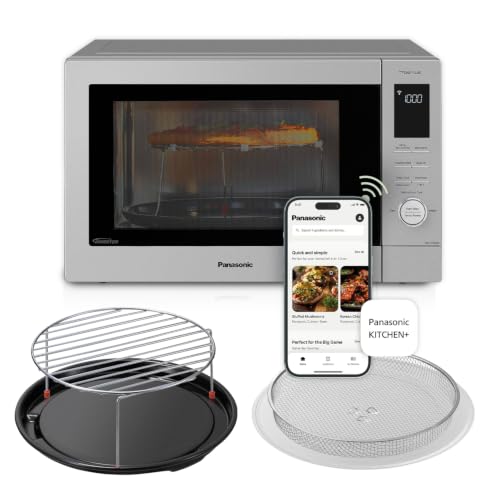
3. Panasonic HomeChef 4-in-1 NN-CV (1.2 Cu.Ft, 1000W Inverter) — Best Premium Countertop
The HomeChef is the premium countertop answer at the size most counters prefer: 1.2 cubic feet. Panasonic’s inverter gives it the gentlest, most even microwave delivery here; the convection and air-fry systems handle small-batch oven work; and the preset library with app-linked recipes makes combination cooking — its party trick — accessible rather than theoretical. It suits couples and small families who cook with variety and care.
Strengths
- Inverter delivery is the finest microwave performance in this guide
- Combination programmes with app guidance produce results neither mode matches alone
- 1.2 cu ft is the countertop sweet spot — real dishes, manageable footprint
Trade-offs
- Premium pricing — the technology is the cost, not the size
- Feature depth exceeds casual households’ needs
- App-linked features assume a household happy to cook with a phone nearby
| Capacity | 1.2 cu ft |
|---|---|
| Microwave power | 1000W, inverter |
| Modes | Microwave, convection, air fry multi-oven |
| Presets | 20 presets, app-linked recipes |
On a counter, the HomeChef reads as a considered appliance rather than a big microwave, and its cooking backs the impression. The inverter’s low-power control shows daily — defrosting without cooked edges, reheating without rubbery spots — and the convection side handles the two-to-four-person roasts and bakes that are this size’s honest work. Its app-linked recipes are the rare smart feature with a job: they set the staged sequences that make combination cooking worth owning. Buy it if your countertop is a real cooking station and your household will use the depth; the premium is steep for reheat-only homes, and this guide will not pretend otherwise.
Best for: Couples and small families who cook varied food and value inverter quality / Not suited for: Reheat-only households, or buyers maximising capacity per purchase
Check on Amazon — check the current price on Amazon before you order, and confirm the finish and configuration on the listing match the version reviewed here.

4. Galanz ToastWave GTWHG09S1A09 4-in-1 (0.9 Cu.Ft, 900W) — Best Toast-Plus Combo for Counters
Countertop economics favour the ToastWave’s argument: if your counter currently hosts a microwave and a toaster oven, this 0.9-cubic-foot 4-in-1 — microwave, convection, air fry and a real toast function — returns one appliance’s worth of space while keeping both jobs. It suits breakfast-led households, small kitchens and anyone whose toaster oven and microwave are both weekly appliances.
Strengths
- Toast function makes it a true consolidation buy — three appliances, one footprint
- Convection and air fry handle small bakes, roasts and frozen food credibly
- Stainless cabinet presents well on an open counter
Trade-offs
- Consolidation means one appliance down is every function down
- 0.9 cu ft caps dish size for both its oven and microwave roles
- 900W microwave pace is a step below the 1000W models
| Capacity | 0.9 cu ft |
|---|---|
| Microwave power | 900W |
| Modes | Microwave, convection, air fry (TotalFry 360), toast |
| Finish | Stainless steel |
The ToastWave is the countertop strategist’s pick: its value is measured in reclaimed centimetres as much as in cooking. Judged purely as a microwave it is a good compact; judged as a microwave plus the toaster oven it replaces, it is the most space-efficient purchase in this guide. Its convection crisps and bakes at small-batch scale, its toast function is a genuine oven function rather than a timed blast, and its stainless cabinet earns its visibility. Small households that breakfast properly and cook in small batches will find it covers a startling amount of their cooking from one footprint.
Best for: Small households running both a microwave and a toaster oven on limited counter / Not suited for: Families, or cooks whose dishes exceed compact capacity in any mode
Check on Amazon — check the current price on Amazon before you order, and confirm the finish and configuration on the listing match the version reviewed here.

5. GE 4-in-1 Air Fry Countertop Microwave (1.0 Cu.Ft, 1050W) — Best Mainstream Countertop
GE’s 4-in-1 is the mainstream countertop citizen: a 1.0-cubic-foot cabinet in white that suits bright kitchens and rental-standard suites, the mid-class’s fastest microwave at 1050W, and a four-mode set — microwave, air fry, convection, broil — that maps onto real weeknight cooking. GE’s national service network stands behind it, which for a countertop appliance you will move, clean around and use daily is a practical virtue.
Strengths
- Broil mode adds the finishing function most combos in this class omit
- 1050W gives the briskest plain microwave work of the mid-size picks
- GE service coverage is the ownership safety net for a complex appliance
Trade-offs
- White finish only in this configuration — check variants for dark suites
- 1.0 cu ft is the deliberate compromise size
- Design is mainstream-functional rather than a countertop feature
| Capacity | 1.0 cu ft |
|---|---|
| Microwave power | 1050W |
| Modes | Microwave, air fry, convection, broil |
| Finish | White |
Countertop appliances live harder lives than built-ins — shifted for cleaning, knocked by prep, used by everyone — and the GE’s mainstream virtues suit that life: nothing fragile in its proposition, every mode genuinely useful, and a service network that treats it as a core product. The broil mode deserves its emphasis: cheese-topped dishes, gratins and finishing work are weekly tasks in most homes, and combos without broil send you back to the main oven for exactly those. If your counter wants a capable, supportable, four-mode worker in white, this is the straightforward buy.
Best for: Mainstream households wanting a supported four-mode countertop in a bright kitchen / Not suited for: Design-led kitchens, or households needing 1.2 cubic feet and up
Check on Amazon — check the current price on Amazon before you order, and confirm the finish and configuration on the listing match the version reviewed here.

6. Sharp SMC0985KS 3-in-1 Convection Air Fry Microwave (0.9 Cu.Ft, 900W) — Best True Compact
The Sharp is the countertop pick for the tightest counters that still demand real convection: 0.9 cubic feet, three modes, stainless finish, and the even-handed cooking of the company that pioneered the countertop microwave. Offices adding cooking capability, caravans and boats, studio kitchens and second-zone stations — a bar counter or guest suite that can bake — are its natural placements.
Strengths
- Genuine convection and air fry at the smallest footprint in this guide
- Sharp’s cavity and turntable engineering deliver notably even results for the size
- Stainless finish keeps a compact unit looking like a real appliance
Trade-offs
- Compact capacity is a hard ceiling — one-to-two-person dishes only
- 900W is adequate rather than fast
- Convection clearances still apply — compact does not mean cubby-proof
| Capacity | 0.9 cu ft |
|---|---|
| Microwave power | 900W |
| Modes | Microwave, convection, air fry (3-in-1) |
| Finish | Stainless steel |
Compacts earn trust by doing their small job completely, and the Sharp’s completeness is its convection honesty: this is a temperature-controlled oven mode in a 0.9-cubic-foot cabinet, not an air-fry label. Personal pizzas emerge crisp-based, small gratins brown, vegetables for two roast properly — the full small-kitchen repertoire, from a footprint that fits where the family models cannot. Its microwave side is predictably even, as Sharp’s are. Respect its clearances, size your dishes to it, and it will be the hardest-working appliance on a small counter.
Best for: The tightest counters, offices, caravans and second cooking zones / Not suited for: Anyone cooking for more than two, or regularly using large dishes
Check on Amazon — check the current price on Amazon before you order, and confirm the finish and configuration on the listing match the version reviewed here.
Comparison Table
| Pick | Badge | Key spec | Best for |
|---|---|---|---|
| TOSHIBA OptiChef Basic 0.9 Cu.Ft (Origin Inverter) | Best Overall Countertop Pick | 0.9 cu ft, Origin Inverter, convection bake & broil, 27 menus | Small kitchens and one-to-three-person households wanting flagship tech at counter scale |
| TOSHIBA 4-in-1 Microwave Oven with Air Fryer Combo 1.5 Cu.Ft (1000W) | Best for Families | 1.5 cu ft, 1000W, convection + air fry + smart sensor | Families with deep counters or an island to host a full second cooking station |
| Panasonic HomeChef 4-in-1 NN-CV (1.2 Cu.Ft, 1000W Inverter) | Best Premium Countertop | 1.2 cu ft, 1000W inverter, 20 presets, app-linked recipes | Couples and small families who cook varied food and value inverter quality |
| Galanz ToastWave GTWHG09S1A09 4-in-1 (0.9 Cu.Ft, 900W) | Best Toast-Plus Combo for Counters | 0.9 cu ft, 900W, microwave + convection + air fry + toast | Small households running both a microwave and a toaster oven on limited counter |
| GE 4-in-1 Air Fry Countertop Microwave (1.0 Cu.Ft, 1050W) | Best Mainstream Countertop | 1.0 cu ft, 1050W, microwave / air fry / convection / broil | Mainstream households wanting a supported four-mode countertop in a bright kitchen |
| Sharp SMC0985KS 3-in-1 Convection Air Fry Microwave (0.9 Cu.Ft, 900W) | Best True Compact | 0.9 cu ft, 900W, microwave + convection + air fry | The tightest counters, offices, caravans and second cooking zones |
How Much Clearance Does a Countertop Convection Microwave Really Need?
More than a microwave-only model, because convection mode turns the cabinet into an oven and ovens radiate. Every model in this guide specifies clearances — typically a few inches at the sides and rear and more above — and those numbers are cooking specifications, not legal padding: a combo starved of airflow runs hot, cooks unevenly, cycles its thermal protection and ages its electronics early. Measure your intended spot for the cabinet plus its clearances as one envelope before ordering.
Countertop placement adds two checks built-ins never face. Door swing: the door opens across your worktop, so walk the arc mentally against where you stand and set down hot dishes. Heat neighbours: keep the unit’s exhaust path away from plastics, paper storage and the underside of low wall cabinets, which convection heat will mark over months. A combo placed with the same care as a countertop oven — because it is one — will serve for years; wedged into a microwave cubby, it will not.
If your space cannot give a convection combo its envelope, the honest alternatives are a microwave-only model (which needs far less clearance) plus your main oven, or a compact convection oven placed where it can breathe. Forcing the category into the wrong hole helps nobody, least of all the appliance.
How to Measure Your Counter for a Convection Combo
Work in three measurements. First, the run: cabinet width plus side clearances, against the uninterrupted counter length available — remembering that the space in front of the unit is your loading zone and cannot double as permanent storage. Second, depth: cabinet depth plus rear clearance, against counter depth, with the plug and cable’s bend included; deep combos on standard counters can overhang their welcome quickly. Third, height: cabinet height plus top clearance, against the underside of wall cabinets — the measurement that eliminates the most models in real kitchens.
Then check the human factors. Controls at counter height should be readable without stooping; the cavity floor should sit at a height where lifting a hot casserole out is a level, safe motion; and the turntable’s diameter — not the cubic-foot figure — decides whether your dinner plates spin. Take your largest everyday plate and dish to the specifications, not to the showroom’s optimism.
Finally, weigh the footprint against your prep habits honestly. A 1.5-cubic-foot combo on a small kitchen’s only run can cost more in daily prep friction than its cooking returns. The right countertop model is the largest your counter hosts without resentment — which is why this guide spans 0.9 to 1.5 cubic feet rather than crowning the biggest.
Countertop Combo or Separate Small Oven: Which Uses a Counter Better?
The combo wins when counter space is the binding constraint and cooking is sequential: one footprint does microwave work all day and oven work most evenings, and the counter keeps a single appliance’s worth of territory. It also wins on combination cooking — the staged microwave-then-convection programmes no pair of separate appliances can replicate in one dish without moving it.
Separate appliances win when two-mode simultaneity is your real pattern — the oven roasting while the microwave reheats, daily — or when your oven work is large-format and your microwave work is trivial, in which case a good countertop oven plus a basic microwave serves each job better than a compromise. They also win on failure isolation: one appliance in service never strands both functions.
Most households reading this guide cook sequentially and value the counter — the combo’s home ground. Buy the combo sized to your counter and dishes, from a maker with a service network, and the single-appliance kitchen station stops being a compromise and becomes a system.
Countertop Styling: Living With a Large Appliance in the Open
A countertop convection microwave is furniture whether you planned it or not, and the models here were partly chosen for how they hold a room. The black stainless Toshibas read as deliberate, dark appliances that sit calmly beside modern suites; the Café and the stainless Sharp and Galanz present the brighter, professional face; the white GE disappears into bright and rental-standard kitchens, which is its own styling virtue. Choose the finish for the kitchen the unit will actually live in — a dark combo on a white worktop under white cabinets is a visual event every day, for better or worse.
Styling discipline extends to the zone around the unit. Keep its clearance envelope genuinely clear — not ‘clear except for the bread bin’ — and give it a defined landing strip for hot dishes on the opening side of the door. A combo given a composed station looks like a designed cooking centre; the same unit wedged among clutter looks like storage. Since convection work means the door opens on roasting-hot dishes, that landing strip is safety as well as tidiness.
Cable and plug management finish the job: route the cord directly to its socket without draping across the hob or the sink, and if the unit shares a circuit with a kettle or toaster oven, learn the circuit’s limit before the breaker teaches you during a dinner party. Countertop appliances live in the open electrically as well as visually, and an hour spent on placement and power in week one is repaid for the unit’s whole life.
When the Countertop Combo Is the Second Oven: Holiday and Batch Duty
Many owners buy a countertop combo for weeknights and discover its defining role at the first big gathering: it is the second oven that makes a single-oven kitchen cook like a two-oven one. The division of labour writes itself — the range takes the bird and the big tray, the combo takes the second roast, the gratin, the reheated starters and the keeping-warm duty — and the cook stops performing the oven Tetris that defines holiday cooking in small kitchens. The 1.5-cubic-foot Toshiba and the Café are sized for exactly this role; the smaller models contribute reheating and side-dish duty honourably.
Batch cooking follows the same logic on ordinary weekends. A combo running a tray of roast vegetables while the range bakes doubles a small kitchen’s throughput without doubling its footprint, and combination programmes shorten the combo’s share further. Meal-prep households — the Sunday-afternoon cooks — are among the most satisfied owners of this category, because their cooking pattern is sequential batches, which is the combo’s home ground.
Plan the supporting cast for these duties: a second rack or pan sized to your cavity, a thermometer, and dishes that fit both ovens so food can move between them. With those in place, the countertop combo’s holiday audition tends to become a permanent promotion — and the range oven, like the Toshiba’s owner, gets to rest on the days it was never needed.
The Countertop Combo in Four Kitchens: A Placement Field Guide
Kitchen one is the renter’s galley: no renovation rights, one worktop run, a landlord’s basic range. Here the compact Toshibas, the Galanz or the Sharp earn their place — a 0.9-cubic-foot station at the run’s end, clearances honoured with a small shelf rethink, combination cooking supplying the oven quality the landlord’s range cannot. The renter’s combo is also the only appliance in this guide that moves house with its owner, which argues for the size that fits every future counter, not just this one.
Kitchen two is the family semi with an island: the Toshiba 1.5 or the Café claims the island’s end as a permanent second-oven station, landing strip beside it, school-night production flowing across both ovens. Kitchen three is the keen couple’s small flat: the Panasonic at 1.2 cubic feet as the primary oven in practice, the range demoted to batch days, the counter arranged around the appliance that cooks most. Kitchen four is the second zone — the garden room, the guest suite, the office kitchenette — where the GE or the Sharp provides self-contained cooking for people the main kitchen is not serving.
The field guide’s rule is constant across all four: the right model is the one whose capacity matches the cooking and whose footprint matches the counter’s real life, clearances included. Every review in this guide states both sides of that match, because in the countertop category the placement is half the product.
Noise, Heat and Light: The Sensory Life of a Countertop Combo
Specifications omit the senses, but owners live with them. Fan noise is the first: convection mode runs a fan continuously, and in a small flat the difference between a composed appliance and a droning one is a daily quality. The established makers here engineer their fans to a background hum rather than a presence; in showrooms and first runs, listen for tone as much as volume — a low, even note disappears into kitchen life, while a whine at any volume does not. Microwave mode adds its own hum and the turntable’s rhythm; none of the six is silent, and none should be.
Heat is the second sense: a convection session warms the kitchen noticeably in summer and pleasantly in winter, and the cabinet’s top and sides become surfaces to respect — the clearances in this guide are partly a burn-prevention system for the cook who reaches across the unit mid-roast. Light is the third: interior lights that let you watch a bake without opening the door (and dumping the cavity’s heat) are a small feature with outsized value in convection work, and control displays that dim or sleep keep a dark kitchen dark in open-plan living.
None of these qualities appears in a comparison table, and all of them decide whether a countertop combo is loved or tolerated by its second year. Weigh them as you read the reviews — the models’ characters differ here as much as in their cooking — and if you can hear a unit run before buying, take the opportunity. The counter is a stage; the appliance performs on it daily.
One Last Check Before You Order
Countertop buying’s final check is spatial before it is anything else. Measure the envelope — cabinet plus the manufacturer’s clearances on every side that needs them — against the actual counter, with the door’s swing walked and the landing strip for hot dishes identified. Measure your largest regular dish against the cavity and turntable. Confirm the socket and circuit the unit will live on, especially if a kettle or toaster oven shares it. Only then confirm the model: the exact verified unit from this guide, in the listing, at its current price.
A countertop convection microwave bought this way arrives as a planned citizen of the kitchen rather than an occupying force — and in this category, that planning is the difference between the appliance owners recommend and the one they apologise for. Measure first; cook happily for years after.
Why This Guide Measures Counters Before It Praises Cooking
A closing note on method. Countertop convection is the category where specification sheets and kitchens most often disagree, because the sheet describes a cavity and the kitchen must host a cabinet — with clearances, door swing, heat neighbours and a household flowing around it. This guide therefore verified two things for every pick: that the machine is a true convection unit, from its maker’s own documented modes and capacities, and that its life on a real counter was considered in the judgement — footprint, finish, service access and all. A model that failed the first test was excluded however well it photographed; a model that passed both earned the reviews above. If the guide has a single sentence to leave with you, it is the one its structure keeps repeating: in this category, the right appliance in the measured space beats the best appliance in the wrong one, every time.
How to Set Up and Cook Well With a Countertop Convection Microwave
Countertop combos reward a correct first setup more than any other microwave type, because placement, airflow and mode discipline all interact. This sequence sets up both the appliance and the habits.
- Position the unit with its full specified clearances on a level, heat-tolerant surface, with the exhaust path unobstructed and nothing stored against the sides or on top that the manual forbids.
- Run a first convection cycle empty, per the manual, to burn off manufacturing residues — and to learn the cabinet’s external heat pattern so you know what the counter around it will live with.
- Preheat in convection mode for all baking and roasting, and use the supplied rack so air circulates under the food; countertop cavities are compact, and airflow discipline is the difference between oven results and hot-box results.
- Match dishes to the cavity with a margin around them, and learn your three staple dishes — one reheat, one roast, one bake — with notes before improvising; every countertop cavity has a personality worth a page of notebook.
- Use combination programmes for dense foods once you trust the basics: microwave energy cooks the centre while convection finishes the surface, the technique this appliance class exists for.
- Check meat temperatures with a thermometer rather than trusting colour — convection browns early and enthusiastically in small cavities.
- Wipe the cavity after convection sessions while warm, and keep the area beneath and behind the unit crumb-free; countertop appliances live where food is prepared, and their surroundings are part of their hygiene.
Within a month the setup becomes the kitchen’s geography: the combo’s zone, its dishes, its timings. That settled routine is when a countertop convection microwave stops feeling like an experiment and starts feeling like the kitchen’s second oven — because by then, it is.
Common Buying Mistakes
Measuring the cavity and forgetting the cabinet
Cubic feet describe the inside. Your counter must fit the outside plus clearances plus door swing. The category’s returns are dominated by this single oversight — measure the envelope, not the brochure number.
Treating convection clearances as optional
A combo sealed into a microwave cubby cooks unevenly and ages fast. If the space cannot breathe, buy a microwave-only model for that space and put convection elsewhere.
Buying the largest model for a small counter
Capacity you cannot place is not capacity. A 1.5-cubic-foot unit that consumes your only prep surface will be resented daily; the 0.9–1.2 models exist because they are, for many counters, the better appliance.
Using microwave habits for convection work
No preheat, no rack, dish on the floor — then concluding convection ‘doesn’t work’. Oven mode demands oven discipline; the how-to section’s habits are the difference between the two verdicts.
Ignoring turntable diameter
Your largest plate must spin freely. Check the turntable measurement against your plate before ordering — it is the specification that decides daily usability and the one buyers check least.
Final Recommendation
For most counters, start with the Toshiba OptiChef Basic — inverter technology at a footprint real kitchens can host. Families with the counter for it should take the Toshiba 1.5 and enjoy a genuine second oven; the Panasonic HomeChef is the premium 1.2 for cooks who will use its depth; the Galanz ToastWave uniquely consolidates a toaster oven too; the GE is the mainstream four-mode worker; and the Sharp owns the tightest counters. Measure first, match capacity to dishes second, and any of the six will earn its counter space.
Check the current price on Amazon for the exact model before ordering. Related research in this series:
Shortlist:
- TOSHIBA OptiChef Basic 0.9 Cu.Ft (Origin Inverter) — Best Overall Countertop Pick: Check on Amazon
- TOSHIBA 4-in-1 Microwave Oven with Air Fryer Combo 1.5 Cu.Ft (1000W) — Best for Families: Check on Amazon
- Panasonic HomeChef 4-in-1 NN-CV (1.2 Cu.Ft, 1000W Inverter) — Best Premium Countertop: Check on Amazon
Best Convection Oven Microwaves Best Convection Ovens With Microwaves Best Counter Microwaves Under $100 Best Microwaves Best Small Countertop Microwaves
Frequently Asked Questions
What is a countertop convection microwave?
A countertop appliance combining a microwave with a true convection oven — a heating element and fan providing temperature-controlled baking and roasting — in one cavity designed to sit on a kitchen counter with specified ventilation clearances.
How much space do I need around one?
Follow the model’s specified clearances — generally a few inches at the sides and rear and more above — and treat cabinet plus clearances as the footprint to measure. Convection mode radiates oven-level heat, so the clearances are functional, not decorative.
What size is best for a countertop?
For most kitchens, 1.0–1.2 cubic feet balances real dish capacity against footprint. Choose 1.5 cubic feet only with a deep counter or island to host it, and 0.9 when the counter is genuinely tight or the household is one to two people.
Can a countertop convection microwave replace my oven?
For small and medium dishes, effectively yes — it roasts, bakes and browns properly. Full-size trays, large poultry and two-dish cooking still belong to the range oven; most owners use the combo as the everyday oven and the range as the capacity reserve.
Is a countertop combo better than a separate countertop oven and microwave?
If counter space is scarce and you cook sequentially, yes — one footprint, plus combination programmes separates cannot match. If you routinely need both modes at once, separate appliances serve better.
Do countertop convection microwaves need special dishes?
Convection mode uses oven-safe dishes and the supplied racks; microwave mode follows standard microwave-safe rules; combination modes have their own accessory guidance in each model’s manual. The supplied rack for convection work is essential, not optional.
Can a countertop convection microwave go in a cabinet or appliance garage?
Only if the enclosure provides the manufacturer’s full clearances with the door able to open completely and heat able to escape — most enclosed cubbies cannot, especially above the unit. If your kitchen design demands an enclosed home, a built-in model designed for it is the correct purchase instead.
Do countertop convection microwaves need a special electrical supply?
They run from standard household outlets, but convection mode draws oven-level power, so avoid sharing the circuit with another heavy appliance in simultaneous use. Check your model’s manual for its electrical requirements and give it a sound, preferably dedicated, socket where practical.


