Disclosure: airfryerkitchensupply.com is reader-supported. When you buy through links on our site, we may earn an affiliate commission at no extra cost to you.
Where to Buy
If you are shopping for the best compact outdoor grills, start here. Compact outdoor grills span every fuel — charcoal kettles, kamados, folding gas travelers and tiny portables — and Amazon lists the category in real depth. Every pick below was verified against Amazon’s catalog data for this site, and the sizes and features quoted in the spec boxes come from those verified listings.
- Weber Smokey Joe 14-Inch Portable Charcoal Grill — Best Overall. Check the current price on Amazon before you order, and confirm the listing matches the exact model described in this guide.
- Kamado Joe Joe Jr 13.5-Inch Portable Ceramic Grill — Best Premium Compact. Check the current price on Amazon before you order, and confirm the listing matches the exact model described in this guide.
- Char-Griller AKORN Jr Portable Kamado — Best Kamado Value. Check the current price on Amazon before you order, and confirm the listing matches the exact model described in this guide.
- Weber Traveler Compact Portable Gas Grill — Best Folding Gas. Check the current price on Amazon before you order, and confirm the listing matches the exact model described in this guide.
- Coleman Fold N Go Portable Propane Grill — Best Ultralight Gas. Check the current price on Amazon before you order, and confirm the listing matches the exact model described in this guide.
- Cuisinart 14-Inch Portable Charcoal Grill (CCG-190RB) — Best Budget Charcoal. Check the current price on Amazon before you order, and confirm the listing matches the exact model described in this guide.
The best compact outdoor grills are the ones that actually leave the house. A full-size grill is a fixture; a compact grill is a companion — it rides to the campsite, the beach, the tailgate and the riverbank, it serves the balcony and the small patio, and it stores in the space a full-size grill’s cover would occupy. Choosing one is therefore less about maximum cooking power and more about the honest geometry of your life: how many people you feed, how far the grill travels, and which fuel you are willing to manage at the end of a dirt road.
Unlike the single-fuel guides in this series, this roundup compares across fuels, because compact outdoor cooking is where fuel choice matters most. Charcoal brings flavor and ritual at the cost of time, ash and fire management. A small kamado brings charcoal flavor with insulation that stretches a handful of coals through a long cook. Gas brings instant heat and instant off, at the cost of cylinders and a flavor ceiling. The six picks below include the best of each philosophy, sized for the outdoors rather than the showroom.
One warning before the picks: “compact” is the most abused word in grill marketing. A grill that folds to the size of a suitcase but weighs like one full of bricks is not compact in any sense your shoulders will respect. We weighed packed size, carry weight and setup time alongside cooking performance — because the grill that stays home cooks nothing.
In this guide
Quick Picks
If you only read one section, make it this one. These are the best compact outdoor grills worth serious consideration this season, each chosen for a different kind of buyer:
- Weber Smokey Joe 14-Inch Portable Charcoal Grill — Best Overall. The 14-inch kettle that defined portable charcoal: lightweight, Tuck-N-Carry lid lock, and Weber build quality in the smallest serious package. Check the current price on Amazon.
- Kamado Joe Joe Jr 13.5-Inch Portable Ceramic Grill — Best Premium Compact. A real ceramic kamado at portable scale — 13.5 inches of insulated, heat-soaking kamado cooking with a stand and stainless grate, for one or two people done properly. Check the current price on Amazon.
- Char-Griller AKORN Jr Portable Kamado — Best Kamado Value. Kamado cooking without the ceramic price or fragility: triple-wall insulated steel, cast-iron grates, and a portable body that shrugs off travel. Check the current price on Amazon.
- Weber Traveler Compact Portable Gas Grill — Best Folding Gas. The folding-cart gas grill, compact edition: one-hand fold, wheels, and Weber cooking in a package that stands in the corner of a garage or balcony. Check the current price on Amazon.
- Coleman Fold N Go Portable Propane Grill — Best Ultralight Gas. A 6,000 BTU briefcase grill that folds flatter than anything else here — the lightest serious gas option for hikers-adjacent campers, boaters and picnic minimalists. Check the current price on Amazon.
- Cuisinart 14-Inch Portable Charcoal Grill (CCG-190RB) — Best Budget Charcoal. A 14-inch charcoal portable with a dual-vent system and three lid locks for one-handed carrying — the picnic classic, at a picnic price. Check the current price on Amazon.
How These Picks Were Chosen
Every pick was verified against Amazon’s catalog data account; sizes, formats and headline features in the spec boxes come from that verified listing data. Ranking then balanced four outdoor-specific criteria: packed size and carry reality (handles, latches, weight distribution), setup and teardown time at a site, cooking quality per square inch — with heavy credit for cast-iron grates and insulated bodies — and durability under transport, which is where cheap portables go to die.
Fuel diversity was deliberate. A compact-outdoor shortlist that was all gas would fail the charcoal cook; one that was all charcoal would fail the family that needs dinner in twenty minutes at a campsite with tired children. The six below are the best current expression of each approach: the definitive small kettle, a ceramic mini-kamado, a steel kamado value play, a folding gas traveler, an ultralight folding gas grill, and a budget charcoal portable that has fed more picnics than the rest combined.
The 6 Best Compact Outdoor Grills
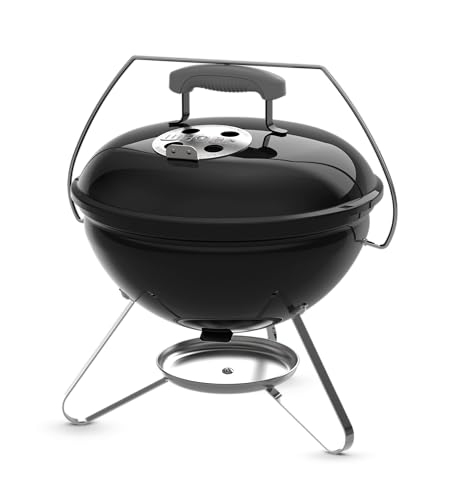
Weber Smokey Joe 14-Inch Portable Charcoal Grill — Best Overall
The Smokey Joe is the portable grill against which all others are measured, and the current version keeps the formula pure: a 14-inch porcelain-enameled kettle, a plated steel cooking grate, and the Tuck-N-Carry lid lock that doubles as a handle and keeps the whole unit sealed for transport. It is the grill that lives in trunks and boat lockers for decades, because there is almost nothing on it to break.
Strengths
- Tuck-N-Carry lid lock makes it a true one-hand carry with no ash spills
- Porcelain-enameled kettle shrugs off weather, heat and years of use
- Weber parts and accessories keep a decades-old design fully supported
Trade-offs
- 14 inches means burgers for two to four, cooked in honest batches
- No lid thermometer and simple vents — temperature control is the cook’s craft
- Tabletop use only; bring a heat-safe stand or surface
| Specification | Detail |
|---|---|
| Grate diameter | 14 inches (per verified listing) |
| Format | Portable kettle charcoal grill |
| Lid | Tuck-N-Carry locking lid (per verified listing) |
The Smokey Joe’s genius is subtraction. No igniter to fail, no hinge to bend, no electronics to drown — just a kettle, a grate, a charcoal grate and vents, in proportions Weber has refined for generations. It cooks the way a kettle cooks: a chimney of coals, a two-zone arrangement pushed to one side, the lid doing the oven work. Burgers, sausages, chicken pieces, corn, kebabs — the entire portable canon — come off it tasting like charcoal-grilled food should, because it is charcoal-grilled food, with none of the compromises of folding novelty grills. Its limits are written on its face: the grate serves small groups, and low-and-slow cooking is a fiddly improvisation rather than a feature. But as the compact outdoor grill to own first and replace never, it has no serious rival. Buy it, learn fire on it, and hand it down.
Best for: Couples, small families, campers and boaters who want definitive charcoal flavor in the most portable honest package / Not suited for: Groups over four, low-and-slow barbecue, or anyone who wants push-button convenience
Check on Amazon — check the current price on Amazon, since listings and configurations change through the season.

Kamado Joe Joe Jr 13.5-Inch Portable Ceramic Grill — Best Premium Compact
The Joe Jr answers a question most makers ignore: what if the portable grill were not a compromise at all? It is a genuine ceramic kamado — thick insulated walls, a stainless steel cooking grate, a heat deflector for indirect cooking — scaled to 13.5 inches and set in a portable stand. It grills, roasts, bakes and smokes in miniature, holding kamado temperatures with kamado stability.
Strengths
- Ceramic insulation holds heat on a handful of charcoal — remarkable fuel economy
- Heat deflector enables true indirect cooking and small low-and-slow sessions
- Stainless grate and quality hardware throughout; it feels like equipment, not a toy
Trade-offs
- Ceramic means weight and fragility in transport — this is a careful carry, not a toss-in carry
- 13.5 inches serves one to two people, period
- Premium price for its size; you are paying for the format, not the area
| Specification | Detail |
|---|---|
| Grate diameter | 13.5 inches (per verified listing) |
| Body | Ceramic kamado with stand (per verified listing) |
| Grate | Stainless steel (per verified listing) |
| Extras | Heat deflector included (per verified listing) |
Cooking on the Joe Jr recalibrates what small means. The ceramic mass heat-soaks until the whole body is the cooking environment, so a steak sears over coals while the dome roasts it through, a small chicken cooks indirectly like it was in an oven, and a pork shoulder can genuinely smoke for hours on a charcoal load that would embarrass a kettle. For the solo cook, the couple, or the apartment balcony where charcoal is allowed, it delivers a quality of result that larger cheap grills cannot touch. The cautions are physical: ceramic is heavy for its size and unforgiving of drops, so it travels in its stand, in a protected spot, carried with two hands and respect. It also cooks for few — this is a deliberate, small-batch instrument. Accept those terms and it is the most capable compact outdoor grill in this roundup, square inch for square inch.
Best for: Solo cooks and couples who want true kamado performance — sear, roast, smoke — in a portable footprint / Not suited for: Groups, rough transport, or anyone who will resent carrying ceramic carefully
Check on Amazon — check the current price on Amazon, since listings and configurations change through the season.

Char-Griller AKORN Jr Portable Kamado — Best Kamado Value
The AKORN Jr takes the kamado idea and rebuilds it for the road: triple-wall insulated steel instead of ceramic, cast-iron cooking grates, and a portable form that can ride in a trunk without a prayer. It delivers the insulated, efficient, wide-temperature-range cooking that makes kamados special, at a price and toughness that suit camping and tailgating rather than careful patio life.
Strengths
- Triple-wall insulated steel holds heat like a kamado and travels like a cooler
- Cast-iron grates sear properly and season into a durable cooking surface
- Wide temperature range — genuine smoking heat to real searing heat in one unit
Trade-offs
- Steel insulation is excellent but a step below ceramic for the longest, lowest cooks
- Heavier than the kettle-style portables here
- Paint and finish need basic care to stay ahead of rust at the seams
| Specification | Detail |
|---|---|
| Body | Triple-wall insulated steel (per verified listing) |
| Grates | Cast iron (per verified listing) |
| Format | Portable kamado grill and smoker |
The AKORN Jr is the thinking camper’s kamado. On site it does what its ceramic cousin does — settles into a temperature and holds it with miserly charcoal use, sears hard when asked, smokes a small load of ribs with real composure — and then it does the thing ceramic cannot: it gets latched, lifted and driven home over rough roads without anxiety. The cast-iron grates are a genuine cooking advantage, holding the heat that makes marks and crusts, and they reward the standard cast-iron courtesies of oiling and dry storage. Where it concedes ground is the extreme end of the kamado repertoire — the twelve-hour, barely-tended low cook is ceramic’s home turf — and in the finish department, where a season of travel will mark the paint. For the outdoor cook whose kamado must earn its place in a vehicle, those are the right trades, made in the right places.
Best for: Campers and tailgaters who want kamado versatility with travel-proof construction / Not suited for: Purists chasing the longest unattended ceramic cooks, or ultralight packers
Check on Amazon — check the current price on Amazon, since listings and configurations change through the season.
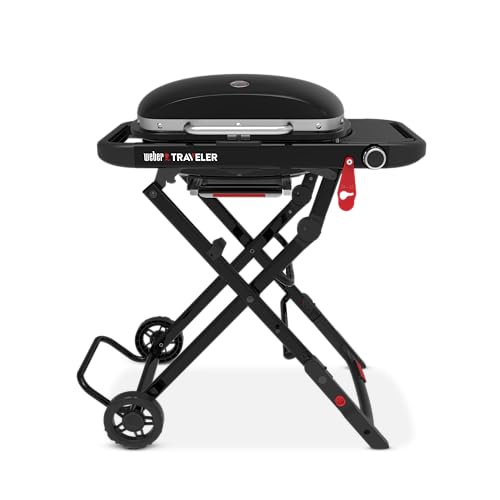
Weber Traveler Compact Portable Gas Grill — Best Folding Gas
The Traveler Compact takes Weber’s folding traveler concept — a full grill on a cart that folds with one hand to roll and store like a suitcase — and trims it for smaller households and smaller vehicles. It cooks standing up, wheels to the pitch or the patio corner, and folds flat enough to live against a wall, which is precisely the storage profile compact buyers actually have.
Strengths
- One-hand folding cart with wheels — the easiest transport in the gas class
- Standing-height cooking without a table, anywhere it unfolds
- Weber burner and grate quality in a genuinely compact fold
Trade-offs
- Compact edition means a compact grate — couples and small families, not crowds
- Folded is not the same as light; it is a roll-it, not carry-it, grill
- Gas only, with the cylinder logistics that implies
| Specification | Detail |
|---|---|
| Format | Folding portable gas grill with wheels (per verified listing) |
| Fuel | Propane |
| Storage | Folds for upright, compact storage |
The Traveler’s party trick — the fold — is not a gimmick but a storage solution, and storage is where compact grills live or die. A grill that stands folded in a foot of garage wall space gets used; a grill that must be assembled from a box of parts gets left. On site, the virtues compound: it unfolds in seconds, cooks at a civilized height, lights instantly, and its Weber burner and grate deliver the even, predictable cooking the brand is known for, in a size honestly matched to two to four people. It is the gas pick for the household whose outdoor cooking happens in many places — the balcony on Tuesday, the campsite on Saturday, the beach lot on Sunday — and whose storage is one shared closet. Treat the folding mechanism kindly, keep the wheels and joints blown clean after sandy sites, and it will be unfolding for your cookouts a decade from now.
Best for: Apartment, condo and RV households that need one gas grill for home and travel, with minimal storage / Not suited for: Large groups, charcoal devotees, or anyone needing to carry a grill any real distance on foot
Check on Amazon — check the current price on Amazon, since listings and configurations change through the season.

Coleman Fold N Go Portable Propane Grill — Best Ultralight Gas
The Fold N Go is the minimalist’s gas grill: a low, flat unit that folds into a briefcase profile, lights with Instastart ignition, and puts a 6,000 BTU burner under a modest grate. It is not trying to feed a tailgate party. It is trying — successfully — to be the grill that is actually in the car, the boat locker or the picnic kit when the moment for grilled food arrives.
Strengths
- Folds flatter and lighter than any other gas grill here — it disappears into storage
- Instastart ignition and simple controls suit spontaneous, small-scale cooking
- Perfectly sized for two-person picnics, boat days and solo camping
Trade-offs
- 6,000 BTU is gentle heat — searing is modest and wind steals performance
- Small grate: two to four items is a full load
- Light construction is the price of the format; handle it like the portable it is
| Specification | Detail |
|---|---|
| Burner output | 6,000 BTU (per verified listing) |
| Ignition | Instastart (per verified listing) |
| Format | Folding portable propane grill |
Judge the Fold N Go by its mission and it shines: it turns an ordinary picnic into a grilled lunch, cooks sausages and burgers at a boat anchorage, and handles a camper’s dinner for two without occupying the vehicle’s life. Its heat is the honest limit — 6,000 BTU under a light grate means patience with thicker items, a lid kept down, and modest expectations for steakhouse crusts, especially in wind, which strips small grills cruelly. A windscreen position and a sheltered setup recover much of the deficit. What it returns for those compromises is presence: the best grill is the one you brought, and no grill in this roundup is brought more often than the one that folds flat and weighs almost nothing. For minimalists, small-boat owners and picnic romantics, it is not the budget choice — it is the correct one.
Best for: Picnics, small boats, solo and two-person camping where packed size rules every decision / Not suited for: Steak searing, groups, or exposed windy sites without shelter
Check on Amazon — check the current price on Amazon, since listings and configurations change through the season.

Cuisinart 14-Inch Portable Charcoal Grill (CCG-190RB) — Best Budget Charcoal
The Cuisinart CCG-190RB is the portable charcoal grill of a thousand picnics: a 14-inch kettle-style body, a dual air vent system for heat control, and three lid locks that clamp the unit shut so it carries one-handed by its handle without shedding ash. It costs little, weighs little, and cooks the entire portable canon without complaint.
Strengths
- Three lid locks and a carry handle — genuinely one-handed, spill-free transport
- Dual vents give real temperature control for a budget portable
- The lowest price of entry into portable charcoal in this roundup
Trade-offs
- Light-gauge steel will not age like the Weber kettle’s enamel
- Grate and fit are functional rather than refined
- Like all 14-inch grills, it batches for groups
| Specification | Detail |
|---|---|
| Diameter | 14 inches (per verified listing) |
| Vents | Dual air vent system (per verified listing) |
| Lid | 3 lid locks, one-handed carry (per verified listing) |
| Model | CCG-190RB |
The CCG-190RB understands its job completely. The lid locks are the standout — three of them, so the lid stays sealed over the ash on the walk back to the car, which is the moment cheap portables usually redecorate your trunk. The dual vents matter more than buyers expect: charcoal control is air control, and a portable that can be choked down for gentler cooking or opened up for searing is a portable that can cook chicken without cremating it. Construction is where the price shows — the steel is light, the grate is basic, and a decade of service is not the promise. A season of picnics, beach days and campsite dinners absolutely is. For the buyer who wants charcoal flavor at the lowest sensible cost, or a second grill for the beach house that nobody will mourn, it is exactly right — and its one-handed carry makes it, quietly, the most picnic-friendly design here.
Best for: Picnics, beach days and budget buyers who want real charcoal flavor and spill-free carrying / Not suited for: Daily use over many years, or cooks who want kettle-grade enamel and heft
Check on Amazon — check the current price on Amazon, since listings and configurations change through the season.
Comparison Table
| Pick | Badge | Key Spec | Best For |
|---|---|---|---|
| Weber Smokey Joe 14-Inch Portable Charcoal Grill | Best Overall | 14 in kettle, lid lock carry | Couples, small families, campers and boaters who want definitive charcoal flavor in the most portable honest package |
| Kamado Joe Joe Jr 13.5-Inch Portable Ceramic Grill | Best Premium Compact | 13.5 in ceramic kamado | Solo cooks and couples who want true kamado performance — sear, roast, smoke — in a portable footprint |
| Char-Griller AKORN Jr Portable Kamado | Best Kamado Value | Insulated steel kamado, cast iron | Campers and tailgaters who want kamado versatility with travel-proof construction |
| Weber Traveler Compact Portable Gas Grill | Best Folding Gas | Folding cart gas, wheels | Apartment, condo and RV households that need one gas grill for home and travel, with minimal storage |
| Coleman Fold N Go Portable Propane Grill | Best Ultralight Gas | 6,000 BTU, folds flat | Picnics, small boats, solo and two-person camping where packed size rules every decision |
| Cuisinart 14-Inch Portable Charcoal Grill (CCG-190RB) | Best Budget Charcoal | 14 in charcoal, 3 lid locks | Picnics, beach days and budget buyers who want real charcoal flavor and spill-free carrying |
The table spans three fuels, so read it as three shortlists sharing a page: charcoal flavor (Smokey Joe, Cuisinart, and the kamados for those who want insulation with their charcoal), gas convenience (Traveler for the stand-up fold, Fold N Go for the vanishing act). The right column is not ‘best for’ — it is ‘best for you, if your outings look like this.’
How to Choose Compact Outdoor Grills
Fuel first, because fuel is the outing. Charcoal means carrying fuel and ash, lighting time at the site, and the flavor that makes people seek these grills out. Gas means cylinders, instant heat, instant off, and a cleaner exit from the site. Kamados mean charcoal with insulation — longer cooks, less fuel, more weight. There is no wrong answer, but there is a wrong answer for a specific trip: the family arriving at a campsite at dusk with hungry children needs gas; the couple planning a slow afternoon around a fire needs charcoal.
Interrogate the packed size, not the cooking size. Ask how the grill travels: does the lid lock, do the legs fold or detach, does it have a handle that balances the load, and what does it weigh with the grate and tools inside? Then ask where it will live at home — a grill that stores in its travel footprint, like the Traveler folded against a wall or the Smokey Joe on a shelf, gets used ten times as often as one that needs a storage project.
Match the grate to the group, honestly. A 14-inch grate cooks four burgers at once. That is dinner for two with sides, a batch for four, and a production line for six. Buy for your usual group, not your biggest annual gathering — the gathering can borrow a second grill, while the usual Tuesday cannot borrow a smaller one.
Durability is a transport spec. Hinges, latches, leg pivots and lid locks are the parts that fail on portables, and they fail from being carried, not from being cooked on. Favor simple mechanisms, replaceable parts and brands with parts catalogs. A portable grill is luggage that cooks; judge it by both standards.
Fire and Fuel Rules for Parks, Beaches and Campsites
Compact outdoor grilling happens on other people’s land, under other people’s rules, and the rules vary more than newcomers expect. Many parks and beaches restrict charcoal to installed grills or ban it entirely in dry seasons; campgrounds commonly allow gas when charcoal is banned, and total fire bans can include every flame. The professional habit is to check the specific site’s current rules before the trip, carry the fuel that complies, and have a no-cook backup plan for the days when nothing may burn.
Ash and grease are the other half of outdoor citizenship. Charcoal ash leaves only when it is cold — drowned, stirred and cold to the touch — and goes where the site directs, never into dry brush or a plastic bin. Grease and food scraps pack out. A compact grill kit that includes a small metal ash can, a brush and a trash bag is not being fussy; it is how the next group finds the site as clean as you did, and how these places stay open to grilling at all.
How to Set Up a Compact Grill at a Campsite or Picnic Site
- Scout the spot first. Level ground, out of the wind where possible, clear of overhanging branches and dry grass, and positioned so smoke drifts away from where people sit. Check the site’s fire rules before a single coal is lit.
- Build a stable, heat-safe base. Tabletop grills go on stone, metal or a heat mat — never plastic tables or dry wooden surfaces without protection. Legs fully extended and locked, grill level before it is hot.
- Light for the fuel you brought. Charcoal: a chimney starter, fully ashed-over coals, arranged two-zone with a cooler side. Gas: leak-check the connection, light per the manual, preheat with the lid down.
- Cook with the lid and the zones. Sear over the heat, finish to the side, lid down to cook through. On small grates, sequence the menu — items that hold well first, quick items last.
- Manage the fire down, not out. As cooking ends, close charcoal vents to starve the coals for a controlled cool-down; shut gas at the cylinder first, then the burner.
- Leave it clean and cold. Ash drowned and cold before disposal, grease contained, grill latched and cool before it goes back in the vehicle. The site should show no sign of the feast.
The Two-Grill System: Why Many Outdoor Cooks Own a Pair
Experienced outdoor cooks often converge on the same quiet conclusion: one compact grill is a compromise, but two small ones are a system. The classic pairing is a kettle or kamado for flavor cooking and a folding gas grill for speed — the charcoal unit handles the Saturday ritual and the smoked projects, the gas unit handles weeknight campsite dinners, fire-ban days and the breakfast shift. Together they still store in less space than one mid-size residential grill, and each is cheap enough that the pair costs less than a single premium full-size unit.
The pairing also solves the group problem without a giant grill. Two compact grates cooking in parallel — proteins on one, vegetables and bread on the other — feed a gathering more gracefully than one big grate, because each fire runs at its own temperature and nothing waits. If your outings regularly stretch a single compact past its comfort, do not buy a bigger grill that travels worse; buy a second small one that travels the same. Systems beat sizes, outdoors.
Charcoal Technique for Small Grates: Banking, Zones and the Lid
Small charcoal grills reward technique more than big ones, because there is less margin for error. The foundational skill is banking: coals pushed to one side, leaving the other side empty, creating a sear zone and a safe zone on a grate that looks too small for zones. Nearly everything cooks across that divide — sear over the coals, finish beside them, lid down. The lid is the second skill: on a kettle or kamado, the lid turns a grate into an oven, and most portable charcoal failures are really lid failures — food left open to the air, drying and flaring, when ten covered minutes would have cooked it through.
Vent discipline is the third skill. Bottom vents feed the fire, top vents draw it; small adjustments, made early, steer a small grill’s temperature far better than large corrections made late. And charcoal quantity is the fourth: a small grill needs a small, measured fire — a chimney two-thirds full cooks most portable dinners, and the instinct to fill the bowl is the beginner’s most common error, producing a grill too hot to use and a wait while it calms down. Master these four modest skills and a 14-inch grill cooks with a competence that surprises people who equate size with capability.
Storing Compact Grills in Small Homes
The compact grill’s final test happens at home, in the closet, the balcony corner or the garage. Store it clean — ash out, grease tray emptied, grates brushed and lightly oiled if they are cast iron — because a grill stored dirty corrodes in the dark and greets its next outing with rancid old grease. Store it dry and covered: a fitted cover or even a heavy bag keeps dust and balcony weather off the finish, and keeps the grill ready rather than project-like.
Keep the kit together. The tongs, chimney, thermometer, gloves and a starter supply of fuel should live with the grill, in one bin or bag, so an outing is a grab rather than a scavenger hunt — the friction of gathering gear is the silent killer of spontaneous grilling. Gas cylinders store separately, upright and outdoors per safety rules. Do this and the compact grill fulfills its founding promise: it is the grill that is always ready, in the homes with the least room to spare. That readiness, more than any spec, is what this entire category is for.
A Short History of the Portable Grill, and Why the Old Designs Won
It is worth noticing how old the winning designs in this roundup are. The kettle form is a mid-twentieth-century idea; the kamado is a centuries-old one refined; the folding gas traveler is the newest shape here and it is, at heart, a grill on a luggage cart. Portable grilling has had seventy years of novelty poured into it — grills shaped like suitcases, briefcases, buckets and footballs — and the market keeps returning to the same few forms, because the physics of fire, food and carrying do not change with fashion.
That history is a buying guide in itself. When a category’s best products are refinements of old designs — a better lid lock on a kettle, insulation on a kamado, a smarter fold on a cart — it means the fundamentals are settled and the differences live in execution: enamel quality, grate weight, latch engineering, parts support. Shop the execution, not the silhouette. The grills in this roundup are all, in that sense, conservative choices, and they are recommended precisely because seventy years of picnics have already done the experimenting for you.
Feeding a Crowd From a Small Grate: The Event Playbook
Sooner or later every compact grill owner faces the gathering that outnumbers the grate, and the difference between triumph and chaos is a plan made before the first coal lights. Start with the menu architecture: choose one hero protein that cooks in a single batch and holds gracefully — sausages, chicken thighs, marinated kebabs — and build the rest of the meal around things that do not need the grill at all, or need it only for a finishing minute. Cold salads, slaws, breads and desserts carry a cookout further than a second protein ever will.
Then run the grill like a production line rather than a stage. Cook in waves with a resting station — a foil pan at the grate’s edge or a low oven at home — so finished food accumulates instead of being served piecemeal to whoever is standing nearest. Put the quick, eat-immediately items last: burgers and shrimp cook in the final wave and go straight to the table. Assign one person to the grill and protect them from every other job; a small grate punishes distraction twice as fast as a large one. And say the quiet part early: with a compact grill, the meal is a procession, not a single reveal — which, at every good cookout anyone remembers, it always was anyway.
Wind, Rain and Cold: Weather Technique for Small Grills
Compact grills live outdoors in a way big patio grills do not, and weather is their constant opponent. Wind is the chief enemy: it strips heat from gas burners until they cook unevenly, and fans charcoal from a simmer to a blaze in minutes. The countermeasures are placement and patience — grill on the lee side of a car, a wall or a windbreak, keep the lid down as your shield, and on charcoal, close the vents a notch earlier than instinct suggests, because the wind is doing your stoking for you.
Rain demands a decision rather than a technique: never grill under a low tarp or awning that can catch heat or sparks, and never bring a lit grill into a tent, garage or vehicle — carbon monoxide makes that a lethal improvisation, full stop. A pop-up canopy with high clearance and open sides is the legitimate shelter, and knowing when to move the meal indoors is a skill, not a surrender. Cold, by contrast, is merely a tax: longer preheats, more fuel, lids kept shut. Small grills actually pay that tax more cheaply than big ones, because there is less iron to heat. The outdoor cooks who grill year-round are not hardier than anyone else; they have just learned which weather is an inconvenience and which is a verdict.
Common Buying Mistakes
- Buying the cooking size and ignoring the packed size. The grill that does not fit the car or the closet does not go anywhere.
- Charcoal where it is banned. Check the site rules first; a gas backup plan saves the trip.
- Plastic tables under hot grills. Tabletop units need stone, metal or a heat mat. Every time.
- Crowding a small grate. Compact grills cook in batches by design. Plan the sequence instead of piling everything on.
- Dumping warm ash. Ash stays hot for many hours. Drown it, stir it, confirm it cold.
- Forgetting the wind. Wind is the compact grill’s worst enemy — it steals gas heat and fans charcoal wild. Shelter is a cooking technique.
Final Recommendation
If you buy one compact outdoor grill, buy the Weber Smokey Joe — it is the portable archetype for a reason, and it will outlive the car it rides in. Couples who want the finest small cooking available should take the Kamado Joe Joe Jr; campers who want kamado range without ceramic anxiety, the AKORN Jr. Gas households should choose between the Weber Traveler Compact for stand-up, fold-away living and the Coleman Fold N Go for the lightest possible kit. And the Cuisinart CCG-190RB remains the picnic bargain that carries like a briefcase and cooks like a grill. Match the fuel to your outings and the size to your usual group, and any of these will earn its place in the car.
Start your shortlist there: Weber Smokey Joe 14-Inch Portable Charcoal Grill, Kamado Joe Joe Jr 13.5-Inch Portable Ceramic Grill, Char-Griller AKORN Jr Portable Kamado — check the current price on Amazon for each and confirm the configuration matches your site before ordering.
Keep exploring the cluster before you decide:
- Best Compact Gas Grills
- Best Compact Electric Grills
- Best Competition Bbq Grills
- Best Commercial Wood Smoker Grills
Frequently Asked Questions
What size compact grill do I need for four people?
A 14-inch round grate is the working minimum for four — it cooks four burgers or equivalent at once, with sides done in a quick second batch. If four-person cooking is your norm rather than your exception, step up to the folding gas traveler class or the largest tabletops for a less batched experience.
Charcoal or gas for camping?
Gas for speed, cleanliness and fire-ban resilience; charcoal for flavor, ritual and independence from cylinders. Many experienced campers carry gas as the main grill and treat charcoal as the occasion. Your answer depends on your sites’ rules and your patience at dusk.
Can a compact grill really smoke meat?
The kamado picks can — insulated bodies and deflectors make genuine small-scale smoking possible, from ribs to a small pork shoulder. Kettles can improvise short smokes with two-zone setups. Tabletop gas grills are grills, not smokers, and are best kept to their strength.
How do I transport a charcoal grill without making a mess?
Let the ash cool fully or drown it, close the vents, lock the lid — the Smokey Joe’s Tuck-N-Carry lock and the Cuisinart’s three lid locks exist for exactly this — and carry the grill upright in a bin or bag. Never transport a grill with warm ash in a vehicle.
Are compact grills allowed on balconies?
It depends entirely on the building and local fire code. Gas and electric are permitted in many buildings where charcoal is banned; some ban all grilling. Check your lease and local rules first — the compact electric guide in this series covers the balcony-legal options in depth.
What accessories does a compact outdoor grill actually need?
A chimney starter for charcoal models, a fitted cover or carry bag, long tongs, an instant-read thermometer, and a small metal ash can for charcoal users. That short list covers nearly every real outing; leave the gadget sets in the store.


