Disclosure: airfryerkitchensupply.com is reader-supported. When you buy through links on our site, we may earn an affiliate commission at no extra cost to you.
Where to Buy
Every set in this guide to the best ceramic cookware for induction cooktops was matched to a live Amazon listing through our product database check before it received a link, and each one is positioned by its maker as induction cookware — that phrase, in the verified listing, is the entry requirement for this guide. Use the links here and throughout the article to check price on Amazon and confirm the piece count and colour before ordering, because these sets are sold in several configurations under similar names. Before any ceramic set touches your hob, run the magnet test described in this article on the first pan out of the box.
Shop the verified picks on Amazon: SENSARTE Ceramic Cookware Set 14 Piece Induction · KitchenAid Hard-Anodized Induction Ceramic Pots and Pans Set 9pc · CAROTE 25pcs Ceramic Cookware Set with Detachable Handle · Farberware Forged Induction Ceramic Nonstick Cookware Set 12-Piece · SENSARTE Ceramic Pots and Pans Set 18-Piece White · GOTHAM STEEL Hammered 13 Pc Titanium Ceramic Cookware Set. Availability and configurations change, so check price on Amazon before you order.
The best ceramic cookware for induction cooktops has to clear a hurdle that most ceramic cookware fails, and it is worth stating plainly at the start: ceramic nonstick pans are usually built on aluminium, and aluminium does not work on induction. A ceramic-coated pan only heats on an induction hob if its base carries a magnetic layer — a bonded steel plate or induction disc — and a large share of the ceramic sets on the market simply do not have one. Shoppers discover this at home, one beeping, error-coded hob at a time.
That is why this guide was built backwards from verified listings. Every set below is sold explicitly as induction cookware in its maker’s own listing, checked through Amazon’s product data for this site on 2026-11-21. Within that verified field, the real choices are about size (9-piece essentials versus 25-piece everything-boxes), construction (forged and hard-anodized bodies versus standard), handle systems — including the detachable-handle designs that have changed small-kitchen storage — and the honest limits of ceramic coatings, which this guide will not gloss over: ceramic is a pleasure to cook and clean with, and it is not a buy-for-life surface.
In this guide
Quick Picks
Six verified ceramic cookware sets, each sold as induction-compatible in its own listing: premium, value, space-saving and large-set options for different kitchens. Badges match the full reviews below; the magnet test in the guide section is your final verification at home.
- SENSARTE Ceramic Cookware Set 14 Piece Induction — Best Overall: A 14-piece set sold squarely as induction cookware, non-toxic and free of PFAS, PTFE, PFOA and PFOS — the balanced centre of this category. Check price on Amazon.
- KitchenAid Hard-Anodized Induction Ceramic Pots and Pans Set 9pc — Best Premium: Hard-anodized construction under ceramic, from a heritage kitchen brand, in a focused 9-piece count — the premium, buy-fewer-better-pieces option. Check price on Amazon.
- CAROTE 25pcs Ceramic Cookware Set with Detachable Handle — Best Space-Saving: A 25-piece induction-compatible set built around detachable handles — pans nest into a fraction of their usual space and go from hob to oven to table. Check price on Amazon.
- Farberware Forged Induction Ceramic Nonstick Cookware Set 12-Piece — Best Value Brand: A forged-body 12-piece induction ceramic set from one of the oldest names in American cookware — the heritage value pick in Taupe. Check price on Amazon.
- SENSARTE Ceramic Pots and Pans Set 18-Piece White — Best Large Set: The 18-piece SENSARTE in white — the same induction ceramic formula as our top pick, scaled up for households that cook in breadth as well as depth. Check price on Amazon.
- GOTHAM STEEL Hammered 13 Pc Titanium Ceramic Cookware Set — Best Heavy-Duty Design: A hammered-finish 13-piece set in titanium ceramic at a heavy-duty 3.0mm gauge — induction, oven and dishwasher safe, and built thicker than the category norm. Check price on Amazon.
How These Picks Were Chosen
The first filter was binary and non-negotiable: the set’s own verified listing had to present it as induction cookware or induction compatible. That single rule eliminated most of the ceramic market — including several famous ceramic brands whose standard lines are aluminium-based and induction-incompatible — and it is why you will not find some expected names below. We would rather explain an absence than recommend a set that errors out on your hob.
Every set named here was returned by a Amazon listing data search for ceramic induction cookware run through this site’s product database on 2026-11-21, and the claims printed — piece counts, induction positioning, PFAS-free statements, oven and dishwasher notes, gauge figures — come from those verified listings. Where a listing did not state a detail, we did not print it. Per this site’s standing rules, we print no fixed prices (check price on Amazon) and no fixed star ratings or review counts.
Within the verified field we spread the picks across the real buying situations: the complete mid-size set, the premium hard-anodized option, the detachable-handle space saver, the forged value set, the big family box, and the heavy-gauge hammered design. One theme runs through the reviews and deserves stating here: ceramic coatings, across all brands, trade the decades-long durability of bare metal for a few years of superb release. Buy them with that contract understood and they delight; buy them expecting cast-iron lifespans and they disappoint.
The 6 Best Ceramic Cookware Sets for Induction Cooktops
Each review covers the set as induction cookware first — base, body and hob behaviour — then as ceramic cookware in daily life: release, care and realistic lifespan expectations. Spec boxes use only verified listing facts.

SENSARTE Ceramic Cookware Set 14 Piece Induction — Best Overall
SENSARTE has built its name in ceramic nonstick, and this 14-piece set is its induction expression: sold explicitly as induction cookware, with a non-toxic positioning and a full house of frying pans and pots, per its verified listing. Fourteen pieces is the size at which a set covers the real cooking of a household without filling the cupboard with novelty shapes.
Strengths
- Sold explicitly as induction cookware — the base is the point
- Free of PFAS, PTFE, PFOA and PFOS per the listing
- 14-piece count covers everyday cooking without filler
Trade-offs
- Ceramic coating lifespan is measured in years, not decades
- White goods discipline applies: ceramic shows scorch marks if abused
- Serious searing still belongs in iron or steel; ceramic is a gentler tool
| Pieces | 14 piece set |
| Type | Ceramic nonstick induction cookware |
| Coating claims | PFAS, PTFE, PFOA, PFOS free (per listing) |
| Positioning | Non-toxic, healthy nonstick (per listing) |
The case for this set as Best Overall is balance. The piece count suits a household that cooks daily; the induction base is the headline rather than a footnote; and the chemical-free positioning is stated in the specific terms (PFAS, PTFE, PFOA, PFOS) that let a careful shopper verify what is being claimed, rather than in vague wellness language. SENSARTE’s specialisation matters too: a brand whose entire business is ceramic nonstick tends to execute the coating — its evenness, its release, its behaviour at the edges — better than a generalist’s side line.
Set the ownership contract clearly and it satisfies: cook on low-to-medium heat for most work (induction makes this easy, because its low settings are genuinely low), use soft utensils, hand-wash when you can, and expect the release to be superb now and gradually more ordinary over the years. Bakers and searers should keep one iron or steel pan alongside for the violent jobs. As the centre of an induction kitchen, this is the set this guide would buy first.
A final practical strength: fourteen pieces is the count at which delivery, storage and daily rotation all stay simple. The set arrives in one box, lives in one cupboard zone, and its pieces rotate through the dishwasher-or-sink rhythm of a normal week without a spreadsheet. Ambition in cookware is good; friction is not, and this set is calibrated to the low-friction end of complete.
Best for: Most induction households wanting one complete, honestly specified ceramic set / Not suited for: High-heat searing specialists or buy-for-life shoppers
Check on Amazon — check the current price on Amazon before ordering.

KitchenAid Hard-Anodized Induction Ceramic Pots and Pans Set 9pc — Best Premium
KitchenAid approaches ceramic from the construction side: a hard-anodized body — aluminium hardened for strength and even heating — with a ceramic cooking surface and induction capability, in a 9-piece set finished in Cardamom. It is the pick for buyers who want fewer, better-built pieces and a brand with a service department.
Strengths
- Hard-anodized body is a genuine construction upgrade
- KitchenAid brand support and availability
- Focused 9-piece count: essentials without filler
Trade-offs
- Nine pieces may leave large households a pan short
- Premium positioning within the ceramic category
- Ceramic surface still asks for ceramic manners — no metal utensil heroics
| Pieces | 9 piece set |
| Body | Hard-anodized (per listing) |
| Type | Induction ceramic pots and pans |
| Colour | Cardamom (per listing) |
Hard-anodizing deserves its explanation, because it is the substantive word in this listing. Anodizing thickens and hardens aluminium’s surface, producing a body that resists warping and corrosion better than plain aluminium and distributes heat with aluminium’s natural evenness. Under a ceramic coating and over an induction base, that body is the difference between a set that feels like equipment and one that feels like merchandise — and on induction, where a warped base means a rocking, buzzing, unevenly heated pan, body quality is performance.
The 9-piece discipline suits kitchens that cook a repertoire rather than a catalogue: the core saucepans, the everyday frypans, the stockpot. If your cooking regularly needs the extra specialty pieces, the larger sets below serve you better. If it does not, this KitchenAid is the set whose every piece will be used weekly and whose build will still feel tight when the coating eventually retires — at which point the brand’s ecosystem makes replacing individual pieces painless.
The Cardamom finish deserves a sentence for the design-minded: it is a warm, muted tone that sits comfortably in kitchens tired of both stainless glare and novelty colours, and it photographs as calmly as it cooks. Aesthetics are not performance, but a set you enjoy looking at is a set you keep on the hob and use — and on the margin, that is worth more than one extra saucepan you would never have reached for.
Best for: Quality-first buyers and smaller households wanting essentials built properly / Not suited for: Large families needing maximum piece count per purchase
Check on Amazon — check the current price on Amazon before ordering.
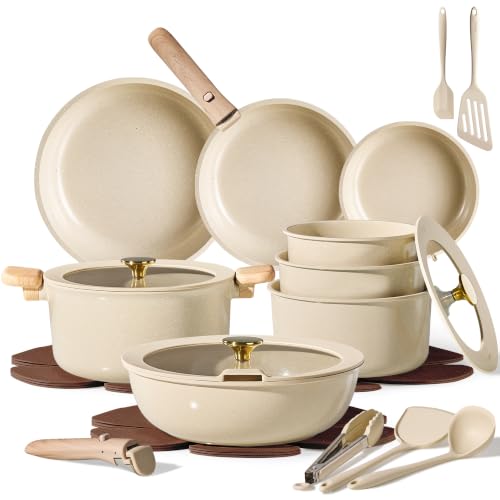
CAROTE 25pcs Ceramic Cookware Set with Detachable Handle — Best Space-Saving
The detachable-handle system of CAROTE is the most consequential design idea in modern ceramic cookware, and this 25-piece set is its full expression: induction compatible, PFAS free, dishwasher and oven safe per its verified listing, with handles that click off so pans stack into a single tidy tower. For small kitchens, RVs and boats, it rewrites the storage maths entirely.
Strengths
- Detachable handles transform storage — pans nest completely
- Induction compatible and oven safe: hob-to-oven in the same pan
- 25 pieces cover cooking, serving and storage in one system
Trade-offs
- The handle mechanism is a moving part to keep clean and check
- One or two handles serve many pans — busy cooks may want spares
- Ceramic care rules still apply in full
| Pieces | 25 pieces |
| Handles | Detachable handle system |
| Compatibility | Induction compatible (per listing) |
| Care | Dishwasher and oven safe (per listing) |
| Coating claims | Non-stick, non-toxic, PFAS free (per listing) |
Live with the system for a week and its logic compounds. Without handles, the pans stack in perhaps a third of the cupboard volume of a conventional set. Without handles, the same pan goes from induction hob to oven to table (as its own serving dish) to fridge (with a storage lid, the set’s organisation pieces suggest) without a transfer or a second vessel. For the RV and small-flat kitchens the listing itself names, this is not a gimmick; it is the difference between a full cookware capability and a compromise kit.
The duties are mechanical honesty: the handle must click positively onto each pan, every time, and a handle that feels loose is a handle to clean, inspect or replace — never a handle to trust with a full pan of hot food. Buyers who build that two-second check into their routine get the most space-efficient induction ceramic set in this guide, and the one we recommend first to anyone whose kitchen storage is measured in centimetres.
Campers and RV cooks should note the double fit: the listing itself names camping and RV use, and the logic is sound — a nested tower of pans replaces the rattling assortment of mismatched cookware that small vehicles usually carry, and induction compatibility pairs with the portable induction hobs increasingly standard in modern vans. It is rare for one set to be the right answer to both a small flat and a campervan; this is that set.
Best for: Small kitchens, RVs, boats and anyone storage-constrained / Not suited for: Cooks who dislike any mechanism between hand and pan
Check on Amazon — check the current price on Amazon before ordering.

Farberware Forged Induction Ceramic Nonstick Cookware Set 12-Piece — Best Value Brand
Farberware has sold cookware to American households for generations, and its forged induction ceramic set brings that mainstream reliability to this niche: a forged body (stronger and more warp-resistant than stamped construction), ceramic nonstick, induction positioning and a 12-piece count in Taupe, per its verified listing.
Strengths
- Forged construction resists warping — vital on induction
- Heritage brand with wide retail and support presence
- 12-piece count is the classic family configuration
Trade-offs
- Design and finish are mainstream rather than premium
- Ceramic lifespan expectations apply as with all picks here
- Fewer specialty pieces than the big CAROTE boxes
| Pieces | 12 piece set |
| Body | Forged (per listing) |
| Type | Induction ceramic nonstick cookware |
| Colour | Taupe (per listing) |
The word “forged” is doing the same work here as “hard-anodized” does for the KitchenAid: it describes a body made to stay flat. On induction, flatness is not cosmetic — the hob heats through contact with the magnetic base, and a base that domes or warps with heat cycles loses contact, buzzes, and cooks in rings. A forged body is the value tier’s correct answer to that physics, and it is why this set, rather than a cheaper stamped alternative, carries the value badge.
Farberware’s other asset is boring and valuable: the company will be there in five years, its pieces are sold everywhere, and its sets are priced for the mainstream from the start rather than discounted into it. For a family equipping an induction kitchen on a real budget — with children, tenants or students in its future — this is the set whose loss or retirement would be an inconvenience rather than a financial event, and there is genuine wisdom in that.
The Taupe colourway plays the same mainstream hand: a warm neutral that coordinates with the wood-and-stone kitchens most families actually have, rather than demanding the kitchen redecorate around the cookware. It will not be the set guests ask about. It will be the set still cooking, uncomplaining, when the fashionable ones have been replaced — which, for the household this pick serves, is the entire point.
Best for: Families wanting forged-body reliability at a mainstream price / Not suited for: Design-led kitchens or maximum-piece-count shoppers
Check on Amazon — check the current price on Amazon before ordering.

SENSARTE Ceramic Pots and Pans Set 18-Piece White — Best Large Set
Where the 14-piece SENSARTE is the balanced centre, this 18-piece version in white serves the household whose cooking needs the extra pans: more frying pan sizes, more capacity, the same verified induction positioning and the same PFAS, PTFE, PFOA and PFOS free specification, per its listing.
Strengths
- 18 pieces cover large households and varied cooking
- Same trusted SENSARTE ceramic induction formula
- White finish brightens open-shelf kitchens
Trade-offs
- White ceramic shows every scorch and demands gentle habits
- More pieces need more storage than the 14-piece set
- Shares a brand with the top pick — variety seekers should mix
| Pieces | 18 piece set |
| Type | Ceramic nonstick induction cookware set |
| Coating claims | PFAS, PTFE, PFOA, PFOS free (per listing) |
| Colour | White (per listing) |
Why would a household choose eighteen pieces over fourteen? Because cooking breadth is real: the second frypan while the first holds resting eggs, the extra saucepan when the holiday menu runs four burners deep, the size between sizes that turns out to be the one reached for daily. Piece count is filler only when the pieces duplicate; in a well-composed large set they extend the working range, and SENSARTE’s set composition leans that way.
The white finish is a commitment to honesty in the kitchen: it will show you every overheated moment and every lazy wash, and in exchange it shows guests a bright, deliberate kitchen and shows you the state of your pans at a glance. Cooks who like that feedback loop — and who cook gently enough to keep it pretty — get the most complete SENSARTE. Everyone else should take the 14-piece in its standard finish and never think about it again.
One buying note specific to large sets: confirm your hob’s zone layout against the set’s largest pans before ordering. An 18-piece set typically includes a wide frypan or stockpot that wants the largest zone; on a compact four-zone induction hob that pan is the kitchen’s anchor tenant, and everything else schedules around it. Households with generous hobs will never notice; households with small ones should size their ambitions to the glass they own.
Best for: Large households and prolific cooks wanting the full SENSARTE range / Not suited for: Small kitchens or anyone who will resent white-pan upkeep
Check on Amazon — check the current price on Amazon before ordering.

GOTHAM STEEL Hammered 13 Pc Titanium Ceramic Cookware Set — Best Heavy-Duty Design
Gotham Steel sells durability theatre, but the verified listing of this set contains a real specification: a heavy-duty 3.0mm gauge body under its titanium ceramic surface, in a hammered cream finish, induction-ready and oven and dishwasher safe. Thickness is the anti-warp argument again — and on induction, it is the argument that matters most after the base itself.
Strengths
- 3.0mm gauge is genuinely heavy-duty for this category
- Induction, oven and dishwasher safe per the listing
- Hammered finish hides the marks of daily use gracefully
Trade-offs
- Heavier pans — the gauge cuts both ways for smaller cooks
- Brand marketing is loud; judge it by the specification, as we have
- Titanium-ceramic blends still follow ceramic care rules
| Pieces | 13 piece set |
| Gauge | Heavy duty 3.0mm (per listing) |
| Surface | Titanium ceramic, diamond infused (per listing) |
| Compatibility | Induction; oven and dishwasher safe (per listing) |
| Colour | Cream, hammered finish |
Gauge is the specification ceramic cookware usually hides, because thin bodies are cheaper. A 3.0mm pan carries more metal, which buys three things on induction: resistance to the thermal warping that breaks base contact, more even heat spread from the induction disc outward, and a pan that feels planted rather than tinny when a spoon works a sauce. For cooks who are hard on equipment — busy family kitchens, confident teenage cooks, pans that live on the hob rather than in a cupboard — that substance is the correct priority.
The hammered finish is the aesthetic counterpart of the same philosophy: it disguises the small marks of honest use that would glare on a glossy surface, so the set ages gracefully in appearance as well as structure. If your instinct is that cookware should be bought by weight and specification rather than by sheen, this set was listed for you — and its induction, oven and dishwasher credentials, all stated in the verified listing, complete a unusually checkable package.
Weight is the consideration to settle before ordering rather than after: a 3.0mm pan is reassuring in the hand and planted on the hob, but a full stockpot at that gauge is a two-hand, both-mitts commitment, and smaller cooks should handle the idea honestly. The same is true, to be fair, of the cast iron this site recommends elsewhere — substance and effort travel together in cookware, and this set simply chooses substance.
Best for: Hard-use family kitchens wanting the thickest ceramic pans here / Not suited for: Cooks who prefer the lightest possible pans
Check on Amazon — check the current price on Amazon before ordering.
Comparison Table
All six sets are sold as induction cookware in their verified listings — the magnet test at home remains your final check on delivery day. Beyond that shared qualification, body construction, handle systems and piece count divide the field into clearly different ownership experiences.
| Pick | Badge | Key Spec | Best For |
|---|---|---|---|
| SENSARTE Ceramic Cookware Set 14 Piece Induction | Best Overall | 14pc ceramic induction set, PFAS/PTFE free | Most induction households wanting one complete, honestly specified ceramic set |
| KitchenAid Hard-Anodized Induction Ceramic Pots and Pans Set 9pc | Best Premium | 9pc hard-anodized induction ceramic set | Quality-first buyers and smaller households wanting essentials built properly |
| CAROTE 25pcs Ceramic Cookware Set with Detachable Handle | Best Space-Saving | 25pc detachable-handle induction ceramic set | Small kitchens, RVs, boats and anyone storage-constrained |
| Farberware Forged Induction Ceramic Nonstick Cookware Set 12-Piece | Best Value Brand | 12pc forged induction ceramic set | Families wanting forged-body reliability at a mainstream price |
| SENSARTE Ceramic Pots and Pans Set 18-Piece White | Best Large Set | 18pc ceramic induction set, white | Large households and prolific cooks wanting the full SENSARTE range |
| GOTHAM STEEL Hammered 13 Pc Titanium Ceramic Cookware Set | Best Heavy-Duty Design | 13pc titanium ceramic, 3.0mm gauge, induction | Hard-use family kitchens wanting the thickest ceramic pans here |
How to Choose the Best Ceramic Cookware for Induction Cooktops
Rule one is the magnet. Induction heats through magnetism: a pan works only if its base contains enough ferromagnetic material, which is why a fridge magnet is the most important shopping tool in this category. On any ceramic set you consider — including every pick here — the base should grip a magnet firmly across its surface. Makers implement this with a bonded stainless plate or an induction disc under the aluminium body; both work, and a full-coverage base heats more evenly than a small central dot, especially on large burners.
Rule two is body quality, because induction punishes warping. A pan that rocks or domes loses contact, buzzes and cooks unevenly — and thin aluminium bodies warp fastest under induction’s rapid heating. Forged, hard-anodized and heavier-gauge bodies (all represented in the picks) are the structural answers. When comparing two sets at similar prices, choose the one that talks about its body construction; it is telling you where the money went.
Rule three is honest expectations of ceramic itself. A ceramic (sol-gel) coating releases beautifully, cleans with a wipe, and avoids the chemistries some buyers are shopping to avoid — the picks here state their PFAS-free positions explicitly. In exchange, the coating is a consumable surface: superb for the first years, gradually less slick, eventually a candidate for replacement, with lifespan driven mostly by heat habits. Cook mostly at low-to-medium settings — which induction’s precision makes natural — and ceramic lasts; sear everything at maximum and nothing coated survives long.
Why Your Old Ceramic Pans Probably Do Not Work on Induction
If you already own ceramic cookware and are moving to an induction hob, test before you plan around it. Most ceramic nonstick sold in the last decade is aluminium-bodied with no magnetic layer: on induction it will not heat at all, and the hob will typically flash an error or simply refuse the pan. The magnet test takes two seconds per pan and settles every case — firm grip means induction-ready; weak edge-only grip means marginal; no grip means the pan’s future is the oven, the camping box or a friend with a gas stove.
The same test explains this guide’s shape. Several celebrated ceramic brands are absent because their standard lines failed this requirement in our verified data — not because they are poor cookware, but because this search asks a specific question (ceramic, for induction) and honesty requires answering exactly it. Some of those brands sell separate induction lines; if your heart is set on one, apply the same rule: the specific set’s own listing must claim induction, and the magnet confirms it at home.
Do not be tempted by induction converter discs as a rescue for incompatible pans. A steel disc that heats on the hob and then conducts into an aluminium pan works after a fashion, but it discards induction’s speed and efficiency advantages and adds a loose, hot, sliding component to your cooking. Replacing the pan is cleaner, safer and — once the disc’s cost is counted — barely more expensive.
Set Composition: What the Piece Counts Actually Mean
Piece counts in cookware marketing count lids and utensils as pieces, which is why a “25-piece set” does not contain 25 pans. Read any set’s composition before comparing counts: the honest core of a set is its vessels — frypans, saucepans, sauté pan, stockpot — and everything else (lids, protectors, utensils, storage pieces) is supporting cast. The picks in this guide were chosen on their vessel cores first; the CAROTE 25-piece earns its count partly through a storage system, which is legitimate value of a different kind, and the KitchenAid 9-piece is nearly all vessel, which is why it suits repertoire cooks.
A practical composition checklist for an induction household: two frypans (a small one for eggs, a large one for family sautés), two saucepans with lids, one wide sauté or chef’s pan, and one stockpot covers roughly ninety percent of home cooking. Sets that match that skeleton — in whatever total count — will be used completely. Sets heavy in tiny specialty pans will fill a drawer with good intentions. Compare skeletons, not headlines.
Finally, consider the replacement question at purchase. Ceramic sets retire piece by piece, the frypan first. Brands with open-stock availability let you replace the one dead pan; closed sets force a whole new purchase. The mainstream brands in this guide are generally easier to supplement later — one more unglamorous argument for buying names you can find again.
Ceramic Care on Induction: Heat Discipline and Cleaning
Induction and ceramic are natural partners precisely because induction’s control is fine enough to respect ceramic’s limits. The working rules: preheat on medium, cook mostly between low and medium-high, and reserve maximum settings for boiling water in a saucepan rather than searing in a frypan. Thermal shock is the other enemy — a hot pan under a cold tap stresses both coating and body — so let pans cool before washing, every time.
Utensils and abrasives decide the coating’s middle age. Wood, silicone and nylon tools; soft sponges; no scouring pads, no oven cleaner, no dishwasher habit even where the listing permits it (dishwasher-safe means survivable, not optimal — detergents are harsh and handles and coatings age faster). A pan washed gently by hand after cooling will out-release a dishwashered twin by a wide margin.
Storage finishes the routine. Stack ceramic pans with protectors, cloths or paper between the cooking surfaces, or hang them. The classic nested stack, pan grinding on pan, is how coatings acquire the scratches their owners later blame on the material. Ceramic asks for a little choreography; in exchange it gives you the easiest-cleaning surface in the induction kitchen.
Ceramic vs Other Nonstick and Bare Surfaces on Induction: An Honest Map
Ceramic (sol-gel) coatings — this guide’s subject — offer excellent release, high heat tolerance relative to conventional nonstick, and the PFAS-free positioning many buyers want, at the cost of the shortest coating lifespan of the group. Conventional PTFE nonstick releases even better and lasts comparably, but carries the chemical concerns that send shoppers to ceramic in the first place, and dislikes high heat more. Neither is immortal; both are consumables with different virtues.
Bare stainless steel is the induction kitchen’s permanent citizen: magnetic by construction in its induction-ready lines, sears superbly, scrubs clean forever, and demands technique (preheating, fat management) instead of coating care. Cast iron and carbon steel are induction naturals too — magnetic, eternal, and the right answer for violent heat — with weight and seasoning as their tolls.
The mature induction kitchen is usually a coalition: ceramic for eggs, fish, sauces and gentle daily work; steel or iron for searing and deglazing; a stockpot in whatever material you like. This guide’s sets equip the ceramic wing of that coalition. Buy them for what they are — the pleasantest everyday surface on the hob — and keep one heavy bare pan for the jobs coatings should never be asked to do.
How to Use Ceramic Cookware on an Induction Cooktop
Step 1 — Verify the base before first use. Run the magnet test across each pan’s base: firm, even grip is what you want. Centre each pan on a zone matched to its base diameter — induction heats only where the pan sits, and a small pan on a large zone is fine, while a large pan on a small zone heats in a disc.
Step 2 — Preheat gently, with fat or food in mind. Bring the pan up on a medium setting. Ceramic over an empty, maximum-power zone overheats quickly — induction is fast — and repeated overheating is the fastest way to age a coating. Add oil or butter as the pan warms, and let the food, not the empty pan, meet the heat.
Step 3 — Cook in the low-to-medium register. Most frying, sautéing and sauce work lives between low and medium-high on induction, which delivers more heat than the same words meant on gas. Reserve boost settings for water in a lidded pot. If food sticks, the answer is usually patience (proteins release as they sear) or a touch more fat — not more power.
Step 4 — Lift to move. Induction glass is still glass: slide a pan and you drag its base across the surface. Lift, move, set down — the same discipline as the glass-top guides elsewhere on this site — and keep the base clean of grit and sugar for the same reason.
Step 5 — Cool before washing. Let the pan cool on the switched-off hob or a trivet. Wash warm with a soft sponge, dry, and store with a protector between stacked surfaces. The whole routine takes two minutes and is the difference between a coating that delights for years and one that fades in a season.
Step 6 — Retire gracefully. When a ceramic pan’s release is gone — food clings despite fat and patience, or the surface is scratched through — retire it from nonstick duty. It may live on as a roasting or serving piece, but forcing a dead coating teaches bad habits and worse meals. Replacement is part of the ceramic contract; budget for it and there is no resentment in it.
Common Buying Mistakes
Assuming “ceramic” means “induction-ready”. Most ceramic cookware is aluminium-bodied and will not heat on induction at all. The set’s own listing must claim induction — as every pick in this guide does — and the magnet test confirms it at home.
Cooking everything on boost. Induction’s maximum settings are fierce, and ceramic coatings age rapidly under repeated overheating. Medium on induction is the new high; cook there.
Metal utensils and scouring pads. The two fastest routes through a ceramic surface. Soft tools and soft sponges are not a preference in this category; they are the maintenance contract.
Washing hot pans under cold water. Thermal shock stresses coating and body together. Cool first, wash warm — thirty patient seconds that add seasons to a set’s life.
Stacking without protection. Nested pans grind their cooking surfaces against each other’s bases. A cloth or protector between them costs nothing and saves the coating you paid for.
Expecting a lifetime surface. Ceramic is a years-long pleasure, not a decades-long heirloom. Buyers who accept that contract at purchase are happy with every set in this guide; buyers who do not should put their money into stainless steel instead — and this guide would rather tell you that than sell you a disappointment.
Trusting the word “ceramic” on any box. The word describes the coating, not the base, and says nothing about induction. Sets that do not claim induction in their own listing should be assumed incompatible until a magnet proves otherwise — the two-second test that prevents the most common return in this category.
Final Recommendation
Buy the SENSARTE 14-piece for the balanced centre of the category: verified induction positioning, a complete everyday piece count and a clearly stated PFAS-free specification. Buy the KitchenAid hard-anodized set if construction quality and brand support lead your list, the CAROTE detachable-handle set if storage is your constraint, and the Farberware forged set for forged-body value. Large households should scale up to the SENSARTE 18-piece; hard-use kitchens should take the 3.0mm Gotham Steel. Whichever arrives, greet it with a magnet: two seconds that confirm the promise the listing made.
Related research: Best Cookware For Induction Cooktops, Best Ceramic Cookware Sets, Best Nonstick Cookware For Induction, Best Induction Cooktops and Best Cookware Sets.
Frequently Asked Questions
How can I tell if a ceramic pan works on induction?
Two checks. First, the set’s own listing should state induction cookware or induction compatible — every pick in this guide does. Second, the magnet test at home: a fridge magnet should grip the pan’s base firmly. If it does not grip, the pan will not heat on induction, whatever the box implies.
Why do most ceramic pans not work on induction?
Because most are made of aluminium, which is not magnetic, and induction heats through magnetism in the pan base itself. Induction-ready ceramic pans add a magnetic steel base or disc beneath the aluminium body — that added layer is the entire difference between a pan that works and a pan that beeps.
How long does ceramic nonstick last?
With gentle heat habits, soft utensils and hand washing, expect a few years of excellent release that gradually becomes ordinary. High heat, metal tools and dishwashers shorten that considerably — a hard-used ceramic frypan can tire within a year or two, while a gently used one is still releasing eggs happily at year four. Ceramic should be bought as a consumable surface with a multi-year life, not as a lifetime pan.
Is ceramic cookware safer than regular nonstick?
The sets in this guide state their positions explicitly — free of PFAS, PTFE, PFOA and PFOS in the SENSARTE listings, PFAS free in the CAROTE and Gotham Steel listings — which is the verifiable part of the safety conversation. Ceramic coatings also tolerate higher heat than conventional nonstick without the degradation concerns attached to overheated PTFE.
Can ceramic pans go in the oven and dishwasher?
Several picks state oven and dishwasher safety in their verified listings — the CAROTE detachable-handle set and the Gotham Steel set among them, and one KitchenAid set lists oven safety to 500°F. Treat dishwasher safety as permission rather than advice: hand washing is measurably kinder to coatings over years of use.
What should I cook in ceramic, and what should I avoid?
Ceramic excels at eggs, fish, pancakes, sauces, reheating and gentle sautéing — the sticky, delicate work where release matters more than brute heat. Violent searing, blackening and dry high-heat cooking belong in cast iron or stainless steel, both for the result and for the coating’s life. A mixed kitchen, as the deep-dive section argues, is the honest end-state for serious cooks.


