Disclosure: airfryerkitchensupply.com is reader-supported. When you buy through links on our site, we may earn an affiliate commission at no extra cost to you.
Where to buy
Every rack in this guide was verified against Amazon’s catalog data, with its material, size and construction confirmed in the manufacturer’s own listing. The Ultra Cuisine Set is the buy-once answer, the Spring Chef Pair fits jelly roll pans, and the Checkered Chef brings the grid design. Short on counter space, the HIWARE 3-Tier and the Geesta Adjustable go vertical, while the P&P CHEF 2-Pack covers the value end. Check the current price on Amazon for each, and measure your pans before ordering — rack sizing is pan sizing.
Introduction
The best cake cooling racks do something deceptively simple: they hold a hot cake perfectly level while air circulates under it, so the crumb sets instead of steaming itself soggy against a plate. Get that wrong — cool a cake on a solid surface, or on wires so wide the cake sags between them — and you get a gummy bottom, a domed top that will not stack, and layers that slide when frosted. This guide picks six racks that get it right, and it grades them on the things that actually separate racks in use: material, because chrome plating rusts and coatings chip where stainless steel simply endures; wire pattern, because parallel wires, dense wires and crosshatch grids support cakes differently; and size, because a rack is only useful if it matches the pans you own. Every pick was verified in Amazon’s catalog data, with materials and dimensions taken from the manufacturers’ own listings.
The list deliberately spans the shapes the category takes. Two flat sets in the two standard pan sizes cover most kitchens. A grid-design rack serves pastry bakers whose sponges and meringues need even support. Two collapsible tiered racks solve the counter-space crisis of batch baking by going vertical, one fixed and one adjustable. And a dense-wire value pair equips a first kitchen without apology. What they share is stainless steel construction — after checking the field, we found no reason to recommend a coated or plated rack to anyone in 2026 — and honest sizing to real pans. Measure your favorite pan before you buy, decide whether your baking life is flat or tiered, and the right rack below will become one of those invisible tools you use weekly and think about never.
In this guide
Quick Picks
- Best Overall: Ultra Cuisine Cooling and Baking Rack Set, 11.5 x 16.5 Inch — the set most bakers should buy — two heavy-duty stainless racks sized for half sheet pans, oven-safe for baking and roasting duty as well as cooling, and dishwasher-safe for real life.
- Best for Jelly Roll Pans: Spring Chef Cooling Rack 10 x 15 Inch, Set of 2 — the jelly-roll-pan pair — heavy-duty stainless racks in the 10 x 15 inch size that fits jelly roll pans exactly, oven-safe, and sold as a matched set of two.
- Best Grid Design: Checkered Chef Cooling Racks — the grid specialists — a crosshatch wire grid in stainless steel that will not warp, sold in a multi-pack spanning quarter, jelly roll and half sheet pan sizes.
- Best Space-Saving: HIWARE Collapsible Cooling Rack, 3 Tier — the vertical answer — a three-tier stackable rack at 12 x 16.5 inches that triples your cooling area on one patch of counter, then collapses flat for storage.
- Best Adjustable: Geesta Collapsible Cooling Rack with Adjustable Tiers — the configurable rack — a collapsible, stackable design that adjusts between two, three and four tiers with three height settings, so the rack reshapes itself to the bake.
- Best Dense-Wire Value: P&P CHEF Cooling Baking Rack 16.6 x 11.5 Inch, 2-Pack — the value workhorse — a two-pack of stainless racks at 16.6 x 11.5 inches with dense wires and smooth finished edges, positioned for cooling, baking, roasting and grilling.
How These Picks Were Chosen
We chose these six by applying the tests a working baker applies, after verifying every candidate so that materials, sizes and pack contents come from the manufacturers’ own listings rather than from roundup folklore. Stainless steel was a hard requirement: it is the only common rack material that is simultaneously rust-proof, oven-safe without qualification and dishwasher-tolerant for a decade. Within the stainless field we then diversified deliberately — by pan size (half sheet and jelly roll), by wire pattern (parallel, dense and grid), and by architecture (flat, fixed-tier and adjustable-tier) — because “best rack” has no meaning detached from the pans and the baking it serves.
What did not make the cut is as instructive as what did. Coated nonstick racks were excluded: the coating is a wear item on a tool that takes metal spatulas and oven heat, and its failure mode — flakes near food — is unacceptable when stainless costs little more. Oversized novelty racks with no standard pan fit were excluded. And any listing whose size or material could not be confirmed through the API was excluded, because a rack bought to the wrong centimeter is a rack returned. Prices are not printed in this guide; in a category this durable, the honest comparison is cost per year of service, and on that measure the stainless picks below separate themselves from the disposable end of the market very quickly.
The 6 Best Cake Cooling Racks

Ultra Cuisine Cooling and Baking Rack Set, 11.5 x 16.5 Inch — Best Overall
A cake cooling rack has one job — hold a hot cake level while air moves underneath it — and this Ultra Cuisine set does that job with the fewest compromises in the category. The construction is 100 percent stainless steel, which matters twice: it will not rust the way chrome-plated racks eventually do at every scratch, and it is genuinely oven-safe, so the same racks crisp bacon, roast vegetables and hold a drip-catching position under a cooling cake across their working life. The 11.5 x 16.5 inch size is the half-sheet standard, the pan serious home bakers own in multiples, and the set includes two racks because real baking is batch work — the second cake does not wait politely while the first one cools. The wire grid is close enough to support a tender sponge without sagging marks, and the raised feet give the airflow clearance that is the entire point of a rack.
Strengths
- 100% stainless steel — no coating to chip, no plating to rust
- Oven-safe, so the racks double for baking, roasting and crisping
- Set of two in the half-sheet size most kitchens actually use
Trade-offs
- Half-sheet footprint is large for very small kitchens and ovens
- Not the cheapest set here — you pay for the steel and the build
- Grid is a classic wire pattern rather than the tightest mesh for very soft cakes
| Material | 100% stainless steel |
| Size | 11.5 x 16.5 inches (half sheet) |
| Quantity | Set of 2 |
| Care | Dishwasher-safe (per manufacturer listing) |
| Oven use | Oven-safe (per manufacturer listing) |
The reason this set wins is durability math. A cooling rack is a buy-once item only if it is built like one: the failure modes of cheap racks are bent wires under a heavy fruitcake, rust blooming where a coating chipped, and feet that fold the first time a Dutch oven lands on them in a crowded kitchen. Stainless construction with heavy-gauge wire removes the first two failure modes entirely, and the raised, braced frame addresses the third. In daily use the pair earns its keep beyond cakes — cooling cookies in rotation, holding fried food so it stays crisp, resting a roast. Owners downsizing to a tiny kitchen might prefer a collapsible design, and bakers who mostly cool cupcakes and small loaves can spend less on the Spring Chef set below. But for the standard question — which cooling racks should a home baker buy once and use for a decade — this is the answer, and the reviews of every other pick in this guide are written in its shadow.
Best for: home bakers who bake regularly and want one set for cooling and oven work / Not suited for: very small kitchens where a half-sheet footprint is hard to store
Check the current price on Amazon for the Ultra Cuisine Cooling and Baking Rack Set, 11.5 x 16.5 Inch.

Spring Chef Cooling Rack 10 x 15 Inch, Set of 2 — Best for Jelly Roll Pans
Pan sizes run baking more than brand names do, and the 10 x 15 inch jelly roll pan is one of the standard sizes of American home baking — the pan of sheet cakes, Swiss rolls, slab pies and cookie batches in smaller ovens. The Spring Chef set is built precisely for it: two stainless steel racks that drop into or sit over a jelly roll pan with the edges where they should be, instead of the overhang-and-wobble compromise of using a half-sheet rack on a smaller pan. The build is described by the manufacturer as heavy duty, the racks are oven-safe, and the wire spacing suits the cookies and cakes this pan size produces. For apartment bakers and anyone whose oven swallows a jelly roll pan more happily than a half sheet, this is not the smaller compromise pick — it is the correctly sized one.
Strengths
- Exact fit for the jelly roll pans many home bakers use most
- Stainless steel and oven-safe — no coating to baby
- Set of two supports batch baking and cooling rotation
Trade-offs
- Too small for half-sheet bakers and big layer-cake work
- Grid spacing is general-purpose rather than extra-fine
- If you later move to half-sheet baking, you will buy racks again
| Material | Stainless steel |
| Size | 10 x 15 inches (jelly roll pan fit) |
| Quantity | Set of 2 |
| Oven use | Oven-safe (per manufacturer listing) |
Fit is an underrated specification. A rack that matches its pan can go straight from oven to counter as a unit, catches drips in the pan below when you glaze a cake, and stores nested with the pans instead of living awkwardly across a drawer. The Spring Chef set leans into that system thinking. Its honest limits are the limits of its size class: a 9-inch layer cake layer fits, but a large sheet cake or a full half-sheet batch of cookies does not, and bakers who graduate to bigger pans will graduate to bigger racks. Within its class, though, the combination of stainless build, oven safety and a true two-pack makes it the set we recommend to the large population of bakers whose kitchens and ovens are jelly-roll scaled. Buy racks for the pans you own today, not the bakery you daydream about — this set is what that principle looks like.
Best for: bakers whose main pan is the 10 x 15 jelly roll, and smaller kitchens / Not suited for: half-sheet bakers and anyone cooling large sheet cakes regularly
Check the current price on Amazon for the Spring Chef Cooling Rack 10 x 15 Inch, Set of 2.

Checkered Chef Cooling Racks — Best Grid Design
Most cooling racks are parallel wires: strong in one direction, flexible in the other, and prone to leaving long sag marks on anything soft. The Checkered Chef design replaces the parallel wires with a grid — wires crossing in both directions — and the manufacturer’s listing leads with exactly that: a no-warp grid design in stainless steel. The grid changes three things in use. Soft items like sponge cakes, meringues and delicate cookies are supported evenly instead of bridging between wires. Small items — nuts being roasted, berries being dried, individual petit fours — cannot slip between the crossings the way they slip between parallel wires. And the rack resists the twisting warp that heat cycles gradually work into single-direction racks. The line is sold in a multi-pack covering quarter, jelly roll and half sheet pan sizes, so a kitchen can standardize on one grid across its pans.
Strengths
- Crosshatch grid supports soft cakes evenly and keeps small items from falling through
- No-warp design intent — grid racks resist twisting better than parallel wires
- Size range covers quarter, jelly roll and half sheet pans in one system
Trade-offs
- Grid squares hold crumbs and glaze more than open parallel wires — cleaning takes a moment longer
- Sold in multi-packs; single-rack buyers should check the exact configuration
- Premium positioning within the category for the design
| Material | Stainless steel |
| Design | Crosshatch grid, no-warp (per manufacturer listing) |
| Fit | Quarter, jelly roll and half sheet pans (per manufacturer listing) |
| Oven use | Oven-safe (per manufacturer listing) |
The grid is one of those improvements that sounds like marketing until you cool a genoise on it. A tender sponge on parallel wires emerges with corduroy ridges pressed into its base, which matters when the cake will be flipped, layered and frosted — the ridges telegraph through fillings and make clean slices harder. On a grid, the marks are a fine crosshatch that disappears under the first crumb coat. Pastry work makes the case even stronger: cooling tuiles, florentines and glazed items that would weld themselves to wide-spaced wires lift cleanly off a grid. The cleaning trade is real but modest — a soak and a brush handle what a grid holds. If your baking leans delicate, this is the design to buy; if your baking is mostly sturdy cookies and breads, the classic wire racks above and below will serve you equally well for less fuss. Specialty tools should be bought by the bakers whose work needs them, and delicate work needs this one.
Best for: pastry bakers and anyone cooling delicate sponges, meringues and small items / Not suited for: bakers of sturdy goods who will not notice grid support and prefer the easiest cleaning
Check the current price on Amazon for the Checkered Chef Cooling Racks.

HIWARE Collapsible Cooling Rack, 3 Tier — Best Space-Saving
Counter space, not oven space, is the bottleneck of a serious baking day. Three trays of cookies, two cake layers and a tray of scones all come out of the oven within the hour, and a small kitchen simply has nowhere flat to put them. The HIWARE answers with height: a three-tier collapsible rack, 12 x 16.5 inches per tier in stainless steel, sized to the half-sheet footprint. Stacked, it cools three batches in the counter area of one; collapsed, it stores in the sliver of space beside the pans. The tiered format also separates work intelligently — one tier per batch, oldest on the bottom — instead of the archaeological pile that forms when racks and pans stack ad hoc. For holiday baking, bake sales and cookie swaps, where volume arrives in a surge, this is the rack that changes what a small kitchen can produce in a day.
Strengths
- Three tiers triple cooling capacity on a single counter footprint
- Collapses flat — storage cost is nearly zero
- Half-sheet footprint per tier matches standard pans and batches
Trade-offs
- Tier spacing limits very tall items — domed loaves and tall cakes need the top tier or another rack
- A loaded three-tier stack deserves a level, stable counter spot
- More parts to wash than a single flat rack
| Material | Stainless steel |
| Tiers | 3, collapsible / stackable |
| Size | 12 x 16.5 inches per tier (half sheet footprint) |
The collapsible tiered rack is a specialist, and its specialty is surge capacity. Fifty weeks a year it might sit folded while a flat rack does the daily work; in the two weeks of holiday production it becomes the most valuable square foot in the kitchen. That profile suits some households perfectly and others not at all, and the review’s job is to say which is which. If you bake in batches — cookies by the hundred, layers for a celebration cake, rolls for a crowd — the HIWARE pays for itself the first December. If your baking is a loaf on Sunday, it is an elegant solution to a problem you do not have, and the flat Ultra Cuisine set above is the better buy. One practical note: load the tiers in the order the batches finish, and put the heaviest items on the bottom tier, where the structure is happiest. Treated that way, the stack is stable, the airflow is genuine, and the counter stays usable for the next batch — which is the entire point.
Best for: batch bakers, holiday producers and small kitchens with surge workloads / Not suited for: occasional bakers whose single flat rack never runs out of room
Check the current price on Amazon for the HIWARE Collapsible Cooling Rack, 3 Tier.

Geesta Collapsible Cooling Rack with Adjustable Tiers — Best Adjustable
Where the HIWARE fixes its tiers at three, the Geesta makes configuration the feature: its upgraded collapsible design adjusts between two, three and four tiers, with three height settings, so the same rack is a modest two-level cooler for a Saturday batch and a four-level tower for a wedding-cookie marathon. The adjustability also answers the tiered rack’s classic objection — clearance. Tall items need headroom; flat items do not. A rack whose spacing adapts lets a layer cake cool on a tall setting while cookies take the compact ones, instead of forcing everything into one fixed geometry. The manufacturer positions it across roasting, cooking and drying as well as cooling, which suits the rack’s sturdy stackable frame: tiers of drying herbs, cooling roasted vegetables, or holding components during a big cook all use the same vertical logic.
Strengths
- Adjustable 2/3/4-tier configuration with three height settings
- One rack covers both everyday batches and celebration-scale surges
- Collapses for storage like the fixed-tier designs
Trade-offs
- Adjustable mechanisms add moving parts a flat rack does not have
- At full four-tier height, load it thoughtfully and keep it level
- Bakers with one fixed workload may never use the flexibility they paid for
| Design | Collapsible, stackable, adjustable tiers |
| Configuration | 2 / 3 / 4 tiers, 3 height settings (per manufacturer listing) |
| Uses | Cooling, roasting, cooking, drying (per manufacturer listing) |
The Geesta is the rack for bakers whose workload refuses to be one size. A home baker who sells at weekend markets, a grandparent whose December production is legendary, a cooking instructor working in a home kitchen — these are the users for whom “how many tiers today?” is a real question with a different answer each week. The three height settings matter more than the tier count, in practice: they are what let the rack take a domed loaf or a tall layer without wasting a whole level. The honest costs are complexity and care — hinges and adjustments want a rinse and a dry rather than a neglectful soak, and a four-high stack of hot pans deserves the respect of a clear, level counter. Neither cost is large. For the variable-workload kitchen, this is the most adaptable cooling tool in the guide, and adaptability, in a tool bought for years, compounds.
Best for: bakers with variable, sometimes-large workloads who need one rack to reshape / Not suited for: bakers with a single steady routine who are better served by a simple flat or fixed-tier rack
Check the current price on Amazon for the Geesta Collapsible Cooling Rack with Adjustable Tiers.
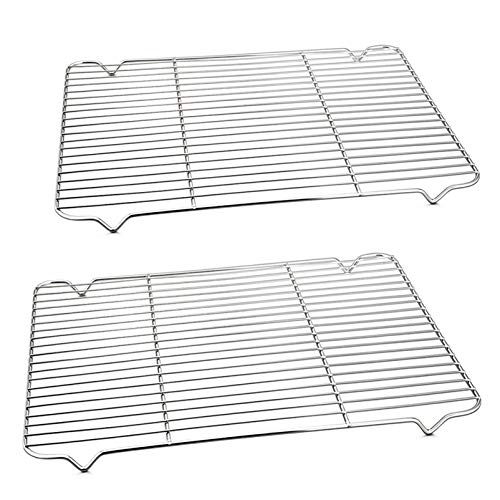
P&P CHEF Cooling Baking Rack 16.6 x 11.5 Inch, 2-Pack — Best Dense-Wire Value
P&P CHEF sells the fundamentals: stainless steel, a dense wire pattern, smooth finished edges, and two racks in the box at a value position in the category. The dense wires are the functional headline — closer spacing supports cookies and smaller baked goods without the sagging and tipping that wide-spaced wires allow, and it makes the rack a better roasting and grilling platform, which the manufacturer explicitly includes among its uses. Smooth edges sound like a footnote until you have handled racks whose cut wire ends snag dish towels and scratch pan coatings; finished edges are the difference between a tool that lives in the daily drawer and one that lives in the back of a cupboard. At 16.6 x 11.5 inches the racks cover the half-sheet class, so they pair with the pans most kitchens already own, and a two-pack at a value price is the natural way to equip a kitchen that bakes in rotation.
Strengths
- Dense wires support small items and double as a roasting platform
- Smooth finished edges — no snagging towels or scratching pans
- Two-pack value in the standard half-sheet size class
Trade-offs
- Wire gauge and frame are everyday-grade rather than heavy-duty
- No grid crosshatch for the most delicate sponge work
- Value positioning means fewer refinements than the premium picks
| Material | Stainless steel |
| Size | 16.6 x 11.5 inches |
| Quantity | 2-pack |
| Design | Dense wires, smooth edges (per manufacturer listing) |
This is the pick we hand to new bakers, gift buyers and anyone equipping a first serious kitchen, because it gets the fundamentals right at a price that leaves budget for the pans and ingredients that matter more. Nothing about it is exotic, and that is the recommendation: cooling racks are infrastructure, and infrastructure should be adequate, standard-sized and cheap enough to own in pairs. Its ceiling is equally clear. Bakers who cool a heavy fruitcake weekly, who want a crosshatch grid for pastry, or who are buying a decade-long heirloom set should step up to the Ultra Cuisine or Checkered Chef picks. But the distance between this rack and those is smaller than the price distance suggests, and for the great middle of home baking — cookies, cakes, roasts, cooling in rotation — the P&P CHEF pair will simply do the work, wash easily, and be forgotten, which is what good infrastructure does.
Best for: new bakers and value buyers equipping a kitchen with standard pans / Not suited for: heavy-duty or pastry specialists who need the premium builds above
Check the current price on Amazon for the P&P CHEF Cooling Baking Rack 16.6 x 11.5 Inch, 2-Pack.
Comparison Table
| Pick | Badge | Key spec | Best for |
|---|---|---|---|
| Ultra Cuisine Cooling and Baking Rack Set, 11.5 x 16.5 Inch | Best Overall | Stainless, 11.5 x 16.5 in, set of 2 | All-round baking and cooling |
| Spring Chef Cooling Rack 10 x 15 Inch, Set of 2 | Best for Jelly Roll Pans | Stainless, 10 x 15 in, set of 2 | Jelly roll pan bakers |
| Checkered Chef Cooling Racks | Best Grid Design | Stainless crosshatch grid | Delicate cakes and pastry |
| HIWARE Collapsible Cooling Rack, 3 Tier | Best Space-Saving | 3-tier collapsible, 12 x 16.5 in | Batch baking in small kitchens |
| Geesta Collapsible Cooling Rack with Adjustable Tiers | Best Adjustable | Adjustable 2–4 tiers, 3 heights | Variable batch sizes |
| P&P CHEF Cooling Baking Rack 16.6 x 11.5 Inch, 2-Pack | Best Dense-Wire Value | Stainless, dense wires, 2-pack | Everyday value |
How to Choose Cake Cooling Racks: Size, Wire and Material
Size comes first, and it is dictated by your pans, not your ambitions. The half sheet (roughly 13 x 18 inches, with racks around 11.5–12 x 16.5–17 inches to sit inside or over it) is the professional standard that home baking has adopted; the jelly roll (10 x 15) is the smaller standard for sheet cakes and Swiss rolls; quarter sheets serve small-batch and toaster-oven baking. A rack should match its pan closely enough to rest in or on it without sliding — that fit is what lets you move a hot cake and its rack as one unit, and park the pan underneath as a drip tray when you glaze. If you own one pan size, buy that size. If you own two, the larger rack usually serves both, parked across the smaller pan’s rim.
Wire pattern comes second. Parallel wires are the classic: strong, easy to clean, fine for sturdy cakes and cookies. Dense wires — the same idea with closer spacing — support smaller and softer items and double better as roasting platforms. A crosshatch grid supports most evenly of all and keeps small items from slipping through, at a small cleaning cost. Material is the easiest decision: stainless steel, full stop. It survives the oven, the dishwasher and the decade; plated and coated racks are on a countdown from their first scratch. Finally, check the feet: a rack must hold the cake high enough for real air movement — a rack that sits nearly flat on the counter is a trivet with ambitions.
Flat, Tiered or Grid: Matching Rack Architecture to Your Baking
Flat racks are the default because most baking is sequential — a cake cools while the next tray bakes — and a flat rack stores anywhere. Own two and rotation covers almost any home workload. Tiered racks exist for the surge: holidays, bake sales, celebration cakes with three layers cooling at once. Their value is measured in counter area saved, and in a small kitchen that can be the difference between a joyful production day and a miserable one. If your baking has a surge season, a collapsible tiered rack earns its storage sliver; if it does not, it is a solution advertising itself to a problem you will never have.
Grid racks are the specialist’s flat rack. The crosshatch costs a little cleaning effort and returns the most even support in the category — the right trade for sponge, chiffon and meringue work, and an unnecessary refinement for chocolate-chip cookies. The mature kitchen often ends with two architectures: flat racks for the weekly rhythm and one tiered rack folded away for December. That combination appears in this guide as separate picks rather than a bundle because households arrive at it at different speeds — but if you recognize your December in this paragraph, you already know which two to buy.
How to Cool a Cake Properly, Step by Step
Cooling is a stage of baking, not an absence of one, and it has a technique. When the cake comes out of the oven, let it rest in its pan on the rack for the time the recipe specifies — usually around ten minutes for layer cakes. This pause lets the crumb firm enough to hold its shape; a cake turned out too early tears, and one left in the pan too long steams its own base and sticks. Then run a thin knife around the edge, invert the cake onto the rack, lift the pan away, and — for layers that will be stacked — invert once more onto a second rack so the cake cools right-side up and the top stays level and unmarred by wire marks.
Leave the cake completely alone until it is fully cool before frosting: warm crumb melts buttercream, tears under a knife and traps steam that sogs the finished cake from inside. A standard layer takes one to two hours; a dense fruitcake longer. Resist the refrigerator shortcut for cakes destined for the counter — chilling firms the crumb in a way that reads as staleness and can sweat under frosting — though a brief chill is a legitimate trick before torting a cake into layers, when firmness helps the knife. Cookies follow the same logic in miniature: a minute or two on the hot pan to set, then onto the rack so the bottoms crisp instead of steaming. The rack is what makes all of this possible; the patience is what makes it work.
Common Buying Mistakes
- Cooling cakes on a plate or board. A solid surface traps steam against the base and guarantees a gummy bottom. Air underneath is the entire point of a rack.
- Buying coated or chrome-plated racks. Coatings chip and plating rusts at every scratch. Stainless steel costs little more and removes the failure mode entirely.
- Guessing the size. A rack that does not match your pans slides, overhangs and stores badly. Measure the pan; buy the rack that fits it.
- Turning a cake out too early — or too late. Too early tears the crumb; too late steams the base in the pan. The recipe’s resting time is an instruction, not a suggestion.
- Frosting a warm cake. Buttercream melts, crumbs tear, and trapped steam sogs the crumb. Fully cool means fully cool — an hour or two, not twenty minutes.
- Using wide-spaced wires for delicate work. Sponges sag and mark between parallel wires. Delicate baking is what dense wires and grids exist for.
Final Recommendation
Most bakers should buy the Ultra Cuisine Set and be done for a decade. Jelly-roll kitchens take the Spring Chef Pair, pastry bakers the Checkered Chef Grid, and batch bakers the HIWARE 3-Tier or the adaptable Geesta. On a budget, the P&P CHEF 2-Pack covers the fundamentals honestly. Round out the cooling shelf with our sibling guides: Best Baking Cooling Racks, Best Cookie Cooling Racks and Best Baking Sheet And Cooling Racks.
Racks Beyond Cake: The Second Life of a Cooling Rack
A good rack refuses to be a single-purpose tool. In the oven it elevates a roast so hot air circulates and drippings fall away, crisps bacon and reheats pizza without a soggy base, and holds vegetables above a pan for roasting. On the counter it rests roasts, drains fried food so it stays crisp, and becomes the landing strip for everything that comes off a grill. Bakers use it as a glazing station — cake on rack, rack over pan, glaze poured once and caught below — and as a drying rack for washed berries and herbs. This second life is the practical argument for stainless, oven-safe construction and for owning a pair: the rack that can go in the oven and under the cake is the rack that never really gets put away. When you evaluate the picks in this guide, price them against that whole workload, not against cake alone, and the durable sets look less like a splurge and more like the cheapest shelf in the kitchen.
Wire Marks and the Finishing Details Nobody Mentions
Every rack leaves some mark on a cake; the craft is in making the marks irrelevant. A cake that will be frosted hides its cooling marks under the crumb coat, which is why most bakers never think about them. A cake that will be served bare — a Victoria sponge dusted with sugar, a flourless chocolate cake under cocoa — shows its base if it is flipped for presentation, and here the double-inversion technique earns its place: cool the cake right-side up after the first flip so the show surface never rests on wires at all. Glazing inverts the problem beautifully, because a cake glazed on the rack wears the rack as a feature — the excess runs off, the base sets clean, and the crosshatch never touches the glossy top. And for the truly delicate — angel food and chiffon, which cool upside down in their pans by design — the rack’s job changes to simply being a stable, level place for the pan to hang. Knowing which surface of your cake is the show surface, before it leaves the oven, is the whole secret; the rack just executes the plan.
A Note on Cost per Year: Why This Category Punishes Cheap
Cooling racks are nearly pure labor and steel, which makes their pricing unusually honest: a very cheap rack is cheap because the wire is thin, the welds are few and the finish is a coating on a countdown. The arithmetic that follows is brutal in its simplicity. A coated rack that rusts at its scratches in year two and is replaced twice in a decade costs more — in money, in landfill and in one ruined bake along the way — than the stainless set bought once. This is why this guide’s value pick is a stainless two-pack rather than the absolute cheapest rack we could verify, and why the premium picks are framed as decade purchases rather than indulgences. Few kitchen categories reward buying once and buying right as reliably as this one; the rack has no motor to fail, no electronics to obsolesce, nothing to date it except the quality of its welds. Buy the welds.
Care and Feeding: Keeping Stainless Racks True for Years
Stainless racks ask for almost nothing, which is precisely why they outlive their owners’ other tools. Wash them hot and soapy or in the dishwasher; stuck glaze and caramel dissolve in a soak rather than yielding to violence. The two habits worth keeping are drying and honesty about heat. Drying matters at the joints — the welded crossings where water sits longest — because even stainless appreciates not being stored wet in a closed drawer. Honesty about heat matters because “oven-safe” describes the rack, not the plastic feet or silicone coatings some designs add; every pick in this guide is full stainless construction, but check any rack’s feet before it goes under a broiler. Store racks flat or nested with their pans so wires are not bent by drawer chaos, and if a wire ever does bend, straighten it promptly — a rack that cools a cake unevenly teaches the cake to lean. That is the entire maintenance manual. Tools this simple reward the people who choose them well exactly once.
Frequently Asked Questions
How long should a cake cool on a rack before frosting?
Until it is completely cool to the touch — typically one to two hours for a standard layer cake. Frosting a warm cake melts buttercream, tears crumbs into the icing and traps steam that makes the crumb gummy. The resting time in the pan first (usually about ten minutes) is part of the same process, not a shortcut around it.
Can I put a cooling rack in the oven?
Yes, if it is stainless steel — every pick in this guide is, and each manufacturer lists its racks as oven-safe. That is what lets the same rack crisp bacon, elevate a roast and reheat pizza. Avoid putting racks with plastic feet or nonstick coatings under high heat, and check the listing for the specific model.
What size cooling rack do I need?
The size of your pans. Half-sheet bakers want racks around 11.5–12 x 16.5–17 inches; jelly roll pans (10 x 15) want their own matched racks; quarter sheets have their size too. A rack that fits its pan can rest in it, move with it and catch drips under it — a mismatched rack does none of those things well.
Are tiered cooling racks stable?
Yes, when loaded sensibly: heaviest items on the bottom tier, stack placed on a level counter, and tall items given a tier with clearance. Collapsible tiered racks like the HIWARE and Geesta in this guide are built for batch baking loads. Treat a full stack like a full cake — carry it with two hands and respect it — and it will behave.
Why not just cool cakes on the counter or a plate?
Because the bottom of the cake is where the steam is. On a solid surface that steam condenses against the crumb and produces the gummy, dense layer bakers call a soggy bottom. A rack lifts the cake so air carries the moisture away, and the crumb sets evenly on all sides. It is the cheapest quality improvement in all of baking.
How many cooling racks should a home baker own?
Two flat racks in your main pan size cover nearly everything: one for the cake that just came out, one for the batch behind it, and the pair for the double inversion that keeps a layer cake’s top pristine. Add a tiered rack only when batch days regularly overwhelm that pair — most bakers know within one holiday season whether they need the third dimension.
How do I stop a cake from sticking to the rack?
Most sticking is really tearing — the cake was turned out too early or too late. Follow the recipe’s in-pan rest, and for delicate cakes invert onto a rack lined with a clean tea towel or a sheet of parchment. A grid or dense-wire rack also helps, because the cake’s weight is spread across far more contact points.
