Disclosure: airfryerkitchensupply.com is reader-supported. When you buy through links on our site, we may earn an affiliate commission at no extra cost to you.
Where to buy
The best 12 volt noise filter picks below were each verified against Amazon’s own catalog data before inclusion, so every linked model is a real, currently listed unit. Noise filters are small, inexpensive, and brutally specific: the right one depends on whether your noise rides in on the power line or through a signal ground loop, and on how much current the device it protects actually draws. Use the links in this box, in the Quick Picks, in each review, and in the comparison table to check live availability.
- Install Bay IBNF50 Noise Filter — Check the current price on Amazon
- Install Bay IBNF10 Noise Filter — Check the current price on Amazon
- Install Bay IBNF40 Noise Filter — Check the current price on Amazon
- EKYLIN Car Power Filter — Check the current price on Amazon
- BESIGN Ground Loop Noise Isolator — Check the current price on Amazon
- Universal 70 Amp Audio CB Noise Filter — Check the current price on Amazon
Choosing the best 12 volt noise filter starts with a diagnosis, not a product: the whine, buzz, or ticking in your speakers is a symptom, and it arrives by one of two roads. Most commonly it rides the power line — alternator ripple and ignition noise travelling up the same 12-volt feed that powers your head unit or amplifier, rising and falling with engine revs. The second road is the signal path, where a ground loop between components at different ground potentials hums through the audio cable itself. A power-line filter cannot fix a ground loop, and a ground-loop isolator cannot clean a dirty power feed, which is why this guide carries both types and tells you how to tell them apart.
Once the road is identified, the power-line half of the category reduces to one specification that actually matters: current rating. A noise filter sits in series with the power feed, so every amp the device draws passes through it. Fit a 10-amp filter to a 10-amp head unit and life is good; fit it to a hungry amplifier and you have built a bottleneck that starves the amp and cooks the filter. The verified picks below span 10, 40, 50 and 70 amps for exactly that reason, plus one budget in-line filter and one signal-side isolator for the other road.
One more piece of honesty before the picks, because this category attracts magical thinking: a noise filter suppresses noise that enters through the wire it is fitted to. It does not repair a corroded ground, a failing alternator diode, or an amplifier gain structure set so high it amplifies the vehicle’s electrical weather. The buying-guide sections below include the checks worth doing first — several of them free — so that the filter you buy is solving the problem you actually have.
Every pick was confirmed in Amazon’s catalog data as a genuine 12-volt noise product, with its current rating or signal role taken from its own listing title. Where a listing is terse — several of these are trade parts with trade-style listings — the review says only what the listing supports and leans on correct application rather than invented features.
In this guide
Quick Picks
Six verified filters covering both noise roads — power-line units rated from 10 to 70 amps, and a signal-side ground-loop isolator:
- Install Bay IBNF50 Noise Filter — Best Overall: The 50-amp Install Bay unit is the safest default for power-line noise: enough current capacity for a head unit plus a modest amplifier on one feed, from a brand that supplies the car-audio trade. Check the current price on Amazon.
- Install Bay IBNF10 Noise Filter — Best for Head Units: The correctly sized filter for the most common case of all: whine entering through a head unit’s own power feed, where the draw is small and a compact 10-amp filter is the tidy, sufficient cure. Check the current price on Amazon.
- Install Bay IBNF40 Noise Filter — Best for a Single Amplifier: A 40-amp in-line suppressor aimed squarely at amplifier feeds — the middle rating for the single-amp systems that make up most real installations. Check the current price on Amazon.
- EKYLIN Car Power Filter — Best Budget: The budget in-line filter whose listing names the whole audio chain — stereo, amplifier, equalizer, subwoofer — a low-cost first attempt for mild power-line noise in modest systems. Check the current price on Amazon.
- BESIGN Ground Loop Noise Isolator — Best for Signal-Path Hum: The other road’s cure: a 3.5mm in-line isolator that breaks the ground loop humming through an aux connection — the fix when the noise appears only with a phone or aux source plugged in. Check the current price on Amazon.
- Universal 70 Amp Audio CB Noise Filter — Best High-Current: The heavy end of the range: a 70-amp suppressor for high-draw audio systems and CB radio installs, where smaller filters would be the bottleneck in the feed. Check the current price on Amazon.
How These Picks Were Chosen
Every candidate was verified through the Creators API on this site’s own Amazon integration: searched by product type, the returned listing title matched against the part, and the ASIN accepted only on a confident match. Current ratings and applications in this guide come from those listing titles and nothing else — where a listing gives no rating (the EKYLIN budget filter), the review says so and restricts the recommendation accordingly rather than guessing a number.
The set was then balanced deliberately across the two noise roads and the current range: 10, 40, 50 and 70-amp power-line filters, one unrated budget power filter for mild cases, and one signal-side isolator. A guide that listed six power filters would fail every reader whose problem is a ground loop, and a guide that listed six isolators would fail everyone else — the mix is the methodology.
- Correct road first: power-line filtering and signal-path isolation are different cures; the guide covers both and teaches the free test that separates them.
- Verified current rating: for power filters, the amp rating is the specification that decides safe application, and it had to appear in the listing.
- Trade credibility: installer-channel brands (Install Bay) anchor the range, because noise suppression is a solved trade problem with standard parts.
- Honest scope: each pick’s badge states the case it wins, and each review states the cases it cannot fix.
- No miracle claims: no filter here is presented as a cure for bad grounds, failing alternators, or gain staging errors.
The 6 Best 12 Volt Noise Filters

Install Bay IBNF50 Noise Filter — Best Overall
Install Bay parts live in installers’ bins rather than on retail pedestals, and the IBNF50’s listing is correspondingly plain: a 50-amp noise filter for 12-volt car audio. That plainness is the point. At 50 amps it covers the realistic centre of the market — a head unit and a moderate amplifier sharing a feed, or a single substantial amp — without the owner needing to calculate draw to the last amp, and it comes from the trade channel that professionals reorder when a fix has to work the first time.
Strengths
- 50A rating covers head units and most single-amplifier systems without current anxiety
- Trade-brand part fitted by installers as a standard cure for power-line whine
- Simple in-line installation on the power feed of the noisy component
Trade-offs
- Trade-style listing and packaging — minimal instructions for a first-timer
- Fixes power-line noise only; a signal ground loop needs the isolator pick instead
- Very high-draw multi-amp systems should step up to the 70-amp pick or filter per component
| Current rating | 50 amps (per API listing) |
| Application | 12V car audio power-line filtering (per API listing) |
Why does the biggest sensible rating win Best Overall in a category where smaller is cheaper? Because the failure mode of an undersized filter is worse than the cost of an oversized one. An oversized filter simply filters; an undersized one adds resistance under load, drops voltage at musical peaks, and can overheat. Most owners do not know their amplifier’s true peak draw, and the 50-amp unit forgives that ignorance across the widest range of real systems.
Fitting is a series connection on the power wire of the component that whines — most often the head unit or the amplifier — with the filter’s ground lead to a clean chassis point. Keep the filter’s leads short and its ground honest; a filter grounded through a rusty screw is a decoration. If the whine survives a correctly fitted IBNF50, the diagnosis moves: the noise is either entering through the signal path (see the BESIGN pick) or being generated by a fault no filter should be asked to hide.
It is also the pick to hand a friend. Of everything in this guide, the IBNF50 is the unit most likely to be the right answer to ‘my stereo whines with the revs’ without a follow-up conversation about amplifier wattage — and in a category this cheap, being the default right answer is worth more than any single feature.
Best for: power-line alternator whine in head-unit and single-amplifier systems / Not suited for: signal-path ground-loop hum, or very high-current multi-amp competition systems
Check the current price on Amazon

Install Bay IBNF10 Noise Filter — Best for Head Units
A great many whining stereos have no amplifier at all — just a head unit whose power feed carries alternator ripple straight into its audio stages. The IBNF10 exists for exactly that job: its listing states a 10-amp noise filter for 12-volt car audio products, which comfortably covers a head unit’s draw while staying small enough to tuck behind the dash where the work is happening.
Strengths
- Correctly sized for head units — the most common single source of power-line whine
- Compact enough to live behind the dashboard at the point of installation
- Same trade lineage as the 50-amp pick, at the budget end of the range
Trade-offs
- 10 amps is a hard ceiling — never put this on an amplifier feed
- No help for signal-path ground loops
- Minimal listing detail, like its siblings; installation knowledge is assumed
| Current rating | 10 amps (per API listing) |
| Application | 12V car audio products (per API listing) |
Sizing a filter to the component rather than the system is the professional habit this pick rewards. A head unit draws a handful of amps; filtering its feed with a compact unit placed inches from the radio attacks the noise where it enters, keeps leads short, and avoids disturbing the amplifier wiring entirely. Owners are often surprised that the whine came through the radio’s feed rather than the amp’s — the amp merely amplifies what the head unit hands it, noise included.
The diagnostic that points here: whine present at all volumes, tracking engine revs, through every source the head unit offers. If the noise instead appears only on one input — an aux lead or a phone connection — suspect the signal path and read the BESIGN review before spending on power filtering at all.
Respect the ceiling. Ten amps is generous for a radio and meaningless for an amplifier, and the filter will not warn you politely if misapplied — it will simply run hot and underperform. The IBNF10’s badge is deliberately narrow, and narrow is honest.
Best for: alternator whine entering through a head unit’s power feed / Not suited for: amplifier feeds, high-draw accessories, or signal-path hum
Check the current price on Amazon

Install Bay IBNF40 Noise Filter — Best for a Single Amplifier
The IBNF40’s listing calls it a 40-amp, 12-volt hum filter and engine-noise suppressor, and that is the amplifier-feed job in one line. A single four-channel or modest mono amplifier typically draws well within 40 amps in real musical use, and filtering at the amp’s own feed cleans the power for the component with the most gain in the system — the one that turns millivolts of ripple into audible whine.
Strengths
- 40A rating matches single-amplifier systems without oversizing
- Listed explicitly as an engine-noise suppressor and hum filter
- Lets you filter the amplifier feed independently of the head unit
Trade-offs
- Big multi-amp systems exceed its sensible range; step to 50 or 70 amps
- As with all power filters, it cannot cure a ground loop in the signal cables
- Listing is a trade one-liner; no hand-holding for beginners
| Current rating | 40 amps (per API listing) |
| Application | 12V hum filter / engine noise suppressor (per API listing) |
Filtering the amplifier feed separately is often the winning move in a two-component system, because it isolates the diagnosis: if the whine dies with the IBNF40 fitted, the power road was guilty and the case is closed; if it persists, you have learned — cheaply — that the noise is travelling the signal cables, and the isolator or a grounding correction is next. Troubleshooting by elimination only works when each step changes one variable, and a per-component filter is a clean single variable.
Placement matters more than owners expect. Fit the filter close to the amplifier, on a short, sound ground, rather than at the battery end of a long power run — noise picked up along the run after the filter is noise the filter never saw. The same logic, reversed, explains the IBNF10’s dash-side placement for head units: filter late, filter close.
Between this and the 50-amp pick, the honest difference is headroom philosophy. Owners who know their amplifier’s draw and it sits comfortably under 40 amps can buy the exact tool; owners who do not know, or who may upgrade the amp later, should take the IBNF50’s margin instead.
Best for: whine entering through a single amplifier’s power feed / Not suited for: multi-amplifier high-current systems, or head-unit-only noise
Check the current price on Amazon
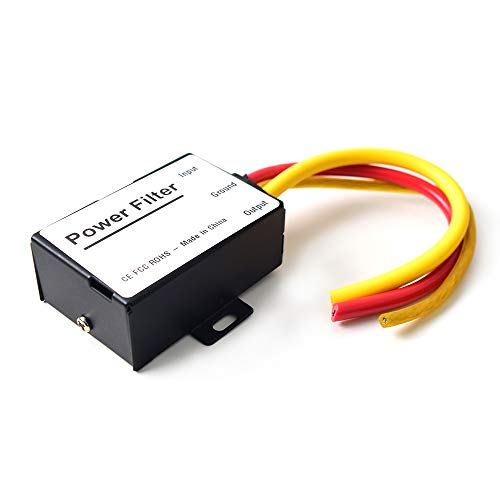
EKYLIN Car Power Filter — Best Budget
The EKYLIN filter is the inexpensive, widely bought answer to mild whine, and its listing positions it as an EMI noise suppressor for car stereo, amplifier, speaker, equalizer and subwoofer systems on 12 volts. For a simple setup — a head unit, perhaps a powered subwoofer — with noise that is annoying rather than deafening, it is the rational first try: fit it on the feed of the component that whines, and a good share of mild cases simply end there.
Strengths
- Budget tier makes it a low-risk first diagnostic step as well as a cure
- Listing covers the full audio chain, including powered subwoofers and equalizers
- Simple in-line fitting on the component’s power feed
Trade-offs
- Listing states no current rating — keep it to modest-draw components, not big amplifiers
- Budget construction; heavy-draw or high-heat engine-bay use is beyond its brief
- Like every power filter, useless against a true signal ground loop
| Application | 12V car stereo, amplifier, equalizer, subwoofer EMI noise suppression (per API listing) |
| Current rating | Not stated in listing — apply to modest draws only |
The missing current rating is this pick’s defining caveat, and the review will not paper over it: a filter of unknown rating belongs on a head unit or a small powered accessory, never in series with a serious amplifier. Used within that discipline, it is a sensible product; used outside it, it becomes the bottleneck described in the buying guide. Owners unsure of their draw should default to the rated Install Bay units — the rating is printed, and that certainty is worth the small premium.
Where the EKYLIN genuinely earns its badge is the economics of diagnosis. Noise chasing can consume weekends; an inexpensive filter fitted in twenty minutes either cures the whine or eliminates the power road as a suspect, and both outcomes are progress. Think of it as the first test in the sequence the how-to section lays out, with the rated filters as the heavier artillery if the noise is stubborn.
It also suits the second-car and work-truck cases: systems that need to be quiet enough, not perfect, in vehicles whose audio budget is rightly small. Not every install is a showpiece, and a category guide that only respects expensive answers would fail most real owners.
Best for: mild power-line noise in modest systems, and budget-first diagnosis / Not suited for: high-draw amplifiers, or any feed whose current you cannot keep modest
Check the current price on Amazon

BESIGN Ground Loop Noise Isolator — Best for Signal-Path Hum
Every other pick in this guide filters power; the BESIGN filters the signal, and its listing says so plainly: a ground-loop noise isolator for car audio and home stereo, working with 3.5mm connections. The classic symptom it cures is specific — a buzz or whine that appears when a phone or player is connected by aux cable (and often worsens when that device is also charging from the car), because the device and the head unit sit at slightly different ground potentials and the audio cable becomes the bridge the difference hums across.
Strengths
- Treats the actual cause of aux-input hum instead of masking it
- Plug-in 3.5mm fitting takes seconds and needs no wiring
- Works in home stereo systems as well as the car
Trade-offs
- Only helps noise travelling the 3.5mm signal path — useless for power-line whine
- Adds a component and cable bulk at the aux connection
- Systems using RCA interconnects need the equivalent RCA-style isolator instead
| Connection | 3.5mm audio (per API listing) |
| Application | Ground loop buzz/hum in car audio and home stereo (per API listing) |
The tell-tale test costs nothing: if the hum changes or vanishes when the phone is unplugged from its charger, or appears only on the aux source while radio and Bluetooth stay clean, the loop is in the signal path and no power filter in this guide — at any amperage — will touch it. Owners routinely buy two power filters chasing this fault; the isolator ends it in one step because it electrically separates the grounds while passing the audio.
There is a small purist debate about whether isolators can subtly affect sound quality, and the honest summary is that any effect is minor next to a buzz that ruins every quiet passage. For a problem input, the isolator is not a compromise; it is the standard professional remedy, used in studios and installs alike.
Note the boundary of the badge: this pick assumes a 3.5mm aux connection. Amplifier systems humming through RCA interconnects have the same disease in a different connector, and need an RCA-format isolator or a grounding correction at the amp. The diagnosis transfers exactly; only the fitting changes.
Best for: buzz or whine that appears on a 3.5mm aux input, especially while the source charges / Not suited for: power-line alternator whine through all sources, or RCA-based amplifier systems
Check the current price on Amazon

Universal 70 Amp Audio CB Noise Filter — Best High-Current
Some systems simply outgrow the middle ratings: multiple amplifiers, a high-power CB or ham installation, or a work vehicle running audio plus radios from one heavy feed. The 70-amp universal filter’s listing names car audio and CB suppression at 70 amps, which is the headroom those installs need — the filter stops being a restriction and goes back to being only a filter.
Strengths
- 70A capacity serves multi-amp systems and radio installs smaller filters cannot
- Listing covers CB radio suppression as well as car audio
- Universal format suits custom and work-vehicle wiring
Trade-offs
- Oversized and unnecessary for ordinary head-unit or single-amp systems
- Generic trade listing — verify lead configuration suits your install before ordering
- High current capacity does not make it any more able to fix a signal ground loop
| Current rating | 70 amps (per API listing) |
| Application | Car audio and CB noise suppression (per API listing) |
The CB and radio angle is more than a footnote. Transceivers are exquisitely sensitive to power-line noise — a feed that merely annoys a stereo can make a CB receiver unusable — and radio installs in trucks and off-road vehicles are exactly where high sustained current and noisy alternators coexist. A 70-amp suppressor on the radio’s feed is standard practice in that world, and this pick imports it into the car-audio context where big systems need the same headroom.
For ordinary systems this is deliberately not the recommendation, and the guide’s honesty cuts both ways: capacity you never use buys nothing but size and cost. The IBNF50 covers the realistic top of most audio builds. The 70-amp unit is for owners who did the draw calculation — or know their system’s appetite from its fuse ratings — and found the middle of the range wanting.
Installation discipline scales with current: at these draws, connections must be genuinely solid, leads appropriately gauged, and the filter mounted away from heat. A high-current filter installed casually is a resistance looking for a place to get hot; installed properly, it disappears from the system entirely, which is the goal.
Best for: multi-amplifier systems and CB/radio installs with high current draw / Not suited for: ordinary head-unit or single-amplifier systems, where it is pure excess
Check the current price on Amazon
Comparison Table
| Pick | Badge | Key spec | Best for |
|---|---|---|---|
| Install Bay IBNF50 Noise Filter | Best Overall | 50 amp power-line noise filter, 12V car audio | power-line alternator whine in head-unit and single-amplifier systems |
| Install Bay IBNF10 Noise Filter | Best for Head Units | 10 amp power-line noise filter, 12V car audio | alternator whine entering through a head unit’s power feed |
| Install Bay IBNF40 Noise Filter | Best for a Single Amplifier | 40 amp power-line hum/noise suppressor, 12V | whine entering through a single amplifier’s power feed |
| EKYLIN Car Power Filter | Best Budget | 12V EMI noise suppressor for stereo/amplifier/speaker systems | mild power-line noise in modest systems, and budget-first diagnosis |
| BESIGN Ground Loop Noise Isolator | Best for Signal-Path Hum | 3.5mm signal-side ground loop isolator, car and home audio | buzz or whine that appears on a 3.5mm aux input, especially while the source charges |
| Universal 70 Amp Audio CB Noise Filter | Best High-Current | 70 amp noise filter suppressor, car audio and CB | multi-amplifier systems and CB/radio installs with high current draw |
Read the Key spec column as an application limit, not a performance score: a filter must pass at least the current its component draws, and beyond that threshold more amps buy headroom, not quieter audio. The one unrated pick is flagged as such — restrict it to modest draws. And remember the table’s silent column: five of these six filter power, one filters signal, and choosing the wrong road wastes the money however good the part is. When in doubt, diagnose again before ordering.
How to Choose the Best 12 Volt Noise Filter: Diagnose Before You Buy
Run the free tests first. Noise that rises and falls with engine revs, present on every source, is alternator or ignition noise on the power line — the power filters’ territory. Noise that appears on one input only, especially a 3.5mm aux connection, and changes when the source device is unplugged from its charger, is a ground loop — the isolator’s territory. Noise that persists with the engine off is neither, and points at the components themselves. Three minutes of listening, structured this way, decides which half of this guide applies to you.
Then do the free repairs. Clean and tighten the head unit’s and amplifier’s ground connections — a surprising share of ‘filter problems’ are a corroded ground screw asking for a wire brush. Confirm the amplifier’s ground is short, stout, and on bare metal. Check that signal cables do not run bundled along power cables for the length of the car; separating them by a few inches costs nothing and sometimes ends the case before any purchase.
Only then size the filter. Add up the draw of the component whose feed you will filter — the fuse rating on the component is a fair guide — and choose a filter rated at or above it: the IBNF10 class for head units, IBNF40 for a single amplifier, IBNF50 for combined or uncertain cases, the 70-amp unit for multi-amp and radio installs. When the draw is genuinely unknown and the component is small, the budget EKYLIN is a reasonable experiment; when the component is an amplifier, buy a rated filter and skip the experiment.
- Match the cure to the road: power-line whine → power filter; single-input hum → ground-loop isolator.
- Filter as close to the noisy component as wiring allows, on the shortest, cleanest ground available.
- Never exceed the filter’s amp rating with the component’s draw — the filter is in series with the feed.
- Fix grounds before filtering; a filter over a bad ground is a bandage on a fracture.
- Change one variable at a time when troubleshooting, so the cure tells you what the disease was.
Alternator Whine, Explained Without the Mysticism
An alternator does not produce perfectly smooth direct current; it produces DC with a ripple riding on it, and that ripple’s frequency tracks engine speed — which is why power-line noise whines up and down with revs. Ignition systems add their own pulsed interference. In a perfect installation the vehicle’s wiring, the component’s internal filtering, and solid grounds keep all of this out of the audio. In real installations — ageing grounds, long power runs, components of mixed quality — some of it leaks in, and an in-line filter’s job is to scrub the feed at the component’s door.
This also explains the limits. If the alternator itself is failing — a bad diode can pour excessive ripple into the whole electrical system — the correct repair is the alternator, and a filter is at best a temporary mask. Similarly, a whine that appeared suddenly after years of quiet service is a changed-condition symptom: something corroded, loosened, or began failing. Filter the noise if you must drive with it, but read the symptom as the vehicle telling you something, because it is.
Ground Loops: The Other Road, and Why It Hums
A ground loop forms when two connected components reference ground at points with slightly different electrical potentials. The interconnecting audio cable then carries not just the music but a small current equalising that difference — and because the vehicle’s electrical noise rides on it, you hear a hum or buzz layered under the programme. It is not a defect in either component; it is geometry plus electricity, which is why it so often appears when a phone (grounded through its charger to the car) meets a head unit (grounded to the dash).
The isolator’s fix is elegant: it passes the audio signal while breaking the DC ground connection between the two sides, so the equalising current has no path and the hum has no carrier. That is why the BESIGN pick works instantly or not at all — the loop is either in that cable or it is not. Where the loop runs through RCA interconnects to an amplifier, the same principle applies with an RCA-format isolator, or by correcting the grounding so both components share one honest reference point.
Gain Staging and Cable Dressing: The Noise You Invite Yourself
Some noise is not the vehicle’s fault at all — it is the system turned up against itself. An amplifier’s gain control is not a volume knob; it sets how much the amp magnifies everything at its input, including the noise floor of the head unit and cables. Gains set by ear to ‘as loud as possible’ routinely sit far too high, and the resulting hiss and whine get blamed on the power supply. Setting gains properly — head unit strong, amplifier gain only as high as needed — lowers the noise floor of the whole system before any filter is considered, and it is free.
Cable dressing is the other self-inflicted wound. Signal interconnects and power cables that leave the dash together and run side by side to the boot are an invitation: the power cable’s fluctuations couple into the signal cable along the whole run. The professional habit is separation — power down one side of the vehicle, signal down the other, crossing at right angles where they must meet. Owners chasing noise in an existing install should check this before buying anything; a rerouted cable has cured more ‘alternator whine’ than any filter ever sold.
None of this makes filters pointless — it makes them correctly placed in the sequence. Grounds first, gains and cables second, diagnosis third, and the right filter fourth. Followed in that order, the filter is usually the last and smallest step. Followed in reverse, owners buy three filters to compensate for a ground screw that needed a wire brush.
How to Install a 12 Volt Noise Filter (and Test the Result Properly)
Installation is simple wiring, but the testing discipline around it is what separates a fix from a coincidence. Work through the steps in order, and change nothing else at the same time.
- Diagnose first: note whether the noise tracks engine revs and whether it appears on all sources or one input. Write it down — after the install, this note is your evidence.
- Disconnect the vehicle’s battery negative terminal before cutting into any power feed. These are small wires, but they are live wires.
- Choose the feed to filter: the power wire of the component identified in diagnosis (head unit or amplifier), as close to that component as practical.
- Cut the feed and connect the filter in series per its markings — input from the vehicle side, output to the component — using crimped or soldered joints insulated with heat-shrink, never twisted-and-taped joints.
- Connect the filter’s ground lead to a clean, bare-metal chassis point with a tight fastener; scrape paint from the contact patch if the point is painted.
- For a ground-loop isolator instead: simply plug it in line with the 3.5mm aux cable between the source device and the head unit. No wiring, no battery disconnection needed.
- Reconnect the battery, start the engine, and test at the same volume and source settings as your diagnosis note — rev the engine gently through the range where the noise was worst.
- If noise remains, do not stack a second filter on top. Re-run the diagnosis: the remaining noise is on the other road, or it is a fault (ground, alternator, component) that needs repair rather than filtering.
A word on expectations: a correct filter on the correct road typically removes the targeted noise entirely or reduces it to inaudibility at listening levels. A partial improvement usually means two noise paths were present — uncommon but real in older vehicles with several ageing grounds — and the correct response is to treat the second path on its own terms, not to buy a bigger version of the first filter.
Common Buying Mistakes
Buying a power filter for a ground loop (or the reverse). The two noise roads need different cures, and the free tests in the buying guide separate them in minutes. Guessing wastes the purchase; diagnosing spends nothing.
Undersizing the filter for an amplifier feed. A filter in series with a feed must pass the component’s full draw. A 10-amp filter on a serious amplifier is a bottleneck and a heat source, not a bargain.
Filtering over a corroded ground. Bad grounds cause a large share of noise complaints. Clean, tight, bare-metal grounds are free — do them before spending, and ground the filter itself just as carefully.
Masking a failing alternator. Sudden new whine in an older vehicle can be a dying alternator diode flooding the system with ripple. A filter may quiet the stereo while the alternator finishes failing — diagnose the change, don’t just mute it.
Stacking filters when the first one ‘didn’t work’. A correctly chosen filter on the correct road works. If it didn’t, the diagnosis was wrong — stacking a second unit doubles down on the error instead of correcting it.
Running signal and power cables together. Interconnects bundled along power runs pick up noise by proximity. Rerouting cables a few inches apart is free and sometimes curative; no filter compensates for careless cable dressing.
Final Recommendation
For the majority of readers — rev-tracking whine through a typical system — the Install Bay IBNF50 is the buy: rated generously, trade-proven, and forgiving of uncertain amplifier draws. Narrow the case and the guide narrows with it: the IBNF10 for a head unit’s feed, the IBNF40 for one amplifier, the 70-amp universal unit for multi-amp and CB installs, and the EKYLIN when the system and the noise are both modest. If your noise lives on an aux input, skip every power filter here and take the BESIGN isolator — it is the only pick that treats that disease.
Noise problems sit inside the wider 12-volt electrical picture, and the neighbouring guides in this program cover the rest of it: Best 12 Volt Marine Battery, Best 12 Volt Multipurpose Battery Chargers, Best 12 Volt Meter, and Best 12 Volt Meter For Marine Battery. Clean power starts with a healthy battery and charging system; a filter is the finishing touch, not the foundation.
Frequently Asked Questions
Will a noise filter fix alternator whine?
If the whine enters through the power feed of the head unit or amplifier — the common case, identified by noise that tracks engine revs on all sources — yes, a correctly rated power-line filter fitted close to that component is the standard cure. If the whine enters through a signal cable ground loop, or the alternator itself is failing, a power filter will not fix it; the guide’s diagnosis section separates the cases.
What amp rating do I need?
At least the current draw of the component whose feed you are filtering — its fuse rating is a good guide. Head units sit comfortably within a 10-amp filter; a single amplifier typically suits 40–50 amps; multi-amplifier systems and radio installs may need the 70-amp class. Oversizing a filter is harmless; undersizing creates a bottleneck and heat.
Where in the wiring does the filter go?
In series with the power feed of the noisy component, as close to that component as practical, with its ground lead on a clean bare-metal point. Filtering at the battery end of a long run leaves the run itself free to pick up noise after the filter — placement is part of the cure.
My noise only happens when my phone is plugged into the aux input. Which pick?
That symptom is a ground loop in the signal path, not power-line noise — especially if it worsens while the phone charges from the car. The BESIGN 3.5mm ground-loop isolator in this guide is the specific cure. No power filter, at any rating, addresses that path.
Can a noise filter damage my stereo or amplifier?
A correctly rated filter, wired in series with sound connections and a solid ground, is a passive, safe component. The risks come from misapplication: an undersized filter on a high-draw feed can overheat and drop voltage, and sloppy joints can introduce the very noise you are chasing. Match the rating, make clean connections, and the filter is electrically invisible except for the quiet.
The whine started suddenly after years of quiet. Should I just fit a filter?
Fit one if you need the noise gone today, but treat the change itself as a symptom worth diagnosing: a corroding ground, a loosening connection, or an alternator diode beginning to fail are the usual causes, and two of the three get worse. A filter can mask the sound while the cause progresses — check the grounds and charging system as well.
Do I need one filter per component?
Only for the components whose feeds carry the noise. Often one filter on the head unit’s feed quiets the whole system, because the amplifier was only amplifying noise the radio handed it. Filter per component when diagnosis points at that component’s feed — the amplifier-feed pick in this guide exists for exactly that case — rather than filtering everything on principle.


