Disclosure: airfryerkitchensupply.com is reader-supported. When you buy through links on our site, we may earn an affiliate commission at no extra cost to you.
Where to buy
Every fridge below is a compressor model confirmed against a live Amazon listing at review time. Check price on Amazon before ordering, and measure your intended locker or berth space against the listing’s dimensions twice — on a sailboat, a fridge that is 10mm too tall for its locker is not a fridge, it is an expensive ornament. Allow ventilation clearance around the compressor vents in your measurements, not just the box size.
- Dometic CFX2 28L Electric Cooler — check price on Amazon
- Dometic CFX2 37L Electric Cooler — check price on Amazon
- ICECO GO20 Dual Zone 12V Refrigerator (21 Quart) — check price on Amazon
- Alpicool C20 Portable Fridge Freezer (21 Quart) — check price on Amazon
- BougeRV 12V Refrigerator (23 Quart) — check price on Amazon
- Setpower 12V Refrigerator 48QT Dual Zone — check price on Amazon
A sailboat is the hardest home a 12 volt fridge will ever have. Power comes from a battery bank that also runs your lights, instruments and bilge pumps, so every amp-hour the fridge drinks is an amp-hour of anchoring you spend. The boat heels, so the fridge must keep cooling at angles that would defeat an absorption unit. Space is measured in millimetres, ventilation is whatever the locker allows, and the nearest repair shop is measured in sea miles. The best 12 volt mini fridge sailboat crews can rely on is the one designed, knowingly or not, for exactly those terms.
The good news is that modern compressor portables are closer to sailboat-ready than any previous generation. Every pick in this guide is a true compressor fridge-freezer running on 12/24V DC, with multi-level battery protection that cuts the fridge off before it can flatten the bank, and cooling that ignores heel angles because a compressor does not care which way is up within any sane sailing range. The differences that remain are the ones this guide is organised around: efficiency, capacity per locker litre, single versus dual zones, and how gracefully each box lives in a small boat.
Dometic’s CFX line leads the list on marine pedigree — the brand’s heritage is boat refrigeration — in two sizes. ICECO’s GO20 brings a SECOP compressor and dual zones to small cabins. Alpicool’s C20 proves how little money a competent boat fridge can cost. BougeRV’s 23 Quart suits the smallest cabins, and Setpower’s 48QT dual-zone serves boats that provision for weeks. All six were verified against their Amazon listings; the amp-hour arithmetic in the buying guide is the part to read twice, because on a sailboat the fridge you choose is an energy decision disguised as an appliance.
In this guide
Quick Picks
Dometic CFX2 28L for most sailboats, the 37L if the locker allows, ICECO GO20 for two temperatures in a small cabin, Alpicool C20 on a budget, Setpower 48QT for long-passage provisioning.
- Best Overall: Dometic CFX2 28L Electric Cooler — 28 litres of Dometic marine-grade refrigeration with 3-stage battery protection and app control — the sailboat default.
- Best Capacity (Premium): Dometic CFX2 37L Electric Cooler — the CFX2 formula at 37 litres — 48 cans’ worth — for bigger crews and longer legs between shops.
- Best Dual Zone for Small Boats: ICECO GO20 Dual Zone 12V Refrigerator (21 Quart) — two independently controlled zones and a SECOP compressor in 21 quarts — frozen goods and cold drinks, one small box.
- Best Budget: Alpicool C20 Portable Fridge Freezer (21 Quart) — 21 quarts of honest compressor refrigeration at a budget tier — the fridge that gets small boats cold without a marine price tag.
- Best for Small Cabins: BougeRV 12V Refrigerator (23 Quart) — fast pull-down to fridge temperature and a -8°F floor in a tidy 23-quart box that suits the smallest cabins.
- Best for Long Passages: Setpower 12V Refrigerator 48QT Dual Zone — 48 quarts in two independently controlled zones, -4°F to 68°F, with a 3-year warranty — provisioning for weeks, not weekends.
How These Picks Were Chosen
Every pick was verified against its manufacturer’s Amazon listing through the Creators API before earning a link, and capacities and temperature ranges in the spec boxes are the verified listing figures. Thermoelectric coolers were excluded without discussion: their cooling collapses in a hot cabin and they cannot freeze, which disqualifies them from serious boat duty regardless of price. Absorption fridges were likewise out of scope for this keyword — they demand level operation a heeling sailboat cannot promise.
Marine criteria governed the ranking. Battery protection had to be multi-level and selectable, because the fridge must never be the reason a bilge pump stops. Efficiency — the quality of the compressor and insulation — outweighed raw capacity, since a sailboat’s constraint is amp-hours, not litres. We favoured shapes that suit lockers and quarter berths, lids that open within the space boats actually have, and construction that tolerates a damp, salty atmosphere without complaint.
We also mixed tiers honestly. A weekend racer-cruiser and a liveaboard on passage need different fridges, and pretending one premium box serves both would waste the first owner’s money and the second owner’s provisions. The verdicts assign each pick its boat plainly.
The 6 Best 12 Volt Mini Fridges for a Sailboat
Capacities are manufacturer totals. On a boat, usable capacity is what fits around bottles and provisions in a box you load from the top — the analysis under each pick speaks to real stowage, not brochure litres.

Dometic CFX2 28L Electric Cooler — Best Overall
Dometic built its name on boat refrigeration, and the CFX2 28L is that heritage in portable form. Twenty-eight litres suits a couple’s weekend-to-week provisioning, it freezes to -7°F if you ask it to, its 3-stage battery protection stands guard over the house bank, and app control lets you check and adjust it from the cockpit without opening the cabin. For the typical 28-38 foot cruising sailboat, this is the fridge the rest of the list is measured against.
Strengths
- Marine-bred brand and build, with 3-stage battery protection as standard
- Freezes to -7°F, so one box covers fridge and freezer duty on most passages
- App control and monitoring suit a boat, where the fridge lives in a locker you open rarely
Trade-offs
- Premium-tier pricing, the highest per litre in this guide alongside its bigger sibling
- 28 litres is a couple’s fridge; family provisioning will outgrow it
- App features are only as good as your willingness to use them; the box controls remain essential knowledge
| Capacity | 28 litre (holds 36 cans) |
| Temperature | Freezes to -7°F |
| Power | 12/24V DC (AC capable) |
| Battery protection | 3-stage |
| Control | App control + onboard |
What the premium buys aboard is trust in the two systems a sailor cannot watch: the compressor’s efficiency across a hot afternoon at anchor, and the battery monitor’s discipline at 3 a.m. Dometic’s battery protection, set to its most protective stage on a starter-inclusive bank or the middle stage on a dedicated house bank, makes the fridge the first load shed and the last problem. The CFX2’s insulation and compressor pairing sip where budget boxes gulp, and over a week at anchor that difference is measured in engine-charging hours you did not have to run.
The size deserves a defence, because buyers flinch at 28 litres. Provision a sailboat properly — decant, freeze flat, stow in order of use — and 28 litres feeds two people for a week with discipline and a long weekend without any. It also fits the lockers and quarter-berth spaces of real boats, which the 50-litre boxes in this category often theatrically do not. Measure your space; if the 28L fits and the crew is two, this is your fridge.
Best for: cruising couples on 28-38 foot sailboats wanting marine-grade efficiency and battery protection / Not suited for: families provisioning for long passages, or budgets that cannot stretch to the premium tier
Check on Amazon — check the current price on Amazon before you buy, because listings and bundle contents change over time.

Dometic CFX2 37L Electric Cooler — Best Capacity (Premium)
Everything said for the 28L applies here with nine more litres. The CFX2 37L holds 48 cans by Dometic’s measure, freezes to the same -7°F, carries the same 3-stage battery protection and app control, and asks only for a larger locker and a larger budget. It is the pick for family cruising, three or four crew, and boats whose passages are measured in weeks of self-sufficiency rather than weekends of marina-hopping.
Strengths
- 37 litres provisions a family or a long passage without a second fridge
- Same -7°F freezing and 3-stage battery protection as the 28L
- One efficient box beats two cheap ones on total amp-hours and complexity
Trade-offs
- Needs a genuinely large locker or dedicated space; measure twice, in three dimensions
- Premium-tier price, and a heavier lift when loaded for provisioning day
- Oversized for a couple’s weekend boat, where its empty volume wastes power and space
| Capacity | 37 litre (holds 48 cans) |
| Temperature | Freezes to -7°F |
| Power | 12/24V DC (AC capable) |
| Battery protection | 3-stage |
| Control | App control + onboard |
Capacity on a boat is a provisioning strategy, not a bragging number. Thirty-seven litres lets you freeze meat flat for a fortnight, carry fresh food for the first week in the order you will eat it, and still hold the drinks a crew expects at anchor. The CFX2’s efficiency matters more, not less, at this size: a big box with a thirsty compressor is an anchor-watch anxiety, while this one’s insulation and battery protection keep it a citizen of the electrical system rather than its landlord.
The locker question is the whole decision. Sailboats hide fridge space in quarter berths, under-dinette lockers and cockpit lockers with cable runs of varying sanity; the 37L rewards the boat that has one honest, ventilated home for it. If yours does, and your cruising is family-scale, this is the premium pick with headroom. If the tape measure says no, believe it, and take the 28L with no sense of loss.
Best for: family crews and longer passages on boats with a locker that truly fits it / Not suited for: small boats and couples, for whom its volume is a liability dressed as a feature
Check on Amazon — check the current price on Amazon before you buy, because listings and bundle contents change over time.

ICECO GO20 Dual Zone 12V Refrigerator (21 Quart) — Best Dual Zone for Small Boats
Small sailboats face a cruel either/or: freeze for the passage, or chill for the week. The GO20 refuses the choice in 21 quarts, splitting its cabinet into two independently set zones driven by a SECOP compressor — the component the premium marine industry trusts — across a 0°F to 50°F span. For a couple on a 26-32 footer who provision seriously, it is the cleverest box in this guide.
Strengths
- True dual-zone control: a freezer and a fridge in one locker-sized box
- SECOP compressor efficiency suits battery-limited sailboat life
- Compact total footprint despite the two-zone layout
Trade-offs
- Each zone is small; the freezer side is for essentials, not a month of meat
- 0°F floor does not reach the Dometics’ -7°F deep freeze
- Premium-tier pricing per litre, as dual-zone engineering costs
| Capacity | 21 quart, dual zone |
| Temperature range | 0°F to 50°F |
| Compressor | SECOP |
| Power | 12/24V DC, 100-240V AC |
The GO20’s zones change passage cooking. Frozen meat and fish in one side, dairy, produce and drinks at a true fridge temperature in the other — no more salad frozen by proximity to the icebox’s cold corner, no more meat thawing early because the box was set for the salad. On a small boat, where the alternative is a second appliance with nowhere to live, that is not a feature; it is the whole provisioning plan in one locker.
SECOP efficiency underwrites the plan electrically. Dual-zone boxes cycle their compressors with intent, and a compressor designed for mobile refrigeration does it on fewer amp-hours — the currency a sailboat actually budgets. If your boat is small, your passages are long and your crew is two, the GO20 is the most sailboat-appropriate fridge in this list after the Dometics, and arguably the smartest.
Best for: couples on smaller sailboats who need frozen and chilled storage simultaneously / Not suited for: crews whose volumes need one big single space, or the deepest freeze for long tropical passages
Check on Amazon — check the current price on Amazon before you buy, because listings and bundle contents change over time.

Alpicool C20 Portable Fridge Freezer (21 Quart) — Best Budget
Not every sailboat budget reaches Dometic, and the Alpicool C20 is why that is no longer a tragedy. It is a genuine compressor fridge-freezer — 21 quarts (20 litres), 12/24V DC in the boat and 110V AC ashore — at a budget-tier price that has made it the default first fridge for small-boat owners, van lifers and campers alike. For a trailer-sailer, a club racer that cruises twice a year, or a first season of figuring out your provisioning, it is the sensible spend.
Strengths
- True compressor cooling at a fraction of premium marine pricing
- 21 quarts is a useful size for small crews and short cruises
- Dual DC/AC power for boat, dock and home pre-cooling
Trade-offs
- Efficiency and insulation trail the premium picks; budget more amp-hours per day
- Fit and finish are functional; latches and handles will not be heirlooms
- Battery protection exists but the premium brands’ implementations are more refined
| Capacity | 21 quart (20 litre) |
| Power | 12/24V DC and 110V AC |
| Type | Compressor fridge/freezer |
| Use | Car, home and boat |
The C20’s marine case rests on arithmetic. On a small boat with a modest bank and a solar panel, its extra appetite versus a Dometic is real but manageable — the difference of some daily amp-hours that a sunny afternoon repays. What it returns is the entire compressor-fridge experience: food kept at a set temperature regardless of cabin heat, ice for drinks if you set it low, no ice-buying errands, no meltwater in the bilge of your provisions. Owners routinely report seasons of service that shame its price.
Help it succeed aboard. Pre-cool on AC at home or the dock, load cold provisions, give its vents air in the locker, and set its battery protection thoughtfully. Treated as a system rather than an appliance, the C20 is the budget pick that lets a small sailboat cruise like a bigger one — which is the highest praise this guide gives any product.
Best for: small-boat and budget-conscious sailors wanting real compressor refrigeration now / Not suited for: liveaboards and long-passage boats where daily efficiency compounds into charging hours
Check on Amazon — check the current price on Amazon before you buy, because listings and bundle contents change over time.
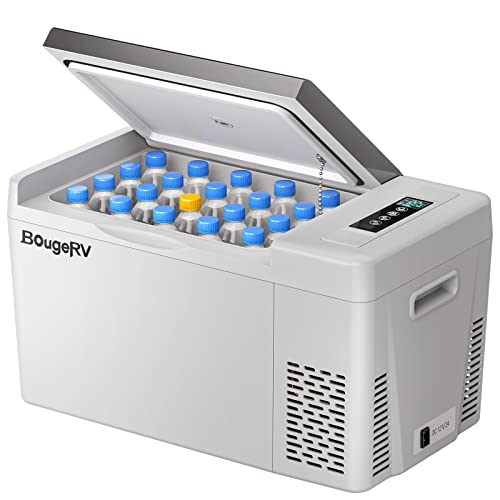
BougeRV 12V Refrigerator (23 Quart) — Best for Small Cabins
Boats at the small end — pocket cruisers, trailer-sailers, day boats with overnight ambitions — need a fridge that cools fast after a late launch and sips while it cruises. BougeRV’s 23 Quart answers with a claimed 15-minute pull-down to 32°F, a -8°F to 50°F range that covers freezer duty, and a compact footprint that finds homes in small cabins. Its fast cooling is a genuine sailboat feature: provision at the dock, launch, and the box is cold before the first tack.
Strengths
- Fastest pull-down claim here — cold quickly after loading at the dock
- Deep -8°F floor gives real freezer capability in a small box
- Compact 23-quart size suits the smallest cabins and lockers
Trade-offs
- Fast cooling draws hard during pull-down; arrive with a charged bank or shore power
- Single zone, so frozen and fresh share one setpoint
- Brand’s marine pedigree is thinner than Dometic’s; protect it from spray accordingly
| Capacity | 23 quart |
| Temperature range | -8°F to 50°F |
| Power | 12/24V DC, 110V AC |
| Cooling claim | 32°F in approx. 15 minutes (manufacturer figure) |
Discount the 15-minute figure as cabinet-air marketing, as with all such claims, and a real virtue remains: this fridge gets on top of a warm load faster than most, which compresses the riskiest hour of any boat fridge’s life — warm food, warm box, hot cabin, battery alone. On shore power at the dock the trick is effortless; at anchor after a restock, it shortens the deep-draw period your bank feels most.
In cruise it settles into the class’s normal manners, and its deep low end lets a small boat carry a genuinely frozen reserve — a few days of meat, ice for the evening — that pure fridge boxes cannot. For the small-cabin sailor who loads late and sails far, BougeRV has aimed this box precisely, and it lands.
Best for: small cabins, trailer-sailers and late-loading sailors who value fast pull-down / Not suited for: buyers wanting dual zones, or the deepest marine-brand support network
Check on Amazon — check the current price on Amazon before you buy, because listings and bundle contents change over time.

Setpower 12V Refrigerator 48QT Dual Zone — Best for Long Passages
Some sailboats shop monthly. For liveaboards, offshore passages and family boats that provision in bulk, Setpower’s 48QT dual-zone is the capacity pick: 48 quarts split into independently controlled zones across a -4°F to 68°F range, backed by a 3-year warranty that stands out in this category. It is a big box that assumes a big boat — a dedicated space, a serious bank, a crew that eats — and for that boat it replaces the icebox entirely.
Strengths
- 48 quarts in two zones: a week’s-plus provisioning for a family in one unit
- Independent zone control across a wide -4°F to 68°F span
- 3-year warranty, the strongest stated backing in this roundup
Trade-offs
- Size and weight demand a dedicated, ventilated home; many sailboats simply lack one
- A full 48QT box is a provisioning-day workout to move
- Its appetite at full cry needs a bank and charging sized for it — do the amp-hour maths first
| Capacity | 48 quart, dual zone |
| Temperature range | -4°F to 68°F |
| Control | Independent zone control |
| Warranty | 3-year |
| Power | 12V DC (AC capable) |
Judge this fridge as infrastructure. Boats that carry it reorganise provisioning around it: bulk-buy where food is cheap, freeze flat in meal order, and let the zones run a fresh week and a frozen fortnight simultaneously. The independent control is the feature that survives contact with reality — zones set for their contents, not compromised between them — and the warranty suggests a maker expecting the box to be used hard and long.
The discipline it demands is electrical honesty. Model its consumption against your bank and charging before purchase, site it with real ventilation, and secure it for a seaway — 48 quarts of food is a mass that must not travel in a knockdown. Boats that do that work get a fridge that changes their cruising radius. Boats that skip it bought a very large battery problem.
Best for: liveaboards, offshore passages and family boats provisioning for weeks / Not suited for: weekend boats, small lockers, and electrical systems not sized for it
Check on Amazon — check the current price on Amazon before you buy, because listings and bundle contents change over time.
Comparison Table
| Pick | Badge | Key spec | Best for |
|---|---|---|---|
| Dometic CFX2 28L Electric Cooler | Best Overall | 28L, freezes to -7°F, 3-stage protection | cruising couples on 28-38 foot sailboats wanting marine-grade efficiency and battery protection |
| Dometic CFX2 37L Electric Cooler | Best Capacity (Premium) | 37L, freezes to -7°F, 3-stage protection | family crews and longer passages on boats with a locker that truly fits it |
| ICECO GO20 Dual Zone 12V Refrigerator (21 Quart) | Best Dual Zone for Small Boats | 21 qt dual zone, SECOP compressor | couples on smaller sailboats who need frozen and chilled storage simultaneously |
| Alpicool C20 Portable Fridge Freezer (21 Quart) | Best Budget | 21 qt compressor, 12/24V + AC | small-boat and budget-conscious sailors wanting real compressor refrigeration now |
| BougeRV 12V Refrigerator (23 Quart) | Best for Small Cabins | 23 qt, -8°F to 50°F, fast cool | small cabins, trailer-sailers and late-loading sailors who value fast pull-down |
| Setpower 12V Refrigerator 48QT Dual Zone | Best for Long Passages | 48 qt dual zone, -4°F to 68°F | liveaboards, offshore passages and family boats provisioning for weeks |
On a sailboat the table’s hidden column is amp-hours per day, which no listing prints honestly because it depends on cabin temperature, loading and setpoint. The premium compressors (Dometic, ICECO’s SECOP) earn their price in that invisible column over a season; the budget boxes repay their savings in sunshine and charging time. Choose with your bank’s size in view, not just your locker’s.
How to Choose the Best 12 Volt Mini Fridge Sailboat Owners Trust
Do the energy maths before the capacity maths, because at anchor the bank is the boss. Estimate honestly: a small compressor fridge in a warm cabin typically consumes somewhere in the broad band of a few dozen amp-hours per day, varying with setpoint, ambient heat, loading discipline and the unit’s efficiency. Set that against your usable bank capacity — half the rated amp-hours for lead-acid, most of it for lithium — and your daily charging from solar, wind or engine. The fridge that fits that equation is your shortlist; the fridge that breaks it is a generator schedule wearing a cooler’s clothes.
Compressor only, and why heel settles it
A compressor fridge cools with a sealed refrigerant circuit that works at sailing heel angles without complaint, holds a setpoint in a 35°C cabin, and freezes when asked. Thermoelectric boxes cool relative to ambient and fail exactly on the hot, still anchorages where fridges matter. Absorption units demand near-level operation a heeled sailboat cannot offer and bring flame or heavy draw into the bargain. For this keyword the technology question has one answer, and every pick here embodies it.
Battery protection is a safety feature
Multi-stage battery protection — Dometic’s 3-stage system is the reference — lets you choose the voltage at which the fridge sacrifices itself for the bank. On a boat, set it so the fridge can never take the bank below what bilge pumps, lights and engine starting require; the correct stage depends on whether the fridge shares the start battery’s bank. A warm fridge is an inconvenience. A flat bank at anchor, with pumps and lights dead, is an emergency. Any fridge without selectable protection was excluded from this guide on that ground alone.
Size to the locker and the crew, in that order
Measure the locker with ventilation clearance, then provision honestly. Two people cruising weekends live happily in 21-28 litres; a family or a passage-maker needs the 37-48 litre class and the bank to feed it. Remember that top-loading boxes — all of these — reward loading in order of use and punish rummaging with cold loss, so capacity you cannot organise is capacity you do not have. Buy the smallest fridge that holds your real provisioning; every extra litre is weight, space and amp-hours spent cooling air.
Living with a Fridge Aboard: Ventilation, Securing and Loading
Installation decides whether a good fridge performs like one. The compressor and condenser must shed heat, and a locker sealed like a tomb turns any fridge into a heater arguing with itself: provide vent paths — low intake, high exhaust — and keep a hand’s width around the vent panels. Secure the box for sea: cleats, straps or a fitted recess, because a loaded fridge in a seaway is a battering ram with a grudge. Run its power in properly sized, fused, tinned cable direct from the distribution panel; voltage drop from thin cable makes compressors labour and battery protection trip early.
Loading is seamanship too. Pre-cool the box on shore power, load provisions already cold, freeze flat in meal order, and keep a loading map in your head so the lid opens once per meal, briefly. A small battery fan is unnecessary in these compressor boxes, but air gaps between items are not — cold must circulate to be even. Defrost when frost builds; an iced evaporator insulates itself and the amp-hours climb to prove it. Sailors who run their fridge with this discipline routinely halve its consumption against the same box run carelessly, which is the cheapest capacity upgrade in this entire guide.
The Icebox Conversion Question: Portable Fridge or Built-In Kit?
Sooner or later every sailboat owner with a portable fridge in this guide asks whether a built-in refrigeration kit in the boat’s own icebox would be better. The honest comparison runs like this. A built-in kit uses the icebox’s existing — often generous — insulation and volume, disappears into the boat, and suits owners who keep the boat for years and provision from the same box every week. A portable like the six here asks nothing of the boat: it pre-cools at home, lifts out for winter, moves to the next boat when you sell, and its cost is a fraction of a built-in conversion once labour is counted.
The portable’s weaknesses are the mirror of its strengths: it occupies a locker as an object rather than using the icebox’s architecture, its capacity is capped by its cabinet, and its efficiency depends on the ventilation you give it rather than on insulation a boatbuilder fitted. For boats under about 38 feet, cruised seasonally by owners who may change boats, the portable usually wins on total cost and flexibility — which is why this category has grown so fast. For liveaboards in larger boats with a sound icebox, the built-in kit eventually wins on volume and disappearance.
Many owners run the portable as the experiment that settles the question: a season or two with a CFX2 or GO20 aboard teaches you your real capacity, your real consumption and your crew’s real habits. If the portable proves itself marginal, the built-in decision is now an informed one; if it proves sufficient — as it does for most — you have saved the conversion money permanently. Either way, the portable was not a compromise. It was the research.
Winter Ashore and Other Second Lives of a Portable Boat Fridge
A portable fridge’s story does not end at lay-up, and its second lives belong in a sailboat buying decision because they are value a built-in box can never return. Lifted out at winterisation, the same fridge pre-cools provisions at home before every trip, serves as the overflow fridge for holidays and parties, rides in the car for the road trips that fill a sailor’s winter, and stands ready as the emergency fridge when a household appliance fails at the worst moment — a role owners report with the gratitude of people whose Christmas dinner was saved by a boat locker. An appliance earning its keep twelve months a year justifies its premium very differently from one used eight weekends.
Winter is also the fridge’s maintenance season, and the routine is short. Run it empty for a day to dry the cabinet fully before storage, store it with the lid ajar so seals rest uncompressed and air circulates, and clean the condenser vents of the season’s dust and salt film. Check the DC cable and plug for the green creep of corrosion and remake any suspect connection at the bench, in warmth, rather than at the boat, in April, in the rain. Once a winter, power it up for an hour and confirm it pulls down to temperature; a fault found in February is a warranty claim, while the same fault found at the first May launch is a spoiled weekend.
Boats change, too, and the portable changes with them — to the next boat, to the camper, to the child heading for a first flat. That portability is the quiet line item under every pick in this guide, and for sailors whose lives are not finished evolving, it may be the decisive one.
How to Install and Commission a 12 Volt Fridge on a Sailboat
A half-day’s careful work converts a delivered box into part of the boat. Do it at the dock, on shore power, with the provisioning trip still ahead of you.
Step 1: Choose and prepare the home
Pick the fridge’s space for ventilation first and convenience second: vent path for warm air to escape, clearance at the compressor vents, a cable route to the panel, and a position where the lid opens fully within the cabin’s geometry. Add cleats or strap points to secure it for sea.
Step 2: Wire it properly from the panel
Run a dedicated, fused circuit in tinned marine cable sized for the round trip, so the compressor sees full voltage under load. Label both ends. Never power a boat fridge from a random accessory socket circuit shared with who-knows-what.
Step 3: Set battery protection before the food
Select the protection stage for your bank arrangement — most protective if the fridge shares a bank with starting, middle for a dedicated house bank — and note the setting in the boat’s log where a future you will find it.
Step 4: Pre-cool and verify temperatures
Run the empty fridge on shore power to your cruising setpoints, then verify with a standalone thermometer in each zone. Learn any display offset now, in harbour, rather than mid-passage.
Step 5: Load like a passage-maker
Load provisions already chilled or frozen, in reverse order of use, with air gaps for circulation. Freeze flat packs at the bottom of the freezer zone; keep daily items at the top. Close the lid and leave it closed.
Step 6: Commission the routine
For the first days aboard, log the bank’s morning state of charge against the fridge’s running. That log teaches you your real consumption — the number every future anchoring decision will use — and confirms the installation while fixes are still easy.
After a month, review the log and the locker: ventilation working, straps holding, frost in check, consumption as modelled. A boat fridge installed and commissioned this way stops being an appliance you worry about and becomes what it should be — cold food, quietly, at the far end of the anchor chain.
Common Buying Mistakes
Buying capacity before doing the amp-hour maths
The classic sailboat fridge error. A big box on a small bank is not refrigeration; it is a charging regime. Model consumption against usable bank capacity and daily charging first, then choose the largest fridge the equation — and the locker — supports.
Choosing a thermoelectric cooler for boat duty
It cannot hold temperature in a hot cabin, cannot freeze, and its apparent cheapness is repaid in spoiled food on the first still, sunny anchorage. Compressor is the only technology in this guide for a reason.
Sealing the fridge in an unventilated locker
A compressor fridge exports heat; trap the heat and the fridge fights itself, drawing more and cooling less until something gives. Ventilation is not an installation nicety — it is half the appliance.
Setting battery protection to its lowest stage
Low protection lets the fridge eat the bank’s reserve — the reserve your bilge pump, lights and radio were counting on. The fridge must always be the first load to die. Set protection accordingly and never revisit it in a thirsty moment.
Leaving the fridge unsecured for sea
A loaded 30-litre box adrift in a knockdown damages joinery, crew and itself. Cleats, straps or a fitted recess are part of the purchase price of any boat fridge. Fit them before the first passage, not after the first lesson.
Loading warm provisions into a battery-powered box
Warm food loaded at anchor makes the compressor run for hours at full draw — the single most expensive habit in boat refrigeration. Pre-cool on shore power, load cold, and let the fridge maintain rather than rescue.
Final Recommendation
For most cruising sailboats, the Dometic CFX2 28L is the answer: marine-bred efficiency, genuine freezing, 3-stage battery protection and a size that fits real lockers and real couples. Step up to the CFX2 37L when crew and passages grow, provided the tape measure gives its blessing. Choose the ICECO GO20 when a small boat needs two temperatures at once, the BougeRV when fast pull-down after late loading defines your sailing, and the Setpower 48QT when your cruising is measured in weeks between shops.
On a budget, the Alpicool C20 gets a small boat genuinely cold for budget-tier money, and thousands of sailors have the seasons to prove it. Whichever you choose, check price on Amazon, measure the locker with ventilation in mind, wire it on its own fused circuit, and set the battery protection before the first provision goes in. A sailboat fridge is an energy decision, a space decision and a safety decision that happens to keep food cold — choose it like one.
Shop the top picks: Dometic CFX2 28L Electric Cooler, Dometic CFX2 37L Electric Cooler, ICECO GO20 Dual Zone 12V Refrigerator (21 Quart) — check price on Amazon for each before you buy.
Related guides in this series: Best 12 Volt Medical Cooler For Travel Best 12 Volt Meter For Marine Battery Best 12 Volt Marine Water Pump Best 12 Volt Meter
Frequently Asked Questions
How many amp-hours does a 12 volt boat fridge use per day?
It varies widely with cabin temperature, setpoint, loading and the unit’s efficiency — broadly, a few dozen amp-hours per day for the sizes in this guide. Efficient premium compressors sit at the kind end of the range; hot cabins and warm loading push any fridge upward. Your own first-week log aboard is the only figure worth planning passages on.
Will a compressor fridge work while the boat is heeled?
Yes. Compressor refrigeration does not depend on gravity or level operation within any normal sailing range, which is one of its decisive advantages over absorption fridges on a sailboat. Secure the box itself for sea, and it will keep cooling through the heel of a fresh beat.
What battery protection setting should I use?
Choose the stage that guarantees the fridge stops before the bank reaches the reserve you need for bilge pumps, lights, instruments and starting. If the fridge shares the starting bank, use the most protective setting. The fridge is always the expendable load.
Can one of these fridges replace a built-in icebox?
For many boats, yes — that is exactly how they are used, either inside a converted icebox space or in a locker of their own. The portable format adds the ability to pre-cool at home and remove the unit for winter. Ensure ventilation in the icebox space, which was designed for ice, not for a compressor’s waste heat.
Single zone or dual zone for a sailboat?
Dual zone if your provisioning genuinely splits — frozen stores for passages plus fresh for the week — and your boat is small enough that two boxes are impossible. Single zone is simpler, cheaper per litre and entirely sufficient for weekend and fresh-focused cruising.
How should I power the fridge at anchor for several days?
From the house bank, within a budget your charging can repay: solar sized for the load is the usual answer, supplemented by engine charging on passage. The fridge’s own battery protection is the backstop, not the plan — the plan is an energy budget where the fridge’s measured consumption fits your daily harvest.
Can I run a 12 volt fridge from solar alone at anchor?
In sunny latitudes with a sensibly sized panel, yes — that is the standard modern cruising arrangement. The discipline is matching: the panel’s daily harvest must exceed the fridge’s measured daily consumption plus your other loads, with margin for grey days. Measure your fridge’s real appetite in the first week aboard, then size or adjust the solar to the number, not the brochure.
What temperature should I set for general cruising?
Set the fridge zone to the temperature your provisions actually need rather than the coldest it can reach: a typical fridge setpoint in the mid-30s to around 40°F keeps fresh food properly cold without burning amp-hours chasing degrees nobody eats. Every degree colder costs energy around the clock, and at anchor that energy is your bank. Use the freezer zone — or a single-zone box set low — only for what genuinely needs freezing, and let the rest ride at an honest fridge temperature. Boats that provision in order and set temperatures by need routinely outlast boats with bigger banks and colder boxes, which is the final lesson of this guide: on a sailboat, refrigeration is a discipline that happens to involve a compressor.


