Disclosure: airfryerkitchensupply.com is reader-supported. When you buy through links on our site, we may earn an affiliate commission at no extra cost to you.
Where to buy
Every meter below was confirmed against a live Amazon listing at review time. Check price on Amazon before ordering, and for panel gauges, confirm the cutout size against your helm or panel before the box arrives — round marine gauges come in more than one ‘standard’ diameter, and the wrong one is a fibreglass problem, not a returns problem.
- Victron Energy SmartShunt 500A — check price on Amazon
- DaierTek Battery Voltage Meter Panel Voltmeter — check price on Amazon
- Nilight 12V LED Voltmeter with Touch Switch — check price on Amazon
- CZ106 Battery Monitor Round Gauge (7-100V) — check price on Amazon
- SUPNOVA Waterproof Battery Monitor with Bracket and Alarm — check price on Amazon
- Renogy 500A Battery Monitor with Shunt — check price on Amazon
A boat asks more of a battery meter than any other 12 volt environment. The best 12 volt meter for marine battery duty has to survive humidity, spray and vibration, stay readable in cockpit glare, and answer for not one battery but two very different ones: a starting battery whose only job is to never fail you, and a house bank whose slow decline you manage every day at anchor. Meters that thrive in an RV cabinet can die in a season at a helm, and gauges that are fine for a quick voltage glance cannot tell you whether the house bank will survive the night.
This guide therefore splits its six picks by marine job. At the helm and the electrical panel, waterproof panel meters — the DaierTek, Nilight and CZ106 round gauges and SUPNOVA’s alarmed monitor — give an instant, glove-friendly voltage picture that anyone aboard can read. For the house bank’s real state of charge, two shunt monitors, Victron’s SmartShunt and Renogy’s 500A unit, do the amp-hour bookkeeping that voltage cannot. Most well-found boats end up with one of each type, and this guide explains how to choose yours in that order.
Marine honesty about voltage matters here. A house bank feeding the fridge, lights and anchor windlass will show voltages that swing with load, and a battery ‘resting’ at a marina charger shows the charger’s voltage, not its own. Voltage at the panel is a health indicator and a charging check; the shunt is the fuel gauge. Confusing those roles is how sailors end up with warm beer, a silent VHF and a 2 a.m. generator start that the whole anchorage hears.
In this guide
Quick Picks
Panel gauges for the helm, shunt monitors for the truth. Most boats want one of each; start with the shunt if you anchor out, the gauge if you daysail.
- Best Overall for House Banks: Victron Energy SmartShunt 500A — a display-free 500A Bluetooth shunt at the battery that reports the house bank’s true state of charge to your phone.
- Best Panel Gauge: DaierTek Battery Voltage Meter Panel Voltmeter — a waterproof round LED panel voltmeter made for marine dashboards — instant voltage at the helm, readable at a glance.
- Best Budget Panel Gauge: Nilight 12V LED Voltmeter with Touch Switch — a waterproof LED voltmeter with a touch on/off switch, covering 8-24V systems at a budget-tier price.
- Best Drop-In Round Gauge: CZ106 Battery Monitor Round Gauge (7-100V) — a waterproof round percentage gauge that auto-matches 12V-72V systems and buzzes before the battery is flat.
- Best No-Cutout Install: SUPNOVA Waterproof Battery Monitor with Bracket and Alarm — a waterproof percentage monitor on a bracket — no panel hole to cut — with temperature display and buzzer alarm.
- Best Display Shunt Monitor: Renogy 500A Battery Monitor with Shunt — the shunt monitor with a real display: 500A shunt, 20 ft shielded cable and programmable alarms for the nav station.
How These Picks Were Chosen
Every pick was verified against its manufacturer’s Amazon listing through the Creators API before earning a link, and the ranges, shunt sizes and waterproof claims in the spec boxes come from those verified listings. Instruments with no identifiable maker were excluded; on a boat, an untrustworthy gauge is worse than a blank panel space, because crews act on what gauges say.
Marine criteria led the selection. Sealing came first for anything panel-mounted: a meter at a helm or in a cockpit locker lives in spray and condensation, so waterproof construction was a requirement for our gauge picks, not a bonus. Readability in sunlight and at night, one-glance percentage displays for non-technical crew, and alarms that announce a dying bank before the lights dim all scored heavily. For the shunt monitors, we required true bidirectional coulomb counting, capacity settings for real house banks, and signal cabling up to engine-room environments.
We also weighted the two-battery reality of boats. Instruments that make it easy to watch a second bank — or cheap enough to duplicate per bank — scored over single-bank elegance, because the starting battery you ignore is the one that strands you at the ramp.
The 6 Best 12 Volt Meters for Marine Batteries
Read the picks in two groups: the four gauges answer ‘what is the voltage doing right now, from where I stand’, and the two shunt monitors answer ‘how much is actually left in the house bank’. Both questions are legitimate; only the second needs a shunt.

Victron Energy SmartShunt 500A — Best Overall for House Banks
For the house bank of any boat that anchors out, this is the single most useful electrical instrument you can fit. The SmartShunt lives at the battery — no display to find panel space for, nothing at the helm to fog or fade — counts every amp-hour in and out through its 500A shunt, and reports percentage, current, voltage, time-to-go and history to Victron’s app over Bluetooth. In a marine environment where displays die of sun and spray, moving the display into your pocket is not a gimmick; it is a reliability strategy.
Strengths
- True state-of-charge bookkeeping for the house bank, immune to voltage’s load-related lies
- No exposed display to suffer UV, spray or condensation; the unit hides in the battery compartment
- History and trend data reveal the fridge’s real overnight cost and the alternator’s real contribution
Trade-offs
- No fixed display; checking the bank means a phone and Bluetooth range of the battery compartment
- Crew without the app see nothing, which matters on shared and charter boats
- Premium-tier pricing, and it monitors one bank per unit
| Type | Shunt battery monitor, Bluetooth |
| Shunt | 500A |
| Voltage range | 6.5V-70V |
| Display | Phone app |
| Environment | Fits at battery, away from helm exposure |
What the SmartShunt changes aboard is behaviour. Once you can see that the fridge costs 38 amp-hours overnight and the solar returns 30 on a grey day, decisions about running the engine stop being folklore. Its time-to-go estimate, computed from the actual present load, answers the anchor-watch question — will the bank last until morning — better than any voltage reading ever has. The 6.5 to 70 volt range also future-proofs it across 12, 24 and 48 volt refits.
Fit it with marine discipline: shunt in the negative line with nothing bypassing it, connections protected against the battery-compartment atmosphere, and the unit mounted where bilge water cannot reach. Then fully charge the bank to synchronise it. Boats with Victron chargers or inverter-chargers gain extra integration, but the shunt stands alone perfectly well. For house-bank truth on a cruising boat, nothing in this guide beats it.
Best for: cruising and liveaboard boats that anchor out and manage a real house bank / Not suited for: daysailers that never sleep aboard, or crews who need a fixed gauge everyone can read
Check on Amazon — check the current price on Amazon before you buy, because listings and bundle contents change over time.

DaierTek Battery Voltage Meter Panel Voltmeter — Best Panel Gauge
Sometimes the right instrument is a number, in the panel, right now. The DaierTek is a waterproof round digital voltmeter built for marine dashboards, showing battery voltage on a blue LED display that reads clearly day and night. It is the pick for the helm of a fishing boat, the panel of a daysailer, or as the starting-battery watchdog beside the ignition — anywhere a shunt monitor would be overkill but a dead battery would ruin the day.
Strengths
- Waterproof construction specified for marine panel duty
- Round gauge format drops into standard panel cutouts and looks factory-fitted
- Instant, always-on voltage awareness with zero menus or pairing
Trade-offs
- Voltage only: it cannot tell you amp-hours remaining, and under load its reading reflects the load
- One gauge watches one bank; dual-bank boats need two or a switch
- LED brightness that is perfect at noon can be assertive at the helm at night
| Type | Panel voltmeter |
| Display | Round digital LED, blue |
| Systems | 12V / 24V / 36V batteries |
| Construction | Waterproof |
| Use | Marine boat, car, motorcycle panels |
The DaierTek’s value is diagnostic speed. A helm voltage reading tells you the alternator is charging the moment the engine starts — the number jumps, and you relax — and warns of a failing battery or a forgotten load before it becomes a no-start. Mounted over the starting battery, it is the cheapest insurance in this guide; switched between banks or duplicated, it covers the house bank’s rough health too, provided you read it at rest and interpret it as a trend.
Installation is an hour’s honest work: a panel cutout, a fused positive feed from the bank you are watching, a negative, and done. Use tinned marine wire and sealed crimps, because the back of a helm panel is a condensation farm. For boats whose electrical lives are simple — engine, lights, a sounder, home by dark — this gauge plus a sensible owner is a complete battery management system.
Best for: helm and panel voltage monitoring on fishing boats, daysailers and runabouts / Not suited for: anyone needing true remaining capacity for a house bank at anchor
Check on Amazon — check the current price on Amazon before you buy, because listings and bundle contents change over time.

Nilight 12V LED Voltmeter with Touch Switch — Best Budget Panel Gauge
Nilight’s little panel voltmeter solves an annoyance the always-on gauges ignore: sometimes you want the display dark and drawing nothing. Its touch switch lets you wake the voltage reading when you want it and put it to sleep at anchor or in storage, and its waterproof build and 8-24V range suit marine panels, motorcycles and carts alike. It is the budget panel pick for boats that sit unused between weekends.
Strengths
- Touch switch kills display draw and glare when you do not need a reading
- Waterproof panel design at a budget-tier position
- Wide 8-24V operating range covers 12V and 24V boats
Trade-offs
- Voltage-only information, with all the interpretation caveats that carries
- Touch controls and wet gloves or spray are not always friends; test your use case
- Basic mounting and instructions compared with premium marine brands
| Type | Panel voltmeter with touch switch |
| Display | LED digital |
| Voltage range | 8-24V |
| Construction | Waterproof |
| Use | Marine boat, car, motorcycle, golf cart |
The touch switch is a small feature with outsized marine value. A voltmeter that draws current and glows all winter in a stored boat is working against you; one that sleeps until touched is a tool that waits patiently. Weekend anglers and trailer-boat owners, whose batteries live or die by what happens between trips, are exactly the users this design serves, and the waterproofing acknowledges where those panels live.
As with every gauge here, read it intelligently: check voltage at rest for a health estimate, watch it jump when the engine starts to confirm charging, and never mistake a loaded reading for a verdict on the battery. Within those rules, the Nilight gives a small boat genuine battery awareness for very little money and less panel surgery than most rivals.
Best for: weekend and trailer boats wanting switchable, waterproof voltage awareness on a budget / Not suited for: house-bank management on boats that anchor out for days
Check on Amazon — check the current price on Amazon before you buy, because listings and bundle contents change over time.

CZ106 Battery Monitor Round Gauge (7-100V) — Best Drop-In Round Gauge
The CZ106 is the gauge for owners who want a percentage, not a lecture. This waterproof round meter auto-matches systems from 12 to 72 volts, takes a one-tap battery-type setting, displays remaining capacity as a percentage, and sounds a buzzer at low state of charge. It drops into a round panel hole on a yacht, RV or cart and asks almost nothing of its owner — which, for a lot of boats, is exactly the specification.
Strengths
- Percentage display the whole crew understands, in a waterproof round gauge
- Low-charge buzzer alarm turns a passive gauge into active protection
- Auto-matching 7-100V range and no complex setup
Trade-offs
- Percentage is inferred from voltage, so it is an estimate that wobbles under load — not shunt truth
- Buzzer enthusiasm must be configured thoughtfully on a boat where people sleep
- Round format only; panels without a suitable hole need cutting
| Type | Voltage-based battery gauge |
| Voltage range | 7-100V, auto-match 12V-72V |
| Display | Round gauge, percentage + voltage |
| Alarm | Low state-of-charge buzzer |
| Construction | Waterproof |
Position this gauge honestly and it shines. On a boat with modest DC loads — lights, instruments, a small fridge — a voltage-derived percentage, read mostly at rest and backed by a low-charge alarm, gives the crew a shared, simple picture of battery health that a raw voltage number never achieves. The alarm is the feature that earns the panel space: it converts ‘someone should have checked’ into a sound, at a threshold you choose, while options still exist.
It does not replace a shunt on a serious cruising boat, and this guide’s first pick exists for that job. But as the panel instrument for a second bank — watching the starting battery the shunt ignores — or as the only gauge on a simple boat, the CZ106’s blend of sealing, simplicity and alarm is hard to beat.
Best for: simple boats and second-bank monitoring where a percentage and an alarm beat raw voltage / Not suited for: cruisers needing precise amp-hour accounting for a large house bank
Check on Amazon — check the current price on Amazon before you buy, because listings and bundle contents change over time.

SUPNOVA Waterproof Battery Monitor with Bracket and Alarm — Best No-Cutout Install
Cutting holes in a boat is a commitment, and the SUPNOVA exists for owners who would rather not. It mounts on its bracket — on a bulkhead, beside the panel, in the battery compartment itself — and delivers a waterproof digital display of voltage and remaining-capacity percentage across 7-100V, with a temperature reading and a buzzer alarm. Renters of their own future plans, charter skippers and anyone allergic to hole saws: this is your gauge.
Strengths
- Bracket mount installs anywhere with screws or adhesive — zero panel surgery
- Waterproof build suits exposed and below-deck locations alike
- Percentage, voltage, temperature and a low-charge buzzer in one unit
Trade-offs
- Voltage-derived percentage, with the usual estimation caveats under load
- Bracket mounting looks added-on compared with a flush panel gauge
- One unit per bank, as with all gauges in this class
| Type | Voltage-based battery monitor, bracket mount |
| Voltage range | 7-100V |
| Display | Digital: percentage, voltage, temperature |
| Alarm | Buzzer |
| Construction | Waterproof |
The bracket is a more strategic feature than it first appears. It lets you put battery information where decisions happen — beside the switch panel, at the chart table, even in the cockpit locker where the battery switch lives — rather than where a legacy gauge hole happens to be. It also makes the unit removable for winter storage and transferable to the next boat, which flush gauges are not.
Functionally it matches its SUPNOVA sibling in our general meter guide — percentage estimate, temperature, alarm — with the marine-relevant upgrades of waterproofing and flexible mounting. For a boat whose electrical system is evolving, or an owner still deciding how serious their cruising will get, it is the lowest-regret way to start watching the batteries properly.
Best for: owners who want battery monitoring without cutting the panel, and temporary or evolving installs / Not suited for: buyers wanting a flush factory look, or shunt-grade accuracy
Check on Amazon — check the current price on Amazon before you buy, because listings and bundle contents change over time.
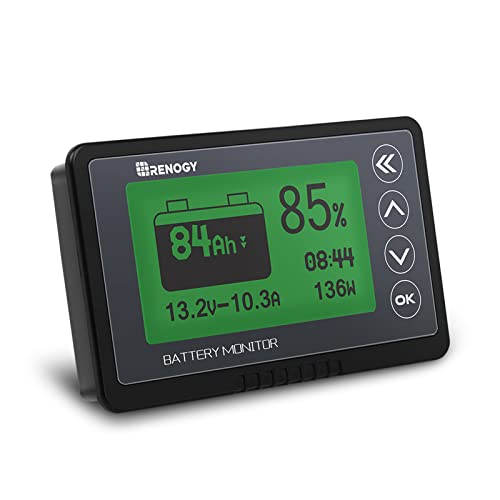
Renogy 500A Battery Monitor with Shunt — Best Display Shunt Monitor
If the SmartShunt’s phone-only design is a dealbreaker — because crew rotate, phones die, or you simply want the number on the bulkhead — the Renogy is the marine shunt monitor to buy. Its display shows true state of charge from a 500A shunt, its 20 ft shielded cable reaches from a battery compartment to a nav station in most boats, and programmable high and low voltage alarms stand watch while you sleep.
Strengths
- True amp-hour state of charge on a fixed, always-visible display anyone can read
- 20 ft shielded cable suits real boat distances between bank and nav station
- Programmable alarms announce a failing bank before the cabin lights do
Trade-offs
- Display needs a mounting location protected from direct spray; it is a cabin instrument, not a cockpit one
- Cable routing from battery to display is the main labour of the install
- Requires capacity setup and a full-charge synchronisation to read true
| Type | Shunt battery monitor with display |
| Shunt | 500A |
| Voltage range | 10V-120V |
| Cable | 20 ft shielded |
| Alarms | Programmable high/low voltage |
| Batteries | Lithium, sealed, gel, flooded |
Aboard, the Renogy’s display placement writes its own routine: mounted at the nav station or companionway, it gets glanced at on every pass, and battery awareness becomes ambient rather than an event. The shielded cable earns its keep in engine-adjacent runs, where unshielded signal leads pick up alternator noise and report phantom currents. The 500A shunt swallows windlass and inverter loads that would embarrass a 100A unit — relevant on boats, where the windlass is often the biggest single draw aboard.
Set it up as carefully as the Victron: true capacity entered, bank fully charged to sync, alarms set to warn with margin. Do that, and this is the instrument that ends the anchorage guessing game for crews who will never open an app. Between it and the SmartShunt there is no wrong answer — only the question of whether your boat’s battery truth should live on the bulkhead or in your pocket.
Best for: cruising boats wanting a fixed nav-station display of true house-bank state of charge / Not suited for: open cockpits with no protected mounting spot, or owners who prefer app-based data
Check on Amazon — check the current price on Amazon before you buy, because listings and bundle contents change over time.
Comparison Table
| Pick | Badge | Key spec | Best for |
|---|---|---|---|
| Victron Energy SmartShunt 500A | Best Overall for House Banks | 500A shunt, Bluetooth, 6.5-70V | cruising and liveaboard boats that anchor out and manage a real house bank |
| DaierTek Battery Voltage Meter Panel Voltmeter | Best Panel Gauge | Waterproof round LED voltmeter | helm and panel voltage monitoring on fishing boats, daysailers and runabouts |
| Nilight 12V LED Voltmeter with Touch Switch | Best Budget Panel Gauge | 8-24V, waterproof, touch switch | weekend and trailer boats wanting switchable, waterproof voltage awareness on a budget |
| CZ106 Battery Monitor Round Gauge (7-100V) | Best Drop-In Round Gauge | 7-100V round gauge, SOC buzzer | simple boats and second-bank monitoring where a percentage and an alarm beat raw voltage |
| SUPNOVA Waterproof Battery Monitor with Bracket and Alarm | Best No-Cutout Install | 7-100V, waterproof, bracket mount | owners who want battery monitoring without cutting the panel, and temporary or evolving installs |
| Renogy 500A Battery Monitor with Shunt | Best Display Shunt Monitor | 500A shunt, display, 20 ft cable | cruising boats wanting a fixed nav-station display of true house-bank state of charge |
Two instruments in this table measure (the shunt monitors); four estimate from voltage (the gauges). On a boat, both earn their place — the gauge as the helm’s instant health check, the shunt as the house bank’s fuel gauge — but the table keeps them clearly labelled so nobody buys an estimate expecting a measurement.
How to Choose the Best 12 Volt Meter for Marine Battery
Start from your boat’s two-battery reality. The starting battery needs surveillance, not management: a panel voltmeter that confirms charging and warns of decline is proportionate, because that battery is either fine or a phone call. The house bank needs management: it is cycled daily, sized in hundreds of amp-hours, and its state of charge decides your comfort and your safety systems’ endurance. The best 12 volt meter for marine battery use is therefore usually a pairing — a gauge for the start battery, a shunt monitor for the house bank — and this guide’s picks are chosen to combine that way.
Waterproofing is not optional at the panel
A helm or cockpit panel lives in spray, rain driven sideways, and the condensation that forms when warm cabin air meets a cold hull. Panel instruments for boats need genuine waterproof construction, sealed faces and corrosion-resistant terminals, and the wiring behind them needs tinned cable and sealed crimps. Our gauge picks — DaierTek, Nilight, CZ106, SUPNOVA — are all specified waterproof for this reason. A bargain automotive gauge in the same hole is a one-season experiment.
Read voltage like a sailor, not a spec sheet
Voltage still tells truth if you ask at the right moment. Read at rest — loads off, charging off, battery settled — it estimates lead-acid state of charge well enough for a health check. Read while the engine runs, it confirms the alternator’s output. Read under a heavy load, it mostly describes the load. Lithium house banks flatten the whole exercise: their voltage barely moves between full and nearly empty, which is why lithium boats, above all, belong on shunt monitors.
Alarms are the feature crews actually benefit from
Instruments get glanced at in good times and ignored in busy ones. An alarm — the CZ106’s and SUPNOVA’s buzzers, the Renogy’s programmable warnings — speaks up in the busy times: the night the fridge runs away with the bank, the evening a light is left on in the forepeak. On a boat, where a flat house bank can mean no lights, no VHF and no bilge pump, an alarm is not a convenience feature. Weight it accordingly.
Wiring Meters the Marine Way
Marine wiring discipline decides whether a good meter stays good. Use tinned copper wire, which resists the black corrosion that creeps up plain copper in salt air. Seal every crimp with adhesive-lined heat shrink. Fuse the meter’s positive feed close to the battery end — a meter lead is a long, thin wire connected to a battery, and it deserves the same protection as any other conductor aboard. Route signal and sense leads away from alternator and windlass cables, whose transients can put fiction on a display.
For shunt monitors, the rule from our general guide applies with extra force aboard: the shunt is the only path to the battery negative post. Boats accumulate stray negatives over the years — a bilge pump wired direct here, a stereo memory wire there — and each one bypasses the shunt and corrupts the count. A meter install is the perfect audit moment: gather every negative to the shunt’s system side, and your percentages become trustworthy the same afternoon. Label both ends of every new wire. The next electrician aboard, possibly you at midnight in a seaway, is the audience.
The Two-Bank Watch: A Seasonal Routine for Boat Batteries
Boats reward owners who watch batteries on a rhythm matched to the seasons. During the season, the routine is the one this guide has built toward: the shunt monitor’s percentage read morning and evening at anchor, the start battery’s gauge glanced at every engine start — watching for the day its resting voltage sags a little lower than last month, which is a battery writing its retirement letter in pencil. Note both in the log. A house bank whose overnight cost creeps upward is reporting a fridge seal, a failing cell or a new parasitic load, and it is reporting early enough for the fix to be a choice rather than a rescue.
At lay-up, the meters earn their keep differently. Fully charge both banks, synchronise the monitor, and record resting voltages after a day disconnected. Through the winter, a monthly visit — or a glance whenever you check the boat — compares today’s resting voltage with that baseline; a bank that falls noticeably faster than its twin is asking for a load test in spring, not a surprise at the first launch. If your boat winters afloat with a small charger, the gauges confirm at a glance that the charger is alive, which is the difference between a maintained bank and a frozen, sulphated one.
At commissioning, reverse the process: resting voltages first, then a deliberate load test — cabin loads on, monitor counting — before the first overnight at anchor depends on the numbers. Owners who run this rhythm stop buying batteries in emergencies, which is to say they stop paying marina prices for them, and their electrical systems acquire the reputation every sailor wants: boring. Boring is the sound of meters being read.
What the Numbers Mean at Anchor: A Skipper’s Translation Table in Words
Gauges and monitors speak in numbers; skippers think in decisions, so here is the translation experienced owners carry in their heads. A lead-acid house bank at rest showing roughly 12.7 volts is full and content; around 12.2 it is half spent and the evening’s decisions — lights, fridge settings, a charging hour — should start accounting for it; at 12.0 and below at rest, you are spending the bank’s longevity, not just its charge, and the engine or the sun needs to intervene today, not tomorrow. These figures are for a rested battery with loads off; under load everything reads lower, which is why the shunt monitor’s percentage, immune to that theatre, becomes the anchor watch’s trusted number.
The shunt’s other great translation is time. A monitor showing a 6-amp draw with 80 amp-hours remaining is really saying ‘about thirteen hours of this’ — the arithmetic that decides whether the anchor light, fridge and cabin lights coexist until dawn or whether something gets switched off now, in the calm, rather than at 3 a.m. in the dark. Skippers who internalise that translation stop experiencing dead banks, because dead banks are almost always arithmetic that nobody did in time.
The starting battery’s translation is the simplest of all: a resting voltage that holds its familiar number week after week means forget it exists; a number that begins sliding, or an engine that turns a fraction slower on the gauge’s watch, means test it this month and budget for its replacement at your convenience. Every instrument in this guide exists to buy that convenience — information early enough to act on cheaply. Read them on that basis and they will pay for themselves in avoided emergencies alone.
The Anchorage Test: Knowing Your System Is Right
There is a simple test of whether your boat’s battery metering is finally right, and it happens at anchor on the second evening. You glance at the monitor before dinner and know — not hope, know — that the bank will carry the fridge, the lights and the anchor light to morning with reserve. You glance at the start battery’s gauge and file it under ‘fine’ without a second thought. Nobody aboard discusses electricity at all. That silence is what the instruments in this guide are actually for: not numbers for their own sake, but the removal of an entire category of worry from life afloat. Fit them well, read them on rhythm, and let your boat’s electrical system become what every good system aboard should be — invisible.
How to Install a Marine Battery Meter
These steps cover a panel gauge install and the additional shunt work for a monitor. The setting is a boat, so the golden rules double: battery switch off before you start, and every connection made as if salt water is personally offended by it — because it is.
Step 1: Choose locations with the environment in mind
Panel gauges go where they will be read — helm for the start battery, switch panel or nav station for the house bank — with waterproof faces to the weather. Shunts mount close to their battery, high enough to stay out of bilge water, with the display’s cable run planned before any hole is cut.
Step 2: Isolate the batteries
Turn the main battery switch off and, for shunt work, disconnect the negative cable. Tape or cover the terminal; a boat’s battery compartment is a crowded place to wave a loose live cable.
Step 3: Cut and seal the panel opening
For flush gauges, cut the correct diameter for your gauge — measure the gauge, not the listing’s optimism — and seal the cut edge, especially in cored panels, so moisture cannot migrate into the laminate.
Step 4: Wire with tinned cable and sealed crimps
Run a fused positive sense lead from the battery or its switch, and a negative, using tinned marine wire with adhesive heat-shrink crimps. For a shunt monitor, land every system negative on the shunt’s load side and the battery cable alone on its battery side.
Step 5: Route the signal cable away from noise
Keep shunt signal leads clear of alternator, windlass and inverter cables, and use the shielded cable supplied with quality kits. Cross heavy cables at right angles where crossing is unavoidable.
Step 6: Commission and verify
Reconnect, switch on, and verify against reality: gauge voltage against a handheld multimeter at the battery posts; shunt percentage after a full charge to synchronise. Run a known load — cabin lights, the fridge — and watch the monitor count down at a believable rate.
Finish by labelling the new wires at both ends and noting the install in the boat’s log. Then adopt the habit that makes the instrument pay: a glance at the panel on arrival, on departure, and before bed at anchor. Meters do not save batteries; routines informed by meters do.
Common Buying Mistakes
Fitting an automotive gauge at a marine helm
Unsealed car gauges fog, corrode and die in marine panels, usually mid-season and always at an inconvenient moment. Waterproof construction is the price of admission for anything mounted on a boat.
Managing a house bank by voltage alone
Under load, voltage describes the load; on charge, it describes the charger; with lithium, it barely describes anything. Anchoring out on voltage readings is how banks get murdered young. A shunt monitor is the fix.
Letting bilge pumps and stray wires bypass the shunt
Boats collect direct-to-battery negatives like barnacles. Each one makes the shunt under-count and the percentage drift optimistic — the dangerous direction. Audit the negative post during install and annually after.
Watching only the house bank
The starting battery fails silently and announces itself at the dock with the whole crew aboard. A cheap panel gauge on the start battery is the highest-value instrument per dollar in this entire guide.
Unsealed connections behind the panel
Plain crimps and untinned wire behind a helm panel corrode invisibly until the gauge reads nonsense or nothing. Tinned wire and adhesive heat-shrink are not gold-plating; they are the marine baseline.
Silencing the low-charge alarm permanently
An alarm that buzzes at 2 a.m. is delivering information, not committing an offence. Fix the cause — shed load, charge the bank, adjust a threshold you set too tight — rather than muting the messenger for the season.
Final Recommendation
Build the system in the order boats actually need it. First, give the house bank a shunt monitor: the Victron SmartShunt if you are happy living in an app and want the richest data, the Renogy 500A if your crew needs the number on the bulkhead. Either ends the era of guessing at anchor. Second, give the starting battery a waterproof panel gauge — the DaierTek for a factory look, the Nilight if you want it switchable, the CZ106 if a percentage and a buzzer suit your crew better — or the bracket-mounted SUPNOVA where no hole may be cut.
Whichever combination you choose, check price on Amazon, confirm the gauge diameter against your panel before ordering, and install with tinned wire, sealed crimps and a fused sense lead. On a boat, a battery meter is not an accessory; it is the instrument panel of your electrical life afloat, and it deserves to be chosen and fitted like one.
Shop the top picks: Victron Energy SmartShunt 500A, DaierTek Battery Voltage Meter Panel Voltmeter, Nilight 12V LED Voltmeter with Touch Switch — check price on Amazon for each before you buy.
Related guides in this series: Best 12 Volt Meter Best 12 Volt Marine Water Pump Best 12 Volt Mini Fridge Sailboat Best 12 Volt Medical Cooler For Travel
Frequently Asked Questions
Does a boat really need two different battery meters?
Most do, because the batteries have different jobs. The starting battery needs a watchdog — a panel voltmeter that confirms charging and warns of decline. The house bank needs a fuel gauge — a shunt monitor counting amp-hours. One of each is the classic, correct setup.
Why does my house bank voltage drop so much when the fridge starts?
Voltage sags under load, especially through long cable runs, and recovers when the load stops. A brief sag is normal; a deep or lasting one suggests an undersized cable, a tired battery or a failing connection. A shunt monitor’s percentage is unaffected by these momentary swings, which is its advantage.
Can a waterproof gauge really live at an open helm?
The gauges in this guide are specified waterproof for marine panel duty, which covers spray and rain at the face. Protect the rear connections anyway — sealed crimps, a dab of corrosion protection, and sensible cable routing — because the back of the panel is where marine electrics actually die.
Which meter suits a lithium house bank?
A shunt monitor, without much debate. Lithium’s voltage curve is so flat that voltage-based gauges can barely distinguish 80 percent from 20 percent. The Victron SmartShunt and Renogy monitor in this guide both support lithium banks and count amp-hours, which is the measurement that stays meaningful.
Where should the shunt be mounted on a boat?
In the main negative cable, close to the house battery, mounted clear of bilge water, with every load and charger negative on its system side and nothing but the shunt touching the battery’s negative post. Protect its small signal connections from the battery-compartment atmosphere.
How do I check the starting battery if my monitor is on the house bank?
Fit an inexpensive waterproof panel voltmeter for the start battery, as this guide recommends, or use a gauge with a bank selector switch. A weekly glance — and watching it jump when the engine starts — is all the surveillance a healthy start battery needs.
Should my bilge pump be wired through the battery monitor’s shunt?
The bilge pump must work when everything else is off, so it is commonly wired directly to the battery — which means its draw bypasses the shunt and the monitor will not count it. That is the correct safety trade: accept the small accounting gap, and if the pump ever runs significantly, investigate the water, not the wiring. Never compromise bilge-pump reliability for meter completeness.
Can I monitor two battery banks with one shunt monitor?
A single shunt measures a single bank properly, because it must sit in that bank’s negative line and count only its current. Boats with house and start banks have three honest options: a shunt monitor on the house bank plus a simple gauge on the start bank — this guide’s recommended pairing; a monitor model with an auxiliary input that watches the second bank’s voltage only, which several ecosystems offer; or two shunt monitors, one per bank, for owners who want full accounting on both. What does not work is one shunt somehow straddling both banks: their negatives interconnect through switches and charging relays in ways that make the count meaningless. The recommended pairing is popular precisely because the start bank’s needs are simple — a watchdog, not an accountant — while the house bank rewards full bookkeeping. Spend the shunt money where the cycling happens.


