Disclosure: airfryerkitchensupply.com is reader-supported. When you buy through links on our site, we may earn an affiliate commission at no extra cost to you.
Where to buy
Every cooler below is a 12 volt compressor model confirmed against a live Amazon listing at review time. Check price on Amazon for the exact capacity you are considering, because several of these lines come in multiple sizes that look identical in photos. Confirm the interior dimensions against the items you actually travel with before ordering — a cooler that cannot fit your supplies and a cold pack layout is the wrong cooler at any price.
- Alpicool C15 Portable Car Freezer (16 Quart) — check price on Amazon
- Alpicool 10 Quart Car Refrigerator — check price on Amazon
- EUHOMY 19QT 12 Volt Refrigerator — check price on Amazon
- BougeRV 12V Refrigerator (23 Quart) — check price on Amazon
- ICECO GO20 Dual Zone 12V Refrigerator (21 Quart) — check price on Amazon
- EUHOMY 23QT 12 Volt Refrigerator — check price on Amazon
Searching for the best 12 volt medical cooler for travel leads most people to a shelf of small compressor coolers, and it is worth being precise about what these products are. The six picks in this guide are portable 12 volt refrigerator-freezers: insulated boxes with a real compressor, a thermostat you can set in degrees, and the ability to hold a steady chilled temperature for as long as they have power from a vehicle, a battery pack or a wall outlet. People use them on road trips to keep temperature-sensitive items — food for special diets, baby supplies, cosmetics, and personal health items — consistently cold in a way ice and gel packs cannot.
One boundary must be stated plainly at the start. These are consumer travel coolers, not certified medical devices, and nothing in this guide claims otherwise. If you travel with anything whose maker specifies a storage temperature range, that specification — from the product’s own packaging and your own clinician or pharmacist — is what governs, and you should verify any cooler holds your required range in your conditions before relying on it. What we can evaluate, and do below, is the hardware: temperature range, cooling speed, capacity, power draw, battery protection and how honestly each unit holds its setpoint on the move.
Judged as hardware, the field divides cleanly. True compressor models, all six of ours, can chill below ambient by a wide margin and freeze if asked. Thermoelectric coolers, which we excluded, can only cool a limited amount below the surrounding air and drift with cabin temperature — exactly the inconsistency travellers shopping this keyword are trying to escape. Within the compressor field, the Alpicool C15 and the little 10 Quart Alpicool own the compact end, EUHOMY owns the value end, BougeRV cools fastest, and the ICECO GO20 brings a premium SECOP compressor and dual-zone control for people splitting space between chilled and frozen items.
In this guide
Quick Picks
All six picks are real compressor coolers that run on 12/24V DC in the vehicle and AC power indoors. Choose by capacity first, then by how much temperature control you need.
- Best Overall: Alpicool C15 Portable Car Freezer (16 Quart) — a 16-quart compressor box with a -4°F to 68°F range that hits the travel sweet spot of size, control and price tier.
- Best Ultra-Compact: Alpicool 10 Quart Car Refrigerator — the smallest true compressor cooler in the roundup — 10 quarts that ride in a footwell or between seats.
- Best Budget: EUHOMY 19QT 12 Volt Refrigerator — 19 quarts of compressor cooling with ECO/MAX modes and 3-level battery protection at the value end of the market.
- Best Fast Cooling: BougeRV 12V Refrigerator (23 Quart) — pulls down to 32°F in about 15 minutes per its listing, with a -8°F to 50°F range and 23 quarts of space.
- Best Dual Zone: ICECO GO20 Dual Zone 12V Refrigerator (21 Quart) — a SECOP-compressor dual-zone box that holds two temperatures at once in 21 quarts.
- Best Mid-Size Value: EUHOMY 23QT 12 Volt Refrigerator — the 19QT’s bigger sibling — same ECO/MAX modes and battery protection, with 23 quarts for longer trips.
How These Picks Were Chosen
Every pick was verified against its manufacturer’s Amazon listing through the Creators API before earning a link, and the capacities and temperature ranges in the spec boxes come from those verified listing titles — nothing is copied from roundups or guessed. Models that turned out to be thermoelectric rather than compressor-driven were removed during selection, because their cooling ceiling depends on cabin temperature and that defeats the purpose of this category.
Beyond the compressor requirement, we weighted the things that decide travel usefulness. Setpoint range and stability came first: a unit that reaches well below fridge temperature gives you margin on hot days. Second, power behaviour — 12/24V DC input, an AC adapter for hotels and home, and multi-level battery protection so the cooler cannot strand you with a flat vehicle battery. Third, honest capacity: manufacturer quart figures describe the whole box, so we favoured models whose shapes suit real containers and supplies rather than awkward dead corners. Fourth, noise and vibration, because these coolers often sleep in the same room or vehicle as their owners.
We also deliberately included a spread of sizes, from a 10-quart personal unit to a 23-quart family box, because overbuying capacity is its own travel penalty: a half-empty cooler works harder, weighs more and eats seat or boot space you needed for luggage.
The 6 Best 12 Volt Coolers for Travel
Temperature ranges and capacities below are the verified figures from each listing. Where we discuss holding temperature, we describe the hardware’s capability and controls — the decision about what any specific item requires always belongs to that item’s own storage instructions.

Alpicool C15 Portable Car Freezer (16 Quart) — Best Overall
The C15 is the cooler most travellers shopping this keyword actually need. Sixteen quarts swallows several days of supplies for one or two people without colonising the whole boot, the compressor drives the cabinet from -4°F to 68°F so the same box can deep-chill or simply refrigerate, and it runs from the vehicle’s 12/24V socket on the road and a 100-240V AC adapter at the destination. It is the default recommendation because it makes the fewest compromises.
Strengths
- True compressor cooling across a wide -4°F to 68°F setpoint range, independent of cabin temperature
- Compact 16-quart footprint suits a footwell, boot corner or hotel room
- Runs on 12/24V DC and 100-240V AC, so the cold chain never breaks between car and room
Trade-offs
- Single zone only; you cannot hold two different temperatures in separate compartments
- No built-in battery, so it stops cooling when unplugged unless paired with a power station
- Lid and latch feel functional rather than premium at this price tier
| Capacity | 16 quart (15 litre) |
| Temperature range | -4°F to 68°F |
| Power | 12/24V DC and 100-240V AC |
| Type | Compressor fridge/freezer, single zone |
What makes the C15 work for travel is predictability. Set it to a fridge temperature in the morning and it simply stays there through a hot afternoon parked at a trailhead, cycling its compressor as needed, where an ice chest is on a one-way warming curve from the moment you close it. Pre-cool it at home on AC power, load items already chilled, and the compressor’s job on the road becomes maintenance rather than rescue, which also keeps power draw modest.
The control panel is basic but honest: a setpoint, a display of cabinet temperature, and battery-protection settings that cut the cooler off before it can drain a starter battery. For travellers whose priority is a steady, verifiable chill in a box that still leaves room for luggage, this is the balanced pick of the six.
Best for: solo travellers and couples wanting one compact, steady, set-and-forget cooler for multi-day road trips / Not suited for: travellers needing separate chilled and frozen zones, or capacity for a whole family’s supplies
Check on Amazon — check the current price on Amazon before you buy, because listings and bundle contents change over time.

Alpicool 10 Quart Car Refrigerator — Best Ultra-Compact
Some travellers need to keep a small number of items cold and nothing more, and for them every extra litre of cooler is dead weight. This 10-quart Alpicool is the smallest genuine compressor unit we verified, with the same -4°F to 68°F capability as its bigger siblings in a 9-litre box that fits where full-size coolers cannot: a rear footwell, beside a seat, in the corner of a van conversion.
Strengths
- Smallest footprint here while keeping true compressor cooling, not thermoelectric
- Same wide -4°F to 68°F range as the larger Alpicool models
- AC/DC power flexibility for vehicle and hotel-room use
Trade-offs
- 10 quarts fills fast; a weekend of food for two will not fit alongside supplies
- Single small compartment means organisation is on you and your pouches
- Like all small compressors, it needs ventilation space around its vents in tight installs
| Capacity | 10 quart (9 litre) |
| Temperature range | -4°F to 68°F |
| Power | 12V DC and AC adapter |
| Type | Compressor fridge/freezer, single zone |
The honest case for the smallest cooler is discipline: it forces a tight packing list and rewards you with a unit one person can carry loaded, that sips power, and that can live permanently in the vehicle for people who travel with temperature-sensitive items every week, not just on holidays. Cooling performance per litre is strong precisely because the cabinet is small; the compressor has little air volume to manage.
Check your load against 9 litres with real-world pessimism — manufacturer capacity assumes you fill every corner like sand. If your supplies plus a small bottle or two fit with room for air to circulate, this is the most liveable cooler here. If the dry-fit at home looks like a puzzle, step up to the C15 instead of forcing it.
Best for: travellers carrying a compact set of items who value a tiny, always-in-the-car footprint / Not suited for: anyone whose supplies, food and drinks must share one box on longer trips
Check on Amazon — check the current price on Amazon before you buy, because listings and bundle contents change over time.

EUHOMY 19QT 12 Volt Refrigerator — Best Budget
EUHOMY has become the value benchmark in 12 volt coolers by including the features travellers actually use at prices a tier below the famous badges. This 19QT model offers the full -4°F to 68°F compressor range, ECO and MAX cooling modes, and three levels of battery protection, in a box sized between our compact and mid-size picks. For a first compressor cooler, it is the easiest recommendation in the list to justify.
Strengths
- Full compressor temperature range at a budget-tier position in the market
- ECO mode stretches a battery or power station; MAX mode pulls temperature down fast
- 3-level battery protection guards the vehicle battery with selectable cut-off points
Trade-offs
- Fit and finish trail the premium brands; handles and hinges are purely functional
- Temperature display accuracy is adequate rather than laboratory-grade; verify with your own thermometer for critical loads
- App and smart features are absent — controls are on the box, which some will count as a plus
| Capacity | 19 quart |
| Temperature range | -4°F to 68°F |
| Power | 12V DC and 100-240V AC |
| Modes | ECO / MAX |
| Battery protection | 3-level |
The ECO/MAX split is more useful than it sounds. MAX earns its keep in the first hour, dragging a warm box down to temperature before a departure; ECO is where the cooler should live on the road, sipping current and cycling gently. Battery protection deserves the same respect: set it to the middle or high cut-off in a vehicle you depend on, and the cooler sacrifices itself before the starter battery — the correct priority, every time.
As with any value-tier appliance, calibrate your expectations and verify performance yourself during the first trips: run it at home, log the cabinet temperature with an inexpensive thermometer, and learn its habits before a journey that matters. Owners who do that homework get premium-tier utility from this EUHOMY at a fraction of the spend.
Best for: first-time compressor-cooler buyers and value-focused travellers who will verify performance at home first / Not suited for: travellers wanting dual zones, app control or premium-brand fit and finish
Check on Amazon — check the current price on Amazon before you buy, because listings and bundle contents change over time.
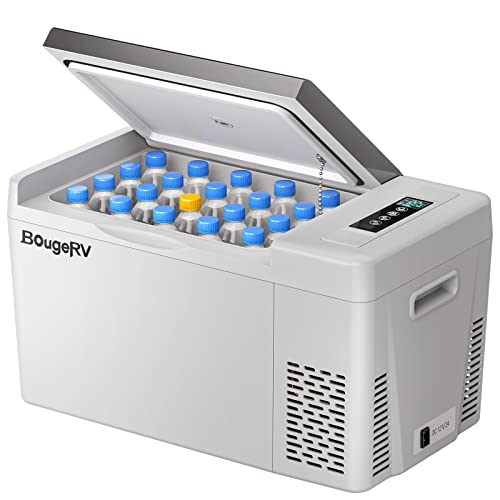
BougeRV 12V Refrigerator (23 Quart) — Best Fast Cooling
Trips do not always start from a cold kitchen. If your reality is loading a warm cooler in a hot car and needing it cold quickly — a late departure, a forgotten pre-cool, a roadside restock — the BougeRV 23 Quart is built around exactly that moment. Its listing claims a fast pull-down to 32°F in around 15 minutes, and its -8°F floor is the deepest in this roundup, giving frozen capability alongside fridge duty.
Strengths
- Fastest claimed pull-down in this list, a real advantage when pre-cooling was not possible
- Deepest low end here at -8°F, so it genuinely freezes as well as chills
- 23-quart capacity balances family supplies against a still-portable box
Trade-offs
- Aggressive cooling draws harder on the battery during pull-down; battery protection settings matter
- 50°F top end is lower than rivals, fine for chilling but less flexible for cool-not-cold storage
- Fast-cooling marketing across the category assumes a modest load; a packed warm box takes longer
| Capacity | 23 quart |
| Temperature range | -8°F to 50°F |
| Power | 12/24V DC, 110V AC |
| Cooling claim | 32°F in approx. 15 minutes (manufacturer figure) |
Treat the 15-minute figure the way engineers do: it describes the cabinet air reaching temperature under test conditions, not a warm six-pack becoming ice cold in the same span. Even discounted, the BougeRV’s pull-down pace is a genuine differentiator, and its deep low end makes it the most capable freezer here for travellers who split loads between chilled items and things that must stay hard-frozen.
The practical routine this cooler rewards: run it on MAX-style fast cooling while the engine runs and the alternator is generous, then let it cruise once at temperature. Paired with a power station for overnight stops, it covers the widest range of travel patterns of any single-zone pick in this guide.
Best for: travellers who load warm, leave late and need fast, deep cooling from one mid-size box / Not suited for: minimalists for whom a 23-quart box is more cooler than the trip requires
Check on Amazon — check the current price on Amazon before you buy, because listings and bundle contents change over time.

ICECO GO20 Dual Zone 12V Refrigerator (21 Quart) — Best Dual Zone
Some loads genuinely live at two temperatures: items that must stay frozen beside items that must stay merely chilled, where freezing would ruin them. The GO20 is the only dual-zone pick in this roundup, splitting 21 quarts into independently controlled compartments driven by a SECOP compressor — the compressor brand the premium end of this industry, including famous marine names, builds around. Its 0°F to 50°F range covers the chilled-to-frozen span travellers need.
Strengths
- True dual-zone control: two setpoints in one box, the only pick here that can do it
- SECOP compressor, the industry’s reference-grade component, known for efficiency and longevity
- Compact 21-quart total size despite the two-zone layout
Trade-offs
- Premium-tier pricing, the highest positioning in this roundup
- Splitting 21 quarts into two zones makes each compartment small; neither side is generous
- 0°F floor does not reach the deepest freeze of the BougeRV or Alpicool single-zones
| Capacity | 21 quart, dual zone |
| Temperature range | 0°F to 50°F |
| Compressor | SECOP |
| Power | 12/24V DC, 100-240V AC |
Dual-zone control changes packing from compromise to plan. The chilled side holds its setpoint without the frozen side dragging it down, and vice versa — the failure mode of single-zone boxes with divider boards, where everything slowly converges on one temperature. For travellers whose items have genuinely different storage requirements, that separation is not a luxury feature; it is the entire requirement, met in one box instead of two.
The SECOP compressor underwrites the purchase in a second way: efficiency. Dual-zone boxes work their compressors harder, and a compressor designed for mobile refrigeration sips less power per degree of cooling, which translates directly into longer runs from the same battery or power station. If your travel pattern involves days off-grid, that arithmetic matters as much as the zones themselves.
Best for: travellers who must hold chilled and frozen items simultaneously and value compressor quality / Not suited for: budget buyers, or anyone whose load fits happily at a single temperature
Check on Amazon — check the current price on Amazon before you buy, because listings and bundle contents change over time.

EUHOMY 23QT 12 Volt Refrigerator — Best Mid-Size Value
If the EUHOMY formula appeals but 19 quarts reads small for your trips, this 23QT version is the same recipe in a larger box: the full -4°F to 68°F compressor range, ECO and MAX modes, three-level battery protection, and dual AC/DC power. It suits travellers carrying supplies plus food and drinks for several days who still want value-tier pricing.
Strengths
- 23 quarts covers multi-day combined loads without stepping into bulky territory
- Same ECO/MAX flexibility and 3-level battery protection as the smaller EUHOMY
- Wide -4°F to 68°F setpoint range for fridge or freezer duty
Trade-offs
- Bigger box tempts overpacking; a full 23-quart cooler is a two-hand carry
- Single zone, so frozen and chilled items share one setpoint
- Value-tier finish, as with its smaller sibling
| Capacity | 23 quart |
| Temperature range | -4°F to 68°F |
| Power | 12V DC and 100-240V AC |
| Modes | ECO / MAX |
| Battery protection | 3-level |
Choosing between this and the 19QT is purely a packing question, and the right method is unglamorous: assemble your real travel load — supplies, containers, drinks, a day of food — and measure the volume it actually occupies. Travellers are routinely surprised in both directions. If the pile clearly overwhelms a shoebox-scale footprint, the 23QT’s extra space also improves airflow around items, which helps any cooler hold an even temperature.
Everything said about its sibling’s modes and battery protection applies unchanged, which is a compliment: EUHOMY’s control scheme is sensibly designed, and consistency across the range means the habits you learn on one model transfer. For families and longer itineraries, this is the value pick with headroom.
Best for: families and longer trips needing mid-size capacity at a value-tier position / Not suited for: solo travellers, for whom the 10 or 16-quart picks are easier to live with
Check on Amazon — check the current price on Amazon before you buy, because listings and bundle contents change over time.
Comparison Table
| Pick | Badge | Key spec | Best for |
|---|---|---|---|
| Alpicool C15 Portable Car Freezer (16 Quart) | Best Overall | 16 qt, -4°F to 68°F, compressor | solo travellers and couples wanting one compact, steady, set-and-forget cooler for multi-day road trips |
| Alpicool 10 Quart Car Refrigerator | Best Ultra-Compact | 10 qt, -4°F to 68°F, compressor | travellers carrying a compact set of items who value a tiny, always-in-the-car footprint |
| EUHOMY 19QT 12 Volt Refrigerator | Best Budget | 19 qt, -4°F to 68°F, ECO/MAX | first-time compressor-cooler buyers and value-focused travellers who will verify performance at home first |
| BougeRV 12V Refrigerator (23 Quart) | Best Fast Cooling | 23 qt, -8°F to 50°F, fast cool | travellers who load warm, leave late and need fast, deep cooling from one mid-size box |
| ICECO GO20 Dual Zone 12V Refrigerator (21 Quart) | Best Dual Zone | 21 qt dual zone, SECOP, 0–50°F | travellers who must hold chilled and frozen items simultaneously and value compressor quality |
| EUHOMY 23QT 12 Volt Refrigerator | Best Mid-Size Value | 23 qt, -4°F to 68°F, ECO/MAX | families and longer trips needing mid-size capacity at a value-tier position |
Capacity figures are manufacturer totals for the whole cabinet; usable space for rigid containers is always less, which is why the buying guide insists on a real-world dry fit. Temperature ranges are setpoint ranges from the verified listings — how evenly a loaded box holds a setpoint depends on load, ventilation and ambient heat, and should be confirmed with your own thermometer during your first trips.
How to Choose the Best 12 Volt Medical Cooler for Travel
Begin with the distinction that decides everything in this category: compressor versus thermoelectric. A compressor cooler is a true refrigerator. It holds its setpoint whether the car cabin is at 60°F or 100°F, and it can freeze. A thermoelectric cooler can only push its interior a limited distance below the surrounding air, so its interior temperature floats with the weather and the cabin. For travellers whose whole purpose is a dependable, steady chill, compressor is the only serious answer, and it is why every pick in this guide uses one.
Size the box to the load, not the trip length
Capacity mistakes run in both directions. Too small, and supplies get crushed, airflow stops, and temperatures turn uneven. Too large, and you haul air, drain more power cooling empty volume, and lose luggage space. Lay out everything the cooler must carry on a table, measure the pile, and buy the smallest cooler that swallows it with finger-width gaps for air circulation. For most solo and couple travel loads, that lands between 10 and 23 quarts — exactly the span of this roundup.
Read temperature range like an engineer
A wide setpoint range such as -4°F to 68°F gives you options: deep chill for frozen goods, ordinary fridge temperatures for daily supplies, gentler cooling for produce. What matters more than the extremes is stability at your chosen setpoint, and that is a function of compressor quality, insulation and how often the lid opens. Whatever you carry, follow its own labelled storage instructions, run the cooler at home first, and confirm with an inexpensive standalone thermometer that the cabinet holds the temperature you set, in the spot where your items will sit.
Plan the power chain end to end
A 12 volt cooler is only as reliable as its power. In the vehicle it runs from a 12/24V socket or, better, a fused direct connection; at a hotel or home, an AC adapter keeps it cold overnight. For stops where neither exists — campsites, ferries, long parking — a portable power station bridges the gap, and the cooler’s battery-protection settings decide whether it can ever endanger the vehicle’s starter battery. Set protection to medium or high in any vehicle you depend on, and treat low as a setting only for dedicated auxiliary batteries.
Keeping a Cooler Steady on the Move: Loading and Airflow
How you load matters as much as what you bought. Pre-chill the empty cooler for an hour before departure, and load items already cold from a home refrigerator; asking a small compressor to pull a warm load down while also fighting a hot cabin is how mediocre first impressions are made. Keep the items you need most often on top so the lid opens briefly and shallowly, and leave small gaps between containers so cold air can circulate — a cooler packed like concrete develops warm pockets no thermostat can see.
Ventilation is the second half of steadiness. The compressor and condenser need to shed heat, and a cooler wedged under luggage with its vents smothered will run constantly, draw more power and hold temperature worse. Leave a hand’s width around the vent panels, keep the box out of direct sun where possible, and in a parked vehicle, crack windows or choose shade with the same seriousness you would for a pet. These habits cost nothing and are worth more than a model tier.
Finally, monitor honestly. A small min-max thermometer inside the box tells you what actually happened overnight, not what the display hoped. For any load whose storage requirements are strict, that ten-dollar habit — plus following the item’s own instructions and your clinician’s or pharmacist’s guidance — is the difference between assuming and knowing.
Power Stations and Overnight Gaps: Keeping the Chain Unbroken
The hardest hours of any travel cooler’s life are the gaps: the night in a motel where the room’s only free socket is across the room, the ferry crossing, the long park at a trailhead. This is where a portable power station earns its place in the system. The arithmetic is simple and worth doing once for your own cooler: multiply the cooler’s average draw in watts by the hours of the gap, and choose a power station whose usable watt-hours exceed that figure with a third to spare. Compressor coolers cycle rather than run constantly, so their average draw in mild weather is well below their rated draw — but size for the hot day, not the mild one, because the hot day is when the contents matter most.
Two habits multiply whatever capacity you carry. First, keep the cooler on vehicle or wall power until the last possible minute, so the power station starts its shift with the box already cold and the load already chilled; maintaining temperature is far cheaper than achieving it. Second, park and pitch smart: a cooler in a shaded boot or a cool room corner cycles a fraction as often as one baking behind glass. Travellers who combine a modest power station with these habits routinely bridge gaps of a day or more, and the cooler’s own battery protection remains what it should be — a backstop that never actually fires.
Finally, rehearse the failure. On a home trial, unplug everything and watch how your thermometer log behaves across twelve hours on the power station alone. Knowing — not hoping — that your chain holds for the longest gap in your itinerary is the difference between a system and a wish, and it costs you one evening at home to find out.
Budget Tiers in This Category, Without Prices
Because this guide prints no prices, it owes you a map of the tiers instead. The budget tier — where the EUHOMY pair sits — buys a competent compressor, a wide setpoint range and battery protection, and spends its savings on finish, refinement and brand support. Nothing about that trade is shameful; it is why the tier exists, and owners who verify performance at home, as this guide keeps advising, extract full value from it. The mid tier — the Alpicool pair and the BougeRV — adds polish, stronger pull-down performance and, in BougeRV’s case, the deepest freeze in the list, at a moderate step up. The premium tier, represented here by the ICECO GO20, charges for the compressor brand, dual-zone engineering and efficiency, and repays travellers who run off-grid for days, where every watt-hour of efficiency is range.
The mistake the tiers punish is buying by tier rather than by requirement. A solo traveller with a 10-quart load gains nothing from the premium dual-zone except a bill; a traveller splitting frozen and chilled loads gains nothing from a budget single-zone except a compromise repeated daily. Read the verdict lines in the reviews as tier translations: each names the traveller for whom that tier is the correct spend. Then check price on Amazon on the day — tier positions move with promotions, and a mid-tier cooler on offer can undercut a budget model holding its price, which is the one legitimate reason to buy above your tier.
One last tier honesty: no tier in this guide changes the category’s fundamental boundary. Every pick, budget to premium, is a consumer travel cooler with a thermostat, not a certified medical device. The tiers buy cooling quality, capacity and efficiency — worth having, and worth describing accurately.
How to Set Up and Run a 12 Volt Travel Cooler
This routine takes a new cooler from delivery box to trustworthy travel duty. Do it at home, days before a trip that matters, so any surprise happens in your kitchen rather than at a border crossing.
Step 1: Unbox, rest and inspect
Compressor coolers travel best upright; if yours was shipped or stored on its side, let it stand upright for several hours before first power-on so compressor oil settles. Check the lid seal closes evenly all round and that both DC and AC cables are present.
Step 2: Pre-cool empty on AC power
Plug into wall power at home, set your target temperature, and let the empty box pull down and cycle for a few hours. This proves the compressor, controls and display before anything you care about goes inside.
Step 3: Verify with your own thermometer
Place a standalone thermometer or min-max logger where your items will ride and compare it against the cooler’s display over half a day. Note any offset between display and reality; every cooler has one, and knowing yours is basic travel competence.
Step 4: Set battery protection for your vehicle
Choose the medium or high battery-protection level if the cooler will run from a starter battery, so the cooler cuts off before the battery is too flat to start the engine. Reserve the low setting for dedicated auxiliary batteries and power stations.
Step 5: Load cold, load loose
Transfer items already chilled from your home fridge, keep air gaps between containers, put frequently needed items on top, and close the lid with intent. Avoid opening the box ‘just to check’ — that is what your thermometer log is for.
Step 6: Manage power at every stop
Keep the chain unbroken: vehicle power while driving, AC power in rooms, a power station for gaps. At each transfer, confirm the cooler is actually running — a cable knocked loose at a fuel stop is the most common cold-chain failure of all.
After the first trip, review your thermometer log and your power arrangements while the memory is fresh, and write down what the next trip should change. Two or three trips of this discipline turn a new cooler into a known quantity, which is the real goal: equipment whose behaviour you have verified, not equipment you hope behaves.
Common Buying Mistakes
Buying a thermoelectric cooler for a compressor’s job
Thermoelectric boxes cool relative to the surrounding air, so their interiors drift upward exactly when the day gets hot. For travellers who need a set temperature held steadily, that is a category error no bargain price can fix.
Assuming ‘medical cooler’ means a certified medical device
Portable 12 volt coolers are consumer appliances, however they are marketed in search results. Anything you carry with labelled storage requirements should be transported according to those instructions and professional advice, with the cooler’s real performance verified by your own thermometer first.
Skipping the home trial
The first run of any cooler should happen in your kitchen with a thermometer and nothing irreplaceable inside. Discovering a faulty unit, a confusing control or a display offset on departure morning is a self-inflicted wound.
Disabling battery protection
Setting battery protection to low, or buying a cooler without it, trades a cold box for a stranded vehicle. The cooler should always be the thing that shuts down; the engine starting is not negotiable.
Packing the box solid
A cooler crammed without air gaps develops warm pockets and uneven temperatures. Leave circulation room, keep the lid openings brief, and let the compressor manage air that can actually move.
Breaking the power chain at stops
Most travel cooling failures are unplugged cables and forgotten transfers, not failed compressors. Build a physical habit — touch the cable, see the display, hear the fan — at every stop.
Final Recommendation
If you buy one cooler from this list, buy the Alpicool C15: 16 quarts is the size travel loads actually are, and its compressor range and dual power make it the most adaptable pick here. Travellers carrying only a small set of items should shrink to the 10 Quart Alpicool and enjoy a cooler that lives in the car permanently; families and longer trips should step up to the BougeRV 23 Quart for its fast, deep cooling or the EUHOMY 23QT for the same capacity at a value position.
Choose the ICECO GO20 when two temperatures at once is a genuine requirement — it is the only dual-zone here, and its SECOP compressor justifies its premium tier for off-grid efficiency. Whichever you pick, check price on Amazon, dry-fit your real load before the return window closes, verify temperatures at home with your own thermometer, and follow the storage instructions of anything you carry. The hardware in this list can hold a steady chill for days; using it well is a routine, and routines are what make travel boring in the best way.
Shop the top picks: Alpicool C15 Portable Car Freezer (16 Quart), Alpicool 10 Quart Car Refrigerator, EUHOMY 19QT 12 Volt Refrigerator — check price on Amazon for each before you buy.
Related guides in this series: Best 12 Volt Mini Fridge Sailboat Best 12 Volt Marine Water Pump Best 12 Volt Meter Best 12 Volt Mini Air Compressor
Frequently Asked Questions
Are 12 volt travel coolers the same as medical refrigeration devices?
No. The coolers in this guide are consumer compressor appliances for travel. They can hold a set temperature steadily, which is why travellers choose them, but they are not certified medical devices. Always follow the storage instructions supplied with anything you carry and the advice of your clinician or pharmacist.
Compressor or thermoelectric — which do I need?
Compressor, for any load where the actual temperature matters. Compressor coolers hold a setpoint regardless of cabin heat and can freeze. Thermoelectric coolers only cool a limited amount below ambient air, so their contents warm up on hot days.
How long will a 12 volt cooler run from my car battery?
It depends on the cooler’s draw, the battery’s size and the battery-protection setting. With protection set correctly, the cooler will switch itself off before the battery is too flat to start the engine. For long parked periods, a portable power station or auxiliary battery is the right tool.
What size cooler do I need for travel?
Lay out everything it must carry and measure the pile. Most solo and couple loads fit in 10 to 23 quarts. Buy the smallest box that holds your load with small air gaps for circulation — oversized coolers waste power, space and money.
Can these coolers freeze as well as chill?
Yes — the compressor picks here reach 0°F or below, so they can keep items frozen as well as refrigerated. The ICECO GO20 can even hold a frozen zone and a chilled zone simultaneously. Follow each item’s own storage instructions when choosing a setpoint.
How do I know the cooler really held its temperature?
Put an inexpensive min-max thermometer or temperature logger inside with your items and read it at the end of the trip. The cooler’s display shows the setpoint and current reading; an independent logger shows the history, which is what actually matters.
Can I fly with a 12 volt cooler?
The coolers in this guide are vehicle and mains appliances, sized as luggage rather than cabin medical kits, and airline rules for powered cooling devices and any battery packs vary by carrier. Check your airline’s current policy well before travel, ship or hire at the destination if the rules do not fit, and never assume a device acceptable on one airline is acceptable on another.
How should I pack the cooler for the most even temperature?
Cold air sinks and still air stratifies, so pack with that physics in mind. Put the items that matter most in the middle of the load, surrounded by other cold items that act as thermal ballast, rather than against the warm lid or a sun-facing wall. Fill dead space with a towel or empty containers — a full cooler holds temperature better than a half-empty one because there is less air to warm at each opening — but leave the small circulation gaps this guide keeps mentioning, because a cooler packed solid develops warm pockets around its centre. Group items by when you will need them so each opening retrieves a whole stop’s worth at once. Finally, keep the cooler itself out of direct sun and off hot vehicle floors where possible; the cheapest degree of cooling is the one the sun never adds. Packed this way, any of the six picks will hold a steadier, more even temperature than a carelessly loaded premium box — loading is a feature, and it is free.


