Disclosure: airfryerkitchensupply.com is reader-supported. When you buy through links on our site, we may earn an affiliate commission at no extra cost to you.
Where to buy
Every best 12 volt marine fans pick in this guide is sold on Amazon, and that is the sensible place to buy them: the listings state the exact model, voltage range and mounting style before you pay, genuine Caframo and SEEKR models are easy to distinguish from lookalikes, and you can check the current price on Amazon across the whole shortlist in one sitting. Cabin fans are small and light, so ordering a pair — one for the bunk, one for the galley — costs nothing extra in shipping hassle.
- SEEKR by Caframo Sirocco II 12V/24V Fan (White) — check price on Amazon
- SEEKR by Caframo Sirocco II Fan (Black) — check price on Amazon
- Caframo Bora 12V Marine Fan — check price on Amazon
- Caframo Ultimate 757 12V 2-Speed Fan — check price on Amazon
- SEEKR Ultimate Fan by Caframo (White) — check price on Amazon
- TN TONNY DC 12V Marine Fan, 6 Inch — check price on Amazon
The best 12 volt marine fans do a job that air conditioning does badly on a small boat: they move air across skin, quietly, all night, on a trickle of battery power. At anchor there is no shore power and no generator you want to listen to until dawn — there is only the battery bank and whatever breeze the night provides. A good cabin fan turns a still, sticky berth into a place you can actually sleep, and it does it while drawing so little current that even a modest house bank barely notices.
This category has a clear establishment. Caframo — now selling many models under its SEEKR brand — has built marine fans for decades, and five of the six picks below come from that stable, because the verified listings show exactly what a boat fan needs: direct-wire 12-volt power (with several models auto-sensing up to 24 volts), low current draw, long-life motors, and designs that survive being grabbed, bumped and left running in a seaway. The sixth pick is a budget screw-mount fan that earns its place for simple jobs.
What a marine fan is not: it is not a household fan with a cigarette-lighter plug, and it is not a bilge blower. Household fans waste power through inverters and rattle themselves apart; bilge blowers are deafening ventilation devices for engine spaces, not cabin comfort. Everything below is a purpose-built cabin fan, hardwired into the boat’s 12-volt system, designed to run for thousands of hours within arm’s reach of a sleeping person.
In this guide
Quick Picks
The shortlist: the Sirocco II is the fan most boat owners end up loving, the Bora is the compact workhorse, the Ultimate designs trade the grill for finger-safe blades, and a budget TN TONNY covers simple duty.
- Best Overall: SEEKR by Caframo Sirocco II 12V/24V Fan (White) — the benchmark boat cabin fan — a gimballed, omnidirectional design that points anywhere and folds flat against the bulkhead, auto-sensing 12 or 24 volts, with famously low power draw. — Check on Amazon
- Best for Dark Interiors: SEEKR by Caframo Sirocco II Fan (Black) — the same benchmark Sirocco II in a black finish — identical gimbal, identical auto-sensing voltage and low draw — for cockpits, dark-trimmed cabins and fishing boats where white shows every mark. — Check on Amazon
- Best Compact Fan: Caframo Bora 12V Marine Fan — a small, three-speed, direct-wire fan with a stated 5000-hour motor life, in a housing just 6.5 by 3 by 9.5 inches — the fan for tight corners, small bunks and heads. — Check on Amazon
- Best Open-Blade Design: Caframo Ultimate 757 12V 2-Speed Fan — a 7-inch, two-speed, direct-wire fan from Caframo’s long-running Ultimate line — simple, proven and easy to mount, for owners who value mechanical simplicity over features. — Check on Amazon
- Best Grill-Free Fan: SEEKR Ultimate Fan by Caframo (White) — a grill-free fan whose soft, shock-absorbing FingerSafe blades make it safe to mount within grabbing distance of bunks and children — whisper-quiet, two speeds, direct wire. — Check on Amazon
- Best Budget: TN TONNY DC 12V Marine Fan, 6 Inch — the budget pick — a quiet 6-inch, screw-mounted 12V cabin fan with low power draw, for simple jobs on boats where a premium fan is hard to justify. — Check on Amazon
How These Picks Were Chosen
We chose cabin fans on the criteria that decide whether a fan is still loved in its third season: current draw, because overnight hours multiply quietly into real battery capacity; mounting and aiming, because a fan cools only where it points; noise, because a fan you can hear is a fan you will switch off at 3 a.m.; and construction for the marine environment, because cabin air is damp and salty even when the cabin looks dry.
Every fan here was verified through this site’s Creators API connection to Amazon listing data, and the spec boxes quote only what those listings state — voltages, mounting styles, dimensions and the Bora’s motor-life figure among them. Where a listing did not publish a figure, notably current draw in amps, we describe the fan in the listing’s own terms (“low draw”) rather than inventing a number, and we flag the budget pick’s unproven record plainly.
We excluded two categories on purpose. Cigarette-lighter and USB fans are portable accessories, not installed marine fans, and they belong in a different guide. Bilge blowers are safety ventilation equipment for engine compartments — loud, thirsty and entirely wrong for a cabin — and including them in a comfort-fan guide would be a category error.
- Overnight current draw weighed first — fans run for hours, not minutes
- Aiming and mounting judged as performance features, not cosmetics
- Hardwired 12V (or 12/24V) designs only; no plug-in accessories
- Specifications quoted only from verified listings
- Noise treated as a disqualifier, not a footnote
The 6 Best 12 Volt Marine Fans
Five of the six picks share one manufacturer’s DNA, and that is an honest reflection of this market rather than a lack of imagination: Caframo and its SEEKR brand simply make most of the serious cabin fans sold for boats. The differences that matter are in mounting, aiming, size and safety design — which is what the reviews below concentrate on.
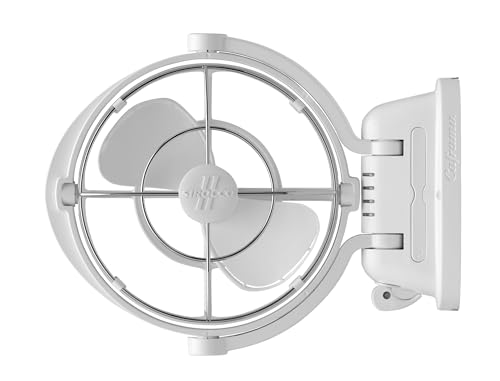
SEEKR by Caframo Sirocco II 12V/24V Fan (White) — Best Overall
Ask a dock full of cruisers which fan lives over their bunk and this is the name that comes back. The Sirocco II mounts on a gimbal that lets the fan body rotate and tilt to literally any angle — down at a bunk, up at the cabin top to stir warm air, sideways across a galley — and then folds flat out of the way when you need the space. It auto-senses whether the boat is wired 12 or 24 volts, draws very little power, and is built in Canada by the company that essentially invented this product category.
Strengths
- Omnidirectional gimbal aiming: the fan points exactly where you want air
- Folds flat against the bulkhead when not in use — precious in a small cabin
- Auto-sensing 12V/24V suits boats of either system voltage
Trade-offs
- Premium price for a cabin fan — most owners buy one, then come back for more
- Hardwired installation only; no plug-in option
- White finish shows scuffs in working-boat interiors (a black version exists, below)
| Voltage | 12V/24V auto-sensing DC |
| Mounting | Gimballed bulkhead mount, folds flat |
| Power | Low-power draw (per API listing title) |
| Installation | Hardwire required |
| Origin | Made in Canada |
The gimbal is the whole story, and it is hard to appreciate until you have lived with fixed fans. A fixed fan cools one spot — the spot it happened to point at during installation. Bodies move; cabins have more than one seat, more than one bunk, more than one hot corner. A fan that can be re-aimed in two seconds, silently, one-handed, in the dark, gets used constantly, and a fan that gets used constantly is worth every penny over one that cools the same square foot forever.
The low draw deserves its reputation too. Overnight fan use is where house banks quietly bleed: a thirsty fan can consume a meaningful slice of a small bank between dusk and dawn, multiplied by every cabin that has one. The Sirocco II was designed by people who understood that arithmetic, which is why it is the default fan on boats that live at anchor rather than at marinas.
Best for: sleeping cabins and any berth where aim and low draw matter / Not suited for: buyers wanting a plug-in fan they can move between boats
Check on Amazon — check the current price on Amazon before ordering, and confirm the listing matches the model described here.

SEEKR by Caframo Sirocco II Fan (Black) — Best for Dark Interiors
This is not a lesser trim level or a different fan wearing the same name: it is the Sirocco II, with the same omnidirectional mount, the same 12V/24V auto-sensing electronics and the same low power draw, finished in black instead of white. It gets its own place in this guide because finish is a legitimate buying criterion on a boat — black disappears against dark headliners, wood trim and fishing-boat interiors, and it hides the scuffs and fly-specks that make white fans look tired within a season.
Strengths
- Identical proven Sirocco II mechanism and electronics
- Black finish suits cockpits, wheels houses and dark interiors
- Same fold-flat, aim-anywhere gimbal as the white model
Trade-offs
- Same premium pricing as the white version
- Hardwire installation only
- Black housing absorbs heat in direct sun, a minor cosmetic consideration
| Voltage | 12V/24V auto-sensing DC |
| Mounting | Gimballed bulkhead mount, folds flat |
| Power | Low-power draw (per API listing title) |
| Installation | Hardwire required |
| Origin | Made in Canada |
There is a practical placement where the black version is not just prettier but better: the helm. A fan at the helm or in a wheelhouse keeps a skipper alert on night watches and demists the inside of windscreens by moving air across them, and in that working environment a white fan looks like galley equipment that wandered. The black Sirocco II belongs visually with the electronics and instruments around it.
Owners often mix finishes deliberately — white fans in the sleeping cabins where they blend with the headliner, black at the helm and in the cockpit. Because both colors are the same fan mechanically, spares, mounting habits and expectations carry across the whole boat, which is a small but real ownership convenience.
Best for: helms, cockpits and dark-trimmed cabins wanting the benchmark fan / Not suited for: bright white interiors where the standard white model disappears better
Check on Amazon — check the current price on Amazon before ordering, and confirm the listing matches the model described here.
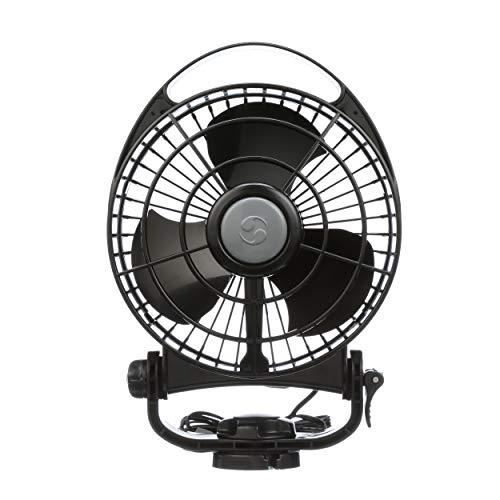
Caframo Bora 12V Marine Fan — Best Compact Fan
The Bora is the fan you fit where a Sirocco will not go. Its housing measures 6.5 by 3.0 by 9.5 inches per the verified listing, it wires directly into the 12-volt system, and Caframo rates the motor for 5000 hours of life — at eight hours a night, that is years of sleeping weather. In small cruising boats, truck campers that moonlight as boats’ shore transport, and cramped quarter berths, compactness is not a compromise; it is the entire requirement.
Strengths
- Smallest footprint in this guide; fits heads, quarter berths and tight corners
- Stated 5000-hour motor life gives a concrete durability figure
- Low draw suits overnight running on small battery banks
Trade-offs
- Smaller fan moves less air than the larger models here
- 12V only — no 24V auto-sensing
- Fixed-purpose design lacks the Sirocco’s fold-flat gimbal trick
| Voltage | 12V, direct wire |
| Motor life | 5000 hours (per API listing title) |
| Dimensions | 6.5 x 3.0 x 9.5 inches |
| Power | Low draw (per API listing title) |
A stated motor-life figure is rarer in this category than it should be, and it tells you something about the maker’s confidence. Fans die by their motors and bearings, not their blades, and a manufacturer willing to print a 5000-hour figure in the listing title is designing for the long, slow accumulation of overnight hours that defines marine fan use — a duty cycle household fans never see and are not built for.
Place the Bora thoughtfully and it punches above its size. Air movement is about placement as much as power: a small fan close to a sleeper, aimed along the bunk, feels stronger than a big fan across the cabin. In a head compartment, the same fan doubles as ventilation that keeps mirrors clear and air fresh. Small fans in the right spots beat big fans in the wrong ones, every time.
Best for: tight spaces — quarter berths, heads, small cabins — and close-range bunk cooling / Not suited for: large open cabins needing whole-space air movement
Check on Amazon — check the current price on Amazon before ordering, and confirm the listing matches the model described here.

Caframo Ultimate 757 12V 2-Speed Fan — Best Open-Blade Design
The Ultimate 757 is the traditionalist’s pick: a 7-inch fan, two speeds, direct-wire connection, black finish, and a design that has been moving air in boat cabins for years without asking for attention. There is no gimbal ballet and no electronics to configure — you mount it, wire it, and choose between two speeds with your fingertips. For a galley, a nav station, or a bunk in a working boat, that simplicity is a feature in itself.
Strengths
- Simple two-speed operation with nothing to configure or fail
- 7-inch size moves a useful volume of air for its class
- Long-running Caframo design with proven marine manners
Trade-offs
- Two speeds only — less fine control than three-speed rivals
- 12V direct-wire only; no 24V sensing
- Aiming flexibility is limited next to the gimballed Sirocco models
| Voltage | 12V, direct wire |
| Speeds | 2 speeds |
| Size | 7 inch |
| Finish | Black (per API listing title) |
There is a quiet argument for two speeds that feature lists obscure: most cabin fan use is binary. The fan is either on low, stirring the night air over a bunk, or on high, clearing cooking heat and steam from a galley. A third speed is nice; its absence is rarely felt. What is felt, nightly, is reliability — and a fan with fewer modes and a simpler switch has fewer ways to disappoint you at 2 a.m.
The 7-inch blade diameter sits in the sweet spot for cabin use: large enough to move real air at low, quiet speeds, small enough to mount on the bulkheads and cabin sides where fans actually live. Mount it high in a galley and it will do double duty — comfort for the cook and a steady push of cooking moisture out of the cabin.
Best for: galleys, nav stations and owners who prefer simple, proven equipment / Not suited for: buyers wanting fine speed control or fold-flat mounting
Check on Amazon — check the current price on Amazon before ordering, and confirm the listing matches the model described here.

SEEKR Ultimate Fan by Caframo (White) — Best Grill-Free Fan
Every other fan in this guide hides its blades behind a grill, because spinning blades and fingers are a bad combination. The SEEKR Ultimate takes the opposite approach: its blades are soft and shock-absorbing — the listing calls them FingerSafe — so the grill can be deleted entirely. The result is a fan you can mount low, close, and within reach of a bunk, a child’s berth, or a galley workspace, with nothing between the blades and the air they are moving.
Strengths
- FingerSafe soft blades remove the need for a grill — safe at grabbing distance
- Grill-free design is whisper-quiet and easy to wipe clean
- Direct-wire 12V with two speeds keeps installation simple
Trade-offs
- Open blades still deserve respect; mount with the maker’s guidance
- Two speeds only
- White finish only in this listing
| Voltage | 12V, direct wire |
| Speeds | 2 speeds |
| Design | Grill-free, FingerSafe shock-absorbing blades |
| Origin | Made in Canada |
The safety design changes where a fan can live, and placement is half of fan performance. A guarded fan over a child’s bunk must sit high and far; this fan can sit close enough to actually cool the child, at low speed, all night. The same logic applies to a cook working over a hot stove in a small galley, or a sleeper in a V-berth whose hands wander in the night — proximity without anxiety is the product here.
There is a maintenance dividend as well. Grills clog with the fine dust and cooking film that boat cabins accumulate, and cleaning them is a screwdriver job nobody does. An open-blade fan wipes clean with a damp cloth in seconds, which means it actually gets cleaned, which means it stays quiet and efficient instead of slowly choking on its own grill.
Best for: family boats, low bunks and anywhere a fan must live within reach / Not suited for: owners who simply prefer a traditional guarded fan
Check on Amazon — check the current price on Amazon before ordering, and confirm the listing matches the model described here.

TN TONNY DC 12V Marine Fan, 6 Inch — Best Budget
Not every fan position deserves the premium treatment. A fan for the head compartment, a spare bunk used twice a season, or a workboat wheelhouse needs to move air quietly, draw little power, and mount with a few screws — and that is precisely the TN TONNY’s listing: a 6-inch 12V cabin fan, screw-mounted, described as quiet with low power draw, aimed at marine, RV and truck use. It is the fan to buy when the alternative is no fan at all.
Strengths
- Lowest-cost route to a hardwired 12V cabin fan in this guide
- Simple screw mounting installs in minutes
- Low power draw suits overnight use on modest battery banks
Trade-offs
- No published motor-life figure or brand track record like Caframo’s
- Basic aiming and speed control compared with the premium picks
- Long-term durability in salt air is unproven
| Voltage | 12V DC |
| Size | 6 inch |
| Mounting | Screw mounted |
| Power | Low-power draw (per API listing title) |
Budget fans have a legitimate strategy behind them: coverage. Two budget fans — one over each bunk — often deliver more real comfort than one premium fan asked to serve a whole cabin, because air movement is local. If the choice is between perfect equipment in one spot and good-enough equipment in every spot where people actually sleep, the second boat sleeps better.
Buy this fan with the right expectations and it will not disappoint: mount it securely so it cannot buzz against the bulkhead, wire it with a proper fused circuit like any other fan, and treat it as a consumable with a shorter expected life than the Caframo picks. For a head, a spare berth or a project boat, that is a perfectly sound piece of seamanship.
Best for: secondary positions — heads, spare bunks, workboats — and tight budgets / Not suited for: the main sleeping cabin on a boat you live aboard for weeks
Check on Amazon — check the current price on Amazon before ordering, and confirm the listing matches the model described here.
Comparison Table
| Pick | Badge | Key spec | Best for |
|---|---|---|---|
| SEEKR by Caframo Sirocco II 12V/24V Fan (White) | Best Overall | 12/24V, gimballed, folds flat | Bunks and main cabins |
| SEEKR by Caframo Sirocco II Fan (Black) | Best for Dark Interiors | 12/24V, gimballed, black finish | Helms and dark cabins |
| Caframo Bora 12V Marine Fan | Best Compact Fan | 12V, 5000-hour motor, compact case | Small spaces and bunks |
| Caframo Ultimate 757 12V 2-Speed Fan | Best Open-Blade Design | 12V, 2 speeds, 7 inch | Galleys and work spaces |
| SEEKR Ultimate Fan by Caframo (White) | Best Grill-Free Fan | 12V, grill-free FingerSafe blades | Family boats and low bunks |
| TN TONNY DC 12V Marine Fan, 6 Inch | Best Budget | 12V, 6 inch, screw mount | Budget and secondary spots |
The table’s real dividing lines are aiming and safety. The Sirocco pair aim anywhere and fold away; the Ultimate pair trade aiming for simplicity, with the white model adding finger-safe open blades; the Bora wins on size; the TN TONNY wins on price. Decide where the fan will live first — that answer picks the fan more reliably than any specification.
How to Choose a 12 Volt Marine Fan
Start with the mounting location, because it eliminates most options immediately. A bunk wants a fan that can aim down and along the berth. A galley wants a fan mounted high that can push heat and steam toward a hatch. A head wants small and simple. A helm wants a fan that can also sweep the windscreen. Only once the location is fixed does it make sense to compare speeds, sizes and prices.
Next, do the overnight arithmetic. Multiply the fan’s draw by the hours it will run — eight is a realistic night — and then by the number of fans aboard. On a boat with a generous lithium house bank the total is trivial; on a small boat with a single lead-acid battery it can be the difference between a comfortable night and a flat battery. This is why every pick in this guide is a low-draw design, and why the low-draw claim matters more than blade diameter.
Finally, think about who sleeps near the fan. Adults in a main cabin can live with any guarded fan. Children, restless sleepers and low bunks argue for the grill-free FingerSafe design. Guests in a spare berth argue for the budget pick. The best fan is the one matched to its sleeper, not the one with the longest feature list.
- Fix the location first; it eliminates most of the field
- Calculate overnight amp-hours for every fan aboard
- Match safety design to who sleeps within reach
- Prefer hardwired fans for permanent positions
- Two modest fans usually beat one premium fan for whole-cabin comfort
Where to Mount Cabin Fans for the Most Comfort
Air movement cools people, not rooms, so mount fans where the air stream crosses skin: at the head of a bunk aimed along the body, over a settee aimed at seated height, in a galley aimed at the cook rather than the stove. A fan stirring empty air at the cabin top is decoration.
Cross-ventilation multiplies any fan’s effect. A fan exhausting warm air through a hatch or port while another draws cooler air in from low on the opposite side creates a through-draft that a single fan in a sealed cabin cannot match. On still nights at anchor, rigging the boat for airflow — hatches open, windscoop up if you carry one, fans assisting the natural path — is worth more than any single product in this guide.
How Much Power Does a 12V Cabin Fan Use Overnight?
Less than most owners fear, provided the fan was designed for boats. Marine cabin fans are built around the reality that they run all night on battery power, and the picks here are all described in their listings as low-draw designs. Even so, the honest way to plan is arithmetic, not adjectives: find the draw figure in the fan’s documentation, multiply by hours and by fan count, and hold that total against your house bank’s usable capacity.
The comparison that puts it in perspective is lighting. A night of cabin fans typically costs a healthy house bank less than an evening of old incandescent cabin lights did — and modern LED lighting plus efficient fans together are why today’s boats can anchor out for days on banks that would once have lasted a weekend. If your bank is small, the Bora and the Sirocco models are the picks designed with your arithmetic in mind.
Fan Noise: Why Quiet Is a Specification, Not a Luxury
A cabin fan’s real working environment is a sleeping boat at 3 a.m., and in that environment noise is not a preference — it is the difference between equipment that runs and equipment that gets switched off. Noise aboard comes from three sources: the motor itself, the airflow, and — most commonly and most fixably — vibration transmitted into the bulkhead, which turns the boat’s structure into a sounding board. A fan that measures acceptably on a bench can drone unbearably through a fiberglass panel at a sleeper’s head height.
This is why the picks in this guide lean toward designs with marine pedigrees: their makers design for the night-watch test, balancing blade and housing so the sound that remains is smooth airflow rather than mechanical complaint. The grill-free SEEKR Ultimate removes one entire noise source — air chopping through a grill — which is part of why its listing leads with quiet. And it is why installation matters as much as selection: a fan mounted firmly to a backed, solid surface, with its cable supported so it cannot buzz, will always be quieter than the same fan screwed into a flexing panel.
Judge a new fan at night, in the berth, at the speed you will actually sleep with — usually the lowest. If it annoys you in the marina, it will not improve at anchor. The good news is that every fan in this guide was chosen by people who understand that the lowest speed is the product, and the higher speeds are merely a bonus for galleys and still afternoons.
Fans and the Rest of the Cabin Climate System
A fan is one tool in a cabin climate system that also includes hatches, ports, windscoops, shades and the boat’s own motion at anchor. Used together, they multiply: a boat swung head-to-wind with a windscoop over the forehatch pours air through the cabin that a fan then distributes to the corners the breeze cannot reach. Aft cabins and enclosed heads — the spaces natural airflow forgets — are where fans stop being helpers and become the entire system.
Shading is the fan’s silent partner. A boom tent or awning that keeps sun off the deck can lower cabin temperature by several degrees, moving the fan’s job from “fight the heat” to “stir the shade”, which it does at its lowest, quietest, least power-hungry speed. Cruisers who rig shade and fans together routinely sleep comfortably in anchorages where unshaded boats run generators for air conditioning — a difference measured not just in comfort but in the entire character of the evening.
Plan the cabin as a system when you refit: shade above, airflow paths through, fans at the sleeping and working positions, and a battery bank sized for the total. Each element is cheap compared with air conditioning; together they deliver most of its comfort at a fraction of its power, noise and complexity.
Fans for Specific Spaces: Head, Galley and Helm Notes
Three cabin spaces deserve individual fan logic. The head wants ventilation as much as comfort: a small fan exhausting through a port or vent clears steam and moisture that otherwise feed mildew, and the compact Bora or the budget TN TONNY in this guide suits the space and the duty perfectly. Run it during showers ashore-style and for a while after, and the head stays the freshest small room on the boat.
The galley wants power and height: heat and cooking moisture rise, so a fan mounted high and aimed to push that air toward a hatch does double duty — cooling the cook on its way. The Ultimate 757’s simplicity suits a space where hands are wet and busy. The helm wants aim and discretion: a gimballed Sirocco, black in a wheelhouse, sweeps the windscreen against misting, cools the watchkeeper at 3 a.m., and folds away when the harbor maneuvering needs every inch of visibility and space.
Cleaning and Caring for Cabin Fans
Cabin fans ask for little: a wipe, a check, and an occasional listen. Dust and cooking film accumulate on blades and grills through a season, unbalancing blades minutely and muffling airflow; a damp cloth restores both quiet and performance in minutes — a job the grill-free SEEKR Ultimate makes almost trivially easy. Do it at the same rhythm as other cabin housekeeping and the fan never gets the chance to become the rattling nuisance that gives cabin fans a bad name.
Once a season, check the mount’s screws for the loosening that vibration patiently works on everything aboard, confirm the wiring and its fuse are sound, and run the fan through its speeds listening for bearing wear — a new roughness in the sound is the motor’s early resignation letter, arriving while replacement is still a choice rather than an emergency. Fans maintained this way routinely outlast their owners’ expectations, which is the quiet hallmark of every pick in this guide.
A Note on Fans in Winter and Storage
Fans earn a final mention for the season when nobody is aboard to enjoy them. A cabin left closed for winter traps moist air against cold hull surfaces, and the mildew that follows is the quiet tax of storage. Where shore power or solar keeps a bank alive, a cabin fan run periodically — on a timer where the system allows — stirs that air, evens the temperature, and measurably discourages the damp corners where mildew starts. It is not a substitute for ventilation and a dry boat at lay-up, but as part of a storage routine it is nearly free insurance. The same fan that cools the crew in July protects the cabin in January, which is a fair summary of why simple, reliable 12-volt equipment earns its place aboard.
How to Install a Hardwired 12V Cabin Fan
Hardwiring a cabin fan is one of the most satisfying small electrical jobs on a boat: an hour’s work, basic tools, and a comfort upgrade you will feel every single night at anchor. The rules are the usual marine ones — fuse the circuit, use proper cable, and mount the fan so it cannot work loose in a seaway.
- Choose the mounting spot with the fan powered temporarily if possible, and confirm the air stream actually crosses the bunk or workspace it serves.
- Mark and drill mounting holes; on thin fiberglass or headliner panels, use a backing pad so screws hold in material with some substance.
- Run marine duplex cable from the fan to the distribution panel, protecting it where it passes through bulkheads and keeping it clear of moving gear and hot surfaces.
- Connect the fan circuit to a fused breaker or fuse sized for the fan’s draw, and label it at the panel — future troubleshooting starts with labels.
- Wire positive and negative with crimped, sealed terminals; support the cable so its weight never hangs on the fan’s own leads.
- Mount the fan, aim it, and test every speed; listen for buzzes or rattles and correct the mounting now, not at midnight.
- Run the fan for a full evening before the first overnight trip and confirm the battery bank’s morning voltage looks exactly as expected.
A final placement trick from liveaboard practice: if a fan must serve two positions — a settee by day, a bunk by night — the gimballed Sirocco models earn their price in that single trick, swinging between the two without tools. Fixed fans should be bought per position; gimballed fans can be bought per cabin.
Common Buying Mistakes
Buying a household fan and an inverter. Running a mains fan through an inverter wastes power in conversion, adds a humming box to the cabin, and subjects a land appliance to a salt environment it was never built for. Native 12V fans exist for every position on a boat; use them.
Mounting the fan where it cannot reach the sleeper. A fan bolted wherever the screws fit easily, stirring air over empty floor, cools nobody. Air must cross skin to work. Temporarily power the fan and sit where you will sleep before drilling a single hole.
Ignoring overnight power draw. One fan is a sip; four fans across two cabins, a head and a galley are a real line item in the battery budget. Do the arithmetic for the whole boat, not the single purchase.
Choosing a guarded fan for a child’s low bunk. Grills keep fingers out only while they stay attached and intact, and low bunks put small hands at fan height. The grill-free FingerSafe design exists for exactly this berth; use the right tool.
Forgetting the circuit needs a fuse and a label. Fans are small loads, and owners wire them casually — tapped into lighting circuits, unfused, unlabeled. Every fan deserves its own fused, labeled circuit, because the night it fails is the night you will be tracing wires by torchlight.
Final Recommendation
For most boats the answer is the Sirocco II — white for bright cabins, black for helms and dark interiors — bought one per sleeping cabin as the budget allows. Tight spaces take the Bora; simple, proven duty takes the Ultimate 757; family boats with low bunks take the grill-free SEEKR Ultimate; and secondary positions take the TN TONNY without a shred of shame. Every one of them will make nights at anchor measurably better, which on a boat is about the highest praise equipment can earn.
Fans spend the power your batteries store, so keep the whole system in view: the batteries in Best 12 Volt Marine Deep Cycle Battery and Best 12 Volt Marine Battery For Trolling Motor, the chargers in Best 12 Volt Marine Battery Charger, and the other 12-volt comforts that share the bank — Best 12 Volt Marine Tv for the evening’s entertainment and Best 12 Volt Marine Horns for the safety side of the electrical system.
If you are ready to buy, start with these three: SEEKR by Caframo Sirocco II 12V/24V Fan (White), SEEKR by Caframo Sirocco II Fan (Black), Caframo Bora 12V Marine Fan. Each link goes to the exact model reviewed above — check the current price on Amazon and confirm the model name matches before ordering.
Frequently Asked Questions
How much battery power does a marine fan use overnight?
It depends on the fan and speed, which is why this guide favors designs whose listings emphasize low draw. Do the arithmetic for your own boat: multiply the fan’s stated draw by the hours it runs and the number of fans aboard, and compare with your bank’s usable capacity. For most healthy house banks, a night of cabin fans is a modest line item.
Can I run a 12V fan on a 24V boat?
Only if the fan is rated for it. The Sirocco II models in this guide auto-sense 12 or 24 volts; the other picks are 12V designs and would be damaged by a 24V supply. Check the voltage rating before wiring any fan on a 24V boat.
Are grill-free fans really safe near children?
The SEEKR Ultimate’s blades are soft and shock-absorbing by design — the listing calls them FingerSafe — specifically so the fan can run without a grill within reach of bunks. They are the correct choice for low berths and family boats, mounted following the maker’s guidance.
Where is the best place to mount a fan in a V-berth?
High at the forward end, aimed back along the berth so air crosses both sleepers, or low and close if it is the grill-free model. Temporarily power the fan and lie in the berth before drilling — five minutes of testing beats a season of almost-right airflow.
Can a cabin fan help with condensation?
Yes. Moving air across cabin surfaces and through lockers discourages the still, saturated air that condenses on hull sides and under mattresses. A fan run periodically in an unused cabin is cheap insurance against mildew, especially combined with vents left open.
How long should a marine cabin fan last?
The Bora’s listing states a 5000-hour motor life, which at eight hours a night is several seasons of nightly use — a useful benchmark for the category. Premium fans commonly outlast that in practice; budget fans should be bought expecting a shorter life, which their price reflects.


