Disclosure: airfryerkitchensupply.com is reader-supported. When you buy through links on our site, we may earn an affiliate commission at no extra cost to you.
Where to buy
Shoppers comparing the best crock pots or slow cookers can find every model below in the makers’ current ranges. Choose size and timing style first, then check price on Amazon for your finalists.
- Crock-Pot Oval Manual Slow Cooker 7-Quart — Check price on Amazon
- Crock-Pot 6-Quart Cook & Carry Programmable Slow Cooker — Check price on Amazon
- Crock-Pot 7-Quart Programmable Slow Cooker With MyTime — Check price on Amazon
- Crock-Pot Manual Slow Cooker 8-Quart — Check price on Amazon
- Crock-Pot Manual Slow Cooker 3-Quart — Check price on Amazon
- West Bend 4-Quart Manual Slow Cooker — Check price on Amazon
Prices and availability change often, so check price on Amazon before you decide rather than relying on any number quoted elsewhere.
Introduction: The Appliance That Never Left
The best crock pots or slow cookers — the terms mean the same appliance, one a brand name turned generic — survive every kitchen fashion because they solve a permanent problem: dinner that cooks itself while life happens elsewhere. Load the stoneware in the morning, and eight gentle hours later the toughest, cheapest cuts in the shop have become the tenderest food in the house. This guide compares six verified machines across the category’s real decisions — manual versus programmable versus finish-time smart, 3 quarts versus 8, Crock-Pot versus the heritage alternative — so the cooker you buy matches the household you actually run.
Three questions organise everything. First, timing: will someone be home to switch a manual dial off, does the day need a programmable timer that holds warm, or is your schedule so fluid that only MyTime’s finish-time logic will protect dinner? Second, size and shape: count your people, then your roasts — oval crocks fit the food, and a crock cooks best half to two-thirds full, so buy the size your dinners actually fill. Third, role: a household’s only cooker, a crowd cooker, or the small second crock for sides and oats are three different purchases wearing one name. Every model below was verified as current before inclusion, mini-box specs come from the verified listings, and we say check price on Amazon throughout rather than printing numbers that stale.
In this guide
Quick Picks
- Crock-Pot Oval Manual Slow Cooker 7-Quart — Best Overall: The classic done right: a big oval stoneware crock, glass lid, high/low/warm and room for the roasts other shapes refuse. — Check on Amazon
- Crock-Pot 6-Quart Cook & Carry Programmable Slow Cooker — Best Programmable: A digital timer that cooks then holds warm, plus a locking lid — the slow cooker for workdays and potlucks alike. — Check on Amazon
- Crock-Pot 7-Quart Programmable Slow Cooker With MyTime — Best for Unpredictable Schedules: Tell it when you will eat; MyTime adjusts the cycle so dinner is ready at that hour — not hours before it. — Check on Amazon
- Crock-Pot Manual Slow Cooker 8-Quart — Best for Crowds: Eight quarts of family-size stoneware with simple high/low/warm settings — the feast, batch and holiday cooker. — Check on Amazon
- Crock-Pot Manual Slow Cooker 3-Quart — Best Small Slow Cooker: A 3-quart stoneware crock sized for one to three people — dips, sides, small stews — without a giant pot to wash. — Check on Amazon
- West Bend 4-Quart Manual Slow Cooker — Best Budget Alternative: A 4-quart oval ceramic crock with a glass lid and keep-warm, from the other heritage name in slow cooking — at a friendly cost of entry. — Check on Amazon
How These Picks Were Chosen
We limited the field to slow cookers and crock pots verified against current catalogue data — every model here is real and orderable — and scored stoneware quality and shape, honest capacity, timing controls from manual through programmable to finish-time intelligence, lid design including travel locks, cleaning burden and spare-parts availability. We deliberately spanned the category’s full range: the classic benchmark, both programmable philosophies, the crowd size, the small size, and the strongest alternative brand, because the right answer in this category is always a fit, never a flagship. Pressure multi-cookers were excluded by this guide’s brief and are covered in our crock multi-cookers roundup. Ratings and review counts played no part in selection — they fluctuate constantly and cannot assess a crock.
The 6 Best Crock Pots or Slow Cookers to Buy

Crock-Pot Oval Manual Slow Cooker 7-Quart — Best Overall
In any honest comparison of the best crock pots or slow cookers, the classic oval Crock-Pot is the machine to beat: seven quarts of stoneware under a glass lid, three honest settings, and a shape that fits the food slow cooking exists for.
Strengths
- Oval stoneware fits roasts, shoulders and whole chickens flat
- Glass lid lets you monitor without lifting and losing heat
- Dead-simple controls the whole household can run
Trade-offs
- Manual only — no timer, no programming
- Stoneware is heavy when loaded
- No locking lid for transport
| Detail | What to know |
|---|---|
| Capacity | 7-Quart, serves 8+ (Amazon title) |
| Settings | High/Low cook, Warm (Amazon title) |
| Insert | Removable oval stoneware (Amazon title) |
The case for this Crock-Pot as Best Overall is the case for the classic itself. Slow cooking rewards three things — even gentle heat, a moist sealed climate and a vessel shaped like the food — and the oval stoneware crock delivers all three without a single electronic intermediary. A pork shoulder lies flat and submerged; a whole chicken cooks in its own juices under a glass lid you can read at a glance, without lifting it and taxing the cook with lost heat. The manual dial is a virtue disguised as simplicity: high, low, warm, nothing to program and nothing to fail, operable identically by every generation of a household. Stoneware’s thermal mass smooths the heating element’s cycles into the steady, low braise that melts connective tissue into tenderness, and the crock then goes to the table, the fridge and the dishwasher as servingware. Its limits are the honest ones of its kind: it will not time itself, it will not travel locked, and it is heavy with a full load. But judged as the slow cooker most households will use most happily for most years, the original formula, at family size, in oval — remains unbeaten, which is why it has been copied for half a century.
Ownership craft for the classic: fill between half and two-thirds for the most even cooking, layer root vegetables beneath the meat where heat and liquid concentrate, and treat the glass lid as a window rather than a door — every lift costs the cook real time. The warm setting holds a finished dish beautifully for an hour or two of service; it is not a second cooking mode. Handle stoneware kindly — no cold water into a hot crock — and this cooker will out-serve most of the electronics in your kitchen.
There is a final, unfashionable argument for the manual classic: it will be repairable and understandable forever. No boards, no sensors, no firmware — a heating element, a dial and a stone pot, a system any future decade can maintain. In a guide full of cleverness, the classic’s claim is endurance, and endurance is why so many of these are inherited rather than bought.
Best for: most households buying one slow cooker / Not suited for: commuters needing timers or travellers
Check the current price on Amazon
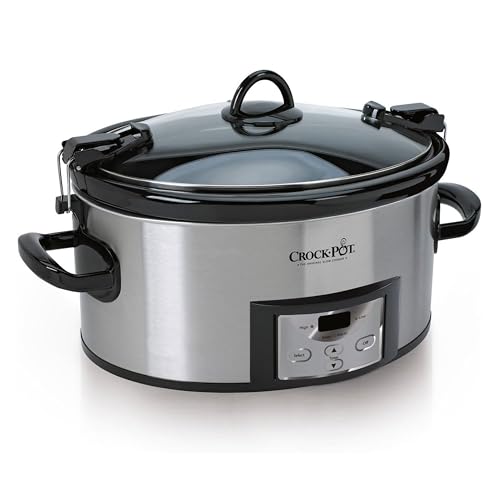
Crock-Pot 6-Quart Cook & Carry Programmable Slow Cooker — Best Programmable
Programmability is the first upgrade most slow-cooker owners want, and this is the canonical version: set the hours, the cooker cooks and shifts to warm by itself, and the locking lid means the same machine travels to wherever dinner is happening.
Strengths
- Timer plus auto-warm ends the overcooked-by-commute problem
- Locking lid makes it the travel and potluck standard
- Family-honest 6-quart capacity
Trade-offs
- Programmable within a set window, not finish-time smart
- Gasket needs a wash after saucy cooks and trips
- Unlock before serving — a habit to teach the household
| Detail | What to know |
|---|---|
| Capacity | 6 Quart (Amazon title) |
| Controls | Programmable with digital timer (Amazon title) |
| Lid | Cook & Carry locking lid (Amazon title) |
Programmability changes who a slow cooker serves. A manual crock cooks for the person who is home; this one cooks for the person who is not. Set the cooking hours in the morning and the machine cooks, then steps down to warm and holds dinner in condition until the household reassembles — the difference between a slow cooker as a weekend hobby and a slow cooker as weekday infrastructure. The locking Cook & Carry lid then extends the same machine outward: gasketed and clamped, it carries its dinner to potlucks, tailgates and family tables without the car-boot incidents that end lesser lids’ careers. The rituals are minor and learnable — unlock before serving so steam escapes away from hands, wash the gasket after anything tomato-rich — and the spares are standard and cheap. It is not the smartest cooker in this guide; the MyTime model reasons about finish times more cleverly. But as the complete programmable package — timer, warm hold, travel integrity, family size — it is the slow cooker the largest number of real households should buy, and its years as the category’s default recommendation were earned one commute at a time.
Cook & Carry owners develop the potluck liturgy: cook, lock, carry flat, unlock at the table, serve. At home the timer earns its keep differently — a stew set for the true length of the workday, then held warm for the staggered arrivals of a real family evening. Buy a spare gasket when you buy the cooker and the machine’s one consumable is solved for years; the rest is stoneware and a dial, which is to say, nearly nothing can go wrong.
Note also what programmability does to a household’s cooking range: dishes that need six hours stop being weekend-only, because the machine manages the finish while the house is empty. That expansion of the weekday repertoire — not any single dinner — is the feature’s true return, and it compounds every week the cooker is used.
Best for: working households and potluck regulars / Not suited for: set-by-the-clock purists wanting finish-time logic
Check the current price on Amazon

Crock-Pot 7-Quart Programmable Slow Cooker With MyTime — Best for Unpredictable Schedules
MyTime inverts slow-cooker logic. Instead of cooking for a fixed count of hours and holding, it asks for your eating time and the dish, then modulates the cycle to land the food at ready exactly then — the answer for evenings that refuse to be scheduled.
Strengths
- Finish-time cooking protects food from long warm holds
- Generous 7 quarts with a travel-ready locking lid
- Set by meal and hour — no mental arithmetic
Trade-offs
- Costs more than fixed-timer models
- The logic requires one trusting read of the manual
- Slow-only, like everything in this guide
| Detail | What to know |
|---|---|
| Capacity | 7-Quart (Amazon title) |
| Technology | MyTime adjusts cooking (Amazon title) |
| Lid | Cook & Carry locking lid (Amazon title) |
MyTime exists because of a specific, universal experience: the slow cooker did everything right, and dinner was still ruined — by the meeting that ran long, the train that did not, the evening that slid two hours past the plan while the stew held and held and dried at the edges. Fixed timers cannot help; they count hours, not readiness. MyTime instead takes the two inputs that actually matter — what is cooking, and when you will eat — and shapes the temperature curve between now and then, so the dish arrives at done at the hour named, whether the interval was six hours or ten. That is a genuinely different machine wearing a familiar shape, and for households whose schedules are aspirational rather than real, it is the difference between slow cooking that fits their life and slow cooking that lectures it. The surrounding package is generous — seven quarts, a locking travel lid, standard stoneware virtues — and the discipline it asks is a new kind of honesty: tell the machine the true hour, and trust it with the curve.
MyTime rewards one experiment: cook the same stew twice, once on a fixed timer that ends two hours before dinner, once on MyTime set to the dinner hour, and taste the difference the curve makes. Owners who run that test stop describing the feature as a gimmick. Afterward, the machine’s whole demand is honesty at setup — the real eating hour, the real dish — which is a pleasant discipline to be asked for by an appliance.
MyTime also travels, via its locking lid, which makes it the rare smart appliance that is also the potluck appliance. Intelligence plus portability is an unusual pairing, and households that both work unpredictably and socialise generously will find this the single cooker that covers their whole calendar.
Best for: households whose evenings run late unpredictably / Not suited for: buyers who keep strict, known schedules
Check the current price on Amazon

Crock-Pot Manual Slow Cooker 8-Quart — Best for Crowds
Some slow cooking is measured in crowds: the holiday side dish, the double batch for the freezer, the soup for the whole street. This 8-quart manual Crock-Pot is the category’s big simple answer — maximum stoneware, minimum complication.
Strengths
- Largest capacity here for genuine crowd cooking
- Simple manual controls that will never confuse a helper
- Batch-cooking economics: one cook, many meals
Trade-offs
- Big and heavy — needs a real storage home
- Manual settings only
- Oversized for couples’ everyday dinners
| Detail | What to know |
|---|---|
| Capacity | 8-Quart, serves 10+ (Amazon title) |
| Settings | High/Low, Warm (Amazon title) |
| Insert | Removable stoneware (Amazon title) |
Eight quarts is a statement about how a household eats: in gatherings, in batches, in quantities that make leftovers a plan rather than an accident. This manual Crock-Pot serves that life with the category’s simplest possible interface — a dial, three settings, an enormous stoneware crock — because at crowd scale, reliability and capacity outrank cleverness every time. It is the holiday cooker (the side dish that frees the oven), the batch cooker (the Sunday stew that becomes four weeknight dinners), and the community cooker (the soup that feeds the street after the storm). Manual controls mean any helper can run it without instruction, and stoneware means the food holds its gentle heat through a long, unstructured service. The costs are physical: it is big to store, heavy to carry loaded, and faintly absurd for a couple’s Tuesday soup — those households should buy the 3-quart or the 7-quart oval and leave this one to the crowd cooks it was built for. Within its brief, it is complete: the largest honest slow cooker in this guide, doing the oldest job at the biggest scale.
Crowd-crock craft: at eight quarts, seasoning scales sub-linearly — double the food does not need double the salt or spice at the start; season, cook, and correct at the end, because a sealed crock concentrates as it goes. The big crock also proofs dough beautifully on warm in a cold kitchen and holds mulled drinks at gatherings, two second careers that make its storage footprint easier to defend in February than in November.
And when the crowd is not coming, the 8-quart still earns its shelf as the freezer’s best friend: one enormous cook, portioned and frozen, is meal prep at its most efficient — an hour of assembly for a week of dinners, which is the slow cooker’s founding promise kept at full scale.
Best for: large families, batch cooks and holiday hosts / Not suited for: small households
Check the current price on Amazon
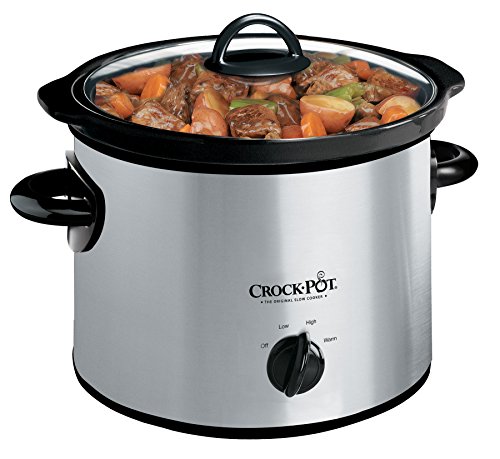
Crock-Pot Manual Slow Cooker 3-Quart — Best Small Slow Cooker
Big crocks cook small dinners badly — too little food in too much pot dries and scorches at the edges. This 3-quart Crock-Pot is the right-sized tool for couples, small households, side dishes and the legendary warm dip at a party.
Strengths
- Right-sized batches cook evenly and taste right
- Compact footprint and easy washing
- Perfect second cooker for sides and dips
Trade-offs
- Too small for roasts or family mains
- Manual controls only
- Not a household’s only slow cooker, for most
| Detail | What to know |
|---|---|
| Capacity | 3-Quart, serves 3+ (Amazon title) |
| Settings | High/Low, Warm (Amazon title) |
| Insert | Removable stoneware, oven safe (Amazon title) |
Small slow cookers are not lesser slow cookers; they are correctly sized ones, and sizing is a cooking variable. A stew for two in a 7-quart crock spreads thin, loses its braising depth and scorches at the edges; the same stew in this 3-quart stoneware sits deep in its liquor and cooks the way the recipe intends. That is the whole argument, and it is decisive for couples, singles who cook, and small households — plus every household that wants a second cooker for the side dish, the steel-cut oats overnight, or the warm dip that makes a party. The manual controls keep it thoughtless, the stoneware keeps it honest, and the footprint keeps it on the counter where small appliances must live to be used. It will not take a roast or feed a family main course, and it does not pretend to; within its size class it is the benchmark, and as a companion to a big crock it may be the most-used cooker in a two-cooker kitchen — which, once you have cooked a holiday meal with help, is a kitchen configuration this guide warmly recommends.
The 3-quart’s second career is breakfast: steel-cut oats loaded at night are ready at waking, a trick that converts households to the small-crock cause permanently. It is also the right vessel for melting, warming sauces and keeping gravy at temperature through a long dinner — the supporting roles at which small, gentle, even heat excels and at which a big crock is clumsy. Small is not a compromise here; it is a specialisation.
Couples upgrading from this 3-quart rarely sell it when the big crock arrives; it becomes the sides-and-oats machine permanently. Appliances that survive their own replacement have earned a particular respect, and this little crock earns it in kitchen after kitchen.
Best for: couples, singles, sides and dips / Not suited for: family main courses
Check the current price on Amazon

West Bend 4-Quart Manual Slow Cooker — Best Budget Alternative
West Bend has made slow cookers nearly as long as Crock-Pot has, and this 4-quart oval is its honest household offering: ceramic crock, glass lid, two heats plus warm, sized for small families — a reminder that the category’s virtues never required a premium badge.
Strengths
- Accessible cost of entry from a heritage maker
- Oval ceramic crock suits small roasts and casseroles
- Simple settings, dishwasher-friendly parts
Trade-offs
- Mid-size 4 quarts suits neither singles nor crowds perfectly
- Manual only, no timer
- Brand ecosystem smaller than Crock-Pot’s
| Detail | What to know |
|---|---|
| Capacity | 4-Quart (Amazon title) |
| Insert | Oval ceramic crock, dishwasher safe (Amazon title) |
| Lid | Glass (Amazon title) |
| Settings | Two temperatures plus Keep Warm, 210 watts (Amazon title) |
West Bend’s presence in this guide is a useful corrective to badge-thinking. Slow cooking is a mature, simple technology — a heated housing, a ceramic crock, a lid — and a heritage maker executing it plainly produces food indistinguishable from the famous name’s, because the physics does not check the logo. This 4-quart oval gets the fundamentals right: ceramic that holds gentle heat evenly, a glass lid for monitoring, two cooking temperatures plus a warm hold, and parts that go in the dishwasher. Four quarts is the small-family size — a modest roast, a casserole, a soup for four — and for households between the 3-quart’s snugness and the 7-quart’s sprawl, it may be the most honest size of all. What you give up against the Crock-Pots is ecosystem: fewer spares on shelves, no programmable or locking flagship above it in the same brand. What you gain is entry cost and a second maker’s proof that this category’s virtues are democratic. Budget buyers and small families should shortlist it without apology.
West Bend ownership is deliberately unremarkable, which is the compliment: the crock lifts out, the parts wash, the dial turns, dinner happens. Small families find the 4-quart size quietly perfect for the recipes written for ‘a medium slow cooker’ that larger crocks over-spread and smaller ones cannot hold. Keep the glass lid’s rim chip-free with ordinary care and this cooker will run for years on nothing but electricity and ingredients.
For renters and first kitchens, the West Bend is also the rational scale of commitment: a real slow cooker, honestly made, at a cost that does not require certainty about a five-year cooking future. If slow cooking becomes your life, upgrade with knowledge; if it does not, this cooker still served well for its price.
Best for: small families and budget-conscious buyers / Not suited for: timer seekers or crowd cooks
Check the current price on Amazon
Comparison Table
| Pick | Badge | Key detail | Best for |
|---|---|---|---|
| Crock-Pot Oval Manual Slow Cooker 7-Quart | Best Overall | 7 qt, oval stoneware, glass lid | most households buying one slow cooker |
| Crock-Pot 6-Quart Cook & Carry Programmable Slow Cooker | Best Programmable | 6 qt, digital timer, locking lid | working households and potluck regulars |
| Crock-Pot 7-Quart Programmable Slow Cooker With MyTime | Best for Unpredictable Schedules | 7 qt, MyTime finish-time, locking lid | households whose evenings run late unpredictably |
| Crock-Pot Manual Slow Cooker 8-Quart | Best for Crowds | 8 qt, manual, family size | large families, batch cooks and holiday hosts |
| Crock-Pot Manual Slow Cooker 3-Quart | Best Small Slow Cooker | 3 qt, compact, stoneware | couples, singles, sides and dips |
| West Bend 4-Quart Manual Slow Cooker | Best Budget Alternative | 4 qt, oval ceramic, glass lid | small families and budget-conscious buyers |
How to Choose Between Crock Pots and Slow Cookers
Choose on timing first, because it decides whether the cooker fits your day. Households with someone home, or with fixed and honest hours, lose nothing with a manual classic and gain its simplicity and price. Commuters should buy programmability — the timer that cooks and then holds warm is the feature that turns a slow cooker into weekday infrastructure. Households whose evenings genuinely cannot be predicted should pay for MyTime’s finish-time intelligence, the only system that reasons about readiness rather than duration. Then size honestly by the fill rule, choose oval if roasts and whole birds are your repertoire, and consider whether a small second crock will quietly become your most-used appliance, as it does in so many two-crock kitchens. Brand, finally, is the least important variable in this category — the West Bend in this guide cooks the same physics as the Crock-Pots — so let fit, not fame, sign the decision.
Common Buying Mistakes
The classic mistake is oversizing: a 7-quart crock bought for a couple’s dinners cooks them thin, dry and scorched at the edges, because fill level is a cooking variable. Second is buying manual for a commuter’s life, or a timer for a household that is always home — match the timing to the day you actually live. Third is lifting the lid to ‘check’, repeatedly taxing the cook; buy the glass lid and look through it. Fourth is skipping the sear and then calling slow cooking bland — browning happens before the crock, by design, and five minutes of it transforms the result. Fifth is treating the warm setting as storage for a whole day; it is a service setting for hours, not a refrigerator substitute. And finally, shop live: check price on Amazon when you decide, anchored on the verified models in this guide.
Final Recommendation
For most households, the Crock-Pot 7-Quart Oval is the best slow cooker: the classic formula at family size. Commuters should take the Cook & Carry Programmable, unpredictable schedules the MyTime 7-Quart, crowds the 8-Quart, small households the 3-Quart, and budget buyers the West Bend 4-Quart. Continue exploring in Best Crock Multi Cookers, Best Cookers With Lids, Best Countertop Electronic Pressure Cookers, Best Instant Pot Cookers and Best Crawfish Cookers.
Crock-Pot or Slow Cooker: Is There a Difference?
Only a trademark. Crock-Pot is the original brand name — the slow cooker that defined the category in the 1970s — and it has become the generic word for the appliance the way tissues take a brand’s name. Every other maker’s version, West Bend included, is a slow cooker; every Crock-Pot is also a slow cooker. The useful distinctions are not in the name but in the machine: stoneware or coated pot, manual or programmable, round or oval, and the size in quarts. This guide uses both terms the way shoppers do — interchangeably — and spends its comparisons on the variables that change dinners: capacity, shape, timing intelligence and lids. Buy the specification, not the syllables, and you will buy well from either side of the name.
How Does Slow Cooking Actually Work?
A slow cooker is a heated stoneware well. The crock sits in a housing whose element warms it gently; the food inside rises slowly to a steady, moist simmer far below a boil’s violence, and stays there for hours. In that long, gentle bath, the tough connective tissue in inexpensive cuts — collagen — melts into gelatin, which is why slow-cooked shoulders and shanks emerge spoon-tender and why the method forgives cheap meat so completely. The sealed lid recycles moisture: what evaporates condenses and returns, so flavours marry rather than reduce. The same gentleness defines the limits — nothing browns inside a crock (sear first, on the stove, for depth), delicate vegetables and dairy go in late, and herbs lose their top notes over hours, so bright finishes belong at the table. Understand those three rules and a slow cooker stops being a recipe appliance and becomes a technique you own.
How to Use a Slow Cooker Well: The Household Method
Morning: brown the meat if the dish deserves it, while the coffee brews — five minutes that pay for eight hours. Load in order: root vegetables at the bottom in the heat and liquid, meat above them, aromatics and liquids around, the crock between half and two-thirds full. Set low for the all-day cooks that define the method, high for the half-day ones, and then — the discipline that separates slow-cooker cooks from slow-cooker owners — do not lift the lid. Every peek is heat and moisture the cook must rebuild. Evening: taste and correct at the end, because a sealed pot concentrates; add the bright things now — herbs, citrus, a splash of vinegar, the dairy swirl — and let the dish rest on warm while the table is set. That is the entire method, and every machine in this guide, from the manual classic to the finish-time flagship, is built to serve it.
What Size Slow Cooker Do You Need?
Match the crock to the household and the dish, because fill level is a cooking variable: a crock cooks best between half and two-thirds full, so an oversized pot genuinely cooks a small dinner worse. One to three people, sides and dips: 3 to 4 quarts — the little Crock-Pot or the West Bend. Families of three to five cooking mains: 6 to 7 quarts, oval if roasts are the repertoire. Crowds, batches and holidays: the 8-quart. Households that regularly do both ends — a couple that hosts — are the honest case for owning two sizes, a configuration this guide endorses without embarrassment: the small crock will work weekly and the big one monthly, and both will be the right tool every time. Measure storage before the second purchase, because stoneware is bulky and heavy, and a cooker exiled to a high cupboard is a cooker retired.
How Do You Clean and Care for Stoneware?
Stoneware asks for exactly one kindness: no thermal shock. Let a hot crock cool before cold water touches it, and never set a cold crock into a preheated housing shock — room-temperature transitions keep the glaze crazing-free for decades. Beyond that, care is washing: crocks and glass lids are dishwasher-friendly in every pick here, though hand washing is gentler on glazes over years. Baked-on rings yield to a warm soak and a non-abrasive pad; metal scouring is the enemy of both glaze and coatings. Coated and nonstick variants elsewhere in the category trade that ruggedness for release, and want soft tools. Bases wipe clean and are never immersed. Follow the one rule and the washing routine, and a stoneware crock is effectively a lifetime object — the rare appliance your household may hand down with the recipes still inside the lid.
What Are the Best Things to Cook in a Slow Cooker?
The method’s hall of fame is a list of inexpensive, patient foods transformed: pork shoulder into pulled pork, chuck into pot roast, dried beans into creamy submission without a soak’s planning, whole chickens into stock-rich tenderness, steel-cut oats overnight into breakfast that waits for you. Soups and stews are its native literature; curries and dals deepen beautifully; tough sausages and meatballs hold for parties in a way no oven matches. Its honest failures are equally instructive: lean fish and quick vegetables overcook, pasta turns to paste over hours (add it at the end, cooked), and anything whose glory is crispness belongs elsewhere entirely. Cook to the method’s strengths — the cheap, the tough, the dried, the braisable — and a slow cooker produces food that tastes like money and time while costing little of either. That exchange, repeated weekly, is why this fifty-year-old category outsells most of the clever appliances that were supposed to replace it.
What Does a Slow-Cooker Week Look Like?
Sunday is the big cook: a shoulder or a double batch of stew in the large crock, half eaten, half frozen, while the small crock — if the house has one — runs the side or the oats for Monday. Monday’s dinner is Sunday’s, reheated, which is not a compromise but the plan. Tuesday belongs to beans or a curry set in the morning and finished with rice at night. Wednesday is the soup night that empties the vegetable drawer into the crock and calls it cooking. Thursday is the programmable machine’s showcase: a stew loaded before work, held perfectly, eaten whenever the day releases its grip. Friday is for the dish that makes the house smell like a weekend — a braise started at lunch, eaten late. Saturday, the crock rests or holds drinks warm at a gathering. That rhythm is why owners defend this category so stubbornly: it is not an appliance in their week, it is the week’s infrastructure, quietly converting cheap ingredients and absent attention into dinners that taste like somebody was home cooking all day. Somebody was. It was the crock.
Slow Cooker or Multi-Cooker: Which Should You Buy?
The honest answer depends on which problem is yours. If your dinners fail for lack of time in the evening and you are home in the morning, a slow cooker — especially a programmable or MyTime model — solves them completely, cheaply and with the best texture for braises. If your dinners fail because nothing is decided until five o’clock, only pressure helps, and our multi-cooker guides are your next read. If both failures alternate through your week, the two-appliance kitchen is not indulgence; it is the correct toolset, and it still costs less than a month of takeaway. What this guide resists is the suggestion that the slow cooker is the multi-cooker’s ancestor awaiting replacement. For the foods it cooks — the tough, the dried, the braisable — gentle hours remain the best technology, and the newest multi-cookers, tellingly, all include a slow mode that imitates this fifty-year-old pot. Buy the machine your failures ask for.
Frequently Asked Questions
Is a Crock-Pot the same as a slow cooker?
Yes. Crock-Pot is the original brand, now used generically; every Crock-Pot is a slow cooker, and other makers’ slow cookers — like the West Bend in this guide — cook by the identical principle of gentle heat in a stoneware crock.
Should I buy manual or programmable?
Manual if someone is home or your hours are fixed and short. The price difference between the three timing philosophies buys exactly one thing — freedom from the clock — so the question to ask is not which is ‘better’ but how much your household’s evenings vary. A retired couple with a steady rhythm gains nothing from MyTime; a nurse on rotating shifts gains dinner itself, nightly, reliably. Price the feature against your calendar, not against your neighbour’s.
Manual if someone is home or your hours are fixed and short; programmable if the cooker must finish and hold dinner without you. If your finish time itself is unpredictable, MyTime’s finish-time models are the third, smarter option.
Can I leave a slow cooker on while I am out?
Slow cookers are designed for unattended cooking on low. They draw modest power, their temperatures are far below anything that threatens a clear counter, and their entire cultural history — from the 1970s working households they were invented for — is unattended daytime cooking. The sensible precautions are the ones for any heating appliance: a stable, clear, heat-safe surface, an undamaged cord, and nothing stored on or over the lid.
Slow cookers are designed for unattended cooking on low, on a clear, heat-safe counter away from anything flammable — the use case they were invented for. Use common sense: intact cord, stable surface, nothing draped over the lid.
Why is my slow-cooked food watery?
A sealed crock loses almost no moisture. New slow-cooker cooks import stovetop instincts — a soup’s worth of stock, a sauce that will ‘cook down’ — and the crock, which cooks nothing down, hands them a diluted dinner and an unfair opinion of the method. Correct the liquid once, downward, and the same recipes return concentrated and rich; correct it in your recipe notes, in ink, because every household relearns this lesson exactly once per new cook who was not told.
A sealed crock loses almost no moisture, so stovetop recipes often need less liquid — reduce by roughly a third — and thickening can be finished at the end with the lid off on high, or with a slurry, once the cooking is done.
Do I need to brown meat before slow cooking?
Not for safety or tenderness, but emphatically for flavour. The crock’s moist gentleness cannot create the browned compounds that make braised meat taste roasted rather than boiled, so the cook must donate them in advance: a hard, patient sear, in batches, without crowding the pan, and the fond scraped into the crock with a splash of liquid. It is the single step that separates restaurant-depth slow cooking from the pale kind, and it is why experienced cooks treat ‘dump and go’ recipes as a starting point rather than a philosophy.
Not for safety or tenderness, but emphatically for flavour: a hard sear before the crock adds the roasted depth that gentle moist heat cannot create. Five minutes at the start is the best-tasting time investment in the whole method.
How long can food stay on warm?
Treat warm as a service window of a few hours. There is a quality argument inside the safety one: even at a safe holding temperature, a braise continues to soften, herbs continue to fade and sauces continue to tighten, so the dish you hold for two hours is a slightly different dish from the one that finished cooking. Plan the hold as part of the recipe — vegetables a shade firmer, seasoning a shade bolder — and the window becomes a feature of the meal rather than a tax on it.
Treat warm as a service window of a few hours at safe holding temperature — long enough for staggered dinners and parties. For anything longer, refrigerate the crock’s contents and reheat; warm is a bridge, not storage.


