Disclosure: airfryerkitchensupply.com is reader-supported. When you buy through links on our site, we may earn an affiliate commission at no extra cost to you.
Where to buy
Shoppers comparing the best countertop electronic pressure cookers can find every model below in the makers’ current ranges. Shortlist by size and pot material first, then check price on Amazon for your finalists.
- Instant Pot Duo 6-Quart 7-in-1 Electric Pressure Cooker — Check price on Amazon
- Instant Pot Pro 6-Quart 10-in-1 Electric Pressure Cooker — Check price on Amazon
- Instant Pot Duo Plus 6-Quart 9-in-1 Electric Pressure Cooker — Check price on Amazon
- Cosori 6-Quart 9-in-1 Pressure Cooker — Check price on Amazon
- COMFEE’ 12-in-1 Electric Pressure Cooker 6-Quart — Check price on Amazon
- CHEF iQ Smart Pressure Cooker With WiFi and Built-in Scale — Check price on Amazon
Prices and availability change often, so check price on Amazon before you decide rather than relying on any number quoted elsewhere.
Introduction: Pressure Cooking Grew Up and Plugged In
The best countertop electronic pressure cookers took the speed of the old stovetop pressure pot — food cooked far above boiling point, in a fraction of the time — and wrapped it in sensors, timers and layered safety systems that run the whole process unattended. The result is the appliance that changed weeknight cooking for millions of households: dried beans without soaking, braises in under an hour, stock in one. This guide compares six verified electric models across the category’s real fault lines — stainless versus coated pots, simple versus smart, benchmark versus challenger — so you can buy the one your kitchen will actually use.
Three decisions organise the field. First, pot material: stainless pots (the Instant Pot family) brown beautifully and last indefinitely, while ceramic or nonstick pots (Cosori, COMFEE’) release grains and porridges with a wipe but age faster. Second, intelligence: the CHEF iQ’s scale and guidance suit cooks who want a teacher, while the Duo’s plain competence suits cooks who want a tool. Third, ecosystem: Instant Pot’s recipe and accessory universe is a genuine, compounding advantage that challengers answer with price, cleanup or features. Every model below was verified as current before inclusion, specs come from the verified listings, and we say check price on Amazon throughout rather than printing numbers that stale quickly.
In this guide
Quick Picks
- Instant Pot Duo 6-Quart 7-in-1 Electric Pressure Cooker — Best Overall: The original benchmark: seven functions, a stainless pot and the largest recipe and accessory ecosystem in the category. — Check on Amazon
- Instant Pot Pro 6-Quart 10-in-1 Electric Pressure Cooker — Best Premium Instant Pot: Ten functions, a stovetop-and-oven-safe inner pot with handles, and gentler steam diffusion — the flagship done properly. — Check on Amazon
- Instant Pot Duo Plus 6-Quart 9-in-1 Electric Pressure Cooker — Best for Beginners: Nine functions with a friendlier steam release and a display that speaks in words — the confidence-building upgrade. — Check on Amazon
- Cosori 6-Quart 9-in-1 Pressure Cooker — Best Alternative Brand: A ceramic-coated pot, a strong safety-feature list and calm, clear controls — the most credible non-Instant Pot in the class. — Check on Amazon
- COMFEE’ 12-in-1 Electric Pressure Cooker 6-Quart — Best Budget: Twelve menu functions, a nonstick pot and a 24-hour timer at the friendliest price in this guide — the value door into pressure cooking. — Check on Amazon
- CHEF iQ Smart Pressure Cooker With WiFi and Built-in Scale — Best Smart Cooker: A built-in scale, guided cooking programs and WiFi — the pressure cooker that teaches while it cooks. — Check on Amazon
How These Picks Were Chosen
We restricted the field to countertop electric pressure cookers verified against current catalogue data — every model here is a real, orderable machine — and scored pressure performance and stability, inner-pot material and handling, interface clarity, steam-release design, the usefulness (not the count) of programs, cleaning burden and the depth of each maker’s recipe and spare-parts ecosystem. We spanned the category honestly: the benchmark, its two upgrades, the strongest alternative brand, the budget door and the smart flagship. Stovetop pressure cookers were excluded by the brief of this guide and are covered in our cookers-with-lids roundup. Ratings and review counts played no part: they fluctuate constantly and cannot assess a sealing ring.
The 6 Best Countertop Electronic Pressure Cookers

Instant Pot Duo 6-Quart 7-in-1 Electric Pressure Cooker — Best Overall
Among the best countertop electronic pressure cookers, the Duo is the reference point every rival is priced and programmed against. Seven functions, a stainless pot that sautés honestly, and a decade of recipes written for its exact buttons make it the safest purchase in the category.
Strengths
- Every recipe ecosystem and accessory assumes this machine
- Stainless pot browns, pressure-cooks and dishwashes for years
- Simple, proven controls with nothing fragile to fail
Trade-offs
- Steam release valve feels basic beside newer rivals
- No dedicated sous vide or baking programs
- The display is functional rather than informative
| Detail | What to know |
|---|---|
| Capacity | 6 Qt (Amazon title) |
| Functions | 7-in-1 (Amazon title) |
| Pot | Stainless steel (Amazon title) |
The Duo’s formula has survived a decade of rivals because it gets the pressure-cooking fundamentals right in the order households feel them. It comes to pressure quickly, holds it steadily, sautés in its own stainless pot so browning and braising share one vessel, and releases steam by methods a beginner can learn in one cook. Around that core sits the category’s deepest support system: effectively every electric pressure cooker recipe published in the last ten years was tested on this machine’s timings, and every accessory — rings, lids, pots, racks, air-fryer lids — exists for it first and cheapest. That ecosystem is not a footnote; it is the difference between a cooker that adapts to your cooking and one you adapt to. The compromises are generational rather than serious: the steam valve is a simple lever where newer machines diffuse, the display tells you less than the Plus or Pro, and the program list stops at seven honest functions. For a first electric pressure cooker, or a household that cooks from recipes, it remains the recommendation we make without caveats — the benchmark is the benchmark because it earned the title in millions of kitchens, one weeknight at a time.
Duo mastery is three habits. Deglaze after sautéing, every time, to prevent burn warnings and build sauce. Match the release to the food — natural for meats and beans, quick for vegetables — until it is reflex. And keep two sealing rings, savoury and sweet, because the ring remembers flavours the pot forgets. With those habits the Duo disappears into your cooking, which is the fate of all great tools. Its recipe ecosystem then becomes a library you actually use, because every timing in it was written for the machine sitting on your counter.
Longevity is the Duo’s closing argument. Stainless pot, replaceable rings and valves, no coating to wear and no app to abandon: the failure modes are a worn ring or a tired float valve, both cheap and both user-replaceable in minutes. Owners routinely report many years of weekly service, and the second-hand market in accessories alone testifies to the installed base. Buy it once, maintain it lightly, and it is entirely plausible that this is the only electric pressure cooker your household purchases this decade.
Best for: most households buying their first electric pressure cooker / Not suited for: smart-kitchen enthusiasts
Check the current price on Amazon

Instant Pot Pro 6-Quart 10-in-1 Electric Pressure Cooker — Best Premium Instant Pot
The Pro is Instant Pot’s answer to its own success: the same pressure competence with the ownership details upgraded — an inner pot with stay-cool handles you can lift and even use on the hob, a quieter, diffused steam release and five programmable favourite buttons.
Strengths
- Handled inner pot lifts safely and doubles as a stovetop vessel
- Whisper-style diffused steam release is calmer and quieter
- Favourite buttons store your household’s repeat programs
Trade-offs
- Premium pricing over the Duo for refinement, not capacity
- More programs than most households will ever open
- Still 6 quarts — big families should size up separately
| Detail | What to know |
|---|---|
| Capacity | 6 Qt (Amazon title) |
| Functions | 10-in-1 (Amazon title) |
| Finish | Black (Amazon title) |
The Pro justifies its flagship status with the two upgrades owners of lesser machines actually envy. The first is the inner pot: stainless with a flat, hob-compatible base and silicone-wrapped handles, so it lifts out safely when full of stew, starts a sauté on the stove if you prefer, and goes in the oven to finish — a pot that behaves like cookware, not an insert. The second is the steam release, diffused so the end of a cook is a sigh rather than a geyser, which changes how a kitchen feels about weeknight pressure cooking more than any program can. Add five favourite buttons that remember your household’s exact repeat cooks — the Tuesday lentils, the Sunday stock — and ten functions including sous vide and baking, and the Pro is the machine for people who have already decided pressure cooking is permanent in their lives. It does not cook larger, and it does not cook magically better; pressure is pressure. It cooks more gracefully, more quietly and with better tools, every single day, and for frequent users that grace is the product.
Pro owners should exploit the favourite buttons ruthlessly: program the five cooks your household repeats until the machine runs your greatest hits from memory. The handled pot also changes serving — lift it straight to the table onto a trivet for family-style meals, which keeps the base clean and the stew hot. And use the hob compatibility for what it is: a proper sear with real pan control before the pot ever meets the base, for the deepest-flavoured braises this category can produce.
The Pro also future-proofs in a subtle way: its pot’s hob and oven compatibility means it remains useful cookware even on days the base is busy or the cooking is conventional — a duality no other pick here offers. Households that cook in overlapping waves, a sauce on the hob while the base pressure-cooks the main, feel this immediately. It is the enthusiast’s Instant Pot, and it earns the title without gimmicks: better pot, calmer steam, remembered favourites, same trusted pressure.
Best for: frequent pressure cooks who value refinement / Not suited for: occasional users — the Duo suffices
Check the current price on Amazon

Instant Pot Duo Plus 6-Quart 9-in-1 Electric Pressure Cooker — Best for Beginners
The Duo Plus redesigns the two moments beginners fear: releasing steam, which becomes a deliberate, controlled action, and reading the machine, which becomes a plain-language display. The cooking is the Duo’s; the confidence is new, and confidence is what gets a pressure cooker used.
Strengths
- Controlled steam release removes the scary moment
- Clear status display ends preheat guesswork
- Extra programs cover sterilising and gentle baking
Trade-offs
- Costs more than the Duo for interface, not output
- Same 6-quart capacity ceiling
- Rings and accessories still need managing
| Detail | What to know |
|---|---|
| Capacity | 6 Qt (Amazon title) |
| Functions | 9-in-1 (Amazon title) |
| Pot | Stainless steel (Amazon title) |
Read the Duo Plus as a study in fear removal. Survey any group of pressure-curious cooks and the same two anxieties appear: the steam release, imagined as a small explosion, and the machine’s silence, which leaves beginners wondering whether anything is happening. The Plus answers both directly — a release control designed to be deliberate and gradual, and a display that narrates preheating, cooking and releasing in plain words. Everything else is the proven Duo platform: the same stainless pot, the same timings every recipe assumes, the same accessory universe, with sterilise and cake programs added for the households that asked. The result is a machine whose owners graduate faster: by the fifth cook they are converting their own recipes, because the interface taught them what the machine was doing while it did it. If the standard Duo is the value answer, the Plus is the confidence answer, and for the large class of buyers who would otherwise leave a pressure cooker in its box, confidence is the feature that decides whether the purchase succeeds at all.
The Plus rewards owners who read its display like a teacher: watch one full cook’s phases — preheat, cook, release — and the mystery of pressure cooking evaporates permanently. After that, the sterilise program earns quiet keep in households with babies or preserving habits, and the cake setting produces steamed puddings of a tenderness ovens struggle to match. It is the machine most likely, in our judgement, to convert a nervous first-time buyer into a person who pressure-cooks three times a week by the second month.
There is a social dimension to the Plus worth naming: it is the pressure cooker to lend. Its narrated display and tamed release let a parent, a teenager or a visiting grandparent run it safely after one demonstration, which spreads the cooking labour in a household instead of concentrating it in the one person who ‘knows the machine’. Appliances that can be shared get used more, and used appliances are the only ones worth their counter space. The Plus’s friendliness is therefore not a soft feature; it is a utilisation feature, and utilisation is value.
Best for: first-time pressure cooks who want reassurance / Not suited for: confident cooks happy with the Duo
Check the current price on Amazon
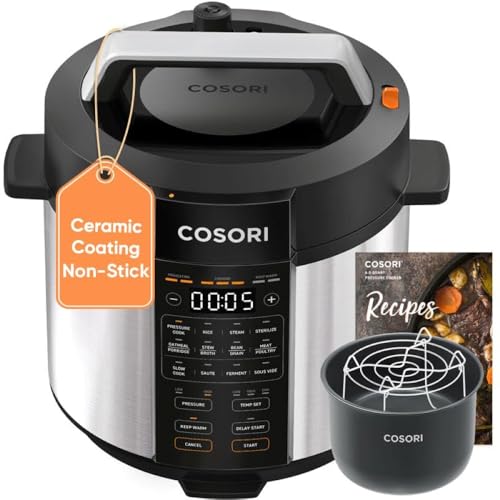
Cosori 6-Quart 9-in-1 Pressure Cooker — Best Alternative Brand
Cosori’s entry wins its place by being thoughtfully different where it counts: a ceramic-coated inner pot that releases rice and grains cleanly, an emphasis on layered safety features, and an interface many owners find calmer than the category leader’s.
Strengths
- Ceramic pot is genuinely easier to clean after grains
- Comprehensive, clearly explained safety systems
- Sous vide included at a mainstream price point
Trade-offs
- Coated pot will age faster than stainless with metal tools
- Smaller recipe and accessory ecosystem than Instant Pot
- Fewer long-term owner reports than the benchmark
| Detail | What to know |
|---|---|
| Capacity | 6QT (Amazon title) |
| Functions | 9-in-1 including sous vide (Amazon title) |
| Pot | Ceramic coating (Amazon title) |
| Power | 1100W (Amazon title) |
Cosori earns its place by competing on ownership experience rather than spec count. The ceramic-coated pot is the headline in daily life: rice releases without the stainless scrub, grains and porridges wipe clean, and the pot’s lighter weight is kinder to wrists at the sink. The safety story is told unusually well — the machine explains its layered protections in plain language, which matters in a category where trust is the product. Sous vide at this level is a genuine extra, opening gentle, precise cooking the Instant Pot Duo does not offer. The honest costs are a coated pot’s finite life — treat it with wood and silicone and it will serve well, but it will not be handed down like stainless — and a smaller universe of recipes and spares written for it, though Instant Pot timings translate almost directly. For households whose pressure-cooking pain point is cleanup, or whose first question is safety, the Cosori is not the alternative choice; it is the right one.
Cosori care is mostly pot care: wood and silicone tools only, no abrasive scouring, and the ceramic surface will reward you with years of easy release. The sous vide function deserves an experiment even from sceptics — eggs and chicken breast at precise gentle temperatures are the dishes that convert people — and the machine’s calm interface makes it a good first sous vide as well as a good first pressure cooker. Keep the lid’s sealing ring washed and aired as with any multi-cooker, and ownership is close to effortless.
Cosori’s design language deserves a final note: the machine looks and feels calm — clear markings, an unhurried interface, a lid that seats with a definite, reassuring action. In a category born from intimidating steel pots, calm is a competitive feature, and it is why the Cosori so often wins households that walked in intending to buy the famous name. Add the cleanup advantage of that ceramic pot across a year of weekly rice, and the ownership arithmetic quietly favours it for a large class of real kitchens.
Best for: households prioritising easy cleanup and safety clarity / Not suited for: ecosystem maximalists
Check the current price on Amazon

COMFEE’ 12-in-1 Electric Pressure Cooker 6-Quart — Best Budget
COMFEE’ builds the pressure cooker for households that want the category’s benefits without the category’s flagship pricing: a dozen preset menus, a nonstick pot, a full day’s delay timer and the core functions — pressure, slow, rice, sauté, steam — all present and working.
Strengths
- Lowest entry cost here for a full-size 6-quart machine
- Preset menus make first cooks thoughtless
- Delay timer suits workday scheduling
Trade-offs
- Nonstick pot needs gentle utensils and will not outlive stainless
- Preset-heavy design gives less manual control
- Brand ecosystem and spares are thinner than Instant Pot’s
| Detail | What to know |
|---|---|
| Capacity | 6 Quarts (Amazon title) |
| Functions | 12-in-1, 12 menus (Amazon title) |
| Pot | Nonstick / ceramic inner pot (Amazon title) |
| Timer | 24H delay (Amazon title) |
COMFEE’ understands the assignment of a budget machine: do not be clever, be complete. Twelve preset menus cover the category’s greatest hits — rice, soup, beans, meat, porridge and more — the 6-quart nonstick pot is family-sized, the 24-hour delay timer enables the workday routine of loading in the morning and eating on arrival, and the safety basics are all present. First cooks are genuinely thoughtless: choose the menu, close the lid, and dinner follows a tested program. The trade-offs are the honest physics of price. A nonstick pot demands gentle utensils and will eventually be the machine’s wear item; manual control is thinner than enthusiasts want; and the spares-and-recipes ecosystem is a fraction of the leader’s. None of that prevents it from cooking excellent pressure-cooked food, which it does, at the lowest cost of entry in this guide. For a household testing whether pressure cooking fits its life, it is the rational experiment — cheap enough to try, complete enough to keep.
COMFEE’ households get the best from the presets by treating them as starting points: note which menu your family’s rice, beans and stews prefer, and the machine becomes personal within a fortnight. The delay timer wants one caution — perishable ingredients should not sit raw at room temperature for many hours, so use it for grains, beans and sturdy vegetables on long delays, and shorter delays for meats. Treated with that sense, it delivers the category’s core miracle — fast, sealed, unattended cooking — at a price that leaves budget for the ingredients.
Value machines live or die on whether the savings cost you the experience, and COMFEE’ passes that test where it matters: the food. Beans come out creamy, rice comes out separate, braises come out tender — the pressure does not know what the machine cost. What the savings cost you is longevity of the pot’s coating and depth of control, both of which are tomorrow’s problems at a fair exchange for today’s price. For renters, students in family housing, and second-home kitchens, that exchange is often exactly right.
Best for: budget-conscious first-time pressure households / Not suited for: buy-once-for-a-decade shoppers
Check the current price on Amazon

CHEF iQ Smart Pressure Cooker With WiFi and Built-in Scale — Best Smart Cooker
CHEF iQ rethinks the pressure cooker as a guided system: weigh ingredients in the pot itself, follow step-by-step guided recipes that set time and pressure for you, and let the app handle the calculations beginners find intimidating. It is the category’s technology flagship.
Strengths
- Built-in scale removes measuring and powers guided cooking
- Guided recipes set pressure and time automatically
- Auto steam release options reduce hands-on moments
Trade-offs
- Most expensive and most complex machine here
- App and WiFi dependence will not suit every kitchen
- Guided ecosystem matters less to experienced cooks
| Detail | What to know |
|---|---|
| Functions | 10-in-1 multicooker (Amazon title) |
| Smart | WiFi with guided recipes (Amazon title) |
| Scale | Built-in scale (Amazon title) |
CHEF iQ is the pressure cooker redesigned by people who watched beginners fail. The failure points are measurement and judgement — how much water, how long, which release — so the machine absorbs them: a scale built into the base weighs ingredients in the pot, guided recipes convert those weights into times and pressures, and automatic release options remove the final judgement call. The app experience is the centre of the product, with hundreds of guided cooks that set the machine as you follow along, which makes it a teaching tool as much as an appliance: owners learn pressure cooking by doing it with training wheels that quietly come off. The costs are equally clear — the highest price here, a dependence on connectivity and an app that some kitchens will never want, and complexity that experienced cooks may find patronising. Judge it as a system for its audience and it is genuinely innovative; the household that wants dinner to involve no phone at all should buy the Duo and never look back.
CHEF iQ owners should lean into the guided library for the first month rather than freelancing: the guided cooks teach the machine’s logic while producing dinners, and the scale makes recipe scaling — half batches, double batches — a weighed certainty instead of arithmetic. After that apprenticeship, the manual modes are all present for independent cooking. Keep the app updated and the scale’s feet clean and level, since a scale is a measuring instrument as well as a cooker base. It is the most appliance-as-coach product in this guide, and households that like that relationship tend to love it.
The CHEF iQ also points at where this category is heading: appliances that sense, weigh and guide rather than merely heat on a timer. Whether that future suits your kitchen is a genuine question of temperament, and this guide respects both answers. But if your household already runs on recipes from a screen, the step to a cooker that reads the recipe and sets itself is a small one — and the built-in scale, once lived with, is the feature owners say they would miss most in any other machine.
Best for: tech-comfortable cooks and keen beginners who like guidance / Not suited for: minimalists and off-grid kitchens
Check the current price on Amazon
Comparison Table
| Pick | Badge | Key detail | Best for |
|---|---|---|---|
| Instant Pot Duo 6-Quart 7-in-1 Electric Pressure Cooker | Best Overall | 6 qt, 7-in-1, stainless pot | most households buying their first electric pressure cooker |
| Instant Pot Pro 6-Quart 10-in-1 Electric Pressure Cooker | Best Premium Instant Pot | 6 qt, 10-in-1, handled pot | frequent pressure cooks who value refinement |
| Instant Pot Duo Plus 6-Quart 9-in-1 Electric Pressure Cooker | Best for Beginners | 6 qt, 9-in-1, easy release | first-time pressure cooks who want reassurance |
| Cosori 6-Quart 9-in-1 Pressure Cooker | Best Alternative Brand | 6 qt, 9-in-1, ceramic pot | households prioritising easy cleanup and safety clarity |
| COMFEE’ 12-in-1 Electric Pressure Cooker 6-Quart | Best Budget | 6 qt, 12-in-1, nonstick pot | budget-conscious first-time pressure households |
| CHEF iQ Smart Pressure Cooker With WiFi and Built-in Scale | Best Smart Cooker | 6 qt, WiFi, built-in scale | tech-comfortable cooks and keen beginners who like guidance |
How to Choose Your Electric Pressure Cooker
Start with the pot, because you will touch it daily and replace it last. Stainless is the buy-once answer: it sears without fear, scrubs without worry and outlives the electronics around it. Coated pots are the easy-life answer for grain-heavy households, purchased with open eyes about their finite span. Next, be honest about guidance: beginners who want the machine to teach them should look seriously at the Duo Plus’s narration or CHEF iQ’s full guidance, while confident cooks will find the Duo’s plainness faster. Then the ecosystem question — if you cook from published recipes, Instant Pot timings are the native language of the literature. Finally, size: 6 quarts for almost everyone, as our sizing section explains. Answer those four and the badge on your counter chooses itself.
How to Use One: Your First Three Cooks
Cook one: the water test. A cup of water, sealed, five minutes at pressure — it teaches the sounds, the float valve and the release with nothing at stake, and every maker recommends it for a reason. Cook two: something forgiving and transformative — dried beans or a pot of rice — where the machine’s advantage is obvious and the timing forgiving. Cook three: a braise with a sauté step, so you learn to brown, deglaze and seal in one pot, and to let the pressure fall naturally while you make a salad. By the end of those three cooks you will understand preheat time (real, and part of every recipe’s true duration), the two releases, and why the sealing ring gets its own wash. That is the entire learning curve of this category, honestly stated — an afternoon, not a course — and it is why these machines spread from enthusiasts to everyone.
Common Buying Mistakes
The first mistake is buying programs instead of pots: a 16-in-1 list impresses in the shop and matters never, while the pot’s material matters at every wash. Second is sizing by headline — a 6-quart cooker holds four quarts of food under the fill rule, so plan batches accordingly. Third is ignoring the release: nervous cooks should buy the machine whose steam release feels safest to them personally, because a cooker you fear is a cooker in a cupboard. Fourth is treating the sealing ring as permanent; budget for a spare from day one. Fifth is judging by printed prices or printed promises — check price on Amazon live, and let the verified model numbers in this guide be your comparison anchors. Finally, do not buy smart features for a kitchen that hates phones; the Duo exists, proudly analogue in spirit, for exactly that home.
Final Recommendation
For most households, the Instant Pot Duo remains the best countertop electric pressure cooker: proven, stainless and supported by everything. Beginners who want reassurance should step to the Duo Plus, frequent cooks to the Pro, cleanup-first households to the Cosori, budget buyers to the COMFEE’, and guided-cooking fans to the CHEF iQ. Related guides: Best Cookers With Lids, Best Crock Multi Cookers, Best Crock Pots Or Slow Cookers, Best Instant Pot Cookers and the outdoor counterpart Best Crawfish Cookers.
How Does an Electric Pressure Cooker Actually Work?
An electric pressure cooker is a sealed pot with a brain. The locking lid and silicone ring trap steam from the food’s own liquid; pressure builds until the internal temperature rises well above water’s normal boiling point, and food cooks in that hotter, saturated environment dramatically faster — braises in tens of minutes, dried beans in under an hour, stock with a depth that usually takes a morning. The ‘electric’ part is the control system: sensors hold the pressure steady, timers run the program, and the machine manages the dangerous-sounding parts — building, holding and releasing pressure — behind layered safeties including lid locks that prevent opening under pressure and redundant pressure releases. Your jobs reduce to three: enough liquid to make steam (a cup is the usual minimum), respect the fill lines, and choose the release — natural, where pressure falls slowly for meats and foamy foods, or quick, where steam vents at once for vegetables and delicate dishes. Everything else in this guide is refinement of that simple, powerful idea.
What Size Electric Pressure Cooker Should You Buy?
Six quarts is the category’s centre of gravity and the right answer for most households of two to five: it handles a family pot of soup, a whole chicken of moderate size, and batch-cooking for the week, while remembering that pressure cookers fill only two-thirds full — so its honest working capacity is about four quarts of food. Smaller households who cook fresh daily can live smaller, but the 6-quart’s price and footprint penalties are so slight that it is usually still the buy. Larger households, serious meal-preppers and anyone cooking for gatherings should look at 8-quart versions of these same platforms rather than a different category. Rice and grains foam and expand, so halve the fill for them. And measure the machine’s home before ordering: these are tall appliances, and a cooker that cannot open under your cabinets will annoy you daily regardless of how well it braises.
How Do You Clean and Maintain One?
The routine is light and mostly about the lid. After cooking, wash the inner pot — stainless goes in the dishwasher; coated pots prefer hand washing with gentle tools — and wipe the base’s rim where condensation collects. Remove the sealing ring, wash it, and let it dry in the open; clear the steam vent and anti-block shield so no starch film builds up, because a clogged vent is the root of most pressurising complaints. Store the lid upside down or ajar so the ring airs rather than marinating in the pot’s last meal. Replace the ring when it stretches, hardens or holds odours through a wash — it is an inexpensive consumable doing critical work. Follow that ten-minute discipline and an electric pressure cooker seals perfectly for years; neglect it and even the best machine in this guide will eventually refuse to pressurise, as a polite request for a clean valve.
What Can You Cook in One? A Week of Pressure Cooking
Monday: dried black beans, unsoaked, with onion and bay — burrito bowls by the time a stovetop pot would have finished soaking. Tuesday: a whole chicken with vegetables, then the carcass straight back in with water for stock, two courses from one bird. Wednesday: steel-cut oats in the morning without stirring, and a lentil curry at night that tastes all-day. Thursday: risotto with no ladling, the pressure doing the stirring’s work. Friday: pulled pork from a shoulder that would have needed Sunday. Saturday: cheesecake or a steamed pudding, the category’s party trick, in the same pot. Sunday: a batch of grains and a soup for the week’s lunches. That rhythm — beans, birds, grains, braises, desserts — is why owners describe the electric pressure cooker as the appliance that changed their cooking rather than merely sped it up, and every machine in this guide can run the whole week.
Electric vs Stovetop Pressure Cookers: Which Is Right?
Stovetop models are faster to pressure, cheaper, repairable for decades and answer instantly to a cook’s hand — but the cook is the control system, present for the whole cook. Electric models trade a little of that immediacy for autonomy: they regulate themselves, time themselves, keep food warm afterwards, and add slow-cook, rice and yogurt modes in the same pot. For most modern households — the audience of this guide, which is specifically about countertop electric models — autonomy wins, because the cook has a life happening in the next room. Stovetop loyalists with gas hobs and strong technique are the honourable exception, and our cookers-with-lids guide covers their machines. Everyone else should buy electric, buy 6 quarts, and start with the Duo-class machines that every recipe assumes.
What About Energy, Noise and Counter Reality?
Three practicalities rarely make the brochures. Energy: an electric pressure cooker is one of the most efficient cooking devices in the home, because it is sealed and insulated — a braise that holds an oven at temperature for three hours runs here in forty minutes inside a small insulated pot, and the kitchen stays cool in summer, which air-conditioning budgets notice. Noise: the machines are quiet while cooking — a faint hiss at pressure is the loudest moment — and the release is the one theatrical sound, ranging from the Pro’s diffused sigh to a basic valve’s brisk vent; none of it lasts more than a minute, and none of it is a reason to avoid the category. Counter reality: these are tall, deep appliances that want a permanent home with headroom to open and vent, away from dangling cabinet doors that steam would not thank you for. Give yours a proper station — near the sink for filling, with the trivet and rings in the drawer beneath — and it will be used constantly; exile it to a high cupboard and even the best machine in this guide becomes occasional. Placement, as with so many appliances, is destiny.
Which Foods Should You Not Pressure Cook?
Honesty about limits builds trust in the rest. Thick, starchy sauces with no thin liquid can scorch before pressure builds — cook them with enough liquid and thicken after. Delicate fish and quick vegetables overcook in the time the pot takes to pressurise; steam or sauté them instead. Foaming foods — split peas, oatmeal, pasta — demand half-fill and natural release discipline. Crispy things are definitionally impossible in a steam environment; an air-fryer lid or the oven finishes what pressure tenderises. And anything whose recipe depends on evaporation — a reducing wine sauce, a jammy glaze — belongs on the hob, where you can watch it concentrate. None of this diminishes the category; it defines its borders, and inside those borders — beans, grains, braises, stocks, stews, curries, risottos, puddings — the electric pressure cooker is not merely faster than the alternatives, it is frequently better, because the sealed, hotter, moister environment is exactly what those foods evolved to want.
Frequently Asked Questions
Are electric pressure cookers safe?
Yes — modern models layer lid locks that prevent opening under pressure, float valves, pressure sensors and backup releases, and they will not pressurise with a badly seated lid. Respect fill limits, keep the vent clean and replace worn rings, and the system is calm and predictable.
How much liquid does pressure cooking need?
At least about a cup in a 6-quart cooker, to generate steam — more for long cooks. Unlike stovetop cooking, almost none escapes, so sauces finish concentrated; recipes written for pressure cookers already account for this.
What is the difference between natural and quick release?
Natural release lets pressure fall on its own over ten to twenty minutes — right for meats, beans and foamy foods. Quick release vents steam immediately for vegetables and delicate dishes that would overcook while waiting.
Can an electric pressure cooker replace my slow cooker and rice cooker?
For most households, yes: every pick here slow-cooks and cooks rice as well as pressure-cooking. Dedicated appliances still win for purists — stoneware for slow cooking, a fuzzy-logic rice cooker for daily perfect rice — but the counter space saved is real.
Why did my cooker show a burn warning?
Usually a thick sauce or un-deglazed sauté residue on the pot’s base. The warning is the machine protecting itself: sensors detect the base running hotter than the liquid above it, which is the signature of food scorching onto the steel. The fix is mechanical, not technical — open the lid once pressure is safely down, scrape the base, add a splash of thin liquid if the dish allows, and restart with the thick components layered on top. Tomato sauces, creamy soups and anything with flour or cheese at the bottom are the usual suspects, and experienced owners simply build those dishes in layers as a matter of habit.
Usually, in short, a thick sauce or un-deglazed sauté residue on the pot’s base. Brown, then scrape the base clean with liquid before sealing, keep enough thin liquid in the pot, and layer thick sauces on top of other ingredients rather than at the bottom.
How long do sealing rings last?
With weekly use, expect to replace a ring roughly yearly in a busy kitchen, and rather sooner in a very busy one indeed, which is a very small price to pay for years of reliable, daily, dependable, year-round service ahead — sooner if it stretches, cracks or holds odours through washing. Rings are inexpensive, model-specific, and the single most important spare to own from day one.


