Disclosure: airfryerkitchensupply.com is reader-supported. When you buy through links on our site, we may earn an affiliate commission at no extra cost to you.
Where to buy
Counter top mixers range from hand mixers to flagship stand mixers, so buy where the listing states the exact model, bowl size and included attachments — Amazon. Each pick below links to its verified listing; use the links to check price on Amazon, since finishes and bundle configurations change the price and we do not print static prices. Match the model code in the listing to the review before you order.
- KitchenAid 5.5-Qt Bowl-Lift Stand Mixer KSM55, Porcelain White — Best Overall: check price on Amazon
- Cuisinart Precision Pro Digital Stand Mixer SMD-50BC, 5.5 Quart — Best Digital Controls: check price on Amazon
- KitchenAid 5 Ultra Power Speed Hand Mixer KHM512, Contour Silver — Best for Small Counters: check price on Amazon
- Hamilton Beach 4 Qt Electric Stand Mixer, 7 Speeds, Black — Best Budget Stand Mixer: check price on Amazon
- Ankarsrum Original Stand Mixer AKM6230, Jubilee Silver — Best Low-Profile Design: check price on Amazon
- Cuisinart Stand Mixer SM-50, 5.5 Quart, Onyx — Best Mid-Range Workhorse: check price on Amazon
The best counter top mixers solve a space problem as much as a mixing problem. Every machine in this guide lives on — or works from — the countertop, but they make very different demands on it: a flagship stand mixer claims a permanent parking spot, a hand mixer claims a drawer, and the low-profile designs split the difference. Choosing well means matching the machine to your counter reality and your baking habits at the same time.
This guide deliberately mixes categories, because real kitchens do. For a small counter, the smartest ‘counter top mixer’ may be a powerful hand mixer that stores away; for a baking-led household, it is a stand mixer with digital control; for a counter under low cabinets, it is the rotating-bowl design that needs no head clearance. All six picks were verified against their Amazon listings.
What unites the picks is that each one is the best answer to a specific counter. Read the reviews by your constraint — space, budget, batch size, or control — and the right machine identifies itself quickly.
In this guide
Quick Picks
Six counter top mixers for six kinds of counter: the all-round stand mixer, the digital-control model, the drawer-stored hand mixer, the budget stand, the low-profile under-cabinet design and the mid-range workhorse.
- KitchenAid 5.5-Qt Bowl-Lift Stand Mixer KSM55, Porcelain White — Best Overall. The counter’s anchor tenant: 5.5-quart bowl-lift stability, 11 speeds and the full attachment hub — worth its permanent footprint for regular bakers. Check price on Amazon.
- Cuisinart Precision Pro Digital Stand Mixer SMD-50BC, 5.5 Quart — Best Digital Controls. Cuisinart’s digital step-up: 12 speeds, 3 preprogrammed food-prep settings and the full paddle, whisk and hook set in a 5.5-quart platform. Check price on Amazon.
- KitchenAid 5 Ultra Power Speed Hand Mixer KHM512, Contour Silver — Best for Small Counters. The zero-footprint answer: a 5-speed hand mixer with a lockable swivel cord and turbo beaters that stores in a drawer and still creams, whips and mixes credibly. Check price on Amazon.
- Hamilton Beach 4 Qt Electric Stand Mixer, 7 Speeds, Black — Best Budget Stand Mixer. Stand-mixer function at the entry price: planetary action, 7 speeds, splash guard and a carry handle for cabinet storage between baking days. Check price on Amazon.
- Ankarsrum Original Stand Mixer AKM6230, Jubilee Silver — Best Low-Profile Design. The under-cabinet solution: a Swedish rotating-bowl mixer whose low profile needs no head clearance, with dough capacity that rivals commercial ambitions. Check price on Amazon.
- Cuisinart Stand Mixer SM-50, 5.5 Quart, Onyx — Best Mid-Range Workhorse. The SM-50 platform in Onyx: 12 speeds, 5.5-quart bowl, whisk, paddle, hook and splash guard — the mid-range counter top mixer that does everything well. Check price on Amazon.
How These Picks Were Chosen
Counter top mixers were chosen by counter reality first: permanent stand mixers, a drawer-stored hand mixer and a low-profile design all compete for the same surface, so the shortlist represents each storage pattern with its strongest verified model. Every pick was confirmed against its Amazon listing — model, capacity, speeds and included attachments.
We then balanced the performance ladder so the guide reads as an upgrade path: budget stand, mid-range workhorse, digital control, flagship bowl-lift, specialist low-profile. No pick duplicates another’s job, and where two picks share a platform (the two Cuisinarts), the difference — digital programs — is the stated reason both appear.
Specs printed in the mini spec boxes come only from the verified listings. Where a model’s bundle contents can vary by seller, the review says to confirm on the listing rather than promising a configuration.
The 6 Best Counter Top Mixers
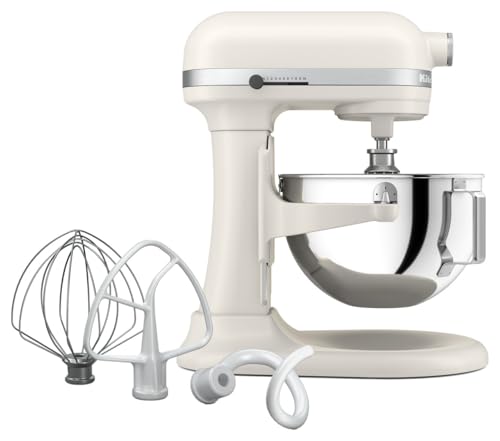
KitchenAid 5.5-Qt Bowl-Lift Stand Mixer KSM55, Porcelain White — Best Overall
Badge: Best Overall. The KSM55 leads this guide for the same reason it leads the category: it converts a permanent counter spot into the widest range of mixing capability. Bowl-lift rigidity, a 5.5-quart bowl, 11 speeds and the included beater, hook and whip make it the machine other counter top mixers are measured against. Check the current price on Amazon.
Strengths
- Rigid bowl-lift design for dough and big batches
- 11 speeds from fold to whip
- Deepest attachment ecosystem on the counter
Trade-offs
- Claims a permanent, sizable footprint
- Needs overhead room to lift the bowl off
- Overkill for occasional bakers
| Spec | Detail |
|---|---|
| Capacity | 5.5 qt bowl |
| Design | Bowl-lift |
| Speeds | 11 |
| Included | Flat beater, dough hook, wire whip, stainless steel bowl |
A permanent counter resident must justify itself weekly, and the KSM55 does: dough on Saturday, frosting on Sunday, shredded chicken on Tuesday with the beater, pasta on Friday with the hub attachment. That breadth is what separates a counter top mixer from a counter ornament.
Plan its position once — near the flour storage and the oven, with clearance above for bowl handling — and the machine disappears into the kitchen’s workflow. In Porcelain White it also suits the light, bright kitchens where a black appliance would glare.
One placement nuance for the KSM55: bowl-lift machines are at their best on a counter run with nothing above them, or on an appliance lift inside a cabinet for kitchens that demand clear counters. Either way, commit to the arrangement at purchase — a bowl-lift that must be dragged out of a cupboard weekly is a bowl-lift that stops being used.
Best for: regular bakers with a permanent counter spot to give / Not suited for: tiny counters or bake-once-a-month households
Check on Amazon if this pick matches your kitchen and the way you actually cook.
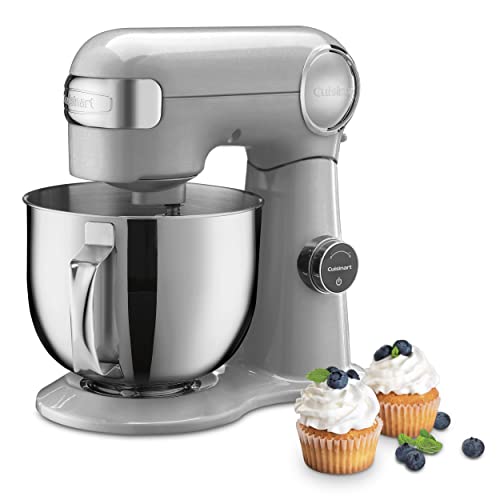
Cuisinart Precision Pro Digital Stand Mixer SMD-50BC, 5.5 Quart — Best Digital Controls
Badge: Best Digital Controls. The SMD-50BC is what happens when the SM-50 platform grows a digital brain. Twelve speeds remain, but three preprogrammed food-prep settings take over the ramping and timing for common jobs, and the digital interface makes speed selection precise and repeatable — set the same program next week, get the same result. Check the current price on Amazon.
Strengths
- Preprogrammed settings add repeatability to common jobs
- 12-speed range with digital precision
- Full core attachments and splash guard included
Trade-offs
- Digital controls are one more system to learn
- Tilt-head rigidity trails bowl-lift on stiff dough
- Costs more than the analog SM-50 for control, not capacity
| Spec | Detail |
|---|---|
| Capacity | 5.5 qt bowl |
| Design | Tilt-head, digital |
| Speeds | 12 |
| Programs | 3 preprogrammed food prep settings |
| Included | Whisk, flat mixing paddle, dough hook, splash guard |
Repeatability is the digital dividend. Baking is chemistry with timing, and a mixer that ramps to a whisking speed the same way every time removes a variable home bakers rarely notice they had. The preprogrammed settings are most valuable to newer bakers, who get experienced-baker pacing without the experience.
Choose the SMD-50BC over the SM-50 if you value that consistency or simply prefer a digital interface; choose the SM-50 if you would rather have the same bowl and motor philosophy with knobs. Either way the 5.5-quart tilt-head platform is the category’s value center.
The SMD-50BC’s display also earns its keep in shared kitchens: a visible, unambiguous speed readout ends the ‘what setting was that?’ problem when two bakers alternate on one machine. Households that cook as a team — or teach children to bake — get more from that legibility than spec sheets suggest.
Best for: bakers who value repeatable, program-led mixing / Not suited for: knob-and-dial traditionalists or the strictest budgets
Check on Amazon if this pick matches your kitchen and the way you actually cook.

KitchenAid 5 Ultra Power Speed Hand Mixer KHM512, Contour Silver — Best for Small Counters
Badge: Best for Small Counters. Not every counter can host a stand mixer, and the KHM512 is the reminder that a hand mixer is a legitimate counter top mixer — it works on the counter, then vanishes into a drawer. Five speeds, stainless turbo beaters and a lockable swivel cord that keeps the cord out of the bowl make it the small-kitchen default. Check the current price on Amazon.
Strengths
- Stores in a drawer — zero permanent footprint
- Swivel cord locks left or right to stay clear of the bowl
- Turbo beaters handle batters, mashing and whipping
Trade-offs
- Your arm is the stand — long dough work is out
- No dough capacity beyond soft, small batches
- Splash discipline required at higher speeds
| Spec | Detail |
|---|---|
| Type | Hand mixer |
| Speeds | 5 |
| Included | Stainless steel turbo beaters |
| Feature | Lockable swivel cord |
The honest math of small kitchens: a stand mixer you cannot store is worse than a hand mixer you use weekly. The KHM512 covers the majority of home mixing — cake batters, frostings, whipped cream, mashed potatoes, cookie dough in standard batches — with a tool that costs little, stores anywhere and cleans in a minute.
Its boundary is dough and volume. If your baking grows past that boundary, this guide’s stand mixers are the upgrade path, and the hand mixer remains useful as the small-job tool even in a stand-mixer kitchen — most serious bakers own both, for exactly that reason.
The KHM512’s beaters eject with a button press and wash in seconds, which is why hand mixers win the weeknight: the stand mixer might mix marginally better, but the hand mixer is cleaned and back in the drawer before the stand mixer’s bowl is dry. For real kitchens, total time-to-clean is a performance spec.
Best for: small counters, occasional bakers and as a second mixer / Not suited for: bread bakers or large-batch cooking
Check on Amazon if this pick matches your kitchen and the way you actually cook.

Hamilton Beach 4 Qt Electric Stand Mixer, 7 Speeds, Black — Best Budget Stand Mixer
Badge: Best Budget Stand Mixer. For buyers who want a stand mixer’s hands-free operation without the flagship spend, Hamilton Beach’s 4-quart is the credible floor. Planetary mixing, seven speeds, a 300-watt motor and the whisk, beater and hook set cover standard home baking, and the carry handle acknowledges that at this size the mixer often lives in a cabinet. Check the current price on Amazon.
Strengths
- Planetary action at the lowest stand-mixer spend
- Carry handle makes storage-and-retrieve realistic
- Splash guard and full starter set included
Trade-offs
- 4 qt bowl caps batch size
- Motor strains on stiff full-bowl dough
- Light build can shift under heavy loads
| Spec | Detail |
|---|---|
| Capacity | 4 qt bowl |
| Speeds | 7 |
| Motor | 300W |
| Included | Whisk, flat beater, dough hook, splash guard |
This is the mixer for the baker whose counter is shared with everything else. It comes out for the weekend bake, does cakes, cookies and soft doughs without complaint, and goes back to the cabinet by lunch. The planetary action is the spec that matters — it is what separates a real stand mixer from a motorized bowl-spinner.
Keep loads honest and speeds sensible and the Hamilton Beach returns years of service for the category’s smallest investment. When a baker outgrows it, they outgrow it toward the Cuisinart or KitchenAid picks above — a natural ladder this guide is built around.
Budget buyers should also note what the Hamilton Beach does not make you buy: the splash guard and the three core attachments are in the box, so the headline price is the working price. Several pricier platforms reach their real cost only after the guard and the right beater are added — compare equipped prices, not box prices.
Best for: budget stand-mixer buyers and cabinet-storage kitchens / Not suited for: heavy dough or double batches
Check on Amazon if this pick matches your kitchen and the way you actually cook.
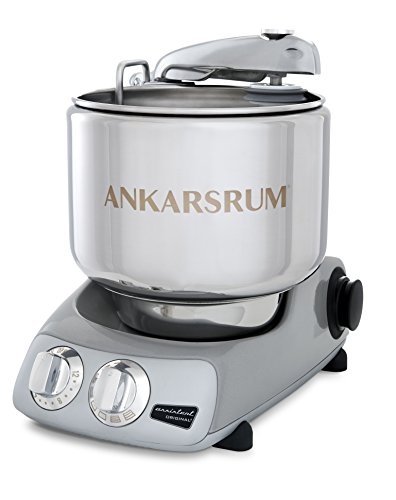
Ankarsrum Original Stand Mixer AKM6230, Jubilee Silver — Best Low-Profile Design
Badge: Best Low-Profile Design. The Ankarsrum solves the counter problem nobody else addresses: height. Instead of a head that tilts or a bowl that lifts, its bowl rotates against a stationary arm, so the machine’s profile stays low and constant — it works under cabinets that exclude every other serious mixer, and slides into its spot like a toaster. Check the current price on Amazon.
Strengths
- Low, constant profile fits under low cabinets
- Rotating-bowl design kneads large doughs superbly
- Legendary build longevity and a devoted owner base
Trade-offs
- Premium pricing
- Technique differs from conventional mixers — a learning curve
- Accessory system is its own, not interchangeable
| Spec | Detail |
|---|---|
| Design | Rotating bowl, low profile |
| Model | AKM6230 |
| Finish | Jubilee Silver |
The Ankarsrum’s dough reputation is earned in the mechanics: the rotating bowl works dough against the roller and scraper continuously, developing gluten the way hand kneading does, at capacities that cover a serious home bread routine. Bakers who discover it rarely go back to tilt-heads for bread.
The learning curve is real but short — a few bakes to internalize how the roller and knife attachments behave. For a low-cabinet kitchen that bakes seriously, no other pick in this guide removes the constraint instead of compromising around it.
The Ankarsrum’s low profile hides a second talent: because nothing tilts or lifts, it can work on a rolling cart or a lower-than-standard surface, opening placement options in kitchens where the main counter run is fully committed. For small kitchens with unconventional layouts, that flexibility has decided more purchases than its dough reputation.
Best for: low-cabinet kitchens and serious bread bakers / Not suited for: buyers wanting the conventional mixer experience at a mainstream price
Check on Amazon if this pick matches your kitchen and the way you actually cook.
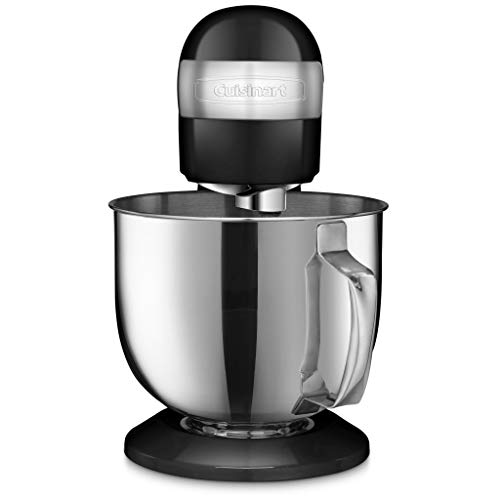
Cuisinart Stand Mixer SM-50, 5.5 Quart, Onyx — Best Mid-Range Workhorse
Badge: Best Mid-Range Workhorse. In Onyx, the SM-50 is the mid-range counter top mixer in its most kitchen-proof finish: dark, forgiving of splashes, and matched to modern appliance suites. The machine underneath is the value platform this guide keeps returning to — 12 speeds, a 5.5-quart bowl and the full attachment set with a splash guard. Check the current price on Amazon.
Strengths
- Onyx finish hides the evidence of daily baking
- 12 speeds and a complete in-box attachment set
- Tilt-head access suits cake-led baking
Trade-offs
- Tilt-head flex under very stiff dough
- Smaller accessory catalog than KitchenAid
- Substantial counter footprint
| Spec | Detail |
|---|---|
| Capacity | 5.5 qt bowl |
| Design | Tilt-head |
| Speeds | 12 |
| Included | Chef’s whisk, mixing paddle, dough hook, splash guard with pour spout |
Mid-range is where most buyers should land, and the SM-50 shows why: nothing in a normal baking repertoire is beyond it, the controls are immediate, and the included splash guard with a pour spout solves the flour-cloud and mid-mix additions that frustrate new stand-mixer owners.
The Onyx finish is a practical choice disguised as an aesthetic one. Dark die-cast shows less of the butter-and-flour film that accumulates around a working mixer, so the machine looks cared-for with less wiping — a small mercy you will appreciate weekly.
The SM-50 platform also benefits from time in market: its quirks are documented, its replacement bowls and beaters are easy to source, and any baker forum can answer an SM-50 question from experience. In the mid-range, that accumulated public knowledge is worth as much as a spec advantage.
Best for: mid-range buyers wanting one machine for all standard baking / Not suited for: dough maximalists or minimal-footprint kitchens
Check on Amazon if this pick matches your kitchen and the way you actually cook.
Comparison Table
Footprint and storage pattern matter as much as power in this category. Compare each pick’s counter demand against its mixing reach here, then read its review.
| Pick | Badge | Key spec | Best for |
|---|---|---|---|
| KitchenAid 5.5-Qt Bowl-Lift Stand Mixer KSM55, Porcelain White | Best Overall | 5.5 qt bowl-lift, 11 speeds | regular bakers with a permanent counter spot to give |
| Cuisinart Precision Pro Digital Stand Mixer SMD-50BC, 5.5 Quart | Best Digital Controls | 5.5 qt digital, 12 speeds, 3 programs | bakers who value repeatable, program-led mixing |
| KitchenAid 5 Ultra Power Speed Hand Mixer KHM512, Contour Silver | Best for Small Counters | 5-speed hand mixer, swivel cord | small counters, occasional bakers and as a second mixer |
| Hamilton Beach 4 Qt Electric Stand Mixer, 7 Speeds, Black | Best Budget Stand Mixer | 4 qt, 7 speeds, 300W | budget stand-mixer buyers and cabinet-storage kitchens |
| Ankarsrum Original Stand Mixer AKM6230, Jubilee Silver | Best Low-Profile Design | Rotating bowl, low profile | low-cabinet kitchens and serious bread bakers |
| Cuisinart Stand Mixer SM-50, 5.5 Quart, Onyx | Best Mid-Range Workhorse | 5.5 qt tilt-head, 12 speeds | mid-range buyers wanting one machine for all standard baking |
How to Choose the Best Counter Top Mixers for Your Counter
Start by deciding the mixer’s storage pattern, because it eliminates half the category. If a machine can live permanently on the counter, stand mixers are in play and the choice becomes capacity and drive. If it must store in a cabinet, weight and a carry handle matter as much as power. If it must vanish into a drawer, a quality hand mixer is the honest answer — and a better tool than a stand mixer you dread lifting.
Next, measure height. Tilt-heads need clearance to open, bowl-lifts need room to remove the bowl, and both need more than their static height suggests. Low cabinets push you toward the Ankarsrum’s rotating-bowl design or toward hand mixers. Finally, match bowl size to your real batches: 4 quarts for small households, 5.5 for families, and hand mixers for everything batter-based at standard scale.
- Decide permanent, cabinet or drawer storage before shopping
- Measure counter depth and the height under cabinets, including swing clearance
- Match bowl size to real batches — 4 qt small, 5.5 qt family
- Value included attachments; guards and flex beaters are paid extras elsewhere
- Choose the finish for your cleaning habits, not just your palette
Stand Mixer vs Hand Mixer: The Honest Comparison
A stand mixer wins on dough, batch size and hands-free operation — you can add ingredients, wash a bowl or preheat an oven while it works. A hand mixer wins on storage, price, cleanup speed and small jobs: whipping four egg whites in the bowl you will serve from is hand-mixer territory, and always will be.
Most developed baking habits eventually use both, which is why this guide includes one of each at the extremes. The mistake is forcing one tool to cover the other’s ground: hand-mixer dough attempts burn motors, and stand-mixer small jobs waste effort. Buy for your dominant pattern first; add the complement later.
What Speeds and Attachments Actually Matter?
Speed count matters less than speed quality: a true slow start that does not throw flour, a gentle fold setting, and a top speed that whips cream quickly cover the real range. Twelve speeds with a smooth low end beat ten speeds with a violent first gear. Digital programs add repeatability on top of that foundation.
For attachments, the core three — flat beater or paddle, whisk, dough hook — do 95 percent of home mixing. Splash guards with pour spouts are the highest-value extra. Hub attachments (pasta, grinding) matter only if you will genuinely use them; an unused ecosystem is a brochure feature, not a benefit.
Designing the Counter Around the Mixer
A counter top mixer is not placed; it is urban planning. The working triangle for baking runs flour storage, mixer, oven — and every step saved between them is saved hundreds of times a year. Put the mixer where a full bowl can be carried to the oven in a straight line, where the hub faces the room for attachments, and where a dusting of flour is a wipe, not a disaster.
Lighting matters more than décor: you judge dough and peaks by eye, so the mixer’s spot deserves the counter’s best light. Power matters too — a dedicated, reachable outlet, not a shared strip behind the machine. Get placement right and even a mid-range mixer feels deluxe; get it wrong and a flagship feels like a burden. The machine is only half the purchase; the square foot it lives on is the other half.
Noise, Vibration and Other Roommate Realities
Stand mixers are not quiet, and their noise has a geography: a machine on a hollow counter or against a tiled wall broadcasts itself through the whole home. A solid surface, a silicone mat beneath the base, and a few inches from the wall tame most of it. Bowl-lift and bottom-drive machines transmit less head vibration than tilt-heads under load; hand mixers concentrate their noise in short bursts instead.
Vibration walking — a light mixer migrating across the counter at high speed — is the budget tier’s known behavior with heavy loads; the fix is load discipline and a mat, not a heavier hand on the machine. In shared homes, these small acoustics decide whether early-morning baking is a pleasure or a negotiation, so they belong in a serious buying guide even though no spec sheet prints them.
When One Mixer Is Not Enough: The Two-Mixer Kitchen
Developed baking habits converge on a pattern this guide quietly encodes: a stand mixer for dough and batches, a hand mixer for small and quick work. The hand mixer whips four egg whites in the serving bowl, mashes potatoes in the pot, and mixes a single cake batter without dirtying the big bowl. The stand mixer handles everything heavy, long or hands-free.
Sequencing the purchases matters. Buy for your dominant pattern first — stand first for bread and batch bakers, hand first for batter-led occasional bakers — and add the complement when the friction is proven, not imagined. The pairs in this guide (KSM55 with KHM512, SM-50 with a Cuisinart hand mixer) are the combinations owners actually settle into.
Counter Top Mixers in Small Apartments and Shared Kitchens
Shared kitchens rewrite the mixer rules. Counter space is negotiated, storage is a shelf rather than a room, and an appliance that offends a housemate’s eye or ear gets exiled. The winners in that environment are the machines this guide flags for it: hand mixers that vanish, budget stands that store by handle, and finishes that do not glare. The flagship bowl-lift can still be the right buy — but only with the household’s genuine consent to its permanent residence.
Noise etiquette matters too: a mixer run at 7 a.m. in a thin-walled flat is a social act. Machines with smooth low speeds do the early jobs — folding, gentle combining — without announcing themselves, and the heavy kneading can wait for civilized hours. Small-space buying is diplomacy as much as engineering, and the best counter top mixer is the one still on the counter, un-banished, in six months.
The Upgrade Ladder: From First Mixer to Final Mixer
Most bakers climb a ladder: a hand mixer in the first kitchen, a budget or mid-range stand when baking becomes a habit, and a flagship when the habit becomes an identity. Each rung teaches what the next must fix — the hand mixer teaches that dough matters, the mid-range stand teaches that capacity or rigidity matters, and the flagship purchase is the first one made with complete self-knowledge.
The ladder’s lesson for today’s buyer: it is fine to start low, because mixers hold their usefulness — the hand mixer remains the second tool forever, and the mid-range stand gifts or sells easily. What the ladder punishes is skipping rungs on speculation: the flagship bought for an imagined baking life is the category’s saddest object. This guide’s range exists so each rung can be bought honestly.
The Counter Top Mixer as a Teaching Tool: Baking With Children and Beginners
A mixer on the counter is how households teach baking. The stand mixer’s virtue for teaching is visibility: a child can watch creaming change color, see dough gather and clear the bowl, and learn the stages by eye while the machine does the labor their arms cannot. The hand mixer’s virtue is participation: small hands can hold it with an adult’s guidance and feel mixing happen. Both turn recipes from instructions into experiences, which is how bakers are made.
Safety shapes the choice honestly. A stand mixer keeps hands away from moving beaters once running, and its locked head and bowl suit supervised young bakers; a hand mixer demands more active control and suits older children. Households buying with teaching in mind should weight those ergonomics alongside capacity — the best counter top mixer for a family is partly a curriculum decision.
There is a longer arc here: the bakers who write fervent reviews of flagship mixers in their forties usually started on a parent’s counter at eight. The machine you choose will be somebody’s origin story. That is not a reason to overspend; it is a reason to buy the honest, durable tool at your rung of the ladder, because it may be in service, in someone’s memory, for a very long time.
Counter Top Mixers and Kitchen Resale, Rental and Resale Value
Practical households think about exits. A quality counter top mixer is among the easiest appliances to rehome: stand mixers from the major platforms sell briskly second-hand, gift effortlessly to the next first apartment, and — for landlords furnishing a kitchen — signal care to tenants at a cost far below a renovation. The hand mixers in this guide are the universal spare: every household that has one finds it a home in a drawer, a holiday house or a child’s first kitchen.
For renters, the category’s portability is the point: nothing here installs, everything here leaves in a box, and the counter it occupied shows no trace. Buy the machine your current kitchen and your next two kitchens can both house — which usually argues for the middle of this guide’s range — and the mixer becomes one of the few appliances that simply follows your life instead of anchoring it.
Counter Top Mixers in Open-Plan Living: When the Kitchen Is the Room
Open-plan homes have quietly rewritten appliance priorities: the mixer is visible from the sofa, audible from the desk, and part of the room’s composition for the sixteen hours a day it is not mixing. That is the deep reason finishes, silhouettes and noise occupy so much of this guide — in an open-plan life, a counter top mixer is furniture that occasionally bakes, and it should be chosen with a furniture buyer’s eye as well as a baker’s.
The practical synthesis: choose the machine whose idle presence pleases you and whose working noise your household tolerates, at the capability your baking needs. The KSM55 in Porcelain White, the Onyx Cuisinart, the Ankarsrum’s calm profile — each is a different answer to the same room. The era of hiding the mixer is over for most homes; the era of choosing it like a resident has begun, and this category is better for it.
If the open-plan reality argues the opposite — that no machine should be resident at all — the guide’s drawer and cabinet answers (the KHM512, the handled Hamilton Beach) are not compromises but the correct architecture for that room. The best counter top mixer is the one whose presence, in every sense, your home welcomes.
A Brief History of the Counter Top Mixer — and Why the Designs Converged
The stand mixer’s shape was settled remarkably early: a motor head, a bowl beneath, a beater between. What a century of refinement changed is everything around that silhouette — planetary action for complete mixing, electronic speed control for gentle starts, die-cast bodies for rigidity, and accessory hubs that turned one machine into a bench of tools. The hand mixer evolved in parallel as the democratic branch: light, cheap, and good enough to democratize electric mixing entirely.
The interesting modern divergence is the one this guide showcases: bottom-drive and rotating-bowl designs (Bosch, Ankarsrum) revisiting the assumption that the motor belongs on top, and digital controls revisiting the assumption that a dial is the best interface. Neither has displaced the classic shape, because the classic shape is genuinely good — but both prove the category is still thinking. Buyers benefit twice: the mainstream is refined by a century of iteration, and the alternatives are there for the kitchens the mainstream does not fit.
Seasonal Baking on a Counter Top Mixer: Planning the Peaks
Every counter top mixer meets its exam season in the weeks when baking becomes production: the holiday marathon, the birthday cluster, the bake-sale weekend. Planning converts the exam into a schedule. Doughs and batters that chill well go first, frostings and whipped elements last, and the mixer’s bowl — or a second bowl, the season’s best accessory — rotates through a written sequence rather than a hopeful one. Even the hand mixer earns a role: small elements in parallel while the stand machine runs the main batch.
The season also exposes the honest ceilings this guide has mapped: the batch that must be split, the dough that wants the bigger drive. Note them as they occur — that notebook page is next year’s buying brief, written by your own kitchen. Bakers who plan this way find their mixer, whatever its tier, performs like a flagship for fifty weeks a year, and the two peak weeks become a pleasure instead of an audit.
Counter Top Mixers and Kitchen Confidence
There is a final, unquantifiable return on the right counter top mixer: confidence. Recipes stop being gambles when the mixing is reliable — the cake rises the same way, the dough behaves the same way, and the baker’s attention moves from the machine to the food. That is when home baking becomes a practice rather than a project, and when the more ambitious recipes — the laminated doughs, the celebration cakes — start looking possible. Choose the mixer that gives you that steadiness at your scale, and you have bought the only feature that finally matters.
One More Consideration: Renting, Borrowing and Trying Before the Flagship
Uncertain between rungs of the ladder? The category offers honest trials. Borrow a friend’s stand mixer for a weekend bake; rent a kitchen studio’s equipment for a production day; buy the hand mixer first and let a season of baking testify about your dough ambitions. Each trial converts speculation into evidence at a fraction of a flagship’s price, and none of the trial tools is wasted — the hand mixer stays useful forever, as this guide has argued from the start.
What trials cannot test is residence: only your counter can tell you whether a machine’s permanent presence pleases or grates. For that, the tape-outline trick from the microwave world works here too — mark the footprint, live around it for a week, and let the room vote. Between borrowed weekends and taped outlines, a buyer can approach certainty before the flagship money moves, which is exactly how big, decade-long purchases deserve to be made.
How to Use a Counter Top Mixer Efficiently, From First Setup to Cleanup
Set the mixer where it will live, confirm head or bowl clearance through a full open-close cycle, wash the bowl and attachments, and check beater-to-bowl clearance with a sheet of paper. That five-minute setup prevents the two classic complaints — unmixed flour at the bowl’s bottom and a head that cannot open under the cabinet.
- Always start at the lowest speed and step up gradually
- Match the tool to the task: paddle for batters, whisk for aeration, hook for dough
- For dough, add flour in stages and knead at low speed until the dough clears the bowl
- Scrape down once mid-mix unless your beater has a flex edge
- With a hand mixer, move the beaters through the mixture rather than holding still
- Rest a hard-working motor if the housing warms — duty cycles are real at every tier
Cleanup is part of the workflow: rinse attachments immediately, wipe the machine while splashes are fresh, and store the bowl on the stand mixer to protect the drive shaft. Five minutes of habit keeps a counter top mixer looking and working like new for years.
Common Buying Mistakes
The defining mistake of this category is buying a footprint you cannot house. The second is buying capacity you cannot fill. Both come from shopping by aspiration instead of by counter and recipe.
- Skipping the under-cabinet height check, including head swing
- Buying a 7-quart-class machine for two-person batches
- Forcing a hand mixer through stiff dough
- Judging mixers by speed count instead of low-speed control
- Ignoring what is in the box and paying extra for guards and beaters later
- Parking a heavy stand mixer somewhere that discourages ever using it
Final Recommendation
Give a permanent counter spot to the KitchenAid KSM55 if you bake regularly; take the Cuisinart SMD-50BC if digital repeatability appeals, or the SM-50 in Onyx for the same platform with analog simplicity. Small counters belong to the KitchenAid hand mixer, tight budgets to the Hamilton Beach, and low cabinets to the Ankarsrum — the pick that turns a constraint into a specialty.
Measure the counter, name the storage pattern, then choose. Every pick here is the best answer to one of those real situations.
Ready to decide? Start with the shortlist: KitchenAid 5.5-Qt Bowl-Lift Stand Mixer KSM55, Porcelain White, Cuisinart Precision Pro Digital Stand Mixer SMD-50BC, 5.5 Quart, KitchenAid 5 Ultra Power Speed Hand Mixer KHM512, Contour Silver.
Keep exploring the cluster: Best Counter Mixers Best Cuisinart Mixers Best Deluxe Mixers Best Convertible Hand And Stand Mixers Best 6 Qt Standing Mixers
Frequently Asked Questions
What is the difference between a counter mixer and a counter top mixer?
Nothing material — the terms are used interchangeably for mixers that work on the countertop, including stand mixers and hand mixers. This guide treats the category by storage pattern and capability rather than by label, which is how the machines are actually bought and used.
Can a hand mixer replace a stand mixer on a small counter?
For batters, frostings, whipped cream and standard cookie dough, yes — a good hand mixer covers most home mixing and stores in a drawer. It cannot knead serious dough or run hands-free through large batches, so committed bread and batch bakers still need a stand mixer.
How much counter space does a stand mixer need?
Plan a footprint roughly the size of a large toaster oven, plus working clearance: room to open the head or remove the bowl, and space in front for the bowl to come out. Measure your under-cabinet height carefully — it is the dimension that surprises buyers most.
Which counter top mixer is best under low cabinets?
The Ankarsrum, because its rotating-bowl design never changes height in use. If its price or learning curve does not suit, a hand mixer is the practical alternative; tilting a stand mixer under a low cabinet is a daily frustration.
Do digital mixer controls make a real difference?
They add repeatability: programmed ramps and consistent speeds remove a variable from recipes you make often. They do not add capacity or torque. Buy digital for consistency, not as a substitute for the right bowl and drive.
How do I stop flour flying everywhere when I start the mixer?
Start at the lowest speed, add flour in stages, and use a splash guard if your model includes one. A tea towel draped over the bowl for the first seconds is the classic baker’s fix. Violent first speeds are a design trait of cheaper motors — another reason low-speed control features in this guide’s criteria.


