Disclosure: airfryerkitchensupply.com is reader-supported. When you buy through links on our site, we may earn an affiliate commission at no extra cost to you.
Where to buy
For the best composting toilets for houses, every linked pick in this guide was verified against Amazon’s catalog before it earned a link, and Amazon is the practical place to buy a composting toilet for a house: the listing confirms the exact model variant, the vent and power parts in the box, and delivery to your door for a bulky fixture you do not want to wrestle into a car. Unlinked mentions are flagged where they appear. Start with the confirmed options below, and check price on Amazon on the listing page itself, since composting toilet pricing moves with seasons and stock.
- Nature’s Head Self Contained Composting Toilet with Close Quarters Spider Handle — Best Overall: Check the current price on Amazon
- Separett Villa Urine-Separating Compost Toilet — Best for High-Capacity Family Use: Check the current price on Amazon
- Nature’s Head Self Contained Composting Toilet with Foot-Spider Handle — Best for Tight Bathroom Layouts: Check the current price on Amazon
- OGO Origin Compact Composting Toilet — Best Compact Premium Pick: Check the current price on Amazon
- Compo Closet Cuddy Composting Toilet — Best Value Compact: Check the current price on Amazon
- Separett Weekend Prime Urine-Separating Compost Toilet — Best Non-Electric for Guest Houses: Check the current price on Amazon
Shopping for the best composting toilets for houses is different from shopping for a camper or a boat, because a house asks more of the toilet: full-time duty, guests who have never seen one before, and a bathroom that has to stay pleasant every single day. The good news is that the current market splits cleanly into two proven philosophies. Medium-based self-contained units like the Nature’s Head and OGO Origin actually compost solids inside the toilet with the help of coco coir or peat moss. Urine-separating dry toilets like the Separett range skip the medium entirely and collect solids in a bag. Both approaches eliminate water, sewer connections and septic load — the three reasons a house chooses composting in the first place.
This guide covers six verified models across both philosophies, sized and matched to real house jobs: the main bathroom, the family bathroom, the tight ensuite, the added second bathroom, the small household on a budget, and the guest house out back. Every pick below was confirmed in Amazon’s catalog, and where a famous name could not be verified for this update, we say so in the buying guide rather than inventing a listing. Read the trade-offs as carefully as the strengths — with composting toilets, the right match between toilet and household matters more than any single feature.
In this guide
Quick Picks
Nature’s Head Self Contained Composting Toilet with Close Quarters Spider Handle — Best Overall. The benchmark self-contained composting toilet for a full-time house: urine-diverting, medium-based, vented, and built around a hand-crank agitator that has been proven in cabins, boats and off-grid homes for years. Check the current price on Amazon
Separett Villa Urine-Separating Compost Toilet — Best for High-Capacity Family Use. A urine-separating dry toilet that skips the compost medium entirely: solids collect in a compostable bag inside a high-capacity chamber, which suits busy houses that would rather swap bags than manage coir and cranks. Check the current price on Amazon
Nature’s Head Self Contained Composting Toilet with Foot-Spider Handle — Best for Tight Bathroom Layouts. The same proven Nature’s Head platform with a foot-operated spider handle, made for houses where the toilet sits close to a wall or vanity and a side crank would be awkward to swing. Check the current price on Amazon
OGO Origin Compact Composting Toilet — Best Compact Premium Pick. A compact composting toilet with a 15-inch footprint and push-button electric mixing, built for houses adding a second bathroom in a small footprint — a basement corner, a converted closet, an ADU. Check the current price on Amazon
Compo Closet Cuddy Composting Toilet — Best Value Compact. A waterless, self-contained composting toilet with a 3.9-gallon solids capacity, 12V fan and carbon filter, sized for small spaces but entirely workable as a house unit for one or two people. Check the current price on Amazon
Separett Weekend Prime Urine-Separating Compost Toilet — Best Non-Electric for Guest Houses. A non-electric, self-contained urine-separating toilet aimed at weekend and guest use — a sensible fit for the guest house, pool house or in-law suite on a property that already has a main bathroom. Check the current price on Amazon
How These Picks Were Chosen
We chose these picks the way a house actually uses a toilet. First, every model had to be a complete, house-appropriate unit — self-contained or urine-separating designs with a real track record in residences, not camping buckets dressed up for the occasion. Second, every linked model was verified against Amazon’s live catalog: brand and model searched, the returned title matched to the product we describe, and only then was a link attached. Models that could not be confirmed were left without a link or left out.
Within that verified set we weighted, in order: odor control (urine diversion plus ventilation is the proven formula), capacity matched to household size, the daily routine a normal person will actually keep up, installation demands in a finished house bathroom — vent route, 12V power, floor space — and the availability of consumables like medium and liner bags. No pick here pays for its place, and no pick carries a price or a star rating in this guide, because both change too often to print honestly.
The 6 Best Composting Toilets for Houses
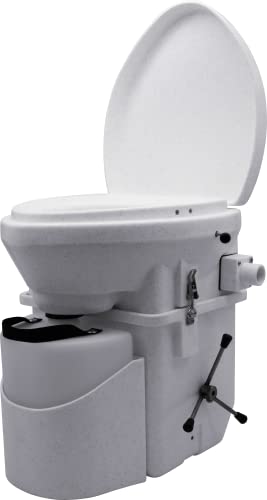
Nature’s Head Self Contained Composting Toilet with Close Quarters Spider Handle — Best Overall
If you ask experienced off-grid homeowners which composting toilet to buy first, the Nature’s Head is the name that comes back most often, and the Close Quarters Spider Handle version is the one to pick for a house. It is a self-contained, urine-diverting toilet: liquid and solid waste are separated at the bowl, solids fall into a chamber filled with a damp composting medium such as coco coir or peat moss, and a hand crank turns an agitator bar through the medium after use. A small 12V fan draws air through the unit and out a vent hose, which is what keeps the bathroom smelling like a bathroom instead of a outhouse.
The Close Quarters detail matters in real houses. The spider handle folds and sits tight to the side of the unit, so the toilet fits into the kind of modest bathroom footprint most houses actually have, instead of demanding the swing clearance the standard crank needs. For a full-time residence — not a weekend toy — that compactness, plus a housing made from durable molded plastic with stainless hardware, is why this model anchors the list.
Check the current price on Amazon
Strengths
- Urine diversion at the bowl keeps the solids chamber dry, which is the single biggest factor in odor control and in how far apart emptying days can be spaced.
- The agitator-and-medium system genuinely composts in place, so what you eventually empty is a soil-like material rather than raw waste in a bag.
- The vented design with a continuously running low-draw fan is proven in full-time homes, cabins and liveaboard boats, so the ownership routine is well documented.
Trade-offs
- You must supply and manage the composting medium yourself: keeping spare coir on hand, rehydrating it, and judging moisture is part of ownership.
- The fan needs a 12V supply and a vent route to the outside, so installation in a finished bathroom takes more planning than dropping in a flush toilet.
- Capacity suits one to two full-time users comfortably; a large family using it as the only toilet will empty more often than the marketing suggests.
| Spec | Detail |
|---|---|
| Type | Self-contained composting toilet with urine diversion |
| Agitation | Hand-crank spider handle agitator |
| Ventilation | 12V fan with vent hose |
| Medium | Coco coir or peat moss (owner supplied) |
Living with a Nature’s Head in a house is a rhythm, not a chore list. After each solid use you turn the handle a few rotations, which buries the deposit in the medium and aerates it. The urine bottle at the front lifts out for emptying every day or two depending on household size, and most owners simply dilute and pour it onto ornamental ground or into a regular drain where local rules allow. The solids chamber, in a one- or two-person house, typically goes several weeks between emptyings; when it is time, the top of the unit unlatches, the chamber is carried out, and the contents go onto a compost pile or into the trash according to your local regulations.
Two honest warnings belong in any house review. First, the learning curve is real for the first fortnight: too dry and the medium does not break waste down, too wet and you get odor and possibly fungus gnats. Second, guests need a thirty-second briefing — sit to use it, every time, and do not throw anything in that is not toilet paper. Households that accept those two facts almost always settle in; households that want a flush-and-forget appliance should look at the Separett Villa instead.
Best for: Full-time houses that want one proven unit for a main or only bathroom / Not suited for: Households that refuse any hands-on emptying routine

Separett Villa Urine-Separating Compost Toilet — Best for High-Capacity Family Use
The Separett Villa takes the opposite philosophy to the Nature’s Head, and for many houses it is the easier philosophy to live with. There is no composting medium, no crank and no in-unit composting at all. The toilet separates urine at the bowl — urine drains away through a hose to a soakaway, a container or an existing drain — while solids drop into a compostable bag lining a roomy internal chamber. A small fan keeps air moving so the seat area stays odor-free, and when the bag is full you tie it off and remove it. That is the whole routine.
For a house, the appeal is capacity and simplicity. The Villa is marketed as a high-capacity design, and in practice the bag system scales better to family use than a medium chamber sized for two. There is nothing to rehydrate, nothing to churn, and nothing to diagnose if the moisture balance goes wrong, because there is no moisture balance to manage.
Check the current price on Amazon
Strengths
- No additives or mixing are needed at all, which removes the entire medium-management learning curve that puts some households off composting toilets.
- The high-capacity solids chamber and bag system handle family traffic with a simple tie-off-and-remove routine anyone in the house can do.
- Urine separation with a plumbed drain option means no front bottle to carry through the house every day or two.
Trade-offs
- Solids are bagged, not composted in the unit, so finishing the composting job — or disposing of the bag — happens outside the toilet and must comply with local rules.
- You are committed to a continuing supply of the compostable liner bags, which is an ongoing consumable cost the medium-based designs do not have in the same way.
- The urine drain hose needs a sensible destination planned before installation; a house without a good soakaway or drain point needs extra plumbing thought.
| Spec | Detail |
|---|---|
| Type | Urine-separating dry toilet |
| Additives | None — no mixing or medium needed |
| Solids handling | Compostable liner bag in high-capacity chamber |
| Intended use | Full-time homes, homesteads, cottages (per Amazon listing) |
The Villa is the pick we steer busy families toward because its failure modes are boring. A medium-based toilet that is neglected gets wet, smelly and unpleasant; a Villa that is neglected just fills its bag. The vent fan still matters — run it, and check the fan and the urine hose for scale build-up a few times a year, because urine scale is the one slow problem every urine-diverting design shares. Houses on septic should also appreciate what the Villa does for the system: blackwater never reaches the tank at all, which stretches pump-out intervals and removes the most demanding load from an older septic field.
Choose the Villa over the Nature’s Head if your household includes people who will not crank, will not manage coir, or will not be briefed. Choose the Nature’s Head if you want finished compost coming out of the unit and no bag consumables. Both are legitimate house toilets; they just ask different things of the people using them.
Best for: Families and busy houses that want the lowest-effort emptying routine / Not suited for: Buyers who want active in-unit composting rather than bag-and-remove

Nature’s Head Self Contained Composting Toilet with Foot-Spider Handle — Best for Tight Bathroom Layouts
Take everything said about the Nature’s Head platform above — the urine diversion, the medium chamber, the vent fan, the proven full-time track record — and change exactly one thing: how you turn the agitator. The Foot-Spider Handle version replaces the side hand crank with a foot-operated mechanism, and that small change decides real purchases in real houses, because the standard crank needs clear space beside the toilet to swing.
In a typical house bathroom the toilet often sits between a vanity and a wall, or close beside a tub. If the crank side is the tight side, every use becomes an awkward reach. The foot-spider solves it: you press and work the agitator with your foot, no side clearance needed, and the unit can sit closer to the wall or cabinet on the crank side.
Check the current price on Amazon
Strengths
- Solves the genuine installation problem of crank swing clearance in tight house bathrooms without giving up the proven Nature’s Head composting system.
- Foot operation keeps hands away from the mechanism entirely, which some households simply prefer on hygiene grounds.
- Same medium-based, in-unit composting and vented design as the Best Overall pick, so all the ownership guidance for that model applies unchanged.
Trade-offs
- Costs more than the hand-crank version for what is, mechanically, a handle change — the premium only makes sense if your layout actually needs it.
- The foot mechanism has more moving parts at floor level, where it collects bathroom dust and needs an occasional wipe-down and check.
- Still a one- to two-user full-time capacity unit; the handle change does nothing for large-family throughput.
| Spec | Detail |
|---|---|
| Type | Self-contained composting toilet with urine diversion |
| Agitation | Foot-operated spider handle |
| Ventilation | 12V fan with vent hose |
| Medium | Coco coir or peat moss (owner supplied) |
Our advice is simple: measure before you choose between the two Nature’s Head versions. Mock up the toilet’s footprint in your bathroom with painter’s tape, stand where a user would stand, and check whether a hand crank on the side could swing freely through its arc without hitting the vanity, a trash bin or the tub edge. If it clears comfortably, save the money and buy the Close Quarters hand-crank model. If it does not — and in small ensuite bathrooms it very often does not — the Foot-Spider is not a luxury, it is the version that makes the platform work in your house at all.
Everything else about ownership is identical: keep the medium damp like a wrung-out sponge, empty the urine bottle on a short cycle, keep the vent fan running, and brief your guests. Houses that do those things get the same odor-free, water-free service from either handle.
Best for: Houses with a cramped bathroom corner where a side crank will not clear / Not suited for: Users who prefer the simpler, cheaper hand-crank mechanism
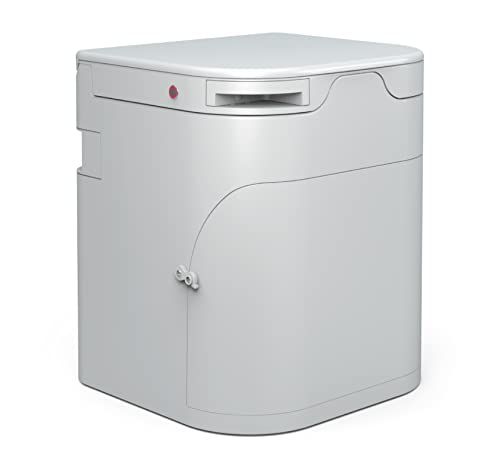
OGO Origin Compact Composting Toilet — Best Compact Premium Pick
The OGO Origin is what happens when a composting toilet is designed from a clean sheet for small spaces and modern expectations. Its footprint is just 15 inches, it diverts urine, and instead of a hand crank it uses an electric push-button mixing system: press the button and the motor turns the medium for you. For a house, that combination targets a very specific and very common job — adding a toilet where a flush toilet cannot easily go. A basement corner without a drain line below the slab. A converted closet. A granny flat or ADU where pulling a sewer connection would cost more than everything else in the project combined.
Because it is compact and self-contained, the Origin also works as a second toilet that relieves pressure on a house’s main bathroom without touching the plumbing system at all, beyond power for the fan and mixer and a vent route.
Check the current price on Amazon
Strengths
- The 15-inch footprint is genuinely small — smaller than most flush toilets — which opens up closet conversions and tight ADU bathrooms that rule out bigger units.
- Push-button electric mixing removes the crank routine entirely, the easiest possible daily interaction of any medium-based composting toilet here.
- Urine diversion and a vented design keep the same odor-control fundamentals as the bigger self-contained models.
Trade-offs
- The electric mixer and fan both need power, so this is a poor choice for a genuinely off-grid house without a battery system to spare.
- Compact cuts both ways: the solids capacity is sized for one or two users, and a busy family bathroom will empty it often.
- As a newer, more electronic design it has more that can fail than a crank and a bucket — motor, button and fan are all service items over a long life.
| Spec | Detail |
|---|---|
| Footprint | 15in (per Amazon listing) |
| Mixing | Electric push-button |
| Type | Compact self-contained composting toilet with urine diversion |
In a house with power — which is most houses considering a composting toilet for water saving, septic relief or a plumbing-free second bathroom — the Origin’s trade-offs land well. The button genuinely changes the ownership experience for households with children, elderly users or anyone who finds the crank ritual off-putting. Set it up with the medium at the right moisture, keep the vent clear, and the daily routine is: use it, press the button, walk away.
Where we would not choose it: as the only toilet for a large household, or anywhere power is precious. Where we would: the ADU, the basement guest room, the workshop bathroom, the pool-house conversion — the long list of house projects where the alternative is an expensive macerating system or no toilet at all.
Best for: Houses adding a compact second bathroom or an accessory dwelling unit / Not suited for: Off-grid houses with no reliable power for the mixing motor and fan

Compo Closet Cuddy Composting Toilet — Best Value Compact
The Compo Closet Cuddy was designed for vans and tiny spaces, but houses should not overlook it, because its fundamentals are exactly what a small household needs: waterless, self-contained, urine-diverting, with a 3.9-gallon solids chamber, a 12V fan and a carbon filter, and no chemicals anywhere in the system. For a one- or two-person house — a small cottage, a starter home adding a half-bath, a cabin-style house on a tricky lot — the Cuddy delivers the composting-toilet experience at the value end of this list.
The carbon filter is a meaningful detail for house use. Most composting toilets must vent outside; the Cuddy’s filtered fan gives more flexibility in placement while the venting is arranged, and in mild-use house settings some owners run it as their main odor control. We still recommend venting outside for a permanent house installation, but the filter widens your options during placement and testing.
Check the current price on Amazon
Strengths
- The lowest-commitment route into a self-contained composting toilet on this list, with urine diversion, a fan and a carbon filter all included.
- The 3.9-gallon chamber and compact body fit the small half-baths, under-stair closets and cottage bathrooms where bigger units will not go.
- No chemicals and no water: running costs are medium and bags or liners only, and nothing in the system can freeze or burst a pipe in an unheated house.
Trade-offs
- A 3.9-gallon chamber is small for full-time use; two adults will empty noticeably more often than with the Nature’s Head or Villa.
- Its design center is mobile and tiny-space use, so long-haul durability in a busy permanent bathroom is less proven than the house-first brands.
- The seat and proportions are compact — larger users should check the dimensions against their comfort before committing.
| Spec | Detail |
|---|---|
| Solids capacity | 3.9 Gal (per Amazon listing) |
| Ventilation | 12V fan with carbon filter |
| Chemicals | None — waterless, self-contained |
Think of the Cuddy as the honest budget door into this category for houses. It asks the same of you as the premium units — manage the medium, empty on a cycle, keep air moving — and it returns the same core benefits: no water, no sewer connection, no septic load. What you give up for the savings is chamber size and the long full-time track record of the Nature’s Head. For a single occupant, a couple in a small house, or a second bathroom that sees weekend guests, that trade is usually worth it. For a family of five’s only bathroom, it is not, and no amount of savings changes the emptying arithmetic.
One practical tip if you install a Cuddy in a house: hard-mount it. In a van it is secured for travel; in a house, bolting or bracketing it to the floor stops the small sideways shifts that compact lightweight units can develop, and makes the seat feel like permanent furniture rather than camping gear.
Best for: One- and two-person houses that want a lower-cost self-contained unit / Not suited for: Large families who would empty a 3.9-gallon chamber too often
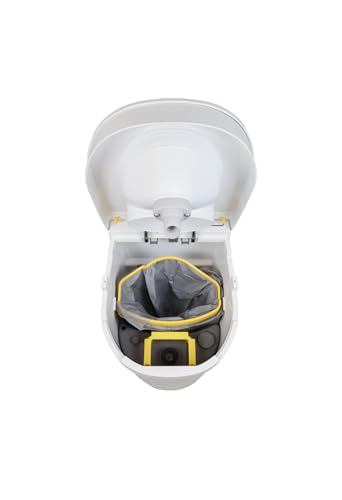
Separett Weekend Prime Urine-Separating Compost Toilet — Best Non-Electric for Guest Houses
Not every toilet on a house property works full-time. The guest house, the pool house, the in-law suite that hosts six weekends a year, the workshop bathroom — these rooms need a toilet that tolerates long idle stretches gracefully, asks nothing while it sits, and is ready when visitors arrive. That is precisely the design brief of the Separett Weekend Prime: a non-electric, self-contained urine-separating toilet built for off-grid and part-time use.
Non-electric is the headline. There is no fan drawing power for months while nobody visits, no motor, nothing to maintain between guests. Urine separates at the bowl, solids collect in a lined chamber, and the routine when guests leave is the routine at the end of any stay: check the chamber, tie off and remove the bag if needed, done.
Check the current price on Amazon
Strengths
- No electricity at all, so it can sit in an unpowered guest house or outbuilding indefinitely with zero standby draw and zero maintenance between visits.
- Urine separation keeps the solids dry and the room odor-free without any medium, crank or additive to manage.
- Self-contained installation needs no water line, no drain and no septic connection — ideal for detached rooms on a house property.
Trade-offs
- Without a fan it leans harder on good natural venting and on the urine separation doing its job; placement in a stuffy, airless room is a mistake.
- It is a part-time design: put it in a full-time main bathroom and its chamber and routine will feel undersized within weeks.
- Like the Villa, solids leave in a bag to be composted or disposed of under local rules — there is no in-unit composting.
| Spec | Detail |
|---|---|
| Power | None — non-electric |
| Type | Self-contained urine-separating toilet |
| Intended use | Off-grid living, guest and seasonal use (per Amazon listing) |
The Weekend Prime earns its place in a houses guide because ‘houses’ in the real world includes the whole property, and the whole property is where flush plumbing is most expensive to extend. Running water and sewer to a detached guest room can cost more than the room’s entire fit-out; a Weekend Prime on a simple vent makes the room genuinely usable for a fraction of that. It is also the emergency-preparedness pick: when a house loses water service — frozen lines, well pump failure, municipal shutoffs — a non-electric dry toilet in the garage or basement keeps the household functioning.
Do not buy it as your main toilet to save money. Buy it for the room that is used sometimes, sits empty often, and has no plumbing — for that job it is the most sensible design on this page.
Best for: Guest houses, pool houses and seasonal rooms on a house property / Not suited for: A full-time main bathroom with heavy daily traffic
Comparison Table
| Pick | Badge | Key spec | Best for |
|---|---|---|---|
| Nature’s Head Self Contained Composting Toilet with Close Quarters Spider Handle | Best Overall | Self-contained urine-diverting design with hand-crank agitator and 12V vent fan | Full-time houses that want one proven unit for a main or only bathroom |
| Separett Villa Urine-Separating Compost Toilet | Best for High-Capacity Family Use | Urine-separating, no additives or mixing needed, high-capacity solids chamber | Families and busy houses that want the lowest-effort emptying routine |
| Nature’s Head Self Contained Composting Toilet with Foot-Spider Handle | Best for Tight Bathroom Layouts | Foot-spider handle variant of the Nature’s Head self-contained composting toilet | Houses with a cramped bathroom corner where a side crank will not clear |
| OGO Origin Compact Composting Toilet | Best Compact Premium Pick | 15in footprint, electric push-button mixing, urine diversion | Houses adding a compact second bathroom or an accessory dwelling unit |
| Compo Closet Cuddy Composting Toilet | Best Value Compact | 3.9 Gal solids capacity, 12V fan, carbon filter, no chemicals | One- and two-person houses that want a lower-cost self-contained unit |
| Separett Weekend Prime Urine-Separating Compost Toilet | Best Non-Electric for Guest Houses | Non-electric, self-contained urine-separating design | Guest houses, pool houses and seasonal rooms on a house property |
How to Choose a Composting Toilet for a House
Start with the philosophy, because it decides your weekly routine for years. A medium-based composting toilet (Nature’s Head, OGO Origin, Compo Closet Cuddy) keeps a chamber of damp coco coir or peat moss that an agitator turns after use; solids break down in the unit and come out as a soil-like material. A urine-separating dry toilet (the Separett models) has no medium and no composting inside; solids drop into a compostable bag you remove. Neither is better in the abstract. Medium-based suits owners who want finished compost and no bag consumables. Separating suits households that want the simplest possible routine and do not mind handling bags.
Match capacity to the household, honestly
Manufacturers quote capacity generously. Our working rule from owner experience: a self-contained medium chamber serves one to two full-time adults comfortably, three at a stretch with more frequent emptying. A high-capacity bag system like the Separett Villa stretches further for families because the chamber is bigger and the routine is just a bag swap. If the composting toilet will be the only toilet for four or more full-time people, either choose the highest-capacity design you can fit, or plan on two units — a common and sensible arrangement in off-grid houses.
Plan the vent and the power before you fall in love
Almost every model here uses a small fan and a vent hose that must reach outside air — through a wall, up through the roof, or into an existing vent path. Walk the route in your bathroom before ordering. The fan and any electric mixer need 12V or mains power depending on model; the one exception on this list, the Separett Weekend Prime, needs neither, which is exactly why it suits unpowered outbuildings. Houses with a battery-backed solar system should note the fan draw is small but continuous.
Decide where the urine goes
Urine diversion is what makes these toilets work, and the urine has to go somewhere. Bottle-based designs (Nature’s Head, OGO, Cuddy) carry a front container you empty every day or two — most house owners dilute it for the garden or pour it into a drain where permitted. Plumbed designs (Separett Villa) route urine through a hose to a soakaway pit, a holding container or an existing greywater line. Neither is wrong, but a house that cannot face carrying a bottle should buy a plumbed design, and a house with nowhere to run a hose should buy a bottle design. Decide this before the toilet arrives, not after.
What Does a House Give Up — and Gain — by Going Waterless?
The gains are concrete. A composting toilet uses no water at all, which matters for wells, water bills and drought restrictions. It needs no sewer or septic connection, which unlocks bathrooms in basements, additions and outbuildings where a drain line is impractical, and it removes blackwater from a septic system entirely, extending the life of older fields. In a freeze-prone house or outbuilding there is no trap or tank to burst.
The costs are equally concrete, and a good guide should name them. You become the waste system: emptying, medium or bags, and a small amount of routine attention replace the flush handle. Guests need briefing. Resale and code questions vary by jurisdiction — some local codes still require a conventional toilet in a primary dwelling, so a composting unit may need to be the second bathroom on paper even when it does the main work in practice. Check your local rules before a whole-house conversion, and keep the paperwork for any permits your area requires.
How to Install and Set Up a Composting Toilet in a House Bathroom
Installation is a half-day job for most of these models and well inside DIY territory, because there is no water line and no drain to connect. The work is positioning, venting and power.
- Choose the spot and check the footprint with tape on the floor, including door swing and, for crank models, the handle’s swing arc — or choose a foot-handle or button model if the arc does not clear.
- Plan the vent route from the unit’s exhaust port to outside air, keeping bends few and gentle; a short, straight vent run works noticeably better than a long, kinked one.
- Set the unit in place and secure it to the floor with the supplied brackets or screws so it cannot shift in daily use.
- Connect the vent hose, seal the joints, and fit the exterior vent cap so rain and insects stay out.
- Wire the fan (and mixer, on the OGO Origin) to its 12V or mains supply and confirm the fan runs continuously and quietly.
- Prepare the medium if your model uses it: rehydrate the coco coir until it feels like a wrung-out sponge, then load the chamber to the level the manual specifies.
- For urine-separating models, fit the liner bag correctly and route the urine hose or position the bottle; do a test pour of clean water through the urine path to confirm it drains where you intend.
- Brief the household: sit for all uses, add nothing except toilet paper, turn the agitator or press the button after solid use, and never spray cleaner inside the bowl — a vinegar-water wipe is the house standard.
After the first week, check the medium moisture and the urine path once, adjust, and then settle into the routine: urine out every day or two, solids on the cycle your household size dictates, fan filter and hose inspected a few times a year.
Common Buying Mistakes
Buying for the brochure capacity. A unit rated optimistically for a family will be emptied constantly by that family, and constant emptying is what makes owners hate a good toilet. Size for your real headcount, or buy the high-capacity design.
Ignoring the vent route until delivery day. Odor control lives and dies on ventilation. A toilet installed with a kinked, uphill or indoor-vented hose will smell, and the toilet will get the blame for an installation error.
Letting the medium dry out — or drown. Too dry and composting stalls; too wet and you get odor and gnats. The wrung-out-sponge feel is the target, checked weekly until it becomes habit.
Skipping the guest briefing. Standing use defeats urine diversion and is the number one cause of a messy, smelly unit in an otherwise well-run house. Thirty seconds of explanation prevents all of it.
Assuming codes do not apply. Some jurisdictions regulate composting toilets in primary residences. A five-minute check with your local building or health department protects the whole project.
Final Recommendation
For most houses, the Nature’s Head with the Close Quarters Spider Handle is the safest first composting toilet: proven, compact enough for a real bathroom, and supported by the deepest pool of owner knowledge. If your household will not manage medium and cranks, the Separett Villa is the better family answer. Tight ensuite? The Foot-Spider Nature’s Head. Adding a small second bathroom? The OGO Origin. Small household on a budget? The Compo Closet Cuddy. Guest house or pool house? The Separett Weekend Prime.
Whichever you choose, buy the consumables with the toilet — spare medium or a roll of liner bags, a spare urine bottle if your model uses one — so the first month runs without a scramble.
The verified shortlist, with live listings:
- Nature’s Head Self Contained Composting Toilet with Close Quarters Spider Handle — Best Overall: Check the current price on Amazon
- Separett Villa Urine-Separating Compost Toilet — Best for High-Capacity Family Use: Check the current price on Amazon
- Nature’s Head Self Contained Composting Toilet with Foot-Spider Handle — Best for Tight Bathroom Layouts: Check the current price on Amazon
- OGO Origin Compact Composting Toilet — Best Compact Premium Pick: Check the current price on Amazon
- Compo Closet Cuddy Composting Toilet — Best Value Compact: Check the current price on Amazon
- Separett Weekend Prime Urine-Separating Compost Toilet — Best Non-Electric for Guest Houses: Check the current price on Amazon
Keep researching the rest of this toilet cluster here: Best Compost Toilets For A House Best Composting Toilets For Tiny Houses Best Compost Toilets For Off Grid Best Composting Toilets For A Home Best Compost Rv Toilets Best Diy Composting Toilets
Frequently Asked Questions
Do composting toilets smell in a house?
A correctly installed and used composting toilet does not smell like waste. Urine diversion keeps solids dry, the fan moves air out through the vent continuously, and the medium or bag system handles the rest. When a house unit does smell, the cause is almost always one of three fixable things: a blocked or badly routed vent, medium that has become too wet, or urine getting into the solids chamber through standing use.
How often do you empty a composting toilet in a full-time house?
The urine container on bottle models needs emptying every one to two days for a couple. The solids side depends on the design: a medium chamber serving one or two people typically goes several weeks, a family using a bag system swaps bags as they fill, and any unit serving more people cycles faster. Emptying a medium chamber takes a few minutes and the contents are largely broken down; emptying a bag system is a tie-off and a carry.
Can a composting toilet be the only toilet in a house?
Functionally, yes — many off-grid and water-conscious houses run exactly that way, and the models on this list are built for it. Legally, it depends on your jurisdiction: some building and health codes require a conventional flush toilet in a primary residence. Check locally before removing your only flush toilet, and size the unit honestly for your household if it will carry the full load.
What happens to the compost — is it safe to use?
Material from a medium-based unit that has fully broken down is typically used on ornamental plantings, trees and non-food landscaping, or disposed of with household waste, depending on local rules. Bag-system contents need further composting in a dedicated outdoor pile or disposal. Food gardens are where owners differ and where local health guidance matters most; the conservative house standard is ornamentals only, and always follow your local regulations.
Do composting toilets work in winter in an unheated house?
The toilet itself cannot freeze — there is no water in it — which makes it ideal for seasonal houses that are drained down in winter. Composting biology slows in the cold, so a unit in an unheated space will process more slowly and may simply store until spring, but it will not be damaged. Fan-vented models keep working as long as they have power; the non-electric Separett Weekend Prime asks for nothing at all.
What do guests need to know?
Three things, in thirty seconds: sit down for everything, because urine diversion only works seated; put nothing in the toilet except toilet paper; and turn the handle a few times or press the mixing button after a solid use, if your model asks for it. Houses that give that briefing — a small framed note in the bathroom works — report that guests cope fine and the toilet stays trouble-free.


