Disclosure: airfryerkitchensupply.com is reader-supported. When you buy through links on our site, we may earn an affiliate commission at no extra cost to you.
Where to buy
Shopping for best commercial rotating gas smokers usually starts on Amazon, where the linked models below can be ordered with delivery to a business address. Start with the Southern Pride Rotisserie Smoker (commercial fabricator line) if you want the headline recommendation first, and check price on Amazon for each linked pick before you commit, because commercial buying should always be done against a live listing rather than a printed number.
Verified listings in this guide: Masterbuilt 40-inch ThermoTemp Propane Smoker MB20051316; Dyna-Glo DGY784BDP 36-inch Vertical LP Gas Smoker; Pit Boss 3-Series Gas Vertical Smoker, Red Hammertone 10773; HAKKA Commercial Electric Smoker DSH-S50B.
The search for the best commercial rotating gas smokers runs into a fact this guide will state plainly rather than decorate: true rotating gas smokers, the kind with motor-driven racks turning inside a commercial pit, are fabricator machines sold direct to restaurants. They are not sold through verified Amazon listings. What Amazon does sell, and what this guide links, are the gas cabinets most buyers in this search actually end up running.
That is not a bait-and-switch; it is the market. A rotating gas pit is a capital project with freight, gas installation and ventilation planning. A gas cabinet is a working tool you can order today. This guide covers the fabricator machines honestly as a pick without a link, then gives you the verified gas alternatives with their real strengths and their real limitation, which is static racks.
If even cooking is the reason rotation appeals to you, read the guide sections carefully. Rotation is one answer to evenness; tray rotation, convection and cabinet design are others, and for many small operations they are the proportionate answer.
In this guide
Quick Picks
Best True Rotating Gas System: Southern Pride Rotisserie Smoker (commercial fabricator line) — The true rotating gas class, sold direct; unlinked, no verified Amazon listing.
Best Rotating Fabricator Alternative: Ole Hickory Pits Commercial Smoker (fabricator line) — Commercial fabricator pits with rotating configurations; unlinked, dealer and direct sales.
Best Amazon Gas Cabinet: Masterbuilt 40-inch ThermoTemp Propane Smoker MB20051316 — 960 sq in propane cabinet with thermostat control; the closest Amazon gas alternative.
Best Portable Gas Cabinet: Dyna-Glo DGY784BDP 36-inch Vertical LP Gas Smoker — Proven portable LP cabinet for events and small kitchens.
Best Branded Gas Cabinet: Pit Boss 3-Series Gas Vertical Smoker, Red Hammertone 10773 — Branded gas vertical with easy, trainable operation.
Best Electric Cabinet Alternative: HAKKA Commercial Electric Smoker DSH-S50B — Eight-rack electric cabinet for buyers whose real need is batch evenness, not gas.
How These Picks Were Chosen
This list was built by separating the two things the keyword mixes together: rotating commercial pits, and gas smokers available to buy online. Fabricator machines were included on reputation and restaurant presence and are written unlinked, because Amazon listing data returned no verified Amazon cooker listing for them and inventing one would be fabrication. Gas cabinets were cross-checked against the API cache by title before earning a link.
No static-rack cabinet below is described as rotating. Where a cabinet is recommended to a rotation-minded buyer, the reason is stated plainly: evenness technique, capacity or running cost, never a mechanism it does not have.
The 6 Best Options for Commercial Rotating Gas Smokers and the Honest Alternatives
Southern Pride Rotisserie Smoker (commercial fabricator line) — Best True Rotating Gas System
Southern Pride is one of the names restaurants actually mean when they say commercial rotisserie smoker: a rotating-rack pit built for daily service, sold direct by the fabricator with freight, installation and code questions handled as part of the sale. That is exactly why it is written unlinked here. There is no verified Amazon listing for the cooker itself, and inventing one would be a disservice.
If your volume is whole birds, ribs and shoulders in daily restaurant quantities and your premises can host a commercial pit, this class of machine is the correct purchase, bought through the fabricator or a restaurant-equipment dealer. Use the linked cabinets in this guide as your interim or satellite capacity while that project runs.
Southern Pride fits the restaurant whose numbers already argue for rotation: daily bird and mixed-load volume, a site that can host gas and extract, and a menu where even browning is the product. At that point the conversation is with the fabricator about specification, not with a catalogue about price.
Strengths
- True rotating rack system evens cooking across large loads without manual tray rotation
- Built for restaurant duty cycles with commercial construction
- Gas and wood configurations exist in the fabricator’s commercial range
Trade-offs
- Sold direct, not on Amazon, so ordering, freight and install are a project, not a parcel
- Commercial-tier investment that needs volume to justify
- Requires planned ventilation, gas and fire-suppression conversations with local code
Key specs: Commercial rotisserie format; sold direct by the fabricator.
Best for: established restaurants needing true rotating commercial capacity / Not suited for: anyone needing a smoker delivered this week from Amazon.
The Southern Pride Rotisserie Smoker (commercial fabricator line) is sold direct by its maker rather than through Amazon, so there is no Amazon listing to link here; it sits in the premium commercial tier and is quoted per specification.
Ole Hickory Pits Commercial Smoker (fabricator line) — Best Rotating Fabricator Alternative
Ole Hickory belongs in any honest commercial smoker discussion. Its pits cook in well-known BBQ restaurants, in convection and rotating formats designed for service rather than weekends. Like Southern Pride, it is a fabricator purchase: you spec the pit, arrange freight and install, and plan ventilation with your local authority.
It is listed unlinked because Amazon does not sell the cookers through a verified listing we could confirm. For a growing operation, the practical path is to run the verified cabinets and offsets in this guide now, track your weekly smoked volume, and use those numbers to spec a fabricator pit when the volume proves the case.
Ole Hickory fits the BBQ restaurant growing out of cabinets: proven commercial pits, dealer support and formats that include rotation, bought as a planned installation. It is the step taken from strength, with a season of logs proving the volume the pit is sized for.
Strengths
- Long-standing commercial BBQ name with pits in restaurants across the US
- Convection and rotating configurations in the commercial range
- Built for the duty cycle a busy BBQ restaurant actually runs
Trade-offs
- Direct and dealer sales only; no verified Amazon cooker listing
- Lead times and freight are part of the purchase
- Overkill, in size and investment, for a start-up menu
Key specs: Commercial fabricator pit; sold direct and through dealers.
Best for: growing BBQ restaurants planning a fabricator-grade pit / Not suited for: start-ups and small stalls.
The Ole Hickory Pits Commercial Smoker (fabricator line) is sold direct by its maker rather than through Amazon, so there is no Amazon listing to link here; it sits in the premium commercial tier and is quoted per specification.

Masterbuilt 40-inch ThermoTemp Propane Smoker MB20051316 — Best Amazon Gas Cabinet
The ThermoTemp is the gas cabinet that behaves most like an oven: set the dial and the burner cycles to hold temperature, which is why restaurants and caterers who cannot staff a fire keep choosing propane cabinets. At 960 square inches it carries real loads, and propane’s independence from the electrical supply suits outdoor catering and market work.
Be clear-eyed about smoke. A chip tray over a gas burner gives a lighter smoke than a wood firebox, so this cabinet suits ribs, poultry and pork where a gentle smoke is a feature. For the rotating-gas question specifically, see the honest discussion in the guide: true rotating gas pits are direct-sale commercial machines, and this Masterbuilt is the closest Amazon-available gas cabinet alternative.
The ThermoTemp fits the buyer who needed rotation’s evenness more than rotation itself: thermostat-held gas heat and a big cabinet, run with a tray-rotation card, deliver most of the result this week, at a cabinet’s cost and simplicity. For many small restaurants this is the correct end of the search, not a consolation.
Strengths
- Propane heat is steady, cheap to run and independent of electrical supply
- ThermoTemp control holds a set temperature like an oven, easing staff training
- 960 square inches is full cabinet capacity for ribs and shoulders
Trade-offs
- Gas smoke flavour depends entirely on the chip tray, so smoke is lighter than wood fire
- Propane storage and connection checks become part of the safety rota
- Not a rotating or rotisserie unit; racks are static
Key specs: 960 sq in (per Amazon title); propane fuel; thermostat-style analog control.
Best for: caterers and restaurants wanting oven-like gas cabinet control / Not suited for: buyers who specifically need a rotating rack system.
Check the current price on Amazon for the Masterbuilt 40-inch ThermoTemp Propane Smoker MB20051316.
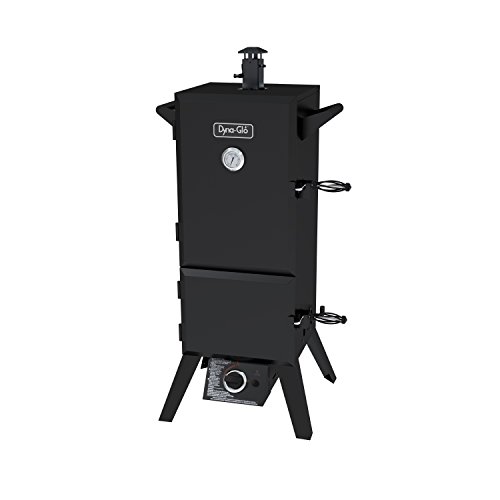
Dyna-Glo DGY784BDP 36-inch Vertical LP Gas Smoker — Best Portable Gas Cabinet
Dyna-Glo’s 36-inch LP cabinet is a veteran of the gas smoker world: light it, set it, and smoke in a vertical format that travels well between kitchen, yard and event site. For rotating-gas shoppers it represents the practical Amazon tier of gas smoking, namely a static-rack cabinet that trades mechanical rotation for simplicity and price discipline.
Rotation in a cabinet is partly a technique, not only a mechanism. Rotating trays top-to-bottom halfway through a batch, which good kitchens do anyway, closes most of the evenness gap that rotisserie marketing talks about, without a motor, gearbox or spit to maintain.
The Dyna-Glo fits the mobile version of the question: caterers and market kitchens that need gas smoking wherever the pitch is, light and proven, with tray rotation as the evenness method. Its portability is the feature the fabricator machines can never offer.
Strengths
- Propane cabinet format is simple, portable and quick to light for service
- Vertical racks suit ribs, sausage and tray items in batches
- Long-running model with a wide owner base and easy familiarity
Trade-offs
- Single-burner cabinets can run hotter at the bottom rack; rotate loads
- Chip box capacity means refills on the longest smokes
- Powder-coat finish needs cover storage to stay ahead of weather
Key specs: 36-inch vertical LP gas cabinet (per Amazon title); propane fuel.
Best for: gas-smoker buyers wanting a proven, portable cabinet / Not suited for: operations that need genuine rotisserie motion for whole birds at volume.
Check the current price on Amazon for the Dyna-Glo DGY784BDP 36-inch Vertical LP Gas Smoker.
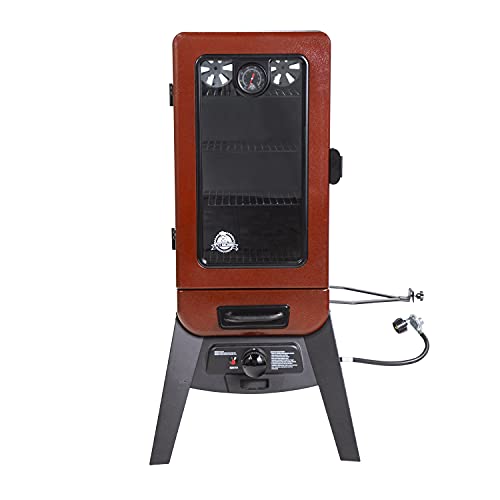
Pit Boss 3-Series Gas Vertical Smoker, Red Hammertone 10773 — Best Branded Gas Cabinet
Pit Boss’s 3-Series gas vertical is the branded, supportable face of propane cabinet smoking. It lights fast, holds a working temperature with little attention and stacks enough racks for a small service of ribs, wings and sausage, which is why it appears in so many small restaurant yards and catering rigs.
In the rotating-gas conversation it plays the same honest role as the other gas cabinets here: it is what you can actually buy, warranty and run today, while true rotating gas pits are ordered from commercial fabricators. If even cooking is your worry, tray rotation plus the cabinet’s natural convection gets you most of the way there.
The Pit Boss fits the small restaurant that wants gas with a badge and a dealer network behind it: easy lighting, steady cabinet heat and racks enough for a focused service, presented well enough to sit in customer view without apology.
Strengths
- Gas cabinet convenience with Pit Boss dealer familiarity
- Vertical format stacks racks for rib and tray batches
- Distinctive finish stands up well in customer-facing outdoor setups
Trade-offs
- Gas smoke intensity is mild; wood chunk management matters
- Cabinet capacity is mid-size, not full commercial volume
- Static racks only; no rotation mechanism
Key specs: 3-series vertical gas cabinet (per Amazon title); propane fuel.
Best for: small restaurants wanting a branded gas cabinet with easy operation / Not suited for: high-volume rotisserie chicken programmes.
Check the current price on Amazon for the Pit Boss 3-Series Gas Vertical Smoker, Red Hammertone 10773.

HAKKA Commercial Electric Smoker DSH-S50B — Best Electric Cabinet Alternative
The HAKKA DSH-S50B is the closest thing on Amazon to a true commercial smoke oven: a vertical cabinet with eight racks built for repeatable batches of sausage, bacon, pastrami and smoked poultry. For a small operation the appeal is workflow, not romance. You load the cabinet, set the heat, and the batch runs without a pitmaster standing over a firebox for ten hours.
Treat it as a production cabinet rather than a brisket pit. It excels where the product is cured, hung or laid in uniform pieces and where consistency across batches matters more than bark theatre. Plan your rack map before the first commercial run, because eight racks reward planning and punish improvisation.
The HAKKA fits the rotation-minded buyer whose menu turns out to be trays, not spits: eight racks of even, unattended electric production. When the honest product audit says sausage, bacon and ribs, this cabinet is frequently the machine the rotating-gas search was actually looking for.
Strengths
- Eight racks give genuine batch capacity for sausage, bacon and pastrami runs in a single load
- Cabinet format suits indoor-adjacent and commissary workflows better than an open backyard pit
- Electric heat removes fire-tending labour during long low-temperature cures
Trade-offs
- Electric smoke flavour is milder than a live-fire offset, which purists notice on brisket bark
- Cabinet needs a dedicated circuit and a dry, ventilated home in the kitchen
- Rack spacing limits very tall cuts unless you re-plan the load
Key specs: Vertical cabinet; 8 racks; electric smoke oven format.
Best for: high-volume sausage, bacon, pastrami and poultry batches in a small commercial kitchen / Not suited for: buyers who want live-fire offset bark as the headline flavour.
Check the current price on Amazon for the HAKKA Commercial Electric Smoker DSH-S50B.
Comparison Table
| Pick | Badge | Key spec | Best for |
|---|---|---|---|
| Southern Pride Rotisserie Smoker (commercial fabricator line) | Best True Rotating Gas System | Commercial rotisserie format; sold direct by the fabricator | established restaurants needing true rotating commercial capacity |
| Ole Hickory Pits Commercial Smoker (fabricator line) | Best Rotating Fabricator Alternative | Commercial fabricator pit; sold direct and through dealers | growing BBQ restaurants planning a fabricator-grade pit |
| Masterbuilt 40-inch ThermoTemp Propane Smoker MB20051316 | Best Amazon Gas Cabinet | 960 sq in (per Amazon title); propane fuel; thermostat-style analog control | caterers and restaurants wanting oven-like gas cabinet control |
| Dyna-Glo DGY784BDP 36-inch Vertical LP Gas Smoker | Best Portable Gas Cabinet | 36-inch vertical LP gas cabinet (per Amazon title); propane fuel | gas-smoker buyers wanting a proven, portable cabinet |
| Pit Boss 3-Series Gas Vertical Smoker, Red Hammertone 10773 | Best Branded Gas Cabinet | 3-series vertical gas cabinet (per Amazon title); propane fuel | small restaurants wanting a branded gas cabinet with easy operation |
| HAKKA Commercial Electric Smoker DSH-S50B | Best Electric Cabinet Alternative | Vertical cabinet; 8 racks; electric smoke oven format | high-volume sausage, bacon, pastrami and poultry batches in a small commercial kitchen |
How to Choose the Best Commercial Rotating Gas Smokers Without Buying the Wrong Machine?
Decide first whether you need rotation itself or the even cooking rotation promises. Whole birds and mixed loads in daily restaurant volume genuinely benefit from a rotating rack, because every piece cycles through the same heat. Occasional batches do not; the same result comes from rotating trays by hand halfway through the cook, which costs nothing and has no motor to fail.
Then decide whether your premises and budget support a fabricator pit at all: gas supply and installation, ventilation, floor space, freight access and the capital tier these machines live at. If any answer is no, your honest shortlist is the gas cabinets in this guide, run with a tray-rotation routine.
Why Are True Rotating Gas Smokers Not Sold on Amazon?
Because they are installed equipment, not parcels. A rotating commercial pit is specified to a kitchen, shipped by freight, connected to gas and ventilation by trades, and commissioned. Fabricators sell that process direct or through restaurant-equipment dealers, and the service relationship after the sale is part of the product.
Understanding that protects buyers from the listings that pretend otherwise. If an online listing claims a full commercial rotating pit at a consumer price with parcel delivery, read it as a warning, not a bargain.
Gas Cabinet or Rotating Pit: Which Evenness Strategy Fits a Small Operation?
For loads up to a small service, a vertical gas cabinet plus disciplined tray rotation delivers most of the evenness at a fraction of the investment, and it can be running this week. The ThermoTemp cabinet in this list adds thermostat-style control, which removes the temperature babysitting that makes static cabinets uneven in the first place.
For daily whole-bird programmes or mixed loads at real restaurant volume, rotation earns its cost, and the fabricator route is the correct one. The mistake is the middle path: paying rotating-pit money for a static cabinet, or starving a genuine volume programme with a cabinet that cannot keep up.
What Does a Rotating Gas Installation Actually Involve?
Gas work by a licensed fitter, sized to the pit’s demand and your kitchen’s existing load, with isolation and leak testing documented for your insurer. This is not a hose-and-regulator job like a backyard cabinet, and treating it as one is how installations fail inspection.
Ventilation designed for a wood-and-gas smoke load, which is heavier and greasier than ordinary cooking extract. Many rotating pits burn gas for heat with wood for smoke, so the extract and fire-suppression conversation must include the smoke, not just the burner.
Floor and access planning: these pits are heavy, arrive by freight and do not turn tight corridor corners. Measure the whole route from kerb to final position, including door heights, before the order, not on delivery day.
Commissioning and training from the fabricator or dealer, covering the rotation drive, burner service and the cleaning routine for the rack system. Budget staff time for it; a rotating pit run by untrained staff loses exactly the consistency it was bought for.
A service relationship. Motors, gearboxes and burners in daily service need parts and a person to call. The dealer network is part of what the fabricator price buys, and it is the part Amazon cabinets replace with simplicity and low replacement cost.
How to Get Rotisserie-Even Results From a Static Gas Cabinet
Load for airflow first: leave gaps between pieces, keep the cabinet to a sensible fill, and group items by size so a tray finishes together. Most cabinet unevenness is loading, not machinery.
Set a tray-rotation schedule and write it on the cook card: top and bottom trays swap halfway through the batch, and trays turn front to back at the same time. Timed, written rotation is how static cabinets quietly match rotating results on tray products.
Use a probe in the thickest piece on the historically coolest rack, which you will identify in your first logged cooks. Cooking to the cool spot’s temperature is what makes the whole batch safe and consistent.
Manage the chip tray as a timed input, not a set-and-forget: smaller, more frequent chip additions give cleaner smoke than one overloaded tray that smoulders thick and bitter through the first hour.
Rest and hold with the same discipline as the cook. Even cooking is wasted if the first trays sit drying while the last finish; stagger loading so batches land together, and hold at a safe temperature in a covered tray.
Extend the routine with a monthly evenness audit: one identical tray product cooked on every rack, timed and tasted, with the results logged. Cabinets drift as seals age and burners foul, and the audit catches the drift while it is still a cleaning job rather than a quality complaint.
Keep the chip supply as disciplined as the technique: dry chips or chunks of a consistent size, stored dry, measured by the handful or scoop the cook card specifies. Variable fuel makes variable smoke, and variable smoke makes the rotation question impossible to judge fairly.
Keep a simple evenness log per cabinet: which rack ran hot this month, which tray position needed the extra minutes. Seals age and burners foul gradually, and the log turns that drift into a maintenance task before it becomes a customer-facing inconsistency.
When a batch matters, a wedding, a first wholesale order, run the cabinet’s proven load rather than a new arrangement. Static cabinets reward the familiar: the known load, the known rotation times, the known probe position. Save experiments for rehearsal days.
Common Buying Mistakes
The headline mistake in this category is buying a static cabinet while believing it rotates, because a listing used the word rotisserie loosely. Read specifications, not adjectives, and check whether a motor and rotating rack are actually described.
The second mistake is the opposite: committing to a fabricator rotating pit for a volume that a cabinet and a tray-rotation card would have handled, tying up capital the business needed elsewhere. The third is ignoring installation costs, which can rival the difference between machine tiers.
Finally, do not let the rotation question distract from smoke quality. Gas heat with a neglected chip tray produces hot, pale, under-smoked food in any cabinet, rotating or not.
How Do Buyers Compare a Rotating Pit Against a Cabinet on Paper?
Put the two columns side by side with real numbers: weekly covers of the items rotation would cook, the labour minutes each option consumes per batch, the fuel cost per batch, and the installed cost, machine plus gas, extract and freight for the rotating pit, machine only for the cabinet. The comparison usually decides itself once labour and installation are priced honestly.
Add a third column for time: the cabinet cooks this week; the rotating pit cooks after specification, freight, installation and commissioning. A season of cabinet production while the fabricator project proceeds is a legitimate plan, and the cabinet remains as satellite capacity afterwards.
Include the failure column too: what stops cooking when each machine faults. A cabinet’s faults are small parts and same-week fixes; a rotating drive or burner fault is a dealer call. Volume justifies that dependency; small menus rarely do.
Then taste honestly. Cook the same birds both ways if you can, at a dealer’s demonstration or a friendly kitchen. Rotation’s even browning is visible and real; whether your customers will pay its premium on your menu is a business question wearing a culinary coat.
The paper exercise protects against the two classic errors of this category: the cabinet bought while believing it rotates, and the rotating pit bought for a menu of trays. Both errors are expensive; the columns are cheap.
What Gas Safety Routine Does a Commercial Smoker Need?
Connections are checked on a rota, with leak testing after any cylinder or line change, and the checks are initialled in the same log that holds the cooks. Gas safety in a commercial kitchen is a documented habit, not a sniff and a shrug, and insurers read the log after any incident.
Cylinders and storage follow the local rules for commercial premises, which are stricter than garden habits: secured, ventilated, away from heat and traffic, with the spare stored as carefully as the one in use. The smoker’s own clearances from combustibles are part of the same discipline.
Burners and chip trays are cleaned before build-up becomes behaviour: a burner that lights unevenly and a tray that smoulders dirty are both telling the team something, and the rota should make someone responsible for listening.
Staff are trained on the shutdown sequence and the fault sequence: gas off, isolate, ventilate, call the right number. In a small operation that training is fifteen minutes, written on the station card, and it is the cheapest safety equipment in this entire guide.
Finally, the installation itself, for any fixed gas pit, belongs to licensed professionals whose paperwork your insurer can read. The savings from informal gas work are the most expensive savings in commercial cooking.
How Does Rotation Change Fuel and Running Costs?
A rotating gas pit’s fuel story is gas for heat with, in many configurations, wood for smoke: two supplies to source, store and cost. Gas consumption at commercial duty is a metered, predictable line; wood for smoke is smaller in volume than an offset’s fuel but demands the same dryness and consistency, because smoke quality does not scale down with quantity.
Electricity joins the bill for the rotation drive and controls, trivial beside the gas but part of the installed picture, as are the service visits that a machine with a drive train earns. Rotating pits are serviced like equipment, on intervals, by people who know them, and that contract belongs in the running-cost column from the first quote.
Against those costs, rotation returns labour: no tray rotation rounds, less product lost to uneven cooking, and a consistency that reduces remakes and complaints. The honest comparison prices both sides per batch, which is why this guide keeps returning to batch costing as the buyer’s real tool.
Cabinet alternatives invert the profile: tiny installation and service costs, a little more human attention per batch, and product loss that good tray discipline keeps small. For many small menus the arithmetic favours the cabinet for years before volume tips it, and knowing your own tip point is the buyer’s real expertise.
Whichever machine is chosen, the first season’s logs decide the argument retrospectively. Buyers who log fuel, labour and yield can defend their choice with numbers; buyers who did not are left defending it with adjectives.
What Should a Buyer Verify Before Signing for a Fabricator Pit?
The specification in writing: capacity in your product, fuel configuration, electrical and gas requirements, dimensions with the door open and the rack out, and the clearances the maker demands. Verbal specifications evaporate; written ones commission the right machine and protect both sides.
The delivery and installation scope in the same document: who freights, who places, who connects, who commissions, and what your trades must provide before the truck arrives. Most fabricator-pit misery lives in the gap between machine delivered and machine cooking, and the document is the bridge.
The warranty and parts picture: what is covered, for how long, what the wear parts are and what they cost today. A rotating drive and a burner are the two systems to ask about by name, because they are the two that move and burn for a living.
Training and documentation: manuals for your exact configuration, a commissioning session for your team, and the cleaning schedule in writing. A fabricator who trains well is telling you how the next ten years will go.
And references at your scale, called and asked the unglamorous questions: downtime, parts waits, cleaning reality. The reference call is the cheapest due diligence in commercial equipment, and skipping it to save an hour is false economy.
How Should a Buyer Trial the Cabinet Alternative Before Committing?
Run the trial as a fortnight of real production, not a single demonstration cook. Borrow, hire or buy the cabinet candidate and put it through the menu it would actually carry: the rib batch, the poultry day, the sausage run, each with the tray-rotation card this guide described, each logged for time, fuel and result. A fortnight exposes what a demonstration hides, which is how the machine behaves on the tired Thursday with the second-best cook.
Score the trial on the buyer’s own criteria, written in advance: evenness across racks judged by the product, labour minutes per batch, cleaning time, and the team’s unprompted opinion after the novelty fades. The last measure matters more than it sounds, because equipment the team respects gets cleaned, logged and cared for, and equipment it resents quietly deteriorates.
Include the failure rehearsal in the trial: what happens when the cabinet is full and a second urgent batch appears, when the chip tray needs attention mid-service, when the probe disagrees with the dial. The answers reveal whether the cabinet’s simplicity is real or merely a quiet day’s illusion.
Then compare the trial’s numbers, not its feelings, against the rotating pit’s proposal: installed cost, per-batch labour, product loss and time to first cook. Buyers who trial properly rarely regret either decision, because both the cabinet and the fabricator pit are good answers to correctly measured questions.
If the trial says the cabinet carries the menu, buy it without apology and bank the difference. Capital saved on equipment is capital available for the product, the team and the second unit the system will eventually want, which is how small operations outlive better-equipped competitors.
What Does the Rotating-Gas Market Look Like Beyond the Big Names?
Beyond the fabricator names in this guide sits a wider world of regional builders and restaurant-equipment dealers who assemble, import or refurbish rotating pits for their local trade. That world is legitimate and often excellent value, but it is researched locally, through dealers, references and site visits, rather than through national listings, and its quality varies with the builder in a way the big names’ does not.
Refurbished rotating pits deserve a buyer’s serious attention: commercial machines are built to be rebuilt, and a dealer-refurbished unit with a new drive service, fresh seals and a warranty conversation can deliver rotation at a friendlier tier. The inspection questions from this guide apply with double force: drive condition, burner state, cleaning reality and parts availability for that specific machine.
What the wider market does not change is the category’s basic geography: rotating gas pits are specified, delivered by freight and installed, wherever they are bought. A listing that contradicts that geography, promising a full rotating commercial pit as a casual parcel purchase, should be read with the suspicion this guide has recommended throughout.
Buyers in this market should also expect lead times and plan menus around them. The cabinet alternatives in this guide are not merely cheaper; they are immediate, and a season of cabinet production while a rotating pit is built and installed is a plan many successful restaurants have followed without a day’s closure.
The market’s lesson, in the end, is patience matched to honesty: rotation is worth pursuing at the scale that justifies it, through the channels that actually sell it, with the cabinet carrying the business honourably in the meantime.
A Final Word on Rotation, Honestly Bought
The rotating-gas search rewards the buyer who separates the dream from the diagnosis. The dream is the turning pit, gleaming and theatrical, and it is a legitimate dream for the restaurant whose volume and room can host it. The diagnosis is colder: what does my menu actually need, even heat on trays, unattended hours, a bird programme’s browning, and which machine, at which installed cost, delivers that need this season rather than some future one?
This guide has deliberately refused to blur that separation, because the category’s listings so often do. The fabricator machines are presented as what they are, specified installations bought from their makers; the cabinets are presented as what they are, static-rack tools that most small operations will run happily for years with a rotation card and an honest menu. Either purchase, made with open eyes, is a good one.
Make the decision on your own logged numbers when you have them and on a trialled fortnight when you do not, and let the machine that wins be the one your kitchen can feed, clean, staff and pay for without strain. Rotation bought at the right scale is a joy; rotation bought as a fantasy is a very heavy ornament, and the difference is entirely in the measuring that happens before the order.
One More Check Before You Decide
Before the decision hardens, walk your own kitchen with the two candidate futures in mind and notice what each one asks of the room. The rotating pit asks for a home, a gas line, an extract path and a service relationship; the cabinet asks for a corner, a socket or a cylinder store and a card on the wall. Rooms answer questions that brochures cannot, and the honest room usually settles the argument in a single walk, provided the buyer is listening for practicalities rather than for permission to want the bigger machine.
Write down what the walk told you, with the menu counts from your busiest honest week beside it, and keep the page. Whether you buy the fabricator pit this year or the cabinet that carries you toward it, that page becomes the first entry in the equipment log this guide keeps recommending, and the business that starts its records before its purchase is already operating like the kind of kitchen both machines deserve.
Final Recommendation
If you need true rotation at restaurant volume, start the Southern Pride or Ole Hickory conversation now and plan the installation properly. If you need gas smoking running this week, the Masterbuilt ThermoTemp is the strongest Amazon cabinet here, with the Dyna-Glo and Pit Boss as portable and branded alternatives. Buyers whose real problem is batch evenness should also weigh the electric option in Best Commercial Restaurant Smokers.
For wider context before you commit, compare Best Commercial Rotisserie Smokers for the rotisserie picture beyond gas, Best Commercial Smokers For Small Operation for small-team setups, and Best Commercial Small Smokers if floor space is your binding constraint.
Shortlist for a final check before you order: Masterbuilt 40-inch ThermoTemp Propane Smoker MB20051316; Dyna-Glo DGY784BDP 36-inch Vertical LP Gas Smoker; Pit Boss 3-Series Gas Vertical Smoker, Red Hammertone 10773; HAKKA Commercial Electric Smoker DSH-S50B. Open each listing, confirm the model name matches the pick above, and check price on Amazon at the moment you buy.
One more comparison worth your time before you order: if brisket is anywhere on the menu, the capacity and overnight logic in Best Commercial Smokers To Cook Brisket will change how you size whichever gas route you choose.
Frequently Asked Questions
Can I buy a true rotating gas smoker on Amazon?
Not through a verified listing we could confirm. True rotating gas pits are fabricator machines sold direct or through restaurant-equipment dealers, with freight and installation. Amazon sells gas cabinets, which this guide links and labels honestly as static-rack alternatives.
What does a rotating rack actually improve?
Evenness across a load. Every piece cycles through the same heat zones, which matters most for whole birds and mixed loads cooked daily at volume. For tray products, hand rotation on a schedule closes much of the gap.
Are gas smokers smoky enough for barbecue?
Gas heat is clean, so smoke comes from the chip or chunk tray. Managed in small, frequent additions it gives a light, pleasant smoke that suits poultry, ribs and fish. It will not match a wood offset for deep smoke, and this guide does not claim it does.
What installation does a rotating gas pit need?
Licensed gas work, ventilation designed for smoke load, possible fire-suppression review, freight access and commissioning. Your local authority and insurer should be consulted before the order.
Is a propane cabinet safe for commercial use?
Propane cabinets are widely used by caterers and small restaurants. Follow the maker’s clearances, check connections on a rota, store cylinders correctly and confirm your premises and insurer accept the setup.
When is the electric cabinet the better answer?
When the menu is sausage, bacon, fish or jerky at steady batch volume, and precise low temperatures matter more than gas or flame. The HAKKA in this list is the example.
Do rotating gas smokers also burn wood?
Many commercial rotating pits use gas for heat and wood for smoke, which is part of their installation and ventilation picture. The exact configuration is a specification question for the fabricator, and it affects both flavour and the extract your premises needs.
Can tray rotation really match a rotating rack?
For tray products, closely: the evenness gap narrows to the point where other factors, loading, chip management, holding, matter more. For whole birds presented as rotisserie product, the rotating machine’s browning and self-basting remain distinctive.
Are there rotating smokers for food trucks?
Compact rotating units exist in the wider commercial market, but truck installation raises gas, ventilation, weight and securing questions that belong to a specialist conversation with the builder and your local authority. Most trucks in this guide’s audience run cabinets for sound practical reasons.
How long does a fabricator rotating pit take to arrive?
Lead times vary by maker and specification and are part of the purchase conversation; plan in terms of a project with freight and installation, not a delivery window. The cabinet alternatives exist partly to keep a business cooking across that interval.
Can a gas cabinet be converted to rotate?
Not sensibly. Rotation is a designed system of drive, rack geometry and clearances, not an accessory. Buyers who need rotation should buy a rotating machine; buyers who need evenness should use the cabinet techniques this guide details.

