Disclosure: airfryerkitchensupply.com is reader-supported. When you buy through links on our site, we may earn an affiliate commission at no extra cost to you.
Where to buy
Shopping for best commercial offset smokers usually starts on Amazon, where the linked models below can be ordered with delivery to a business address. Start with the Oklahoma Joe’s Highland Reverse Flow Offset Smoker if you want the headline recommendation first, and check price on Amazon for each linked pick before you commit, because commercial buying should always be done against a live listing rather than a printed number.
Verified listings in this guide: Oklahoma Joe’s Highland Reverse Flow Offset Smoker; Oklahoma Joe’s Highland Offset Smoker; Char-Griller Smokin’ Pro Charcoal Grill and Offset Smoker; VEVOR Charcoal Offset Smoker with Side Firebox; Royal Gourmet CC1830W Charcoal Grill with Offset Smoker.
Finding the best commercial offset smokers starts with an honest truth about this market: the pits that cook in famous BBQ restaurants are mostly built by fabricators and sold direct, while Amazon sells the heavy end of the consumer offset world plus a few genuinely capable workhorses. This guide covers both, clearly labelled, so a small restaurant, caterer or serious food truck can buy the right offset now and know exactly what the step up looks like later.
An offset smoker cooks with a fire in a side box and a chamber that lives on moving heat and wood smoke. In commercial hands that means two things money cannot shortcut: flavour that customers can identify blind, and a labour bill, because somebody tends that fire for every hour of every cook. Every pick below is judged on both sides of that equation.
If your weekly volume is a few briskets and a rib service, a linked offset in this list will carry you profitably today. If your volume is a dining room, every night, read the fabricator pick carefully and start that conversation early, because lead times are part of commercial offset ownership.
In this guide
Quick Picks
Best Overall: Oklahoma Joe’s Highland Reverse Flow Offset Smoker — Reverse flow evenness and the biggest chamber here make it the default first commercial offset.
Best Value Offset: Oklahoma Joe’s Highland Offset Smoker — The proven 900 sq in starter offset for new BBQ operations.
Best Fabricator Upgrade: Lang Smoker Cookers Offset (fabricator line) — The heavy-gauge step-up pit, sold direct; unlinked because there is no verified Amazon cooker listing.
Best for Mixed Menus: Char-Griller Smokin’ Pro Charcoal Grill and Offset Smoker — Grill-plus-offset flexibility for mixed menus and market stalls.
Best for Mixed Tray Loads: VEVOR Charcoal Offset Smoker with Side Firebox — Six adjustable grates for mixed tray catering loads.
Best Compact Offset: Royal Gourmet CC1830W Charcoal Grill with Offset Smoker — Compact barrel offset for tight pitches, trucks and small yards.
How These Picks Were Chosen
Picks were chosen for commercial reality, not backyard charm. We weighted chamber capacity in usable brisket terms, heat evenness across the grate, steel and construction honesty, and how much skilled labour each pit demands per cook. Every linked model was cross-checked against Amazon listing data cache, matching the listed title before any Amazon link was used; the fabricator model is written unlinked because no verified Amazon cooker listing exists for it.
We also refused to pad this list with kettles, bullets or electric cabinets dressed up as offsets. If a product does not cook with a side firebox and offset airflow, it does not belong in a commercial offset guide, whatever its marketing says.
The 6 Best Options for Commercial Offset Smokers You Can Actually Buy

Oklahoma Joe’s Highland Reverse Flow Offset Smoker — Best Overall
Reverse flow is the thinking cook’s offset layout. Smoke and heat travel under a baffle plate to the far end of the chamber before returning across the food, which irons out the fierce hot spot beside the firebox that ruins the nearest brisket on a standard offset. For a small commercial load, that evenness is money: fewer burnt edges, fewer rotated trays, more sellable slices per cook.
At 1,093 square inches this is also the roomiest offset here, enough for a genuine small-service brisket and ribs programme. It still burns real wood and still needs a fire manager, so staff it honestly. What it removes is not labour but waste, and waste is where small BBQ margins go to die.
In an offset programme this is the pit the menu gets built around: briskets and ribs on service days, with the baffle evening the load so the whole chamber produces sellable meat. Pair it with any cabinet from the restaurant guide for weekday production and the reverse flow stops being a bottleneck and becomes the headline act it should be.
Strengths
- Reverse flow baffle evens out chamber temperatures, reducing hot-spot losses on big loads
- 1,093 square inches is the largest offset capacity in this list
- Traditional wood smoke with more forgiving heat distribution than a standard offset
Trade-offs
- Still a labour-led cooker: reverse flow evens heat, it does not automate it
- Baffle plate needs scraping and care as part of the cleaning rota
- Consumer-gauge steel limits lifespan under daily commercial firing
Key specs: 1,093 sq in cooking area (per Amazon title); reverse flow baffle layout.
Best for: small BBQ restaurants and caterers cooking full offset loads who hate hot spots / Not suited for: operations without a dedicated fire tender.
Check the current price on Amazon for the Oklahoma Joe’s Highland Reverse Flow Offset Smoker.

Oklahoma Joe’s Highland Offset Smoker — Best Value Offset
The Highland is the entry point to real offset cooking that many small BBQ businesses start on, and its 900 square inches explain why. It burns wood and charcoal in a side firebox, pulls heat and smoke across the chamber the traditional way, and produces the bark and smoke ring customers expect from a BBQ joint rather than a smoke-flavoured oven.
The commercial warning belongs in bold mental type: a Highland-class offset is a consumer-thickness pit. In daily service it will work hard and age fast, and it demands a person on fire duty. Many successful small operations run one for a season or two, learn their fire craft, then step up to a heavy fabricator pit, keeping the Highland as a second cooker.
The standard Highland fits the operation that is still proving its BBQ concept: a season or two of real service, real logs and real customer response, bought at a tier that does not endanger the business if the concept pivots. Its lessons transfer directly to any heavier pit bought later.
Strengths
- True offset layout delivers the wood-smoke flavour commercial BBQ is judged on
- 900 square inches handles multiple briskets or a rib service
- Simple steel construction that any welder can repair locally
Trade-offs
- Thin steel by commercial standards, so temperature swings need active fire management
- Fire tending is a labour cost on every single cook
- Seasoning and rust prevention are weekly jobs in outdoor commercial use
Key specs: 900 sq in cooking area (per Amazon title); offset firebox; charcoal and wood fuel.
Best for: start-up BBQ operations, caterers and competition-style cooks wanting true offset flavour / Not suited for: anyone who needs unattended or overnight cooking without staff on fire duty.
Check the current price on Amazon for the Oklahoma Joe’s Highland Offset Smoker.
Lang Smoker Cookers Offset (fabricator line) — Best Fabricator Upgrade
When offset cooks talk about stepping up from consumer pits, Lang is one of the first fabricator names spoken. Its heavy-gauge offsets are built for the daily firing a commercial brisket programme demands, with the heat retention thin-steel pits cannot match. A Lang-class pit is where the Highland owners in this guide often graduate to.
There is no verified Amazon listing for Lang cookers, so it appears unlinked, with respect rather than apology. If your brisket volume is real and weekly, spec a fabricator offset directly, and keep a consumer offset or cabinet from this list as your second cooker.
The Lang fits the operation whose logs already prove the volume: steady weekly packers, a fire tender on the rota, and a consumer pit visibly becoming the limit. Buying it earlier wastes capital; buying it at that moment is the cheapest capacity a brisket business ever purchases, because it is bought once.
Strengths
- Thick-steel offset construction holds heat the way commercial brisket demands
- Reverse-flow style evenness is a hallmark of the fabricator’s designs
- Built to be fired daily for years, not seasons
Trade-offs
- Sold direct by the fabricator; no verified Amazon listing for the cookers
- Heavy pits need planned placement and seasoned fire staff
- Freight and lead time belong in the project plan
Key specs: Heavy-gauge offset fabricator pit; sold direct.
Best for: brisket-led restaurants ready for a heavy-gauge fabricator offset / Not suited for: buyers who need Amazon delivery and consumer pricing.
The Lang Smoker Cookers Offset (fabricator line) is sold direct by its maker rather than through Amazon, so there is no Amazon listing to link here; it sits in the premium commercial tier and is quoted per specification.

Char-Griller Smokin’ Pro Charcoal Grill and Offset Smoker — Best for Mixed Menus
The Smokin’ Pro is the budget-volume offset many food trucks and market stalls start with: a side firebox, dual dampers and a total cooking footprint that includes a warming rack for holding finished items during service. As a grill it earns its keep on chicken and burger days; as a smoker it teaches fire management at a forgiving purchase tier.
Commercial buyers should read the capacity honestly. The main grate is where briskets live; the warming rack is for holding and finishing. Plan loads on the main grate, use the rack as your service buffer, and the Smokin’ Pro becomes a sensible first commercial-adjacent offset rather than an oversold promise.
The Smokin’ Pro fits the stall or truck whose menu is half grill, half smoke: burgers and chicken at lunch, a smoked special that the offset side makes possible without a second appliance. Its warming rack quietly becomes the service holding shelf that small pitches always lack.
Strengths
- Huge headline cooking area for the tier, with a warming rack for holding
- Dual damper control gives the fire manager real airflow levers
- Doubles as a charcoal grill for burgers and chicken service
Trade-offs
- Headline area includes the warming rack, so plan main-grate capacity separately
- Light-gauge steel needs seasoning discipline and cover storage
- Offset mode still demands frequent small fuel additions
Key specs: 1,130 sq in total cooking area per Amazon title (includes warming rack); side firebox; dual damper control.
Best for: budget-led start-ups and trucks wanting one grill-plus-offset unit / Not suited for: high-volume brisket houses needing thick-steel heat retention.
Check the current price on Amazon for the Char-Griller Smokin’ Pro Charcoal Grill and Offset Smoker.
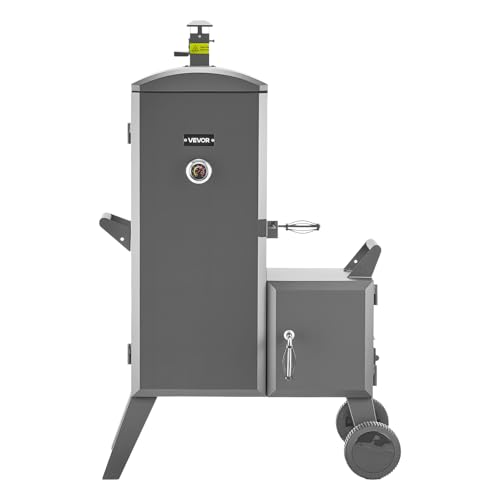
VEVOR Charcoal Offset Smoker with Side Firebox — Best for Mixed Tray Loads
VEVOR’s offset takes a different route to commercial usefulness: instead of one big chamber it offers six adjustable grates, which suits mixed loads of ribs, chicken pieces, sausage and sides better than a pit designed only around whole briskets. For caterers whose bookings are mixed trays rather than brisket mountains, that flexibility is practical capacity.
The movable design matters more than it sounds. Trucks, stalls and pop-ups live by reconfiguration, and a pit that rolls to the windward side of the pitch saves a cook. Keep a thermometer you trust alongside the lid gauge, as with every offset in this class.
The VEVOR fits caterers whose bookings are mixed trays rather than whole-cuts theatre: sausages, chicken pieces, ribs and sides across six grates, moved from pitch to pitch. It is the flexible second pit in many small fleets, and flexibility is its commercial argument.
Strengths
- Six adjustable grates give flexible load layouts for mixed commercial batches
- Movable design suits operations that reconfigure their pitch or yard
- Heavy-duty positioning at a value tier makes it a common second-pit choice
Trade-offs
- Grate count does not equal brisket capacity; whole packers still need horizontal room
- Value-tier hardware benefits from a thorough seasoning and bolt check
- Brand service network is online-led rather than dealer-led
Key specs: 6 adjustable grates (per Amazon title); side firebox; movable design; thermometer and air vents.
Best for: caterers running mixed tray loads and pop-ups that move their pit often / Not suited for: brisket specialists who need maximum unbroken grate length.
Check the current price on Amazon for the VEVOR Charcoal Offset Smoker with Side Firebox.

Royal Gourmet CC1830W Charcoal Grill with Offset Smoker — Best Compact Offset
Royal Gourmet’s CC1830W is a compact barrel offset for operations where the pitch, yard or truck bed sets the size limit. Adjustable fire grates are its working advantage: raising or lowering the coal bed is faster than raking a fire apart mid-service, and the front shelf keeps tools and trays where the cook actually stands.
It is a one-or-two-brisket smoker, not a service line on its own. Small operations use it well as the flavour pit beside an electric cabinet that carries volume, a division of labour this guide returns to often because it is how real small BBQ businesses survive their first years.
The Royal Gourmet fits the smallest honest offset use: one or two briskets or a rib batch for a stall, a farm shop or a truck corner where a bigger pit physically cannot go. Run as the flavour unit beside an electric cabinet, its size stops being a limit and becomes a speciality.
Strengths
- Adjustable fire grates help the operator manage heat without rebuilding the fire
- Front shelf and hooks suit a working stall or truck setup
- Compact barrel footprint fits tight pitches and small yards
Trade-offs
- 783 square inches caps how much service volume one unit can carry
- Barrel offsets at this tier leak smoke until gaskets and seasoning settle them in
- Wooden table needs weather care in outdoor commercial life
Key specs: 783 sq in (per Amazon title); adjustable fire grates; front shelf and hooks.
Best for: market stalls, trucks and tiny yards needing a compact true offset / Not suited for: anyone planning to carry a full restaurant service on one small barrel.
Check the current price on Amazon for the Royal Gourmet CC1830W Charcoal Grill with Offset Smoker.
Comparison Table
| Pick | Badge | Key spec | Best for |
|---|---|---|---|
| Oklahoma Joe’s Highland Reverse Flow Offset Smoker | Best Overall | 1,093 sq in cooking area (per Amazon title); reverse flow baffle layout | small BBQ restaurants and caterers cooking full offset loads who hate hot spots |
| Oklahoma Joe’s Highland Offset Smoker | Best Value Offset | 900 sq in cooking area (per Amazon title); offset firebox; charcoal and wood fuel | start-up BBQ operations, caterers and competition-style cooks wanting true offset flavour |
| Lang Smoker Cookers Offset (fabricator line) | Best Fabricator Upgrade | Heavy-gauge offset fabricator pit; sold direct | brisket-led restaurants ready for a heavy-gauge fabricator offset |
| Char-Griller Smokin’ Pro Charcoal Grill and Offset Smoker | Best for Mixed Menus | 1,130 sq in total cooking area per Amazon title (includes warming rack); side firebox; dual damper control | budget-led start-ups and trucks wanting one grill-plus-offset unit |
| VEVOR Charcoal Offset Smoker with Side Firebox | Best for Mixed Tray Loads | 6 adjustable grates (per Amazon title); side firebox; movable design; thermometer and air vents | caterers running mixed tray loads and pop-ups that move their pit often |
| Royal Gourmet CC1830W Charcoal Grill with Offset Smoker | Best Compact Offset | 783 sq in (per Amazon title); adjustable fire grates; front shelf and hooks | market stalls, trucks and tiny yards needing a compact true offset |
How to Choose the Best Commercial Offset Smokers for Your Operation?
Start with your real weekly load, written down: how many whole briskets, racks of ribs and shoulders, on your busiest week, not your average one. Offsets are bought in brisket units. A chamber that fits four packers with air space between them cooks better than a chamber crammed with six, because offset cooking is airflow cooking and crowded meat steams where it touches.
Then decide who runs the fire. An offset in commercial service is a staffed station. If your team cannot roster a fire tender for the full cook, an offset is the wrong primary pit no matter how good the flavour is, and the honest setup is an offset for service days beside a cabinet for volume, a pattern the other guides in this series develop further.
Does Steel Thickness Really Matter in a Commercial Offset?
Yes, and it is the dividing line of this whole category. Thin consumer steel loses heat fast, so the fire tender feeds the box constantly and temperatures swing with every door opening and weather change. Heavy fabricator steel stores heat, smooths those swings and survives daily firing for years. Neither is a scam; they are different tools at different investment tiers, and this guide labels which is which on every pick.
A practical test when you inspect any offset: lift the lid and feel the door weight, check how the firebox door seals, and look at the welds rather than the paint. Paint is marketing. Metal, seals and welds are the cooker.
What Size Offset Does a Small Restaurant Actually Need?
Most small restaurants overbuy length and underbuy evenness. A reverse flow chamber around the size of the Highland Reverse Flow in this list handles a small service of briskets and ribs with room to rotate, which covers the majority of start-up BBQ menus. Volume beyond that is usually better added as a second, different cooker, an electric or pellet cabinet, than as one ever-larger offset, because two cookers give you two temperatures and a backup when one is down.
Remember the pit’s footprint includes its working room: firebox access, a wood store, a safe ash route and space for the cook to move with hot trays. Measure the whole station, not just the steel.
What Does Commercial Offset Ownership Cost Beyond the Pit?
Wood is a supply chain, not an afterthought. A commercial offset burns seasoned hardwood at a rate that surprises new operators, and green or wet wood will wreck both flavour and temperature control. Secure a reliable local supplier, store splits off the ground under cover, and track consumption per cook from your first service so your menu pricing rests on real fuel numbers.
Labour is the second hidden cost. Fire tending across a ten-hour brisket cook is a rostered shift. Successful small operations either build that shift into their best cook’s role, because fire craft is a skill worth paying for, or they limit offset cooking to days when the staffing genuinely exists.
Maintenance is the third. Ash out after every cook, keep the baffle and grates scraped, oil exterior steel that lives outdoors, and inspect door seals monthly. An offset neglected for a season becomes a rust project; an offset on a rota stays a tool.
Finally, plan the compliance conversation early. Commercial wood-fired cooking can trigger local rules on smoke, ventilation and fire safety that backyard cooking never meets. A short conversation with your local authority before you buy saves an expensive relocation afterwards.
Insurance and siting belong on the same list. Tell your insurer the pit exists, keep clearances the maker specifies, and give the ash a metal container and a cooling routine. Commercial offset cooking is safe when it is run like the professional fire it is.
How to Run Your First Commercial Offset Brisket Cook
Step one is the fire, built an hour before the meat matters. Start with a charcoal base, add seasoned splits, and let the pit settle at your target cooking temperature with thin, pale smoke. Blue-to-clear smoke is the goal; thick white smoke at loading time is how bitter brisket happens.
Step two is loading with a plan. Place briskets fat side according to your pit’s heat direction, leave air gaps between every piece, and put the thickest cuts where your chamber runs hottest, which you will know from a biscuit test or a first sacrificial cook with probes at grate level across the chamber.
Step three is discipline: small splits on a regular rhythm, door openings kept short and purposeful, and a written log of times, temperatures and additions. In a commercial kitchen the log is not fussiness; it is how next week’s brisket matches this week’s when a different cook runs the pit.
Step four is the wrap decision and the rest. Wrap on bark colour and texture rather than the clock, rest the meat properly before slicing, and hold at a safe temperature for service. Your first commercial cook should be a rehearsal without customers, timed and logged, so service day is the second time you have done everything.
Step five is the shutdown routine: ash managed safely, grates scraped while warm, the pit inspected, and notes written while the cook is fresh. The offsets that make money are run on routines like this, not on inspiration.
Add a sixth step to the routine once the pit is earning: the monthly deep service. Wire-brush the baffle and grates, inspect the firebox floor for thinning, touch up exterior rust before it spreads, and check every damper and hinge. An hour a month is the difference between a five-year pit and a two-year pit at commercial firing rates.
And keep a small spares shelf from the first month: a spare probe, door gasket material, high-heat paint and the damper hardware your pit uses. Commercial cooking fails on small parts at large moments, and the shelf is cheap insurance bought in calm weather.
Document the first commercial cook as the pit’s birth certificate: photographs of the loaded chamber, the fire at its best, the finished product sliced. When a later cook disappoints, the birth certificate is the comparison that tells you what changed, the wood, the load, the weather or the tender’s rhythm.
Schedule the second and third rehearsal cooks before opening the offset to customers, each with a different load size. A pit mapped at one load is a rumour; a pit mapped at three loads is a tool the business can plan a menu around.
Common Buying Mistakes
The most expensive mistake is buying a thin-steel offset for daily restaurant firing and expecting fabricator lifespan. Match the pit’s construction to your firing schedule honestly, or budget the replacement into your plan from day one.
The second mistake is shopping by headline cooking area. Warming racks, lids and grill grates inflate the number; what matters is the main smoking grate, measured in whole briskets with airflow space. The third mistake is ignoring the fire tender in the business plan, then discovering that the cheapest pit carries the most expensive labour.
Finally, do not season a new offset during a paid service, and do not skip the first practice cooks. Every pit has a hot end and a personality; learn yours on rehearsal meat, not on a wedding booking.
How Does Fire Management Work Across a Commercial Service Week?
A commercial offset week has a rhythm the backyard never teaches. Firewood is split and stacked by size before the week begins, because a cook mid-service cannot leave the pit to process fuel. Small splits for temperature nudges, larger pieces for sustained heat, and a charcoal base to restart from are staged where the tender works, dry and close.
Each cook starts from the previous cook’s notes: how the pit behaved in that weather, at that load, with that wood. Offset pits are individuals, and the log is how a business stops depending on one person’s memory of this particular pit’s personality. New tenders learn from the log first and the fire second.
Weather is a working variable, not an excuse. Wind strips heat from thin steel, cold lengthens every timeline, and rain changes how a pit draws. Commercial offset cooks adjust start times and fuel staging to the forecast the way bakers adjust to a cold kitchen, because service time does not move.
Ash and grease are managed on the same weekly rhythm: ash out while the pit is part of the closing routine, grease paths checked before they become a flare or a hygiene finding. The offsets that survive commercial life are not necessarily the thickest; they are the ones on a rota.
Finally, the tender’s shift is designed, not improvised: who lights, who feeds during service, who closes the pit down. When those three names are on the rota, an offset is a production station. When they are whoever is free, it is a bonfire with a menu attached.
What Should an Offset Buyer Inspect in Person Before Paying?
Doors first: open and close every door and judge the seal by feel and by light. A firebox door that leaks air steals temperature control all cook long, and a chamber door that leaks smoke leaks heat and flavour with it. Gaskets can improve a decent seal; they cannot redeem a warped door.
Metal second: judge thickness by weight and sound rather than by any printed claim. A heavy lid that closes with a dull, damped note is telling you the truth about the steel. Thin, ringing metal is also telling the truth, and the buyer should listen before the first fire rather than after the fiftieth.
Welds and hardware third: continuous, tidy welds at the firebox joint, hinges that do not wobble, dampers that move smoothly and stay where they are set. In commercial use these parts cycle daily, and sloppy hardware becomes a weekly annoyance with a long memory.
The grease path fourth: where does rendered fat go, and can that route be cleaned by your staff with your sinks? Brisket programmes render a great deal of fat, and a pit whose drainage is an afterthought will make its owner pay attention to it at the worst possible moment.
Last, the support question: can you buy a replacement grate, seal or damper for this model in two years, locally or by post? Commercial equipment is a relationship with its maker’s parts shelf, and experts ask about the shelf before they admire the silhouette.
How Does an Offset Fit With Other Commercial Cookers?
Few successful BBQ operations run an offset alone, and understanding its partners clarifies its job. The offset is the flavour engine and the theatre; it is rarely the best tool for holding, reheating or producing the cured and batch items that fill a menu’s quiet corners. Those jobs belong to cabinets, and the pairing is the system this series keeps recommending because it keeps working.
In practice the week divides itself: the offset fires on the days its products headline, while cabinets run daily production in the background. The offset’s fire tender is rostered like a station chef, the cabinets are supervised like ovens, and the menu is written so neither machine is asked to be the other.
Holding deserves its own sentence in the system. An offset is a poor holding cabinet, cycling heat with every fuel addition, so programmes hold in a cabinet or a dedicated warmer at a steady, safe temperature. Separating cooking from holding is one of the quiet marks of a professional operation.
The pairing also insures the business. When the offset is down for a seal or a grate, cabinets carry a reduced menu; when a cabinet faults, the offset can absorb a service at the cost of labour. Redundancy in a small operation is not luxury; it is the difference between a bad day and a closed one.
Buy the offset for what only it can do, wood-fired flavour at service scale, and let its partners do the rest. That clarity is what makes a mixed fleet cheaper to run than any single heroic machine.
What Wood Should a Commercial Offset Burn?
Oak is the working default of commercial offset cooking: steady heat, clean flavour, wide availability in most regions. Hickory brings a stronger, bacon-like note that suits pork and can overwhelm poultry; fruitwoods such as apple and cherry are gentler and prized for colour on ribs and birds. Houses usually build on one base wood and season with a second, consistently, so the flavour becomes a signature rather than a lottery.
Seasoning matters more than species. Wood should be dried until its splits burn cleanly without hissing and steaming; green wood makes dirty smoke, bitter bark and a fire tender’s afternoon miserable. Buy from a supplier who understands barbecue wood as a product, store it off the ground and under cover, and reject a damp delivery the way a baker rejects damp flour.
Size is a technique: small splits for control, added little and often, keep an offset’s fire clean and its temperature steady. The giant log that promises an unattended hour delivers a smouldering one instead, and commercial tenders learn to feed small on a rhythm, which the log then teaches the next tender.
Charcoal plays the supporting role: a coal base to light from, to restart a flagging fire and to smooth the gaps between wood additions. Houses keep both fuels on the same store list and cost both in the batch, because an offset’s fuel bill is the sum of the partnership.
Finally, know your region’s rules and your neighbours. Commercial wood smoke is a presence; siting, stack direction and firing times are part of being a business the street is glad to have, and the best BBQ operations treat that goodwill as an asset on the same list as the pit.
How Should an Offset Buyer Plan the Pit’s Home?
An offset’s home is a working fire station, and planning it well is worth a section of its own. The pit needs level, non-combustible ground with the maker’s clearances in every direction, because a commercial offset radiates serious heat for twelve hours at a time and its firebox door opens onto whatever stands in front of it. The cook needs standing room at the firebox end and the chamber door’s swing needs a clear arc, since a tender carrying splits and a cook carrying a hot tray will both use that space, sometimes in the same minute, and a cramped offset station is an accident being scheduled in slow motion.
Overhead matters as much as the floor. Smoke and heat rise from the stack and the doors, so the pit’s relationship with canopies, eaves, extract hoods and the building’s own alarms must be thought through before the first fire rather than negotiated with a smoke detector during the first service. Many operations site the offset in a yard or a purpose-made outdoor station precisely to give the smoke a clean exit and the business a clean conscience with its neighbours and its insurer.
The wood store belongs in the plan as furniture, not as a pile: raised, covered, close enough that the tender’s round trip is short and far enough that stored fuel is never part of the fire’s scenery. Beside it, the ash station, a metal container on a non-combustible surface with a defined cooling routine, completes the triangle of pit, fuel and ash that every offset day revolves around.
Water and light finish the station. A hose point or a filled container for the unexpected, and lighting that makes a 5 a.m. fire-lighting safe and pleasant, are the details that separate a station designed for commercial rhythm from a pit parked where it happened to land. Offsets reward this planning every single cook, because the tender works the station as much as the pit.
Finally, plan the station’s growth: room for the cabinet partner this guide keeps recommending, and for the heavier pit the business may graduate to. An offset station designed with its own future in mind saves a relocation at exactly the moment the business can least afford the disruption.
What Does a Good Offset Tender Actually Do All Day?
The tender’s craft looks like doing very little, which is the sign it is being done well. Small fuel additions on a rhythm, damper touches measured in millimetres, a glance at the smoke’s colour every time they pass, and a log entry that takes twenty seconds: the work is a hundred small correct acts spread across a cook, and its product is a temperature line so steady it bores the person reading the chart afterwards.
What the tender is really managing is the fire’s future. Every split added now is the temperature in forty minutes; every door opening is paid for in recovery time; every decision is made for a brisket that will be judged hours later by people who never saw the fire. That forward-thinking habit is the skill, and it is why experienced tenders are rostered, trained and retained like the specialists they are.
The tender also owns the pit’s senses: the sound of the draw, the smell of clean versus dirty smoke, the feel of a door seal, the look of ash building where it should not. Commercial kitchens run on instruments, and rightly, but the offset tender’s calibrated senses catch the changes instruments report late, and the best operations pair the two rather than choosing between them.
Training a tender means supervised cooks, plural, across different weather and loads, with the log reviewed together afterwards. It cannot be compressed into a demonstration, because the skill is judgment accumulated over fires, and a business that wants offset flavour must budget the training fires as honestly as the service ones.
Respect the role in the rota and the pay, and the offset becomes what it should be: the station where the business’s most distinctive product is made by a person proud to make it. Undervalue it, and the pit’s results will explain, service by service, exactly what the role was worth.
Final Recommendation
For most small operations the Oklahoma Joe’s Highland Reverse Flow is the right first commercial offset: even heat, real capacity and a price tier that lets the business survive its first year. The standard Highland is the value alternative, and the Lang fabricator line is the step up when weekly volume proves the case. Compare your situation with Best Commercial Restaurant Smokers if your setting is a full restaurant kitchen.
If your operation is small by design, the sizing logic in Best Commercial Small Smokers and Best Commercial Smokers For Small Operation will help you avoid overbuying. Brisket-led menus should also read Best Commercial Smokers To Cook Brisket, and anyone weighing rotating equipment against an offset should see Best Commercial Rotisserie Smokers before deciding.
Shortlist for a final check before you order: Oklahoma Joe’s Highland Reverse Flow Offset Smoker; Oklahoma Joe’s Highland Offset Smoker; Char-Griller Smokin’ Pro Charcoal Grill and Offset Smoker; VEVOR Charcoal Offset Smoker with Side Firebox; Royal Gourmet CC1830W Charcoal Grill with Offset Smoker. Open each listing, confirm the model name matches the pick above, and check price on Amazon at the moment you buy.
Frequently Asked Questions
Are consumer offsets really suitable for commercial use?
For start-ups, caterers and trucks, yes, with honest expectations: they cook genuine offset flavour at a starter investment, but their thinner steel wears faster under daily firing and they demand constant fire tending. Many businesses start here and graduate to a fabricator pit.
What is the difference between a standard and a reverse flow offset?
In a standard offset, heat enters beside the firebox and exits at the far end, creating a hot zone near the fire. Reverse flow routes heat under a baffle first, evening chamber temperatures and reducing hot-spot losses on full loads.
How much wood does a commercial offset use?
It varies with pit size, weather and cook length, which is why this guide insists on logging your own consumption per cook from week one. Seasoned hardwood from a reliable supplier matters more than any published average.
Can one person run an offset and the kitchen at the same time?
Not well during an active cook. Offset fire management is a rhythm of regular small tasks; pairing it with a full line role produces either neglected fire or neglected tickets. Roster honestly or add a cabinet cooker for volume.
Do I need permission to cook commercially on an offset?
Possibly. Local rules on smoke, ventilation, fire safety and food premises vary widely. Check with your local authority and your insurer before the pit arrives, not after.
When should a business step up to a fabricator offset?
When weekly brisket volume is steady, your consumer pit is the bottleneck or wearing out, and the labour of fire tending is already staffed. That is the point where heavy steel pays for itself in consistency and lifespan.
How long will a consumer offset last in commercial service?
With daily firing, seasoning discipline and monthly care, expect a few hard seasons rather than a decade; the firebox floor and door seals age first. That lifespan is acceptable when the purchase tier is honest and the step-up is planned, which is how this guide frames the Highland-class pits.
Can I add a temperature controller fan to an offset?
Yes, controller fans exist for offset and drum pits and can steady temperatures, and several are verified products in their own right. They assist a tender; they do not replace one, and the fire still needs fuel judgment that no fan supplies.
Can an offset smoker cook all night without a tender?
Not safely or well in its classic form. Offsets are attended cookers; overnight brisket programmes staff the fire in shifts, use a gravity-fed or pellet pit for the unattended hours, or time the cook to waking hours. Planning the cook around human hours is part of offset ownership, not a failure of it.
Is a used commercial offset a good buy?
It can be the best value in this category, because heavy steel ages slowly and fabricator pits hold their worth. Inspect the firebox floor, door seals and grates, ask about its firing history, and budget for seals and a deep clean. Thin-steel used pits deserve more suspicion, as their remaining life is shorter.
How do I stop my offset brisket tasting bitter?
Burn clean: seasoned wood, small splits, a hot small fire with pale smoke, and patience before loading the meat. Bitterness is almost always dirty smoke from smouldering fuel, and it is a fuel and airflow problem, not a rub or sauce problem.


