Disclosure: airfryerkitchensupply.com is reader-supported. When you buy through links on our site, we may earn an affiliate commission at no extra cost to you.
Where to buy
This is the umbrella roundup: the best commercial grills across every fuel and format a professional kitchen or event operation actually buys — gas charbroilers, a charcoal event grill, mobile propane grills and flat top griddles. Every pick was confirmed in Amazon’s catalog data for this site, with specs taken from the verified listing title. Start from how and where you cook; the format follows from that, and the right model follows from the format.
- Crown Verity 60-Inch Outdoor Mobile Grill with Roll Dome — check price on Amazon
- Crown Verity BM-60 Charcoal Grill — check price on Amazon
- CHUMART 48-Inch Commercial Charbroiler — check price on Amazon
- Blackstone 36-Inch Griddle Cooking Station — check price on Amazon
- Crown Verity 36-Inch Mobile Grill Package — check price on Amazon
- VEVOR 22.4-Inch Commercial Gas Griddle — check price on Amazon
The best commercial grills are not a single product type, and any roundup that pretends otherwise is selling you something. A commercial grill might be a 48-inch gas charbroiler anchoring a restaurant line, a charcoal grill the size of a table feeding a festival crowd, a mobile propane unit rolling into a wedding venue, or a 36-inch flat top griddle turning out smash burgers and breakfast at a pace no grate can match. What unites them is commercial intent: sustained output, serviceable parts, and construction that survives being cleaned like it owes you money.
This roundup therefore picks a champion per format rather than forcing one winner. Crown Verity appears twice because it genuinely owns two niches — mobile propane and large-format charcoal. The charbroiler slot goes to the highest-output verified unit, and the griddle slot to the format’s defining model. If you already know your format, jump to its pick; if you are equipping a kitchen from scratch, the buying guide below walks the format decision in the order professionals make it.
One boundary worth stating plainly: everything here is commercial equipment. Countertop gas units belong under commercial hoods on licensed gas connections, mobile units belong outdoors, and none of it is a shortcut to a better home patio. Buy the format your setting can legally and practically support.
Because this is the umbrella roundup for the whole category, it deliberately overlaps its sibling guides: the charbroiler deep-dive, the gas grill comparison and the 24-inch and burger-specific shortlists are all linked at the end. Use this page to choose your format with confidence, then use the specialist pages to choose within the format — that two-step is how equipment buyers avoid the expensive middle mistake of a great grill in the wrong format.
In this guide
Quick Picks
Best Overall — Crown Verity 60-Inch Outdoor Mobile Grill with Roll Dome. A 60-inch propane mobile grill with a roll dome — the most versatile single grill in commercial outdoor cooking, from the category’s benchmark brand. Check the current price on Amazon.
Best Charcoal — Crown Verity BM-60 Charcoal Grill. A 72-inch charcoal grill from Crown Verity — the large-format live-fire option for events and kitchens where charcoal flavor is the product. Check the current price on Amazon.
Best Countertop Charbroiler — CHUMART 48-Inch Commercial Charbroiler. The line-grill champion: 48 radiant inches, four U-shaped burners, 140,000 BTU, and fuel conversion included. Check the current price on Amazon.
Best Griddle — Blackstone 36-Inch Griddle Cooking Station. The format-defining flat top: 36 inches, four burners, 60,000 BTU, with foldable legs and a grease pan — the smash burger and breakfast machine. Check the current price on Amazon.
Best for Small Crews — Crown Verity 36-Inch Mobile Grill Package. Crown Verity durability in a 36-inch propane package — the right-sized professional mobile for two-person catering crews. Check the current price on Amazon.
Best Budget Countertop — VEVOR 22.4-Inch Commercial Gas Griddle. A compact countertop gas griddle with an H-shaped burner — the low-cost entry for cafes and trucks adding a flat top station. Check the current price on Amazon.
How These Picks Were Chosen
Each pick was verified: brand-plus-model search, title match against the returned listing, ASIN and headline specs taken from that verified title. We did not import specs from manufacturer PDFs or retailer blogs, which is why the spec boxes stick to what the verified titles state.
Selection favored the format leaders working buyers actually purchase: Crown Verity for mobile and charcoal event grilling, CHUMART for high-output countertop charbroiling, Blackstone for the commercial-style griddle format, and VEVOR for the budget countertop griddle tier. The goal is a shortlist a real operator could buy from without a second research project.
The 6 Best Commercial Grills

Crown Verity 60-Inch Outdoor Mobile Grill with Roll Dome — Best Overall
If one grill has to represent commercial grilling at its most capable, it is this: five feet of propane-fired grate on a transport-ready frame, topped with a roll dome that adds roasting and holding to straight grilling. Caterers, institutions and rental fleets run Crown Verity because the units survive the lifestyle — loaded, hauled, fired, scraped, repeat.
Strengths
- Event-scale 60-inch capacity that still moves on its own wheels
- Roll dome expands the menu beyond open-grate grilling
- Rental-grade construction built for transport abuse
Trade-offs
- Propane logistics — tanks, storage and swaps — are part of ownership
- Premium price reflects professional, not consumer, positioning
- Too much grill for small patios or occasional events
| Width | 60 in |
| Fuel | Liquid propane |
| Lid | Single roll dome |
| Type | Outdoor mobile grill |
The roll dome is the detail that separates this from cheaper event grills. With it, the same unit that sears burgers at noon can roast chickens, hold vegetables and finish thick cuts with indirect heat at dinner. For an operation selling grilled food outdoors, that versatility is revenue: one grill covers the whole menu instead of most of it.
Event operators should think in seasons: a preseason service (burners, igniters, dome hinge, wheel and leg hardware), a mid-season grate deep-clean, and covered storage between. The Crown Verity’s rental heritage means these parts exist and are documented — the owners who follow the rhythm report units that outlast several sets of cheaper grills bought in the same years.
Best for: Caterers and institutions cooking outdoors at scale / Not suited for: Fixed indoor lines or small occasional events
Check on Amazon — check price on Amazon before you order; commercial configurations and included accessories vary by listing.

Crown Verity BM-60 Charcoal Grill — Best Charcoal
The BM-60 is the charcoal counterpart to Crown Verity’s gas mobiles: a big, simple, brutally durable charcoal grill (the listing dimensions run 72 x 24 x 31 inches) for operations whose brand is live fire. Festivals, barbecue caterers, resorts and steak concepts use grills like this when the smoke is not a side effect but the selling point.
Strengths
- Charcoal flavor no gas system fully reproduces
- Huge cooking footprint for event-scale live-fire cooking
- Simple construction — almost nothing on it can break down electronically
Trade-offs
- Charcoal logistics: fuel cost, ash disposal, fire management labor
- No zone dialing — heat control is coal placement and experience
- Outdoor use with local open-flame rules to respect
| Dimensions | 72 x 24 x 31 in (listing) |
| Fuel | Charcoal |
| Type | Large-format charcoal grill |
| Brand | Crown Verity |
Buying a BM-60 is a menu decision before it is an equipment decision. Charcoal demands a cook who manages a fire, not a dial — building the coal bed, banking it for zones, reading its decline across a service. Operations that staff that skill get food with a signature no competitor’s gas line can copy. Operations that cannot staff it get inconsistency, and should buy the propane mobile instead.
Charcoal ownership is logistics: a dry fuel store, an ash routine that respects fire safety (metal can, cooling time, no plastic bins), and a coal-buying habit that keeps quality consistent — lump and briquette behave differently, and your cooks build their fire craft on whichever you standardize. Standardize, document the fire build for your menu, and the BM-60 becomes teachable instead of tribal.
Best for: Live-fire caterers and concepts selling charcoal flavor / Not suited for: High-turnover stations without a dedicated fire cook
Check on Amazon — check price on Amazon before you order; commercial configurations and included accessories vary by listing.
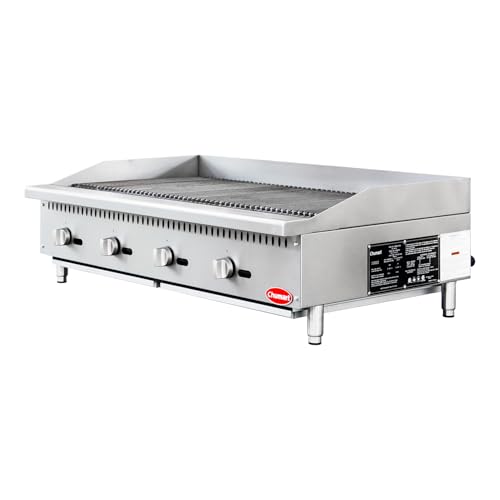
CHUMART 48-Inch Commercial Charbroiler — Best Countertop Charbroiler
For the fixed line, the CHUMART 48 is the output-first choice: four zones of radiant heat with the strongest total BTU in this roundup, sized for the grill station that carries a restaurant’s menu. Radiants keep its behavior civilized across a long service — even marks, managed flare-ups, repeatable results between cooks.
Strengths
- 140,000 BTU across four zones — holds sear under full load
- Radiant evenness suits mixed-skill line staffing
- Natural gas / propane convertible with included LP kit
Trade-offs
- Needs commercial hood, gas capacity and counter run to match
- Newer brand with a thinner service network
- Radiant plates demand daily scraping discipline
| Width | 48 in |
| Burners | 4 U-shaped |
| Total output | 140,000 BTU |
| Heat type | Gas radiant |
Charbroilers earn their floor space at peak, not at average. The CHUMART’s per-zone output is specified for the moment the whole grate is covered with cold product and the tickets keep coming — the moment lesser units start steaming food instead of searing it. If your grill station is the menu’s engine, this is the format and the output class to buy.
Treat commissioning as part of the product: licensed connection, full-load flame verification, hood capture check, and a photographed zone map for the pass. After that, the CHUMART’s needs are the charbroiler standards — nightly scrape, weekly radiant care, grease path discipline — performed on a unit with the output headroom to forgive a busy week.
Best for: High-volume restaurant grill stations / Not suited for: Outdoor events or kitchens without hood capacity
Check on Amazon — check price on Amazon before you order; commercial configurations and included accessories vary by listing.

Blackstone 36-Inch Griddle Cooking Station — Best Griddle
Ask a crowd of food-truck and concession operators which griddle started the modern flat-top wave and this Blackstone is the answer: a 36-inch, four-burner steel griddle station at 60,000 BTU that folds down for transport. It is ‘commercial’ in the working sense — food businesses by the thousand run their whole menu on this format — with a flat surface that does what no grate can: smash burgers, fried rice, cheesesteaks, pancakes and a full breakfast in one plane.
Strengths
- Flat top versatility — proteins, vegetables, eggs and sandwiches on one surface
- Four burners give real zone control across 36 inches
- Foldable legs and grease management suit mobile operation
Trade-offs
- No char marks or flame flavor — it is a griddle, not a grill
- Steel top needs seasoning and rust discipline like a cast iron pan
- Serious fixed-line kitchens may step up to heavier commercial griddles
| Width | 36 in |
| Burners | 4 |
| Total output | 60,000 BTU |
| Surface | Steel flat top griddle |
| Features | Foldable legs, grease pan, storage rack |
The griddle’s commercial superpower is ticket density: dozens of portions cooking simultaneously with two spatulas and no flare-ups, no falling-through-the-grate losses, and sauces and cheese contained on the surface. For burger, breakfast and teppanyaki-style concepts, output per square foot beats any grate grill. Pair it with the seasoning discipline in the how-to section and the top becomes effectively non-stick within a week of services.
The Blackstone’s whole ownership story is the steel top: seasoned faithfully, it becomes a low-stick heirloom; neglected, it rusts and sticks and gets blamed. Keep a cover on it outdoors, oil it warm at close, and scrape it hot after service. The burners and frame are simple and forgiving — it is the top that decides whether owners love this format, so make its care a named job, not an assumption.
Best for: Food trucks, concessions and burger/breakfast concepts / Not suited for: Menus sold on char-grilled flavor and grill marks
Check on Amazon — check price on Amazon before you order; commercial configurations and included accessories vary by listing.
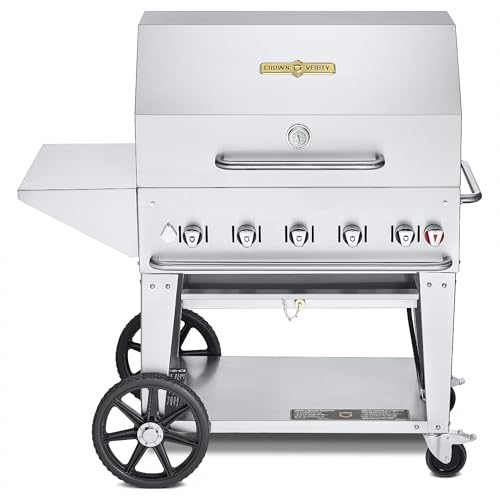
Crown Verity 36-Inch Mobile Grill Package — Best for Small Crews
The 36-inch Crown Verity package is the professional mobile grill scaled to how small caterers actually work: one vehicle, two people, a full event menu. It carries the brand’s rental-grade construction into a footprint that loads fast and cooks a wedding or market day without borrowing capacity.
Strengths
- Pro-grade build that survives weekly transport
- Package arrives as a matched, ready configuration
- 36 inches is the load-in-friendly size for small crews
Trade-offs
- Volume ceiling shows at large events
- Premium pricing versus consumer ‘pro’ styling
- Outdoor role only — not a line appliance
| Width | 36 in |
| Fuel | Propane |
| Type | Mobile grill package |
| Brand | Crown Verity |
Small crews should buy for the load-in as much as the cook. Every pound and awkward dimension is paid twice a day, at setup and teardown, by tired people. The 36-inch package keeps the professional cooking surface while respecting that reality — which is why it, and not the 60, is the correct first Crown Verity for most growing caterers.
Small crews should protect the package’s completeness: inventory it after every event against a photo of the full kit, because the piece left at a venue is always the piece the next event needs first. Stored clean, complete and dry, the 36-inch package is the kind of asset that quietly anchors a catering business’s first five years.
Best for: Small catering crews and serious market vendors / Not suited for: Events regularly feeding several hundred outdoors
Check on Amazon — check price on Amazon before you order; commercial configurations and included accessories vary by listing.

VEVOR 22.4-Inch Commercial Gas Griddle — Best Budget Countertop
VEVOR’s countertop griddle is the budget door into flat-top cooking: a 22.4-inch countertop gas unit with an H-shaped burner spreading heat under the plate, manual controls, and a size that fits a cafe counter or a truck’s short line. At 13,000 BTU it is a gentle unit — suited to eggs, sandwiches, vegetables and moderate protein work rather than a slammed burger rush.
Strengths
- Lowest-cost route into countertop flat-top cooking
- H-burner spreads heat more evenly than a single tube
- Compact footprint fits counters and truck lines
Trade-offs
- 13,000 BTU limits recovery with heavy cold loads
- Budget-tier fit and finish; set expectations accordingly
- Small surface — a station supplement, not a whole menu platform
| Width | 22.4 in |
| Burner | H-shaped |
| Total output | 13,000 BTU |
| Type | Countertop gas griddle |
The right mental model for this VEVOR is ‘second station.’ A cafe that needs a dedicated egg and sandwich surface, a truck adding a veggie station, a bar putting out smash burgers at modest pace — those are its wins. Asked to be the only cooking surface at volume, it will disappoint; matched to a defined, moderate job, it returns its cost quickly and teaches the crew flat-top technique before a bigger investment.
Set the VEVOR up for success with placement: a defined station, a defined menu role, and a defined pace. Owners who ask it to be a specialist — the egg station, the sandwich press alternative, the veggie surface — report satisfaction; owners who ask it to be a slammed line’s only surface report the opposite. The unit is honest; the assignment decides the review.
Best for: Cafes and trucks adding a defined flat-top station / Not suited for: High-volume burger service as the sole cooking surface
Check on Amazon — check price on Amazon before you order; commercial configurations and included accessories vary by listing.
Comparison Table
| Pick | Badge | Key spec | Best for |
|---|---|---|---|
| Crown Verity 60-Inch Outdoor Mobile Grill with Roll Dome | Best Overall | 60 in · propane · roll dome mobile | Caterers and institutions cooking outdoors at scale |
| Crown Verity BM-60 Charcoal Grill | Best Charcoal | 72 in class · charcoal · event grill | Live-fire caterers and concepts selling charcoal flavor |
| CHUMART 48-Inch Commercial Charbroiler | Best Countertop Charbroiler | 48 in · 4 burners · 140,000 BTU | High-volume restaurant grill stations |
| Blackstone 36-Inch Griddle Cooking Station | Best Griddle | 36 in · 4 burners · 60,000 BTU flat top | Food trucks, concessions and burger/breakfast concepts |
| Crown Verity 36-Inch Mobile Grill Package | Best for Small Crews | 36 in · propane · mobile package | Small catering crews and serious market vendors |
| VEVOR 22.4-Inch Commercial Gas Griddle | Best Budget Countertop | 22.4 in · H burner · 13,000 BTU | Cafes and trucks adding a defined flat-top station |
How Do You Budget the Total Cost of a Commercial Grill?
Sticker price is roughly the first half of the real number. Add installation (gas fitter, stand or base, hood capacity verification for line units), the fuel system (tanks, regulators, storage for mobiles and charcoal), the starter consumables (briquettes, spare igniters, covers, brushes), and the smallwares the new station demands. A sensible planning rule is to hold back a meaningful reserve beyond the grill itself so the station opens complete instead of waiting on a dozen small deliveries.
Then budget the year, not just the day: wear parts, fuel at your expected covers, hood cleaning at the interval a charbroiler demands, and the labor minutes of the closing routine. Operators who see the whole number choose better tiers — sometimes discovering the premium unit is cheaper across five years, sometimes confirming the value pick was right all along.
Which Commercial Grill Is Right for a Food Truck?
Trucks live under three constraints buildings do not: space measured in inches, power and fuel that travel with you, and local mobile-vendor codes that vary by city. The proven truck answers in this roundup are the compact formats — a 24- to 36-inch flat top for menu density (the Blackstone format and compact countertop griddles), or a 24-inch charbroiler where codes allow and char is the concept, like the compact units in the 24-inch sibling roundup.
Before buying anything for a truck, get your jurisdiction’s equipment rules in writing: hood and suppression requirements, fuel storage rules and any open-flame restrictions decide the shortlist before preference gets a vote. Then optimize ruthlessly for menu-per-inch, because in a truck the grill is not a station — it is most of the kitchen.
Which Grill Format Does Your Operation Actually Need?
Work through four questions in order. Where does the cooking happen — fixed line, patio, or traveling to events? Line cooking means countertop under a hood; traveling means mobile; a patio can go either way but usually lands on mobile for flexibility. What is the menu’s signature — char and grill marks (charbroiler or charcoal), flat-top versatility (griddle), or mixed proteins at volume (mobile gas or charbroiler)?
How many portions land at peak? Format follows volume: a griddle’s flat plane wins on dozens of small portions; a 48-inch charbroiler wins on steaks and chicken at pace; a 60-inch mobile wins when the crowd is outdoors. Finally, who cooks it? Charcoal needs a fire cook, charbroilers need cleaning discipline, griddles need seasoning discipline. The format your crew will actually run well beats the theoretically perfect format they will not.
Gas, Charcoal or Griddle Surface: How Do the Formats Compare on Flavor and Labor?
Charcoal delivers the deepest smoke and char flavor and the highest labor: fire building, ash, fuel storage, and a cook’s constant attention. Gas charbroiling trades a slice of that flavor for dial control, instant readiness and zone precision; lava rock beds narrow the flavor gap further. Griddles give up char entirely and gain surface versatility — anything that benefits from contact cooking and containment, from smash burgers to fried rice, is better on a flat top.
Labor follows the same order. A griddle station is the easiest to staff at volume, a gas charbroiler is close behind with its cleaning cadence, and charcoal is a specialist’s station. Many mature operations run two formats — griddle for volume items, charbroiler or charcoal for signature items — rather than forcing one surface to do everything.
What Separates Commercial Construction From Consumer ‘Pro-Style’?
Check the things marketing cannot fake: a listing from a recognized safety agency for line equipment, stainless or heavy steel in the firebox and body, grates with real mass, and burners and valves a service tech can source. Commercial units are also honest about their requirements — they assume a hood, a fitter and a cleaning schedule, and their manuals say so.
Consumer pro-style grills borrow the look — stainless panels, big knobs — over thinner materials and residential listings. There is nothing wrong with them at home. In a business they fail on duty cycle: hinges, igniters and burners designed for weekend use do not survive daily service, and an unlisted unit can create inspection and insurance problems money cannot quickly fix.
How Should a First-Time Commercial Buyer Sequence the Purchase?
Buy the constraint first: confirm the setting (hood and gas for line units, outdoor rules and transport for mobiles), then the format, then the size, then the brand tier. Most regret comes from reversing that order — falling for a specific model and discovering the setting cannot support it.
Within a tier, spend on the surface and the burners before the trim. Grate mass, burner quality and zone count cook the food; badge polish does not. And keep a reserve for the unglamorous essentials the purchase triggers: stands, covers, tanks, conversion fittings, spare igniters and the smallwares the new station needs. A grill that arrives without its ecosystem sits idle while the paperwork catches up.
How to Season a Commercial Griddle or Grill Grate Before First Service
New cooking surfaces — steel griddle plates and cast iron grates alike — need seasoning before they will release food properly. This is the break-in that turns a sticky new surface into the low-stick workhorse your crew expects, and it applies to the griddle picks above as much as to cast iron charbroiler grates.
- Wash the surface with hot water and a mild detergent to remove factory oils and shipping coatings; rinse and dry completely — this is the only time detergent should touch it.
- Heat the surface to medium-high until a drop of water dances and evaporates quickly, confirming the whole plate or grate is evenly hot.
- Apply a very thin film of high-smoke-point oil with a folded towel in tongs, covering every inch; thin is critical — puddles turn gummy instead of seasoning.
- Let the oil smoke and polymerize until the surface darkens and the smoke fades, then repeat the thin-coat-and-heat cycle three to five times; the surface should take on an even amber-to-dark tone.
- Cook something forgiving first — onions are the classic griddle break-in (their moisture and sugars finish the surface), or fatty burgers on a grate — before trusting it with delicate proteins.
- After service, scrape while hot, wipe with a thin oil film, and never soak or detergent-wash; the seasoning you built is now a maintained asset, renewed a little every service.
A seasoned surface is a living thing: it improves for weeks, survives daily scraping, and only asks for thin oil and heat in return. Crews that protect it get release performance no spray can match; crews that scour it off with chemicals start over — usually mid-season, at the worst possible time.
The One-Page Summary: Matching Grill Format to Mission
If this whole category had to collapse into one page, it would read like this. Mission: feed a crowd outdoors with theater and flavor — charcoal, big, simple (the BM-60’s brief). Mission: feed a crowd outdoors with control and range — mobile gas with a dome (Crown Verity 60, or the 36 for smaller crews). Mission: run a restaurant’s grill station all day, every day — a countertop charbroiler sized to the line, radiant for consistency or rock for flavor (the CHUMART class at 48 inches, the Kratos and Atosa class at 36, the compact class at 24). Mission: maximum portions per hour of anything flat — a griddle, from the Blackstone 36 down to the VEVOR’s compact station. Every commercial grill purchase is one of those four missions wearing a budget.
What the one page cannot capture is the second-order truth this roundup keeps returning to: the grill is a system — setting, fuel, hood or sky, crew skill, cleaning rhythm, parts shelf — and the model is only its most visible component. Buyers who purchase the system get the performance the brochure promised. Buyers who purchase only the model spend the first season assembling the rest of the system at retail prices and rush rates. Read the picks above as systems with names, choose the system your operation can actually run, and the metal will take care of itself.
How Do You Compare Commercial Grills Across Formats Fairly?
Cross-format comparison needs a common currency, and portions per hour at acceptable quality is the honest one. A 36-inch griddle, a 36-inch charbroiler and a 36-inch mobile grill all wear the same width, but their hourly output of your actual menu items differs by multiples. Estimate each format’s throughput on your menu — not on the manufacturer’s favorite test food — and the comparison stops being apples-to-oranges and starts being a business case.
Quality belongs in the same ledger: the format that produces your signature item at its best earns a premium that raw throughput cannot capture. The mature way to decide is two-column — throughput economics on one side, signature quality on the other — and to notice when one format wins both. That happens more often than the industry admits, and it is usually the moment a concept finds its equipment identity.
What Role Do Commercial Grills Play in Kitchen Resale and Exit?
Equipment lists appear in every restaurant sale, and grills are among the line items buyers actually value: known brands with live parts support (Crown Verity, Globe, Vulcan-class names) appraise; anonymous imports discount to scrap. Owners planning an eventual sale should keep purchase records, service logs and model documentation in the equipment file — the same file that makes inspections boring makes valuations better.
Even without a sale, documented equipment finances better, insures cleaner and hands over to a new chef or manager without archaeology. The grill you buy this year is an asset with a paper life as real as its metal one. Run both well and the category’s ‘expensive’ tier often proves, on exit, to have been the cheaper ownership all along.
How Do Commercial Grills Influence Menu Pricing and Profit?
A grill is a pricing instrument as much as a cooking one. Char and live fire support premium menu language — ‘char-grilled,’ ‘wood-fired style,’ ‘smashed to order’ — that guests pay more for, while a griddle’s speed supports volume pricing and fast ticket times that profit on throughput instead. The format you buy quietly decides which of those games your menu plays, which is why the format decision in this roundup comes before any model comparison.
Run the rough math for your concept: portions per hour at peak, average margin per portion, and the grill’s fully-loaded cost (unit, install, fuel, maintenance) amortized across its service life. Operators who do this arithmetic buy with unusual confidence — and they are the ones who can tell you exactly which month the grill paid for itself.
What Safety Culture Does a Commercial Grill Demand?
Commercial grills concentrate three hazards in one station: open flame or very hot surfaces, rendered fat in quantity, and gas under pressure. The culture that manages them is unglamorous — leak checks on schedule, grease paths cleaned on schedule, no water on grease fires, extinguishers and suppression known to every cook, and a hard rule that a grill behaving strangely (yellow flames, ignition failures, gas smell) leaves service immediately for a technician, not after the rush.
None of this is optional garnish on the purchase; it is the purchase’s operating system. The good news is that it is all routine — a page of checklists at the station — and kitchens that run it stop thinking of it as safety overhead and start calling it what it is: how the station works.
How Should a Multi-Location or Growing Operation Standardize Grills?
Standardize the platform, not just the purchase: the same charbroiler model across locations means one parts shelf, one training standard, one zone map in every kitchen, and cooks who can transfer between sites without relearning the station. The savings show up in training hours and downtime more than in any volume discount.
Where locations genuinely differ — a truck fleet beside flagship restaurants — standardize within each format family instead: one mobile platform, one line platform. And document the standard’s reasoning, because the next buyer in your organization will otherwise re-litigate it from scratch. The brands anchoring this roundup (Crown Verity, Globe, Atosa, Kratos) all support this kind of fleet thinking with real parts catalogs — one more reason they, and not one-off imports, hold these slots.
How Do You Decide Between Buying New and Used Commercial Grills?
Used commercial equipment is a real market, and grills are among its better categories because their condition is inspectable: burner flames tell the truth, grates show their mass and warping, valves either turn smoothly or do not. A used Crown Verity or a used legacy charbroiler with even flames and solid grates can be excellent value — especially for seasonal or event use.
The risks concentrate in what you cannot see: gas train corrosion, undocumented fuel conversions, and models whose parts support has ended. Mitigate with a fitter’s inspection before the unit joins a line, a preference for brands with live parts catalogs (the same names that anchor this roundup), and pricing that leaves room for a burner-and-igniter refresh. Bought that way, used is a strategy; bought on photos alone, it is a lottery.
What Is the Smartest First Commercial Grill for a Growing Business?
The one matched to the constraint you cannot change. A food truck’s first grill is its largest legal, code-compliant surface. A cafe’s first grill is the 24-inch listed unit that fits its hood. A caterer’s first grill is the 36-inch mobile that one vehicle and two people can run anywhere. In each case the ‘smartest’ answer looks different, and in each case it is the grill that starts earning immediately instead of waiting for a renovation, a bigger truck or a second crew.
Growth then adds formats rather than replacing them: the cafe adds a flat top, the caterer adds the 60-inch, the truck adds a second truck. Businesses that buy their first grill against their real constraint rarely regret it; businesses that buy for the business they imagine usually own an expensive storage problem.
Common Buying Mistakes
Forcing one format to do every job
A griddle cannot char, a charbroiler cannot fry rice, and a mobile grill cannot join the line. The expensive version of this mistake is buying twice; the cheap version is choosing the format from the menu before shopping models.
Ignoring the setting’s legal requirements
Line units without hood capacity, mobiles used indoors, charcoal where open flame is restricted — setting violations shut operations down. Confirm the setting first, in writing where possible.
Buying event capacity for daily size, or the reverse
A 60-inch mobile for monthly small events wastes money and storage; a 22-inch griddle as a slammed concept’s only surface guarantees a bottleneck. Size to the peak you actually serve most months, and rent for the exceptional day.
Neglecting the wear-parts budget
Burners, igniters, radiants, briquettes and grates are consumables on a long enough timeline. Buyers who budget only the grill itself get surprised by the first year’s small invoices; operators who plan for them are not.
Final Recommendation
Match format to mission and the shortlist resolves itself. Outdoor scale and versatility: Crown Verity 60 mobile. Charcoal as the brand: Crown Verity BM-60. A fixed line’s grill station: CHUMART 48 charbroiler. Flat-top throughput: Blackstone 36, with the VEVOR 22.4 as the budget station addition. Small-crew professionalism: Crown Verity 36 package.
Before ordering any commercial grill, verify the setting — hood, gas, outdoor rules, transport — and check price on Amazon on purchase day, since commercial listings vary in included accessories and configuration.
- Best Overall: Crown Verity 60-Inch Outdoor Mobile Grill with Roll Dome — check price on Amazon
- Best Charcoal: Crown Verity BM-60 Charcoal Grill — check price on Amazon
- Best Countertop Charbroiler: CHUMART 48-Inch Commercial Charbroiler — check price on Amazon
- Best Griddle: Blackstone 36-Inch Griddle Cooking Station — check price on Amazon
- Best for Small Crews: Crown Verity 36-Inch Mobile Grill Package — check price on Amazon
- Best Budget Countertop: VEVOR 22.4-Inch Commercial Gas Griddle — check price on Amazon
Keep exploring the cluster: Best Commercial Charbroiler Grills · Best Commercial Gas Grills · Best Commercial Grills 24 · Best Commercial Grills For Burgers · Best Commercial Griddle
Frequently Asked Questions
What is the best type of commercial grill for a new restaurant?
For most new restaurants, a gas charbroiler in the width your line supports (usually 36 inches) is the core grill, because it delivers char flavor with dial control under the hood you already need. Add a griddle surface — often on the range or as a countertop unit — when the menu proves it needs one.
Are Blackstone griddles considered commercial?
They occupy the working end of the category: food trucks, concessions and caterers run them commercially at scale, and the 36-inch station format is built for that duty. A fixed high-volume restaurant line may still step up to heavier welded commercial griddles, but for mobile and moderate-volume work the format is proven.
Charcoal or gas for a commercial patio?
Charcoal wins flavor and theater; gas wins staffing, speed and consistency. Patios attached to concepts that sell live fire choose charcoal and staff it; patios that need the grill to run itself between other duties choose gas.
How much space does a commercial grill station need?
Beyond the unit’s own width, plan working clearance in front, the hood overhang your code requires for line units, and landing space beside the grill for pans and resting product. A grill with no landing zone slows the whole line no matter how powerful it is.
Can one grill handle both lunch and dinner menus?
Yes, if the format matches both menus’ core techniques. Mobile gas grills with domes and multi-zone charbroilers are the most flexible single units; griddles flex across dayparts (breakfast to burgers) better than any grate grill.
What should I check on a used commercial grill?
Burner condition (even flame, no rust-through), grate mass and warping, valve operation on every zone, and whether the model is still supported with parts. Price in a professional cleaning and a gas fitter’s inspection before it joins your line.
What is the difference between a charbroiler and a grill?
In commercial usage, a charbroiler is the line appliance — burners under radiants or rocks with grates above, built for hooded indoor stations. ‘Grill’ is the umbrella term covering charbroilers, mobile grills, charcoal grills and, loosely, griddles. Menus and inspectors care about the specific type; shoppers should too.
Do commercial grills come with warranties for business use?
Commercial units are warranted for commercial use — that is part of what the category means — while residential grills often void warranty in a business setting. Confirm the warranty terms on the exact model, and keep the purchase records with your equipment file.
Should a restaurant buy its grill before or after finalizing the menu?
After the menu’s core is set, but before the kitchen is built out. The menu decides the format; the build-out (hood, gas, counters) must then be designed around the chosen unit’s requirements. Reversing that order — building first, shopping later — is how kitchens end up with hoods that almost fit the grill they actually needed.
What is the single most useful accessory for any commercial grill?
A second set of the tools the station uses constantly — tongs, scraper, brush — so a lost or dirty set never stops service. After that, the answer is format-specific: a dome for cheese melts on a charbroiler, a press and scraper pair on a griddle, a fitted cover on a mobile grill.


