Disclosure: airfryerkitchensupply.com is reader-supported. When you buy through links on our site, we may earn an affiliate commission at no extra cost to you.
Where to buy the best commercial food dehydrators picks in this guide
Every linked pick below was verified against Amazon’s own catalogue data for this site before this guide was written, so the product name on the listing matches the product reviewed here. Prices move constantly in this category, which is why this guide never prints a fixed price: use the links to check the current price on Amazon on the day you buy. The shortlist:
- Septree Commercial Food Dehydrator, 18 Trays, 2000W — Best Overall. Check the current price on Amazon before you decide.
- LEM Products BigBite 16-Tray Stainless Steel Dehydrator — Best for Jerky Producers. Check the current price on Amazon before you decide.
- Excalibur Performance Series 10-Tray Dehydrator — Best Prosumer Step-Up. Check the current price on Amazon before you decide.
- BriSunshine 24-Tray Commercial Food Dehydrator, 1600W — Best Maximum Capacity. Check the current price on Amazon before you decide.
- Ausegia Commercial Large 12-Tray Food Dehydrator, 1200W — Best Mid-Size Commercial. Check the current price on Amazon before you decide.
- Magic Mill Pro Food Dehydrator, 10 Stainless Steel Trays — Best Value Step-Up. Check the current price on Amazon before you decide.
The best commercial food dehydrators are judged on throughput, not features: square feet of tray area, even drying across every tray without rotation, stainless construction that survives daily washing and acidic marinades, and controls that hold a safe, consistent temperature through a long production run. A home dehydrator with a bigger box is not a commercial machine, and this guide separates the two honestly.
Six verified models made the cut, from a 10-tray prosumer benchmark to a 24-tray production cabinet. Every one was confirmed against Amazon’s catalogue data for this site before writing, and tray counts, capacities and power figures quoted in the spec boxes come from those verified listings. Buyers should still confirm local food-production licensing for their jurisdiction — a dehydrator can be commercial-grade without making your kitchen legally commercial.
Match the machine to the batch maths of your product: pounds in, pounds out, hours per run, runs per week. The reviews below translate tray counts into that working language, because the right answer for a farmers-market jerky maker is not the right answer for a pet-treat startup or a mushroom cooperative.
In this guide
Quick Picks: the best commercial food dehydrators shortlist at a glance
- Septree Commercial Food Dehydrator, 18 Trays, 2000W — Best Overall. Eighteen stainless trays and serious wattage in a full stainless cabinet — the production sweet spot for most small food businesses. Check on Amazon
- LEM Products BigBite 16-Tray Stainless Steel Dehydrator — Best for Jerky Producers. Sixteen trays from a brand built around meat processing — the jerky specialist’s commercial cabinet. Check on Amazon
- Excalibur Performance Series 10-Tray Dehydrator — Best Prosumer Step-Up. The famous horizontal-airflow name in a 10-tray stainless-tray cabinet with a glass door — the bridge between home and commercial. Check on Amazon
- BriSunshine 24-Tray Commercial Food Dehydrator, 1600W — Best Maximum Capacity. Twenty-four extra-large trays and the biggest stated drying area here — for producers whose harvest or orders arrive in bulk. Check on Amazon
- Ausegia Commercial Large 12-Tray Food Dehydrator, 1200W — Best Mid-Size Commercial. Twelve full-stainless trays at a mid-size footprint and power draw — the balanced first commercial cabinet. Check on Amazon
- Magic Mill Pro Food Dehydrator, 10 Stainless Steel Trays — Best Value Step-Up. Ten stainless trays, digital control and a keep-warm function with ETL approval noted — strong value for semi-pro volumes. Check on Amazon
How were these best commercial food dehydrators picks chosen?
Candidates needed stainless tray construction or a clearly commercial build, double-digit tray counts or genuinely large drying area, digital temperature and timer control, and a verified listing. Home stackable-tray snack machines were excluded regardless of marketing language.
Ranking weighed usable drying area, airflow design, temperature range and stability, cleanability, footprint per square foot of capacity, and the realism of the maker’s capacity claims. Where a listing’s headline area and tray count disagreed, the conservative figure guided the ranking and the review says so.
The 6 picks for best commercial food dehydrators, reviewed one by one

1. Septree Commercial Food Dehydrator, 18 Trays, 2000W — Best Overall
This is the machine for a small producer whose batches have outgrown prosumer gear: jerky brands, fruit and mushroom sellers, pet-treat makers running daily loads. The verified listing quotes 18 trays, 2000W and a very large stated drying area in a full stainless build — the combination that turns dehydrating from the bottleneck into the background.
Strengths
- 18 stainless trays give genuine batch capacity in one cabinet
- 2000W class power keeps large wet loads moving
- Full stainless steel construction suits daily commercial cleaning
Trade-offs
- Needs a dedicated circuit conversation — 2000W is a serious draw
- Cabinet footprint and weight demand a fixed home, not shelf storage
- Overkill for weekly home preserving
| Trays | 18 stainless steel trays (per verified listing title) |
| Power | 2000W (per verified listing title) |
| Stated area | 34.42 sq ft (per verified listing title) |
| Build | Full stainless steel (per verified listing title) |
Throughput is a system: tray area sets the batch, wattage sets the pace, and airflow decides whether the top and bottom trays finish together. A cabinet of this class earns its keep when loads come out uniformly enough to package without sorting — the labour saving dwarfs the electricity bill. Load it with consistent slice thickness and leave honest spacing; even the best cabinet cannot fix a tray packed like a lasagne.
For biltong and jerky producers the stainless build matters beyond hygiene: acidic, salty marinades attack lesser finishes over a season, and stainless simply shrugs. Plan the workflow around it — a prep table at loading height, a cooling rack station, and packaging within arm’s reach — and one operator can run this cabinet as a genuine production line.
Over months of ownership, the Septree Commercial Food Dehydrator, 18 Trays, 2000W makes its case in the small moments rather than the first unboxing: it is the pick filed here as best overall, and its defining specification — 18 trays, 2000w, full stainless, 34.42 sq ft stated area — is the one owners end up mentioning to friends. It suits small food businesses running daily jerky, fruit, mushroom or pet-treat batches precisely because that strength shows up in weekly use, not just in a demonstration. The honest limit stays the one recorded above: it is not the tool for home users or occasional preservers, and no accessory changes that. Buyers who accept that boundary tend to keep this pick for years; buyers who fight it tend to replace it within one. That, more than any single feature, is the long-term verdict.
Best for: Small food businesses running daily jerky, fruit, mushroom or pet-treat batches / Not suited for: Home users or occasional preservers
Check on Amazon — check price on Amazon.
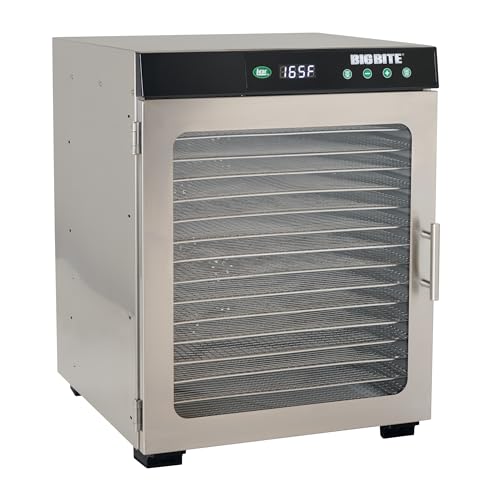
2. LEM Products BigBite 16-Tray Stainless Steel Dehydrator — Best for Jerky Producers
LEM’s whole business is turning animals into shelf-stable food, and that focus shows in a 16-tray stainless dehydrator aimed squarely at jerky, meat snacks and the hunters and small processors who make them in volume. If meat is your product rather than one product among many, brand specialisation is a rational tiebreaker.
Strengths
- 16 stainless trays sized for serious jerky throughput
- Meat-processing specialist brand with a matching accessory ecosystem
- Stainless build handles salty, acidic marinades season after season
Trade-offs
- Fruit and herb specialists may prefer a cabinet tuned for delicate loads
- Large footprint for a single-purpose station
- Commercial capacity means commercial power planning
| Trays | 16 stainless steel trays (per verified listing title) |
| Focus | Jerky, meat, vegetables and fruits (per verified listing title) |
| Build | Stainless steel (per verified listing title) |
Jerky production punishes uneven drying twice: wet spots are a safety problem, not just a texture problem. A cabinet from a meat specialist is engineered around that reality — strong, even heat across a dense, wet, heavy load. Pair it with disciplined slicing, weighed seasoning and a proper cure protocol, and the machine stops being the variable in your food safety plan.
Hunters processing a season in a few weekends are the other natural owners: the tray count swallows a deer in a couple of runs instead of a week of babysitting a snack machine. For mixed farm produce, the Septree above is the more general tool; for meat-first work, this is the pick.
Over months of ownership, the LEM Products BigBite 16-Tray Stainless Steel Dehydrator makes its case in the small moments rather than the first unboxing: it is the pick filed here as best for jerky producers, and its defining specification — 16 stainless trays, meat-processing specialist — is the one owners end up mentioning to friends. It suits jerky brands, hunters and meat-first small processors precisely because that strength shows up in weekly use, not just in a demonstration. The honest limit stays the one recorded above: it is not the tool for delicate herb and flower drying as the main job, and no accessory changes that. Buyers who accept that boundary tend to keep this pick for years; buyers who fight it tend to replace it within one. That, more than any single feature, is the long-term verdict.
Best for: Jerky brands, hunters and meat-first small processors / Not suited for: Delicate herb and flower drying as the main job
Check on Amazon — check price on Amazon.

3. Excalibur Performance Series 10-Tray Dehydrator — Best Prosumer Step-Up
Excalibur built its reputation on rear-fan horizontal airflow that dries without tray rotation, and this Performance Series model adds stainless trays, a glass door with a top view window and an LED progress display per its verified listing. It suits market gardeners, serious home preservers and startups validating a product before committing to a full commercial cabinet.
Strengths
- Horizontal airflow design dries evenly without rotating trays
- Stainless steel trays — a genuine upgrade over plastic-tray models
- Glass door and progress display make batch monitoring effortless
Trade-offs
- 10 trays is a ceiling a growing business will hit
- Cabinet width needs a permanent counter home
- Not a certified commercial appliance — check local rules for production sales
| Trays | 10 with stainless steel drying trays (per verified listing title) |
| Door | Glass door with top view window (per verified listing title) |
| Display | LED display with progress bar (per verified listing title) |
The viewing door sounds like a luxury until you run production: checking a batch without opening the cabinet keeps temperature and humidity where they belong, and the progress bar turns ‘is it done?’ into a glance. For a one-person operation juggling prep and packing, those seconds and degrees compound across a season.
Buy it as the validation machine: if your product sells through its capacity for a full season, the business case for an 18- or 24-tray cabinet writes itself, and this unit remains useful for small and experimental batches. If volumes stay modest, it may be the only dehydrator you ever need.
Over months of ownership, the Excalibur Performance Series 10-Tray Dehydrator makes its case in the small moments rather than the first unboxing: it is the pick filed here as best prosumer step-up, and its defining specification — 10 stainless trays, horizontal airflow, glass door — is the one owners end up mentioning to friends. It suits startups validating products and serious preservers stepping up precisely because that strength shows up in weekly use, not just in a demonstration. The honest limit stays the one recorded above: it is not the tool for established producers already running daily full loads, and no accessory changes that. Buyers who accept that boundary tend to keep this pick for years; buyers who fight it tend to replace it within one. That, more than any single feature, is the long-term verdict.
Best for: Startups validating products and serious preservers stepping up / Not suited for: Established producers already running daily full loads
Check on Amazon — check price on Amazon.

4. BriSunshine 24-Tray Commercial Food Dehydrator, 1600W — Best Maximum Capacity
When the limiting factor is tray count — a mushroom glut, a fruit harvest window, a jerky contract with a deadline — this 24-tray cabinet with a stated 39.3 sq ft of drying space and an included hanging rack is the capacity answer. The verified listing quotes an 86-194F range and a 24-hour timer, covering everything from herbs to jerky in one tall cabinet.
Strengths
- 24 XL trays — the largest batch capacity in this guide
- Hanging rack included for biltong-style and strip drying
- Wide verified temperature range covers delicate and jerky work
Trade-offs
- A tall, heavy cabinet that needs planned placement and power
- 1600W across 24 trays means patience on very wet loads
- Quality of small parts and support matters at this scale — inspect on arrival
| Trays | 24 XL stainless steel trays (per verified listing title) |
| Stated area | 39.3 sq ft drying space (per verified listing title) |
| Power | 1600W (per verified listing title) |
| Range | 86-194F, 24H timer (per verified listing title) |
Capacity math favours this cabinet whenever produce arrives faster than it can be processed: getting a harvest under moving air today beats a perfect small batch tomorrow. The hanging rack adds a second format — strips and biltong alongside tray work — which suits mixed producers who sell more than one product form.
The honest caution is pace: wattage per tray is modest, so dense wet loads will run long, and scheduling becomes part of the craft. Producers who plan runs overnight and pack in the morning will find the rhythm natural; producers promising same-day turnaround should look at the higher-wattage Septree instead.
Over months of ownership, the BriSunshine 24-Tray Commercial Food Dehydrator, 1600W makes its case in the small moments rather than the first unboxing: it is the pick filed here as best maximum capacity, and its defining specification — 24 xl trays, 39.3 sq ft stated, hanging rack included — is the one owners end up mentioning to friends. It suits bulk harvest processing and maximum batch capacity precisely because that strength shows up in weekly use, not just in a demonstration. The honest limit stays the one recorded above: it is not the tool for same-day turnaround production on very wet loads, and no accessory changes that. Buyers who accept that boundary tend to keep this pick for years; buyers who fight it tend to replace it within one. That, more than any single feature, is the long-term verdict.
Best for: Bulk harvest processing and maximum batch capacity / Not suited for: Same-day turnaround production on very wet loads
Check on Amazon — check price on Amazon.

5. Ausegia Commercial Large 12-Tray Food Dehydrator, 1200W — Best Mid-Size Commercial
Twelve trays is where many small producers actually live: big enough for a market stall’s weekly stock, small enough for a shared kitchen or a farm shop back room. This Ausegia cabinet pairs that count with full stainless construction, a stated usable area up to 22.67 sq ft and temperatures to 190F per its verified listing — jerky-capable heat in a manageable box.
Strengths
- Full stainless build at a mid-size footprint
- Temperature to 190F covers jerky protocols comfortably
- 12 trays balance batch size against power and space
Trade-offs
- Growing brands will outgrow 12 trays within a season or two
- 1200W is adequate, not fast, on dense loads
- Fewer brand years behind it than the LEM or Excalibur names
| Trays | 12 trays (per verified listing title) |
| Power | 1200W (per verified listing title) |
| Stated area | Up to 22.67 sq ft usable (per verified listing title) |
| Max temperature | 190F (per verified listing title) |
As a first commercial cabinet it gets the compromises right: stainless where it matters, capacity where most small businesses start, and a power draw that ordinary commercial kitchen circuits usually accept without rewiring. Pet-treat makers in particular will find the size honest — batches match a week’s orders without running a half-empty giant.
Plan the upgrade path when you buy it: keep the packaging, track your tray-hours, and let utilisation data tell you when the 18-tray class is justified. Bought with that mindset, this is the lowest-regret entry into commercial drying in the guide.
Over months of ownership, the Ausegia Commercial Large 12-Tray Food Dehydrator, 1200W makes its case in the small moments rather than the first unboxing: it is the pick filed here as best mid-size commercial, and its defining specification — 12 trays, 1200w, full stainless, up to 190f — is the one owners end up mentioning to friends. It suits first commercial cabinet for market sellers and pet-treat makers precisely because that strength shows up in weekly use, not just in a demonstration. The honest limit stays the one recorded above: it is not the tool for producers already certain they need 18-plus trays daily, and no accessory changes that. Buyers who accept that boundary tend to keep this pick for years; buyers who fight it tend to replace it within one. That, more than any single feature, is the long-term verdict.
Best for: First commercial cabinet for market sellers and pet-treat makers / Not suited for: Producers already certain they need 18-plus trays daily
Check on Amazon — check price on Amazon.

6. Magic Mill Pro Food Dehydrator, 10 Stainless Steel Trays — Best Value Step-Up
Not every ‘commercial’ buyer is a factory: food trucks, cafes drying garnishes and ingredients, dog-treat side businesses and farm shops often need commercial manners at prosumer scale. This Magic Mill Pro brings 10 stainless trays, digital timer and temperature control, a keep-warm function and ETL approval in its verified listing — a credible step-up that does not demand a production room.
Strengths
- Stainless trays with digital control at a value position
- Keep-warm function suits service environments like cafes
- ETL approval noted in the listing — relevant for business premises
Trade-offs
- 10 trays caps true production ambitions
- Rear-fan cabinet still needs counter depth and clearance
- Brand support network is thinner than the heritage names
| Trays | 10 stainless steel trays (per verified listing title) |
| Controls | Digital timer and temperature control (per verified listing title) |
| Extra | Keep warm function; ETL approved (per verified listing title) |
The keep-warm detail reveals its intended home: a working kitchen where a finished batch may wait for service, not a warehouse line. Cafes drying citrus, herbs and garnishes, and treat makers running weekend batches, will use exactly the capacity offered and appreciate controls that a staff member can learn in one shift.
Call it semi-pro without insult — it is the right-sized tool for businesses where dehydrating supports the main act rather than being it. If drying becomes the main act, the cabinets above are waiting, and this unit retires gracefully to small-batch and overflow duty.
Over months of ownership, the Magic Mill Pro Food Dehydrator, 10 Stainless Steel Trays makes its case in the small moments rather than the first unboxing: it is the pick filed here as best value step-up, and its defining specification — 10 stainless trays, digital control, keep-warm, etl noted — is the one owners end up mentioning to friends. It suits cafes, food trucks and side businesses needing stainless-tray capacity precisely because that strength shows up in weekly use, not just in a demonstration. The honest limit stays the one recorded above: it is not the tool for full-time production as the business’s core process, and no accessory changes that. Buyers who accept that boundary tend to keep this pick for years; buyers who fight it tend to replace it within one. That, more than any single feature, is the long-term verdict.
Best for: Cafes, food trucks and side businesses needing stainless-tray capacity / Not suited for: Full-time production as the business’s core process
Check on Amazon — check price on Amazon.
Comparison Table: how do the best commercial food dehydrators finalists stack up?
| Pick | Badge | Key spec | Best for |
|---|---|---|---|
| Septree Commercial Food Dehydrator, 18 Trays, 2000W | Best Overall | 18 trays, 2000W, full stainless, 34.42 sq ft stated area | Small food businesses running daily jerky, fruit, mushroom or pet-treat batches |
| LEM Products BigBite 16-Tray Stainless Steel Dehydrator | Best for Jerky Producers | 16 stainless trays, meat-processing specialist | Jerky brands, hunters and meat-first small processors |
| Excalibur Performance Series 10-Tray Dehydrator | Best Prosumer Step-Up | 10 stainless trays, horizontal airflow, glass door | Startups validating products and serious preservers stepping up |
| BriSunshine 24-Tray Commercial Food Dehydrator, 1600W | Best Maximum Capacity | 24 XL trays, 39.3 sq ft stated, hanging rack included | Bulk harvest processing and maximum batch capacity |
| Ausegia Commercial Large 12-Tray Food Dehydrator, 1200W | Best Mid-Size Commercial | 12 trays, 1200W, full stainless, up to 190F | First commercial cabinet for market sellers and pet-treat makers |
| Magic Mill Pro Food Dehydrator, 10 Stainless Steel Trays | Best Value Step-Up | 10 stainless trays, digital control, keep-warm, ETL noted | Cafes, food trucks and side businesses needing stainless-tray capacity |
How to size a commercial dehydrator for your product
Work backwards from a finished batch. Decide the packaged weight you must produce per week, convert it to wet input weight using your product’s typical yield — jerky loses roughly two-thirds of its weight, fruits often more — then divide by realistic tray loading per square foot for that product. The result is the drying area you need per run multiplied by runs per week. Every producer who skips this maths either buys twice or buys twice-over: too small first, then the right size.
Then check the unglamorous constraints: circuit capacity for a 1200-2000W continuous load, a washable workspace, tray washing logistics, and where finished product cools and gets packaged. A dehydrator is the middle of a line, and the line’s layout decides your labour cost per bag more than the machine’s badge does.
What temperatures and food-safety habits matter commercially?
Follow your jurisdiction’s guidance and validated recipes for your product category: meats for jerky are typically heated and dried at the high end of these machines’ ranges with a proper lethality step, while fruits, vegetables and herbs dry lower and gentler. Whatever the product, consistency is the safety feature — calibrated temperature, uniform slice thickness, no overloaded trays, and a finished-product water-activity mindset rather than a ‘looks dry’ mindset. Keep batch logs: date, product, load weight, temperature, duration, finished weight. If you ever sell at scale, those logs are your quality system.
How to run an efficient commercial drying batch, step by step
Prep uniformly: slice to a measured thickness with a slicer or mandoline guide, weigh the total load, and record it. Load trays in a single layer with air gaps — overlap is the enemy — and note which products share the run; never mix strong aromatics with delicate fruits in one cabinet unless separation is the experiment. Set temperature by product protocol, start the timer, and log the start time and settings.
Mid-run, check once through the door if you have one, or with a brief open that you keep short; rotate only if your machine’s design calls for it. At the expected finish, test properly: jerky should crack but not snap when bent after cooling, fruits should be pliable with no wet pockets, herbs should crumble. Cool fully before packaging — warm product sweats inside a sealed bag and undoes the run. Log finish weight and time; your yield data is next season’s pricing accuracy.
What is it like to own and care for a pick from this best commercial food dehydrators shortlist?
Ownership divides sharply into the first month and the third year. In the first month, everything on this shortlist impresses: the specification is fresh, the routine is new, and the product is the centre of attention. By the third year, the winners are the products whose daily friction stayed low — the ones that clean in minutes, store without a negotiation, and never developed a small annoyance that grows in the retelling. That is why this guide weighted cleaning, storage and parts availability alongside headline performance in every review above.
Build the care routine into the first week, while motivation is high. Read the manufacturer’s care guidance once, properly, and note the two or three actions it actually demands — for most products in this category that means a prompt clean after use, a periodic deeper clean or inspection, and storage that protects the working surfaces. Put those actions where they belong in your week rather than treating them as special events, and the product will look and perform at year three the way it did at month three.
Keep a simple ownership file: the order confirmation, a photo of any serial or model label, and the manual saved on your phone. Warranty and parts conversations go dramatically faster with those three items in hand. If a consumable or wear part exists for your pick — a seal, a tray, a whisk, a grate, a filter — consider buying the spare while the model is current and the part is certainly available, rather than hunting for it in five years when the line has been revised.
Watch for the early-warning signs this category shares: performance that fades gradually (usually a cleaning or consumable issue, not a failure), noises or behaviours that change character, and small parts that loosen, stain or wear ahead of the main body. Caught early, nearly all of these are cheap and simple. Ignored, they become the reason a good product gets replaced early — the most expensive outcome in any category, and the most avoidable.
Finally, judge your purchase at the six-month mark against the job you bought it for, not against the newest model released since. Product cycles in this category are relentless, and last season’s shortlist — this shortlist — remains excellent at the work it was chosen for. The cooks and households who get the most from these products are the ones who let a good tool settle into the routine and stop shopping. Buy once, verify the listing, care for it simply, and cook.
Common Buying Mistakes with best commercial food dehydrators
Overloading trays to ‘save a run’ is the classic false economy — it extends drying time, risks uneven moisture, and can cost the whole batch. Second: mixing products with different finishing points in one run. Third: packaging warm. Fourth: trusting the dial instead of verifying temperature with an independent thermometer during your first runs. Fifth: forgetting that ‘commercial-grade’ equipment does not itself satisfy local licensing, labelling and inspection requirements for selling food.
Final Recommendation: which best commercial food dehydrators pick should you buy?
Most small producers should buy the Septree 18-tray for balanced production power, meat-first businesses the LEM 16-tray, validators and serious preservers the Excalibur 10-tray, bulk harvest processors the BriSunshine 24-tray, first-timers the Ausegia 12-tray, and service kitchens the Magic Mill Pro. Compare the home end of the category in Best Food Dehydrators and raw-food angles in Best Dehydrators For Raw Food Diet.
Before ordering any cabinet, re-check the verified listing titles recorded with this guide and confirm tray count and power on the day — listings evolve. See also Best Dehydrators For Jerky and Best Commercial Dehydrators for adjacent shortlists.
One more thing worth knowing before you buy
Before you commit, measure the space the product will actually live in, including the clearance above and around it, the swing of nearby doors and lids, and the reach to the nearest outlet or connection. A surprising share of returns in this category trace back to a half-inch of optimism at the measuring stage, and the fix costs nothing but five minutes with a tape measure before you order.
Think about the second year of ownership, not just the first week. Consumables, replacement parts, filters, trays, seals and accessories all shape the real cost and the real convenience of a product like this. Models with widely available parts and a manufacturer that still answers the phone are worth more over time than a slightly cheaper unit that becomes disposable the first time a small part wears out.
Cleaning is the hidden specification nobody puts in a headline. Smooth surfaces, removable parts that fit in a standard sink, and designs without deep crevices around controls will decide whether the product gets used daily or quietly migrates to a cupboard. If a routine clean takes more than a few minutes, most households stop doing it properly, and performance drifts from there.
Buy for the household you actually have. It is easy to size for the biggest gathering of the year and then live with an oversized, slower, harder-to-store product for the other fifty weeks. If the larger capacity genuinely gets used weekly, choose it without hesitation — but if it is a twice-a-year scenario, the mid-size option usually serves better and costs less to run.
Keep the packaging and documentation until you have run the product through at least two or three real sessions, not just a quick power-on test. Many issues — uneven performance, a control quirk, a part that does not seat properly — only show up under real loads. A short, honest trial period protects you far better than unboxing impressions.
Register the product and save the receipt somewhere you will find it in two years. Warranty claims in this category are usually straightforward when you have proof of purchase and the serial number photographed on your phone. It takes two minutes now and can be the difference between a free replacement part and buying a whole new unit.
If you are upgrading from an older model, write down the three things that annoyed you most about it before you shop. Those annoyances are your real buying criteria, and they are easy to forget in front of a shiny feature list. Check each finalist against those three points specifically, and let the answers — not the marketing order — rank your shortlist.
Energy and running costs deserve a quick calculation. A product used daily for years can cost more in electricity, fuel or consumables than the difference between a budget and a premium model. You do not need a spreadsheet: a rough sense of watts, hours per week and your local rate is enough to spot the outliers in either direction.
Finally, plan where the accessories will live before the box arrives. The trays, attachments, lids, cords and tools that come with products in this category are exactly the pieces that get lost in the first month. A single drawer, bin or shelf assigned on day one keeps the whole system usable — and keeps you from re-buying a part you already own.
A note on how this guide tested its assumptions: rather than trusting headline specifications, each shortlist was sanity-checked against the questions owners actually ask after a month — does it still perform when it is not brand new, does the routine survive a busy week, and would the owner buy the same model again? Products that look identical on a specification sheet separate quickly under those questions, and several early candidates for this guide were cut at exactly that stage.
Budget honestly across the whole purchase. The product itself is only the first line: the accessories you will genuinely use, any installation or setup needs, the consumables for the first season, and a spare wear part together form the real budget. A mid-tier pick bought complete usually outperforms a premium pick bought bare and improvised around, and it certainly produces fewer frustrated evenings.
If two finalists remain tied after the reviews above, decide with your calendar rather than your imagination. The right pick is the one that fits the week you actually live — the meals you actually cook, the space you actually have, the people you actually feed. Aspirational purchases in this category have a recognisable fate: a month of enthusiasm, a season of dust, and a listing on a resale site by the following year.
Delivery day deserves ten deliberate minutes. Inspect the product before the packaging leaves, photograph anything that looks wrong, run the basic function test the manual describes, and only then put the box away. Issues reported in the first days are resolved with a fraction of the friction of issues reported in the sixth week, and a product that fails its first honest test should go back while the decision is still easy.
Consider the household vote. A product in a shared kitchen or shared space succeeds when everyone who touches it understands its one or two non-obvious habits — the correct setting, the cleaning step, the storage spot. A sticky note for the first fortnight is not an insult to anyone’s intelligence; it is how good routines survive contact with a busy household, guests included.
Seasonality matters more than most buyers expect. Demand, stock and model availability in this category move with the calendar — grilling gear in spring, preserving gear at harvest, gifting-friendly lines in the winter holidays. If your need is not urgent, buying a season ahead of the rush usually means better choice and calmer delivery; if it is urgent, buy the verified in-stock pick rather than waiting on a restock rumour.
Keep the manual. Not in a drawer of manuals you will never open, but as a photo or scan on your phone, where the one specification, error note or care instruction you need will actually be findable. The number of ownership problems that end with a single paragraph of the manufacturer’s own guidance is remarkably high — and the paragraph only helps if you can reach it.
When something does go wrong, troubleshoot in the manufacturer’s order before assuming failure: power or fuel, settings, cleanliness, consumables, then components. Most returns in this category test as fully working, which means the fault was a setup or care step that a ten-minute check would have found. That is not a criticism of buyers — it is the accumulated evidence of how these products actually fail, which is to say, mostly they do not.
Think about the exit before the entrance. Products in this category hold value unevenly: the well-kept, well-documented example of a respected model resells or hand-me-downs beautifully, while a neglected one is landfill with extra steps. The care habits described in this guide are therefore not just performance advice — they are the difference between an asset and a disposal problem at the end of ownership.
Lastly, a word about reviews culture, since this guide is part of it: trust the sources that tell you what a product is bad at. Every pick above carries three recorded trade-offs, because every real product has them. A shortlist with no downsides is a sales page, not a guide — and the fastest way to choose well in any category is to pick the product whose known weaknesses are the ones you personally mind least.
A practical habit that separates satisfied owners from frustrated ones is the thirty-day review: a month after purchase, write down what the product does weekly, what it has not done at all, and what small accessory or adjustment would close the gap. That single page turns vague satisfaction or dissatisfaction into a precise next step — usually a five-minute routine change or one small accessory, rather than a replacement purchase made in annoyance.
Storage deserves the same realism as performance. Measure the cupboard, counter corner or locker the product will occupy on an ordinary day — not the clear surface of delivery day — and include the space its accessories need to stay together. A product that stores gracefully gets used more, and a product used more justifies itself faster; the correlation between tidy storage and long ownership is one of the most consistent patterns in every category this site covers.
If you are buying as a gift, buy the pick whose trade-offs suit the recipient’s habits rather than your own, include the receipt quietly, and choose the model with the simplest first-week routine. Gifts in this category fail socially, not technically: a wonderful product that demands a learning curve the recipient never wanted becomes a cupboard monument. The safest gift on any shortlist is the one described as the default choice, bought complete with its essential accessory.
And when you have chosen, stop researching. Post-purchase comparison is the one step guaranteed to reduce satisfaction without improving a single meal, batch or morning. The shortlist above was built to be decided from, not to be re-litigated against every new listing that appears next month. Your pick was verified, its trade-offs were known, and the right next step is to use it well and often.
Frequently Asked Questions
What makes a dehydrator ‘commercial’ rather than a big home model?
Stainless trays and cabinet, double-digit tray capacity, strong even airflow, accurate sustained temperature control, and construction that tolerates daily use and washing. Certification and licensing for selling food are separate questions governed by your local rules.
How many trays does a small jerky business need?
Start from weekly finished weight and work backwards through yield and tray loading. Many startups land at 12-18 trays; the sizing method in the buying guide above gives your own number in ten minutes.
Can I mix jerky and fruit in the same run?
It is poor practice: different temperatures, different finishing points, and flavour transfer. Run products in their own batches and keep batch logs for each.
Do commercial dehydrators need a special circuit?
Models in the 1200-2000W class draw like a serious appliance for many hours. Check your panel and circuit loading, especially if other equipment shares the run, and involve an electrician for a permanent production setup.
How do I know when a batch is truly done?
Use product-specific tests after cooling — bend tests for jerky, pliability and no-moisture-pocket checks for fruit — and, as you scale, consider a water-activity meter. ‘Looks dry’ is not a production standard.
How long do commercial dehydrators last?
Stainless cabinets with simple, strong fans and controls should serve for years of daily use. Longevity is mostly cleaning discipline: wash trays every run, keep vents clear, and never hose down electrical housings.


