Disclosure: airfryerkitchensupply.com is reader-supported. When you buy through links on our site, we may earn an affiliate commission at no extra cost to you.
Where to buy
This guide to the best commercial charbroiler grills starts with the line, not the logo. A commercial charbroiler is a countertop line purchase, not a backyard upgrade: it has to sit under your hood, match your gas type, and survive a full service of steaks, burgers and chicken without hot-spot complaints from the line. Every unit below was confirmed through Amazon’s own catalog data for this site, with the burner count and BTU output taken from the verified listing title. Buy the size your ticket volume actually needs — an oversized charbroiler wastes hood space and gas every single day.
- CHUMART 48-Inch Commercial Charbroiler — check price on Amazon
- Kratos 36-Inch Commercial Gas Charbroiler (29Y-002) — check price on Amazon
- Globe GCB24G-RK 24-Inch Char Rock Charbroiler — check price on Amazon
- Atosa ATCB-24 Natural Gas Lava Rock Charbroiler — check price on Amazon
- Vulcan VCRB36 36-Inch Charbroiler — check price on Amazon
- KoolMore 24-Inch Commercial Charbroiler (KM-GCB2-24M) — check price on Amazon
If you are shopping for the best commercial charbroiler grills, you are really shopping for three things at once: sear intensity, zone control, and a grate system your crew can clean at midnight without a fight. A charbroiler earns its place on the line by putting real char marks and flame-kissed flavor on proteins at ticket speed — something a flat top griddle simply cannot imitate. The six units below cover the full working range of the category, from a compact 24-inch two-burner box for a small cafe to a 48-inch four-burner line anchor for a busy grill station.
Two design families dominate this category, and the difference matters more than brand. Radiant models put angled metal plates over the burners that vaporize drippings and spread heat evenly, while lava rock (char rock) models spread briquettes over the grate support so fat drips onto hot rock and flares back as flavor. Radiants run cleaner and more consistent; rock models give a closer-to-charcoal taste but demand periodic rock replacement and more flare-up management. Every pick below states which family it belongs to so you can match it to your menu and your crew’s habits.
One honest note before the picks: true commercial charbroilers are built for restaurant gas lines and commercial ventilation. They are not residential patio toys, they are not certified for home garages, and they need a proper hood and gas connection installed to local code. Buy the unit that fits your line, your hood width and your gas type — natural gas and propane versions are not interchangeable without the correct conversion, which some picks include and some do not.
A final framing before the picks: a charbroiler is the one station where ‘commercial’ cannot be faked by styling. The fire is real, the grease load is real, and the difference between a listed, serviceable unit and a lookalike shows up in inspection outcomes and Friday-night reliability. That is why this roundup sticks to verified units from working brands and states each one’s heat system and output plainly — so the comparison you make here is the comparison that matters on your line.
In this guide
Quick Picks
Best Overall — CHUMART 48-Inch Commercial Charbroiler. A 48-inch radiant charbroiler with four U-shaped burners and 140,000 BTU of total output, plus an LP conversion kit in the box — the widest, most flexible line anchor in this roundup. Check the current price on Amazon.
Best for Mid-Size Lines — Kratos 36-Inch Commercial Gas Charbroiler (29Y-002). Three burners, 105,000 BTU and a 36-inch radiant grate — the size most independent restaurants actually need, from a brand built for value-driven commercial kitchens. Check the current price on Amazon.
Best Premium 24-Inch — Globe GCB24G-RK 24-Inch Char Rock Charbroiler. Globe’s char rock model pushes 80,000 BTU through two burners under a bed of briquettes — the highest output per inch in this roundup and the closest flavor to charcoal in a gas box. Check the current price on Amazon.
Best Value Lava Rock — Atosa ATCB-24 Natural Gas Lava Rock Charbroiler. Atosa’s 24-inch lava rock charbroiler pairs an iron grill grate with a stainless radiant plate under the rock — real char flavor at a value-brand price for natural gas lines. Check the current price on Amazon.
Best Heavy-Duty Brand Name — Vulcan VCRB36 36-Inch Charbroiler. Vulcan builds the VCRB36 around six cast iron burners — more, smaller zones than rivals — for kitchens that want granular control and a name their service tech already knows. Check the current price on Amazon.
Best Budget 24-Inch — KoolMore 24-Inch Commercial Charbroiler (KM-GCB2-24M). An ETL-listed 24-inch, two-burner radiant charbroiler at 60,000 BTU — the lowest-cost way into a listed commercial unit for a small line. Check the current price on Amazon.
How These Picks Were Chosen
Each charbroiler below was verified against the Amazon catalogue for this site: we searched by brand and model, matched the returned listing title, and took the ASIN, burner count and BTU figure from that verified title. Specs printed in the mini spec boxes come only from those verified titles — nothing here is copied from a reseller blog or a spec sheet we could not confirm.
The shortlist balances the two heat families (radiant and lava rock), three working widths (24, 36 and 48 inches), and the brands working kitchens actually buy: value line brands like Kratos, Atosa and KoolMore, and legacy commercial names like Globe and Vulcan. We weighted zone control (one burner per roughly 12 inches of grate), grate material, and how honestly the BTU figure is stated — total output across all burners, which is how the industry lists it.
The 6 Best Commercial Charbroiler Grills
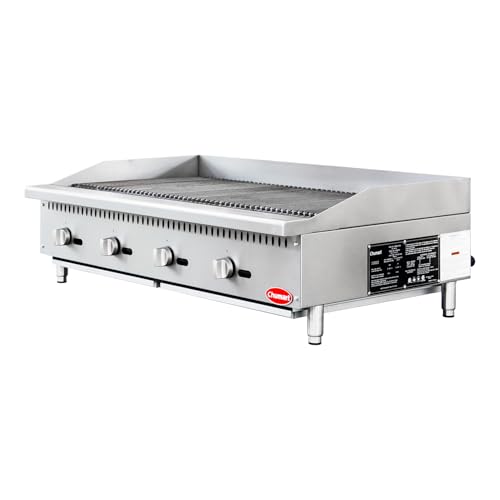
CHUMART 48-Inch Commercial Charbroiler — Best Overall
The CHUMART 48 is the pick for a grill station that never really slows down: four burners across 48 inches means four true heat zones, so the sauté-side tickets, the well-done burgers and the delicate chicken can all live on the same grate without compromise. U-shaped burners are the right call at this width because each burner heats a broader band of grate than a straight tube burner, evening out the surface.
Strengths
- Four independent zones across a full 48-inch grate for genuine multi-temperature cooking
- 140,000 BTU total output — strong recovery when cold product hits the grate mid-rush
- Ships convertible between natural gas and propane with the LP kit included
Trade-offs
- 48 inches of charbroiler demands 48-plus inches of hood — measure before ordering
- Radiant plates need daily scraping and a weekly deep clean to stay even
- At this output, gas line sizing must be checked; undersized lines starve all four burners
| Width | 48 in |
| Burners | 4 U-shaped |
| Total output | 140,000 BTU |
| Heat type | Gas radiant |
| Fuel | Natural gas / propane (LP kit included) |
What separates a good wide charbroiler from a frustrating one is recovery: drop twelve cold patties on a weak unit and the grate temperature craters, steaming instead of searing. With 35,000 BTU per burner zone, the CHUMART holds its sear through a rush, and the radiant design keeps flare-ups controlled rather than theatrical — fat vaporizes on the radiants instead of pooling and igniting. For a burger-and-steak concept doing real volume, this is the configuration we would put on the line first.
Ownership at this size is about systems. Assign the radiants a weekly lift-and-brush, keep a spare igniter in the drawer, and log gas pressure at install so a future ‘weak flame’ complaint has a baseline. The CHUMART’s four-valve layout also rewards a labeled zone map taped at the pass — new cooks learn in one shift what the station’s heat geography is, instead of burning a week of steaks discovering it.
Best for: High-volume grill stations that need four heat zones / Not suited for: Small cafes whose hood and gas line suit a 24-inch unit
Check on Amazon — check price on Amazon before you order; commercial configurations and included accessories vary by listing.

Kratos 36-Inch Commercial Gas Charbroiler (29Y-002) — Best for Mid-Size Lines
Kratos is the house value brand of commercial foodservice catalogs, and the 29Y-002 shows why it sells: honest specs, stainless construction, and a 36-inch footprint that fits the standard line. Three burners give you a hot zone, a holding zone and a finishing zone, which covers the way most kitchens actually run a charbroiler during service.
Strengths
- 105,000 BTU across three burners — 35,000 BTU per zone, matching bigger units burner-for-burner
- 36-inch width is the sweet spot for most independent restaurant lines
- Radiant design keeps flare-ups down and heat even across the grate
Trade-offs
- Value-brand fit and finish is a step below legacy names like Vulcan
- Confirm gas type at order time — conversion parts are a separate conversation
- Grate seasoning and daily cleaning discipline matter more at this price tier
| Width | 36 in |
| Burners | 3 |
| Total output | 105,000 BTU |
| Heat type | Gas radiant |
| Body | Stainless steel |
The math that matters on a charbroiler is BTU per burner zone, and the Kratos matches the premium units zone for zone. Where the savings show up is in the details around the firebox — knob feel, grate casting weight, trim finish — not in the cooking. For a diner, bistro or food hall stall building its first real grill station, that trade is usually the right one: the food comes off the grate tasting the same, and the money saved buys the smallwares you also need.
The Kratos rewards a simple ownership habit: photograph the burner flames at commissioning. Months later, any change — lifting, yellowing, unevenness — is visible against that baseline, and most charbroiler ‘failures’ are really cleaning or pressure issues caught early by exactly that comparison. Parts for value brands travel through catalog channels rather than local dealers, so ordering a spare valve or igniter before you need one is cheap insurance.
Best for: Independent restaurants building a first serious grill station / Not suited for: Buyers who want legacy-brand resale value and dealer networks
Check on Amazon — check price on Amazon before you order; commercial configurations and included accessories vary by listing.
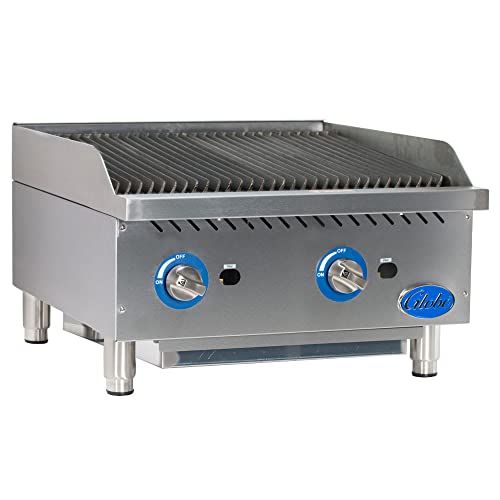
Globe GCB24G-RK 24-Inch Char Rock Charbroiler — Best Premium 24-Inch
Globe Food Equipment has built commercial countertop cooking gear for decades, and the GCB24G-RK is its flavor-first answer: lava rock briquettes over two strong burners, so drippings hit hot rock and come back as smoke and char. At 80,000 BTU in a 24-inch body, it runs hotter per inch than anything else here — exactly what a steakhouse-style sear in a small footprint requires.
Strengths
- 80,000 BTU in 24 inches — exceptional sear intensity for the footprint
- Char rock bed delivers the closest-to-charcoal flavor of any gas design
- Globe’s commercial dealer and parts network backs it long-term
Trade-offs
- Lava rock needs periodic replacement and more flare-up attention than radiants
- Premium pricing versus value brands at the same width
- Rock beds shed grit into the drip tray — budget the cleaning time
| Width | 24 in |
| Burners | 2 |
| Total output | 80,000 BTU |
| Heat type | Char rock / briquette |
| Brand | Globe Food Equipment |
Choose the rock bed deliberately. For a concept whose signature is a hard, smoky char — a steak frites bistro, a yakitori-inspired bar, a burger program selling ‘char-grilled’ on the menu — the flavor difference over radiant is real and guests can taste it. The cost is operational: rocks foul, flare-ups need a cook who pays attention, and the box wants a thorough weekly clean. Kitchens with a strong grill cook will love it; kitchens staffing the station with whoever is free should look at the radiant picks instead.
Rock-bed ownership has one golden rule: the bed is a consumable, not a fixture. Keep a spare bag of briquettes on the shelf, turn the bed weekly so fresh faces meet the fat, and replace rocks when they crumble or stay greasy after a burn-off. Kitchens that treat the bed as permanent watch the flavor fade and the flare-ups grow, then blame the grill. The grill is fine — the bed is done.
Best for: Flavor-first menus that sell char as the signature / Not suited for: High-turnover stations staffed by rotating junior cooks
Check on Amazon — check price on Amazon before you order; commercial configurations and included accessories vary by listing.

Atosa ATCB-24 Natural Gas Lava Rock Charbroiler — Best Value Lava Rock
Atosa has become the default value brand in American commercial kitchens by building straightforward, serviceable equipment, and the ATCB-24 follows the formula: two burners, a lava-rock grate, an iron grill surface, and a stainless body that hoses down fine at close. This listing is the natural gas version, so it suits kitchens already plumbed for NG.
Strengths
- Lava rock flavor at a value-brand acquisition cost
- Iron grill grate holds and transfers sear heat well
- Atosa’s parts availability is strong for a budget brand
Trade-offs
- This listing is natural gas — propane kitchens need the correct conversion path
- Rock maintenance and flare management come with the design
- Two zones only — no dedicated low holding zone at 24 inches
| Width | 24 in |
| Burners | 2 |
| Heat type | Lava rock with radiant plate |
| Grate | Iron grill |
| Fuel | Natural gas (this listing) |
The ATCB-24 is how a small kitchen buys char flavor without buying the Globe badge. The cooking experience — rock flare, iron grate marks, two-zone control — is recognizably the same category of tool; what you give up is refinement and some long-term trim durability. For a cafe adding a char-grilled chicken sandwich or a bar adding a proper burger, it is the rational spend: the menu item pays for the unit quickly, and the unit’s job is flavor, not showroom polish.
Because this listing is natural gas, confirm your line pressure with the fitter at install and keep the regulator setting documented. The ATCB-24’s iron grate also deserves the cast-iron courtesy: a light oil wipe after the nightly scrape keeps it seasoned and rust-free through steamy dish-pit air. Small rituals, but they are the difference between a value unit that ages well and one that looks tired in year two.
Best for: Small kitchens adding char flavor on a natural gas line / Not suited for: Propane kitchens unwilling to arrange a proper conversion
Check on Amazon — check price on Amazon before you order; commercial configurations and included accessories vary by listing.

Vulcan VCRB36 36-Inch Charbroiler — Best Heavy-Duty Brand Name
Vulcan is one of the oldest names in commercial cooking, and the VCRB36 takes a different engineering path from the three-burner 36-inch units: six cast iron burners at 14,500 BTU each. Smaller zones mean finer control — you can run a narrow hot strip for steaks and keep the rest of the grate gentle, instead of heating a full third of the box for one order.
Strengths
- Six zones across 36 inches — the finest heat control in this roundup
- Cast iron burners are durable and familiar to every commercial service tech
- Vulcan’s dealer and parts network is among the deepest in foodservice
Trade-offs
- Six smaller burners mean more pilots/valves to maintain than a 3-burner design
- Total output per zone is lower — technique matters for a hard sear
- Premium brand pricing, and freight delivery is typical at this class
| Width | 36 in |
| Burners | 6 cast iron |
| Output per burner | 14,500 BTU |
| Type | Gas countertop charbroiler |
| Brand | Vulcan |
The VCRB36 rewards a thinking grill cook. With six valves you can build a heat map that follows your menu: two zones roaring for steaks, two medium for chicken, two low for holding and vegetables. That granularity also saves gas across a long service, because you are never heating grate you are not using. It is the choice for an chef-driven kitchen that treats the charbroiler as a precision station, and for any operation that values a service network — when a Vulcan goes down on a Friday, somebody local can fix it.
Six burners means six flames to glance at during preheat — build that ten-second inspection into the opening routine and the VCRB36 will tell you about a clogged port or a tired igniter before service does. Vulcan’s documentation culture helps here: keep the manual at the station, because its zone and cleaning guidance is written by people who expect the unit to be serviced, not replaced.
Best for: Chef-driven kitchens wanting fine zone control and service support / Not suited for: Buyers who want maximum single-zone sear power above all
Check on Amazon — check price on Amazon before you order; commercial configurations and included accessories vary by listing.
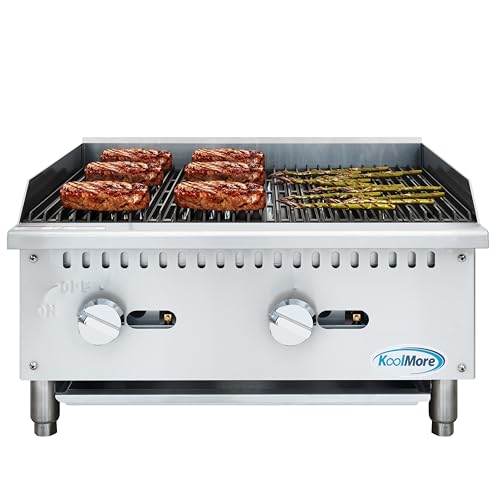
KoolMore 24-Inch Commercial Charbroiler (KM-GCB2-24M) — Best Budget 24-Inch
KoolMore’s pitch is simple: a stainless, ETL-listed commercial charbroiler at a price that undercuts the legacy brands by a wide margin. The 60,000 BTU total is honest mid-pack power for a 24-inch box — enough for burgers, chicken and vegetables at small-restaurant volume, without the sear intensity of the Globe rock model.
Strengths
- ETL listing matters for inspectors and insurers — this one has it
- 60,000 BTU is adequate, honest power for small-volume service
- Stainless body cleans down easily at close
Trade-offs
- Sear recovery under heavy load is a step below the 80,000 BTU Globe
- Value-brand long-term parts support is thinner than legacy names
- Natural gas configuration — verify fuel before ordering
| Width | 24 in |
| Burners | 2 |
| Total output | 60,000 BTU |
| Listing | ETL Listed |
| Body | Stainless steel |
For a food truck, a concession, or a cafe adding one grilled protein, the KoolMore is the pragmatic pick: it satisfies the health and fire inspector with its listing, fits a short line, and cooks respectably. The discipline it demands is expectation management — do not spec it as the sole grill station for a 120-seat steakhouse. Matched to the right volume, a budget charbroiler that is listed, stainless and honestly rated beats a bigger name bought second-hand with no history.
The KoolMore’s ownership bargain is attention instead of money. Its output asks for batching discipline at peak, and its value construction asks for the nightly scrape and weekly radiant check that premium owners sometimes skip. Do those two things and the ETL-listed box simply works — which, for a cafe or truck watching every dollar, is the entire point of the purchase.
Best for: Food trucks, cafes and concessions needing a listed compact unit / Not suited for: High-volume steak service as the only grill station
Check on Amazon — check price on Amazon before you order; commercial configurations and included accessories vary by listing.
Comparison Table
| Pick | Badge | Key spec | Best for |
|---|---|---|---|
| CHUMART 48-Inch Commercial Charbroiler | Best Overall | 48 in · 4 burners · 140,000 BTU radiant | High-volume grill stations that need four heat zones |
| Kratos 36-Inch Commercial Gas Charbroiler (29Y-002) | Best for Mid-Size Lines | 36 in · 3 burners · 105,000 BTU radiant | Independent restaurants building a first serious grill station |
| Globe GCB24G-RK 24-Inch Char Rock Charbroiler | Best Premium 24-Inch | 24 in · 2 burners · 80,000 BTU char rock | Flavor-first menus that sell char as the signature |
| Atosa ATCB-24 Natural Gas Lava Rock Charbroiler | Best Value Lava Rock | 24 in · 2 burners · lava rock, natural gas | Small kitchens adding char flavor on a natural gas line |
| Vulcan VCRB36 36-Inch Charbroiler | Best Heavy-Duty Brand Name | 36 in · 6 cast iron burners · 14,500 BTU each | Chef-driven kitchens wanting fine zone control and service support |
| KoolMore 24-Inch Commercial Charbroiler (KM-GCB2-24M) | Best Budget 24-Inch | 24 in · 2 burners · 60,000 BTU · ETL listed | Food trucks, cafes and concessions needing a listed compact unit |
What Does a Charbroiler Station Need Around It?
A charbroiler does not work alone. It needs landing space on both sides — raw product staged on one side, resting and finishing on the other — because a cook who has to walk with a tray of raw steaks is a cook losing ticket time and risking cross-contamination. It needs its tools at arm’s reach: long tongs, a stiff grate brush, a scraper, and a spray-free flare plan (move the product, close the zone down, never flood a grease fire with water).
It also needs the pass to understand it. Charbroiled items have real cook times that cannot be rushed below the laws of heat; a kitchen that sells its charbroiler items honestly — ‘grilled to order’ — sets ticket expectations the station can meet. The best charbroiler setups we see treat the station, its landing zones and its menu promises as one designed system.
How Long Do Commercial Charbroilers Last, and What Wears Out First?
The firebox and body of a decent commercial charbroiler last for many years of daily service; the wear list is predictable. Burners eventually corrode at the ports, radiant plates warp and thin, lava rocks foul and crumble, igniters die early and often, and grates — even cast iron — eventually lose their seasoning-friendly surface to years of scraping. All of these are replaceable parts on the brands in this roundup, which is precisely what makes them commercial equipment rather than appliances.
Plan on igniters and rocks as annual-scale consumables, radiants and burners as multi-year items, and keep the model number and serial recorded with your kitchen’s equipment file. The kitchens that get a decade from a charbroiler are not lucky — they are the ones whose closing checklist includes the grease path and whose manager orders the spare before the failure, not after.
What Is the Difference Between Radiant and Lava Rock Charbroilers?
Radiant charbroilers place angled steel plates — radiants — between the burner and the grate. The plates catch drippings, vaporize much of them for flavor, and spread the burner’s heat into a wide, even field. The result is consistency: fewer flare-ups, more uniform marks, and a grate that behaves the same on a Tuesday as on a Saturday. Most high-volume lines choose radiants for exactly that predictability.
Lava rock (char rock) models lay a bed of porous briquettes over the burner area. Fat drips onto superheated rock and flashes into smoke and flame, which is why rock models taste closer to a charcoal grill. The trade is management: rocks absorb grease over time, flare-ups are more frequent, and the bed eventually needs replacing. Neither design is ‘better’ in the abstract — radiants suit volume and consistency, rock suits menus that sell char flavor as the headline.
How Many BTUs Does a Commercial Charbroiler Actually Need?
BTU figures on charbroilers are totals across all burners, and the useful way to read them is per zone and per inch. A working rule from the picks above: roughly 30,000–40,000 BTU per 12-inch zone gives strong recovery for searing. The CHUMART 48 runs about 35,000 per zone; the Globe 24 concentrates 40,000 per zone, which is why it sears so hard; the KoolMore’s 30,000 per zone is adequate for moderate volume.
More is not automatically better. Excess output under a small hood overwhelms ventilation, and a station that mostly holds chicken at medium does not need steakhouse firepower. Match the output to the protein and the pace: steakhouses and burger concepts at volume want the top of the range; mixed grill stations want zones and control, which is where a design like the six-burner Vulcan earns its keep.
How Do You Size a Charbroiler to Your Line and Hood?
Start with the hood, not the menu. A charbroiler must sit fully under your Type I hood with the overhang your local code requires, and it is a high-heat, grease-producing appliance that inspectors look at closely. Measure the free counter run under the hood, subtract the space your other hot equipment needs at peak, and let that number cap your charbroiler width.
Then sanity-check against tickets. A 24-inch grate handles a small cafe or a single grilled protein comfortably. A 36-inch unit is the standard independent-restaurant station. A 48-inch unit is justified when the grill station carries the menu — burgers, steaks, chicken and vegetables simultaneously at rush. Buying one size up ‘for growth’ sounds wise but costs gas and hood capacity every day until the growth arrives.
What Should You Check About Gas, Ventilation and Codes Before Ordering?
Confirm your fuel: natural gas and propane run at different pressures and orifice sizes, and a unit plumbed wrong will soot, underperform or fail inspection. Several picks above include an LP conversion kit; others are fuel-specific listings. Confirm which you are buying, and have a licensed gas fitter make the connection — this is not a DIY install.
Check three paperwork items before the unit arrives: the listing (ETL or equivalent) your inspector and insurer expect, the clearance requirements in the manual for the counter and wall materials around it, and whether your jurisdiction wants a fire suppression tie-in for the added appliance. A charbroiler also produces heavy grease vapor, so confirm your hood and duct cleaning schedule can absorb it — most kitchens shorten the interval once a charbroiler joins the line.
How to Season and Break In a New Commercial Charbroiler
A new charbroiler does not cook its best on day one. Cast iron grates need seasoning, burners need a burn-off to clear manufacturing oils, and the crew needs one calm session to learn the heat map before the first rush. An hour invested here pays back in release, flavor and fewer stuck proteins all year.
- After the licensed gas connection and leak test, remove the grates and wash them in hot soapy water to strip factory coatings; dry them completely.
- Run all burners on high for 20–30 minutes with the hood on to burn off manufacturing oils — expect smoke and a chemical smell that should not return after this session.
- Coat the warm grates thinly with a high-smoke-point oil using a folded towel held in tongs, then heat until the oil polymerizes; repeat two or three times for a real seasoning base on cast iron.
- Map the heat: lay slices of plain white bread across the whole grate for one minute and read the toast pattern — it shows you every hot and cool spot your cooks need to know.
- Cook a sacrificial first batch (inexpensive burgers or chicken thighs) to finish the break-in and confirm flare behavior with fatty product before service.
- Write the station standard on a card at the pass: preheat time, zone layout for service, and the nightly cleaning steps, so every shift runs the unit the same way.
From then on, maintenance is rhythm: scrape grates while hot after service, empty the grease drawer daily, lift and brush radiants or turn rocks weekly, and deep-clean monthly. Charbroilers die from neglect and grease buildup, not from cooking — the kitchens that keep a cleaning cadence get years of hard sear out of the same box.
A Short Word on Charbroilers and Menu Honesty
One last idea ties the equipment to the business: a charbroiler lets a menu make promises — char-grilled, flame-kissed, seared over open fire’s gas cousin — and the equipment choice decides whether those promises are true. A radiant unit kept clean delivers honest char flavor; a fouled rock bed delivers smoke of the wrong kind. Guests may not know the vocabulary, but they know the taste, and repeat business is built on the match between the menu’s words and the plate’s reality.
That is the real reason to buy the right system and maintain it on rhythm. The charbroiler is not back-of-house equipment that happens to cook; it is the physical form of a claim your restaurant makes every night. Choose the claim you can keep — radiant consistency or rock-bed drama — buy the unit that keeps it, and clean it like the claim depends on it. It does.
How Do Charbroilers Affect the Rest of the Line?
A charbroiler is the line’s weather system: its heat, smoke and grease influence everything near it. Place it so its plume goes straight into the hood without crossing the pass or the fryer — fryer oil and charbroiler flare are unhappy neighbors — and give the grill cook a landing zone that does not borrow the sauté station’s board space. Lines that treat placement as an afterthought spend years working around a problem one drawing could have prevented.
The charbroiler also sets the kitchen’s cleaning tempo. Its grease load shortens hood and duct intervals, its closing routine anchors the hot line’s shutdown, and its smell — glorious in the dining room at 7 p.m., stale in the kitchen at 7 a.m. — depends entirely on whether last night’s clean actually happened. Buy the charbroiler and you are also buying its position in the kitchen’s daily rhythm; plan both.
What Do Inspectors and Insurers Look At With Charbroilers?
Three things, reliably: the listing mark on the unit itself, the installation’s conformance (clearances, gas connection by a licensed fitter, correct fuel configuration), and the suppression and hood system’s coverage of the appliance as installed. A charbroiler added to a line without updating the hood calculation is the classic finding — the unit is legal, the installation is not.
Keep the paperwork that proves all three: the unit’s documentation, the fitter’s invoice and permit where required, and your hood service records. When everything is filed, inspections become short and insurance conversations become boring — which is exactly what a business wants from both. The ETL-listed budget picks in this roundup exist so that even the cheapest legitimate route keeps that file complete.
How Should You Train a New Grill Cook on a Charbroiler?
Start off-service: the heat map lesson with the bread test, the zone layout for your menu, and the flare drill — move the product, never water, never panic. Then supervised services with a limited menu section, expanding as timing becomes reliable. Charbroiling is a craft of anticipation: the cook who learns to read the grate’s recovery and the fire’s mood produces consistent food on any unit; the cook who only learns knob positions is lost the day the unit changes.
Document your station’s standards as you train — preheat time, zone map, item times, cleaning steps — because the trainer will not always be there. The kitchens with the most consistent grill food are rarely the ones with the most talented individual cooks; they are the ones whose standards survive a staffing change. Your charbroiler will outlast several crews. Make sure its knowledge does too.
Radiant Plates, Rocks and Grates: How Do the Consumables Compare?
Every charbroiler’s flavor system is a consumable with a personality. Radiant plates are the low-drama option: they last for years, ask for scraping and brushing, and fail slowly by warping — you will see uneven heat developing over months, which is your cue to plan replacement. Lava rocks are the high-flavor, high-turnover option: cheap to replace, but on a cycle of months at volume, and their decline shows up as constant flaring and a greasy smoke note in food that should taste clean.
Grates sit above both systems. Cast iron grates are the traditional choice — heavy, superb at marking, and happy for years if seasoned and kept dry; stainless rod grates are lighter, easier to clean and more forgiving of neglect, with slightly less dramatic marks. None of these choices is a lifetime commitment: grates and radiants swap, rocks pour out and pour in. Buy the system whose maintenance rhythm your crew will actually keep.
What Should You Ask Before a Charbroiler Is Delivered?
Freight is part of commercial equipment life: confirm whether delivery is curbside or inside, whether a liftgate is included, and who removes the old unit if there is one. A 48-inch charbroiler that arrives on a pallet at a curb without a plan becomes an afternoon of improvisation your kitchen does not need. Also confirm the crate dimensions against your door widths — commercial units are wider than residential doors more often than buyers expect.
Finally, line up the install before the truck: the gas fitter booked, the hood verified on, the stand or chef base in place, and the old station’s last service planned. Kitchens that sequence delivery, install and commissioning into one day lose a single service at most; kitchens that wing it lose the week.
Common Buying Mistakes
Buying width before checking the hood
The most expensive charbroiler mistake is a unit that cannot legally sit where you planned. Hood width, overhang rules and clearances decide your maximum size — confirm them with your installer or inspector before the freight truck is booked, not after.
Comparing total BTU without dividing by zones
A 140,000 BTU 48-inch unit and an 80,000 BTU 24-inch unit have similar power per zone. Shoppers who compare headline totals buy the wrong intensity for their menu. Always divide by burners and think in heat per cooking zone.
Ignoring fuel type on the listing
Natural gas and propane listings look identical in photos. Ordering the wrong one means conversion parts, a fitter’s visit and lost days — or a dangerous mismatch if someone forces it. Read the fuel line of the listing twice.
Skipping the cleaning cadence
Grease-laden radiants and fouled rocks flare, smoke out the dining room and eventually ignite. The charbroiler is the appliance most likely to cause a kitchen fire when neglected; daily and weekly cleaning is part of the purchase price.
Final Recommendation
For most buyers the decision narrows quickly. If the grill station carries your menu, the CHUMART 48 gives you four real zones and the recovery to hold a sear through a rush. Mid-size lines should take the Kratos 36 or, for finer control and dealer support, the Vulcan VCRB36. Small footprints split by philosophy: the Globe GCB24G-RK for maximum char flavor and sear, the Atosa ATCB-24 for the same rock-bed idea on a budget, and the KoolMore 24 when a listed, affordable compact unit is the whole brief.
Whichever you choose, confirm fuel, hood fit and listing before ordering, and check price on Amazon on the day you buy — commercial configurations shift between listings more often than residential products do.
- Best Overall: CHUMART 48-Inch Commercial Charbroiler — check price on Amazon
- Best for Mid-Size Lines: Kratos 36-Inch Commercial Gas Charbroiler (29Y-002) — check price on Amazon
- Best Premium 24-Inch: Globe GCB24G-RK 24-Inch Char Rock Charbroiler — check price on Amazon
- Best Value Lava Rock: Atosa ATCB-24 Natural Gas Lava Rock Charbroiler — check price on Amazon
- Best Heavy-Duty Brand Name: Vulcan VCRB36 36-Inch Charbroiler — check price on Amazon
- Best Budget 24-Inch: KoolMore 24-Inch Commercial Charbroiler (KM-GCB2-24M) — check price on Amazon
Keep exploring the cluster: Best Commercial Grills · Best Commercial Gas Grills · Best Commercial Grills 24 · Best Commercial Grills For Burgers · Best Commercial Griddle
Related guides
Frequently Asked Questions
Can a commercial charbroiler be used at home?
Generally no. Commercial charbroilers are designed for restaurant ventilation, commercial gas connections and non-combustible surroundings, and they typically lack residential certification. Using one in a home or garage can void insurance and violate local code. Home cooks wanting this style of sear should look at residential outdoor grills instead.
Which is better for burgers, radiant or lava rock?
Lava rock gives a smokier, more charcoal-like flavor and dramatic char, at the cost of flare-ups and rock maintenance. Radiants give more even, repeatable results across a long service. Burger concepts selling flame-grilled flavor lean rock; high-volume lines that prize consistency lean radiant.
How long does a commercial charbroiler take to preheat?
Plan on roughly 15–25 minutes for the grate to reach full searing temperature, depending on size and output. Lava rock beds take a little longer to saturate with heat. Build preheat into your opening checklist rather than firing it when the first ticket lands.
How often should lava rocks be replaced?
It depends on volume and how much fatty product you cook, but rocks that are crumbling, grease-soaked or producing constant flare-ups are done. Many kitchens refresh the bed every few months at volume. Radiant plates, by comparison, need cleaning rather than replacement unless they warp or corrode through.
What size charbroiler does a food truck need?
Most trucks run a 24-inch unit: two zones, modest gas draw, and a footprint that fits a short line. Confirm your truck’s hood, gas capacity and local mobile-vendor rules — several jurisdictions restrict open-flame charbroiling in mobile units.
Do these charbroilers come with stands?
Most countertop charbroilers are sold as counter units; equipment stands are separate accessories. Check the listing contents before assuming a stand, casters or a conversion kit is in the box — several picks above state kit inclusion explicitly in their titles.
Do charbroilers need a special gas regulator?
Most commercial charbroilers specify a regulator matched to the fuel and the unit’s total BTU; your gas fitter sizes and sets it at install. Using an undersized or wrong-pressure regulator is a common cause of weak flames across all burners at once.
Can I convert a radiant charbroiler to lava rock?
Generally no — the burner and grate geometry are designed around one system. If you want rock flavor, buy a rock model; if you want radiant manners, buy a radiant. The picks above label each unit’s system so you can choose deliberately.


