Disclosure: airfryerkitchensupply.com is reader-supported. When you buy through links on our site, we may earn an affiliate commission at no extra cost to you.
Where to buy
Every pick in this guide to the best combination coffee and espresso machines was confirmed through our product verification channel, so you can shop with direct links: use the Check on Amazon buttons throughout the article to check the current price on Amazon for each machine. Combination machines are sold in several configurations, so confirm on the listing that both the drip and espresso sides described in the review are included.
- De'Longhi BCO430 Combination Pump Espresso and Drip Coffee Machine — Check on Amazon
- De'Longhi COM530M All-In-One Combination Coffee and Espresso Machine — Check on Amazon
- De'Longhi COM630BK All-In-One Combination Coffee and Espresso Machine — Check on Amazon
- De'Longhi All-in-One Espresso & Coffee Maker with Dual Heating — Check on Amazon
- Cuisinart Coffee Center Barista Bar 4-in-1 Coffee Maker — Check on Amazon
- Ninja Espresso & Coffee Maker CFN601 — Check on Amazon
The best combination coffee and espresso machines exist for households that refuse to choose. One person wants a full pot of drip coffee for the morning; another wants a proper espresso or cappuccino; nobody wants two machines eating the counter. When people search for the best combination coffee and espresso machines, they are shopping for that truce: a single appliance with a drip brewer on one side and a pump espresso maker, with a steam wand for milk, on the other. The six verified machines below are the strongest current ways to buy it, and De’Longhi’s dominance of the list is an honest reflection of the market, not a lack of looking.
Set expectations correctly and this category delights. A combination machine is a compromise by design: its espresso side will not match a dedicated espresso machine with a large boiler and a separate grinder, and its drip side will not out-brew a specialist drip maker. What it offers is genuinely good versions of both, in one footprint, at one purchase, with one water routine and one cleaning routine. For mixed households, offices and small kitchens, that trade is not a weakness; it is the entire point, and the best models execute it with real care.
Who should buy one? Couples and families split between drip and espresso drinkers, small kitchens and offices with no room for two machines, and hosts who need a pot for guests plus lattes for themselves. Who should not: espresso purists chasing café-level extraction, who should buy a dedicated machine and grinder, and single-style households, who will pay for a side they never use. Every pick below is verified, and the buying guide explains the pump, heating and milk questions that separate the good combinations from the disappointing ones.
In this guide
Quick Picks
Six verified combination machines ranked by role. De’Longhi owns this category, so the real choice is which configuration of the idea fits your household.
- De'Longhi BCO430 Combination Pump Espresso and Drip Coffee Machine — Best Overall: the classic combination machine: a ten-cup drip brewer beside a pump espresso side with a frothing wand, in one proven design. — Check on Amazon
- De'Longhi COM530M All-In-One Combination Coffee and Espresso Machine — Best for Busy Mornings: a modern all-in-one with dual heating, so drip brewing and espresso steaming do not have to queue behind each other. — Check on Amazon
- De'Longhi COM630BK All-In-One Combination Coffee and Espresso Machine — Best for Cappuccino Lovers: the milk-focused member of the family, built around an advanced cappuccino system for easy lattes and cappuccinos. — Check on Amazon
- De'Longhi All-in-One Espresso & Coffee Maker with Dual Heating — Best Value All-in-One: a ten-cup all-in-one with dual heating and a milk frother, covering the full combination brief in one widely sold model. — Check on Amazon
- Cuisinart Coffee Center Barista Bar 4-in-1 Coffee Maker — Most Versatile: a four-in-one centre: full pot brewing, single-serve pods and espresso-style brewing in one Cuisinart footprint. — Check on Amazon
- Ninja Espresso & Coffee Maker CFN601 — Best Capsule and Grounds Hybrid: Ninja’s hybrid uses Nespresso-compatible capsules for espresso and grounds for coffee, with three espresso brew styles. — Check on Amazon
How These Picks Were Chosen
Picks were chosen on the integrity of both halves. The espresso side had to be a real pump machine with a portafilter and a steam wand capable of texturing milk, not a steam-toy or a pod-only shortcut, unless the model’s concept was explicitly capsule-based and labelled as such. The drip side had to brew a genuinely useful pot size with a warming system that does not stew the coffee. Dual heating, the ability to brew and steam without a long sequential wait, was ranked as a major advantage because it decides whether the machine feels fluid on a busy morning.
Only confirmed listings carry a purchase link. Prices and ratings are excluded, because they change constantly; check price on Amazon through the links when you shop.
One category honesty note: combination machines ask you to maintain two brewing systems, which means two descaling routines and more parts to clean than a single-purpose machine. The reviews below are frank about which models make that maintenance easy and which make it a chore, because in this category the second month of ownership matters more than the first morning.
The 6 Best Combination Coffee and Espresso Machines Reviewed

De'Longhi BCO430 Combination Pump Espresso and Drip Coffee Machine — Best Overall
The BCO430 is the reference design for this category and the safest recommendation in it. On one side, a ten-cup drip coffee maker with a front-access water reservoir; on the other, a pump espresso machine with a frothing wand for cappuccinos and lattes. It suits mixed households that want both drinks daily, value a design that has been refined over years, and prefer filling water and coffee from the front rather than pulling the machine out from under cabinets.
Strengths
- Proven, refined design from the category’s defining brand
- Front access to water and coffee makes daily refilling genuinely easy
- Real pump espresso with a frothing wand for proper milk drinks
Trade-offs
- Espresso and drip share the machine’s attention: it is a compromise by design
- No built-in grinder, so budget for pre-ground coffee or a separate grinder
- Footprint is wide compared with a single-purpose machine
| Drip side | 10-Cup drip coffee machine |
| Espresso side | Pump espresso with frothing wand |
Daily life with the BCO430 explains its longevity in the market. The drip side handles the household pot with a programmable routine, the espresso side pulls a respectable shot and steams milk for the person who wants a cappuccino, and the front-access design, a detail rivals still get wrong, means the machine lives happily under cabinets without a daily drag-forward ritual.
Its limits are the category’s limits, honestly presented: a dedicated espresso machine will out-extract it, and the steam wand asks for basic technique and a wipe after every use. But as a single purchase that ends the two-machine standoff in a mixed household, it remains the benchmark, and the machine the other picks in this guide are measured against.
Best for: mixed drip-and-espresso households wanting the proven design / Not suited for: espresso purists who will outgrow a combination machine quickly
Check on Amazon — check the current price on Amazon before you decide, because listings, colours and bundle contents change.

De'Longhi COM530M All-In-One Combination Coffee and Espresso Machine — Best for Busy Mornings
The COM530M modernises the combination idea with a dual heating system, which lets the drip side brew while the espresso side heats for steaming, removing the sequential waiting that slows older combination machines on a busy morning. It suits households where two people get ready at once, one filling a travel mug from the pot while the other makes a latte, and anyone upgrading from an older combi who knows exactly which frustration they are paying to remove.
Strengths
- Dual heating removes the brew-or-steam queue on busy mornings
- Modern controls and styling update the classic combi formula
- Full combination function: drip pot plus pump espresso and steam
Trade-offs
- More systems to descale and maintain than a single-purpose machine
- No integrated grinder, as with most of this category
- Premium position within the De’Longhi combination range
| Format | All-in-one combination |
| Heating | Dual heating system |
The dual heating difference is one you feel in the first week. Combination machines with a single heating path force a small negotiation every morning, whose drink goes first, and over months that friction defines whether the machine feels clever or compromised. The COM530M dissolves it: the pot brews on its schedule while the espresso side stays ready for milk work.
Everything else is the mature De’Longhi formula, competent drip, honest pump espresso, a wand that textures milk well with a little practice. If your household’s mornings are parallel rather than sequential, this is the combination machine designed for you, and the one that most completely delivers the category’s promise of no compromises that matter.
Best for: households making drip and milk drinks at the same time / Not suited for: solo drinkers who will never use both sides together
Check on Amazon — check the current price on Amazon before you decide, because listings, colours and bundle contents change.

De'Longhi COM630BK All-In-One Combination Coffee and Espresso Machine — Best for Cappuccino Lovers
The COM630BK tilts the combination formula toward milk drinks, with an advanced cappuccino system designed to make frothing easier and more consistent for people whose espresso is rarely drunk straight. It suits latte and cappuccino households first and drip households second: the pot is there for guests and mornings that need volume, but the machine’s heart is the milk side. Buyers who take their espresso black should look at the BCO430 instead.
Strengths
- Cappuccino system lowers the skill needed for good milk texture
- Full drip side retained for pots, guests and batch mornings
- Black finish suits modern kitchens and hides coffee splashes
Trade-offs
- Milk system parts need diligent rinsing to stay hygienic and reliable
- Espresso purists will still prefer a traditional wand and technique
- Value depends on how much of your drinking is milk-based
| Format | All-in-one combination |
| Milk | Advanced Cappuccino System |
Milk is where home espresso dreams usually stall, because texturing milk on a basic wand is a skill that takes weeks to learn. Systems like this one trade a little of the barista’s control for a lot of consistency, producing the soft, integrated foam that makes a homemade cappuccino taste like a café’s rather than like coffee with bubbles on top. For the household whose order is always milky, that trade is the whole ballgame.
The discipline it demands is cleaning: milk residue is unforgiving, and the system’s parts must be rinsed after use and washed regularly, or flavours and reliability suffer. Owners who accept that two-minute routine get the easiest route in this guide to drinks that impress guests. Owners who know they will not, should choose the simpler wand of the BCO430 and learn it instead.
Best for: latte and cappuccino households wanting easy, consistent milk / Not suited for: black-espresso drinkers or anyone who neglects milk-system cleaning
Check on Amazon — check the current price on Amazon before you decide, because listings, colours and bundle contents change.
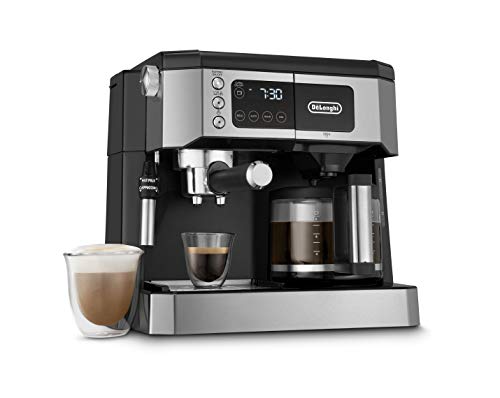
De'Longhi All-in-One Espresso & Coffee Maker with Dual Heating — Best Value All-in-One
This widely distributed De’Longhi all-in-one pairs a ten-cup drip pot with pump espresso, a milk frother and dual heating, which makes it the value-centred way to buy the complete combination concept. It suits households that want every feature of the category, pot, espresso, steamed milk, simultaneous operation, without stepping up to the newest model in the range, and it is a frequent choice for offices and shared kitchens where many hands will use it.
Strengths
- Complete feature set: ten-cup pot, espresso, frother, dual heating
- Proven all-in-one platform with broad availability
- Handles mixed groups, the exact job combination machines exist for
Trade-offs
- Overlaps closely with its siblings: compare configurations carefully
- Two systems to descale and keep clean
- No built-in grinder
| Drip side | 10-Cup pot |
| Heating | Dual heating system, milk frother |
Think of this model as the category’s sensible default in its modern form. The dual heating keeps mornings fluid, the ten-cup pot covers family and guest volume, and the frother handles the milk drinks that make the espresso side worthwhile. In shared spaces it earns special praise, because its controls are legible to a first-time user standing in a kitchen at work, which is a real and underrated virtue.
Because De’Longhi’s combination range overlaps, the buying skill here is comparison: line this model up against the COM530M and the BCO430 on the features you will actually use, simultaneous heating, front access, milk system style, and buy the configuration that matches rather than the newest badge. On features per commitment, this one is frequently the sweet spot.
Best for: households and offices wanting the complete combi feature set / Not suited for: buyers who want the newest model or a built-in grinder
Check on Amazon — check the current price on Amazon before you decide, because listings, colours and bundle contents change.

Cuisinart Coffee Center Barista Bar 4-in-1 Coffee Maker — Most Versatile
Cuisinart’s Barista Bar widens the definition of combination: alongside carafe brewing it offers single-serve brewing compatible with pods and an espresso-style side, in three brewing sizes. It suits households whose members cannot agree on anything, one wants a pot, one wants a single pod cup, one wants an espresso-style drink, and kitchens where versatility per inch of counter is the deciding metric. It is the maximalist pick in this guide.
Strengths
- Four brewing modes cover more household preferences than any rival here
- Single-serve pod compatibility adds weekday speed and variety
- Three brewing sizes suit everything from a small cup to a travel mug
Trade-offs
- Breadth trades against depth: no single mode matches a dedicated machine
- More modes mean more parts, more cleaning and more to learn
- Pod use adds ongoing cost and waste that ground-coffee brewing avoids
| Format | 4-in-1 coffee center |
| Modes | Carafe, single-serve pods, espresso-style; three sizes |
The Barista Bar is best understood as a peace treaty for the most divided households. Dedicated-machine owners scoff at four-in-one breadth, but the household reality it serves is real: different people, different drinks, one counter. Each mode is competent, the carafe side handles the morning pot, the pod side handles the rushed single cup, and the espresso-style side handles the after-dinner drink without a second appliance.
The cost of breadth is that no mode is the best in this guide at its job, and the cleaning routine spans several systems. If your household genuinely uses three or four modes weekly, that is a bargain. If you will use one mode ninety percent of the time, buy the machine that does that mode best and ignore the rest of this category.
Best for: divided households that will use several brewing modes weekly / Not suited for: anyone with one fixed drink who wants it done perfectly
Check on Amazon — check the current price on Amazon before you decide, because listings, colours and bundle contents change.
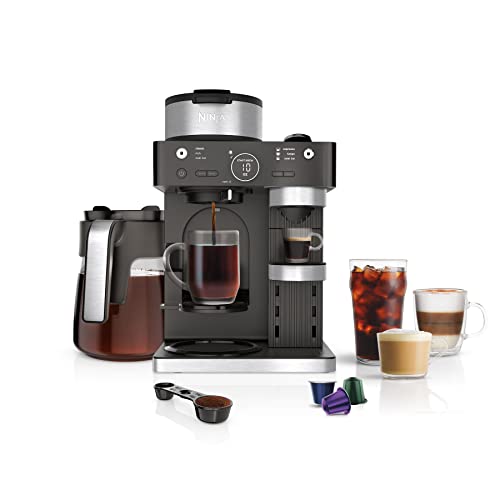
Ninja Espresso & Coffee Maker CFN601 — Best Capsule and Grounds Hybrid
The CFN601 rethinks the combination for the capsule era: espresso comes from Nespresso-compatible capsules in three brew styles, while the coffee side brews grounds as single-serve cups rather than a carafe. It suits capsule devotees who also drink brewed coffee, solo and couple households that never brew a full pot, and anyone who wants espresso with zero grinding, dosing or tamping. If your household’s unit of coffee is the cup rather than the pot, this is your combination machine.
Strengths
- Capsule espresso is fast, consistent and mess-free
- Grounds side covers brewed coffee without a carafe commitment
- Three espresso styles vary the drink without any barista skill
Trade-offs
- No carafe: households that brew pots should look at the De’Longhi picks
- Capsule cost per drink exceeds ground espresso over time
- Capsule espresso will not satisfy drinkers chasing fresh-ground extraction
| Espresso | Nespresso capsule compatible, 3 brew styles |
| Coffee | Single-serve grounds brewing |
Ninja understands its buyer precisely: someone who loves the capsule ritual, press, wait, drink, but resents needing a second machine for a mug of filter-style coffee. The CFN601’s grounds side closes that gap neatly, and the three espresso styles, which vary length and intensity, give capsule drinkers more range than a basic capsule machine. The whole experience is speed and tidiness, with no portafilter to knock out and no grounds in the sink.
The boundaries are equally clear. There is no pot for guests, the per-cup economics of capsules apply, and the espresso, while good capsule espresso, is a different drink from fresh-ground pump espresso. Households that recognise themselves in the capsule description will find this the most natural combination machine here; households that do not should start at the top of the list.
Best for: capsule lovers and cup-at-a-time households / Not suited for: pot-brewing households or fresh-ground espresso seekers
Check on Amazon — check the current price on Amazon before you decide, because listings, colours and bundle contents change.
Comparison Table
| Pick | Badge | Key spec | Best for |
|---|---|---|---|
| De'Longhi BCO430 Combination Pump Espresso and Drip Coffee Machine — Check on Amazon | Best Overall | 10-cup drip plus pump espresso | mixed drip-and-espresso households wanting the proven design |
| De'Longhi COM530M All-In-One Combination Coffee and Espresso Machine — Check on Amazon | Best for Busy Mornings | Dual-heating all-in-one | households making drip and milk drinks at the same time |
| De'Longhi COM630BK All-In-One Combination Coffee and Espresso Machine — Check on Amazon | Best for Cappuccino Lovers | Cappuccino-system combi | latte and cappuccino households wanting easy, consistent milk |
| De'Longhi All-in-One Espresso & Coffee Maker with Dual Heating — Check on Amazon | Best Value All-in-One | 10-cup, dual heating | households and offices wanting the complete combi feature set |
| Cuisinart Coffee Center Barista Bar 4-in-1 Coffee Maker — Check on Amazon | Most Versatile | 4-in-1 with pod brewing | divided households that will use several brewing modes weekly |
| Ninja Espresso & Coffee Maker CFN601 — Check on Amazon | Best Capsule and Grounds Hybrid | Capsule espresso plus grounds | capsule lovers and cup-at-a-time households |
How to Choose the Best Combination Coffee and Espresso Machines
Start with your household’s real drink census for one week. Count pots of drip, single cups, straight espressos and milk drinks. The right combination machine is the one whose configuration matches that census: carafe-plus-portafilter for pot and espresso households, a milk system model for cappuccino households, a four-in-one for divided households, and a capsule hybrid for cup-at-a-time households. Buying for an imaginary census, the dinner-party host you are twice a year, is how combination machines become counter clutter.
On the espresso side, look for a real pump and a portafilter if you want genuine espresso, and decide the milk question honestly: a manual wand rewards practice with café-quality texture, while a cappuccino system trades control for consistency and adds cleaning obligations. On the drip side, check pot size against your mornings and prefer a thermal carafe or a gentle warmer if coffee sits, because hot plates stew a pot over an hour. Dual heating is worth seeking if two drinks happen at once in your home; it is wasted money if mornings are sequential.
Finally, confront the grinder question, because no pick in this guide grinds beans. Espresso from pre-ground coffee is convenient and decent; espresso from beans ground seconds before brewing is better, and the difference is the main reason enthusiasts graduate to separate machines. If you suspect you are on that path, buy the combination machine for the household’s present, not as a stepping stone, and enjoy it for what it is.
Do Combination Machines Make Good Espresso?
They make good espresso, honestly defined: a concentrated, crema-topped shot that tastes right in milk drinks and perfectly pleasant straight, from a real pump and portafilter. What they generally cannot match is a dedicated machine’s thermal stability, pressure control and pairing with a quality grinder, which is where the last increment of clarity and sweetness in straight espresso lives.
For most households, the combination machine’s shot is not the limiting factor in the cup; freshness of coffee, grind consistency and milk texture are. Use fresh pre-ground espresso coffee, store it airtight, learn your machine’s dose and tamp routine, and texture the milk properly, and the drinks will satisfy everyone except the household’s resident espresso obsessive, who was always going to buy a separate setup eventually.
How to Keep a Combination Machine Running Well
Two brewing systems means two maintenance rhythms. The drip side wants regular descaling and a washed carafe and filter basket; the espresso side wants its portafilter and shower screen rinsed, its wand purged and wiped after every milk session, and descaling on the schedule your water hardness dictates. Milk residue is the urgent one: it spoils fast, tastes terrible and clogs systems, so the two-minute post-latte routine is non-negotiable.
Water quality is the quiet variable behind both taste and longevity. If your tap water is hard, filtered water will improve every drink in this guide and stretch the interval between descalings. Keep a simple log on the machine’s side if your household is forgetful; combination machines reward households that treat maintenance as a rhythm rather than a rescue.
Combination Machine vs Two Separate Machines: The Real Maths
The separate-machines route, a good drip maker plus a good home espresso machine, wins on peak quality in both cups and loses on counter space, total spend and daily friction. It also wins on failure isolation: when one machine is descaled or repaired, the other still makes breakfast. The combination route wins the moment counter space is the binding constraint, which in most kitchens it is, and it wins on household diplomacy, because one purchase ends the argument about whose drink deserves the counter.
There is a subtler advantage to combination machines that owners report consistently: they get used more. A dedicated espresso machine in a drip household becomes a weekend hobby; a combination machine’s espresso side sits beside the daily pot, warmed by proximity, and gets pulled into weekday service. Utilisation is a quality of its own, and it is why so many combination owners are happier than the specification comparison predicted.
The honest threshold is enthusiasm. If anyone in the household is drifting toward espresso as a hobby, weighing shots, timing extractions, talking about grinders, buy the combination machine for the household’s present drinks and accept that a dedicated setup may join it later. The combination machine will still earn its keep on the drip side, which is more than can be said for most stepping-stone purchases.
How to Get Better Espresso from a Combination Machine
Three upgrades cost little and change everything. First, coffee freshness: buy espresso coffee in small quantities, store it airtight away from heat, and treat a month-old open bag as drip coffee. Second, dose consistency: use the same scoop or, better, a small scale, tamp with the same pressure each time, and change one variable at a time when you adjust. A shot that gushes is too coarse or too light; a shot that drips and chokes is too fine or too heavy, and those two sentences are most of espresso troubleshooting.
Third, milk discipline: fresh cold milk, a purged wand, air introduced early for foam and heat applied after, and an immediate wipe and purge when you finish. Most disappointing home lattes are milk failures wearing an espresso costume, and the fix is technique, not equipment. Spend a week practising those three upgrades on any machine in this guide and the drinks will improve more than any model upgrade could achieve.
What Drinks Can a Combination Machine Actually Cover in a Week?
Map the category against a real household week and its value sharpens. Weekday mornings: the drip pot, on a timer, for the household’s first cups and travel mugs. Weekday afternoons: a single espresso or a small cappuccino from the other side, made in minutes without a café trip. Evenings: decaf from the pot for one person, a proper latte for another, simultaneously on the dual-heating models. Weekends: a full pot for a slow breakfast, then espressos and milk drinks for guests after lunch, all from one appliance that never left the counter.
The drinks it does not cover are equally definable: competition-level straight espresso for a hobbyist’s palate, very large party volumes beyond the pot’s size, and the café theatre of a big chrome machine. Everything between those poles, which is to say the overwhelming majority of home coffee drinking, is this category’s home ground. Buyers who map their own week honestly against that description rarely regret the purchase, because the machine’s job description and the household’s life actually match.
How to Set Up a Small Coffee Corner Around a Combination Machine
A combination machine rewards a thought-out corner, because two brewing systems generate two streams of small clutter. Give the machine its clear counter run, then zone the rest: coffee storage in an airtight container away from the machine’s heat, the drip side’s filters and carafe path kept unobstructed, the espresso side’s tamper, knock container and cloth within one step, and milk in the fridge run kept short. A small tray under the working area catches the drips and grounds that otherwise migrate across the whole counter by Friday.
Lighting and water complete the setup. You steam milk and judge espresso flow by eye, so the corner deserves decent light rather than the shadow under a cabinet. If your water is hard, a simple filter jug stationed at the corner quietly improves every drink and stretches descaling intervals on both systems. None of this costs much, and together it is the difference between a machine that feels like a café station and one that feels like an appliance with accessories scattered around it. Households drink better coffee from corners that are set up to make it easily.
How to Use a Combination Machine for a Morning Pot and an Afternoon Latte
For the morning pot, set up the drip side the night before if your model has a timer: water in the reservoir, filter and ground coffee in the basket, carafe in place. Use a medium grind for drip, measure consistently, a level scoop per cup is a workable starting point, and adjust by taste over the week rather than chasing precision on day one. When the pot is brewed, move leftover coffee to a thermal carafe if it will sit, rather than letting a hot plate cook it.
For the afternoon latte, work the espresso side in order. Fill the portafilter with finely ground espresso coffee, level and tamp evenly, lock it in firmly and brew directly into your cup, watching for a steady, honey-like flow rather than a fast gush or a slow drip. Steam the milk next, or first if your machine’s heating design prefers it: purge the wand, submerge the tip just below the milk’s surface to introduce air early, then sink it to heat through, and stop when the jug is hot to the touch but not scalding.
Combine, drink, and then do the two minutes that protect the machine: knock out the puck, rinse the portafilter, purge and wipe the wand, and empty the drip tray. That closing routine, repeated daily, is the difference between a combination machine that delights for years and one that tastes stale by spring.
- Set the drip side up the night before for timed morning pots
- Medium grind for drip, fine grind and an even tamp for espresso
- Texture milk with the tip near the surface first, then heat through
- Move leftover drip coffee off the hot plate to protect its flavour
- Clean the espresso side immediately: puck out, wand purged and wiped
Keep a tiny log for the first month, taped inside a cabinet door: the coffee you used, the dose that tasted right, the milk technique that finally worked. Combination machines have two learning curves running in parallel, and the households that write down what they learn are the ones whose drinks are café-good by the second month instead of still experimental by the sixth.
Common Buying Mistakes
The category mistake is buying a combination machine as a cheaper substitute for a serious espresso setup. It is a different product for a different household, and the espresso obsessive who buys one to save money will spend the ownership period annoyed. Buy it for breadth, and it satisfies; buy it for depth, and nothing here will.
- Ignoring the drink census and buying features your household never uses
- Using drip-grind coffee in the portafilter and blaming the machine for weak shots
- Letting milk dry on the wand or in a cappuccino system
- Leaving brewed coffee stewing on a hot plate for hours
- Skipping descaling on both sides until flow slows and flavours sour
- Forgetting the grinder question: pre-ground convenience versus fresh-ground quality
A final mistake is neglecting the footprint check. Combination machines are wide, and their reservoirs and carafes need access space. Measure the counter, including the height under cabinets and the swing room to remove the carafe, before the machine arrives rather than after.
Final Recommendation
Buy the De’Longhi BCO430 for the proven, balanced version of the idea. Choose the COM530M if your mornings need drip and espresso at the same time, the COM630BK if milk drinks rule your household, the De’Longhi All-in-One ten-cup if you want the complete feature set at a value position, the Cuisinart Barista Bar if your household needs every brewing mode there is, and the Ninja CFN601 if your life runs on capsules and single cups. Every pick is a verified listing, so check price on Amazon through the links and confirm the configuration matches the review before ordering.
- De'Longhi BCO430 Combination Pump Espresso and Drip Coffee Machine — Check on Amazon
- De'Longhi COM530M All-In-One Combination Coffee and Espresso Machine — Check on Amazon
- De'Longhi COM630BK All-In-One Combination Coffee and Espresso Machine — Check on Amazon
- De'Longhi All-in-One Espresso & Coffee Maker with Dual Heating — Check on Amazon
- Cuisinart Coffee Center Barista Bar 4-in-1 Coffee Maker — Check on Amazon
- Ninja Espresso & Coffee Maker CFN601 — Check on Amazon
Use those shortlist links to check the current price on Amazon for each verified pick before you order.
Keep exploring the same cluster on this site: Best Commercial Espresso Machines For Home Use Best Compact Espresso Machines Best Espresso Machines Best Commercial Single Group Espresso Machines Best Dual Fuel Cookers 60cm
Frequently Asked Questions
What is a combination coffee and espresso machine?
It is a single appliance that brews drip coffee, usually a full pot, and makes pump espresso with a steam wand for milk drinks. Some models widen the idea with single-serve pods or capsule espresso. The point is one footprint and one purchase for households that drink both styles.
Is the espresso from a combination machine real espresso?
On the pump-and-portafilter models in this guide, yes: water is forced through finely ground coffee under pump pressure, producing a genuine shot with crema. Capsule models make real capsule espresso. Neither matches a dedicated high-end machine paired with a quality grinder, and this guide says so openly.
Do combination machines have grinders?
The models in this guide do not include a built-in grinder, which is typical for the category. You can use pre-ground coffee for convenience, or add a separate burr grinder later if you want the quality step that fresh grinding gives espresso.
Can I brew coffee and make espresso at the same time?
On dual-heating models, yes: the two systems heat independently, so the pot can brew while you steam milk. On single-heating models the jobs queue. If your mornings involve two people drinking at once, dual heating is the feature to prioritise.
Are combination machines hard to maintain?
They ask more than a single-purpose machine because there are two systems to descale and keep clean, and milk parts need immediate rinsing. None of it is difficult, and the guide’s maintenance section lays out the rhythm, but households that know they will skip cleaning should choose the simplest configuration.
Who should not buy a combination machine?
Espresso enthusiasts chasing café-level extraction, who should buy a dedicated machine and grinder, and single-drink households, who will pay for a side they never use. Combination machines reward genuinely mixed drinking habits.
Can a combination machine use ESE pods or capsules on the espresso side?
Some portafilter models accept ESE pods with the right basket, and the Ninja pick in this guide is built around Nespresso-compatible capsules instead of a portafilter. Check the specific model’s listing for pod compatibility before assuming, because baskets and capsule systems are not interchangeable.
How much counter space does a combination machine need?
Plan for a wide footprint, roughly that of a large microwave, plus clearance to remove the carafe, open lids and lift the reservoir, and height under cabinets for filling. Measure your space including those access movements, not just the machine’s static dimensions, before ordering.
Should I buy pre-ground coffee or whole beans for a combination machine?
Start with quality pre-ground coffee matched to each side, drip grind for the pot and fine espresso grind for the portafilter, bought in small quantities and stored airtight. If the espresso side becomes a daily ritual, a separate burr grinder is the upgrade that will improve your drinks most, and it can arrive months after the machine without changing anything about how you use it today.
Do combination machines need special cleaning products?
You need a descaler suitable for coffee machines, used on both brewing systems on schedule, and ordinary washing-up supplies for carafes, baskets and milk parts. Avoid abrasive cleaners on any surface, and never let milk residue sit in a cappuccino system or on a steam wand, because dried milk is the one cleaning job that stops being easy.
Can I use freshly ground beans without a grinder at home?
Many coffee roasters and cafés will grind beans for espresso or drip at the point of sale, which is fresher than supermarket pre-ground but still fades faster than beans ground at home. Buy small quantities, store them airtight, and treat a home burr grinder as the natural future upgrade if the combination machine turns you into a daily espresso drinker.
Can I use my own ground coffee in the single-serve side of a 4-in-1 machine?
Many pod-compatible brewers accept reusable refillable pods for your own ground coffee, which cuts cost and waste while keeping the single-cup convenience. Check the specific model’s compatibility, grind for the pod format rather than for espresso, and expect a little experimentation to find the dose that tastes right.
Why does my drip coffee taste weak from a new combination machine?
The usual causes are too little coffee for the water, a grind that is too coarse, or a first-use system that still carries manufacturing residues. Run a plain water cycle before first use, measure your coffee consistently for a week, and adjust the dose before adjusting anything else; dose solves most weak-pot complaints.
Can I make tea or hot water with a combination machine?
The drip side brews a pot of hot water happily if you run it without coffee, which covers tea and other hot drinks for a group, and some espresso sides dispense hot water through the wand or a dedicated outlet. Check the specific model’s manual, and run a plain water cycle first if the machine has been sitting with coffee oils in the system.
How long do combination machines last?
With descaling on schedule and milk parts kept clean, a quality combination machine is a multi-year appliance. The espresso side’s pump and seals and the drip side’s heating element are the long-term wear items, and both are protected most by the same thing: treated or filtered water and the cleaning rhythm this guide describes.


