Disclosure: airfryerkitchensupply.com is reader-supported. When you buy through links on our site, we may earn an affiliate commission at no extra cost to you.
Where to buy
The fastest way to shop for best coffee makers is on Amazon, where every pick below is sold with full specifications, sizing and configuration options on the product page. Start with our top recommendation, the Technivorm Moccamaster KBGV Select 10-Cup — check price on Amazon — then compare it against the other five picks in the Quick Picks table before you decide.
This is our general guide: six drip coffee makers spanning the heirloom, the certified value pick, the customisable flagship, the family workhorse, the big-household bruiser and the compact certified option. Readers hunting a specific format — grind-and-brew, single-serve, commercial — will find the specialist guides linked at the end, and readers who already know their format can jump straight to the badge that names it.
Ask ten households to name the best coffee makers and you will get ten answers, because ‘best’ in this category is a matching problem, not a podium. The best machine for a couple who savour one careful pot is a liability in a house that burns through fourteen cups before school, and the programmable family brewer that saves one kitchen would bore the enthusiast who wants to tune bloom time. This guide is organised around that truth: six excellent machines, each crowned for the household it actually fits.
What unites the picks is the part of coffee making that cannot be faked — water delivered at the right temperature, evenly, over the grounds. Every machine here does that job properly, from the SCA-certified pair to the budget Ninja, which is why the differences that decide between them are honest ones: capacity, carafe type, programmability, footprint and how long the machine is built to live. Price tiers are described in words rather than numbers throughout, because the right tier is the one matching your household’s volume and horizon, not a figure that will change by the time you read this.
One promise before the picks: no machine here can rescue stale beans or a dirty grinder, and the buying guide below spends as much time on beans, water and maintenance as on the machines themselves. The best coffee maker is a system — machine, grinder, beans, water, and the habits that connect them — and this page’s whole job is to help you assemble yours properly.
In this guide
Quick Picks
Short on time? These are the six best coffee makers options we would buy ourselves, each chosen for a different need and budget tier. Every badge below matches the badge used in the full review further down, so you can jump straight to the model that fits you.
- Technivorm Moccamaster KBGV Select 10-Cup — Best Overall. Hand-built in the Netherlands, brews a full pot in about six minutes at a rigorously held temperature, and is designed to be repaired for decades — the drip machine other drip machines are measured against. Check price on Amazon.
- Bonavita 8-Cup Coffee Maker BV1901TS — Best Value for Serious Coffee. An SCA-certified brewer with a proper showerhead, a pre-infusion bloom mode and a stainless thermal carafe, at the mid tier — most of the Moccamaster’s cup quality for much less commitment. Check price on Amazon.
- Breville Precision Brewer BDC400 — Best Programmable and Customisable. The control freak’s drip machine: adjustable bloom, flow rate and temperature, Gold Cup presets, cold brew and pour-over modes — a lab of brewing in one footprint. Check price on Amazon.
- Ninja CE251 Programmable Brewer 12-Cup — Best Budget 12-Cup. A programmable 12-cup brewer with a small-batch function and a warming plate that behaves itself — the family-size workhorse at the friendliest tier in this guide. Check price on Amazon.
- Cuisinart PerfecTemp 14-Cup Coffee Maker DCC-3200 — Best for Big Households. Fourteen cups, a brew-strength control, and hotter-coffee engineering from the brand that defined the category — the machine for homes where the pot empties and refills all morning. Check price on Amazon.
- OXO Brew 8-Cup Coffee Maker — Best Compact SCA Brewer. An SCA-certified 8-cup brewer that also brews a single serving into a mug, in a footprint small kitchens can actually house — precision coffee for tight counters. Check price on Amazon.
How These Picks Were Chosen
We began with brew performance as a gate, not a gradient: machines had to demonstrate — by certification, by design, or by a long record in real kitchens — that they deliver water in the proper temperature band evenly across the basket. Features were then scored only after that gate: programmability, carafe design, capacity honesty (a ‘cup’ in this industry is five to six ounces, and we note real capacities), and serviceability.
Every model named was verified against the Amazon catalogue data available to this site before being linked. Where a famous machine could not be confirmed, it was omitted rather than recommended on reputation — the list is shorter for it and more trustworthy. We also deliberately spanned the category’s real price architecture, from the budget family tier to the hand-built premium, because a guide with six premium machines is a catalogue, not advice.
Longevity carried unusual weight in the final badges. A coffee maker is a daily appliance bought perhaps a dozen times in a life; the difference between a five-year machine and a twenty-year machine is the largest cost variable in the category, and it is why a repairable Dutch machine with no features at all can still take Best Overall in a guide that also contains machines with colour screens.
The 6 Best Coffee Makers, Reviewed

Technivorm Moccamaster KBGV Select 10-Cup — Best Overall
The Moccamaster’s reputation rests on a boring superpower: it heats water properly. Its copper element brings the full reservoir to the temperature band where coffee extracts sweetly — and holds it there for the whole brew, where cheaper machines spike and sag. The result, pot after pot, year after year, is drip coffee with a clarity that makes people reconsider what their home machine has been doing to their beans. Add a nine-hole showerhead that wets the grounds evenly and a brew time of about six minutes for a full pot, and the KBGV Select is simply the most competent automatic drip brewer most households will ever own.
Strengths
- Benchmark brew temperature and extraction, pot after pot
- Repairable, metal, hand-built — a decade-plus appliance
- Fast full-pot brewing with an even showerhead
Trade-offs
- No timer or programmability of any kind
- Glass carafe on a hot plate — drink or decant promptly
- Highest price tier in this guide
| Specification | Detail |
|---|---|
| Capacity | 10 cups / 40 oz (1.25 L) |
| Brew time | Full pot in roughly six minutes |
| Build | Metal housing, serviceable parts |
The ownership proposition is equally unusual. Technivorm builds these machines by hand in the Netherlands from metal and serviceable components, sells spare parts for them, and designs them to be repaired rather than replaced. A Moccamaster bought today is plausibly the last drip machine its owner buys — an economics that reframes its premium tier entirely. The KBGV Select version adds a half/full carafe selector switch, the one modern convenience the classic design needed.
Its honesty list: there is no timer, no programmability, no clock — you press a switch and it brews, which traditionalists love and schedulers lament. The glass carafe sits on a hot plate, so coffee should be drunk or decanted promptly. And the price tier is the highest in this guide. None of it dents the verdict. If the budget reaches, this is the machine the rest of the page is trying to approximate.
Best for: households that want the best drip coffee and keep appliances for years / Not suited for: anyone who needs coffee brewed and waiting before they wake
Check on Amazon — check the current price on Amazon before you buy, because configurations and bundle options change over time.

Bonavita 8-Cup Coffee Maker BV1901TS — Best Value for Serious Coffee
Bonavita built its name by asking what actually matters in a drip brewer and refusing to charge for anything else. The BV1901TS answers with a powerful heater that reaches and holds proper brewing temperature, a wide showerhead that saturates the basket evenly, an optional pre-infusion mode that lets fresh grounds bloom before the main brew — a pour-over trick, automated — and a double-wall thermal carafe that keeps coffee hot without a plate cooking it. The SCA certification on the box is the independent confirmation that the temperatures are real, not marketing.
Strengths
- SCA-certified temperature performance at a mid tier
- Pre-infusion bloom mode for fresh beans
- Thermal carafe — no hot-plate stewing
Trade-offs
- 8-cup capacity is small for crowds
- No programmability or timer
- Functional build rather than premium materials
| Specification | Detail |
|---|---|
| Capacity | 8 cups |
| Certification | SCA Certified Home Brewer |
| Carafe | Stainless steel thermal, double wall |
| Extras | Optional pre-infusion (bloom) mode |
In the cup, this is the closest any mid-tier machine comes to the Moccamaster: clean, sweet, consistent. The one-touch operation suits households that want the result without the ritual — fill, press, and the machine’s discipline does the rest. For the very large segment of readers who want genuinely excellent drip coffee and would rather spend the difference on beans and a good grinder, this is the rational summit of the category.
The compromises are capacity and finish. Eight cups is a household pot, not a dinner-party pot, and households that routinely brew for crowds should look at the 12 and 14-cup picks below. The build is functional rather than heirloom, and like the Moccamaster it offers no wake-up timer. Judged on coffee per unit of money, though, nothing else in this guide beats it.
Best for: coffee-serious households that brew one pot at a time / Not suited for: large families and entertainers who need 12-plus cups
Check on Amazon — check the current price on Amazon before you buy, because configurations and bundle options change over time.
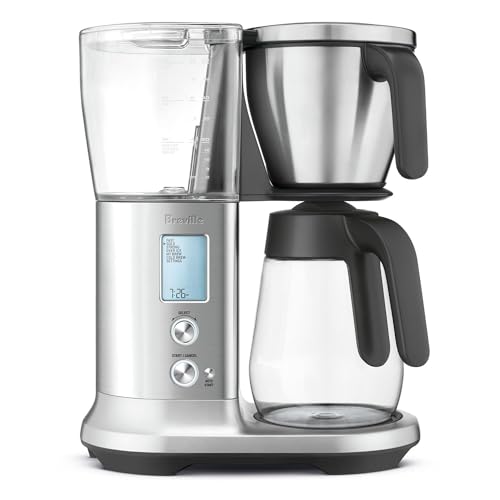
Breville Precision Brewer BDC400 — Best Programmable and Customisable
Where the Moccamaster removes decisions, the Precision Brewer organises them. Its Gold Cup preset brews to the recognised specialty standard automatically, but the machine’s real identity is its custom mode: bloom time, flow rate and water temperature are all adjustable, so the same brewer can be tuned for a light roast that wants heat and patience or a dark roast that wants neither. It adds a genuine cold brew programme and, with an adapter, pour-over brewing — three coffee disciplines in one counter footprint.
Strengths
- Real control over temperature, bloom and flow
- Gold Cup preset for one-touch specialty-standard coffee
- Cold brew and pour-over versatility in one machine
Trade-offs
- Premium tier and a large footprint
- Customisation wasted on set-and-forget users
- More to learn than any other pick here
| Specification | Detail |
|---|---|
| Modes | Gold Cup preset, custom My Brew settings, cold brew, pour-over capable |
| Controls | Adjustable bloom time, flow rate and brew temperature |
| Capacity | 12-cup class thermal carafe format |
For the household that treats coffee as a hobby with a daily habit attached, this is the most interesting machine in the guide. The thermal carafe keeps the results at temperature, the build quality matches Breville’s premium positioning, and the customisation is real engineering rather than a menu of gimmicks — each control changes something a taster can find in the cup.
The costs are the premium tier, a footprint that needs measuring, and the paradox of choice: owners who never leave the Gold Cup preset have paid for a laboratory and used a button. Buy it if you will genuinely tune it — or if your household spans cold brew summers and drip winters and wants one machine for both. Otherwise the Bonavita delivers the preset experience for considerably less commitment.
Best for: enthusiasts who will actually tune their brewing / Not suited for: households that want one button and no decisions
Check on Amazon — check the current price on Amazon before you buy, because configurations and bundle options change over time.

Ninja CE251 Programmable Brewer 12-Cup — Best Budget 12-Cup
Most households do not need a laboratory or an heirloom; they need twelve cups, ready at seven, tasting like coffee. The Ninja CE251 is this guide’s answer at the budget end of the mainstream: fully programmable for the wake-up pot, a small-batch function that brews one to four cups properly instead of running a full cycle for a mug’s worth, and a warming plate with adjustable settings that keeps coffee hot without immediately scorching it — the detail that separates competent budget brewers from the ones that give the tier its reputation.
Strengths
- Programmable 12 cups with a proper small-batch mode
- Adjustable warming plate avoids the worst scorching
- Removable reservoir and guest-proof controls
Trade-offs
- Glass carafe coffee still stews if left for hours
- Plastic-forward build
- Cannot match the top picks’ clarity in the cup
| Specification | Detail |
|---|---|
| Capacity | 12 cups, glass carafe |
| Functions | Programmable start, small-batch (1–4 cup) mode |
| Extras | Adjustable warming plate, removable water reservoir |
Practical touches accumulate in its favour: a removable water reservoir that fills at the sink instead of by jug-and-prayer, a mid-brew pause for the impatient first cup, and controls a guest can run. In blind family service — school mornings, weekend in-laws — it simply does the job, and its coffee, fed with decent beans, is better than its tier suggests because Ninja sweats extraction basics like showerhead coverage.
The ceiling is the tier’s usual one: a glass carafe on a plate will still stew coffee left for hours, the build is plastic-forward, and it will not produce the Moccamaster’s clarity no matter what beans you feed it. But as the family workhorse bought without drama, it is the pick we recommend most often to the most people — which is its own kind of best.
Best for: families who need a programmable pot every morning / Not suited for: small households that brew a few cups at a time
Check on Amazon — check the current price on Amazon before you buy, because configurations and bundle options change over time.

Cuisinart PerfecTemp 14-Cup Coffee Maker DCC-3200 — Best for Big Households
Some households run coffee like a utility: the pot brews at six, empties by eight, brews again. The DCC-3200 is built for that house. Fourteen cups is the largest capacity in this guide, the strength control lets the household dial its default from regular to bold without changing beans, and Cuisinart’s PerfecTemp engineering addresses the classic complaint about big brewers — coffee that is not hot enough — with a heating system designed to deliver and hold a properly hot pot.
Strengths
- Largest capacity in this guide — 14 cups
- Strength control and properly hot brewing
- Complete mainstream feature set, no surprises
Trade-offs
- Big footprint on the counter
- Held coffee declines on the plate like all glass carafes
- Extraction finesse below the SCA-certified picks
| Specification | Detail |
|---|---|
| Capacity | 14 cups, glass carafe |
| Controls | Brew strength control, programmable, 1–4 cup setting |
| Extras | Brew Pause, adjustable carafe temperature |
The supporting cast is complete: full programmability, a 1–4 cup setting for small brews that adjusts the cycle rather than just running less water through a big basket, brew pause for the first-cup thief in every family, and an adjustable carafe temperature so the plate can be set to the household’s patience level. It is a mainstream machine executed by the brand that has made more of them than anyone, and it shows in the absence of surprises.
Its trade-offs are the big-glass-carafe standards: coffee held for hours on any plate declines, the footprint is the largest here, and its extraction finesse sits a class below the certified top picks. In a house that drinks fourteen cups before the pot can stew, none of that matters — throughput and temperature are the spec, and this is the machine that delivers both.
Best for: big households and all-morning coffee drinkers / Not suited for: one-or-two-cup households, who should buy smaller
Check on Amazon — check the current price on Amazon before you buy, because configurations and bundle options change over time.

OXO Brew 8-Cup Coffee Maker — Best Compact SCA Brewer
The OXO Brew 8-Cup solves the space problem without surrendering the standard. It is SCA certified — the same independent temperature-and-extraction benchmark as the Bonavita — yet it is sized for real kitchens, and it adds a trick neither certified rival offers: a single-serve mode that brews a smaller amount directly for one drinker, properly, rather than running a stunted pot cycle. Households of one or two who occasionally host get both machines in one footprint.
Strengths
- SCA-certified brewing in a compact body
- Genuine single-serve mode plus a thermal carafe
- Small-kitchen friendly in size and upkeep
Trade-offs
- 8-cup ceiling for entertaining
- Single serve is basket-brewed, not instant
- Premium for its capacity class
| Specification | Detail |
|---|---|
| Capacity | 8-cup thermal carafe plus single-serve brewing |
| Certification | SCA Certified Home Brewer |
| Carafe | Thermal, stainless steel |
The thermal carafe keeps full pots honest, the interface follows OXO’s house style of saying one thing per control, and the whole machine wipes down and fits under cabinets the way appliances in small homes must. Paired with OXO’s own grinder from our grinder guides, it makes a matched, compact, certified station that a studio apartment can hold and a coffee snob can respect — a rare overlap.
Eight cups remains eight cups: this is not the machine for the fourteen-cup household, and its single-serve mode, while good, is a drip brewer’s single serve — a mug brewed through the basket — not a pod machine’s instant gratification. Within its brief of compact, certified, flexible, it has no serious rival in this guide.
Best for: small households and kitchens short on counter space / Not suited for: large families who brew by the gallon
Check on Amazon — check the current price on Amazon before you buy, because configurations and bundle options change over time.
Comparison Table
| Pick | Badge | Key spec | Best for |
|---|---|---|---|
| Technivorm Moccamaster KBGV Select 10-Cup | Best Overall | 10-cup (40 oz / 1.25 L), copper heating element, 9-hole showerhead, repairable build | households that want the best drip coffee and keep appliances for years |
| Bonavita 8-Cup Coffee Maker BV1901TS | Best Value for Serious Coffee | 8-cup, SCA certified, thermal carafe, pre-infusion mode, one-touch brew | coffee-serious households that brew one pot at a time |
| Breville Precision Brewer BDC400 | Best Programmable and Customisable | Customisable temperature, bloom and flow; Gold Cup preset; cold brew mode | enthusiasts who will actually tune their brewing |
| Ninja CE251 Programmable Brewer 12-Cup | Best Budget 12-Cup | 12-cup glass carafe, programmable, small-batch function, adjustable warming plate | families who need a programmable pot every morning |
| Cuisinart PerfecTemp 14-Cup Coffee Maker DCC-3200 | Best for Big Households | 14-cup glass carafe, brew strength control, programmable, hotter coffee design | big households and all-morning coffee drinkers |
| OXO Brew 8-Cup Coffee Maker | Best Compact SCA Brewer | 8-cup thermal carafe, SCA certified, single-serve option, compact footprint | small households and kitchens short on counter space |
How do you choose between the best coffee makers for your household?
Run three filters in order. First, capacity: count the cups your household drinks in the machine’s busiest hour, remembering that a coffee-maker ‘cup’ is roughly five to six ounces — a ’12-cup’ pot is about eight real mugs. Buy the size that covers that hour without a second cycle, and no bigger, because oversized machines brew small amounts badly. Second, rhythm: if coffee is drunk in one morning round, a glass carafe on a plate is fine; if a pot is sipped across three hours, thermal is the only honest choice. Third, temperament: decide whether your household is a press-one-button household or a tune-the-brew household, and do not buy the other kind — the Precision Brewer’s laboratory and the Moccamaster’s single switch are both perfect, for opposite people.
- Capacity first — match the busiest hour, not the average day.
- Carafe by rhythm — glass for rounds drunk quickly, thermal for pots that linger.
- Features by temperament — programmability for schedulers, simplicity for purists, customisation for hobbyists.
- Horizon last — a five-year budget machine and a twenty-year heirloom can both be right, for different buyers.
Apply those filters and the six picks sort themselves: most households reading this guide will land on exactly one machine whose badge describes their kitchen, which is exactly how a shortlist is supposed to work.
What temperature should a coffee maker brew at — and why does it matter?
Coffee extracts properly in a narrow band of water temperature, roughly 195 to 205 degrees Fahrenheit — the window the SCA’s Golden Cup standard is built around, and the reason ‘200 degrees’ appears in so many coffee searches. Below the band, extraction stalls and the cup turns sour and thin no matter how good the beans; above it, bitter compounds flood in. The tragedy of cheap brewers is not that they brew slightly cool — it is that they swing: too cool at the start, spiking at the end, extracting unevenly in both directions within a single pot.
This is the engineering the top of this guide is paying for. The Moccamaster’s copper element, the Bonavita’s and OXO’s certified heaters, hold the band steadily for the whole cycle, which is why their coffee tastes sweeter from the same beans. When you read ‘SCA Certified’ on the Bonavita and OXO picks, that is the claim being certified — temperature discipline, verified by a third party rather than asserted by a brochure.
You can taste your own machine’s discipline without instruments: brew the same beans, same dose, twice. If the second pot — made when the machine is fully hot — tastes noticeably better than the first, your brewer’s warm-up swing is real, and one of the certified picks is your upgrade. Our dedicated guide to brewers that hold this temperature band is linked at the end for readers who want to go deeper.
Thermal carafe or glass carafe — which should you buy?
A hot plate is a slow cooker for coffee. It holds temperature by continuing to apply heat, and heat keeps extracting and breaking down the brew — a glass-carafe pot is at its best in its first half hour and in honest decline by its second hour. A thermal carafe applies no heat at all; it simply insulates, so the coffee cools very slowly without cooking, and hour-two coffee tastes like hour-one coffee, slightly less hot. For any household where a pot lives longer than a single round of cups, thermal is the quality choice, full stop — which is why three of our six picks, including both certified value options, use it.
Glass keeps two advantages: you can see how much coffee remains at a glance, and glass carafes are cheaper to replace when — not if — one eventually meets the sink. Thermal carafes ask for a rinse-and-air-dry routine and hide their contents. Households that brew and finish, brew and finish, give up nothing with glass and gain the visibility; households that brew once and sip all morning should not consider glass at all.
A hybrid habit worth stealing from cafés: brew into whichever carafe you own, then decant into a preheated thermal server for the table or desk. It rescues glass-carafe machines from their one structural flaw for the price of a simple vacuum jug.
What else decides coffee quality besides the machine?
Beans first: fresh, whole, and ground just before brewing — the single largest variable in the cup, ahead of any machine in this guide. A mid-tier brewer with fresh-ground beans beats a flagship brewer on pre-ground every day of the week, which is why our grinder guides exist and why we link them below. Buy beans in quantities your household finishes within a few weeks and store them sealed, away from heat and light.
Water second: if your tap water tastes of chlorine, so will your coffee, and a simple carbon filter — in a jug or in machines that include one — removes the problem for pennies. Scale third: mineral build-up slows and cools any brewer over months, quietly moving it out of the temperature band it was bought for. A descale cycle on a calendar rhythm, matched to your water’s hardness, is the maintenance that keeps a good machine good.
Dose last, and it is the variable owners most often get wrong by eye: roughly two tablespoons of coffee per six ounces of water is the starting point, weighed once and then repeated faithfully by your grinder’s timer. Machine, beans, water, dose — in that order of purchase, and in the reverse order of daily attention.
How long should a coffee maker last — and what shortens its life?
A coffee maker’s lifespan is decided less by its price than by its water and its design. Scale is the great killer: it insulates heating elements until they overheat, slows flow until brews under-extract, and eventually stops machines entirely — and it is entirely preventable with the descale rhythm from our guide. The second killer is thermal stress on plastic and seals in machines run multiple times daily at the budget end, which is a duty question: a light-duty machine in a fourteen-cup household is being asked to live a life it was not built for, and it will decline the assignment within a few years.
Design decides what happens at the first failure. The Moccamaster’s serviceable build and parts availability turn failures into repairs; sealed budget machines turn them into replacements. Neither is automatically wrong — a budget machine replaced twice in a decade can still cost less than one heirloom — but the buyer should know which game they are playing before the first pot, not at the first breakdown.
Realistic expectations: budget family brewers serve three to five hard years; mid-tier certified machines five to ten; the Moccamaster class, maintained, measures in decades. Match the machine’s design life to your household’s volume and the economics of this guide’s tiers fall into place.
Should you buy a coffee maker with a built-in grinder instead?
It is the obvious neighbouring question, and the honest answer is: for convenience-led households, often yes; for quality-led ones, usually no. A grind-and-brew machine guarantees fresh grinding with zero extra steps, which is why our office guide recommends the format for shared kitchens where a separate grinder would be neglected. The compromise is that the grinder inside a combo is rarely the equal of the better standalone burr grinders, and the combo’s cleaning burden is higher than either appliance alone.
The separate route — any brewer in this guide plus any grinder in our grinder guides — wins on grind quality, on repairability (each half can be serviced or replaced independently), and on upgrade path. It loses on counter space, on steps, and on the discipline a two-appliance routine demands at 6 a.m. Neither answer is a verdict on the other; they are optimised for different households, and this guide’s final recommendation will point you to the right door for yours.
A useful tiebreaker: if more than two people will use the station, or if it lives in an office, choose the combo. If it is your kitchen and your ritual, choose the pair.
Drip, single-serve, espresso — which coffee maker type should a household actually own?
This guide covers automatic drip, because drip is the format that serves households: a pot, brewed well, at a per-cup cost nothing else approaches, from beans any supermarket sells. But readers choosing a household’s one machine should hear the honest comparison. Single-serve pod machines win on speed and per-person variety and lose on per-cup cost, waste and cup quality; they suit households where nobody drinks the same coffee at the same time. Espresso machines win on intensity and milk drinks and demand the most skill, maintenance and budget of any format; they are a hobby that makes coffee, not an appliance that happens to.
Many mature coffee households end up with drip as the foundation and one satellite — a small espresso machine for weekends, a pod brewer for a teenager’s schedule. If you are buying the foundation, buy it from this guide and buy it well: it will make ninety percent of the coffee your house drinks. If you are buying the satellite first because it is more exciting, expect to return for the foundation within the year, slightly poorer and much wiser about which machine a household actually runs on.
French presses, pour-over cones and moka pots cost little and brew beautifully, but they are manual methods, not coffee makers in the sense this guide means — appliances that brew while you do something else. They make excellent companions to any pick here and poor replacements for one in a busy house.
How to Set Up a New Coffee Maker for the Best First Pot
Twenty minutes of setup decides whether a new machine impresses or disappoints:
- Run one or two full cycles of plain water before the first coffee, to flush manufacturing residues from the tank, lines and carafe.
- If your water is hard or chlorinated, fill with filtered water from the start — the first pot sets the household’s opinion, so give the machine its best chance.
- Weigh the first dose rather than scooping it: roughly two tablespoons per six ounces of water, then adjust by taste over the next pots, one change at a time.
- Preheat a thermal carafe with hot water while the machine warms — a cold carafe steals the first pot’s heat.
- Taste the first pot critically and note the one adjustment it wants. Write the winning dose and settings on a card kept with the beans.
- Put the descale date in the calendar now, set by your water hardness — future-you will not remember to do it later.
After setup, resist re-tuning for a week. Beans vary slightly bag to bag and palates vary day to day; a machine judged across a settled week is judged fairly, and most ‘disappointing’ new brewers are actually unsettled routines wearing the machine’s face. Give the routine the week, keep the notes honestly, and the machine you are left with at the end of it is the machine you actually bought.
Common Buying Mistakes
The most expensive mistake in this category is buying capacity you do not need: a 14-cup machine brewing four cups extracts poorly, wastes coffee, and teaches the household that the machine is mediocre — when the mismatch, not the machine, is the problem. The second is its mirror: a beautiful 8-cup certified brewer in a house that entertains twelve, condemned to double cycles and lukewarm second pots.
- Feeding a new premium machine stale pre-ground coffee and concluding the machine is overrated.
- Ignoring the descale calendar until the machine slows — by then the brew temperature has been wrong for months.
- Leaving coffee on a hot plate for hours, then blaming the brewer for the taste of cooked coffee.
- Comparing machines by feature count rather than by temperature discipline, the one specification that decides the cup.
Finally, do not buy a coffee maker as a gift by badge alone. The Moccamaster is a magnificent present for a purist and a baffling one for a scheduler who wanted a timer. In this category, fit is the gift — buy the machine that matches the mornings of the person who will actually stand in front of it, half awake, trusting it with the first decision of their day.
Final Recommendation
If the budget reaches and your household brews a pot at a time, buy the Technivorm Moccamaster — it is the best drip coffee maker here and the last one most owners buy. If it does not reach, the Bonavita BV1901TS delivers most of its cup quality at the mid tier and is this guide’s value summit. The OXO Brew 8-Cup is the compact certified answer, the Breville Precision Brewer the enthusiast’s laboratory, the Ninja CE251 the programmable family workhorse, and the Cuisinart DCC-3200 the big household’s bruiser. There is no wrong door in that list — only wrong matches, and the badges exist to prevent them.
Whichever machine lands on your counter, pair it with fresh beans and a burr grinder, filter the water if it needs it, and descale on schedule. Do those four things faithfully and any pick on this page will make the best coffee your kitchen has ever produced.
Go deeper with the specialist guides: Best Coffee Makers 200 Degrees for the temperature-focused shortlist, Best Coffee Grinder For Drip Coffee Makers for the other half of the station, Best Coffee Grinder And Coffee Makers For Office for shared kitchens, and Best Coffee Makers Accessories for the kit that completes the setup.
To recap the shortlist with links in one place: Technivorm Moccamaster KBGV Select 10-Cup, Bonavita 8-Cup Coffee Maker BV1901TS, Breville Precision Brewer BDC400, Ninja CE251 Programmable Brewer 12-Cup, Cuisinart PerfecTemp 14-Cup Coffee Maker DCC-3200, OXO Brew 8-Cup Coffee Maker. Check price on Amazon for the one that matches your needs, and re-read its review above if you are torn between two badges.
One last practical note: availability and configurations change on Amazon without notice, so confirm the exact variant you want on the product page before ordering. The reasoning behind every badge above, though, does not change — each pick earned its place on the criteria in this guide, and those criteria are the ones your own shortlist should be judged by too.
Frequently Asked Questions
What is the best coffee maker overall?
For drip coffee quality and longevity, the Technivorm Moccamaster KBGV Select: it holds brew temperature with unmatched discipline, brews fast, and is built to be repaired for decades. For most budgets, the SCA-certified Bonavita BV1901TS is the smarter buy — most of the cup quality at the mid tier.
What does SCA certified mean on a coffee maker?
It means the Specialty Coffee Association has independently verified that the brewer meets its Golden Cup standards — principally brewing water held in the proper temperature band, around 195–205 degrees Fahrenheit, with even extraction. It is the most meaningful quality badge in this category because a third party measured it.
How many cups do I need in a coffee maker?
Count real mugs in your busiest hour and remember a coffee-maker cup is five to six ounces: a 12-cup pot is about eight mugs. Couples and small households suit 8–10 cup machines; families and entertainers should look at 12–14. Buying far beyond your busiest hour makes small brews worse, not better.
Is a thermal carafe better than a glass carafe?
For coffee that sits, yes: thermal carafes hold temperature by insulation, so the coffee does not cook the way it does on a hot plate. Glass wins on visibility and replacement cost, and is fine for households that brew and finish a pot in one round.
Do I need a programmable coffee maker?
Only if your mornings need coffee waiting at a set time — in which case it is not a luxury but the feature the purchase turns on, and the Ninja and Cuisinart picks serve it well. If you brew when you wake, programmability buys you nothing and the simpler certified machines spend the money on brewing instead.
How often should I descale my coffee maker?
On a rhythm set by your water: roughly monthly in hard-water areas, quarterly in soft ones, and whenever the brew slows or the coffee turns sour despite fresh beans. Descaling is what keeps a brewer in its proper temperature band across its life — skip it and even the best machine drifts out of tune.
What is the best coffee maker for a small kitchen?
The OXO Brew 8-Cup: SCA-certified brewing, a thermal carafe and a genuine single-serve mode in the smallest footprint of our certified picks. If even that is too much machine, a compact 5-cup brewer from a reputable maker beats a full-size machine that has to be dragged out of a cupboard — the best coffee maker is always the one that stays set up and gets used.


