Disclosure: airfryerkitchensupply.com is reader-supported. When you buy through links on our site, we may earn an affiliate commission at no extra cost to you.
Where to buy
Every grill in this guide to the best coal fired grills was verified against Amazon listings before it earned a place here, so the links below lead to the exact models reviewed. Prices move with seasons and promotions, so we never print a fixed price in the article — check price on Amazon on the product page for the current figure. The shortlist:
- Best Overall Coal-Fired Grill: Kamado Joe Classic Joe I Ceramic Charcoal Grill, 18-Inch — check price on Amazon
- Best Coal-Fired Kettle: Weber Original Kettle Premium Charcoal Grill, 22-Inch — check price on Amazon
- Best Coal-Fired Grill for Precision: PK Grills PK360 Cast Aluminum Charcoal Grill (Graphite) — check price on Amazon
- Best Dual-Chamber Coal-Fired Grill: Dyna-Glo X-Large Premium Dual Chamber Charcoal Grill (DGN576SNC-D) — check price on Amazon
- Best Value Coal-Fired Kamado: Char-Griller AKORN Kamado Charcoal Grill and Smoker, 20-Inch — check price on Amazon
- Best Portable Coal-Fired Grill: Weber Jumbo Joe Charcoal Grill, 18-Inch — check price on Amazon
Coal-fired grilling is cooking in its oldest form: a bed of glowing charcoal, air fed from below, food transformed by radiant heat and smoke. The best coal fired grills are the ones that give that ancient fire modern manners — controlled airflow, heat held or reflected where it helps, ash managed cleanly, and a lid that turns raw heat into an even cooking environment. This guide verifies six coal-fired grills across ceramic, kettle, capsule, dual-chamber and portable designs, and explains which fire each one runs best.
What separates coal-fired from gas or electric is not nostalgia; it is chemistry and heat quality. Charcoal burns hotter than most gas burners can manage, produces the infrared-rich radiant heat that sears crusts properly, and generates the combustion compounds that create grilled flavour. In exchange it asks skill: you build the fire, you set its air, you read its coals. The grills here differ in how much they help with that work — ceramic and insulation forgive, capsules focus, kettles balance, and portables prioritise the journey.
Terminology, briefly: coal-fired in this context means charcoal-fired. Lump charcoal and natural briquettes are the fuels; mineral coal is never a cooking fuel. Within charcoal, lump gives hotter, cleaner, faster-responding fires, while briquettes give steadier, longer, more predictable ones. Every grill in this guide burns both, though kamados show a preference for lump, and your choice of fuel will shape your experience as much as your choice of grill.
In this guide
Quick Picks
If you are short on time, these are the best coal fired grills worth your money, at a glance. Each pick carries a badge for the job it does best, and the same badge appears again in its full review further down so you can jump straight to the detail.
Kamado Joe Classic Joe I Ceramic Charcoal Grill, 18-Inch — Best Overall Coal-Fired Grill
Classic ceramic kamado on a cart — the coal-fired benchmark for heat retention and range. Check price on Amazon.
Weber Original Kettle Premium Charcoal Grill, 22-Inch — Best Coal-Fired Kettle
22-inch kettle with thermometer and One-Touch ash system — the versatile coal-fired standard. Check price on Amazon.
PK Grills PK360 Cast Aluminum Charcoal Grill (Graphite) — Best Coal-Fired Grill for Precision
Graphite cast aluminum capsule — reflected, even heat and fine vent control over coals. Check price on Amazon.
Dyna-Glo X-Large Premium Dual Chamber Charcoal Grill (DGN576SNC-D) — Best Dual-Chamber Coal-Fired Grill
Two chambers, two fires — sear in one, hold or roast in the other, simultaneously. Check price on Amazon.
Char-Griller AKORN Kamado Charcoal Grill and Smoker, 20-Inch — Best Value Coal-Fired Kamado
Insulated steel kamado — coal-fired range from low smoking to hard searing, at a value tier. Check price on Amazon.
Weber Jumbo Joe Charcoal Grill, 18-Inch — Best Portable Coal-Fired Grill
18-inch travel kettle with locking lid — family-sized coal cooking that goes anywhere. Check price on Amazon.
How These Picks Were Chosen
Each grill here passed Amazon listing data verification: searched by brand and model on this site’s own provider account, with the ASIN recorded only where the API’s returned title matched the intended product exactly. Coal-fired grills attract many lookalike listings and regional variants; the ones that could not be confirmed cleanly were excluded rather than approximated.
Judging then followed the fire. Heat quality came first — how the body material and shape treat the coals’ energy: ceramic storing it, aluminum reflecting it, steel containing it. Air control came second, because a coal fire is only as good as its vents. We weighed temperature range (the span from gentle smoking to fierce searing a single load can cover), then the practicalities: ash systems, lid and grate quality, mobility, and parts support. Value was assessed as range and longevity per tier, not as cheapness. The six picks map the category’s real diversity, so a reader can choose a philosophy of fire, not just a product.
The 6 Best Coal Fired Grills
Badges mark each grill’s coal-fired specialty. Note the materials story running through the reviews — ceramic, aluminum, insulated steel, plain steel — because in coal-fired cooking the body is not packaging; it is half the cooking system.

Kamado Joe Classic Joe I Ceramic Charcoal Grill, 18-Inch — Best Overall Coal-Fired Grill
Coal-fired cooking reaches its highest form in ceramic: the fire’s heat soaks into the walls and returns as an even, enveloping cooking environment that no thin metal can imitate. The original Classic Joe delivers that experience on a cart with shelves, in the iconic red, at the friendlier end of the ceramic tier. For the buyer who wants the definitive coal-fired grill rather than an approximation of one, this is the pick.
The original Classic Joe remains a compelling way into ceramic cooking: the same thick-walled 18-inch ceramic platform, on a cart with side shelves, that built Kamado Joe’s reputation. The cooking physics are identical to pricier generations — soak the ceramic with heat and it repays you with stability, efficiency and that enclosed, moisture-friendly environment that makes roast chicken and low-and-slow barbecue so reliable.
Choosing the Series I over the Series II is a hardware-generations decision, not a cooking-results decision. You accept earlier hinge and vent hardware in exchange for a friendlier entry into the ceramic tier, and for many buyers that is the smart trade. It still sears fiercely, still holds a low fire for hours on modest lump charcoal, and still demands the kamado disciplines: light less fuel than you think, move vents in small steps, and let the ceramic settle. If your heart is set on coal-fired ceramic cooking, this is a thoroughly proven place to start.
Strengths
- Same ceramic cooking character as the Series II at a typically friendlier tier
- Cart and shelves included, so it works as a full station out of the box
- Superb heat retention for long, fuel-efficient cooks
Trade-offs
- Earlier-generation hardware compared with Series II refinements
- Heavy ceramic body needs a permanent, level home
- Premium category purchase even as the value option in its line
| Format | 18-inch ceramic kamado on cart (per Amazon listing title) |
| Included per listing title | cart, side shelves, grill gripper |
| Fuel | charcoal |
Best for: Buyers wanting proven ceramic kamado cooking as the value entry to the range / Not suited for: Buyers who want the newest hinge and vent hardware generation.
Check on Amazon — check the current price on Amazon before you decide, as grill pricing shifts through the season.

Weber Original Kettle Premium Charcoal Grill, 22-Inch — Best Coal-Fired Kettle
If the kamado is the specialist, the kettle is the coal-fired everyman — and the Premium is its best-equipped form. A banked fire, a lid thermometer to watch the dome, and ash swept neatly away: everything about it supports the daily craft of cooking over coals. Households that grill, roast and occasionally smoke, all over real charcoal, will find this the most flexible coal-fired tool here.
The 22-inch Kettle Premium is the reference point every other charcoal grill gets measured against, and that status is earned rather than inherited. The deep porcelain-enameled bowl holds a full chimney of briquettes or lump with room to bank coals to one side, which gives you a genuine two-zone fire: a screaming-hot searing side and a cooler indirect side where food can finish without scorching. Airflow is controlled from the lid damper and the One-Touch ash sweep at the base, and once you learn how small movements change the temperature, the kettle holds a cooking range patiently for hours.
What separates the Premium from the basic kettle is the handful of details you feel on every cook. The lid thermometer gives you a fast sanity check before you lift the lid, the ash catcher keeps cleanup contained instead of blowing across the patio, and the overall fit of lid to bowl is tight enough that cooks are repeatable from one weekend to the next. It grills burgers and steaks confidently, roasts whole chickens indirectly, and with a water pan and a snake of briquettes it can even hold a low smoking session. It is not a specialist tool, and that is exactly the point: one grill that teaches you fire management properly and never really becomes obsolete.
Strengths
- Proven kettle shape that runs steady two-zone fires with very little fuss
- Built-in lid thermometer and hinged-style convenience make mid-cook checks simple
- Huge owner community, so techniques, parts and accessories are easy to find
Trade-offs
- No factory work table, so you need a side surface for trays and tools
- Stock grate is plated steel rather than cast iron, so sear marks are lighter
- Two wheels and a handle leg mean it rolls well but can feel tippy on rough ground
| Format | 22-inch kettle, charcoal fuel only |
| Lid thermometer | built in (per Amazon listing title) |
| Ash handling | One-Touch cleaning system (per Amazon listing title) |
| Heat control | adjustable dampers (per Amazon listing title) |
Best for: Most households wanting one charcoal grill that grills, roasts and lightly smokes well / Not suited for: Anyone who needs a built-in prep table or a very large single-zone cooking surface.
Check on Amazon — check the current price on Amazon before you decide, as grill pricing shifts through the season.

PK Grills PK360 Cast Aluminum Charcoal Grill (Graphite) — Best Coal-Fired Grill for Precision
Precision is an unusual promise in coal-fired cooking, where the fuel itself is gloriously analog — but the PK360’s capsule makes it real. Aluminum reflects the coals’ heat evenly across the grate, and the vent system meters air in fine steps, so the fire does what you decided rather than what it felt like. Cooks who treat charcoal as an instrument, not just a fuel, gravitate here.
The graphite PK360 brings the same cast aluminum capsule that competition cooks trust, in the darker finish many buyers prefer. The cooking story is unchanged and it is a good one: aluminum walls reflect heat for remarkable evenness, the capsule shape rolls hot air over food gently for indirect roasting, and the vent system lets you steer both temperature and smoke with small, deliberate adjustments.
For coal-fired cooking specifically, the PK rewards technique. A bed of briquettes on one side gives a controlled indirect zone for chicken pieces and roasts; a full, vent-open fire delivers a fierce, even sear for steaks and chops. The body cannot rust, travels to events without drama, and holds its value in a way thin-steel grills do not. Choose the finish you like; the cooker underneath is a precision instrument either way.
Strengths
- Graphite finish on the same competition-trusted cast aluminum capsule
- Excellent indirect control for roasting and smoking small loads
- Rust-proof aluminum body for low-maintenance ownership
Trade-offs
- Premium tier pricing
- Focused capacity rather than party size
- Distinct shape and workflow take a cook or two to learn
| Format | cast aluminum charcoal grill and smoker (per Amazon listing title) |
| Portability | described as portable in Amazon listing title |
| Fuel | charcoal |
Best for: Technique-driven cooks wanting a rust-proof precision charcoal grill / Not suited for: Crowd feeding on a budget.
Check on Amazon — check the current price on Amazon before you decide, as grill pricing shifts through the season.
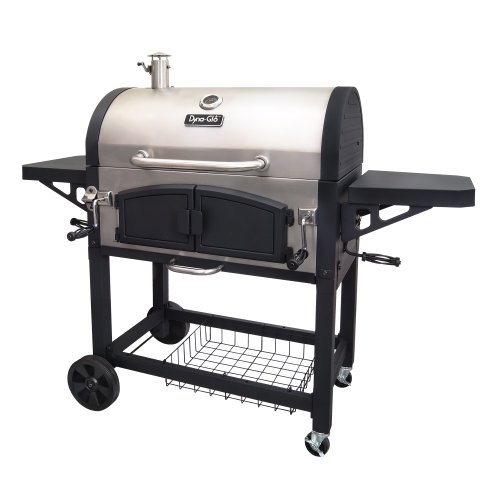
Dyna-Glo X-Large Premium Dual Chamber Charcoal Grill (DGN576SNC-D) — Best Dual-Chamber Coal-Fired Grill
The dual-chamber Dyna-Glo answers a coal-fired problem nobody talks about: everything finishing at once. With two chambers you run a fierce fire for searing in one and a gentle fire for roasting or holding in the other, and a mixed menu stops being a traffic jam. It is a bigger commitment in space and management, and for entertainers who cook varied menus over coals it is worth every inch.
The Dual Chamber Dyna-Glo splits its fire into two zones with their own space, which solves a classic barbecue traffic jam: searing on one side while the other side holds a gentle indirect fire for finishing, holding or vegetables. For households whose barbecues involve mixed menus and staggered timing — chicken finishing while steaks sear, corn holding while burgers cook — that separation is genuinely useful rather than a gimmick.
You pay for it in footprint, assembly and the small discipline of managing two fires when both chambers are lit. Many owners light one side for weeknights and both for parties, which is a sensible rhythm. As a coal-fired platform for people who entertain with varied menus, it offers a flexibility single-chamber grills cannot copy.
Strengths
- Dual chambers let you run two temperatures or two stages at once
- Large total platform for mixed grilling and holding
- Useful for households that cook varied menus simultaneously
Trade-offs
- More lids, seals and parts to keep clean and adjusted
- Takes up significant patio space
- Two fires to manage on full dual-chamber cooks
| Format | X-large dual chamber charcoal grill (per Amazon listing title) |
| Fuel | charcoal |
Best for: Entertainers cooking mixed menus at different temperatures simultaneously / Not suited for: Minimalists wanting the simplest possible grill.
Check on Amazon — check the current price on Amazon before you decide, as grill pricing shifts through the season.

Char-Griller AKORN Kamado Charcoal Grill and Smoker, 20-Inch — Best Value Coal-Fired Kamado
Value in coal-fired grills means range per dollar, and the AKORN’s range is the widest at its tier: insulated walls hold a low fire for hours of smoking, then the same cooker opens up to a searing heat that puts proper crust on steaks. The cast iron grates complete a package that asks only gasket care and vent discipline in return. For the coal-fired enthusiast on a budget, the search starts and often ends here.
The AKORN delivers the kamado experience — one charcoal cooker that smokes low, roasts evenly and sears hard — using triple-wall insulated steel instead of heavy ceramic. That construction is the whole story: it is dramatically lighter and more knock-resistant than ceramic, it heats up efficiently, and it holds a low smoking temperature on a modest load of lump charcoal because so little heat escapes through the walls. The cast iron cooking grates add the searing manners kamado buyers expect.
In daily use the AKORN behaves like a friendly introduction to kamado cooking. Vent control is intuitive, temperature swings settle quickly, and chicken emerges with the kamado signature: juicy meat from the enclosed, humid environment and skin you can crisp by opening the vents at the end. It also shrugs off winter cooking that makes thin-steel grills eat charcoal. Ceramic purists will note the different thermal feel, and the cooker rewards owners who keep the gasket clean and the latches adjusted — small habits that keep low-and-slow sessions boring in the best way.
Strengths
- Insulated steel body holds heat efficiently in cold or windy weather
- Cast iron grates leave proper sear marks and retain heat between batches
- Kamado range covers low smoking temperatures through to fierce searing
Trade-offs
- Steel insulation is efficient but does not match ceramic for multi-day heat soak feel
- Heavier than a kettle, so plan a permanent spot rather than frequent moving
- Gasket and latch care matters for holding low temperatures precisely
| Format | 20-inch kamado, charcoal fuel |
| Construction | triple-wall insulated steel (per Amazon listing title) |
| Grates | cast iron (per Amazon listing title) |
Best for: Buyers wanting kamado versatility for grilling, roasting and smoking without ceramic weight / Not suited for: Purists who specifically want a ceramic kamado body.
Check on Amazon — check the current price on Amazon before you decide, as grill pricing shifts through the season.

Weber Jumbo Joe Charcoal Grill, 18-Inch — Best Portable Coal-Fired Grill
Coal-fired cooking travels well when the grill is designed for it, and the Jumbo Joe is: an 18-inch kettle whose lid locks down for the car, light enough to carry to the campsite, and big enough to cook a family meal when it arrives. It brings real two-zone coal technique on the road — a small banked fire, a cool corner, a lid that finishes food properly — where lesser travel grills only burn things over a tray of coals.
The Jumbo Joe is the travel kettle sized for people who found the 14-inch Smokey Joe just a little too small. At 18 inches the grate takes a family meal of burgers or chicken pieces in one batch, and there is enough depth to bank coals for a small indirect zone — useful for finishing chicken through without burning the skin. The Tuck-N-Carry lid lock keeps the unit sealed for transport, and the whole thing remains light enough to live in a car boot or camper cupboard.
At home it doubles as a sensible small-patio grill for two to four people, sipping charcoal compared with a big kettle. What it will not do is replace a full-size cooker for parties or long smoking sessions; the fire is close to the food and the fuel load is modest by design. Think of it as the largest grill that still counts as portable, and the smallest grill that still counts as a family cooker — a sweet spot many households genuinely live in.
Strengths
- 18-inch grate is a real step up from 14-inch travel grills while staying portable
- Lid lock and light weight suit camping and day-trip cooking
- Enough room for a modest two-zone setup on the road
Trade-offs
- Still a travel grill at heart, with short legs and no work surface
- Capacity tops out well below a full-size 22-inch kettle
- Not built as a low-and-slow smoking machine
| Format | 18-inch portable kettle (per Amazon listing title) |
| Portability | lightweight with Tuck-N-Carry lid lock (per Amazon listing title) |
| Fuel | charcoal |
Best for: Campers and small families wanting one portable grill that still cooks a full meal / Not suited for: Low-and-slow smoking or large gatherings.
Check on Amazon — check the current price on Amazon before you decide, as grill pricing shifts through the season.
Comparison Table
| Pick | Badge | Key spec | Best for |
|---|---|---|---|
| Kamado Joe Classic Joe I Ceramic Charcoal Grill, 18-Inch | Best Overall Coal-Fired Grill | Format: 18-inch ceramic kamado on cart (per Amazon listing title) | Buyers wanting proven ceramic kamado cooking as the value entry to the range |
| Weber Original Kettle Premium Charcoal Grill, 22-Inch | Best Coal-Fired Kettle | Format: 22-inch kettle, charcoal fuel only | Most households wanting one charcoal grill that grills, roasts and lightly smokes well |
| PK Grills PK360 Cast Aluminum Charcoal Grill (Graphite) | Best Coal-Fired Grill for Precision | Format: cast aluminum charcoal grill and smoker (per Amazon listing title) | Technique-driven cooks wanting a rust-proof precision charcoal grill |
| Dyna-Glo X-Large Premium Dual Chamber Charcoal Grill (DGN576SNC-D) | Best Dual-Chamber Coal-Fired Grill | Format: X-large dual chamber charcoal grill (per Amazon listing title) | Entertainers cooking mixed menus at different temperatures simultaneously |
| Char-Griller AKORN Kamado Charcoal Grill and Smoker, 20-Inch | Best Value Coal-Fired Kamado | Format: 20-inch kamado, charcoal fuel | Buyers wanting kamado versatility for grilling, roasting and smoking without ceramic weight |
| Weber Jumbo Joe Charcoal Grill, 18-Inch | Best Portable Coal-Fired Grill | Format: 18-inch portable kettle (per Amazon listing title) | Campers and small families wanting one portable grill that still cooks a full meal |
Choose your material and you have chosen your grill. Ceramic for stored, even heat and range; aluminum for reflected precision; insulated steel for kamado range at value; kettle steel for versatility; dual chambers for simultaneous menus; the travel kettle for the road. The table lines those philosophies up so the decision is about how you cook, not about whose logo is bigger.
How to Choose a Coal-Fired Grill by Body Material
Ceramic is the heat battery. A ceramic kamado absorbs the fire’s energy and re-radiates it evenly for hours, which makes it the most fuel-efficient and stable coal-fired platform, and the most capable across the full temperature range. Its costs are weight, fragility in transit and price. Choose ceramic when the grill will live in one place and cook everything from low-smoked pork to seared steaks.
Cast aluminum is the reflector. It does not store heat like ceramic; it bounces it back at the food, producing remarkable evenness and quick response to vent changes, in a body that cannot rust. Capsule grills exploit this for precision work. Insulated steel is the compromise that works: double or triple walls trap air or insulation to mimic ceramic efficiency at lower weight and cost, with a little less thermal serenity. Plain enamelled steel — the kettle — stores little and reflects little, but its shape, vents and lid make it the most flexible and forgiving platform of all, and the easiest to learn on.
Match material to life, not to status. A grill that travels wants aluminum or light steel. A grill that winters outdoors wants rust-proofing or a good cover habit. A grill that cooks daily wants the material whose maintenance you will actually do. The best coal-fired grill is the one whose body suits your patio, your weather and your patience — the fire inside is the same ancient fire in all of them.
How Hot, How Long, How Steady: Reading a Coal Fire
New coal cooks ask how hot a grill gets; experienced ones ask how steady it is and for how long. Peak heat matters for one job — searing — and every grill here sears. What decides roasts, smokes and whole birds is the middle of the range: can the fire sit calmly at a gentle cooking temperature for an hour, or three, without constant correction? Insulation and thermal mass answer yes most easily, which is why kamados and capsules shine at range work, while kettles achieve it through vent discipline and fuel arrangement — the snake method, the banked fire, the minion-style slow burn.
Fuel arrangement is the skill underneath everything. A full, spread bed is a grilling fire. A banked bed is a two-zone fire. A ring or snake of briquettes is a slow fire that lights itself gradually over hours. A small pile of lump in a kamado is an efficiency fire. The same grill and the same charcoal become four different cookers depending on arrangement, which is why the best investment after any coal-fired grill is not an accessory — it is a few cooks spent learning your grill’s arrangements deliberately, one variable at a time.
Charcoal Storage, Grades and Getting Consistent Fires
Inconsistent fires are usually inconsistent fuel wearing the grill’s name. Charcoal is hygroscopic — it absorbs moisture from the air — and a bag stored in a damp garage will light reluctantly, burn coolly and smoke excessively no matter what grill it lands in. Store charcoal indoors or in a sealed, lidded container, off the floor, and treat a bag that has been rained on as firelighter material rather than cooking fuel. That single habit resolves a surprising share of the complaints filed against perfectly good grills.
Within a bag, sort by size when it matters. Lump charcoal arrives as a mixture of large chunks, medium pieces and fines; the fines choke airflow at the bottom of a kamado firebox and are better screened out for kindling duty, while large chunks are the long-burn foundation of a serious cook. Briquettes are uniform by design, which is their consistency advantage — but they vary by brand and recipe, so find a natural brand you trust and stay with it long enough to learn its burn rate. Switching fuels every cook resets your vent knowledge to zero.
Consistency is ultimately a recording habit. Note the fuel, the load, the vent settings and the weather for cooks that go well, and your grill becomes predictable in the way professionals mean: not identical every day, but understood. A coal-fired grill is an analog instrument, and the player who practises on one fuel, in one setup, is the one who makes it look digital.
Seasoning and Restoring Grill Grates
New grates — and old ones stripped by neglect — cook best after seasoning: heat the clean grate, apply a thin coat of high-heat cooking oil with a folded cloth held in tongs, and let it bake on with the lid down, repeating once or twice. The polymerised layer that forms is the original non-stick, and on cast iron it is also the rust barrier. This is the same care a cast iron skillet receives, because the material and the chemistry are identical.
Restoring a neglected grate starts with honesty about its state. Surface rust on cast iron or steel scrubs away with a stiff brush and heat, followed immediately by seasoning. Flaking porcelain enamel is different — once the coating is shedding into food, the grate is finished and replacement is the safe answer; most grills in this guide have replacement grates available precisely because grates are wear parts. Chrome-plated grates that have rusted through their plating are likewise at end of life.
Ongoing care is measured in seconds: brush the warm grate after cooking, before residue carbonises into cement; oil cast iron lightly before long storage; and never leave a grate sitting in ash and rain, which is the fastest known route to needing this whole section. A coal-fired grill with a sound, seasoned grate cooks like a more expensive grill — because in the only place food touches, it effectively is one.
The Searing Question: How Coal-Fired Grills Brown Food So Well
Browning is chemistry with a deadline. The reactions that create a steak’s crust need a surface that is both hot and dry; moisture is the enemy, because a wet surface spends the fire’s energy boiling water instead of building flavour. Charcoal’s gift to this process is radiant intensity — a glowing bed radiates heat in a way that drives surface drying and browning together, which is why a coal-fired sear has a depth that gentler heat sources struggle to copy. The grill’s job is to hold the food at the right distance from that radiance, on a grate hot enough not to steal the heat back.
This is where the designs in this guide diverge usefully. The kamado concentrates radiance in an enclosed dome and can push grate temperatures to extremes — magnificent for steaks, demanding of attention. The PK capsule reflects radiance evenly, so the crust forms uniformly rather than in stripes of done and raw. The kettle’s direct zone is the classic: fierce over the coals, with the indirect side waiting as the finishing room. Even the little Jumbo Joe sears credibly, because radiant heat does not require size — only proximity and a properly ashed, glowing bed.
The cook’s part is preparation: dry surfaces, patience while the grate heats fully, oil on the food rather than a flooded grate, and the discipline to leave the food alone until the crust releases it. Searing is the coal-fired grill’s party trick, but it is a trick with rules — and every grill here, run by those rules, performs it at a level that explains why cooks keep choosing fire over convenience.
Coal-Fired Cooking Indoors Is Not a Thing — and Other Boundary Lines
Every coal-fired guide owes its readers one clear boundary: charcoal burns outdoors, in open air, full stop. It produces carbon monoxide in quantities that make indoor, garage and tent use genuinely dangerous, and no grill in this guide — however small, however portable — is an exception. The balcony question is a rules question, answered by your building and local codes rather than by enthusiasm; where charcoal is banned, the honest alternatives are the electric grills covered elsewhere in this programme, used with the same two-zone thinking adapted to their gentler heat.
The second boundary is fuel. Coal-fired means charcoal: lump or natural briquettes, lit without petroleum starters in the cooking chamber. Mineral coal, treated timber, painted wood and mystery burnables from the shed have no place under food. The third boundary is the fire’s end: a coal fire is out when it is cold, not when it looks out, and ash waits in metal until that is certain. These lines are not fine print; they are what makes a lifetime of coal-fired cooking a pleasure rather than a statistic.
Within those boundaries, coal-fired cooking is one of the safest and most satisfying ways to cook ever devised — no pressurised fuel, no electrical faults, no moving parts, just fire, air and attention. The grills in this guide were chosen to be cooked on for years by ordinary households, and their safety story is the ordinary one: site them sensibly, tend them while lit, cool them completely, and teach the next cook in the family the same habits by example.
How Coal-Fired Grills Age: What Changes After Fifty Cooks
A coal-fired grill at fifty cooks is a different instrument from the same grill new, and mostly a better one. Interior surfaces carry a seasoned patina that steadies temperatures and scents the smoke faintly with every cook that came before. Vents move with a known resistance. The cook knows — in the hands, not the head — where the hot quadrant sits and how the fire answers on a still day versus a windy one. This is the state grillers mean when they say a cooker is ‘dialled in’, and no purchase can shortcut the fifty cooks it takes to get there.
The honest wear arrives on schedule too. Grates ask for re-seasoning or, at the budget end, replacement. Gaskets on kamados compress and eventually want renewing. Enamel chips where lids met concrete, hinges loosen a fraction, and a steel grill’s firebox shows the map of every hot fire it has held. None of this is failure; it is the maintenance rhythm of a tool that works with fire. The grills in this guide were chosen with parts and covers available, so the fifty-cook service is a pleasure rather than an archaeology project.
What does not change is the fire’s terms: dry fuel, clean ash, small adjustments, patience. A grill ages into its owner’s habits, which is why two identical kettles cook differently in two different gardens. Buy the coal-fired grill whose ageing you want to supervise — ceramic settling in for decades, aluminum shrugging off weather, steel asking for its cover and its oil — and then go and cook the fifty cooks. The instrument you own after them is worth more than the one you bought.
How to Build Three Fires on One Coal Grill
Fire one, the searing fire: a full chimney of lit charcoal spread evenly across the grate, vents fully open, lid off or on only to preheat the grate. This is steak, chops and skewer heat — use it in short, attended bursts. Fire two, the two-zone fire: the same chimney banked to one half of the grill. Sear over the coals, finish beside them, lid down. This is the default fire for chicken, sausages, thick cuts and most family cooking, and the one to master first.
Fire three, the slow fire: arrange unlit briquettes in a snake two or three wide around the edge of the charcoal grate, place a few lit coals at one end, and set the vents to a crack. The snake burns along its length over hours at a gentle temperature — the kettle and barrel method for ribs and roasts. In a kamado, the slow fire is simpler: a modest pile of lump, one lighting point, vents barely open. Whichever grill you own, practise all three fires with inexpensive food before the expensive occasion. Fire craft is learned by repetition, and these three arrangements cover nearly everything coal-fired cooking is asked to do.
Common Buying Mistakes
Treating all charcoal as identical. Lump and briquettes behave differently, and bargain fuel full of fillers behaves worse than both. Fuel quality is a cooking variable — buy the best you can and your grill will suddenly seem better made.
Judging a coal grill by maximum temperature. Searing is one job. Steadiness, range and control decide the other ninety percent of your cooking. A grill that only does fierce is a one-trick fire.
Moving a ceramic grill like a steel one. Ceramic is strong in use and fragile in transit. Site it carefully, move it rarely, and never roll it over rough ground loaded with a hot fire.
Closing vents to ‘save’ a fire you then forget. A choked fire can smoulder for hours. Extinguish deliberately, confirm cold before covering or storing, and treat ash as live until proven otherwise.
Skipping the learning cooks. Every coal grill has hot spots and vent habits. Three deliberate practice cooks teach more than thirty hopeful ones — and they are the difference between owning a grill and knowing one.
Final Recommendation
For the definitive coal-fired experience, the Kamado Joe Classic Joe I is our recommendation: ceramic range and retention at the line’s friendliest tier. The Kettle Premium remains the most flexible answer for mixed households, the PK360 the precision instrument, the AKORN the value kamado, the Dyna-Glo Dual Chamber the entertainer’s two-fire solution, and the Jumbo Joe the coal fire that travels. Choose by material and by the fires you will build most — the coals will do the rest.
Kamado Joe Classic Joe I Ceramic Charcoal Grill, 18-Inch (Best Overall Coal-Fired Grill) Weber Original Kettle Premium Charcoal Grill, 22-Inch (Best Coal-Fired Kettle) PK Grills PK360 Cast Aluminum Charcoal Grill (Graphite) (Best Coal-Fired Grill for Precision) are the three we would start with. Check price on Amazon for each, then commit to the one that matches your space and the way you actually cook.
Related reading on this site: Best Coal Grills; Best Coal Barbecue Grills; Best Charcoal Grills Using Real Charcoal; Best Charcoal Grills; Best Cheapest Grills; Best Charcoal Smoker Grills.
Frequently Asked Questions
What does coal-fired mean for a grill — is it really coal?
In grilling, coal-fired means charcoal-fired: lump charcoal or briquettes made from wood. It never means mineral coal, which is not a food-safe cooking fuel. All six grills in this guide burn charcoal, and the term signals the live-fire, high-radiant-heat style of cooking charcoal produces.
Which coal-fired grill material is best?
Each wins somewhere. Ceramic stores heat for stability and efficiency; cast aluminum reflects it for evenness and cannot rust; insulated steel splits the difference at lower cost; plain enamelled steel in a kettle shape offers the most versatility per dollar. Best depends on whether you value stability, precision, value or flexibility most.
Can a coal-fired grill cook low and slow as well as sear?
The kamados and the PK360 span that full range in one body. Kettles cover it with fuel arrangement — banked fires and snake methods — and barrels handle it with indirect setups. The grills that struggle are shallow, leaky designs, which is why none appear in this guide.
Lump charcoal or briquettes for a coal-fired grill?
Lump for heat, cleanliness and kamados; briquettes for steadiness, long arrangements like the snake, and beginners. Many experienced cooks stock both. What matters most is quality: natural fuel without chemical additives, lit in a chimney, cooked over only once fully ashed.
How long does a coal fire last on one load?
It depends on the grill’s insulation and the fire’s arrangement. Kamados stretch a load furthest, kettles sit in the middle with good vent discipline, and open barrels burn fastest. Slow arrangements like the snake extend burn time dramatically on any platform by lighting fuel gradually.
Are coal-fired grills hard to clean and maintain?
The routine is simple but non-negotiable: brush the grate warm, remove ash only when completely cold into a metal container, keep the body covered, and oil cast iron grates lightly. Ceramic and aluminum bodies ask the least long-term care; plain steel asks for cover discipline to hold its finish.


