Disclosure: airfryerkitchensupply.com is reader-supported. When you buy through links on our site, we may earn an affiliate commission at no extra cost to you.
Key Takeaways
- Learning how to choose a nightstand starts with one measurement: the height of the top of your mattress. The nightstand surface belongs within about two inches of that height, level with it or fractionally above it, never several inches below it.
- Measure the floor space second: width, depth, the swing of drawers and doors, and the gap you need to walk past the bed. A nightstand that fits on paper but blocks a drawer in practice is the wrong nightstand.
- Inventory what actually lives at your bedside before choosing storage. Books, a phone, medication, a glass of water, and a tangle of chargers each point to a different mix of drawers, shelves, and surface.
- Decide the power question early. A built-in charging station tidies cables for some sleepers; a separate power strip you already own does the same job for others, and the furniture itself matters more than the outlet count.
- Check construction the way you would check any furniture you will touch twice a day: stability on the floor, smooth drawer action, honest materials, and a tip-over anchor point for taller pieces, especially in homes with children.
In this guide
How to choose a nightstand: start with your mattress, not the furniture store
If you are working out how to choose a nightstand, resist the natural first move, which is browsing photographs. Nightstands fail in boring, measurable ways far more often than they fail on style: the surface sits four inches below the mattress so you grope downward for your phone in the dark, the drawer cannot open because the bed frame is in the way, or the piece wobbles every time you set down a glass of water. Every one of those failures is predictable before you spend anything, with a tape measure, ten minutes, and an honest list of what you keep beside the bed. This guide walks through the choosing process in the order that prevents mistakes: height first, footprint second, storage third, power fourth, construction fifth, and style last, where it belongs. Style matters, and a nightstand you dislike looking at is its own kind of error, but style is the one attribute you can judge perfectly well from a photograph, while the other five are exactly the ones photographs hide.
A second piece of honesty before the steps: the nightstand market is wide but shallow. At the budget end, many pieces use fabric drawers and engineered frames that are perfectly serviceable for light bedside loads, as long as you buy them knowing that is what they are. In the middle, you find sturdier frames, real drawers, and the charging stations and LED lighting that have become standard bedside features. At the top, solid wood and matched pairs reward buyers who plan to keep the furniture through several mattresses. None of those tiers is the correct one in the abstract. The correct tier is the one whose compromises match your room, your habits, and how long you expect to keep the piece, and the steps below are designed to surface that match before the box arrives.
Step 1: How do you measure mattress height, and why does it rule everything?
Sit on your bed the way you actually sleep in it, with the bedding on and the mattress compressed by your weight, and measure from the floor to the top of the mattress surface. That compressed number, not the showroom thickness printed on a tag, is your reference height. Most bedside surfaces work best level with that measurement or up to roughly two inches above it. Level or slightly high means you reach across and slightly down by instinct, set a glass down without looking, and find the lamp switch without patting the furniture. Several inches low means every reach becomes a small dive, water glasses tip toward the bed, and books slide off the edge. Several inches high creates the opposite problem: you lift items up and over a lip of furniture in the dark, and a tall surface next to a low pillow crowds the sleeper visually and physically.
Write the number down, because it filters the market brutally and usefully. A tall bed on a high frame with a thick mattress can sit well above the surface of a compact nightstand, and no amount of attractive styling fixes a six-inch drop you will feel twice a night for years. Platform beds sit at the other extreme, where a standard-height nightstand can tower. When your bed height is unusual in either direction, shop by the height specification first and let it narrow the field before you look at a single finish. In the shortlist further down, note how deliberately the examples spread: the VASAGLE piece states its full dimensions in its listing, 23.6 by 13.8 by 24.1 inches, which makes the height check a ten-second comparison against your measurement instead of a guess, and listings that state dimensions that plainly deserve the advantage they get.
One refinement for couples: measure both sides. Mattresses are level, but floors are not always, and a bed pushed against a wall on one side and open on the other can present two genuinely different bedside situations. If one side needs a taller or narrower piece than the other, that is not a failure of symmetry; it is the room telling you the truth, and the section on mismatched pairs below covers how to handle it gracefully.
Step 2: How do you measure the footprint without blocking a drawer?
With height settled, measure the rectangle of floor the nightstand may occupy: from the wall to the point where the piece would start crowding your walkway, and from the side of the bed outward to the nearest obstacle, whether that is a door swing, a radiator, a wardrobe door, or the wall itself. Then add the dynamic space furniture needs in use. A drawer extends toward the sleeper, so the bed itself must not sit where the drawer travels. A cabinet door swings through an arc that a laundry basket or a partner’s shin will find if you do not. Even an open shelf needs a hand’s width of honest clearance, or everything you store on it arrives dusty and leaves reluctantly.
Depth is the dimension buyers most often misjudge, because a deep nightstand looks generous in a listing and behaves like a shelf jutting into the room in a small bedroom. Shallow pieces, around the depth of the VASAGLE example above, suit tight rooms precisely because the surface still holds a lamp and a book while the body of the furniture stays out of the traffic path between bed and door. Width works the other way: a wide top is the single most useful luxury at a bedside, because lamps, books, water, and devices all compete for the same flat territory, and a few extra inches of width ends the nightly negotiation. When width and depth fight, as they do in most small rooms, choose width and accept shallowness; you reach across a nightstand far more often than you reach deep into one.
Finally, check the wall behind the piece. You need an outlet reachable for a lamp or charger, skirting boards that may push the furniture an inch off the wall, and, for tall pieces, a stretch of wall you are willing to anchor into. Photograph the space with your measurements written on tape stuck to the wall. That unglamorous photograph, checked against a listing’s stated dimensions, prevents more returns than any amount of review reading.
Step 3: What actually lives at your bedside? Take the inventory honestly
Before choosing storage, empty your current bedside surface and drawers onto the bed and sort what you find into three piles: things used every night, things used weekly, and things that migrated there and never left. The first pile defines the surface and the top drawer. The second defines whether you need a second drawer or a shelf. The third pile is the most valuable, because it tells you what your storage has been failing to organize, and it usually includes the chargers, cables, lip balm, spare glasses, and paperbacks that make bedsides look chaotic in every home. Choose storage for the first two piles and give the third pile a deliberate home, either a small tray or box on the surface or a drawer with dividers, rather than letting it colonize whatever you buy.
Translate the piles into furniture language. Nightly items that must disappear for a calm room, such as medication, earbuds, and a sleep mask, argue for at least one real drawer. Books in active rotation argue for an open shelf, where spines stay visible and reachable, rather than a drawer they will be forgotten in. A water glass argues for surface area and a stable top, ideally with a coaster habit. A laptop or tablet that charges overnight argues for depth and a cable path. Readers of physical books with a lamp habit should protect a corner of the surface for the lamp base and refuse to let charging bricks annex it. This inventory, written down, becomes the checklist you carry into the storage decision in the next step and into the shortlist, where each example is matched to a different inventory profile.
Step 4: Drawers, shelves, or fabric — how do you choose the storage format?
Wood drawers are the reference standard: they hide clutter completely, protect contents from dust, slide thousands of times without complaint in a well-made piece, and carry weight without sagging. Two drawers is the configuration most sleepers settle into, one shallow drawer for nightly smalls and one deeper drawer for books, chargers, and the overflow of bedside life, and it is the arrangement on several shortlist pieces including the LYNCOHOME Fluted Nightstand and the VASAGLE 23.6-inch nightstand. The open-shelf format trades concealment for access and airiness; a drawer over an open shelf, the pattern of the AMERLIFE walnut pair, suits readers and anyone whose bedside items are few and good-looking enough to display.
Fabric drawers deserve a plain explanation rather than either hype or scorn. A fabric drawer is a structured textile box that slides in a frame: light, quiet, inexpensive to ship and assemble, and entirely adequate for clothing, chargers, books, and bedside smalls. It will not carry a stack of hardbacks the way a wood drawer base does, its front can bow if habitually overloaded, and it reads as casual furniture, because it is. For dorms, first apartments, guest rooms, and tight budgets, that trade is often the right one, and pieces like the Furnulem Tall Nightstand, with four fabric drawers stacked in a tall frame, or the Yoobure nightstand, with fabric drawers over a storage shelf, extract remarkable storage volume from the format. The mistake is not buying fabric drawers; the mistake is buying them while expecting wood-drawer behavior, or paying wood-drawer money for them.
Hybrid thinking usually wins. If your inventory showed heavy nightly clutter, weight your choice toward enclosed storage. If it showed books and a lamp and little else, a shelf format keeps the room feeling open and saves you paying for drawers that will store air. And whatever the format, test the count against the inventory: storage you cannot assign to a pile from Step 3 is storage you are buying for a tidier imaginary self, and it will fill with the third pile within a month.
Step 5: Do you need a charging station, and how should bedside power work?
The modern bedside is a small power station whether you plan it or not: a phone, often a watch or earbuds, sometimes a tablet, and a lamp all want electricity within arm’s reach. Built-in charging, typically a pair of USB ports and sometimes outlets set into the top or back of the piece, removes the strip of chargers from the floor and shortens cables to a tidy drop behind the furniture. The VASAGLE, Furnulem, Yoobure, and LYNCOHOME shortlist pieces all integrate charging in some form, which tells you how completely the feature has become the market’s default answer. It is genuinely convenient, and for a single sleeper with two devices it can be the whole solution.
It is not automatically the right solution. Built-in ports charge at whatever rate the manufacturer fitted, which may lag the fast charging your phone supports with its own brick; households with many devices will still outgrow two ports; and a failed built-in outlet is furniture repair, while a failed power strip is a five-minute swap. The honest decision rule: if your nightly device count is two or fewer and cable clutter bothers you, built-in charging earns its place. If you charge a small ecosystem, or you already own a good strip with surge protection, choose the nightstand on furniture merits and route one cable neatly behind it. Either way, plan the cable path before the furniture arrives: outlet position, cable length, and a route that keeps cords off the floor where feet and vacuum cleaners find them. LED accent lighting, fitted to the VASAGLE and Furnulem pieces, belongs in this same conversation; a low glow that lets a partner sleep while you read or find the floor at night is a real quality-of-life feature, provided it can be switched fully off, because a light you cannot extinguish will eventually be a light you tape over.
Step 6: How do you judge construction, stability, and safety before buying?
Furniture listings describe finishes lovingly and construction reluctantly, so learn to read for the tells. Solid wood, as in the leovanni cherry wood pair and the AMERLIFE walnut pair, brings weight, repairability, and drawers that can be waxed back to smoothness in a decade; it also brings a higher tier and, in the leovanni case, the pleasant surprise of no assembly. Engineered wood with a good veneer or laminate is the mid-market workhorse: consistent, stable in humid rooms, and honest value when the frame joinery is sound. Metal-and-fabric frames are the budget architecture, light and quick to assemble, with stability that depends on careful tightening and level floors.
Whatever the material, apply four checks on arrival, during the return window, not after it. First, the wobble test: press down and sideways on the top with the piece empty and loaded; a nightstand that rocks will announce every glass of water for its whole life, and the fix is leveling or tightening now, not coasters forever. Second, drawer action: each drawer should travel its full length without grinding, dropping, or needing a hip check to close. Third, finish honesty: edges and the backs of drawers show manufacturing care more truthfully than the photographed front. Fourth, tip-over safety: tall, narrow pieces, and any nightstand in a child’s room or a home with climbing toddlers, should be anchored to the wall with the strap or bracket provided or a furniture anchor you add. A tall storage piece like the Furnulem earns its footprint partly by going vertical, and vertical furniture near beds where children play is exactly the case anchoring exists for. Treat the anchor as part of assembly, not an optional extra, the same way you would treat a bookcase.
Step 7: How do you match style without falling for the matching-set trap?
Style comes last in this process, but it is not trivial: the nightstand sits at eye level from the pillow, in your first and last sight of the day. The trap to avoid is believing the nightstands must match the bed frame as a purchased set. Rooms assembled from one set on one day tend to look like a showroom photograph and age like one too, all pieces dating together. A more durable approach is coordination on one or two threads only: a shared wood tone family, a shared hardware finish, or a shared silhouette language such as turned legs, fluting, or clean flat fronts. The LYNCOHOME fluted design shows how a single strong texture can carry a piece’s style without needing its neighbors to match it, while the AMERLIFE pair’s turned legs and walnut tone sit comfortably beside traditional and transitional beds alike.
Practical style rules that survive trends: choose the finish in your room’s actual light, because warm evening lamplight shifts pale woods yellow and dark woods nearly black; keep the visual weight proportional, so a massive bed wants nightstands with some presence and a low platform wants pieces that do not loom; and remember the surface styling is yours to change, since a lamp, a small stack of books, and a tray will do more for the bedside’s appearance than any finish upgrade. If two partners want different looks, the mismatched-pair section below turns that disagreement into a method rather than a compromise.
Shortlist: verified nightstands that each teach a different lesson
The six pieces below are the worked examples for this guide. Each was verified, and each illustrates a different branch of the decision tree above, so read them as answers to the steps rather than as a ranking. Where a listing states a specification, it appears in the spec box; where it does not, the box omits it rather than guessing.

VASAGLE 23.6-Inch Nightstand with LED Lights and Charging Station — Best Overall
The VASAGLE is the reference case for Step 2 and Step 5 done together: fully stated dimensions of 23.6 by 13.8 by 24.1 inches, two drawers for the nightly inventory, a charging station for the two-device sleeper, and LED lighting for the partner-asleep scenario. Its shallow depth suits real bedrooms rather than showroom ones. Check the current price on Amazon via the link, and check its 24.1-inch height against your Step 1 measurement before anything else.
- Strengths: dimensions stated plainly for honest measuring; two drawers plus charging plus LED in one footprint; shallow depth fits tight rooms.
- Trade-offs: ink black finish commits the room’s palette; built-in charging caps at two-device households; engineered construction rather than solid wood.
Specs (from listing): 23.6 x 13.8 x 24.1 inches; 2 drawers; LED lights; charging station; Ink Black; CUSTOS Collection.
Best for: most double-occupancy bedrooms wanting one tidy, powered, correctly sized piece / Not suited for: solid-wood purists or beds far from 24 inches at the mattress top.

leovanni Cherry Wood Nightstand, Set of 2 — Best Solid Wood
The leovanni pair is the Step 6 answer: solid cherry wood, two drawers per side, a 22-inch width that gives the surface real working room, and no assembly, which removes the largest variable in furniture satisfaction. A matched pair also settles the symmetry question in one purchase. Check price on Amazon for the pair, and remember a set of two is the unit here, not a per-side price comparison.
- Strengths: solid wood construction that can be maintained for years; no assembly; generous 22-inch width on both sides.
- Trade-offs: farmhouse character will not suit stark modern rooms; a pair is a bigger single commitment than one piece; solid wood is heavy to reposition.
Specs (from listing): set of 2; solid cherry wood; 2 drawers each; 22 inches wide; no assembly required.
Best for: long-term primary bedrooms and buyers who hate flat-pack assembly / Not suited for: renters who move yearly or minimal modern schemes.

Furnulem Tall Nightstand with LED and Charging Station — Best for Small Spaces
The Furnulem demonstrates the vertical answer to Step 2: when the floor rectangle is tiny, storage goes up, here as four fabric drawers over a four-tier storage shelf arrangement, with LED lighting and a charging station with USB ports in the same narrow body. Apply the Step 6 anchor rule to it without exception, and load its fabric drawers by the Step 4 rules, light and bulky rather than heavy and dense.
- Strengths: the most storage volume per inch of floor in this shortlist; charging and LED included; fabric drawers keep the tall piece light.
- Trade-offs: fabric drawers are light-duty by design; tall and narrow demands wall anchoring; the look is functional rather than furniture-fine.
Specs (from listing): tall format; 4 fabric drawers; 4-tier storage shelf; LED; charging station with USB ports; Black Oak.
Best for: dorms, small apartments, and guest corners with almost no floor to spare / Not suited for: heavy book storage or unanchored use around small children.

Yoobure Nightstand with Charging Station — Best Budget
The Yoobure is the honest budget pattern from Step 4: fabric drawers and an open storage shelf in a small footprint, with the charging station, USB ports, and outlets that keep a budget piece from feeling basic at the bedside. It suits the first-apartment inventory perfectly, and its small-space design brief is stated in its own listing rather than discovered after delivery.
- Strengths: charging with ports and outlets at a budget tier; compact footprint for small spaces; shelf plus drawers covers both inventory piles.
- Trade-offs: fabric drawers limit load and lifespan expectations; small surface fills quickly with a lamp added; casual appearance.
Specs (from listing): charging station with USB ports and outlets; fabric drawers; storage shelf; small-space format.
Best for: first apartments, dorms, and guest rooms on a budget / Not suited for: a primary bedroom planned around heirloom furniture.
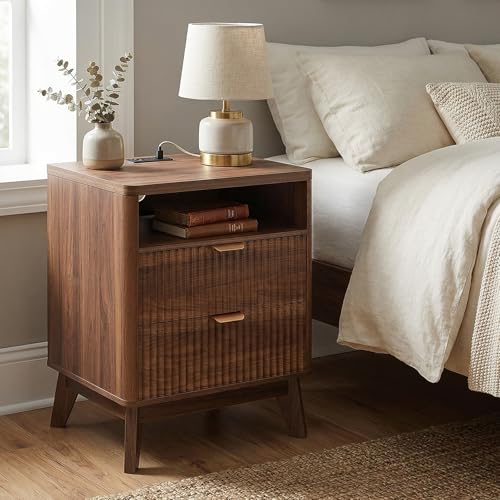
LYNCOHOME Fluted Nightstand with Charging Station — Best Modern Design
The LYNCOHOME shows Step 7 executed well: fluted fronts give a 19.7-inch-wide modern piece its character through texture rather than ornament, two drawers handle the standard inventory, and the charging station keeps the clean look free of cable sprawl. Its moderate width threads the needle for rooms where the VASAGLE’s black is too stark and the leovanni’s farmhouse is too warm.
- Strengths: distinctive fluted texture; two drawers plus charging; a width that fits most bedside gaps.
- Trade-offs: sold as a single piece, so pairs are two purchases; fluting collects dust that flat fronts shed; brown finish narrows palette pairings.
Specs (from listing): 19.7 inches wide; 2 drawers; charging station; fluted fronts; brown; 1 piece.
Best for: modern and transitional primary bedrooms / Not suited for: buyers wanting a matched solid-wood pair in one box.

AMERLIFE Walnut Nightstand, Set of 2 — Best Traditional Pair
The AMERLIFE pair pairs Step 4’s hybrid storage, a drawer over an open shelf, with traditional solid-wood signals: walnut tone, turned legs, and a 20-inch width per side. The open shelf keeps the current book visible, the drawer swallows the clutter, and the pair format keeps both sides of the bed in the same visual language.
- Strengths: solid wood with traditional detailing; drawer-plus-shelf hybrid storage; matched pair simplicity.
- Trade-offs: open shelf shows dust and clutter alike; traditional styling fights ultra-modern beds; assembly is required.
Specs (from listing): set of 2; solid wood, walnut; 20-inch side tables; drawer plus open shelf; turned legs.
Best for: traditional bedrooms and readers who live out of the open shelf / Not suited for: dust-averse minimalists or sharp contemporary schemes.
Reading the shortlist against your Step 3 inventory is the whole exercise: the piece whose storage format, height, and power answer match your piles is your piece, and the others exist to show you what you are trading away, which is what an informed choice actually is. For the full roundup treatment of this category, see Nightstand Buying Guide and Nightstand Reviews.
What do the budget tiers actually buy in a nightstand?
Since this guide prints no product prices, tiers are best understood as construction and convenience bands. The budget tier buys the metal-frame and fabric-drawer architecture, competent charging on better examples like the Yoobure, and dimensions suited to small rooms; what it does not buy is drawer longevity under heavy loads or furniture presence. The mid tier buys engineered or mixed construction, real drawers, integrated charging and lighting, stated dimensions, and finishes that hold up in a primary bedroom; most households should shop here first, because the jump in daily satisfaction from the budget tier is the largest in the category. The premium tier buys solid wood, pairs, joinery and finishes meant to be kept, and the intangibles of weight and silence when a drawer closes at midnight. What no tier buys is immunity from the measuring steps: an expensive nightstand at the wrong height is a worse purchase than a budget one at the right height, every single night.
One nightstand or two? Pairs, singles, and the mismatched solution
Double beds raise a question single sleepers skip: must both sides match? Matched pairs, like the leovanni and AMERLIFE sets in the shortlist, give the bed wall a calm symmetry and one decision instead of two, and they are the right answer when the room is formal or the bed is the room’s centerpiece. But real couples often have asymmetric bedside lives: one partner reads paper books and needs a shelf, the other charges three devices and needs drawers and power. Two different nightstands, coordinated by finish family or by height, serve those two inventories better than a forced pair, and the room reads as collected rather than mistaken when the coordination thread is deliberate. Keep the two surface heights within an inch of each other, repeat one material or color from each side somewhere on the other, and the mismatch becomes a style. Singles and one-sided wall beds simplify everything: buy the single best piece for the one inventory, and spend the pair money on the better tier instead.
Special cases: small rooms, tall beds, children, and guest rooms
Small rooms reward the shallow-and-tall thinking of Step 2, but cap the height ambition at what anchoring and proportion allow, and prefer pieces whose surface still fits a lamp base, since wall-mounted lamps are the usual companion decision. Tall beds, including adjustable bases with thick mattresses, may need nightstands taller than the common run of the market; if your Step 1 number is unusually high, shop height first and accept a smaller style field, because a riser block under a short nightstand is a wobble machine. Children’s rooms change the safety math entirely: anchor everything, prefer rounded corners and drawers without pinch hazards, and expect the piece to store books, a night light, and treasures rather than devices. Guest rooms invert the priorities: a clear surface, an obvious place for a phone charger, a carafe’s worth of flat space, and one empty drawer signal hospitality more clearly than any styling, and a budget-tier piece with charging, such as the Yoobure pattern, is often the smartest guest-room buy in the house.
Assembly and placement: the first hour with your new nightstand
How you set the piece up decides whether your careful choosing survives contact with the room. Assemble on a blanket or the flattened box, in the room where the piece will live, and keep every fastener until the final check is done. Tighten in stages, snug each fastener in turn and then return for a final pass, because frames pulled hard on one corner first will sit twisted and rock. Fit drawers before final tightening where the design allows, since drawer alignment is easier to correct while the frame still has a little give. Place the piece, level it, and only then anchor tall pieces to the wall, marking the anchor point with the furniture in its true position rather than measuring to a plan. Route cables before loading drawers: lamp cord and charger leads down the back, excess length coiled and secured off the floor, and the strip or built-in station reachable without moving the furniture. Finish with the load test from Step 6, a full glass of water, the lamp, tonight’s book, and your phone on charge, and live with it for one evening before deciding the arrangement is final. Small placement shifts, an inch from the wall for a thick skirting board, a swap of lamp and books, are normal in week one and cost nothing if you expect them.
Troubleshooting quick reference
Problem: the surface sits well below the mattress and every reach feels like a dive → Fix: confirm with the Step 1 measurement; if the gap is more than about two inches, the piece is wrong for this bed, and the honest fixes are a taller nightstand or a lower bed setup, not a stack of books used as a riser.
Problem: the drawer will not open fully → Fix: check for the bed frame, a rug edge, or bedding fouling the travel path; shift the piece outward a small amount, and if the footprint truly forbids drawer travel, a shelf-format piece fits that gap better.
Problem: the nightstand wobbles → Fix: test on a hard floor to separate floor unevenness from frame twist; re-tighten fasteners in stages, shim a short leg on uneven floors, and never solve wobble by overloading one side.
Problem: cables cover the floor and the surface → Fix: shorten the path, not the devices; route one lead behind the piece, coil the excess, and move charging into the furniture or a single strip so only one cord crosses open floor.
Problem: the surface is always full → Fix: repeat the Step 3 inventory and evict the third pile to a tray or another room; if the nightly pile itself overflows, the next piece needs width or a second drawer, in that order.
Problem: a fabric drawer sags or bows → Fix: redistribute weight to the shelf or a wood-drawer piece, keep fabric drawers for light and bulky loads, and check the drawer base insert is seated flat.
Problem: the finish clashes in evening light → Fix: change the light before the furniture; a warmer or cooler lamp bulb shifts wood tones dramatically, and a tray or runner on the surface can bridge two finishes that fight.
How do you keep a nightstand clean, calm, and working for years?
Maintenance is light but not zero. Dust the surface weekly, because the bedside is where dust lands closest to where you breathe all night, and use coasters as a reflex so water rings never become the finish’s biography. Wood drawers that stiffen with seasons respond to a rub of drawer wax or a candle stub along the runners; fabric drawers respond to a vacuum and a firm hand reshaping them after heavy loads. Check fasteners and the wall anchor once a year, since nightly use loosens what assembly tightened, and re-level after any floor work or bed move. The calm part is a habit rather than a product: a two-minute reset, surface cleared to lamp, book, water, and phone, drawers closed, cables in their path, keeps the choosing work you did in this guide visible every morning. A nightstand chosen by measurement and inventory should make that reset almost automatic, because everything in it has an assigned place.
How do you read a nightstand listing like a furniture buyer?
Listings are written to be skimmed, and the choosing steps above tell you exactly what to hunt for in them. Dimensions come first: a listing that states width, depth, and height plainly, as the VASAGLE does, is telling you the manufacturer expects to be measured, which correlates with the piece surviving measurement. When dimensions are missing or buried, treat that as information too, and check the specification table and answered questions before assuming a standard size, because there is no standard size in this category. Materials language needs translation: solid wood means what it says; wood finish, wood look, and wood grain describe a surface, not a structure; engineered wood and manufactured wood describe composite boards that can be perfectly good furniture when the frame and hardware are sound. Drawer descriptions deserve the same care, since a drawer count that quietly includes fabric boxes reads differently once you know to look for the word fabric, and a charging description should be pressed for whether outlets as well as USB ports are included, a distinction the Yoobure listing states and many do not. Finally, weigh the assembly description honestly against your patience and tools: a no-assembly piece like the leovanni pair removes an entire failure category, while a many-panel flat-pack asks for an hour and a second pair of hands, which is a fair trade only when the price tier reflects it.
The 48-hour bedside trial: how do you test a nightstand inside its return window?
The return window is the last step of choosing, and most buyers waste it by leaving the piece half-empty in a corner. Instead, run a deliberate two-night trial. Night one is the reach test: lamp on and off from your sleeping position, phone placed and retrieved in the dark, water set down and lifted without looking, and the current book opened and shelved from bed. Any action that needs sitting up fully or switching on an overhead light is a measurement or format error announcing itself while it is still fixable. Night two is the load and noise test: drawers filled with their intended inventory, opened and closed at midnight volume, the surface carrying its full nightly population, and charging running at full occupancy. Listen for the sounds the piece will make for years, check that drawer fronts still sit true under load, and confirm cables have stayed in their routed path. Check the floor beneath for rocking marks and the wall anchor for tension. If the trial exposes a real mismatch, act on it immediately and without sentimentality: a nightstand is touched twice a day for years, and a small wrongness compounds into a daily irritation, while the right piece disappears into the routine so completely that you will only notice it when you sleep somewhere else.
Common Buying Mistakes
- Buying by photograph without measuring mattress height. The single most common and most felt error; Step 1 exists to kill it.
- Forgetting drawer travel and door swing. Footprints are static, furniture use is not; measure the space the piece needs in motion.
- Choosing storage before taking inventory. Drawers bought for an imaginary tidy self fill with clutter within a month.
- Paying for fabric drawers while expecting wood behavior. Fabric is a legitimate budget architecture with light-duty limits, not a defect or a deception.
- Letting the charging tail wag the furniture dog. Ports are replaceable and outdatable; height, footprint, and construction are the purchase.
- Skipping the wall anchor on tall pieces. Anchoring is part of assembly for vertical furniture, above all where children climb.
- Forcing a matched set on asymmetric sleepers. Two coordinated pieces fitted to two inventories beat one symmetrical compromise.
Final Recommendation
Work the steps in order and the choice mostly makes itself. Measure your compressed mattress height and your true footprint, inventory the bedside honestly, pick the storage format that matches the piles, settle power with the two-device rule, and only then let style choose among the survivors. For most primary bedrooms, the VASAGLE 23.6-inch nightstand is the template of the balanced answer: stated dimensions, two drawers, charging, and light in a shallow body, provided its height matches your bed. Solid-wood keepers should look at the leovanni pair or the AMERLIFE pair; small spaces at the Furnulem tall piece, anchored as instructed; tight budgets at the Yoobure; and design-led rooms at the LYNCOHOME fluted nightstand. Before ordering, run the deeper comparisons in Nightstand Review, weigh the long-term case in Is A Nightstand Worth It, and check the honest drawbacks in Nightstand Pros And Cons. Choose by measurement, and the bedside will quietly work every night, which is the highest praise this category earns.
Frequently Asked Questions
How tall should a nightstand be compared with the mattress?
Level with the top of the compressed mattress, or up to about two inches above it. Measure with bedding on and weight in the bed, and shop by that number first, because height errors are felt on every reach, every night.
How wide should a nightstand be?
As wide as your footprint honestly allows. Width is working surface for the lamp, book, water, and phone, and in a choice between width and depth, width serves you more often. Pieces in this guide run from 19.7 to 23.6 inches wide, which brackets most real bedside gaps.
Are fabric drawers a mistake?
No, they are a budget architecture with clear limits: light, quiet, and fine for clothing, chargers, and smalls, but not built for heavy loads or decades of service. Buy them knowingly, load them lightly, and they are good value; expect wood-drawer behavior from them and you will be disappointed.
Is a built-in charging station worth choosing a nightstand for?
It is worth having, not worth choosing by. If you charge two or fewer devices nightly, built-in charging tidies the bedside beautifully. With more devices, or a good strip already owned, choose on height, footprint, and construction, and route one cable well.
Do both nightstands have to match?
No. Matched pairs give calm symmetry, but two coordinated pieces fitted to each partner’s actual bedside inventory often work better. Keep heights within about an inch and repeat one finish or material across both sides, and the pairing looks intentional.
Should I anchor a nightstand to the wall?
Anchor tall or narrow pieces always, and any piece in a child’s room or a home with climbing toddlers. Use the supplied strap or a furniture anchor, fitted with the piece in its final position. It takes minutes and removes the one serious safety risk in this category.