Disclosure: airfryerkitchensupply.com is reader-supported. When you buy through links on our site, we may earn an affiliate commission at no extra cost to you.
Where to buy
Every sink shortlisted in our search for the best deep single bowl stainless kitchen sinks is sold on Amazon, and that is where we recommend buying: the listing photos show the exact bowl profile, the accessory bundle is spelled out in the title, and returns on a heavy steel sink are far easier through Amazon than through a plumbing-supply counter. Use the links below to check price on Amazon for each pick, and always confirm the exterior dimensions and minimum cabinet size on the listing against your own cabinet before ordering — a sink is the one kitchen purchase where a half-inch mistake means a return freight bill.
- Kraus Standart Pro KHU100-30 30-Inch Undermount Sink — Best Overall: check price on Amazon
- BoomHoze 30-Inch Undermount Workstation Sink — Best Deep Workstation: check price on Amazon
- Sarlai 25-Inch Undermount Workstation Sink — Best Compact Deep Bowl: check price on Amazon
- SANYCASA 30-Inch Workstation Sink, 11-Gauge — Best Heavy-Duty: check price on Amazon
- Lordear 36-Inch Undermount Kitchen Sink — Best Extra-Large: check price on Amazon
- Kichae 30-Inch Undermount Single Bowl Sink — Best Budget: check price on Amazon
Finding the best deep single bowl stainless kitchen sinks sounds simple until you start measuring: most stainless sinks sold as “deep” are 9 inches at the rim and closer to 8 usable inches once a bottom grid goes in, and a surprising number of single bowls are wide but shallow, which is exactly backwards for soaking sheet pans and stockpots. This guide focuses on genuinely deep single bowls — 10 inches of bowl depth or the closest honest equivalent — in T-304 stainless steel, the grade that resists rust and staining in daily kitchen use.
A deep single bowl changes how a kitchen works. One undivided basin swallows a half-sheet pan flat, stands a tall stockpot upright under the faucet, and lets you soak a roasting pan overnight without water sloshing over a divider. The trade-off is real too: with no second bowl, washing and rinsing happen in sequence, and a 10-inch-deep bowl asks more of your back and your cabinet plumbing than a standard 8-inch bowl. We weighed both sides for every pick below.
All six sinks here were matched, model by model, against Amazon’s own catalog data before any link was attached, so the dimensions and gauge figures quoted in the spec boxes come from the manufacturer’s listing rather than from a reseller’s guess. Where a listing gave us a verified number we printed it; where it did not, we left the box shorter instead of filling it with invented figures.
In this guide
Quick Picks
Short on time? These are the six deep single bowls we would shortlist for our own kitchens, from the all-round benchmark to the budget buy.
Best Overall — Kraus Standart Pro KHU100-30 30-Inch Undermount Sink. the benchmark deep single bowl: a true 10-inch bowl in 16-gauge T-304 steel, with the grid, drain assembly and hardware in the box — check price on Amazon via the product link.
Best Deep Workstation — BoomHoze 30-Inch Undermount Workstation Sink. a 10-inch-deep workstation bowl with an integrated ledge, sized 30 x 19 for cooks who prep in the sink — check price on Amazon via the product link.
Best Compact Deep Bowl — Sarlai 25-Inch Undermount Workstation Sink. proof that deep does not have to mean huge: a 25-inch workstation bowl that still gives you 10 inches of depth and 16-gauge steel — check price on Amazon via the product link.
Best Heavy-Duty — SANYCASA 30-Inch Workstation Sink, 11-Gauge. built from 3mm plate — roughly commercial-restaurant thickness — with an integrated ledge and a full workstation set — check price on Amazon via the product link.
Best Extra-Large — Lordear 36-Inch Undermount Kitchen Sink. a 36-inch single bowl for kitchens with the cabinet to hold it — two sheet pans, a turkey roaster and room to spare — check price on Amazon via the product link.
Best Budget — Kichae 30-Inch Undermount Single Bowl Sink. the value route to a proper deep bowl: 30 x 18, 16-gauge steel and handmade rounded corners without the premium brand markup — check price on Amazon via the product link.
How These Picks Were Chosen
We started from the full field of single bowl stainless sinks sold on Amazon and filtered hard on three things. First, depth: a pick had to offer a genuinely deep bowl — around 10 inches — because anything less is a standard sink wearing a marketing label. Second, steel: T-304 stainless in 16 gauge was the benchmark, since thinner 18-gauge bowls drum, dent and flex under a full stockpot. Third, one undivided bowl with enough flat floor space to take a half-sheet pan, because that is the entire point of the format.
Within that shortlist we separated the picks by role rather than pretending one sink wins everything. A 36-inch bowl is a gift in a big kitchen and a liability in a small one; a workstation ledge is brilliant if you cook from scratch nightly and pointless if you mostly reheat. Each pick below carries a badge naming the job it does best, and the badge is the same in the Quick Picks, the review heading and the comparison table so you can track a sink through the whole guide.
We also checked what actually ships in the box. Several of these sinks include a bottom grid, drain assembly and mounting hardware; others are bare steel. A grid matters more in a deep bowl than a shallow one — it keeps the floor from scratching and lifts dishes out of standing water — so bundle contents genuinely influenced the ranking, and we say plainly in each review what is and is not included according to the listing.
The 6 Best Deep Single Bowl Stainless Kitchen Sinks, Reviewed
Each review below follows the same pattern: who the sink suits, three strengths, three honest trade-offs, a mini spec box with only the figures we could verify, and a bold verdict line. Read the trade-offs as carefully as the strengths — with sinks, the thing that annoys you is usually a dimension or a mounting detail, and those are exactly what the trade-offs cover.

Kraus Standart Pro KHU100-30 30-Inch Undermount Sink — Best Overall
If you buy one deep single bowl and stop thinking about sinks for a decade, this is the one. The KHU100-30 is Kraus’s long-running Standart Pro design: a 30-inch undermount with a bowl that measures a genuine 10 inches deep, built from 16-gauge T-304 stainless — the thickest steel in common residential use — with rounded interior corners and channel grooves pressed into the floor to move water toward the drain.
It suits the cook who does a bit of everything: sheet pans soak flat, a tall pasta pot fills without tilting, and the 28-inch interior width takes a roasting pan lengthwise. Because it is a pure single bowl with no ledge or divider, it also suits anyone who found workstation accessories more clutter than help in a previous kitchen.
Strengths
- True 10-inch bowl depth in 16-gauge T-304 steel — the combination most ‘deep’ sinks only pretend to offer
- Complete kit in the box: bottom grid, drain assembly with strainer, mounting hardware, cutout template and towel, per the verified listing
- Rounded corners and drainage channels make a deep bowl noticeably easier to rinse clean than sharp-cornered handmade styles
Trade-offs
- Needs a 33-inch minimum cabinet, so it rules out many 30-inch sink bases
- No workstation ledge — if you want boards and racks that ride inside the sink, look at the BoomHoze or SANYCASA picks instead
- Undermount only: it cannot be dropped into a laminate countertop cut for a top-mount sink
| Specification | Detail |
|---|---|
| Exterior dimensions | 30 x 18 in |
| Bowl dimensions | 28 x 16 x 10 in |
| Overall depth | 10.5 in |
| Minimum cabinet size | 33 in |
| Steel | T-304 stainless, 16 gauge |
| Included kit | Bottom grid, drain assembly with strainer, mounting hardware, cutout template, towel |
Depth is the headline, but the floor design is what you will appreciate in month six. Deep bowls collect a visible tide line of starchy water and grease if the floor is dead flat; the pressed channels on this bowl keep a gentle fall toward the drain, so a quick spray-down actually clears the bowl instead of pushing residue into the corners. The rounded corners help the same way — there is no sharp internal seam for a scouring pad to miss.
The 16-gauge steel earns its keep in a deep bowl specifically. A 10-inch column of water plus a cast-iron pot is a real load, and thinner bowls can oil-can — flex with a dull thunk — when a heavy pot lands. This bowl feels dead solid, and the NoiseDefend padding keeps disposal vibration and running water from turning the sink into a drum, a common complaint with big stainless basins.
Installation is conventional undermount work: the included template and hardware cover a standard install, and the rear-set drain position leaves more usable cabinet room underneath than center-drain designs. Pair it with a pull-down faucet with a long hose — in a bowl this deep and wide, reach matters more than faucet height.
Best for: most households upgrading to a deep single bowl — the safe, complete, no-regrets choice / Not suited for: kitchens with a sink base under 33 inches, or anyone set on workstation ledge accessories
Check on Amazon — check the current price on Amazon before you buy, because listings, bundles and included accessories change over time.

BoomHoze 30-Inch Undermount Workstation Sink — Best Deep Workstation
The BoomHoze takes the same deep-bowl idea as our top pick and adds the feature scratch cooks actually use: an integrated ledge inside the bowl that carries a cutting board and drying rack at counter height. At 30 x 19 inches it is an inch deeper front-to-back than most 30-inch sinks, and the bowl itself is a full 10 inches deep in 16-gauge stainless.
It suits the cook whose counter is always crowded. Vegetables wash, drain and get chopped over the bowl; a sheet pan soaks below while prep happens above. If your kitchen workflow is one continuous prep-cook-clean loop, the ledge stops being a gimmick within the first week.
Strengths
- Integrated workstation ledge turns the deep bowl into a prep station without eating counter space
- Full 10-inch bowl depth in 16-gauge stainless, with a wider 19-inch front-to-back footprint than typical 30-inch sinks
- Single deep bowl still swallows sheet pans and stockpots flat when the accessories come out
Trade-offs
- Ledge accessories must fit this sink’s ledge width — replacements come from the same brand, not generic suppliers
- The extra front-to-back depth needs a cabinet and countertop cutout that not every 30-inch base allows; measure twice
- Workstation ledges collect crumbs and water at the step — expect a quick wipe of the ledge as part of cleanup
| Specification | Detail |
|---|---|
| Exterior dimensions | 30 x 19 in |
| Bowl depth | 10 in |
| Steel | 16-gauge stainless steel |
| Configuration | Single bowl undermount workstation with integrated ledge |
Workstation sinks divide people, so be honest about your habits before choosing this over the Kraus. If you regularly break down whole chickens, wash bulky greens or proof dough in bowls that live in the sink, the ledge is a genuine second work surface and the deep bowl below it stays free. If your cooking is mostly stovetop-and-oven with a quick rinse after, the ledge is one more surface to clean and the plainer KHU100-30 serves you better.
The 19-inch depth deserves a note on faucets: the bowl’s extra reach means a standard faucet spout can land short of the bowl’s center. A pull-down faucet solves it completely, and in a workstation setup you will use the sprayer constantly for rinsing the ledge step and board.
As a soaking bowl it matches the best here — 10 honest inches, heavy steel, and a floor that drains properly. Think of it as the deep bowl first and the workstation second, and it justifies its place even if the accessories spend some weeks in a cupboard.
Best for: scratch cooks in compact kitchens who want prep space inside the sink / Not suited for: anyone who knows from experience they will never use ledge accessories
Check on Amazon — check the current price on Amazon before you buy, because listings, bundles and included accessories change over time.

Sarlai 25-Inch Undermount Workstation Sink — Best Compact Deep Bowl
Most compact sinks cheat on depth — a 25-inch bowl is usually 8 inches deep or less, which is why small kitchens end up washing sheet pans in the bathtub. The Sarlai refuses that compromise: 25 x 19 inches outside, a full 10 inches of bowl depth, 16-gauge stainless, and a workstation ledge with accessories included.
It suits apartments, galley kitchens, small-house renovations and anyone replacing a double bowl in a 27- or 30-inch cabinet who refuses to give up soaking depth. In a small kitchen the single deep bowl is arguably more valuable than in a large one, because there is no second basin and no utility sink down the hall.
Strengths
- Rare combination: compact 25-inch footprint with a true 10-inch-deep bowl
- 16-gauge steel at a size where many makers quietly drop to thinner stock
- Workstation ledge and included accessories multiply a small kitchen’s only prep zone
Trade-offs
- A full-size half-sheet pan will not lie flat — it soaks at an angle, the unavoidable tax of the 25-inch class
- Interior width limits side-by-side washing of a big pot and a stack of plates; you wash in sequence
- Accessory fit is brand-specific, as with all workstation ledges
| Specification | Detail |
|---|---|
| Exterior dimensions | 25 x 19 in |
| Bowl depth | 10 in |
| Steel | 16-gauge stainless steel |
| Configuration | Single bowl undermount workstation, accessories included |
The honest way to judge a compact deep bowl is by what fits at an angle versus what does not fit at all. A roasting pan, a Dutch oven and a tall stockpot all work here; a rimmed half sheet needs a tilt and a partial fill, which in practice still beats the countertop-balancing act a shallow sink forces. For one- and two-person households whose biggest regular item is a 12-inch skillet or a casserole dish, nothing is compromised at all.
The workstation ledge is worth more at this size, not less. In a small kitchen the sink is often the only clear surface during cooking, and a board riding the ledge is a real prep station. When the board comes off, the bowl below is deep enough to hold a meal’s worth of washing-up out of sight — a small mercy in an open-plan apartment.
Check your cabinet before ordering: the 19-inch front-to-back dimension is generous for the class, and older small cabinets can be tight on depth once plumbing is counted. The listing gives the full footprint; compare it against your cutout, not just your cabinet’s nominal size.
Best for: small kitchens and apartments that need real soaking depth in a 25-inch bowl / Not suited for: households whose daily cookware includes half-sheet pans that must soak flat
Check on Amazon — check the current price on Amazon before you buy, because listings, bundles and included accessories change over time.
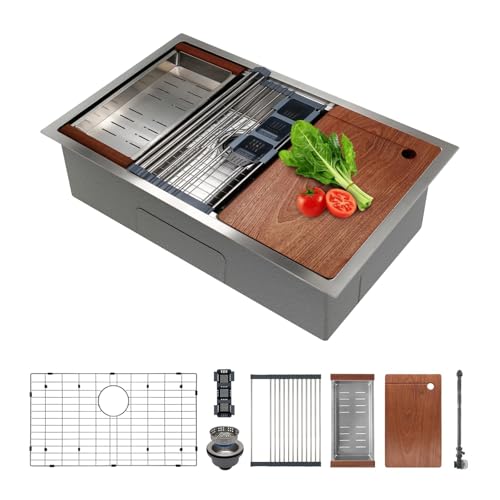
SANYCASA 30-Inch Workstation Sink, 11-Gauge — Best Heavy-Duty
Gauge numbers run backwards: lower is thicker. Residential sinks are 16 or 18 gauge; this SANYCASA is 11 gauge — 3mm plate steel, the territory of commercial kitchens. It is noticeably heavier, deader-sounding and more dent-resistant than anything else in this roundup, and it wraps that overbuilt bowl in a full workstation package with an integrated ledge.
It suits the household that is hard on equipment: cast iron that gets dropped rather than placed, canning days, big-batch cooking, and anyone who has dented a thinner sink and sworn never again. If you keep a sink for twenty years, the extra steel is the cheapest longevity you can buy.
Strengths
- 11-gauge (3mm) stainless plate — far thicker than the 16-gauge residential standard — shrugs off dropped cast iron
- Integrated ledge workstation set included, so the bowl doubles as a prep station out of the box
- Heavy steel is inherently quiet: less drumming, less disposal vibration, no oil-can flex under load
Trade-offs
- Weight: this is a two-person install, and your countertop support and clips must be up to it — plan the install accordingly
- Premium positioning in its class; the steel is what you are paying for, so budget buyers should look at the Kichae
- The ledge step needs the same wipe-down discipline as any workstation design
| Specification | Detail |
|---|---|
| Exterior dimensions | 30 in class undermount |
| Steel | 11-gauge (3mm) stainless steel |
| Configuration | Single bowl, integrated ledge workstation set |
| Drain | Manufacturer’s ‘Superior Drain’ design per listing |
Is 11 gauge overkill? For gentle use, yes — and the review would be dishonest to pretend otherwise. But gauge is not only about dents. Thick plate changes the sound and feel of the whole sink station: water impact is a thud instead of a ping, the disposal’s vibration dies in the bowl instead of broadcasting through the counter, and the rim and ledge edges keep their crisp lines after years of pans sliding across them.
The workstation set makes the thickness easier to justify, because this becomes the kitchen’s main work surface, not just its washing bowl. Boards and racks ride the ledge; the deep bowl beneath takes the mess. Households that cook in volume — preserving, batch baking, holiday production — will use both halves of that design weekly.
One practical warning: confirm your cabinet can take the weight plus a bowl full of water, and use every mounting clip provided. Thick steel forgives daily abuse; it does not forgive a skipped support rail.
Best for: heavy-use kitchens, cast-iron households and buy-it-for-decades renovators / Not suited for: solo DIY installers without a helper, or tight renovation budgets
Check on Amazon — check the current price on Amazon before you buy, because listings, bundles and included accessories change over time.

Lordear 36-Inch Undermount Kitchen Sink — Best Extra-Large
At some point a deep bowl stops being about soaking one big pan and becomes about running a whole production line. The Lordear’s 36-inch single bowl is that sink: 16-gauge stainless, undermount, with enough uninterrupted floor to take a roasting pan and a stack of prep bowls at once, or two half sheets side by side.
It suits large kitchens with a 39-inch-plus sink base, serious home bakers, and households that host — the cooks for whom the standard 30-inch bowl is the bottleneck every holiday. It is emphatically not a small-kitchen sink, and the review below treats the size requirements as the main event.
Strengths
- 36 inches of undivided bowl: the only pick here that swallows two half-sheet pans or a full turkey roaster flat
- 16-gauge stainless keeps the big floor from flexing under a full load of water and cookware
- Single-bowl simplicity at scale — no divider in the way of long items like baguette pans and grill grates
Trade-offs
- Demands a large cabinet (typically 39 in or more) and a long countertop run — measure the cabinet, not the counter
- A bowl this wide uses more water for a full soak and takes longer to rinse down after washing up
- Reaching the back corners is a stretch for shorter users; a pull-down sprayer is effectively mandatory
| Specification | Detail |
|---|---|
| Exterior dimensions | 36 in class undermount |
| Steel | 16-gauge stainless steel |
| Configuration | Single bowl, undermount |
The case for 36 inches is capacity math. Holiday cooking fails at the sink more often than at the oven: the roaster needs soaking while the sides are still being prepped, and in a 30-inch bowl that means the roaster wins and prep migrates to the counter. Here, the roaster soaks at one end and work continues at the other. Grill grates, long baguette pans and oversized cutting boards — the awkward items that defeat normal sinks — simply fit.
The costs are equally concrete. A full soak is a lot of water. The bowl’s far corners are a long reach. And the install is a two-person job into a cabinet many kitchens do not have. None of that is a flaw in the sink; it is the physics of the format, and it is why this pick carries an extra-large badge rather than the overall one.
If your cabinet qualifies and your cooking regularly hits the limits of a 30-inch bowl, this is the upgrade that removes the limit. If you are upsizing on speculation, the KHU100-30 will make you happier day to day.
Best for: large kitchens, bakers and hosts whose cookware outgrew a 30-inch bowl / Not suited for: standard 33- or 36-inch sink-base cabinets, or anyone who fills the sink to soak daily
Check on Amazon — check the current price on Amazon before you buy, because listings, bundles and included accessories change over time.

Kichae 30-Inch Undermount Single Bowl Sink — Best Budget
The Kichae is the pick for renovators whose budget is being pulled apart by countertops, faucets and cabinets all at once. It keeps the essentials this guide insists on — a 30 x 18 single bowl in 16-gauge stainless with handmade styling and rounded corners — and trims the brand premium rather than the steel.
It suits rental upgrades, first renovations and anyone who would rather put the savings toward a better faucet. A deep bowl is a deep bowl: sheet pans soak, pots stand upright, and the daily experience is far closer to our top pick than the price gap suggests.
Strengths
- 16-gauge stainless at 30 x 18 — the core spec of the premium picks — at a budget-tier position
- Rounded handmade corners rinse clean easily and give the bowl a modern, tight-radius look
- Standard 30 x 18 footprint fits the most common undermount cutouts and 33-inch cabinets
Trade-offs
- Accessory bundles vary by listing variant — confirm on the listing whether a grid and drain are included before assuming
- Brand support and replacement parts are thinner than Kraus or Elkay ecosystems
- Sound padding and finish consistency are where budget sinks most often trail the premium brands over years of use
| Specification | Detail |
|---|---|
| Exterior dimensions | 30 x 18 in |
| Steel | 16-gauge stainless steel |
| Configuration | Single bowl undermount, rounded corners, handmade style |
Where does the money not go on a sink like this? Mostly into the ecosystem around the steel: the depth of the accessory catalog, the polish of the packaging and template, and the size of the support operation behind the warranty. The bowl itself — the part you touch every day — keeps the specification that matters, which is why budget sinks have become a rational buy rather than a gamble in this category.
Two checks protect you. First, read the exact listing variant: budget sinks are sold in several bundle configurations, and the difference between ‘sink only’ and ‘sink with grid and drain’ is real money you will spend later anyway. Second, inspect the bowl on arrival for shipping dents, especially at the corners, while the Amazon return window is wide open — that advice applies to every sink here, but budget packaging earns the reminder.
Paired with a decent pull-down faucet, the Kichae delivers the deep-single-bowl experience at the lowest total cost in this roundup. That is exactly what a Best Budget badge should mean.
Best for: budget renovations and rental upgrades that still want 16-gauge depth / Not suited for: buyers who want a deep manufacturer accessory catalog and long-term parts support
Check on Amazon — check the current price on Amazon before you buy, because listings, bundles and included accessories change over time.
Comparison Table
The table below lines the six bowls up by the figures that decide fit and daily use. Bowl depth and steel gauge come from the verified listings; when a listing did not state a figure, we say so in the review rather than guessing here.
| Pick | Badge | Key spec | Best for |
|---|---|---|---|
| Kraus Standart Pro KHU100-30 30-Inch Undermount Sink | Best Overall | 30 x 18 in, 10 in bowl, 16-gauge T-304 | most households upgrading to a deep single bowl — the safe, complete, no-regrets choice |
| BoomHoze 30-Inch Undermount Workstation Sink | Best Deep Workstation | 30 x 19 in, 10 in deep, workstation ledge | scratch cooks in compact kitchens who want prep space inside the sink |
| Sarlai 25-Inch Undermount Workstation Sink | Best Compact Deep Bowl | 25 x 19 in, 10 in deep, 16-gauge workstation | small kitchens and apartments that need real soaking depth in a 25-inch bowl |
| SANYCASA 30-Inch Workstation Sink, 11-Gauge | Best Heavy-Duty | 30 in, 11-gauge (3mm) steel, workstation set | heavy-use kitchens, cast-iron households and buy-it-for-decades renovators |
| Lordear 36-Inch Undermount Kitchen Sink | Best Extra-Large | 36 in single bowl, 16-gauge stainless | large kitchens, bakers and hosts whose cookware outgrew a 30-inch bowl |
| Kichae 30-Inch Undermount Single Bowl Sink | Best Budget | 30 x 18 in, 16-gauge, rounded corners | budget renovations and rental upgrades that still want 16-gauge depth |
How to Choose a Deep Single Bowl Stainless Kitchen Sink
Start with the cabinet, not the sink. Measure the inside width of your sink base cabinet and subtract the wall thickness on both sides; the sink’s exterior must clear that space, and undermount clips need room too. As a rule of thumb a 30-inch sink wants a 33-inch cabinet and a 36-inch sink wants 39 inches or more. Every disappointment in this category begins with a beautiful sink that physically cannot enter the cabinet.
Next, define ‘deep’ for your own cooking. Bowl depth is measured from the bowl floor to the rim. Nine inches is standard, 10 inches is genuinely deep, and anything marketed as deep below 9 inches is ordinary stock with ambitious copywriting. Depth buys you upright stockpots and fully submerged sheet pans; it costs you reach — a 10-inch bowl plus a countertop’s thickness puts the floor a long way down for shorter cooks, one reason workstation ledges and grids earn their place.
Then weigh the single-bowl trade honestly. One undivided basin is unbeatable for big items and simpler to clean, but washing and rinsing share the same water unless you work in sequence or use a small tub inside the bowl — a trick many single-bowl owners adopt for glassware. If your household hand-washes everything daily and hates sequential washing, a low-divide double bowl is the honest alternative; if your pain point is big cookware, single bowl wins and it is not close.
Gauge, grade and finish: the three steel decisions
Gauge is thickness: 16 gauge is the residential premium standard, 18 gauge is acceptable in smaller bowls, and specialty sinks like the SANYCASA go far thicker. In a deep, wide bowl, thickness is not a luxury — the floor spans a large area and carries heavy water loads, and thin floors flex and drum. Grade matters separately: insist on T-304 (also written 18/8 or 18/10) stainless, which carries enough nickel and chromium to resist rust spots and staining. Unspecified ‘stainless’ in a listing is a warning sign, not a detail.
Finish is the third decision. A brushed satin finish hides water spots and fine scratches best, which is why every pick here wears one. Mirror and nano-coated colored finishes look striking in photos and show every fingerprint in life; if you love the look, budget the wiping time. Whatever finish you choose, a bottom grid is the cheapest insurance — it keeps pot bases off the steel and dramatically slows the patina of fine scratches that all stainless bowls eventually develop.
Workstation ledge or plain bowl?
A workstation ledge is an internal step that carries boards, racks and colanders at rim height. It converts the sink into counter space, keeps prep mess over the bowl, and pairs naturally with deep bowls because the working bowl remains usable below. The costs: accessories are brand-specific, the ledge step needs wiping, and ledge sinks usually cost more for the same steel. Choose the ledge if counter space is your kitchen’s scarce resource; choose the plain bowl if you have counters to spare and want the simplest possible basin to clean.
What Size Deep Single Bowl Do You Actually Need?
Work backwards from your largest regular item. A half-sheet pan measures about 18 x 13 inches; to soak it flat you need a bowl floor at least that large, which in practice means a 30-inch-class sink. A 25-inch bowl soaks it at an angle — workable, not ideal. A turkey roaster or grill grate pushes you to 32–36 inches. Measure the item, then the cabinet, and let those two numbers pick the size; buying bigger than both numbers wastes water on every soak for the life of the sink.
Depth interacts with size in one more way: deep and wide together make the heaviest bowl when full. A 36-inch bowl at 10 inches deep holds a serious weight of water, which is an argument for 16-gauge steel and full clip support at the large end, and a reminder to check that your disposal and plumbing can be serviced under a bowl that sits lower in the cabinet than the one it replaces.
How to Measure for and Install a Deep Undermount Sink
You do not need to be a plumber to get the measuring right, and getting it right is 90 percent of a successful install. Professional fitting is money well spent for the mounting itself, but these are the steps — whether you do them or check your installer’s work against them.
- Measure the cabinet interior width, front-to-back depth and the height from the cabinet floor to the underside of the countertop. Write all three down; the sink must clear the width with room for clips, and a deep bowl hangs lower than your old one.
- Confirm the countertop cutout against the sink’s template before anything is ordered. Undermount cutouts are sink-specific; a cutout made for a different model rarely matches.
- Dry-fit the sink from below with a helper or a support jig. Check that the drain hole position clears the disposal, trap and any cabinet cross-members — deep bowls push the drain lower and sometimes further back.
- Apply a continuous bead of silicone sealant to the rim flange, raise the sink evenly, and fit every mounting clip provided, tightening in a cross pattern so the flange seats flat all round.
- Connect the drain assembly and disposal only after the sealant has cured per its instructions; a deep bowl full of water is the worst first test for a green seal.
- Fill the bowl completely, wait ten minutes, and inspect every joint and the trap from below with a dry paper towel before the first real wash-up.
After installation, two habits keep a deep stainless bowl looking new: rinse and wipe the floor after soaking anything starchy or acidic, and lift the grid weekly to clean beneath it. Stainless does not rust under normal kitchen use, but the mineral and iron deposits from water can stain the surface — they clean off with a paste of baking soda and water rubbed with the grain, never across it.
Common Buying Mistakes
Mistake 1: Buying the sink before measuring the cabinet. Nominal cabinet sizes lie — door frames, pipes and drawer boxes all steal space. A 30-inch sink in a true 30-inch cabinet is a return, not an install. Measure the interior, and check the minimum cabinet size printed on the listing.
Mistake 2: Confusing overall depth with bowl depth. Listings quote both, and they differ by the rim and mounting structure. The number that decides whether a stockpot stands upright is the interior bowl depth. Every pick here was screened on bowl depth, and your shortlist should be too.
Mistake 3: Choosing 18-gauge steel for a big, deep bowl. Thin steel is tolerable in a small bar sink. In a 30-inch-plus deep bowl it flexes, drums and dents. The saving is small against a decade of daily use; 16 gauge is the floor for this category.
Mistake 4: Forgetting the faucet’s reach. Deep, wide bowls — especially 19-inch front-to-back workstation models — put the bowl’s center beyond a short faucet’s spout reach. Pair a deep bowl with a pull-down faucet and the problem disappears.
Mistake 5: Skipping the bottom grid to save money. The grid is what stands between your cast iron and the bowl floor for the next ten years. If a bundle omits it, price the grid into the comparison before deciding the bare sink is cheaper.
Mistake 6: Assuming workstation accessories are universal. Ledge widths differ by brand and model. Accessories from your old workstation sink will almost certainly not fit the new one; buy the sink whose included set covers what you actually use.
Final Recommendation
If you only read one line of this guide: buy the Kraus KHU100-30 unless you have a specific reason not to. It is the complete package — true 10-inch depth, 16-gauge T-304 steel, the grid and drain in the box — and it fits the standard 33-inch cabinet most renovators actually have.
The reasons to choose otherwise are all legitimate and all covered above: the BoomHoze if you prep in the sink, the Sarlai if your kitchen is small, the SANYCASA if you are hard on equipment and keep things for decades, the Lordear if your cabinet and your cooking are both genuinely large, and the Kichae if the budget needs the steel without the brand premium. Whichever you choose, measure the cabinet first and check price on Amazon at the listing, because bundles and included accessories change.
Short on time? Start with these three:
- Kraus Standart Pro KHU100-30 30-Inch Undermount Sink — Best Overall
- BoomHoze 30-Inch Undermount Workstation Sink — Best Deep Workstation
- Sarlai 25-Inch Undermount Workstation Sink — Best Compact Deep Bowl
Keep researching within this guide cluster: Best 16 Gauge Stainless Steel Kitchen Sinks Best 24 Single Bowl Kitchen Sinks Best 30 Inch Kitchen Sinks Best 32 Undermount Stainless Steel Kitchen Sinks Best Apron Front Kitchen Sinks
Frequently Asked Questions
Is a 10-inch-deep sink too deep for everyday washing?
For most adults it is comfortable, especially with a bottom grid raising the work floor slightly. Shorter users and anyone with back trouble should try the reach in a showroom if possible: the bowl floor of a 10-inch undermount sits roughly 14–15 inches below counter height once the countertop thickness is counted. A workstation ledge also helps, because prep happens at rim height rather than at the bowl floor.
Does a single bowl make washing dishes harder?
It changes the workflow rather than making it harder. You wash in sequence — wash, stack on the counter or a rack, then rinse — or keep a small plastic tub in the bowl as a rinse basin. What you gain is the ability to soak and wash the large items that never fit a divided bowl at all. Most converts say the trade favors the single bowl within a month.
What is the difference between 16-gauge and 18-gauge stainless?
Gauge measures thickness backwards: 16 gauge is thicker than 18. In practice 16-gauge bowls feel solid under heavy pots, resist denting from dropped cookware, and sound quieter. 18-gauge bowls are lighter and cheaper and are fine in smaller sizes, but in a large deep bowl the thinner floor can flex and drum. For the sinks in this guide’s class, 16 gauge is the sensible minimum.
Can I install an undermount sink with laminate countertops?
Generally no — undermount rims need a sealed, solid edge that laminate over particleboard cannot reliably provide, and water at the seam destroys the substrate. Undermount sinks belong with stone, quartz, solid surface or concrete counters. If you have laminate, shop the drop-in version of the same bowl designs instead.
How do I stop a stainless sink from looking scratched?
You cannot stop fine scratching entirely — it is the nature of the material — but a bottom grid prevents the worst of it, and over time the fine lines blend into a uniform patina that most owners stop noticing. Clean with the grain using non-abrasive cleaners, avoid leaving steel wool pads sitting in the bowl, and dry the bowl after washing up if your water is hard.
Will a deep bowl work with a garbage disposal?
Yes — every pick here takes a standard drain opening and a disposal flange. Two practical notes: the deeper bowl lowers the disposal in the cabinet, so check trap alignment before ordering, and heavy 16-gauge bowls with sound padding noticeably reduce the vibration and noise a disposal transmits through a thin sink.


