Disclosure: airfryerkitchensupply.com is reader-supported. When you buy through links on our site, we may earn an affiliate commission at no extra cost to you.
Where to buy
Every product in this guide to the best apron front kitchen sinks was verified as a current Amazon listing before inclusion, or is clearly marked as a recommendation without a link where no listing could be confirmed with confidence. Models in this category are sold in several sizes, finishes and model years, so use the links below to check the current price on Amazon and confirm the exact configuration before ordering.
Quick links to the picks in this guide: Kraus Kore 30-Inch Farmhouse Workstation, KWF410-30; TUKTUK White Farmhouse Sink, 33 Inch, Fireclay; Ruvati 33×20-Inch White Reversible Fireclay Farmhouse Sink, RVL2300WH; Sinkology Parker 34-Inch Fireclay Farmhouse Sink, Double Bowl; Elkay Crosstown Tall Farmhouse Sink, 35-7/8 Inch, Stainless; Elkay Fireclay Farmhouse Sink, SWUF28179WH, 30 Inch.
The best apron front kitchen sinks share one defining feature — the exposed front panel that replaces the cabinet’s false drawer front — and almost nothing else. Behind that farmhouse face, the real decisions are material (fireclay, stainless steel or granite composite behaviour in an apron format), bowl depth, the cabinet modification the apron demands, and whether the sink is a simple basin or a workstation with a ledge for boards and racks. Getting those right matters more than the silhouette, because an apron sink is the least reversible purchase in a kitchen: it is cut into the cabinetry.
This guide compares six verified apron front sinks across those real axes. Fireclay dominates the style for good reason — its glazed surface is hard, quiet and repairable in appearance for decades — but a stainless workstation apron and a tall stainless farmhouse design make serious practical cases, and a double-bowl fireclay answers the one-bowl objection. Each review states its cabinet requirement and its honest compromises.
Measure before you fall in love. Apron sinks need a cabinet built or modified for them — typically a 33- or 36-inch base with the front cut down — and bowl depth plus apron height decide whether the installation is a weekend project or a cabinetmaker’s job. The picks below are ordered so the classic choice comes first and the specialists follow.
Finally, a note on resale and remodel logic, because apron sinks participate in both. A well-chosen apron sink in a quality material is one of the few kitchen elements that survives a remodel — fireclay examples are routinely reinstalled — and that signals strongly to buyers that a kitchen was built rather than decorated. Choose the sink you would want to inherit, at the size your cabinets honestly take, and the decision tends to age as well as the material does.
In this guide
Quick Picks
Kraus Kore 30-Inch Farmhouse Workstation, KWF410-30 — Best Overall: Stainless practicality behind the farmhouse face: a 30-inch apron workstation with an integrated ledge and an in-sink dish drying rack — the apron sink for people who cook more than they photograph. — Check the current price on Amazon
TUKTUK White Farmhouse Sink, 33 Inch, Fireclay — Best Classic Fireclay: The textbook farmhouse sink: 33 inches of white fireclay, a deep single bowl, a reversible apron face, and the heavy, quiet, glazed permanence that made the style famous. — Check the current price on Amazon
Ruvati 33×20-Inch White Reversible Fireclay Farmhouse Sink, RVL2300WH — Best Fireclay Alternative: Another honest route to the classic: Ruvati’s 33×20 reversible fireclay farmhouse sink, from a maker whose wider sink range is a byword for fit and finish. — Check the current price on Amazon
Sinkology Parker 34-Inch Fireclay Farmhouse Sink, Double Bowl — Best Double Bowl: Two bowls behind the apron: Sinkology’s 34-inch Parker splits the farmhouse bowl for soak-and-rinse households, in SureFire fireclay with a quick-fit drop-in installation for a 36-inch cabinet. — Check the current price on Amazon
Elkay Crosstown Tall Farmhouse Sink, 35-7/8 Inch, Stainless — Best Deep Stainless Apron: Elkay’s take: a tall 16-gauge stainless farmhouse front at nearly 36 inches wide — maximum bowl, commercial-grade steel, from one of the oldest names in sinks. — Check the current price on Amazon
Elkay Fireclay Farmhouse Sink, SWUF28179WH, 30 Inch — Best Compact Fireclay: The classic material in the smaller format: Elkay’s 30-inch white fireclay farmhouse single bowl, for kitchens that want the real apron sink without the 33-inch cabinet commitment. — Check the current price on Amazon
How These Picks Were Chosen
Every sink here was verified against the current Amazon catalogue connection, and only listings whose returned title matched the exact model were linked. Specifications quoted — sizes, materials, bowl configuration — come from those verified listings; where a detail such as minimum cabinet size was not in the verified data, the guide says what to confirm rather than inventing a number.
To qualify, a sink had to be a genuine apron front design (not merely a farmhouse-styled topmount), in a material with a long service record, from a maker with an established sink range. Both single- and double-bowl designs were admitted, as were workstation variants, because apron buyers split genuinely on both questions.
Sinks were excluded if the listing could not be verified or if the design was an apron in name only. The six survivors cover the honest range: classic fireclay singles in two sizes, a reversible fireclay with accessory kit, a fireclay double bowl, a stainless workstation apron, and a tall stainless farmhouse for maximum bowl depth.
A selection transparency note: the apron category contains many visually identical white fireclay sinks from makers with thin documentation. Those whose listings could not be verified, or whose dimensions and cabinet requirements could not be established, were excluded regardless of price or photograph. An apron sink is embedded in cabinetry; the cost of a wrong or undocumented model is not a return label but a remodel delay, and this guide prices that risk at its true value.
The 6 Best Apron Front Kitchen Sinks

Kraus Kore 30-Inch Farmhouse Workstation, KWF410-30 — Best Overall
Check the current price on Amazon
The Kore KWF410-30 is the apron sink for households that love the farmhouse look but live by stainless steel’s rules: it does not chip, it shrugs off thermal shock, and its integrated workstation ledge turns the bowl into a prep surface with boards and racks sliding over the sink instead of crowding the counter. The included in-sink dish drying rack shows the design’s intent — this is a working sink that happens to wear an apron.
Strengths
- Integrated workstation ledge multiplies prep space in smaller kitchens
- Stainless construction cannot chip or crack the way fireclay can
- 30-inch size fits the commonest apron cabinet modification
Trade-offs
- Stainless shows water spots and needs a wipe-down habit fireclay does not demand
- The modern workstation look is less ‘heritage farmhouse’ than glazed fireclay
- Like all apron sinks, it needs a cabinet front cut down to suit
| Specification | Detail |
|---|---|
| Size | 30-inch farmhouse workstation |
| Material | Stainless steel |
| Model | KWF410-30 |
| Included | In-sink dish drying rack |
As a sink to use, the ledge is the story. A board over the bowl catches peelings straight into a disposal or bin below; a rack holds washed produce over the sink instead of on a towel. In a kitchen where counter space is the scarcest resource, that workflow is worth more than any finish. The apron front, meanwhile, brings the bowl closer to the user — the ergonomic point of the whole style — reducing the lean that standard sinks impose.
Choose the Kore if your kitchen works hard daily and your taste runs modern-farmhouse rather than period. It gives up fireclay’s glazed permanence and gains a prep system and an unbreakable bowl — for most cooking households, the right trade.
One workflow worth copying from restaurant kitchens: keep the Kore’s ledge board parked over the bowl during prep-heavy cooking permanently, not stored. A workstation only changes habits if its tools live where the work happens.
The Kore’s ledge also changes washing up, not just prep: a rack over the bowl lets a hand-washed pan drip where it was washed, instead of ferrying water across the counter to a mat.
Best for: hard-working kitchens that want farmhouse ergonomics with stainless practicality / Not suited for: period-style kitchens where glazed fireclay is the point

TUKTUK White Farmhouse Sink, 33 Inch, Fireclay — Best Classic Fireclay
Check the current price on Amazon
If the apron sink in your mind is white, deep and reassuringly heavy, this is it. Fireclay — ceramic fired at very high temperature — gives a glaze that is exceptionally hard, resistant to stains and heat, and quiet under running water and dropped cutlery in a way metal never is. The TUKTUK’s apron is reversible, so you can install the face that suits your kitchen, and its deep single bowl swallows roasting pans and stockpots whole.
Strengths
- Fireclay glaze resists stains, heat and scratches and stays white for decades
- Reversible apron lets you choose the front profile at installation
- Deep single bowl fits the largest pans without tilting or splitting the load
Trade-offs
- Fireclay is heavy — the cabinet and support framing must be built for it
- A hard dropped object can chip fireclay; a bottom grid is cheap insurance
- Single bowl means washing and rinsing share one space unless you use the workstation tricks
| Specification | Detail |
|---|---|
| Size | 33-inch |
| Material | Fireclay |
| Bowl | Single, deep |
| Install | Drop-in / undermount, reversible front |
Fireclay’s virtues compound over years. It does not develop the fine scratch patina of stainless, it does not spot, and its mass makes the whole sink feel — and sound — substantial. Its one vulnerability is impact: a cast-iron pan dropped corner-first can chip the glaze, which is why experienced fireclay owners run a bottom grid and treat the sink firmly but not carelessly.
At 33 inches this is the classic apron size for a 36-inch cabinet run, and the size most apron accessories and grids are made for. For the traditional kitchen — or any kitchen that wants the traditional sink — this is the guide’s reference pick.
If your kitchen has a window over the sink, the TUKTUK’s white fireclay is the pick that will reward it most — the glaze’s depth under natural light is the effect every farmhouse photograph is trying to capture.
Fireclay’s thermal mass has a quiet benefit in winter kitchens: the bowl does not feel icy to the wrists the way thin steel can at first touch on a cold morning.
Best for: traditional and transitional kitchens wanting the classic farmhouse sink / Not suited for: households rough enough on sinks that chip risk rules fireclay out

Ruvati 33×20-Inch White Reversible Fireclay Farmhouse Sink, RVL2300WH — Best Fireclay Alternative
Check the current price on Amazon
The RVL2300WH covers the same ground as the TUKTUK — 33-inch white fireclay, reversible front, deep single bowl — under a brand many kitchen fitters reach for first. Ruvati’s reputation rests on consistency: dimensions that match their drawings, glaze quality that holds up, and a range deep enough that matching accessories and grids are easy to source. In a product cut permanently into your cabinetry, that boring reliability is a feature.
Strengths
- Reversible fireclay front in the standard 33-inch farmhouse format
- Ruvati’s range depth makes grids and accessories easy to match
- Glazed fireclay surface is stain-resistant, heat-resistant and quiet
Trade-offs
- Shares fireclay’s universal caveats: heavy, and chippable under hard impact
- White shows everything until rinsed — the price of the classic look
- Confirm the exact apron height against your cabinet cut before ordering
| Specification | Detail |
|---|---|
| Size | 33 x 20 in |
| Material | Fireclay |
| Model | RVL2300WH |
| Front | Reversible |
Choosing between the two fireclay singles here is a judgement about brand ecosystem and the exact front profile you prefer; the material behaviour will be the same excellent, decades-long story. Ruvati’s version earns its place for buyers who want the maker’s broader range behind the purchase — a real consideration for a fixture you will own longer than your appliances.
Install it on proper support framing, run a bottom grid, and it will outlast the kitchen around it — fireclay sinks routinely survive to be reinstalled in the next remodel, which is a claim no other sink material here can make as confidently.
Ruvati’s reversible front deserves a practical tip: decide the profile at installation with the cabinet doors hung and the handles fitted. The front you prefer in a photograph and the front that suits your cabinetry’s lines are not always the same.
Ruvati’s range depth pays off at accessory time: a grid cut for the exact bowl, from the same maker, is a five-minute purchase rather than a measuring project.
Best for: buyers who value brand range and accessory matching in a permanent fixture / Not suited for: anyone who has not confirmed their cabinet can carry fireclay’s weight

Sinkology Parker 34-Inch Fireclay Farmhouse Sink, Double Bowl — Best Double Bowl
Check the current price on Amazon
The standing objection to farmhouse sinks is the single bowl: where do you rinse while the roaster soaks? The Parker answers with a double bowl in fireclay, sized at 34 inches for a 36-inch cabinet, with a Quick-Fit drop-in installation that is friendlier to retrofit than most apron installs. Sinkology specialises in farmhouse fixtures, and the Parker carries its SureFire fireclay material and the brand’s everyday warranty.
Strengths
- Double bowl restores the wash/rinse division single-bowl farmhouse sinks give up
- Quick-Fit drop-in install is among the most retrofit-friendly apron installations
- Fireclay’s hard, quiet, stain-resistant glaze in a specialist farmhouse brand
Trade-offs
- Each bowl is smaller than a single bowl’s — check your largest pan against one side
- 34-inch width and a 36-inch cabinet requirement narrow the kitchens it fits
- Fireclay weight and chip caveats apply as with all fireclay picks
| Specification | Detail |
|---|---|
| Size | 34-inch |
| Material | Fireclay (SureFire) |
| Bowl | Double |
| Cabinet | 36-inch, Quick-Fit drop-in |
The double-bowl apron is a genuine lifestyle fork. Households that hand-wash in one bowl while the other holds prep or soaking will not go back; households that mostly load a dishwasher will prefer the single bowl’s ability to swallow anything. Neither is wrong — but choose consciously, because the divider is permanent.
Sinkology’s farmhouse focus shows in the details that matter to installers: the quick-fit system and a stated cabinet size remove the two commonest apron-sink surprises. If your kitchen has the 36-inch cabinet and your washing habits want two bowls, the Parker is the most considered answer here.
The Parker’s double bowl pairs naturally with a pull-down faucet: the spray function restores the rinsing flexibility the divider removes, and the combination is the closest a farmhouse sink comes to a professional spray station.
Double-bowl owners should assign the bowls by habit from day one — wash left, rinse right, or your household’s version — because a divided sink only speeds work when the division is a routine.
Best for: soak-and-rinse households with a 36-inch sink cabinet / Not suited for: dishwasher-first households whose pans need one undivided bowl

Elkay Crosstown Tall Farmhouse Sink, 35-7/8 Inch, Stainless — Best Deep Stainless Apron
Check the current price on Amazon
Elkay has made sinks for a century, and the Crosstown farmhouse applies that heritage to the apron format in 16-gauge stainless — the heavy gauge that resists denting and drumming. At 35-7/8 inches wide with a 9-inch-deep bowl, this is the largest-capacity pick in the guide, in a polished satin finish that hides wear gracefully. The ‘tall’ farmhouse front gives the full apron presence in a metal that cannot chip.
Strengths
- 16-gauge stainless is the heavy, dent-resistant grade serious sinks use
- Near-36-inch width and 9-inch depth give the guide’s largest single bowl
- Elkay’s heritage and range make support and accessories straightforward
Trade-offs
- Requires the largest cabinet commitment of any pick here
- Stainless needs a wipe-down routine to look its best
- Polished satin is a working finish — expect a patina of fine scratches over years
| Specification | Detail |
|---|---|
| Size | 35-7/8 x 20-1/4 x 9 in |
| Material | 16-gauge stainless steel |
| Finish | Polished satin |
| Bowl | Single |
The Crosstown suits the cook who found fireclay beautiful and impractical in equal measure. Its bowl takes anything, its front delivers the farmhouse ergonomics and look in a modern material, and its gauge means the apron itself — the part that gets bumped by hips, belts and pan handles — can take the knocks that would mark thinner steel.
Measure carefully: this sink wants its cabinet planned around it, ideally at the design stage of a remodel. Planned in, it is arguably the most capable sink in the guide; retrofitted hopefully, it is the one most likely to punish a guessed measurement.
Because the Crosstown is stainless, it is the one apron pick here that tolerates a garbage disposal’s vibration and the occasional dropped pan with complete indifference — a genuine consideration in the busiest family kitchens.
The Crosstown’s polished satin finish is the most forgiving stainless finish for a farmhouse front, because the apron — the most-touched, most-bumped surface — shows its life as a soft sheen rather than as scratches.
Best for: big-cooking households planning a remodel around a maximum-capacity sink / Not suited for: retrofits where the cabinet cannot be rebuilt to suit
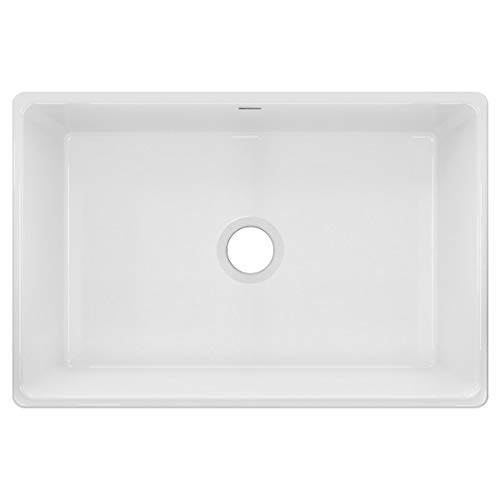
Elkay Fireclay Farmhouse Sink, SWUF28179WH, 30 Inch — Best Compact Fireclay
Check the current price on Amazon
Not every kitchen has 36 inches to give a sink. The SWUF28179WH brings genuine fireclay — with its hard glaze, quiet bowl and decades-long colour — down to a 30-inch farmhouse format, from Elkay’s long-established fireclay range. The single bowl stays usefully deep, and the smaller apron still delivers the style’s ergonomic gift: the bowl front closer to you, the lean taken out of washing up.
Strengths
- Real fireclay at 30 inches — the classic material without the biggest cabinet
- Elkay heritage and range support behind a permanent fixture
- Single deep bowl keeps the farmhouse sink’s pan-swallowing virtue
Trade-offs
- Smaller bowl than the 33-inch picks — batch cooks should measure their trays
- Fireclay’s weight still requires proper cabinet support at this size
- White fireclay shows the day’s cooking until rinsed, as all white sinks do
| Specification | Detail |
|---|---|
| Size | 30-inch |
| Material | Fireclay |
| Colour | White |
| Model | SWUF28179WH |
Thirty inches is the apron format’s underrated size: it fits the 33-inch cabinet bases common in smaller kitchens and older homes, where a 33-inch sink simply cannot go. The Elkay name matters here precisely because the sink is permanent — a century-old sink maker’s small fireclay is a safer decade-long bet than an unknown brand’s large one.
If your kitchen is compact but your taste is not, this is the pick: the genuine material, the genuine ergonomics, at the size your cabinets can honestly accept.
At 30 inches, the Elkay fireclay also suits a butler’s pantry or a laundry conversion where a second, smaller farmhouse sink carries the overflow of a household’s washing — a role its size and material fit perfectly.
A 30-inch apron in a small kitchen gains presence from proportion: because the room is compact, the classic front reads as a deliberate design anchor rather than as a compromise size.
Best for: smaller kitchens wanting a true fireclay apron sink / Not suited for: households whose largest pans demand a 33-inch bowl
Comparison Table
| Pick | Badge | Key spec | Best for |
|---|---|---|---|
| Kraus Kore 30-Inch Farmhouse Workstation, KWF410-30 | Best Overall | 30-inch stainless workstation apron, ledge and rack | hard-working kitchens that want farmhouse ergonomics with stainless practicality |
| TUKTUK White Farmhouse Sink, 33 Inch, Fireclay | Best Classic Fireclay | 33-inch white fireclay, reversible apron | traditional and transitional kitchens wanting the classic farmhouse sink |
| Ruvati 33×20-Inch White Reversible Fireclay Farmhouse Sink, RVL2300WH | Best Fireclay Alternative | 33×20 fireclay, reversible, established maker | buyers who value brand range and accessory matching in a permanent fixture |
| Sinkology Parker 34-Inch Fireclay Farmhouse Sink, Double Bowl | Best Double Bowl | 34-inch fireclay double bowl, 36-inch cabinet | soak-and-rinse households with a 36-inch sink cabinet |
| Elkay Crosstown Tall Farmhouse Sink, 35-7/8 Inch, Stainless | Best Deep Stainless Apron | 35-7/8-inch 16-gauge stainless farmhouse | big-cooking households planning a remodel around a maximum-capacity sink |
| Elkay Fireclay Farmhouse Sink, SWUF28179WH, 30 Inch | Best Compact Fireclay | 30-inch white fireclay single bowl | smaller kitchens wanting a true fireclay apron sink |
How to Choose the Right Apron Front Kitchen Sink
Material first, because it decides your next twenty years. Fireclay — four of the six picks — offers a glazed surface that resists stains, heat and scratches, stays its colour, and runs quiet; its costs are weight and a vulnerability to hard impacts that a bottom grid mostly answers. Stainless steel — the Kraus workstation and the Elkay Crosstown — cannot chip, handles thermal shock without thought, and asks for a wipe-down habit and acceptance of a fine-scratch patina. Choose by your household’s roughness and your tolerance for patina versus perfection.
Bowl configuration second. A single deep bowl is the farmhouse orthodoxy for a reason: it takes roasting pans, stockpots and sheet pans flat. The double-bowl Parker exists for households whose hand-washing routine genuinely uses two bowls — a real need, but one to verify against your largest pan, which must fit in one side, not across both.
Size and cabinet third, and non-negotiably measured. Apron sinks are stated by width — 30, 33, 34, 36 inches — and each assumes a cabinet one size up, modified with a cut-down front and support framing for the sink’s weight. Fireclay in particular is heavy enough that ‘the cabinet will hold it’ must be a designed fact, not a hope. Confirm apron height against your cabinet and dishwasher clearance before ordering; returns on a fireclay sink are nobody’s idea of fun.
Apron Sink Installation, Honestly Explained
An apron sink replaces the cabinet’s false front with its own exposed panel, so installation is carpentry as much as plumbing. The sink base cabinet must be opened at the front, a support frame built inside to carry the sink’s full weight — fireclay sinks are carried by the frame, never hung from the countertop — and the countertop cut to meet the bowl. Drop-in variants like the Parker’s Quick-Fit simplify the countertop side of the job; undermount variants demand the most precise templating.
Sequence matters: the sink is typically set before the countertop, so its height can be made exactly flush, and the faucet holes are drilled in the counter or the wall, since apron sinks have no faucet deck. Plan the faucet reach against the bowl’s depth — a deep farmhouse bowl with a short-reach faucet is a daily annoyance that a tape measure prevents.
None of this is beyond a competent remodel, and most of it is beyond a Saturday afternoon. Budget the installation honestly — cabinet modification, support framing, countertop work — and the apron sink stops being the project that surprises people. The picks here state their cabinet requirements so the planning can start from facts.
Living With Fireclay and Stainless: Care That Keeps Them Beautiful
Fireclay care is mostly about impact and abrasives. Run a bottom grid, avoid dropping cast iron corner-first, clean with non-abrasive cleaners, and the glaze will look new for decades. Its stain resistance is excellent; the rare mark from metal pans usually lifts with a paste of bicarbonate of soda. Chips, if they happen, are cosmetic rather than structural — the sink keeps working — and repair kits exist for the visible ones.
Stainless care is about water and direction. Wipe the bowl dry after heavy use to prevent spot build-up, clean along the grain rather than across it, and let the fine patina develop evenly instead of fighting it. Avoid leaving steel wool or cast iron sitting wet in the bowl, which can leave rust marks on the surface — marks that clean off, but prevention is easier.
Both materials share one rule: the sink is the hardest-worked surface in the kitchen, and ten seconds of rinsing after the worst loads — tomato sauces, coffee grounds, turmeric — keeps either material at its best with no special products at all.
Apron Height, Bowl Depth and the Ergonomics Nobody Mentions
Apron sinks are sold on a silhouette, but they are used through two numbers: apron height and bowl depth. The apron’s exposed face typically stands proud of the cabinet by an inch or so and replaces eight or more inches of cabinet front; its height fixes where your body meets the sink. Stand at your current sink and mime washing a large pan: the apron design removes the countertop edge and cabinet face your hips and forearms currently meet, and that subtraction — not the look — is what owners praise after the first month.
Bowl depth trades against that comfort. A 9- or 10-inch bowl contains splash and stockpots, but its floor is further from your hands. Shorter cooks, and anyone with shoulder trouble, should weight depth honestly; taller cooks will find even the deepest bowl here natural. The picks span the realistic range deliberately, and several state their depth in the specification box precisely so this decision can be made with numbers.
The third ergonomic is the faucet’s: with the bowl moved forward and down, spout reach and height decide whether filling a tall pot is a pleasure or a juggling act. A high-arc faucet with generous reach is the near-universal partner for apron sinks, and planning it with the sink — as the installation section urges — prevents the commonest apron-sink regret.
Fireclay Provenance: Why Where It Is Made Still Matters
Fireclay is an old material with a geography: the classic sanitary fireclays come from regions — England’s Shropshire tradition, Italy’s ceramic districts — where the clay bodies and firing knowledge are generations deep. That heritage is not marketing mist in this category. Fireclay’s quality lives in the consistency of its glaze and the completeness of its firing; underfired or unevenly glazed sinks stain, craze or chip in ways that only appear after installation, when remedy is hardest.
This is one reason the established makers recur in this guide — Elkay, Kraus’s Italian-made fireclay, Ruvati, Sinkology. Their ranges have been fitted by thousands of installers, their dimensions are trustworthy, and their glaze behaviour is a known quantity. An apron sink is the least returnable object in a kitchen; provenance is a practical risk calculation, not snobbery.
The buyer’s check is simple: published dimensions that an installer can work from, a stated cabinet requirement, and a maker whose other sinks you can inspect. All six picks pass that check, which is precisely why they are the six.
Apron Sinks and Dishwashers, Ovens and Islands: Layout Interactions
The apron sink’s forward position changes its relationships. The dishwasher usually stands beside it, and its door swings below the counter where the apron bowl hangs lower than a standard sink’s: in most cabinets the geometry clears, but the check belongs on the measuring list, especially with deep bowls and panel-ready dishwasher fronts that sit proud. Two minutes with both manufacturers’ dimensions prevents the one collision that cannot be styled away.
On an island, the apron front becomes the kitchen’s face — visible from the room’s living side — which is why island apron installations reward the most careful front-profile choice (the reversible models in this guide exist for exactly this decision) and the most disciplined sealing, since the island’s joints are on permanent display. Island plumbing also runs differently, with venting to plan; an apron sink on an island is a design project, and should be resourced as one.
Range and oven interactions are subtler: a deep apron bowl near the range becomes the natural home for oven trays and racks at cleaning time, which is an argument for the largest bowl your cabinet accepts if your oven is a working one. Kitchens are systems; the apron sink, as their most permanent water fixture, should be chosen as one.
The Apron Sink in a Flip, a Rental and a Forever Home
Context changes the right answer within this list. In a flip or a high-turnover property, the stainless workstation is the pragmatic apron: it tolerates tenants’ pans without a chip risk and photographs as a premium feature. In a forever home, fireclay’s permanence compounds — the sink you install at thirty-five is the sink your kitchen still shows at sixty, unchanged.
Rentals sit between: a genuine apron installation is a landlord-grade project, not a tenant one, and the honest advice is to admire from afar unless the property is yours. Where it is yours and tenanted, weight the chip question heavily — fireclay in a household that did not choose it is fireclay at risk, and the Crosstown’s steel front exists for exactly that arithmetic.
How to Measure and Prepare Your Cabinet for an Apron Sink
Start with the cabinet you have or plan: measure its width, then confirm the sink size it supports — as a rule, a 30-inch sink suits a 33-inch base and 33- to 36-inch sinks suit a 36-inch base, but always verify against the specific model’s stated requirement, as the Parker’s listing states its 36-inch cabinet plainly. Measure the interior height available once the false front is removed, and compare it with the sink’s apron height plus bowl depth: the bowl must clear any shelf, plumbing and the top of a dishwasher door swinging open nearby.
Next, plan the support. Apron sinks — above all fireclay — are carried on a frame of timber or the cabinet’s reinforced structure built inside the base, level and solid, at the exact height that brings the sink’s rim flush with the countertop. Build this before the sink arrives if you can; a fireclay sink is not something you want to hold in place while someone thinks.
Finally, plan the water side: faucet reach over a deep bowl, drain position relative to your existing waste (apron bowls often sit further forward than the sink they replace), and clearance for a garbage disposal under a deep bowl, which hangs lower than many expect. Walk the whole installation through on paper with the manufacturer’s template — every pick here is a known model with published dimensions — and the fitting day becomes execution rather than discovery.
Common Buying Mistakes
Ordering before measuring the cabinet. Apron sinks are sized to cabinets, and the cabinet requirement is stated for a reason. Measure, verify, then order.
Hanging a fireclay sink from the countertop. Fireclay is carried by a support frame inside the cabinet. Countertops are not structure.
Choosing double or single bowl by fashion. Choose by how you wash: two-bowl routines are real, and so are sheet pans that only fit an undivided bowl.
Forgetting faucet reach. Deep apron bowls move the washing position forward and down. A short-reach faucet becomes a daily irritation.
Skipping the bottom grid in fireclay. One dropped pan corner can chip a glaze that would otherwise last decades. The grid is the cheapest insurance in the kitchen.
Assuming the sink includes the cabinet work. The price of an apron sink is the sink. Cabinet modification, framing and countertop work are the installation — budget for them.
Final Recommendation
For most kitchens, the Kraus Kore workstation is the apron sink that will be used happiest daily — stainless, ledged, unbreakable — while the TUKTUK 33-inch fireclay is the classic the style is named for, and the Ruvati its best-supported alternative. The Parker answers the two-bowl household, the Elkay Crosstown the maximum-capacity remodel, and the Elkay 30-inch fireclay the smaller kitchen that refuses to compromise on material.
Whichever you choose, let the order of decisions be material, bowl, size, cabinet — and let a tape measure, not a photograph, have the final word.
If you are torn between the workstation and the classic, decide by your counters, not your taste: measure the clear prep run you actually have on an ordinary cooking day. Under a metre of honest workspace, the ledge will change your cooking life; over two metres, the classic bowl’s simplicity will serve you better. The sink should answer the kitchen’s real constraint.
Whichever pick you take forward, take the measurements in the how-to section before the order, and give the numbers to your installer before the cabinet is touched. Apron sinks reward the prepared with decades of daily pleasure and punish only the hopeful — and preparation, in this category, is a tape measure and twenty minutes.
Related guides in this series: Best Apron Kitchen Sinks Best Black Kitchen Sinks Best Blanco Kitchen Sinks Best Farmhouse Kitchen Sinks Best Kitchen Sinks
Frequently Asked Questions
What cabinet do I need for an apron front sink?
A sink base one size wider than the sink — 33 inches for a 30-inch sink, 36 inches for 33- to 36-inch sinks — modified with the front cut down and a support frame built inside to carry the sink’s weight. Some models state their requirement directly, as the Sinkology Parker does for a 36-inch cabinet. Always verify against the specific model’s specification.
Is fireclay or stainless steel better for a farmhouse sink?
Fireclay gives a harder, quieter, stain-resistant glazed surface that stays pristine for decades, but it is heavy and can chip under a hard impact. Stainless cannot chip and handles anything thermally, but shows water spots and develops a fine scratch patina. Choose fireclay for permanence of appearance, stainless for indifference to abuse.
Can an apron sink be installed in an existing kitchen?
Yes, with cabinet modification: the sink base front must be cut down, support framing added, and usually the countertop adjusted or replaced at the sink run. Drop-in designs like the Parker’s Quick-Fit are the most retrofit-friendly. It is a remodel task rather than a swap, and worth planning as one.
Why are apron sinks more comfortable to use?
The exposed front removes the cabinet face and countertop edge that normally sit between you and the bowl, so you stand closer and lean less. Over years of daily washing up, that small ergonomic difference is the style’s most practical virtue — the look is simply what made people notice it.
Do apron sinks need a special faucet?
No special type, but reach matters: deep farmhouse bowls need a faucet whose spout reaches well into the bowl, and since apron sinks have no faucet deck, the faucet mounts in the countertop behind the sink or on the wall. Check the spout reach against the bowl depth before buying either.
Will a white fireclay sink stain?
Fireclay’s glaze is highly stain-resistant — among the best sink surfaces made. Everyday marks rinse away, metal transfer marks lift with a mild abrasive paste, and the colour does not yellow with age. It is one of the lowest-maintenance white surfaces in the kitchen.
Do apron front sinks work in modern kitchens?
Yes — the style has outgrown the farmhouse label. A stainless apron like the Kraus workstation or the Elkay Crosstown reads as industrial-modern, and even white fireclay pairs cleanly with flat-panel cabinetry and stone. The exposed front is a strong horizontal line; modern kitchens use it as one.
Are apron front sinks going out of style?
The farmhouse label cycles, but the design’s substance — a deep bowl, an exposed front, standing closer to your work — does not depend on fashion, and quality examples in fireclay and steel are being installed in contemporary kitchens as confidently as in period ones. Buy the ergonomics and the material; the style will look after itself.
How do I protect a fireclay apron sink from chips?
Fit a bottom grid sized to the bowl and keep it there; it absorbs the pan corners that chip glazes. Handle cast iron with two hands over the bowl rather than swinging it in, and avoid dropping heavy items from height. Follow those two habits and chipping becomes a rarity rather than a risk.
What is the difference between an apron sink and a normal sink, in daily use?
Three things you feel daily: you stand closer to the bowl because the cabinet front is gone, the bowl is typically deeper so splash and clutter stay inside it, and the front itself becomes the kitchen’s visual anchor. Washing up is measurably less of a lean, large pans fit without tilting, and the room gains a focal point — which is why the style survives every trend cycle.


