Disclosure: airfryerkitchensupply.com is reader-supported. When you buy through links on our site, we may earn an affiliate commission at no extra cost to you.
Where to buy
Every model in this roundup of the best 30 inch kitchen sinks is sold through Amazon, which matters more for a sink than for most kitchen purchases: you want the cutout template, the mounting hardware and the return window all coming from the same box and the same seller. The six picks below are the current, verified listings we checked for this guide. Stock and included accessories shift between sellers, so open the listing, confirm the model number in the title matches the one in our review, and confirm whether the drain assembly and bottom grid are in the box before you check out. Start with the Kraus KHU100-30 if you want the safe default, the Kraus Kore KWU110-30 if you want a workstation ledge, or the Oxwiser 30×18 bundle if the budget is the whole point. The remaining picks — the Kraus Kore KWT302-30 drop-in double bowl, the TUKTUK 30 inch fireclay farmhouse sink and the SANYCASA 30 inch workstation — are linked again in their full reviews below.
Introduction: what “30 inch” actually buys you
If you are shopping for the best 30 inch kitchen sinks, you have probably already discovered the one fact that shapes this entire category: a 30 inch sink does not fit a 30 inch cabinet. The 30 inch figure is the outside width of the sink itself, and almost every model in this guide needs a 33 inch base cabinet (some farmhouse models want 36 inches of support structure). That single measurement eliminates more bad purchases than any other, so measure your cabinet box before you fall in love with a finish. The good news is that 30 inches is the sweet spot of the sink market: big enough for sheet pans, stockpots and a full day of family dishes, small enough to fit the standard cabinet runs in most existing kitchens without reframing anything.
The 30 inch class splits into four real families. Undermount single bowls are the default recommendation for stone and solid-surface counters, because the rim disappears and you can sweep crumbs straight into the basin. Workstation sinks add an integrated ledge machined into the bowl so cutting boards, colanders and drying racks slide across the top — genuinely useful in small kitchens where counter space is the bottleneck. Drop-in (top-mount) sinks are the only realistic choice for laminate counters and for replacement jobs where the old cutout already exists. And farmhouse (apron-front) sinks trade some cabinet storage for a deep, exposed-front basin and a very different look. All four families are represented below, because the “best” 30 inch sink depends entirely on which counter and cabinet you already own.
One honest note about this size class: it is dominated by stainless steel, and within stainless, by a handful of construction grades. Sixteen-gauge steel is the thickness you want; eighteen-gauge is acceptable at the budget end; anything thinner will drum, flex and dent. Fireclay is the one non-steel material that makes sense at 30 inches, and we included exactly one fireclay pick for readers who want the farmhouse look without a stainless apron. Every pick below was verified against the manufacturer’s current Amazon listing before this guide was written, and every specification printed here comes from that listing — nothing is copied from roundups of older models.
In this guide
Quick Picks
- Best Overall — Kraus KHU100-30: the classic 30 inch undermount single bowl in true 16-gauge steel, with the grid, drain and template in the box. Check the current price on Amazon
- Best Workstation — Kraus Kore KWU110-30: an integrated accessory ledge, a cutting board and a roll-up drying rack turn the sink into a second prep counter. Check the current price on Amazon
- Best Double Bowl / Drop-In — Kraus Kore KWT302-30: a 50/50 split bowl in a top-mount frame, so it works on laminate counters and over existing cutouts. Check the current price on Amazon
- Best Farmhouse — TUKTUK 30 Inch Fireclay Apron Front: a reversible white fireclay front for the farmhouse look, with an accessory kit included. Check the current price on Amazon
- Best Heavy-Gauge Value — SANYCASA 30 Inch Workstation: unusually thick steel for the tier, a workstation ledge and a full accessory set. Check the current price on Amazon
- Best Budget — Oxwiser 30×18 Undermount Bundle: a 16-gauge single bowl sold as a five-piece set with grid, drain assembly, drain cap and towel. Check the current price on Amazon
How These Picks Were Chosen
We started with the full field of 30 inch sinks currently listed for the US market and applied hard filters before any judgement calls. First, true size: the sink’s outside width had to be 30 inches (30×18 and 30×19 footprints count; sinks marketed as “30 inch class” but measuring 32 inches do not). Second, construction: stainless picks had to be 16-gauge or thicker, or — at the budget end — honestly labelled 16-gauge with the accessories that make a thin-feeling sink livable; the fireclay pick had to be genuine fireclay, not thin ceramic with a farmhouse shape. Third, completeness: preference went to sinks sold as kits, because a bare sink plus a separately sourced grid, drain and clips routinely costs more and fits worse than a matched bundle.
After the filters, we scored what was left on the things that decide whether a sink is pleasant five years in: bowl depth and usable flat bottom area (a 30 inch sink with steep walls and a tiny floor is a 24 inch sink in disguise), corner radius (tight, near-zero-radius corners look sharp and trap grime; gently rounded corners clean in one wipe), sound treatment (pads alone versus pads plus full undercoating), drain position (rear-set drains free up cabinet space and let big pans sit flat), and the quality of the included hardware. We also weighted brand support: a sink is a 15-year purchase plumbed into your house, and a maker with a real warranty operation and replacement grids in stock is worth more than a slightly thicker spec sheet from a brand that may not exist next year. The six survivors cover every mount type and material that makes sense at this size, at tiers from budget to premium.
The 6 Best 30 Inch Kitchen Sinks

1. Kraus KHU100-30 — Best Overall
The KHU100-30 is the sink we would hand to a friend who said “just tell me which 30 inch undermount to buy.” It is a single-bowl undermount in Kraus’s TRU16 construction — true 16-gauge T-304 stainless rather than the “16-gauge equivalent” language budget listings hide behind — with tightly rounded corners, a sloped bottom with channel grooves, and full NoiseDefend soundproofing pads. It suits anyone re-doing a kitchen with stone, quartz or solid-surface counters who cooks seriously: the bowl swallows a half-sheet pan flat, a tall stockpot stands upright, and the single uninterrupted basin never forces the wash-one-side-rinse-the-other dance of a double bowl. It does not suit laminate counters (undermounts need a sealed, rigid counter edge) or anyone whose base cabinet is genuinely 30 inches wide — this sink needs a 33 inch cabinet, full stop.
Strengths
- True 16-gauge T-304 steel: resists dents from dropped cast iron and does not flex or oil-can under a full basin of water.
- Complete kit in the box — bottom grid, drain assembly with strainer, mounting hardware, cutout template and towel — so nothing else needs sourcing.
- Rounded corners and a grooved, sloped floor: food waste rinses to the drain instead of sitting in puddles, and the corners wipe clean in one pass.
Trade-offs
- Single bowl only: no separate side for soaking versus rinsing unless you add a basin tub.
- The brushed satin finish shows water spots in hard-water homes until it develops a patina; it needs a wipe-down habit.
- Undermount only — no drop-in version for laminate counters or quick replacements.
| Spec | Verified detail |
|---|---|
| Outside dimensions | 30 x 18 x 10.5 in |
| Bowl dimensions | 28 x 16 x 10 in |
| Minimum cabinet size | 33 in |
| Material / gauge | T-304 stainless steel, 16 gauge |
| In the box | Sink, bottom grid, drain assembly with strainer, mounting hardware, cutout template, towel |
What makes this sink the default is the accumulation of small correct decisions. The bowl floor is genuinely flat and wide, so a roasting pan sits level instead of teetering on a domed centre. The drain sits where the channel grooves can actually move water, and the included grid is sized to the bowl rather than being a generic rectangle that rattles. NoiseDefend padding covers the underside properly, so running the disposal does not turn the basin into a drum. Long-term owners should know the satin finish will develop fine scratches — that is stainless being stainless, and the grid prevents the worst of it — but the steel underneath is thick enough that none of it is structural. If your remodel has one sink decision in it and you do not want to think about sinks again for fifteen years, this is the one. Check the current price on Amazon
Best for: most full kitchen remodels with stone or quartz counters / Not suited for: laminate counters, 30 inch base cabinets, or anyone who insists on a divided bowl.

2. Kraus Kore KWU110-30 — Best Workstation
A workstation sink earns its name from one machined detail: a ledge integrated into the bowl walls, level front to back, that accessories slide along. The Kore KWU110-30 builds that ledge into the same 30 inch, 16-gauge undermount platform as our top pick and ships with the two accessories that prove the concept — a cutting board and a roll-up dish drying rack. It suits small kitchens, galley layouts, and anyone whose counter is chronically full: washing, chopping and draining happen over the sink instead of across the counter, and drips fall into the bowl instead of onto the floor. It suits keen cooks who prep whole meals in one spot. It does not suit minimalists who will never use the ledge (you pay for machining you will not touch) or anyone who wants a double bowl.
Strengths
- Integrated ledge is part of the bowl, not a clip-on rail, so boards sit level and do not rock under knife pressure.
- Cutting board and roll-up rack included: the rack doubles as a trivet and a draining surface for glasses and produce.
- Same TRU16 16-gauge steel and NoiseDefend soundproofing as the flagship single bowl.
Trade-offs
- The ledge steps the bowl walls in, so the very top of the basin is slightly narrower than a plain bowl of the same footprint.
- Accessories are sized to this ledge system; replacements and extras come from the same ecosystem.
- Costs more than a plain single bowl — the premium only pays back if you actually work on the ledge.
| Spec | Verified detail |
|---|---|
| Outside size | 30 in undermount |
| Material / gauge | TRU16 stainless steel, 16 gauge |
| Bowl configuration | Single bowl with integrated workstation ledge |
| Included accessories | Cutting board, roll-up drying rack |
| Soundproofing | NoiseDefend pads |
The honest test of a workstation is whether the accessories leave the drawer. In practice the roll-up rack is the one everybody keeps using: it unrolls over the bowl for air-drying the things that never fit a countertop rack, then rolls away to nothing. The cutting board over the sink is the meal-prep trick small kitchens have always wanted — peelings and trimmings sweep straight down, and a colander on the ledge drains pasta water without occupying the bowl. Buyers should confirm the accessory dimensions against the listing before ordering extras, because ledge width is not standardised across brands. As a sink first and a workstation second, the Kore is built on the right steel, and that order of priorities is exactly why it is the workstation pick. Check the current price on Amazon
Best for: small kitchens and heavy prep cooks who will use the ledge daily / Not suited for: double-bowl households or buyers who know the accessories will stay in a drawer.

3. Kraus Kore KWT302-30 — Best Double Bowl / Drop-In
Drop-in sinks have an unfair reputation as the cheap option; in reality they are the only option for two common situations — laminate counters, whose particleboard core cannot take an undermount, and replacement jobs where the counter already has a cutout you cannot enlarge. The KWT302-30 is the strongest 30 inch answer to both: a top-mount Kore workstation with a 50/50 double bowl in 16-gauge steel and an accessory set in the box. The divided bowl suits the classic workflow — soapy water on one side, rinsing and stacking on the other — and households without a dishwasher, or with one person washing while another preps. It does not suit sheet-pan owners: each half of a 50/50 split at 30 inches is tight for the largest pans, which will bridge across the divider at an angle rather than sit flat.
Strengths
- Top-mount rim seals onto any counter material, including laminate, and covers the edge of an existing cutout.
- 50/50 double bowl supports the wash-and-rinse workflow and keeps soaking pans out of the working side.
- Workstation ledge and included accessories bring the prep-over-the-sink trick to a drop-in format, which is rare.
Trade-offs
- Neither bowl fits a half-sheet pan flat; big roasters wash at an angle.
- The exposed rim collects crumbs and needs a wipe around the edge — the one cleaning step undermounts eliminate.
- Double-bowl plumbing needs a second drain connection or a tee, slightly more work under the cabinet.
| Spec | Verified detail |
|---|---|
| Outside size | 30 in drop-in / top mount |
| Material / gauge | Stainless steel, 16 gauge |
| Bowl configuration | 50/50 double bowl |
| Format | Workstation with accessories included |
What separates this from the flimsy drop-ins in big-box stores is the steel: 16-gauge in a top-mount is uncommon at any tier, and it shows in how the rim sits — flat, rigid, and quiet when a pot lands on the divider. The workstation ledge on a divided bowl is more useful than it first sounds, because a board spanning one half leaves the other half open for the faucet. Installation is the friendliest on this list: drop the sink into the cutout, clip it down, seal the rim, connect two drains. If you are replacing a dead sink this weekend without touching the counters, this is the pick that respects that plan. Check the current price on Amazon
Best for: laminate counters, replacement installs, and wash-and-rinse households / Not suited for: cooks who need a single wide basin for sheet pans and roasters.

4. TUKTUK 30 Inch Fireclay Farmhouse Sink — Best Farmhouse
The farmhouse decision is really two decisions: the apron-front look, and the material. Stainless aprons read modern; fireclay reads farmhouse. This TUKTUK is genuine fireclay — clay fired at high temperature until it vitrifies into a dense, glassy ceramic — in a 30 inch single bowl with a reversible apron front, so you can install it with the decorative face or the flat face out. It can be dropped in or undermounted depending on the cabinet build. It suits traditional, cottage and transitional kitchens, and anyone who wants a white sink that does not stain the way cheap composites do. It does not suit careless households: fireclay is hard and durable, but a point impact from a dropped cast-iron skillet can chip any ceramic, and the sink itself is heavy enough that the cabinet needs real support framing — this is not a hang-it-on-clips install.
Strengths
- True fireclay body: non-porous, resistant to stains, heat and scratches, and the white stays white instead of greying.
- Reversible apron front lets you choose between a detailed face and a plain face at install time.
- Ships with a luxury accessory kit rather than a bare basin, which matters because fireclay sinks need a fitted bottom grid.
Trade-offs
- Heavy: the cabinet needs a support frame built before the sink arrives, and install is a two-person job.
- Can chip under sharp point impacts; a bottom grid is protection, not decoration.
- Fireclay walls are thick, so interior bowl volume is a little less than a steel sink of the same outside size.
| Spec | Verified detail |
|---|---|
| Outside size | 30 in apron front |
| Material | Fireclay |
| Bowl configuration | Single bowl, reversible front |
| Install options | Drop-in or undermount (with apron-front cabinet build) |
| Included | Accessory kit |
Daily life with fireclay is easier than its delicate image suggests. The glazed surface shrugs off coffee, turmeric and red wine that would tattoo a composite sink, and it cleans with a soft sponge and ordinary detergent — abrasives are the one thing to avoid, since they dull the glaze over years. The deep single bowl hides a day’s dishes behind the apron, which is the unglamorous reason farmhouse sinks stay popular. Budget honestly for the install: support framing, a possible faucet reach check (thick fireclay plus an apron pushes the faucet position back), and a grid if the included kit’s is not to your taste. Readers who want the same silhouette in steel should know apron-front stainless workstations exist in this size class too; we chose fireclay for this slot because it is the material most farmhouse buyers actually picture. Check the current price on Amazon
Best for: traditional and cottage kitchens wanting a white apron front that resists stains / Not suited for: unsupported cabinets, impact-prone households, or anyone expecting a one-hour swap.
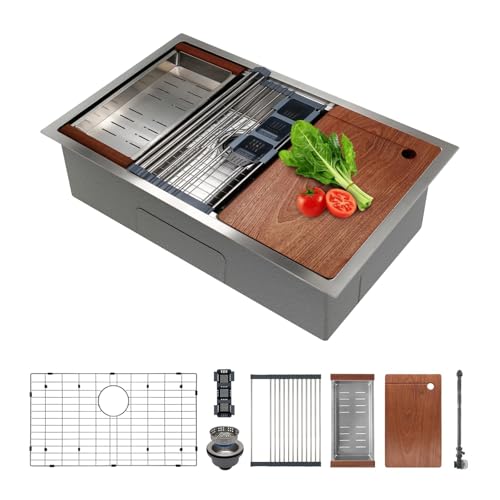
5. SANYCASA 30 Inch Workstation — Best Heavy-Gauge Value
Most value-tier sinks economise on steel. The SANYCASA goes the other way: its listing specifies unusually thick 3mm steel (sold as an 11-gauge class basin) in a 30 inch undermount single bowl with an integrated workstation ledge and a full accessory set. Thick steel is not a spec-sheet vanity — it is what stops a sink from drumming when the disposal runs, flexing when a full stockpot lands, and denting when a skillet slips. This pick suits buyers who want the workstation format and maximum metal for a mid-range tier spend, and who are comfortable choosing a newer brand in exchange. It does not suit buyers who prioritise a long-established warranty network above all else, and — like every undermount here — it needs a 33 inch class cabinet and a counter that can take an undermount.
Strengths
- Exceptionally thick steel for the tier: quiet, rigid, and resistant to dents in daily use.
- Integrated ledge workstation format with a multifunctional accessory set included.
- Single deep bowl keeps the sheet-pan-friendly layout of our top picks.
Trade-offs
- Newer brand: long-term parts and warranty support are less proven than the legacy makers.
- Thick steel is heavy steel — undermount clips and adhesive need to be installed exactly per instructions.
- Accessory fit is specific to this ledge; measure before ordering extras from other brands.
| Spec | Verified detail |
|---|---|
| Outside size | 30 in undermount |
| Material / gauge | Stainless steel, 3mm (listed 11-gauge class) |
| Bowl configuration | Single bowl with integrated ledge |
| Format | Workstation set with accessories |
The sensible way to buy this sink is to verify the unglamorous things on the listing before checkout: the exact outside dimensions, the minimum cabinet size, and precisely which accessories are in the set, because value-brand listings revise bundles more often than legacy brands do. What you are getting for the tier is real, though — in a category where rivals shave the steel thinner every year, a maker competing on thickness is competing on the thing that decides how a sink feels every single day. If the Kore workstation is the refined choice, this is the blunt-instrument choice, and plenty of kitchens are better served by blunt. Check the current price on Amazon
Best for: value-focused buyers who want maximum steel thickness and a workstation ledge / Not suited for: buyers who want a decades-established brand behind the warranty.

6. Oxwiser 30×18 Undermount Bundle — Best Budget
The budget end of the 30 inch market is full of bare, thin sinks that become expensive once you add the grid, drain and clips they omit. The Oxwiser bundle attacks exactly that trap: a 30×18 inch, 16-gauge stainless single bowl sold as a five-piece set — sink, bottom grid, drain assembly, drain cap and towel. On paper, 16-gauge at this tier is the headline; in practice, the bundle completeness is what saves money and a second order. It suits rental-grade remodels, laundry and utility conversions, first kitchens, and anyone whose total sink budget must also cover a faucet. It does not suit buyers expecting flagship fit and finish: expect honest, functional steel rather than jewellery-grade brushing, and check every dimension on delivery before the counter is cut.
Strengths
- Five-piece bundle: the grid and drain assembly most budget sinks leave out are in the box.
- 16-gauge stainless construction at a budget tier, where 18-gauge is the norm.
- Standard 30×18 footprint fits the common 33 inch cabinet and standard cutout templates.
Trade-offs
- Finish and edge work are a step below the premium picks; sound treatment is basic.
- Budget-brand support: keep your order records, and inspect the sink on arrival, not on install day.
- Undermount only, like most of this list — laminate counters should take the drop-in pick instead.
| Spec | Verified detail |
|---|---|
| Outside dimensions | 30 x 18 in |
| Material / gauge | Stainless steel, 16 gauge |
| Bowl configuration | Single bowl, undermount |
| Bundle contents | Sink, bottom grid, drain assembly, drain cap, towel |
Two habits make a budget sink a good buy instead of a gamble. First, unbox and inspect immediately: lay a straightedge across the rim, check the corners, and dry-fit the grid while the return window is wide open. Second, spend the small extra time on installation — full clip set, proper sealant bead, and the drain torqued evenly — because budget sinks are blamed for many leaks that were really rushed installs. Do that, and this bundle delivers the thing the budget tier exists for: a real 30 inch, 16-gauge bowl with everything needed to use it, at a total cost the premium picks cannot approach. Check the current price on Amazon
Best for: tight budgets, rentals, and utility installs that still want 16-gauge steel / Not suited for: buyers expecting premium finishing or flagship soundproofing.
Comparison Table
| Pick | Badge | Key spec | Best for |
|---|---|---|---|
| Kraus KHU100-30 | Best Overall | 30×18 undermount, 16-gauge T-304, full kit | Most stone/quartz remodels |
| Kraus Kore KWU110-30 | Best Workstation | 30 in undermount, 16-gauge, ledge + board + rack | Small kitchens, heavy prep |
| Kraus Kore KWT302-30 | Best Double Bowl / Drop-In | 30 in top mount, 16-gauge, 50/50 split | Laminate counters, replacements |
| TUKTUK Fireclay 30 | Best Farmhouse | 30 in fireclay apron front, reversible | Traditional white farmhouse look |
| SANYCASA 30 Workstation | Best Heavy-Gauge Value | 30 in undermount, 3mm steel, ledge set | Maximum thickness per dollar |
| Oxwiser 30×18 Bundle | Best Budget | 30×18 undermount, 16-gauge, 5-piece set | Rentals and tight budgets |
How to Choose the Best 30 Inch Kitchen Sink for Your Kitchen
Start with the cabinet, not the catalogue. Measure the inside width of your sink base cabinet: a 30 inch undermount or drop-in sink typically requires a 33 inch cabinet, because the bowl, clips and mounting hardware need room the outside dimension does not show. Farmhouse sinks need more — the apron replaces the cabinet’s front rail, and fireclay models need a support frame built inside the cabinet. If your cabinet is a true 30 inches, stop and look at 25–27 inch sinks instead; no amount of product quality fixes a sink that physically cannot be installed. Next, measure front-to-back depth: most 30 inch sinks are 18–19 inches deep front-to-back and fit standard 24 inch counters, but confirm your faucet deck space behind the cutout, especially with a farmhouse install that pushes everything back.
Then choose the mount by your counter material, because the counter decides for you. Stone, quartz, concrete and solid-surface counters support undermount and farmhouse installs. Laminate and tile counters point to drop-in: an undermount on laminate exposes the counter’s core to water at the rim, and it will swell and fail. If you are keeping an existing counter, its cutout decides too — a drop-in with a rim can cover a slightly rough or oversized existing hole, while an undermount demands a precise, finished edge.
Bowl configuration is a lifestyle question disguised as a spec. Single bowls fit the way most people actually cook now: big pans, sheet trays, cutting boards and a dishwasher doing the routine work. Double bowls earn their keep in dishwasher-free kitchens and in households that soak and wash simultaneously — but at 30 inches, a 50/50 split makes each side small, so be honest about your largest pan before choosing one. Bowl depth matters as much: 9–10 inch deep bowls hide mess and contain splashing from tall faucets, while shallower bowls are kinder to shorter users and to anyone with back trouble, because you are not reaching down as far. Finally, if you prep a lot in a small kitchen, treat the workstation ledge as a genuine feature and not a gimmick — but only buy it if the included accessories are ones you will leave out and use.
Steel Gauge, Corner Radius and Sound: The Three Specs That Decide Daily Life
Gauge is the thickness of the stainless steel, and the numbering runs backwards: 16-gauge is thicker than 18-gauge. At 30 inches, 16-gauge is the standard to hold out for. It resists dents when a skillet slips, stays rigid when the bowl is full, and sounds like a sink rather than a drum when water hits it. Eighteen-gauge sinks can be fine at the budget end if the price honestly reflects the thinner steel, but beware listings that advertise a thick rim or deck while the bowl itself is thin — press on the bowl floor of any sink you can inspect in person; flex is the tell. Above 16-gauge you will occasionally find extra-thick claims, like our SANYCASA pick’s 3mm steel; thickness beyond 16-gauge buys quiet and dent resistance with weight as the cost.
Corner radius is the spec nobody photographs and everybody lives with. Handmade-look sinks with near-zero-radius corners have crisp modern lines and the most usable flat floor — and corners that trap food paste and need a brush. Sinks with generously rounded corners wipe clean in one motion and give up a little floor area. The middle ground, a small radius around 10mm, is what most households are happiest with: modern enough, cleanable enough. Drain position matters too: a rear-set drain frees cabinet space below for bins and plumbing, and lets large pans sit flatter because the drain is not under their centre of gravity.
Sound treatment is the third leg. Bare steel is loud. Better sinks add rubber pads on the underside; the best add pads plus a full sprayed undercoating, which also reduces condensation on the bowl’s underside in humid kitchens — condensation that can drip onto cabinet floors. If a listing says nothing about soundproofing, assume there is none. A bottom grid, meanwhile, is not an accessory but part of the sink system: it protects the finish from pan scratches, keeps items off standing water, and quiets impacts. Prefer sinks that include a fitted grid, as all six of our picks do in one form or another.
Budget Tiers for a 30 Inch Sink: What Each Level Actually Buys
Without printing prices, the 30 inch market falls into three honest tiers, and knowing what each tier buys stops both overspending and false economy. The budget tier buys a functional bowl: real stainless, usually honestly gauged if you shop carefully, but basic sound treatment, simpler finishing, and brand support that amounts to a return window. The winning move at this tier is bundle completeness — a sink with the grid and drain included, like our budget pick, beats a bare sink plus separate accessories almost every time. The mid tier is where most households should land: true 16-gauge steel, full soundproofing, fitted accessories, cutout templates that match the sink, and makers who stock replacement grids years later. The premium tier buys refinement rather than function: workstation ledges machined to tighter tolerances, heavier steel, fireclay and other statement materials, and finishes that age more gracefully. What the premium tier does not buy is a sink that washes dishes better — past the mid tier, you are paying for feel, quiet, looks and longevity of support, which are legitimate things to pay for on a fixture you will touch every day for fifteen years. One cost every tier shares and first-time buyers forget: installation extras. Budget for clips or adhesive, sealant, a possible new drain or disposal flange, and — for farmhouse installs — the cabinet framing, before comparing headline numbers.
How to Measure for and Install a 30 Inch Sink
Most 30 inch sink installs are a weekend job for a careful DIYer, and the steps below cover the undermount case, with notes for drop-in and farmhouse differences.
- Measure three times: cabinet inside width (33 inches minimum for most 30 inch sinks), counter depth front-to-back, and the distance from the counter’s front edge to your faucet holes. Write the sink’s listed minimum cabinet size next to your measurement and confirm they agree.
- Dry-fit before anything is cut: if the counter is new, use the sink’s included cutout template — and verify the template against the physical sink, because template errors exist. If replacing a sink, measure the existing cutout and confirm the new sink’s rim (drop-in) or bowl (undermount) works with it.
- Prepare the cabinet: for undermounts, confirm the counter fabricator has finished and polished the cutout edge. For a farmhouse fireclay sink, build the support frame now — horizontal cleats and a platform rated for the sink’s weight plus a full bowl of water — and dry-set the sink to check the apron reveal.
- Fit the hardware to the sink first: attach the drain assembly (and disposal flange, if you run a disposal) to the sink while it is upside down on a padded surface. It is dramatically easier now than lying in the cabinet later.
- Set the sink: for an undermount, run a bead of silicone sealant around the rim, lift the sink into position with a helper or a simple support jig, and engage all mounting clips evenly, snugging them in rotation rather than fully tightening one side. For a drop-in, set the sink into the cutout on its sealant or gasket, then tighten the underside clips in the same rotation.
- Connect and wait: connect the trap and water supplies, then respect the sealant’s cure time before filling the bowl. Fill, wait, and inspect every joint with a dry paper towel — it shows slow seeps your fingers miss.
- Final checks: run the disposal if fitted, check for vibration against the clips, confirm the bottom grid sits flat, and register the warranty while the paperwork is still on the counter.
Two safety notes that are not fine print: a fireclay sink full of water is extremely heavy, so never rely on adhesive or clips alone for an apron-front install — the frame carries it. And if your install involves moving a gas line, a supply line inside a wall, or electrical work for a disposal where none existed, that is licensed-trade territory in most jurisdictions; the sink itself is DIY, the infrastructure may not be.
Common Buying Mistakes
- Buying the sink before measuring the cabinet. The single most common failure in this category. A 30 inch sink needs a 33 inch cabinet; farmhouse models need framing. Measure the box, not the countertop.
- Choosing an undermount for a laminate counter. The exposed core at the rim absorbs water and swells. Laminate means drop-in — or a new counter first.
- Chasing zero-radius corners for the look. Crisp corners photograph beautifully and collect grime daily. Most households are happier with a small, wipeable radius.
- Ignoring the drain position. A centre drain under a big pan makes the pan rock; a rear drain also returns real storage space under the sink.
- Forgetting the accessories in the budget. Grid, drain assembly, clips and sealant are part of the purchase. A “cheap” bare sink is often the expensive option by checkout two.
- Skipping the faucet reach check. Deep 30 inch bowls and farmhouse aprons move the bowl’s centre forward or back; confirm your faucet’s reach actually lands water in the bowl, not on its back wall.
- Assuming all “16-gauge” claims are equal. Some listings describe the deck or use vague equivalence language. Prefer makers who state the bowl gauge plainly, and verify the model number on the listing matches the sink you researched.
Final Recommendation
For most readers, the answer is the Kraus KHU100-30: true 16-gauge steel, a complete kit, rounded cleanable corners, and a bowl that fits the way people actually cook. If your kitchen is small and your counters are full, step up to the Kraus Kore KWU110-30 and let the ledge earn its keep every day. Laminate counters or a replacement job point to the Kraus Kore KWT302-30, while the farmhouse look is best served by the TUKTUK fireclay sink — with the cabinet framing budgeted honestly. Value hunters who think in steel thickness should look at the SANYCASA workstation, and tight budgets are genuinely well served by the Oxwiser bundle rather than by a bare sink from a bigger brand.
Still deciding between sizes and specs? Compare this guide with our coverage of Best 16 Gauge Stainless Steel Undermount Kitchen Sinks for a gauge-first view, Best 32 Undermount Stainless Steel Kitchen Sinks if your cabinet turns out wider than expected, and Best 36 Inch Kitchen Sinks for true farmhouse-scale options. On a tighter spend, Best Affordable Kitchen Sinks rounds up the value end, and if width is your real constraint, Best 24 Single Bowl Kitchen Sinks covers the compact class.
Frequently Asked Questions
Will a 30 inch sink fit a 30 inch cabinet?
Almost never. The 30 inches describes the sink, not the cabinet. Most 30 inch undermount and drop-in sinks require a 33 inch base cabinet, and farmhouse models need a support frame inside the cabinet as well. Always check the sink’s stated minimum cabinet size against your cabinet’s inside width before ordering.
Is 16-gauge steel really better than 18-gauge for a kitchen sink?
Yes, in ways you feel daily. Sixteen-gauge is thicker: it dents less when cookware slips, flexes less under a full bowl, and sounds quieter with water and disposal noise. Eighteen-gauge is acceptable at the budget end if the price is honest about it, but 16-gauge is the standard to aim for in a sink you will keep for a decade or more.
Can I install a 30 inch undermount sink with laminate countertops?
You should not. An undermount exposes the cut edge of the counter, and laminate’s core absorbs water at that edge, swells, and delaminates. For laminate, choose a drop-in sink whose rim seals over the edge — our KWT302-30 pick exists for exactly this case — or plan the undermount for when the counters are replaced with stone or solid surface.
Single bowl or double bowl at 30 inches?
Choose single if you cook with sheet pans, roasters or large pots, and especially if you have a dishwasher: the uninterrupted basin fits everything. Choose a 50/50 double bowl only if you regularly hand-wash with a soak-and-rinse routine and your largest pans are modest, because each half of a 30 inch split is genuinely small.
Are workstation sink ledges worth it?
They are worth it if the accessories will live on the ledge — a roll-up drying rack and a cutting board over the bowl reclaim real counter space in small kitchens. If you know the accessories would end up in a drawer, a plain bowl of the same steel is the better buy, and the money saved can go toward the faucet.
How do I keep a stainless sink looking good?
Rinse and wipe after heavy use, dry the bowl when you can in hard-water areas, and keep the bottom grid in place to prevent pan scratches. Clean with a soft cloth and mild detergent, rubbing in the direction of the brushed grain. Fine scratches are normal and blend into the patina over time; avoid steel wool and undiluted bleach, which damage the finish rather than clean it.


