Disclosure: airfryerkitchensupply.com is reader-supported. When you buy through links on our site, we may earn an affiliate commission at no extra cost to you.
Where to buy
If you are shopping for the best compressor type ice cream makers, start here: every linked model below was cross-checked against Amazon’s own catalog data for this site before this guide was written, and only models with a confirmed listing carry a buying link. Compressor ice cream makers are heavy, spec-sensitive purchases, so use the links here to confirm the exact model number on the product page before ordering — a single letter difference in the model code usually means a different capacity or a freezer-bowl machine instead of a true compressor model.
- Whynter ICM-201SB Upright Ice Cream Maker 2.1 Qt (Best Overall) — check price on Amazon
- Cuisinart ICE-100 Compressor Ice Cream Maker 1.5 Qt (Best for Small Batches) — check price on Amazon
- Breville BCI600XL Smart Scoop Ice Cream Maker (Best Premium) — check price on Amazon
- Whynter ICM-200LS Ice Cream Maker 2.1 Qt (Best for Back-to-Back Batches) — check price on Amazon
- Whynter ICM-220SSY Ice Cream Maker & Yogurt 2 Qt (Best for Yogurt Makers) — check price on Amazon
- Whynter ICM-128WS Ice Cream Maker with Compressor 1.28 Qt (Best Compact) — check price on Amazon
If you are shopping for the best compressor type ice cream makers, the deciding fact is simple: a built-in compressor freezes the mixture as it churns, so there is no freezer bowl to pre-chill for a day and no rock salt or bagged ice to manage. You pour in a base, press start, and the machine holds freezing temperature for as long as you need, including back-to-back batches. That convenience is exactly what separates this category from the cheaper freezer-bowl models that dominate entry-level listings.
The trade-off is equally simple. Compressor machines are bigger, heavier, and firmly in the premium tier as a category. They earn that position when you make ice cream often, when you want to test several flavours in one afternoon, or when your freezer simply has no room to store a bulky bowl permanently. If you make ice cream twice a year, a freezer-bowl machine is the honest recommendation and this guide will say so where it matters. If you make it twice a month, a compressor is the upgrade that removes the planning step entirely.
The six picks below cover the realistic spread of the category: two family-size 2.1-quart machines, a 2-quart model with a dedicated yogurt function, a well-known 1.5-quart countertop unit, a premium machine that senses hardness automatically, and a compact 1.28-quart option for small kitchens. Every pick is a genuine compressor model — no freezer-bowl machines have been padded into the list to fill space.
In this guide
Quick Picks
Short on time? These six compressor models are the shortlist. The badges match the detailed reviews further down, so you can jump straight to the model that fits your kitchen.
- Whynter ICM-201SB Upright Ice Cream Maker 2.1 Qt — Best Overall. A 2.1-quart upright compressor machine with an LCD display and timer that handles family batches and back-to-back flavours without any pre-freezing. — Check on Amazon
- Cuisinart ICE-100 Compressor Ice Cream Maker 1.5 Qt — Best for Small Batches. Cuisinart’s long-running 1.5-quart compressor machine with two paddles — one for ice cream and one for gelato — in a comparatively tidy countertop body. — Check on Amazon
- Breville BCI600XL Smart Scoop Ice Cream Maker — Best Premium. Breville’s premium compressor machine, known for automatic hardness sensing and a full spread of settings from sorbet to frozen yogurt and gelato. — Check on Amazon
- Whynter ICM-200LS Ice Cream Maker 2.1 Qt — Best for Back-to-Back Batches. The stainless 2.1-quart Whynter with built-in compressor, LCD display and timer — a workhorse layout for households that churn several flavours in a row. — Check on Amazon
- Whynter ICM-220SSY Ice Cream Maker & Yogurt 2 Qt — Best for Yogurt Makers. A 2-quart compressor machine with a dedicated yogurt function alongside ice cream — one appliance covering both the incubator and the freezer jobs. — Check on Amazon
- Whynter ICM-128WS Ice Cream Maker with Compressor 1.28 Qt — Best Compact. The smallest true compressor machine on this list at 1.28 quarts — no pre-freezing in a footprint that suits apartments and small counters. — Check on Amazon
How These Picks Were Chosen
We built this list by starting from what makes a compressor machine worth owning and eliminating everything that failed those tests. First, the machine had to freeze with its own compressor — models that rely on a pre-frozen bowl were excluded even when their marketing uses words like automatic. Second, capacity had to match the claim: a family machine needs roughly two quarts, while a compact machine is judged on footprint and single-batch quality instead of size. Third, we weighted controls that matter in real use — a timer you can extend mid-cycle, a keep-cool function that holds texture after churning stops, and a removable bowl and paddle that wash without a fight.
Each product below was then verified individually: the brand and model were searched in Amazon’s catalog data for this site, the returned title was matched against the intended product, and only a confirmed match received a buying link. Specifications quoted in the mini spec boxes come only from that verified listing data. Where a well-known model could not be confirmed, it was left off rather than listed on memory. Finally, we ordered the picks by the job they do best rather than by price, because in this category the cheapest machine that fits your routine beats an expensive one that does not.
The 6 Best Compressor Type Ice Cream Makers
Each review explains who the machine suits, where it is strong, where it compromises, and the verified specifications that matter. Links appear only on models confirmed in Amazon’s catalog for this site.
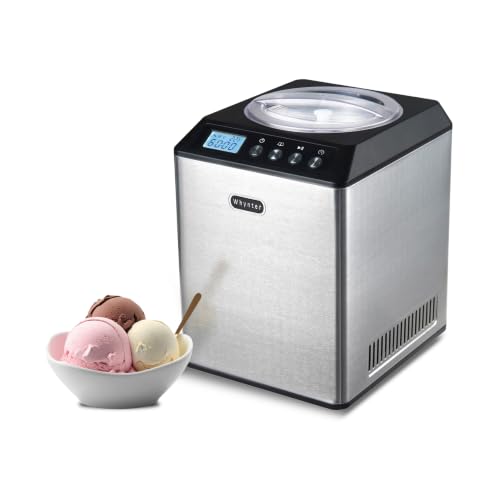
Whynter ICM-201SB Upright Ice Cream Maker 2.1 Qt — Best Overall
The Whynter ICM-201SB is the machine we would point most households to first. Its upright shape uses counter space more politely than wide, low compressor units, the 2.1-quart bowl is genuinely family-sized, and the control set — LCD display, timer, and a removable bowl and churn blade — covers what home makers actually use week after week. It freezes with its own built-in compressor, so a second batch can start the moment the first one is scooped out.
Strengths
- True built-in compressor: no pre-freezing and no gap between batches
- 2.1-quart capacity suits family desserts and small gatherings
- Upright footprint is easier to place than wide compressor bodies
Trade-offs
- Upright height needs clearance under low wall cabinets
- Heavier than freezer-bowl machines, so it tends to live on the counter
- Single bowl included; a spare bowl is a separate purchase
| Type | Compressor, no pre-freezing (per verified listing) |
| Capacity | 2.1 Qt |
| Controls | LCD display and timer (per verified listing) |
| Bowl | Removable bowl with churn blade |
In daily use the ICM-201SB’s advantage is rhythm. Because the compressor holds temperature, you can churn a vanilla base, move it to a container, and immediately start a sorbet while the first batch firms up in the freezer. Freezer-bowl machines force a full day of re-freezing between those two jobs. The timer and display remove the guesswork that leads to over-churned, icy texture: set the cycle, let the machine stop on time, and use the keep-cool behaviour to hold a finished batch briefly while you finish a meal. The removable bowl matters more than it sounds — compact compressor machines with fixed bowls are slower to clean and harder to scrape clean, and residue left behind flavours the next batch. For households that make ice cream as a regular dessert rather than an annual project, this is the balanced point of capacity, footprint, and control.
Ownership details are reassuringly plain. The bowl and blade come out as one simple routine, there are no app connections or accounts to manage, and the control language on the display is the kind any family member can run without a briefing. Noise is present — every compressor machine hums and cycles — but in this upright class it reads as a background appliance sound rather than a conversation-stopper, and it stops mattering once the machine becomes part of the weekly rhythm.
Best for: Families who make ice cream regularly and want back-to-back batches / Not suited for: Kitchens with very low under-cabinet clearance or no permanent counter spot
Check the current price on Amazon

Cuisinart ICE-100 Compressor Ice Cream Maker 1.5 Qt — Best for Small Batches
The Cuisinart ICE-100 has been the default answer in this category for years for a reason: it is a real compressor machine in a size that suits couples and small households, and it ships with two paddles so gelato gets the slower, denser churn it needs instead of being treated like ordinary ice cream. The 1.5-quart capacity is honest — enough for a dinner-party dessert, not so much that leftovers live in the freezer for a month.
Strengths
- Built-in compressor with no pre-freezing, per the verified listing
- Two paddles included, including a dedicated gelato paddle
- 1.5-quart size suits small households and limits waste
Trade-offs
- Too small for large gatherings without running two cycles
- Brushed body shows fingerprints and needs a wipe-down habit
- Premium-tier positioning for its capacity class
| Type | Compressor, no pre-freezing (per verified listing) |
| Capacity | 1.5 Qt |
| Paddles | 2 paddles included (per verified listing) |
| Best-known use | Ice cream and gelato in one machine |
The two-paddle detail is what keeps the ICE-100 relevant. Gelato is churned slower and served warmer and denser than American-style ice cream; a single aggressive paddle whips in air and erases that difference. Swapping paddles takes seconds and genuinely changes the result. The compressor itself is unremarkable in the best way — it reaches temperature, holds it, and lets you run a second flavour immediately. Where the ICE-100 asks for compromise is scale: 1.5 quarts disappears fast with four enthusiastic eaters, and the machine’s keep-cool window is for holding texture, not for storing a batch all afternoon. Buy it as a quality small-batch machine and it is excellent; buy it expecting party volume and you will run it twice and wish you had chosen the 2.1-quart class.
One underappreciated strength is restraint in the control design. The ICE-100 does not bury the simple job of churning under layers of programmes; you set a time, you can add time, and the machine holds its cool-down behaviour predictably. For cooks who develop two or three house recipes and repeat them for years, that predictability is worth more than novelty features. Parts and accessories for long-running Cuisinart models also tend to remain obtainable, which matters for a machine bought as a decade-long appliance rather than a seasonal toy.
Best for: Couples and small households who also want proper gelato / Not suited for: Anyone regularly serving six or more people in one batch
Check the current price on Amazon

Breville BCI600XL Smart Scoop Ice Cream Maker — Best Premium
The Breville Smart Scoop is the pick for the cook who treats ice cream as a craft. It is a compressor machine that goes further than a timer: it senses the hardness of the mixture as it churns and adjusts, and it offers dedicated settings across the frozen-dessert range. The brushed stainless body is the largest presence on this list, and the machine is unapologetically a premium-tier purchase.
Strengths
- Compressor freezing with automatic hardness sensing
- Settings span sorbet, frozen yogurt, gelato, and ice cream
- Keep-cool holding after the cycle for flexible serving
Trade-offs
- Largest and heaviest style of machine in this roundup
- Premium tier; overkill for occasional use
- Feature depth rewards reading the manual once, properly
| Type | Compressor ice cream maker (per verified listing) |
| Model | BCI600XL Smart Scoop |
| Finish | Brushed stainless steel (per verified listing) |
| Programmes | Multiple frozen-dessert settings |
Hardness sensing sounds like marketing until you make a high-sugar sorbet and a low-sugar custard on the same day. Sugar depresses the freezing point, so a fixed timer under-churns one and over-churns the other; a machine that reacts to the mixture itself lands both closer to the intended texture. The Smart Scoop also adds the small courtesies that frequent makers notice: an audible cue when it is time to add mix-ins, so chocolate chips and cookie pieces fold through instead of sinking, and a manual mode for recipes you have already dialled in. None of this makes it the right buy for everyone. It is the right buy when you already own a freezer-bowl machine, use it constantly, and want the upgrade to be about control rather than just convenience.
The Smart Scoop also handles the social side of dessert better than most. Its keep-cool holding means a batch finished before dinner is still presentable when the table is ready, and the add-in cue protects the texture of expensive ingredients — good chocolate and roasted nuts deserve better than being frozen into a lump at the bottom of the bowl. If you regularly cook for people who notice texture, this is the machine whose results most often get commented on, and that feedback loop is what keeps an enthusiast machine in regular use.
Best for: Enthusiasts who make varied frozen desserts and want texture control / Not suited for: Occasional makers, who will not use the extra programmes
Check the current price on Amazon

Whynter ICM-200LS Ice Cream Maker 2.1 Qt — Best for Back-to-Back Batches
The ICM-200LS is Whynter’s stainless-steel take on the same 2.1-quart compressor formula as our Best Overall pick, with a low, wide body instead of the upright shape. That shape is its personality: it slides under cabinets more easily in some kitchens, presents a stable, planted feel on the counter, and suits makers who run flavour after flavour on a weekend afternoon.
Strengths
- 2.1-quart compressor capacity for family-size batches
- LCD display and timer, per the verified listing
- Low-profile body can fit where tall uprights cannot
Trade-offs
- Wide footprint claims more counter width than the upright model
- Stainless finish needs regular wiping to look its best
- Overlaps closely with the ICM-201SB; choose on shape, not specs
| Type | Built-in compressor, no pre-freezing (per verified listing) |
| Capacity | 2.1 Qt |
| Controls | LCD display and timer (per verified listing) |
| Body | Stainless-steel style, low and wide |
Choosing between the two 2.1-quart Whynters is mostly a tape-measure decision, and that is a compliment to both. The ICM-200LS earns its own slot because its low body solves a real problem: many kitchens have a run of counter beneath genuinely low cabinets, where an upright machine cannot open or cannot sit at all. The wide base is also confidence-inspiring when you are scraping a firm batch out of the bowl. Performance expectations should be set correctly — this is a family dessert machine, not a commercial unit, and very hard, low-sugar bases will still benefit from a short rest in the freezer after churning. For a household that wants one machine to cover birthdays, barbecues, and experimental sorbet Sundays, it is a durable, sensible answer.
Expect the same ownership pattern as its upright sibling: simple controls, a removable bowl routine that keeps cleaning honest, and a compressor that does not care whether the freezer is full of holiday food. The wide body does ask for a deliberate storage decision — measure the cupboard run or commit the counter space before it arrives. Households that entertain outdoors in summer also rate this shape, because the low centre of gravity travels more calmly to a sideboard or serving counter than a tall unit does.
Best for: Households with low cabinets who churn multiple flavours per session / Not suited for: Narrow counters where width is scarcer than height
Check the current price on Amazon

Whynter ICM-220SSY Ice Cream Maker & Yogurt 2 Qt — Best for Yogurt Makers
Most compressor machines do one job. The ICM-220SSY does two: it churns and freezes ice cream with its built-in compressor, and it carries a yogurt function for households that culture their own yogurt and then want to turn some of it into frozen yogurt without changing appliances. At 2 quarts it stays in the family-size class while adding that second role.
Strengths
- Compressor freezing plus a dedicated yogurt function
- 2-quart capacity keeps it in family territory
- LCD digital display and timer, per the verified listing
Trade-offs
- Dedicated yogurt makers may still prefer a separate incubator for large batches
- Two-role machines ask you to learn two routines
- Like all compressor units, it wants a permanent home on the counter
| Type | Built-in compressor, no pre-freezing (per verified listing) |
| Capacity | 2 Qt |
| Functions | Ice cream and yogurt (per verified listing) |
| Controls | LCD digital display and timer (per verified listing) |
The honest way to judge a two-role machine is to ask whether each role is real. Here the yogurt function is a genuine programme rather than a sticker, and the pairing makes practical sense: homemade yogurt cultures at warm temperatures for hours, and frozen yogurt is the natural next step for the same household. If your kitchen already ferments, ferments-adjacent appliances earn their space by consolidating, and counter space is the scarcest resource in most kitchens. The ice-cream side follows the established Whynter pattern — compressor freezing, a timer, a removable bowl routine — so there is no experimental risk in the primary job. Choose it when both halves of the proposition match your habits; if you will never culture yogurt, the single-purpose picks above are the cleaner buy.
The yogurt role also changes the shopping maths. A household buying tubs of yogurt weekly and churning frozen desserts monthly is running two habits through one appliance, and consolidation is the only honest way a premium-tier machine earns a small kitchen’s space. The learning curve is real but short: one careful read of the yogurt programme timing, one test batch, and the routine becomes as automatic as the ice-cream side. If your household ferments anything else — kefir drinkers, this means you — the cultural fit is already there.
Best for: Households that make their own yogurt and frozen desserts / Not suited for: Buyers who want a single-purpose machine and nothing else
Check the current price on Amazon

Whynter ICM-128WS Ice Cream Maker with Compressor 1.28 Qt — Best Compact
Compact usually means compromise in this category, because small machines are normally freezer-bowl models. The ICM-128WS is the exception worth knowing: a genuine compressor machine scaled down to 1.28 quarts, in a white finish that disappears into small, light kitchens. It exists for the apartment cook who wants the no-pre-freeze routine without giving a quarter of the counter to a family machine.
Strengths
- True compressor freezing in a compact body
- 1.28-quart batches suit one to three people with little waste
- LCD display and timer, per the verified listing
Trade-offs
- Small batches mean two cycles for a group dessert
- Compact compressor still weighs more than a freezer-bowl mini
- Less headroom for chunky mix-ins than the 2-quart class
| Type | Compressor, no pre-freezing (per verified listing) |
| Capacity | 1.28 Qt |
| Controls | LCD display and timer (per verified listing) |
| Finish | White |
Small-batch ice cream is underrated. A 1.28-quart machine lets you test a brown-butter base or a single seasonal fruit sorbet without committing two quarts of ingredients to an experiment, and leftovers stay a treat instead of a freezer obligation. The compressor is the whole point: in a small apartment the freezer is usually the smallest compartment in the kitchen, and a freezer-bowl machine demands permanent residence in exactly that space. This Whynter asks for counter space instead, which most small kitchens can negotiate more easily. Set expectations on texture correctly — like every home compressor unit it produces a soft-serve consistency straight from the churn, and an hour or two in the freezer firms it to scoopable. Within its size class, it is the complete package.
There is a social size advantage too: a 1.28-quart batch is a dessert for tonight, not a commitment. That makes the machine the one most likely to be used on a whim — a Tuesday sorbet from fruit that needs using, a small test of a new custard — and whims are where home ice cream is at its best. The white finish and modest silhouette also make it the easiest compressor machine on this list to leave out in a small, bright kitchen without it visually dominating the room.
Best for: Apartments, couples, and experimental small-batch makers / Not suited for: Families who need a full two quarts in a single run
Check the current price on Amazon
Comparison Table
| Pick | Badge | Key spec | Best for |
|---|---|---|---|
| Whynter ICM-201SB Upright Ice Cream Maker 2.1 Qt | Best Overall | 2.1 Qt compressor, LCD timer | Families who make ice cream regularly and want back-to-back batches |
| Cuisinart ICE-100 Compressor Ice Cream Maker 1.5 Qt | Best for Small Batches | 1.5 Qt compressor, 2 paddles | Couples and small households who also want proper gelato |
| Breville BCI600XL Smart Scoop Ice Cream Maker | Best Premium | Compressor with hardness sensing | Enthusiasts who make varied frozen desserts and want texture control |
| Whynter ICM-200LS Ice Cream Maker 2.1 Qt | Best for Back-to-Back Batches | 2.1 Qt compressor, LCD timer | Households with low cabinets who churn multiple flavours per session |
| Whynter ICM-220SSY Ice Cream Maker & Yogurt 2 Qt | Best for Yogurt Makers | 2 Qt compressor + yogurt function | Households that make their own yogurt and frozen desserts |
| Whynter ICM-128WS Ice Cream Maker with Compressor 1.28 Qt | Best Compact | 1.28 Qt compact compressor | Apartments, couples, and experimental small-batch makers |
What actually makes a compressor ice cream maker different?
The difference is where the cold comes from. A freezer-bowl machine borrows cold from your freezer: you freeze a gel-filled bowl for many hours, then the bowl slowly gives that cold back while the paddle turns, which is why the texture softens if a batch runs long. A compressor machine makes its own cold continuously, the same way a refrigerator does. It reaches freezing temperature on its own, holds it steadily for the full churn, and can start again immediately.
Three practical consequences follow. First, timing becomes flexible — dessert no longer depends on remembering to freeze a bowl yesterday. Second, batch rhythm changes: several flavours in one session is normal, which is how you build a small freezer library of bases. Third, texture is more repeatable, because the temperature curve of a batch is the same in July as in January, while a freezer bowl’s performance depends on your freezer’s setting and how full it is. The costs are size, weight, and tier. If those consequences do not match how you cook, the honest answer is that you do not need this category at all.
How much capacity do you really need?
Capacity in this category clusters into three honest bands. Around 1.3 to 1.5 quarts serves one to four people a fresh dessert with modest leftovers, and suits couples, small households, and experimental makers. Around 2 to 2.1 quarts is the family band: a full dessert for five or six, or a base batch large enough to split into two flavours with different mix-ins. Beyond that, home compressor machines largely stop; party-scale production is done by running a 2-quart machine twice, which the compressor makes painless.
Two cautions belong here. Bowl capacity is not finished yield in a simple one-to-one sense, because mixtures expand as air is incorporated and because very full bowls churn poorly — leave headroom rather than filling to the rim. And bigger is not automatically better: a 2.1-quart machine making a half-batch can churn unevenly, with the mixture climbing the paddle instead of folding. Match the machine to your typical batch, not your biggest imagined party, and let the compressor’s back-to-back ability cover the exceptions.
Which controls and features are worth paying for?
Start with the features that change results. A timer you can adjust matters because bases differ: custards, sorbets, and low-sugar mixtures finish at different times, and a machine that only runs one fixed cycle forces you to babysit it. A keep-cool function matters because life interrupts dessert — holding a finished batch at serving texture for a short window prevents the melt-and-refreeze cycle that creates ice crystals. A removable bowl and paddle matter every single time you clean up.
Below that tier sit the nice-to-haves: hardness sensing for makers who vary sugar and fat content a lot, multiple programmes for households that genuinely rotate between gelato, sorbet, and frozen yogurt, and add-in signals that tell you when chunky ingredients will distribute instead of sinking. What is not worth paying for is novelty — novelty programmes you will use once, decorative finishes on a machine that lives in a cupboard, and capacity claims that count the bowl rather than a realistic batch. Spend on temperature control and cleanability first; they decide whether the machine is still in weekly use a year from now.
How to Get Smooth, Scoopable Results From a Compressor Machine
Step 1 — Chill the base before it goes in. A compressor removes the pre-frozen bowl, not the laws of thermodynamics. A base that starts cold churns faster and finer than a warm one, so refrigerate custard bases until fully cold, ideally overnight, which also improves flavour as the ingredients meld.
Step 2 — Let the machine pre-cool. Run the empty machine for a few minutes before adding the base if your model offers a pre-cool step. Pouring a base onto a room-temperature bowl wastes the coldest minutes of the cycle on the bowl itself.
Step 3 — Fill with headroom. Fill to roughly two-thirds of the bowl. The mixture needs room to expand as air folds in, and an overfilled bowl climbs the paddle, churns unevenly, and can strain the motor on thick bases.
Step 4 — Add mix-ins late. Chocolate chips, nuts, cookie pieces, and fruit go in during the final minutes, when the base is thick enough to suspend them. Added early, they sink, freeze into a bottom layer, and can jam the paddle.
Step 5 — Judge doneness by texture, not the clock. A finished batch looks like soft-serve and pulls away from the bowl sides in slow folds. Timers are guides; sugar content and starting temperature shift the real finish by several minutes either way.
Step 6 — Harden before scooping. Transfer the batch to a shallow, lidded container and freeze for one to two hours for scoopable firmness. Press parchment or wrap directly on the surface to limit ice crystals, and let a fully frozen batch sit on the counter briefly before serving so the texture opens up.
Step 7 — Clean promptly, dry fully. Wash the removable bowl and paddle in warm soapy water, dry them completely before storage, and wipe the machine body with a damp cloth only — the compressor housing is never immersed. A clean, dry bowl keeps the next batch tasting like itself.
Compressor vs freezer-bowl vs salt-and-ice: which style fits your kitchen?
Freezer-bowl machines are the lightest and sit in the entry tier. Their weakness is logistics: the bowl lives in your freezer, needs many hours to freeze solid, and produces one batch per freezing. They suit small freezers with spare room and households that plan dessert a day ahead. Salt-and-ice machines, including the nostalgic wooden-bucket style, make large batches and a good afternoon activity, but they consume ice and salt, make a wet mess, and ask someone to supervise. They are event machines, not routine machines.
Compressor machines invert every one of those compromises. They are the heaviest and sit in the premium tier, but they ask nothing of your freezer, start on demand, repeat batches back-to-back, and hold a steady temperature that makes results repeatable. The deciding question is frequency. A household that churns monthly or more will feel the freezer-bowl routine as friction every single time; a household that churns twice a year will feel a compressor machine as an expensive cupboard resident. Be honest about which household you are, because the machines themselves are all competent at the job they were designed for.
There is also a middle habit worth naming: many owners of compressor machines still keep a small freezer-bowl unit for taking to a holiday house or a relative’s kitchen. Portability is the one axis where the compressor design simply cannot compete, and no amount of budget changes that.
How do you care for a compressor machine so it lasts?
Compressor appliances reward boring habits. Keep the vents clear — the machine moves heat as it makes cold, and a unit pushed tight against a wall or buried under shopping bags will run hotter, louder, and longer. Leave breathing room on the sides and back, and never cover the top vents while it runs. After moving the machine, let it stand upright for a while before switching it on, so the refrigeration system settles; treat it with the same patience you would give a refrigerator after a move.
For the food-contact parts, wash the bowl and paddle promptly, dry them fully, and never leave mixture residue to dry onto the surfaces — dried custard is abrasive to scrub and flavours the next batch if any trace survives. The body and freezing chamber get a damp-cloth wipe only; water and compressor housings do not mix. Store the machine with the lid ajar or the bowl removed so no stale odour develops, and run a plain, pleasant batch — a simple vanilla — after any strongly flavoured experiment like coffee or mint if you notice carry-over. None of this is difficult, but it is the difference between a machine that serves a decade of summers and one that fades in three.
Finally, respect the duty cycle. Home compressors are built for batch after batch in a session, but they are not commercial units rated for all-day production at an event. If you are catering a crowd, work in sessions with rests between them, transfer finished batches to the freezer promptly, and let the machine breathe. It will repay the courtesy with consistent texture all afternoon.
How much counter space and noise should you expect?
Plan space honestly. Compressor machines in this roundup occupy roughly the footprint of a large stand mixer to a small microwave, and the upright models trade width for height while the low models do the opposite. What surprises buyers is rarely the footprint itself but the clearance: lids lift, bowls rise out, and vents need air on the sides and rear. Measure the working space, not just the parking space, and include the spot where a hot, just-washed bowl will be set down during a session.
Noise deserves the same honesty. A compressor cycles on and off like a small refrigerator, and the churn motor adds a steady mechanical note. In a kitchen during cooking and conversation this disappears into the background; in a studio apartment where the kitchen is also the living room and bedroom, run batches earlier in the evening rather than late at night. None of the machines on this list is silent, and any listing that promises silent operation for a compressor appliance should be read with suspicion.
Weight follows the same logic. These are move-with-two-hands appliances. If your routine involves carrying the machine from a garage shelf to the kitchen for every use, be honest about whether that friction will quietly end the habit — a slightly smaller model that lives on the counter will make more ice cream over a year than a larger one that lives in storage.
Common Buying Mistakes
Buying a freezer-bowl machine by mistake. The most common error in this category is paying compressor expectations for a bowl machine because the listing language said automatic. Check for the words built-in compressor or no pre-freezing, and confirm the exact model number before ordering.
Ignoring the tape measure. Compressor machines are the largest appliances in the home ice-cream world. Measure height under cabinets, counter depth, and the cupboard or counter spot where the machine will live — including room for the lid and bowl to lift out.
Churning a warm base and blaming the machine. A warm base produces coarse, icy texture in any home machine. The fix is patience with chilling, not a more expensive appliance.
Overfilling for a bigger batch. A bowl filled to the rim churns badly and can overflow as the mixture expands. Two correct batches beat one ruined one, and a compressor makes the second batch easy.
Storing ice cream in the churn bowl. The bowl is for making, not storing. Leaving a batch in it freezes it rock-hard around the paddle and stresses the parts; transfer to a proper container every time.
Skipping the second-batch advantage. Owners often keep freezer-bowl habits — one flavour, occasionally — and never use the feature they paid for. Plan sessions in pairs of flavours and the machine earns its counter space within a month.
Final Recommendation
For most households, start with the Whynter ICM-201SB — Best Overall: family capacity, an upright footprint, and the full no-pre-freeze routine. If your cabinets are low and your counter is wide, the Whynter ICM-200LS — Best for Back-to-Back Batches covers the same ground in the other shape. Small households should look hard at the Cuisinart ICE-100 — Best for Small Batches for its gelato paddle, or the Whynter ICM-128WS — Best Compact when space is the binding constraint. Enthusiasts who vary recipes constantly will get the most from the Breville Smart Scoop — Best Premium, and households that culture their own yogurt should shortlist the Whynter ICM-220SSY — Best for Yogurt Makers.
Keep exploring the frozen-dessert shelf with Best Counter Top Ice Makers, Best Counter Top Portable Ice Makers, and Best Ice Cream Makers, then round out the kitchen with Best Coffee Grinders For Espresso Machines and Best Food Processors 700 Watt Or More.
Frequently Asked Questions
Do compressor ice cream makers really need no pre-freezing?
Yes. The built-in compressor generates cold the way a refrigerator does, so there is no bowl to freeze in advance and no waiting between batches. You should still chill your mixture base in the refrigerator before churning, because a cold base churns faster and produces a finer, smoother texture than a warm one.
How long does a batch take in a compressor machine?
Most home batches finish churning in roughly half an hour to an hour depending on the base, its starting temperature, and the batch size. The result at that point has a soft-serve consistency; transferring it to a container and freezing it for another one to two hours gives a firm, scoopable texture.
Can I make gelato and sorbet in the same machine?
Yes, and the picks above include machines with dedicated gelato paddles or programmes. Gelato is churned more slowly to incorporate less air, while sorbet has no dairy and benefits from steady, strong freezing — exactly what a compressor provides. Follow the programme or paddle guidance for the style you are making.
Why are compressor machines so much heavier than other ice cream makers?
The weight is the refrigeration hardware itself: a compressor, condenser, and the insulation around the freezing chamber. That is also why these machines usually live permanently on the counter rather than in a cupboard. Measure your space and plan a permanent spot before buying.
How do I stop homemade ice cream turning icy?
The main causes are a warm base, too much water in the recipe, and slow freezing in storage. Chill the base thoroughly, churn promptly, transfer the finished batch to a shallow lidded container, press wrap onto the surface, and freeze it in the coldest part of the freezer. Serving it slightly softened also makes texture seem smoother.
Is a compressor machine worth it if I only make ice cream in summer?
It can be, because summer is exactly when back-to-back batches and unplanned desserts happen, and a freezer bowl is hardest to keep frozen in a full summer freezer. If you make ice cream only a handful of times a year in total, a freezer-bowl machine remains the honest, better-value recommendation.