Disclosure: airfryerkitchensupply.com is reader-supported. When you buy through links on our site, we may earn an affiliate commission at no extra cost to you.
Where to buy
If you are comparing the best compact audio mixers for a small rig or desk, start with the verified shortlist below — every board here was matched to its manufacturer’s own specification before it earned a link.
Compact audio mixers are sold by music retailers, pro-audio dealers, and Amazon’s musical-instrument storefronts. Buy the exact model named — the difference between a Mix8 and a Mix12FX, or between the 502S and 802S, is channels and features you will either miss or never use. Every linked pick below was verified against Amazon listing data feed so the listing title matches the mixer reviewed. Check the current price on Amazon, and note whether the listing includes the power supply — on compact mixers it always should, and a listing without one is a listing to skip.
Retailer tip: pro-audio dealers often bundle compact mixers with the cable kit described later in this guide, and the bundle usually beats buying cables separately.
- Mackie Mix8 8-Channel Compact Mixer — Check on Amazon
- Behringer XENYX 802S Premium Analog 8-Input Mixer — Check on Amazon
- Yamaha MG06X 6-Input Compact Stereo Mixer — Check on Amazon
- Soundcraft Notepad-8FX Small-Format Analog Mixer — Check on Amazon
- Allen & Heath ZED-6 Ultra Compact 6-Input Mixer — Check on Amazon
- Behringer XENYX 502S Premium Analog 5-Input Mixer — Check on Amazon
The best compact audio mixers solve a specific problem: a handful of sources — a microphone or two, a keyboard, a phone, a guitar — that need to become one clean stereo feed for speakers, a recorder, or a stream, from a board small enough to live on a desk corner or in a gig bag. The six picks below are the proven end of that market: Mackie’s Mix8, two Behringer XENYX streaming-era models, Yamaha’s MG06X, Soundcraft’s Notepad-8FX, and Allen & Heath’s ZED-6. All are analog boards with sensible extras — USB streaming on the Behringers, built-in effects on the Yamaha and Soundcraft — and all were verified as current listings before being recommended.
Compact means trade-offs, and this guide will name them rather than hide them. You give up channel count, faders (most compacts use knobs), and routing depth. What you should never give up is preamp quality and build: a compact mixer from a serious maker sounds clean and survives travel, while a no-name board with more channels usually delivers neither. Ranked accordingly.
A note on scope: this article covers analog compact mixers, including models with USB streaming or recording. Tablet-controlled digital stage boxes — a genuinely different way to mix — are covered under the compact digital mixers keyword in this same batch, and ultra-mini two-channel boards are covered under the micromix keyword. If you are unsure which family your rig belongs to, the buying guide below draws the borders in plain language.
In this guide
Quick Picks
Six compact mixers, six distinct jobs. The badges are consistent from here through the full reviews, so scan the badges first and read deeply only on the two or three boards that match your source count.
Every board here is analog at its core — the differences that matter are preamps, effects, and whether a USB cable carries the result to a computer.
Mackie Mix8 8-Channel Compact Mixer — Best Overall — Check on Amazon
The compact benchmark: two Mackie mic preamps, 3-band EQ on the mic channels, a metal chassis, and a layout a beginner can learn in an evening. The default recommendation for small live rigs, rehearsal rooms, and desktop duties alike.
Behringer XENYX 802S Premium Analog 8-Input Mixer — Best for Streaming — Check on Amazon
The streaming-era compact: an 8-input analog board with a built-in USB streaming interface, so the mix lands in your computer without a separate interface. For podcasters and streamers who want real knobs, this is the efficient answer.
Yamaha MG06X 6-Input Compact Stereo Mixer — Best with Built-In Effects — Check on Amazon
Yamaha’s smallest MG brings D-PRE preamps and SPX-quality built-in effects to a 6-input board. For a singer with a keyboard or backing tracks who needs reverb without a rack, this is the polished pick.
Soundcraft Notepad-8FX Small-Format Analog Mixer — Best Sound Quality per Inch — Check on Amazon
Soundcraft’s Notepad-8FX packs a USB interface and Lexicon effects — reverbs with a genuine pedigree — into a board the size of a hardback book. The audiophile’s compact, for small rigs that record as often as they perform.
Allen & Heath ZED-6 Ultra Compact 6-Input Mixer — Best Build Quality — Check on Amazon
Allen & Heath’s smallest ZED is built like touring gear that shrank: two preamps with high-pass filters, dedicated guitar DI inputs, and a chassis that feels machined rather than molded. The buy-it-for-decades compact.
Behringer XENYX 502S Premium Analog 5-Input Mixer — Best Budget Compact — Check on Amazon
The smallest useful mixer in this guide: one proper mic preamp, stereo line inputs, and USB streaming, in a board that fits a laptop bag’s pocket. For one-microphone streamers and presenters, it is all the mixer there is budget for — and enough.
How These Picks Were Chosen
These six were chosen from compact analog mixers verified feed, with input counts, preamp claims, and interface features matched against each manufacturer’s model line. Digital stage-box mixers and DJ mixers that surfaced in the same searches were excluded — they answer different keywords in this batch — as were no-name boards whose listings could not be matched to a manufacturer’s specification.
Ranking weighted preamp quality and build first, because a compact mixer is bought to be the trustworthy center of a small rig, then matched features to real formats: USB streaming for desk creators, built-in effects for solo performers, DI inputs and filters for duos, and honest budget utility for one-microphone setups. Every pick is the board I would hand to the reader described in its badge without a follow-up apology.
One exclusion is worth explaining because readers will wonder: DJ mixers appeared in the verification searches and were left out deliberately. A DJ mixer is a performance instrument for two playback sources and a crossfader — a fine thing, but it does not mic a singer, run a meeting, or feed a podcast, and including one here would have served the search term rather than the reader. DJ mixers have their own guides on this site.
The 6 Best Compact Audio Mixers
Each review states who the board suits, three strengths, three trade-offs, the specifications verified from its listing, and a bold verdict. Prices are not printed — pro-audio pricing moves with promotions — so check the current price on Amazon for the boards on your shortlist.
Channel counts below always separate microphone preamps from line inputs, because that separation — not the headline number — is what decides whether a board fits your rig.

Mackie Mix8 8-Channel Compact Mixer — Best Overall
The Mix8 suits solo and duo performers, small worship and school rigs, podcasters who prefer hardware, and anyone running a keyboard-plus-microphone setup into powered speakers. Two mic preamps cover the classic voice-plus-instrument or two-voice format; the stereo line channels take keyboards, playback devices, and media players. Mackie’s Mix series preamps are the reason this board leads the list — they are quiet, with enough gain for dynamic microphones used close, which is most real-world compact mixing.
Strengths
- Clean, proven Mackie preamps at a compact price tier
- Metal chassis survives gig-bag life
- Simple layout — ideal first hardware mixer
Trade-offs
- No USB audio — recording needs an interface or the tape outs
- Knob level controls rather than faders
- No built-in effects for vocal polish
| Channels | 8 (2 mic/line, stereo line inputs) |
| EQ | 3-band on mic channels |
| Build | Metal chassis |
In use, the Mix8 is the board you stop noticing. Gain staging is forgiving, the EQ is musical rather than surgical, and the headphone and control-room outs make it a competent desktop hub for a small studio corner. For live work, the aux send feeds a monitor or an external effects box, which partially answers the no-built-in-effects trade-off for players who own a reverb pedal already.
Ownership is uneventful in the best way: Mackie parts and support are everywhere, and the Mix series has been in production long enough that any live-sound volunteer has met one. If your source count grows, the line scales up to the Mix12FX with effects — but buy the 8 for the rig you actually run.
One caution for streamers: without USB, the Mix8 feeds a computer through an interface or a line-in, which is fine for recording into a DAW with an interface you own, but buyers wanting a one-cable stream setup should look at the Behringer picks below instead. Analog purity is this board’s virtue; connectivity minimalism is its price.
Best for: Small live rigs, rehearsal spaces, and first-time hardware mixer buyers / Not suited for: One-cable USB streaming setups
Check the current price on Amazon

Behringer XENYX 802S Premium Analog 8-Input Mixer — Best for Streaming
The 802S suits podcasters, streamers, and small content studios whose destination is a computer. The USB streaming interface carries the stereo mix to recording or broadcast software, while the analog front end gives you gain, EQ, and a hardware mute that software mixers make awkward. Two mic inputs cover the standard host-plus-guest format, with line inputs for music beds and playback.
Strengths
- USB streaming built in — no separate interface
- XENYX mic preamp with phantom power for condensers
- Compact footprint for desk studios
Trade-offs
- USB carries the stereo mix, not multitrack channels
- Behringer build is functional rather than premium
- Live-sound buyers may prefer Mackie or Yamaha feel
| Inputs | 8 |
| Interface | USB streaming (per Amazon listing title) |
| Type | Premium analog mixer |
The workflow is the win: plug in microphones, set gains with real knobs, hear yourself in headphones with zero software latency, and let the USB feed carry the finished mix to the stream. For a two-person podcast recorded to a single stereo track — which describes most podcasts ever made — this is not a compromise at all; it is the correct tool, simpler than a multitrack rig.
Know the ceiling before you buy: if you later want each microphone on its own track for post-production editing, you will outgrow any stereo-USB compact and need a multitrack interface or digital mixer. The guide’s final sections map that upgrade path. Until then, the 802S removes friction from the setup most small creators actually run.
Desk buyers should also note the monitoring arrangement: hardware monitoring through the board means no echo of your own voice delayed by software, which is the single most common complaint new podcasters have with interface-only setups. That alone justifies a hardware mixer for many small studios.
Best for: Podcasters and streamers wanting hardware control with one USB cable / Not suited for: Multitrack recording in post-production
Check the current price on Amazon

Yamaha MG06X 6-Input Compact Stereo Mixer — Best with Built-In Effects
The MG06X suits solo performers, small acoustic acts, and presenters who want a touch of professional reverb or delay on the voice with zero extra gear. Yamaha’s D-PRE preamps are genuinely respected in this class — clean, with a discrete design more typical of larger consoles — and the SPX effects section offers the handful of vocal treatments small gigs actually use. Two mic inputs, stereo line inputs for tracks or keys, and Yamaha’s characteristically tidy layout complete a board built for one-person shows.
Strengths
- D-PRE preamps — a class highlight for clean gain
- Built-in SPX effects for vocals, no extra boxes
- Yamaha build quality and reliability record
Trade-offs
- Only two mic preamps — duos with two mics and instruments must plan
- No USB audio interface
- Effects are shared, not per-channel inserts
| Inputs | 6 |
| Preamps | D-PRE mic preamps |
| Effects | Built-in SPX effects (per model line) |
On stage, the MG06X’s virtue is speed: soundcheck is gain, a little EQ, a breath of reverb, done. The metal chassis and firm knobs feel like the larger MG boards shrunk rather than cheapened, and Yamaha’s manuals are the clearest in the class for first-time owners. For schools and churches with rotating volunteers, that clarity is worth as much as the sound.
The limits are the format’s limits. Two microphones is the ceiling, and there is no USB path to a computer, so recording means an interface downstream. Buyers whose rig is exactly voice-plus-one-thing will never feel either limit; buyers sketching a growing band should count again before ordering.
Presenters and fitness or dance instructors are a sleeper audience for this board: a headset or handheld mic plus music playback, with a little reverb to keep a spoken voice pleasant in a hard-surfaced room. The MG06X handles that job with a professionalism its size does not suggest.
Best for: Solo performers and presenters wanting preamp quality plus vocal effects / Not suited for: Bands needing three or more microphones
Check the current price on Amazon
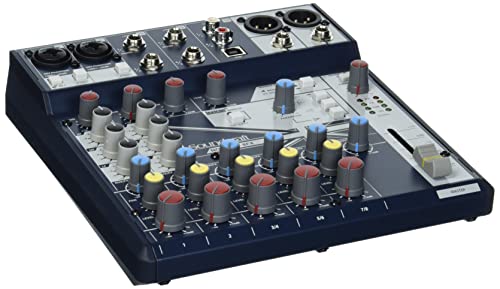
Soundcraft Notepad-8FX Small-Format Analog Mixer — Best Sound Quality per Inch
The Notepad-8FX suits small studios, singer-songwriters, and compact live rigs that also capture performances. Soundcraft preamps carry the brand’s console heritage, the Lexicon effects provide reverbs and delays that flatter voices without extra hardware, and USB I/O connects the whole board to a DAW for recording the stereo mix or playing back tracks. Four mic-capable inputs give it more live headroom than most boards this small.
Strengths
- Lexicon effects — the best built-in reverbs in this class
- USB I/O for recording and playback
- Soundcraft preamp pedigree in a tiny footprint
Trade-offs
- Knob-based layout is dense — small print, close controls
- USB is stereo, not multitrack
- Premium tier for the compact class
| Inputs | 8 |
| Effects | Lexicon effects |
| Interface | USB I/O (per Amazon listing title) |
Sonically, this is the compact board engineers compliment. The preamps stay composed at high gain, the EQ feels voiced by people who mix for a living, and the Lexicon reverbs sit in a mix instead of washing over it. For a songwriter recording demos at home and playing the same songs out at night, one board covering both worlds has obvious appeal.
The density trade-off is real: on a dark stage, the Notepad’s compact control spacing demands familiarity. Owners who set it up at home, label their channels, and learn the layout by touch report no issues; owners who unbox it at the gig do. Treat it as an instrument to learn, not an appliance to glance at.
It is also the strongest desktop pick in this list for hybrid work — part mixer, part interface, part effects box — for creators whose desk space is measured in inches. If your studio is a corner, the Notepad-8FX is the corner’s best friend.
Best for: Singer-songwriters and small studios that record and perform / Not suited for: Volunteers who need a glanceable, spacious layout
Check the current price on Amazon

Allen & Heath ZED-6 Ultra Compact 6-Input Mixer — Best Build Quality
The ZED-6 suits players and small rigs that value build and thoughtful details over feature count. The two mic/line preamps include high-pass filters — the rumble-and-boom cut that small-room vocals always need — and two channels double as guitar DI inputs with proper high impedance, so an acoustic-electric or bass can plug straight in without a DI box. For a duo of voice and guitar, this board is quietly perfect.
Strengths
- Touring-grade build and feel
- High-pass filters on the mic preamps
- Guitar DI inputs eliminate a separate DI box
Trade-offs
- No effects and no USB — a purist’s board
- Six inputs is a hard ceiling
- Premium pricing for its channel count
| Inputs | 6 |
| Preamps | 2, with high-pass filter |
| Extras | Guitar DI inputs (per model line) |
Allen & Heath’s reputation rests on boards that survive the road, and the ZED-6’s knobs, jacks, and casework communicate that in the hand. The sound is correspondingly uncolored: what your microphone hears is what the speakers get, with the HPF quietly removing the low-end mud that makes small PAs sound cheap. Engineers call this honesty; audiences call it clarity.
The purist specification is the decision to make. No reverb means vocalists who lean on effects need a pedal or a different pick (the Yamaha and Soundcraft above exist precisely for them). No USB means recording needs an interface. If your world is live, analog, and quality-first, those absences are features — fewer things to fail, nothing you do not use.
Duos should do the channel math carefully: two voices plus guitar plus a playback track fits the ZED-6 exactly, with nothing spare. If a third source is even a rumor, step up in the ZED line rather than out of it — the family’s build logic is worth staying inside.
Best for: Duos and quality-first small rigs, especially voice plus guitar / Not suited for: Anyone needing built-in effects or USB
Check the current price on Amazon
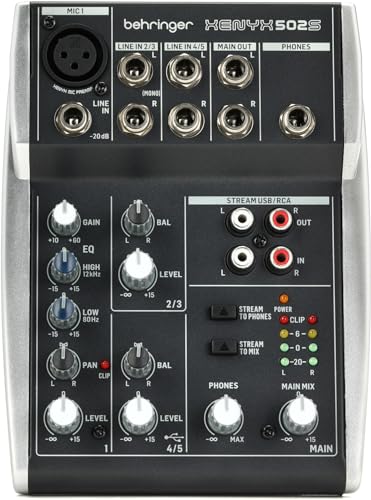
Behringer XENYX 502S Premium Analog 5-Input Mixer — Best Budget Compact
The 502S suits exactly one-microphone worlds: a solo podcaster, a streamer with a mic and game audio, a presenter with a mic and laptop playback, a teacher recording lessons. One XENYX preamp with phantom power takes a condenser or dynamic mic; the stereo inputs carry the second source; USB carries the result to the computer. Everything beyond that brief is honestly out of scope, and the board does not pretend otherwise.
Strengths
- USB streaming at the lowest tier in this guide
- Phantom power for condenser microphones
- Truly pocket-sized for mobile presenters
Trade-offs
- A single mic preamp — no guests on their own mic
- Minimal EQ and routing
- Outgrown quickly if the format grows
| Inputs | 5 |
| Preamps | 1 XENYX, with phantom power |
| Interface | USB streaming (per Amazon listing title) |
Judged against its brief, the 502S is excellent: the preamp is clean enough for broadcast speech, the layout cannot confuse, and the whole setup — mic, board, laptop — packs in minutes. Many working podcasters started on exactly this class of board and upgraded for channel count, never for sound complaints about speech.
The discipline is buying it for the format you have. If a co-host is planned, buy the 802S now and save a replacement cycle. If the format is stably solo, the 502S is the rare case where the cheapest pick is also the correct one, and the savings belong in the microphone, which matters more.
Mobile presenters add one more use: battery-free reliability. A board this simple, powered and connected in seconds, with hardware control of the mic level, beats software mixing in every school hall and community room where the Wi-Fi is a rumor and the show must start on time.
Best for: Solo podcasters, streamers, and presenters with one microphone / Not suited for: Two-microphone formats or live bands
Check the current price on Amazon
Comparison Table
| Pick | Badge | Key spec | Best for |
|---|---|---|---|
| Mackie Mix8 8-Channel Compact Mixer | Best Overall | 8 channels, 2 mic preamps, 3-band EQ | Small live rigs, rehearsal spaces, and first-time hardware mixer buyers |
| Behringer XENYX 802S Premium Analog 8-Input Mixer | Best for Streaming | 8 inputs, USB streaming interface, XENYX preamp | Podcasters and streamers wanting hardware control with one USB cable |
| Yamaha MG06X 6-Input Compact Stereo Mixer | Best with Built-In Effects | 6 inputs, 2 D-PRE preamps, SPX effects | Solo performers and presenters wanting preamp quality plus vocal effects |
| Soundcraft Notepad-8FX Small-Format Analog Mixer | Best Sound Quality per Inch | 8 inputs, USB I/O, Lexicon effects | Singer-songwriters and small studios that record and perform |
| Allen & Heath ZED-6 Ultra Compact 6-Input Mixer | Best Build Quality | 6 inputs, 2 mic preamps with HPF, guitar DI inputs | Duos and quality-first small rigs, especially voice plus guitar |
| Behringer XENYX 502S Premium Analog 5-Input Mixer | Best Budget Compact | 5 inputs, 1 XENYX preamp, USB streaming | Solo podcasters, streamers, and presenters with one microphone |
Read the table by destination: boards feeding speakers value preamps and EQ; boards feeding computers value the USB column that the specs describe. The same six boards sort differently for a coffeehouse duo and a podcast desk, and both sortings are correct.
Two rows deserve a second look from undecided readers. The ZED-6 has the fewest features in the table and some of the strongest long-term owner satisfaction in the class — a reminder that in small-format audio, subtraction is a legitimate design philosophy. The 502S has the least of everything and is, for its one-microphone brief, not a compromise at all.
How to Choose the Best Compact Audio Mixers for Your Setup?
Count microphones first, because mic preamps — not total inputs — are the scarce resource on compact boards. A “12-input” compact may have only two or four preamps; the rest are line inputs for keyboards and playback. List every source, mark which need preamps, and buy the board whose preamp count covers the list with one spare for the guest, the extra vocal, or the instrument you add in month three.
Decide your destination second. Feeding powered speakers live: prioritize preamps, EQ, and an aux send for monitors or effects. Feeding a computer: a USB-equipped board like the Behringer S-series or the Soundcraft removes an interface from the chain, but note that compact USB is stereo — the finished mix, not separate tracks. Feeding both, as many small rigs do, is where the Notepad-8FX earns its premium.
Finally, effects and feel. Singers in dry rooms benefit from built-in reverb (Yamaha, Soundcraft); purists and pedal owners do not need it (Mackie, Allen & Heath). And handle the board if you can: knob spacing and layout legibility decide whether a compact mixer is a joy or a squint at a dark gig.
Gain Staging a Compact Mixer: The Skill That Decides Your Sound
More small-rig sound problems are gain problems than gear problems. The method: set each channel’s gain so the source, at its loudest expected moment, lights the board’s meter strongly without clipping; keep channel levels in their middle range rather than pinned at the top; and let the main output control the room volume. A microphone gained too low and boosted later brings hiss with it; gained too hot, it clips and no downstream control can un-clip it.
Two compact-specific habits help. Use the high-pass filter on vocals whenever the board offers one — it removes rumble before the EQ ever sees it. And set monitor or headphone levels from the board, not by overdriving channels: if the singer cannot hear, the answer is the monitor send, not more gain into an already-hot channel. Ten minutes of gain discipline makes a budget compact sound professional; its absence makes a premium board sound broken.
Compact Mixer vs Audio Interface: Which Should a Creator Buy?
An interface converts sources to digital tracks; a mixer combines sources into a performance. Creators who record one source at a time and edit in software are interface people. Creators who combine sources live — voice plus music, host plus guest, mic plus game audio — and want hardware control, zero-latency monitoring, and a mute they can slap mid-sentence are mixer people. USB-equipped compacts blur the line by sending the stereo mix to the computer, which is why they dominate small podcast desks.
The honest boundary is multitrack. The moment a format needs each microphone editable separately after recording, no stereo compact suffices, and the purchase becomes a multitrack interface or a compact digital mixer — a sibling keyword in this batch covers those. Until that moment, a compact mixer is simpler, faster, and usually cheaper for the same audible result.
What Is the Difference Between a Compact Mixer and a Micromix?
Size is the visible difference; intent is the real one. A compact mixer, the subject of this article, is a small complete console: several preamps, per-channel EQ, aux sends, and main and monitor outputs, designed to run a small performance or studio by itself. A micromix — the sibling keyword in this batch — is a minimal two-to-five-input device designed to sit inside a larger chain: one microphone for a stream, a submix for a drum kit or keyboard rig, a utility blend inside a bigger system.
The practical test is the destination. If the board is the destination — everything plugs into it and speakers or the computer plug out of it — you want a compact mixer from this list. If the board is a waypoint feeding something larger, the micromix article’s smaller, cheaper tools are the right shape. Buying a micromix to do a compact’s job strands you without EQ and sends; buying a compact to do a micromix’s job wastes desk and money. The two articles are written as a pair for exactly this reason.
How to Set Up a Compact Mixer for a Small Live Rig
Step 1 — Connect in order. Sources into channels, main outputs to powered speakers (or amplifier), everything powered off while cables move. Step 2 — Zero the board. Gains down, EQs centered, levels down, main down. Step 3 — Gain each channel. Perform at real volume, raise gain until the meter is strong and clean, back off a touch. Step 4 — Set channel levels for balance, then bring the main up to room volume.
Step 5 — EQ last and lightly. Cut before you boost: roll off low end on vocals with the high-pass filter if fitted, tame one harsh frequency rather than sculpting five. Step 6 — Add effects like seasoning. A breath of reverb on voices in a dry room; none on playback tracks. Step 7 — Soundcheck the loudest moment, not the average — the chorus, the laugh, the drum hit — and leave headroom for it. Step 8 — Mark your settings. A strip of tape and a pen beside each knob turns tonight’s good sound into next week’s starting point, the oldest professional habit in live audio.
Step 9 — Photograph the board. Once the rig sounds right, take a clear photo of every knob position and save it where the next operator will find it. Step 10 — Coil and label the cables. Five minutes of labeling at teardown saves the entire soundcheck at the next setup, and it is the habit that separates rigs that improve from rigs that merely repeat.
Common Buying Mistakes
Counting inputs instead of preamps. The classic compact-mixer disappointment; count microphone inputs first. Buying effects you will not use — or skipping the reverb you need. Match the board to the singer, honestly. Gain at maximum, main at minimum. Reversed staging is hiss and distortion at once; stage from the input forward. No spare channel. Rigs grow by one source at a time; buy one preamp of headroom. Assuming USB means multitrack. On compacts it means the stereo mix — plan formats accordingly. Judging by channel count marketing. “12-input” with two preamps is a two-microphone board with line inputs; read the preamp line of the spec.
Understanding Compact Mixer Specs: Preamps, EQ, and Aux Sends Explained
Three spec lines predict a compact board’s real life. The preamp line tells you microphone count and gain range — enough gain matters for quiet dynamic microphones used at a natural distance, the classic podcast and spoken-word setup. The EQ line tells you control: a 3-band EQ with a sweepable or fixed mid shapes voices adequately for small rooms; a single tone knob is a warning sign. The aux line tells you flexibility: one aux send can feed a stage monitor or an external effects unit, and its absence closes both doors at once.
Read past the channel-count headline every time. Manufacturers count every stereo pair and tape return toward the big number; your band counts microphones. The boards in this guide were chosen partly for honest spec sheets — the preamp counts in their reviews are the numbers their makers publish and their users confirm — and learning to read for that line will protect every future audio purchase you make, compact or otherwise.
Cable and Accessory Kit for a Compact Mixer Rig
The board is half the rig. Budget for: balanced XLR cables for every microphone, one more than you need, because cables fail at gigs and never at home; short balanced leads for powered speakers; a stereo cable for playback sources; a power strip with surge protection; gaffer tape for cable runs and knob marks; and a small bag that holds all of it so the rig travels as a unit. None of this is glamorous, and all of it decides whether the mixer you researched so carefully ever gets to sound good.
Two upgrades punch above their cost. A pair of headphones you trust turns soundcheck from guesswork into measurement, especially in rooms that lie. And a simple cable tester pays for itself the first time it finds the dead lead in thirty seconds instead of thirty minutes. Compact rigs live or die on these unglamorous logistics far more than on the last increment of preamp quality.
Compact Mixers for Worship, Schools, and Community Rooms
Institutional rooms judge mixers by a different rubric: can a volunteer run it after one demonstration, does it survive being left set up for months, and does it make one voice intelligible over music in a reflective room? By that rubric the class divides cleanly. The Mackie Mix8 is the volunteer-proof default — big clear layout, forgiving gain, nothing to misconfigure. The Yamaha MG06X adds the presenter’s friend, built-in reverb, which keeps a spoken voice from sounding bare in a hall. The Allen & Heath ZED-6 is the quality pick where one trained operator runs the same service every week and build longevity is the budget argument.
Two institutional habits matter more than the badge on the board. First, label everything: channels named for their sources, knob positions marked after a good service, a laminated one-page setup card taped inside the cupboard door. Second, lock the recipe: the goal is that any Sunday sounds like every Sunday, and that is a documentation achievement, not an equipment one. The compact boards in this guide reward that discipline precisely because they have so little to drift out of place.
Troubleshooting Compact Mixer Noise, Hum, and Dropouts
Problem: constant hiss. Almost always gain staging — re-stage from the input as the buying guide describes, and mute unused channels. Problem: hum that changes when you touch the board. A grounding or cable issue: swap in a known-good balanced cable, keep audio leads away from power bricks, and plug the whole rig into one outlet strip so grounds agree. Problem: one channel crackles. Work the knob through its range a few times — dust in a rarely moved control is the usual cause — and test with a different cable before suspecting the preamp.
Problem: USB audio drops or stutters (USB models). Try a direct computer port rather than a hub, and a shorter, quality cable; streaming USB is unforgiving of bargain hubs. Problem: the mix sounds thin on speakers but fine in headphones. Check for a high-pass filter engaged on a full-range source, and confirm the speakers are receiving both sides of the stereo feed. Work the list in order — in compact rigs, the cable and the gain knob explain nine problems in ten.
How Compact Mixers Earn Their Place in a Hybrid Desk Studio
The modern small studio is hybrid: part recording rig, part streaming desk, part practice room. A compact mixer earns its place in that hybrid by being the always-on hub — microphone live for calls without opening software, keyboard playable without launching a DAW, speakers fed from one volume knob that a hand can find in the dark. Interfaces alone make each of those a small project; the mixer makes them the default state of the room.
That hub role explains the feature pattern of this guide’s picks. USB streaming boards collapse the call-and-stream chain to one cable. Boards with control-room and headphone outs let the same speakers and cans serve mixing, calls, and casual listening without re-patching. Even the purist ZED-6 plays the hub role for players whose desk is an instrument station first. When you choose among the six, choose for the room’s daily center of gravity — calls, songs, or streams — and the board that makes that activity thoughtless is the right one, whatever the spec-sheet margin says.
Final Recommendation
Most small rigs should buy the Mackie Mix8 and stop thinking: clean preamps, honest build, no distractions. Creators feeding a computer should shortlist the Behringer 802S for value or the Soundcraft Notepad-8FX for sound and effects, with the 502S as the correct one-microphone budget answer. Performers who want reverb in the box should take the Yamaha MG06X; duos who value build above features should take the Allen & Heath ZED-6. Count your preamps, check the current price on Amazon, and leave one channel spare.
One last piece of advice that outlives any model year: buy the board your sources need today plus one preamp, from the maker whose layout you understood fastest when you looked at the photographs. Comprehension speed is a real feature in the dark, under time pressure, with an audience arriving — and it is the feature no comparison table can score for you.
- Mackie Mix8 8-Channel Compact Mixer (Best Overall) — Check on Amazon
- Behringer XENYX 802S Premium Analog 8-Input Mixer (Best for Streaming) — Check on Amazon
- Yamaha MG06X 6-Input Compact Stereo Mixer (Best with Built-In Effects) — Check on Amazon
- Soundcraft Notepad-8FX Small-Format Analog Mixer (Best Sound Quality per Inch) — Check on Amazon
- Allen & Heath ZED-6 Ultra Compact 6-Input Mixer (Best Build Quality) — Check on Amazon
- Behringer XENYX 502S Premium Analog 5-Input Mixer (Best Budget Compact) — Check on Amazon
Keep exploring the mixer range on this site: Best Compact Digital Mixers Best Compact Audio Mixers Micromix Best Compact Portable Sound Mixers Best Compact Mixers Under $100 Dollars Best Audio Mixers
Frequently Asked Questions
How many mic preamps do I need on a compact mixer?
One per microphone, plus one spare. Keyboards, phones, and playback devices use line inputs and do not need preamps. Most solo and duo rigs need two preamps; podcast formats need one per host and guest.
Do compact mixers need powered speakers?
Compact mixers in this guide are unpowered — they output line-level signal — so they pair with powered speakers or a separate amplifier and passive speakers. Powered mixers with built-in amplification are a different category, covered by the portable sound mixers keyword in this batch.
Can I record with a compact analog mixer?
Yes. USB models like the Behringer 802S and Soundcraft Notepad-8FX send the stereo mix to a computer directly. Non-USB models record through an audio interface or a recorder connected to their outputs. None of the compacts here record separate multitrack channels.
What does phantom power do and do I need it?
Phantom power (48V) runs condenser microphones, which need it to work. Dynamic microphones ignore it safely. If you use or plan to use a condenser — most studio-style podcast mics — confirm the board supplies phantom power, as the picks here do on their preamps.
Are knob controls worse than faders?
For compact work, mostly no. Knobs save the space that makes the board compact, and for set-and-leave levels they are precise enough. Faders earn their size on larger live boards where engineers ride levels continuously — a different workflow from anything in this guide.
Which compact mixer is best for a church or school?
The Mackie Mix8 for its simplicity and durability, or the Yamaha MG06X where one person presents with music and wants built-in reverb. Both survive volunteer operation, which is the real specification in those rooms.
Can a compact mixer run a small band?
A trio with two microphones and an instrument or two, yes — that is exactly the Mix8 and Notepad-8FX brief. Beyond three microphones, step up to a larger-format board rather than strangling the format with splitters and compromises.
Why does my compact mixer hiss?
Usually gain staging: a channel gained too low and boosted downstream amplifies its own noise floor. Re-stage from the input — strong, clean gain at the channel, moderate levels after — and check that unused channels are turned down, not left open.


