Disclosure: airfryerkitchensupply.com is reader-supported. When you buy through links on our site, we may earn an affiliate commission at no extra cost to you.
Where to buy
The fastest way to buy any of the best commercial slow cookers in this guide is through Amazon, where stock and editions change often, so check the current price on Amazon on the product page rather than relying on any number printed elsewhere. These are the six verified picks in this guide:
- Hamilton Beach Set & Forget 8 Quart Programmable Slow Cooker — Check on Amazon
- Crock-Pot Programmable Slow Cooker, 8-Quart, Black Stainless Steel — Check on Amazon
- Elite Gourmet MST-900D 8.5 Qt Digital Programmable Slow Cooker — Check on Amazon
- Ninja PossibleCooker PRO 8.5-Qt 8-in-1 Multi-Cooker (MC1001) — Check on Amazon
- Crock-Pot Manual Slow Cooker, 8-Quart (Black) — Check on Amazon
- Crock-Pot Programmable 7-Quart Cook and Carry Slow Cooker (Grey) — Check on Amazon
Availability in this category moves in waves around the holidays and back-to-school season, when event cooking peaks. If a first choice is out of stock, the picks below are ordered so the next one down is a genuine substitute, not a compromise.
The best commercial slow cookers are not a separate species of machine so much as the top end of the regular market used hard: 7- to 8.5-quart capacities, programmable controls that protect food when nobody is watching, lids that survive transport, and crocks that can be replaced when one inevitably chips. True NSF-certified commercial slow cookers are rare and mostly sold through restaurant-supply channels, so this guide is honest about what it covers — the large, heavy-duty models that churches, caterers, offices, soup kitchens and serious home batch cooks actually buy and run like equipment.
Size is the first filter. Below seven quarts you are cooking for a family; at seven quarts and up you are cooking for a room. Every pick here is at least seven quarts, and the guide flags the real dividing lines inside that band: probe versus timer versus plain dial, locking lid versus stay-at-home lid, stoneware crock versus a metal pot that can sear. Those differences, not brand loyalty, decide which machine belongs in which kitchen.
One rule runs through the whole guide: in commercial-style use, food safety is a process, not a feature. Timers and auto-warm settings help, but a probe thermometer, a hold-time habit and a cleaning routine do the real work. The buying guide and how-to sections below build that process out, and the reviews call out exactly where each model helps or leaves you on your own.
The guide is organized the way a purchase decision actually unfolds: the shortlist first, then the reasoning, then the operating practices that decide whether the purchase succeeds. Readers in a hurry can stop after Quick Picks and buy well; readers outfitting a program should keep going, because the difference between a cooker that serves for years and one that disappoints in a month is almost never the cooker itself — it is the routine wrapped around it, and that routine is spelled out below.
In this guide
Quick Picks
If you only read one section, read this one. These are the six best commercial slow cookers we could verify with real Amazon listings, ordered by the job they do best rather than by a single score — because a soup kitchen, a caterer and a church basement need different things from the same shelf.
- Best Overall: Hamilton Beach Set & Forget 8 Quart Programmable Slow Cooker — a probe-equipped programmable 8-quart that cooks to temperature, not just to time — the closest thing to a set-and-supervise commercial workflow in this class. Check on Amazon
- Best Programmable for Serving Stations: Crock-Pot Programmable Slow Cooker, 8-Quart, Black Stainless Steel — the original slow-cooker brand in an 8-quart programmable format with a digital countdown that suits buffet lines and potluck service. Check on Amazon
- Best Extra-Large Capacity: Elite Gourmet MST-900D 8.5 Qt Digital Programmable Slow Cooker — the biggest crock in this guide at 8.5 quarts, with a 20-hour digital timer for operations that prep far ahead of service. Check on Amazon
- Best for Searing and One-Pot Service: Ninja PossibleCooker PRO 8.5-Qt 8-in-1 Multi-Cooker (MC1001) — an 8.5-quart multi-cooker whose pot sears and sautés directly on the base, so browning happens in the same vessel that slow cooks. Check on Amazon
- Best Budget Workhorse: Crock-Pot Manual Slow Cooker, 8-Quart (Black) — a manual three-setting 8-quart with nothing electronic to fail — the buy-two-and-rotate choice for high-turnover kitchens. Check on Amazon
- Best for Transport and Off-Site Service: Crock-Pot Programmable 7-Quart Cook and Carry Slow Cooker (Grey) — a 7-quart programmable with a locking Cook & Carry lid, built for food that is cooked in one place and served in another. Check on Amazon
How These Picks Were Chosen
Picks were chosen for batch-scale usefulness, not home novelty. The criteria, in order: capacity of seven quarts or more; a control system that protects food during unattended or semi-attended cooking (programmable timer, auto-warm shift, or a temperature probe); construction that survives shared use, meaning a removable crock, a replaceable-feeling lid and controls a new volunteer can learn in a minute; and a verifiable Amazon listing from the brand or a clearly identified model line.
Every product named here was checked against live retailer data for this site before a link was attached, and only listings that matched the exact model earned a link. Where a specification could not be verified from the listing, it is left out rather than guessed. Prices are never printed in this guide because commercial buyers purchase in ones and threes across the year; check the current price on Amazon on the listing itself.
A note on what “commercial” means in this guide, because the word is abused in listings. No slow cooker sold for home use carries the duty cycle, warranty terms or certification of a restaurant-supply unit, and any listing that implies otherwise is marketing. What the models here do offer is the overlap that matters in practice: batch capacity, controls that manage food safely without a cook standing over them, and construction that tolerates daily use. Small operations should also check their local rules before serving the public, since some jurisdictions specify certified equipment for licensed premises — the cooking practices in this guide are sound either way, but paperwork is paperwork.
Two honest exclusions are worth stating. First, countertop roaster ovens — the 18- and 22-quart enamel roasters often used for the same jobs — are a different appliance class and are covered in their own guides on this site. Second, genuinely commercial NSF units from restaurant-supply brands rarely appear with reliable consumer listings, so rather than pad the list with unverifiable names, this guide sticks to the heavy-duty models that can actually be bought, serviced and replaced easily.
The 6 Best Commercial Slow Cookers, Reviewed
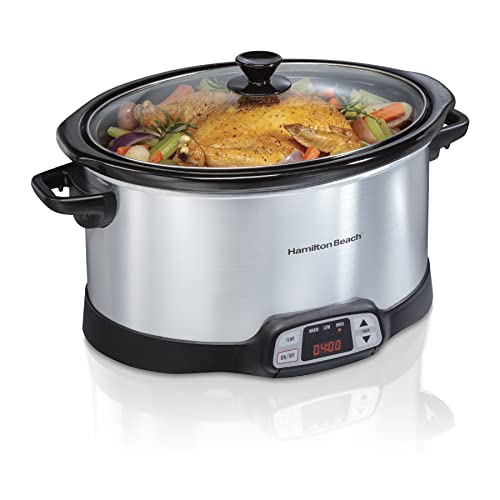
Hamilton Beach Set & Forget 8 Quart Programmable Slow Cooker — Best Overall
For a church kitchen, a small catering operation or an office that feeds a crowd every Friday, the Hamilton Beach Set & Forget is the pick that behaves most like equipment rather than an appliance. Its defining feature is the thermometer probe: push it into a roast or a pork shoulder, set the target temperature, and the cooker shifts to warm when the food gets there. In commercial-style use — where the person who loaded the cooker is rarely the person who serves from it — cooking to temperature instead of to a guessed time is the difference between food held safely and food held hopefully.
The 8-quart capacity is the working size for batch cooking: a whole batch of pulled pork for a fundraiser, two chickens, or a soup quantity that actually serves twenty. The programmable timer covers the second commercial reality, which is that prep happens in the morning and service happens when it happens. Set the cook time, and the unit drops to warm on its own instead of overcooking through a delayed lunch rush.
Ownership details are honest. The stoneware crock is genuinely heavy full of chili, the probe is one more thing to keep track of in a shared kitchen, and the control panel needs a label-maker note if rotating volunteers will use it. None of that outweighs the probe. If your slow cooking is unattended, batch-sized and served to other people, this is the benchmark the rest of the list is measured against.
A word about the probe in daily practice: it changes who can be trusted with the cooker. In a volunteer kitchen, ‘cook it six hours and hope’ produces uneven results depending on who loaded the crock and how full it was. ‘Cook it to temperature’ produces the same result every time, and the display tells the next shift exactly what state the food is in. That repeatability — not raw power — is what commercial buyers are actually purchasing, and it is why this model anchors the guide.
Strengths
- Temperature probe cooks meat to a target internal temperature, then switches to warm — a food-safety feature most rivals skip
- Programmable timer with automatic warm shift suits unattended service windows
- Clip-tight gasket lid travels between kitchen and serving station without spills
Trade-offs
- Probe adds a part to wash, store and eventually replace
- 8-quart stoneware is heavy when full; two-person lift is the safe habit
- Controls are more complex than a dial, so casual staff need a one-minute briefing
| Capacity | 8 quart |
| Controls | Programmable digital with temperature probe |
| Lid | Clip-tight gasket lid |
| Crock | Removable stoneware |
Best for: caterers, church and office kitchens, and anyone cooking unattended batches for a crowd / Not suited for: solo cooks who only need four quarts and a dial
Check on Amazon — check the current price on Amazon before you buy, because editions, bundles and stock change often.

Crock-Pot Programmable Slow Cooker, 8-Quart, Black Stainless Steel — Best Programmable for Serving Stations
Crock-Pot invented this category, and its 8-quart programmable model is the safe institutional buy: the brand every volunteer already knows how to use, in the size that feeds a room. The digital countdown is the feature that earns it a serving-station badge. On a buffet line or at a bake-sale table, being able to glance at the display and know exactly where a dish is in its cook-or-hold cycle is worth more than another preset.
In practice this is the cooker for recurring events — weekly team lunches, concession stands, holiday open houses — where the food is cooked in the back and held in the front. The auto-warm shift means the person running the register is not also running back to check a dial. The black stainless finish is not vanity: equipment that sits in front of customers should not look like it was borrowed from a home kitchen.
The limits are the mirror of the Hamilton Beach above. There is no probe, so a new volunteer still needs a food thermometer and a time chart. And at eight quarts the unit earns permanent counter or shelf space; measure before you buy two. For most serving-first operations, though, this is the straightforward, supportable choice.
Consider the countdown display as a management tool as much as a cooking one. At a fundraiser, the person in charge can see from across the room whether the beans are mid-cook or mid-hold, and can time the rest of the line — rolls, drinks, desserts — around it. Multiply that glanceability across a season of events and the programmable Crock-Pot earns its place even in kitchens that already own a manual cooker for backup duty.
Strengths
- Digital countdown shows at a glance how long food has been cooking or holding
- Auto-warm after the timed cook finishes protects a serving window
- Black stainless finish looks deliberate on a public-facing serving table
Trade-offs
- No temperature probe, so doneness is still judged by time and experience
- Large footprint claims real counter space in a small kitchen
- Finish shows fingerprints in bright serving light
| Capacity | 8 quart |
| Controls | Programmable with digital countdown |
| Finish | Black stainless steel |
| Crock | Removable stoneware |
Best for: buffets, potlucks, concession and event serving where food is held in public view / Not suited for: cooks who want probe-based doneness control
Check on Amazon — check the current price on Amazon before you buy, because editions, bundles and stock change often.

Elite Gourmet MST-900D 8.5 Qt Digital Programmable Slow Cooker — Best Extra-Large Capacity
When the brief is volume — a soup kitchen Saturday, a sauce base for the week, a chili cook-off entry measured in gallons — the Elite Gourmet MST-900D is the pick, because 8.5 quarts is where slow cookers stop being large and start being batch equipment. That extra half-quart over the 8-quart models sounds small until you are ladling the fortieth bowl.
The 20-hour programmable timer is the second reason it suits semi-commercial work. Prep in the afternoon, hold safely, serve the next day: the long window matches how real food operations actually schedule, instead of forcing the food to match a domestic timer. Three heat settings keep the panel understandable for whoever is on shift.
Be clear-eyed about the trade-offs. This is a stationary unit: no locking travel lid, and a filled weight that makes carrying it across a parking lot a bad idea. Elite Gourmet also cannot match the big brands for spare-part depth. Kept in one kitchen and used for volume, neither matters much — and for pure capacity per cooker, nothing else in this guide touches it.
Capacity planning deserves one more note: an 8.5-quart crock is also a storage decision. It needs a shelf or cupboard bay that fits it, a sink or dishwasher that accepts it, and a refrigerator plan for leftovers that does not involve parking the whole crock inside. Kitchens that think through those three things in advance use big cookers constantly; kitchens that do not, quietly stop. The MST-900D rewards the first kind.
Strengths
- 8.5-quart capacity is the largest here — genuine batch scale for soups and sauces
- 20-hour programmable window covers overnight and next-day workflows
- Digital controls with three temperature settings keep the interface simple for shared use
Trade-offs
- Filled weight is the highest in the guide; plan the carry route before you fill it
- Lid is not a locking travel design, so it is a stay-in-place unit
- Brand support network is thinner than Crock-Pot or Hamilton Beach
| Capacity | 8.5 quart |
| Controls | Digital programmable, 20-hour timer |
| Settings | Low, high and warm |
| Crock | Removable stoneware |
Best for: soup kitchens, sauce and soup batch prep, and high-volume home canning-day cooking / Not suited for: anyone who needs to transport food in the cooker
Check on Amazon — check the current price on Amazon before you buy, because editions, bundles and stock change often.

Ninja PossibleCooker PRO 8.5-Qt 8-in-1 Multi-Cooker (MC1001) — Best for Searing and One-Pot Service
Most slow-cooker food in a commercial setting fails at the same step: the browning. Recipes get skipped or dumbed down because nobody has time to sear ten pounds of beef in batches in a separate pan. The PossibleCooker PRO removes that excuse. Its base heats the pot directly for searing and sautéing, then the same vessel slow cooks — one pot, one wash, and a flavor base that a dump-and-go cooker cannot match.
The 8.5-quart size matches the Elite Gourmet for batch volume, and the oven-safe pot adds a service trick stoneware cannot do as confidently: slide the pot under a broiler to crisp a topping before the dish goes out. For a small café or a food truck commissary, the eight functions also consolidate equipment — this can be the slow cooker, the steamer and the warmer in one footprint.
The honest costs: you pay a premium over a plain slow cooker, and the nonstick pot demands wooden or silicone tools and a no-scouring-pad rule in a shared kitchen. If your menu never browns anything, buy the simpler machines above. If browning is where your flavor lives, this is the commercial-style pick.
There is also a menu argument. Slow cookers earn a reputation for one-note food because everything goes in raw and comes out soft. A pot that sears first and can finish under a broiler produces contrast — browned edges, crisped tops — and contrast is what separates food people line up for from food people tolerate. For a small food business, that difference shows up directly in whether the special sells out.
Strengths
- Sear and sauté in the cooking pot itself — no separate pan for browning meat before a braise
- Pot is oven safe, so a slow-cooked dish can finish or crisp under a broiler
- Eight functions replace a second appliance in a tight commercial corner
Trade-offs
- Costs more than a single-purpose slow cooker; you pay for functions you may not use
- Nonstick pot needs gentler utensils and washing than stoneware
- Slow-cook purists should note the pot is metal, not a ceramic crock
| Capacity | 8.5 quart |
| Functions | 8-in-1 multi-cooker including slow cook and sear/sauté |
| Pot | Oven-safe nonstick cooking pot |
| Brand line | Ninja PossibleCooker PRO, model MC1001 |
Best for: small cafés, commissary kitchens and serious home batch cooks who sear before braising / Not suited for: buyers who want a cheap, single-purpose crock
Check on Amazon — check the current price on Amazon before you buy, because editions, bundles and stock change often.

Crock-Pot Manual Slow Cooker, 8-Quart (Black) — Best Budget Workhorse
There is a commercial logic to buying the simplest machine: when a cooker costs this little and has this little to go wrong, the rational move is to buy two or three and rotate them. The manual Crock-Pot 8-quart is that machine. A dial with low, high and warm, a stoneware crock, a glass lid — the same formula that has fed offices and fundraisers for decades.
The absence of electronics is a feature in rough service. No control board to die in year two, no display to crack, no programming for a new volunteer to get wrong. In a kitchen where equipment is borrowed, moved and occasionally dropped, repairability-by-replacement beats features.
What you give up is unattended safety margin. A manual cooker does not shift to warm when time expires; someone owns the schedule, and food-safety discipline — a thermometer, a hold-time limit — has to come from your process rather than the appliance. Kitchens with that discipline get the best value in this guide. Kitchens without it should buy the programmable models above and consider the difference an insurance premium.
Rotation economics make the case concretely. Event kitchens commonly run a cooker hard for a season of weekly events; a manual unit that eventually fails has consumed a season of service at the lowest possible cost, and its replacement is on the shelf already because buying a spare was painless. Compare that with nursing one expensive programmable unit whose control board failure cancels an event, and the budget pick’s logic is hard to argue with.
Strengths
- Manual dial controls: nothing to program, nothing electronic to break
- Lowest-cost route to full 8-quart capacity in this guide
- Simple enough that any volunteer can run it safely with a two-line instruction card
Trade-offs
- No timer and no auto-warm shift — a person must be present to manage the cook
- No locking lid for transport
- Manual control means results depend entirely on the cook’s timing discipline
| Capacity | 8 quart |
| Controls | Manual dial — low, high, warm |
| Crock | Removable stoneware |
| Lid | Glass lid |
Best for: budget-driven programs, fundraisers and kitchens that rotate several cookers / Not suited for: unattended overnight cooking without staff oversight
Check on Amazon — check the current price on Amazon before you buy, because editions, bundles and stock change often.

Crock-Pot Programmable 7-Quart Cook and Carry Slow Cooker (Grey) — Best for Transport and Off-Site Service
Caterers, home-based food businesses and the person who always brings the main dish share one problem the stay-at-home cookers ignore: the food has to travel. The Cook and Carry line exists for exactly that, and this 7-quart programmable version pairs the locking, gasket-sealed lid with a timer and auto-warm — cook at home, lock the lid, drive, plug in at the venue and hold safely until service.
Seven quarts is the deliberate sweet spot for transport. An 8-quart crock of chili sloshing in a car is a spill negotiating to happen; seven quarts full is manageable, and the locking lid changes a risky carry into a routine one. The programmable control matters off-site too: food cooked before a drive finishes into warm mode instead of overcooking in transit time you cannot control.
The discipline this cooker demands is latch discipline — both latches seated, every time, checked before the lift — and latch hardware adds a minute to washing. In exchange you get the only pick in this guide we would put in a vehicle without a second thought. For off-site service, that is the whole decision.
One practical routine for transport day: cook with the crock slightly under the usual fill line, because liquid expands and sloshes more than you expect on the road; lock the lid while the cooker is still on the counter, not balanced at the car; and put the cooker on a flat, towel-lined surface in the vehicle so a hard stop does not become a slide. At the venue, unlock only after the unit is plugged in and settled — the gasket seal holds heat remarkably well, and there is no prize for opening it early.
Strengths
- Locking lid with gasket seals the crock for vehicle transport
- Programmable timing with auto-warm covers the cook-then-drive-then-serve sequence
- 7-quart size is the largest that stays sensibly portable when full
Trade-offs
- One quart smaller than the biggest picks — check your batch math
- Locking latches are extra parts to clean and to seat correctly every time
- Still heavy when full; carry with two hands and a flat route
| Capacity | 7 quart |
| Controls | Programmable with auto-warm |
| Lid | Locking Cook & Carry lid |
| Finish | Grey |
Best for: caterers, potluck mains, tailgates and off-site serving / Not suited for: stationary kitchens that never move food and want maximum capacity
Check on Amazon — check the current price on Amazon before you buy, because editions, bundles and stock change often.
Comparison Table
| Pick | Badge | Key spec | Best for |
|---|---|---|---|
| Hamilton Beach Set & Forget 8 Quart Programmable Slow Cooker | Best Overall | 8 qt, programmable with temperature probe | caterers, church and office kitchens, and anyone cooking unattended batches for a crowd |
| Crock-Pot Programmable Slow Cooker, 8-Quart, Black Stainless Steel | Best Programmable for Serving Stations | 8 qt, digital countdown timer | buffets, potlucks, concession and event serving where food is held in public view |
| Elite Gourmet MST-900D 8.5 Qt Digital Programmable Slow Cooker | Best Extra-Large Capacity | 8.5 qt, 20-hour programmable timer | soup kitchens, sauce and soup batch prep, and high-volume home canning-day cooking |
| Ninja PossibleCooker PRO 8.5-Qt 8-in-1 Multi-Cooker (MC1001) | Best for Searing and One-Pot Service | 8.5 qt, 8-in-1 with sear/sauté | small cafés, commissary kitchens and serious home batch cooks who sear before braising |
| Crock-Pot Manual Slow Cooker, 8-Quart (Black) | Best Budget Workhorse | 8 qt, manual low/high/warm dial | budget-driven programs, fundraisers and kitchens that rotate several cookers |
| Crock-Pot Programmable 7-Quart Cook and Carry Slow Cooker (Grey) | Best for Transport and Off-Site Service | 7 qt, programmable, locking travel lid | caterers, potluck mains, tailgates and off-site serving |
How to Choose a Commercial Slow Cooker
Start with servings math, not quart envy. A quart of slow-cooker capacity serves roughly one person a main-dish portion with a little headroom, and a crock should be filled between half and three-quarters for even cooking. An 8-quart cooker therefore serves about ten to twelve as a main, or twenty-plus as a side or soup course. Buy for your real headcount: an oversized crock cooking a small batch heats unevenly and dries food at the edges, while an undersized one forces a second batch at the worst moment.
Next, choose your control philosophy. A temperature probe (the Hamilton Beach) is the strongest food-safety tool because it cooks to doneness. A programmable timer with auto-warm (the Crock-Pot and Elite Gourmet models) is the strongest scheduling tool. A manual dial (the budget Crock-Pot) is the strongest durability play. Commercial-style buyers should be honest about which risk they actually carry — undercooked food, a missed schedule, or broken equipment — and buy against that risk.
Finally, plan the physical workflow. Where does the cooker live? Who carries it, and how far, full of hot liquid? Does the lid need to lock for a vehicle ride? Is there a dishwasher big enough for an 8-quart crock, or is it a sink wash every time? The right answer to those questions eliminates half this list faster than any feature comparison, and it is why the transport and searing specialists carry their own badges instead of being ranked as lesser versions of the overall pick.
What capacity do catering and event cooks actually need?
For a single-dish event — chili for a fundraiser, pulled pork for a team lunch — one 8-quart cooker per twenty to twenty-five guests is a workable planning ratio when the dish is a side, and one per ten to twelve when it is the main. Two mid-size cookers beat one giant one for menu flexibility: different dishes, different dietary versions, and a built-in backup if a unit fails mid-service.
There is also a staffing ratio hidden in the capacity question. Every cooker in service needs a human owner — someone who loaded it, knows its finish time, and will check its temperature before service. One experienced person can own three or four cookers comfortably; six cookers with one distracted owner is how events go wrong. When you scale the fleet, scale the roster with it, even if the extra hands are only scheduled for the service window itself.
Holding matters as much as cooking. Many operations cook in whatever vessel is handy and use slow cookers purely as serving warmers, which is legitimate and common — but the cooker still has to hold food at a safe serving temperature, and the warm setting on every model here is designed for holding cooked food, not for bringing raw food up to temperature. Build that distinction into your event plan and your signage for volunteers.
Stoneware crocks vs metal multi-cooker pots: which survives commercial use?
Stoneware is the traditional slow-cooker crock for a reason: it heats gently and evenly, holds temperature through a serving line, and goes from cooker to table without looking like equipment. Its weaknesses are weight and fragility — a dropped 8-quart crock is a write-off, and thermal shock from a cold counter can crack it. Metal multi-cooker pots, like the Ninja’s, trade some of that gentle heat for searing ability, broiler use and near-indestructibility, at the cost of nonstick care rules.
In a shared kitchen, write the care rule on the unit itself with a label: no metal utensils in the nonstick pot, no cold water in the hot crock. The appliance rarely fails first; the routine around it does.
What does a commercial slow cooker really cost to own?
The purchase is the small number. The ownership costs that actually accumulate are replacement crocks and lids (the two parts that chip, crack and shatter), the electricity of long holds, and the staff time of cleaning. This is a quiet argument for the big brands in this guide: Crock-Pot and Hamilton Beach crocks and lids are easy to source years later, which turns an accident into a reorder instead of a full replacement. Before committing a program to any model, check that its crock is sold separately — if it is not, price the whole cooker as a consumable.
Electricity is the cost buyers overestimate. A slow cooker on low draws modest power even across a long cook, and an 8-quart unit holding food through an event typically costs less to run than keeping an oven at temperature for the same job. The real waste is a cooker sized wrong: an oversized crock reheating a small batch, or a second emergency batch cooked because the first was too small. Capacity discipline, again, is where the money is.
Finally, budget the unglamorous accessories in the same purchase: a probe or instant-read thermometer for every cooker, spare lids if your events are frequent, labels and a marker for dating and naming contents, and a shelf or cart where the units live between events. A program that buys those in the same order as the cookers runs smoothly from the first event; one that improvises them spends the first season annoyed.
How to Set Up a Slow Cooker Station for Safe Batch Service
Step one: position and power. Place the cooker on a flat, heat-safe surface with clearance around it, plugged directly into a wall outlet — never a lightweight extension cord or a power strip shared with other heating appliances. On a serving table, route the cord so nobody crosses it carrying food, and tape it down if the public walks nearby.
Step two: load with food safety in mind. Thaw meat fully before it goes in; a slow cooker heats too gently to be trusted with frozen roasts in a service setting. Fill the crock between half and three-quarters full, layer dense vegetables at the bottom near the heat and meat above them, and keep the lid closed — every peek costs real heat and time.
Step three: verify, do not assume. Use a probe or instant-read thermometer to confirm the food has reached a safe cooked temperature before service, and once serving starts, keep the cooker on warm and note the time service began. Cooked food should not sit in the warm zone indefinitely; plan service windows in hours, serve, then refrigerate leftovers promptly in shallow containers rather than in the deep crock.
Step three-and-a-half: label everything. In a shared or public kitchen, every cooker in service gets a strip of tape with the dish name, the time it finished cooking, and any allergen flags. It takes twenty seconds, it prevents the two classic service errors — serving the wrong dish to the wrong person and holding a dish past its safe window — and it makes your operation look like what it is: a kitchen that runs on process, not memory.
Step four: clean like equipment. Let the crock cool before washing to avoid thermal shock, wash crock and lid in hot soapy water or the dishwasher if the model allows, wipe the heating base with a damp cloth (never immerse it), and inspect the cord and lid gasket before the unit goes back on the shelf. Five minutes of inspection after each event is what turns a home appliance into reliable commercial gear.
Common Buying Mistakes
Buying capacity by the box photo. Box art shows heaped, styled food. Judge by quarts and your headcount math instead — and remember a crock cooks best half to three-quarters full, so the usable batch is smaller than the headline number
Using warm as a cooking setting. Warm holds cooked food; it is not designed to cook raw food safely. Every dish should reach full cooking temperature on low or high first, and only then move to warm for service
Skipping the thermometer because the cooker has a timer. A timer tells you how long, not how done. In any kitchen serving the public, a probe thermometer check before service is the cheapest insurance in this entire guide
Transporting a full, unlocked crock. Hot liquid in a moving car finds every bump. If food travels, buy the locking-lid model, seat both latches, and carry the cooker level on a flat surface — or cook at the venue
One giant cooker instead of two flexible ones. A single point of failure plus a single menu option. Two 7- or 8-quart units give you a backup, a second dish, and sane carry weights
Final Recommendation
If you buy one machine from this guide, buy the Hamilton Beach Set & Forget 8 Quart: the probe makes it the safest unattended batch cooker here, and unattended batch cooking is what commercial slow cooking mostly is. If your food is served in public view and timing discipline matters more than doneness automation, the Crock-Pot 8-Quart Programmable is the natural serving-station choice, while the Elite Gourmet MST-900D wins any kitchen whose first word is volume.
Buy the Ninja PossibleCooker PRO when browning is central to your menu, the manual 8-quart Crock-Pot when budget and durability outrank automation, and the Cook and Carry when the food has to ride in a car. Every one of those is a deliberate fit for a real workflow — which is the only ranking that matters once the serving line opens.
Related guides on this site: Best Commercial Pressure Cookers Best 10 Quart Pressure Cookers Best 12v Slow Cookers Best Cookers For Camping Best Commercial Rice Japanese Cookers
Frequently Asked Questions
What size slow cooker do I need for 20 people?
For a main dish, plan on roughly one 8-quart cooker per 10 to 12 guests, so two 8-quart units for twenty people. For a side dish or soup course, one 8-quart cooker can stretch to twenty servings. Two cookers also give you a backup and a second dish, which is why most event cooks prefer pairs over one oversized unit.
Can a home slow cooker be used for catering or a food business?
Many small operations do exactly that, and the large programmable models in this guide are built for that workload. Check your local health code, though: some jurisdictions require NSF-certified equipment for licensed food service, and home-rated appliances may not satisfy an inspector. The cooking and holding practices in this guide — probe verification, timed warm holds — are good practice either way.
Is it safe to leave a commercial slow cooker unattended?
Programmable models with auto-warm, and especially the probe-equipped Hamilton Beach, are designed for unattended cooking in a way manual dial models are not. Safe practice is to cook on a clear, heat-safe surface, plugged directly into an outlet, with food loaded correctly — and to verify temperature with a thermometer before serving regardless of what the display says.
How long can food stay on the warm setting?
Warm is for holding cooked food through a service window, not for storage. As a working rule, plan service in a window of a few hours, keep the food visibly steaming and the lid closed between servings, and refrigerate leftovers promptly afterward. When in doubt, shorten the window — quality and safety both decline the longer food sits.
Should I buy a locking lid even if I rarely transport food?
If there is any chance the cooker rides in a vehicle — a potluck, a borrowed kitchen, an off-site event — yes. The locking lid also seals better against sloshing when a full cooker is carried across a room. If the cooker will genuinely never move, the locking hardware is one more thing to clean, and a standard lid is fine.
How should a heavily used crock be cleaned and stored?
Let the crock cool before it meets water — cold water on hot stoneware is the classic crack — then wash it in hot soapy water or the dishwasher if the model allows, using a non-abrasive pad on cooked-on edges and a soak rather than force. The heating base never goes in water; wipe it once cool. Store the crock with the lid inverted or ajar so seals do not pick up odors, and store the probe and cord with the unit, not in a communal drawer. In a daily-use kitchen, inspect the crock monthly for chips at the rim: a chipped crock is retired, because chips harbor residue and grow into cracks.
Why are there no prices in this guide?
Prices on these models move with seasons, sales and stock, and a printed number would mislead more than help — especially for buyers purchasing several units across a year. Each pick links to its Amazon listing so you can check the current price on Amazon at the moment you buy.


