Disclosure: airfryerkitchensupply.com is reader-supported. When you buy through links on our site, we may earn an affiliate commission at no extra cost to you.
Where to buy
Comparing the best commercial kitchen aid mixers? Start with the verified shortlist below. Commercial buying punishes wrong listings, so every pick below was verified by brand and model, and the ASIN in each link comes from the listed title. The KitchenAid commercial flagship in this guide carries its NSF certification in its verified listing title — check for exactly that wording on the live listing, and check price on Amazon there, since commercial configurations and bundles vary.
- KitchenAid NSF Certified Commercial Series 8-Qt Bowl Lift Stand Mixer KSM8990 — check price on Amazon
- KitchenAid 7 Quart Bowl-Lift Stand Mixer KSM70, Cast Iron Black — check price on Amazon
- KitchenAid 5.5-Qt Bowl-Lift Stand Mixer KSM55, Porcelain White — check price on Amazon
- Bosch Universal Plus Stand Mixer 500 Watt, 6.5 Quarts, Bundle — check price on Amazon
- Ankarsrum Original Stand Mixer AKM6230, Jubilee Silver — check price on Amazon
- Cuisinart Stand Mixer SM-50, 5.5 Quart, White Linen — check price on Amazon
Every linked pick in this guide was verified against Amazon’s catalog, so the model name you click is the model you land on. Prices move with finish, bundle and season, which is why this guide never prints a fixed price: use the links to check price on Amazon at the moment you are ready to buy.
Searching for the best commercial kitchen aid mixers means something specific, and this guide will not blur it: a commercial mixer is built and certified for paid food production — duty cycles measured in hours per day, components rated for constant use, and, where the listing states it, NSF certification for inspected kitchens. KitchenAid’s own range draws that line clearly, with a dedicated NSF Certified Commercial Series at the top and a ladder of heavy-duty bowl-lift machines beneath it that suit prosumer and light commercial work to different degrees.
This guide ranks that ladder honestly. The certified commercial flagship leads, because for a bakery, café or catering operation it is the only pick that answers the keyword without an asterisk. Below it sit the strongest KitchenAid bowl-lift models for serious volume at home or in light-duty commercial settings, plus two alternative designs — a bottom-drive Bosch and a rotating-bowl Ankarsrum — that high-volume dough producers often cross-shop when KitchenAid’s format is not the right tool for their production style. Each review states plainly which side of the commercial line the machine sits on.
Commercial pricing is configuration pricing — bowl, tools and finish change the number, and listings move — so this guide prints no prices and asks you to check price on Amazon on the verified listing for the exact setup you are buying. What it gives you instead is the duty-cycle judgment that actually protects a business: which machine will still be mixing, serviceable and supported, when mixing is revenue.
In this guide
Quick Picks
One certified commercial flagship, a ladder of heavy-duty KitchenAid alternatives, and two volume-dough designs for comparison. The badge on each pick states its true duty class — read it before the review.
- Best True Commercial — KitchenAid NSF Certified Commercial Series 8-Qt Bowl Lift Stand Mixer KSM8990: The search’s real answer: KitchenAid’s NSF Certified Commercial Series machine with an 8-quart bowl-lift format built for paid production.
- Best Heavy-Duty Prosumer — KitchenAid 7 Quart Bowl-Lift Stand Mixer KSM70, Cast Iron Black: KitchenAid’s largest domestic bowl-lift: 7 quarts, 11 speeds with a half-speed fold, and a full accessory set — for serious volume short of certification.
- Best for Light Commercial Prep — KitchenAid 5.5-Qt Bowl-Lift Stand Mixer KSM55, Porcelain White: The bowl-lift entry point: rigid frame, 11 speeds and a 5.5-quart bowl for cafés and small operations whose mixer work is prep, not production.
- Best Volume Dough Alternative — Bosch Universal Plus Stand Mixer 500 Watt, 6.5 Quarts, Bundle: The cross-shop for dough producers: a 500-watt bottom-drive with a 6.5-quart bowl whose kneading reputation is built on batch after batch.
- Best Premium Dough Production — Ankarsrum Original Stand Mixer AKM6230, Jubilee Silver: The rotating-bowl option for artisan dough programs: gentle, large-capacity kneading with an open bowl staff can work at continuously.
- Best for Secondary Stations — Cuisinart Stand Mixer SM-50, 5.5 Quart, White Linen: The support-act pick: 12 speeds and a 5.5-quart bowl make it the sensible second machine for frostings, fillings and overflow in a working kitchen.
How These Picks Were Chosen
Verification came first, as it must in commercial buying: each linked pick was searched by brand and model, and its ASIN was taken from the listed title. That matters most for the flagship, whose listing title itself carries the words ‘NSF Certified Commercial Series’ — the certification is part of the verified product identity here, not a claim copied from marketing copy.
Selection then ranked by duty fitness. True commercial certification led, followed by frame rigidity under sustained load, bowl capacity matched to production batching, and the serviceability story — parts, bowls and beaters a working kitchen can actually obtain. Machines were badged by their honest class: commercial, prosumer-heavy, or volume-alternative. A domestic machine wearing commercial language would fail this guide’s standard and your health inspector’s, so none appears here under a false flag.
The 6 Best Commercial Kitchen Aid Mixers, Reviewed in Detail

KitchenAid NSF Certified Commercial Series 8-Qt Bowl Lift Stand Mixer KSM8990 — Best True Commercial
Start where the keyword actually points. The KSM8990 is KitchenAid’s Commercial Series flagship, listed with NSF certification in its verified title, built around an 8-quart bowl-lift format for kitchens where the mixer is production equipment. The bowl-lift architecture is the commercial pattern for a reason: a fixed head on a rigid column, a bowl that locks at two points and cranks into position, and a drive intended for sustained, repetitive work rather than weekend enthusiasm.
In a working kitchen, the virtues compound. Eight quarts batch at production scale — doughs, batters and mashed volumes that would split into two or three runs on a domestic machine — and the format’s stability keeps the unit planted through back-to-back cycles. For a bakery case, a café prep list or a catering commissary, that throughput is the difference between a mixer that keeps up with the menu and one the menu must be written around.
Commercial honesty requires the limits too. This is a countertop commercial unit, not a floor-standing spiral or planetary production mixer; a high-volume bread factory will outgrow it, and its capacity assumes batches a small operation actually runs. It also carries a commercial price class — check price on Amazon — that only makes sense when mixing is revenue. If your kitchen is inspected and your mixer earns money, this is the pick the rest of the guide is context for.
Strengths
- NSF Certified Commercial Series, stated in its verified listing title
- 8-Qt bowl-lift capacity for production-scale batching
- Rigid fixed-head frame built for sustained duty
Trade-offs
- Countertop class; true high-volume production needs floor mixers
- Commercial price tier only justified by revenue use
- Tall, heavy unit that needs a dedicated station
| Series | NSF Certified Commercial Series (Amazon title) |
| Bowl | 8-Qt bowl lift (Amazon title) |
| Model | KSM8990 (Amazon title) |
Best for: Bakeries, cafés and caterers needing a certified countertop commercial mixer / Not suited for: Home bakers, whose needs the heavy-duty picks below serve for less
Check the current price on Amazon for the KitchenAid NSF Certified Commercial Series 8-Qt Bowl Lift Stand Mixer KSM8990. You can also see the full listing here to confirm finish, dimensions and what is in the box before you order.

KitchenAid 7 Quart Bowl-Lift Stand Mixer KSM70, Cast Iron Black — Best Heavy-Duty Prosumer
Below the certified line sits the machine most high-volume home and micro-production bakers should actually buy. The KSM70 brings a 7-quart bowl on the same bowl-lift architecture as the commercial flagship, 11 speeds including the half-speed fold setting, and a generous accessory set in the box — the listing specifies a Double Flex Edge Beater and four other accessories — which suits production-style work where scraping efficiency is throughput.
Its honest class is heavy-duty prosumer. For a home bakery business operating where regulations allow domestic equipment, a farm-stand producer, or a household that simply bakes at near-commercial volume, it delivers most of the flagship’s working experience: big batches, planted stability, and KitchenAid’s support ecosystem. The Cast Iron Black finish in this verified listing also suits front-of-house-adjacent counters where appearance is part of the business.
The line it does not cross is certification. If your operation is inspected and your jurisdiction requires NSF-listed equipment, this machine — however capable — is not the legal substitute for the KSM8990 above, and this guide will not pretend otherwise. Buy it for volume, not for compliance, and it is the strongest value in the upper half of this guide.
Strengths
- 7-quart bowl-lift capacity near commercial scale
- 11 speeds including half-speed fold
- Accessory set led by a Double Flex Edge Beater (Amazon title)
Trade-offs
- Not NSF certified; not a compliance substitute
- Large, heavy machine needing a permanent station
- Domestic support terms, not commercial service
| Bowl | 7 Quart bowl-lift (Amazon title) |
| Speeds | 11 speeds, 1/2 speed for folding (Amazon title) |
| Included | Double Flex Edge Beater and 4 other accessories (Amazon title) |
| Finish | Cast Iron Black (Amazon title) |
Best for: High-volume home bakers and micro-producers not requiring certification / Not suited for: Inspected commercial kitchens, which need the certified flagship
Check the current price on Amazon for the KitchenAid 7 Quart Bowl-Lift Stand Mixer KSM70, Cast Iron Black. You can also see the full listing here to confirm finish, dimensions and what is in the box before you order.

KitchenAid 5.5-Qt Bowl-Lift Stand Mixer KSM55, Porcelain White — Best for Light Commercial Prep
Not every business mixer makes the product; some make the prep. For a café whipping, folding and mixing batters in modest batches, a small bakery’s secondary station, or a deli’s dessert prep, the KSM55 offers the bowl-lift virtues — fixed-head rigidity, two-point bowl locking, an 11-speed range with half-speed fold — at a 5.5-quart scale matched to prep-sized work.
The included flat beater, dough hook and wire whip cover the prep repertoire out of the box, and the machine’s planted behavior under load suits a working counter where staff rotate and technique varies: a rigid frame forgives the hurried scrape and the slightly ambitious batch better than a hinged head does. In Porcelain White, this verified configuration also presents cleanly in open-kitchen settings.
Respect its class. It is a domestic heavy-duty machine doing light commercial prep, not a certified production unit; sustained all-day dough production belongs to the flagship, and inspected kitchens must follow their certification rules. Matched to prep duty, though, it is the most sensible spend in this guide for small operations.
Strengths
- Bowl-lift rigidity at a prep-friendly 5.5-Qt scale
- 11 speeds with half-speed fold for controlled starts
- Complete core tool set included
Trade-offs
- Not certified for inspected commercial production
- Capacity is prep-scale, not production-scale
- Domestic class under sustained all-day loads
| Design | Bowl-lift (Amazon title) |
| Bowl | 5.5-Qt stainless steel bowl (Amazon title) |
| Speeds | 11 mixing speeds (Amazon title) |
| Included | Flat beater, dough hook, wire whip (Amazon title) |
Best for: Cafés and small operations whose mixer work is prep-scale / Not suited for: Production bakeries and inspected kitchens needing certification
Check the current price on Amazon for the KitchenAid 5.5-Qt Bowl-Lift Stand Mixer KSM55, Porcelain White. You can also see the full listing here to confirm finish, dimensions and what is in the box before you order.
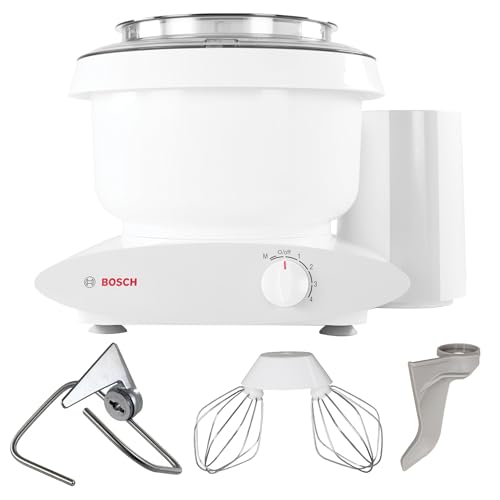
Bosch Universal Plus Stand Mixer 500 Watt, 6.5 Quarts, Bundle — Best Volume Dough Alternative
Production dough bakers often leave the KitchenAid format entirely, and the Bosch is usually why. Its bottom-drive design puts the motor in the base and works a large, open 6.5-quart bowl that staff can feed while it runs — a genuine workflow advantage in a production rhythm — and its kneading reputation among high-volume and whole-grain bakers is the strongest of any countertop format here.
This verified bundle pairs the 500-watt machine with wire whips, a dough hook and a NutriMill dough hook extender, the last aimed at engaging smaller batches properly. For a micro-bakery or serious market baker whose output is dough by the batch, the throughput per station can exceed the bowl-lift picks, because the open bowl shortens every addition and inspection step in the cycle.
It is an alternative, not a certified answer: it carries no commercial certification in its listing, its technique differs from the planetary standard most staff know, and batter-focused production is better served by conventional designs. Dough-led operations cross-shopping formats should trial its workflow seriously; everyone else should read its badge literally.
Strengths
- Open 6.5-Qt bowl can be fed while kneading
- Bottom-drive kneading reputation for volume dough
- Bundle includes dough hook extender for smaller batches
Trade-offs
- No commercial certification in its listing
- Non-standard technique requires staff adjustment
- Batter work is not its specialty
| Power | 500 Watt (Amazon title) |
| Bowl | 6.5 Quarts (Amazon title) |
| Included | Wire whips, dough hook, NutriMill dough hook extender (Amazon title) |
Best for: Dough-led micro-producers who value open-bowl workflow / Not suited for: Inspected kitchens needing certified equipment
Check the current price on Amazon for the Bosch Universal Plus Stand Mixer 500 Watt, 6.5 Quarts, Bundle. You can also see the full listing here to confirm finish, dimensions and what is in the box before you order.
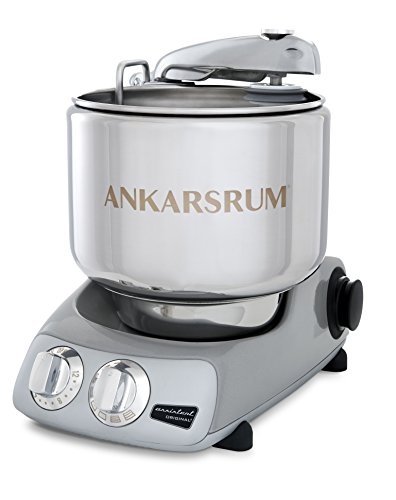
Ankarsrum Original Stand Mixer AKM6230, Jubilee Silver — Best Premium Dough Production
Artisan dough programs — slow, hydrated, carefully developed doughs — are where the Ankarsrum’s rotating bowl earns a commercial-adjacent living. The bowl turns while a roller and scraper work from a fixed arm, developing dough with an action closer to hand kneading than any beater achieves, and the completely open bowl lets a baker adjust hydration, add inclusions and judge development without stopping the cycle.
For a small bakery or serious market operation built around a signature loaf, that control is a production feature, not a luxury: consistency of the hero product is the business. The machine’s build quality and long-service design also suit the buy-once economics that small operations, which cannot afford downtime or replacement cycles, depend on.
Its limits mirror its strengths. Output per hour trails production planetary machines, the technique must be learned rather than assumed, and there is no commercial certification in its listing. It belongs in this guide as the premium dough specialist that KitchenAid-format shoppers should understand before committing — not as a certified substitute.
Strengths
- Rotating-bowl action develops dough gently and consistently
- Open bowl allows continuous adjustment during the cycle
- Long-service build suits buy-once small operations
Trade-offs
- Throughput trails true production machines
- Technique must be trained, not assumed
- No commercial certification in its listing
| Model | AKM6230 (Amazon title) |
| Finish | Jubilee Silver (Amazon title) |
| Design | Rotating bowl, fixed arm (manufacturer design) |
Best for: Artisan dough programs prioritizing quality and consistency / Not suited for: High-throughput or inspected certified production
Check the current price on Amazon for the Ankarsrum Original Stand Mixer AKM6230, Jubilee Silver. You can also see the full listing here to confirm finish, dimensions and what is in the box before you order.

Cuisinart Stand Mixer SM-50, 5.5 Quart, White Linen — Best for Secondary Stations
Working kitchens rarely need two flagships; they need one production machine and a capable second station that absorbs the frosting, the filling, the whipped component and the overflow batter while the main mixer runs dough. The SM-50 is this guide’s nomination for that role: 12 speeds, a 5.5-quart bowl, tilt-head access for fast turnaround, and a splash guard with pour spout included.
Its economics are the point. A secondary station works fewer, lighter hours, so the flagship’s duty premium buys little there, while the SM-50’s speed range and bowl size keep it genuinely useful rather than decorative. The included chef’s whisk, mixing paddle and dough hook mean it can also cover the main station’s lighter work during maintenance or a breakdown — the redundancy every small operation eventually thanks itself for.
Do not promote it beyond its class. As a primary production machine in an inspected kitchen it is neither certified nor framed for sustained duty, and this guide badges it accordingly. As the second mixer in a two-mixer kitchen, it is the smartest money in this guide.
Strengths
- 12 speeds and 5.5-Qt bowl suit varied secondary work
- Tilt-head access speeds turnaround between small jobs
- Complete kit including splash guard with pour spout
Trade-offs
- Not a certified or primary production machine
- Tilt-head format is less planted under heavy dough
- Domestic duty class
| Speeds | 12 speed (Amazon title) |
| Bowl | 5.5 Quart stainless steel bowl (Amazon title) |
| Included | Chef’s whisk, mixing paddle, dough hook, splash guard with pour spout (Amazon title) |
Best for: Working kitchens needing a capable second station / Not suited for: Anyone needing a certified primary production mixer
Check the current price on Amazon for the Cuisinart Stand Mixer SM-50, 5.5 Quart, White Linen. You can also see the full listing here to confirm finish, dimensions and what is in the box before you order.
Comparison Table
Duty class is the column that matters most in this table, and it is embedded in each badge. Match the class to your operation’s legal and workload reality first; capacity and design comparisons only count after that match is made.
| Pick | Badge | Key spec | Best for |
|---|---|---|---|
| KitchenAid NSF Certified Commercial Series 8-Qt Bowl Lift Stand Mixer KSM8990 | Best True Commercial | 8-Qt, NSF Certified Commercial Series | Certified commercial production |
| KitchenAid 7 Quart Bowl-Lift Stand Mixer KSM70, Cast Iron Black | Best Heavy-Duty Prosumer | 7-Qt bowl-lift, 11 speeds | Near-commercial volume at home |
| KitchenAid 5.5-Qt Bowl-Lift Stand Mixer KSM55, Porcelain White | Best for Light Commercial Prep | 5.5-Qt bowl-lift, 11 speeds | Light commercial and café prep |
| Bosch Universal Plus Stand Mixer 500 Watt, 6.5 Quarts, Bundle | Best Volume Dough Alternative | 6.5-Qt, 500W bottom-drive | Volume dough production |
| Ankarsrum Original Stand Mixer AKM6230, Jubilee Silver | Best Premium Dough Production | Rotating bowl design | Artisan dough specialists |
| Cuisinart Stand Mixer SM-50, 5.5 Quart, White Linen | Best for Secondary Stations | 5.5-Qt, 12 speeds | Secondary and support station |
How to Choose the Best Commercial Kitchen Aid Mixers for Your Operation?
Begin with your regulator, not your menu. If your kitchen is inspected and your jurisdiction requires NSF-listed food equipment, the shortlist is the certified flagship and the conversation is about capacity and price — no domestic machine, however sturdy, is a lawful substitute, and any guide that blurs that line is risking your license. If you operate outside inspected commercial rules — a home bakery under cottage-food provisions, a farm kitchen, a serious household — the heavy-duty prosumer picks open up, and the choice becomes about volume and duty rather than certification.
Then size by batch math. Work out your largest regular production batch in quarts of finished dough or batter, and choose the smallest machine whose bowl handles it with working headroom; oversizing wastes money and station space, undersizing multiplies cycles and labor. Finally, plan the station, not just the machine: bowl-lift units need vertical room to work and a permanent home, and production rhythm depends on a second bowl far more often than on a second motor.
- Confirm whether your operation legally requires NSF certification
- Size the bowl by your largest regular batch, with headroom
- Budget for a second bowl before a second machine
- Plan a permanent, powered station for bowl-lift units
- Check parts and bowl availability before committing
What Does NSF Certification Actually Mean for a Mixer?
NSF certification means the equipment has been evaluated against public-health standards for food equipment — materials, cleanability and construction that an inspector can verify from a listing. For a mixer, the practical content is surfaces and seams that can be properly cleaned, food-contact materials that meet the standard, and a model identity that appears in certification listings. It is not a power rating and not a durability promise; a certified machine can still be the wrong size for your production.
That distinction is why this guide treats certification as a gate, not a grade. The KSM8990 passes the gate for inspected kitchens; the capable machines below it do not, and their reviews say so in plain language. Buyers outside inspected settings can weigh those machines on merit. Buyers inside them should treat the gate as the first and non-negotiable filter, then choose within what passes.
Bowl-Lift vs Alternative Designs for Production Work?
The bowl-lift planetary format dominates countertop commercial mixing because it is the generalist: batters, doughs, mashes and whipped work all run on one station with tools staff already understand, and the rigid frame tolerates the pace of a working day. Its production weakness is the closed working area — additions and inspections happen around a fixed head — which is why dough-led operations cross-shop the open-bowl alternatives.
Bottom-drive and rotating-bowl designs trade generality for dough excellence and open access. In a dough-first program their workflow can be faster and their product more consistent; in a mixed menu they ask staff to run two techniques across two formats. Most small operations resolve this by role: a bowl-lift as the primary, certified-or-heavy station, and — if dough volume justifies it — an open-bowl machine as the dough specialist. The comparison table’s badges are written to support exactly that kind of fleet thinking.
How Do You Cost a Commercial Mixer Honestly?
Sticker price is the smallest part of a production mixer’s cost. The real ledger includes throughput (batches per hour against your menu), downtime risk (a mixer down in service week costs more than its repair), consumables and spares (bowls, beaters and hooks are working parts), and the compliance cost of discovering mid-inspection that a domestic machine should not be there. A certified machine that runs for years inside the rules is routinely the cheapest line on that ledger, which is why this guide leads with it despite its tier.
The same ledger disciplines the opposite error: buying certified capacity for a prep-scale job. If the mixer’s day is ninety minutes of frosting and batter, the light-duty picks deliver the same service at a fraction of the capital. Cost honestly in both directions — by duty, volume and legal class — and the right tier usually names itself.
What Does a Production Day Actually Demand from a Mixer?
Domestic reviews test mixers in recipes; production tests them in repetitions. A production day is the same cycle twenty times: load, mix, judge, unload, wipe, repeat — with staff rotating, time pressing and no patience for a machine’s moods. Under that rhythm, the qualities that matter reorder themselves. Bowl locking must be thoughtless, tool changes must be one-handed-fast, the frame must behave identically on cycle twenty as on cycle one, and cleaning between products must be a wipe, not a project.
This is the lens behind this guide’s badges. The certified flagship is built for the repetition; the heavy-duty prosumer picks tolerate it in shorter runs; the prep and secondary picks assume the cycle count stays modest. When you cost a machine, count your cycles honestly — a café’s fifteen gentle cycles and a bakery’s forty dough cycles are different jobs wearing the same word, ‘commercial’, and they point at different picks in this guide.
How Should a Small Operation Plan Mixer Redundancy?
Every production kitchen eventually faces the mixer-down morning, and the operations that survive it planned for it. Redundancy does not require two flagships: it requires a credible second way to mix. That can be the secondary-station pick in this guide covering lighter work while the primary is repaired, a standing relationship with a local service agent, or spares — bowl, beater, hook — that turn the most common failures into five-minute swaps.
Plan the failure modes in order of likelihood. Tools and bowls fail first and cheapest; keep spares. Drive and motor failures are rarer and slower; know your service route before you need it, including realistic turnaround, because a two-week repair in your busiest month is a business event, not an inconvenience. The cheapest insurance in this entire category is the second bowl and spare tool set bought on day one, while the purchase still feels like setup rather than emergency.
What Records and Checks Keep a Commercial Mixer Inspection-Ready?
Inspection readiness is mostly housekeeping made visible. Keep the machine’s model and certification identity documented with your equipment records, as the setup steps in this guide suggest. Keep the station clean in the way inspectors actually assess: food-contact surfaces properly washed, seals and seams free of buildup, the area beneath and behind the machine part of the cleaning routine rather than a forgotten zone.
Add a simple maintenance rhythm: tools inspected for bending and coating damage, bowl-locking points checked for wear, cord and plug examined, and any change in the machine’s sound or behavior logged and acted on rather than worked around. None of this is burdensome, and all of it compounds — the operation that can show a cared-for, documented, correctly classed mixer is the operation for whom inspection day is a formality.
Countertop Commercial vs Floor Mixers: Where Is the Line?
Every growing operation meets the question of when countertop commercial stops being enough. The signals are consistent: batches routinely split across multiple cycles, dough work dominating the day to the point that one station queues the whole kitchen, and batch sizes where a countertop bowl’s working capacity — not its stamped capacity — is the binding constraint on the menu. When two of those three are true, the next purchase conversation is about floor-standing planetary or spiral machines, a different class with different space, power and capital implications.
Until those signals appear, the countertop certified class in this guide is the correct professional tool, and buying floor capacity early is its own mistake: capital parked, space consumed, and a machine whose minimum batch exceeds your daily need. Scale in the order your production demands — countertop certified, then volume support, then floor class — and each step is paid for by the step before it.
How Do You Train Staff on a Shared Production Mixer?
A shared machine needs shared technique, because the fastest way to shorten a production mixer’s life is five operators with five loading habits. Training is short and specific: batch sizes by the station’s posted limits, flour added at low speed in stages, dough judged by development rather than the clock alone, and a hard rule that a straining sound means stop and split, never push through. Laminated at the station, these four habits outlast any individual hire.
Tool discipline completes the training: the right tool for the product — hook for dough, beater for batter, whisk for aeration — every time, with tools washed, inspected and returned to the station rather than the general wash pile. Operations that treat the mixer as a system of machine, tools and habits get the service life the machine was built for; operations that treat it as a magic bowl with a motor spend their money learning the difference.
How Do You Specify a Mixer for a Menu, Not a Catalog?
Professional buyers spec from the menu backward. List the products the mixer will actually make in a week, with their batch sizes and frequencies, and the specification writes itself: the largest batch sets the bowl, the stiffest product sets the frame class, the weekly cycle count sets the duty tier, and the legal setting sets the certification gate. A mixer chosen this way fits on arrival, because it was never really chosen from a catalog — it was derived from the work.
The exercise also exposes the two-station pattern early. Menus usually split into a heavy minority — the doughs and big batches — and a light majority of batters, creams and fillings. One flagship worked within its class plus a capable secondary often serves that split better than one oversized machine doing everything, at comparable capital and with redundancy included. This guide’s badges are arranged to make that fleet decision easy to see.
What Does Warranty and Service Mean at Commercial Scale?
Domestic ownership treats warranty as a receipt in a drawer; commercial ownership treats service as infrastructure. Before committing, a working kitchen should know who services the machine locally, what the realistic turnaround is in peak season, and which parts — bowls, beaters, hooks, guards — are stocked as consumables rather than ordered as events. A machine with a slightly higher price and a same-week service reality is cheaper, in the only ledger that matters, than a bargain down for a fortnight in December.
Keep the paperwork with the equipment records the setup section recommends: purchase details, model and certification identity, service contacts and a simple log of issues and resolutions. When something does fail, that file turns a scramble into a phone call — and in a production kitchen, the difference between those two is measured in menus, not minutes.
What Should a Growing Operation Buy Second?
After the primary mixer, the highest-return purchases in order are a second bowl, spare tools, and then — only then — a second machine. The second bowl removes washing from the production critical path; spare tools convert breakages into pauses; the second machine, when volume finally justifies it, should be bought to a role — dough specialist, secondary station, or redundancy for the flagship — rather than as a duplicate bought in a panic during a breakdown. Fleets planned by role age gracefully; fleets assembled by emergency carry their emergencies with them.
This sequencing is also the honest answer to the most common commercial question this guide receives: not ‘which mixer’ but ‘what next’. Production kitchens rarely fail for lack of a flagship. They fail at the seams — the bowl being washed, the hook nobody can find, the station waiting on a part. Buy the seams first and the flagship you already own becomes the machine you thought you bought.
How to Set Up a Commercial Mixer Station for Production
A production mixer earns its keep at a station designed around it. Set the station up as you would any line position — power, clearance, tools, cleaning — before the first production day, and run a full shakedown batch at production scale to prove the workflow while the stakes are low.
- Position the mixer on a dedicated, level, load-rated counter section with the vertical clearance its bowl lift and feeding require.
- Confirm the circuit suits sustained motor work and keep the cord path dry, short and out of the traffic line.
- Wash and sanitize the bowl and all tools; verify bowl locking and beater clearance per the manual before any food contact.
- Stage the full tool set and a second bowl at the station so changeovers never wait on washing.
- Run a shakedown batch at full production scale, timing the cycle and noting scrape, addition and unload steps.
- Write the station’s cleaning sequence into your closing routine: tools washed, bowl dried, surfaces wiped, machine inspected.
- Log the machine in your equipment records with its model and certification details for inspection readiness.
Maintain the station like revenue depends on it, because it does. Weekly checks of bowl locking, tool condition and cord integrity catch the small failures that become service-day disasters, and keeping one spare beater and hook at the station turns a breakage from a crisis into a pause. A commercial mixer bought well and stationed properly should disappear into your operation’s rhythm — present in every product, absent from every problem list.
Common Buying Mistakes
Commercial mixer mistakes cost businesses money, product and occasionally licenses. These are the ones this guide was written to prevent.
Buying a domestic machine for an inspected kitchen. Capability is not certification. If your operation requires listed equipment, only the certified pick in this guide qualifies — full stop.
Sizing by bowl quarts alone. Working capacity is what matters: dough needs headroom to develop. Size by your largest batch’s real volume, not the number stamped on the bowl.
Running one bowl in production. A single bowl makes the wash cycle your production bottleneck. A second bowl is the cheapest throughput upgrade in this entire guide.
Ignoring station ergonomics. A bowl-lift that cannot be fed comfortably, or a station far from power and prep, taxes every batch. Design the station with the machine.
Skipping the shakedown batch. Discovering workflow problems at full scale during service is the expensive way to learn. Prove the station on a quiet day first.
Treating tools as permanent. Beaters, hooks and whisks are working parts that bend, wear and fail. Stock spares and inspect them like the production components they are.
Final Recommendation
If mixing is revenue and your kitchen is inspected, the answer is the KitchenAid KSM8990: the NSF Certified Commercial Series flagship is the only pick that answers this search without qualification, and its 8-quart bowl-lift format will carry a small operation’s production with room to spare. High-volume bakers outside certification rules should look hard at the 7-quart KSM70; cafés and prep-scale operations at the KSM55; dough-led programs should cross-shop the Bosch and the Ankarsrum with open eyes about their class; and every working kitchen should consider the Cuisinart as its second station.
Confirm the exact configuration — and, for the flagship, the certification wording — on the live listing, and check price on Amazon before committing capital. For neighboring equipment categories in this program, see Best Commercial Mixers For Kitchen and the related guides below.
If you want the short version: start with KitchenAid NSF Certified Commercial Series 8-Qt Bowl Lift Stand Mixer KSM8990, KitchenAid 7 Quart Bowl-Lift Stand Mixer KSM70, Cast Iron Black, KitchenAid 5.5-Qt Bowl-Lift Stand Mixer KSM55, Porcelain White. Each is one click away from its live listing, where you can check price on Amazon and confirm the exact configuration.
Best Commercial Mixers For Kitchen Best Choice Stand Mixers Best Cd Mixers Best Cookie Mixers Best Compact Stand Mixers
Frequently Asked Questions
What is KitchenAid’s true commercial stand mixer?
The NSF Certified Commercial Series 8-Qt Bowl Lift model, KSM8990, is KitchenAid’s certified commercial countertop mixer. Its verified listing title carries the certification and series name; other KitchenAid models are domestic or heavy-duty prosumer machines, however capable.
Can I use a regular KitchenAid in my café or bakery?
That depends on your jurisdiction and inspection regime. Where NSF-listed equipment is required, a domestic model is not a lawful substitute. Where rules permit, heavy-duty bowl-lift models such as the 7-quart KSM70 suit volume work — confirm your local requirements before buying.
Is an 8-quart bowl big enough for a small bakery?
For many small operations, yes: it batches at production scale for doughs, batters and mashed work typical of a café or small bakery case. Operations whose core product is high-volume bread should cost floor-standing production mixers as the next class up.
Why consider Bosch or Ankarsrum in a KitchenAid guide?
Because dough-led producers cross-shop formats, and honest buying advice compares them. Both are presented with their true class — neither carries commercial certification in its listing — as volume-dough alternatives to the KitchenAid format.
What should I budget beyond the mixer itself?
A second bowl, spare beater and hook, and the station setup. In production, the second bowl is the highest-value accessory you can buy, because it removes washing from the critical path between batches.
Why are there no prices in this guide?
Commercial configurations and bundles change the number, and listings move. Each pick links to its verified live listing so you can check price on Amazon for the exact configuration your operation is buying.
How many bowls should a small bakery own per mixer?
Two is the working minimum for production: one in the cycle, one washed and ready. High-throughput dough programs often run three, so proofing, mixing and washing never queue behind each other. Bowls are the cheapest throughput in the building.
Can a small operation start with a prosumer mixer and upgrade later?
Yes, where regulations permit, and it is a common sensible path: begin with the heavy-duty prosumer pick matched to your volume, keep immaculate records of its duty, and let production growth — measured in cycles and batches, not hopes — trigger the certified upgrade. What you must not do is let a growing, inspected operation drift past the point where certification was required; the upgrade is a planned step, not an inspection-day discovery.


