Disclosure: airfryerkitchensupply.com is reader-supported. When you buy through links on our site, we may earn an affiliate commission at no extra cost to you.
Where to buy
You can buy every pick in this best coffee espresso combo machines guide through Amazon, where stock, delivery options and returns are easiest to manage for kitchen gear of this size. Start with our top recommendations: De’Longhi COM530M All-In-One Combination Coffee and Espresso Machine, De’Longhi Combi BCO430 Coffee and Espresso Machine, Ninja Espresso & Coffee Barista System (CFN601), De’Longhi All-in-One with Dual Heating System (10-Cup), Ninja DualBrew Prestige (CFN801), De’Longhi COM630BK All-In-One Combination Machine. Prices and availability change often, so check price on Amazon on the product page before you order, and confirm the exact size, colour and configuration on the listing matches what you measured your kitchen for.
The best coffee espresso combo machines answer a question every shared kitchen eventually asks: why are there two coffee appliances on this counter, and can one of them leave? A combo machine merges a drip coffee brewer and an espresso maker into a single unit — one plug, one footprint, both drinks. The idea sounds like a compromise until you live with a good one: the morning pot brews for the household while the espresso side stands ready for whoever wants a cappuccino, and the counter in between stays clear for actual cooking. This guide is for buyers who have already decided the two-in-one route makes sense and want to know which combo deserves the space.
Shoppers use ‘combo’ loosely, so let us be precise about the species in this guide. There are classic portafilter combos, where one side brews a carafe and the other pulls true espresso shots from ground coffee. There are dual-heating combos that can run both sides at once. And there are modern hybrid combos that pair brewed coffee with capsule espresso for households that value speed over craft. All three species appear below, clearly labelled, because the right choice depends entirely on which kind of espresso your household actually drinks.
Every machine was verified on this site’s Amazon integration before being linked: brand and model code searched, the returned listing title matched to the machine and its format, and only then recommended. Combo line-ups are full of lookalike variants, and the model code is the only reliable identity a machine has. We print no prices and no ratings — both change too fast to be honest in print — so check price on Amazon at the listing and confirm the code matches the review you are following.
A word about who this guide is not for, in the interest of your money: if your household drinks only one kind of coffee, a combo is the wrong purchase no matter how good the machine, because you will pay for a second system that gathers dust. And if espresso has become a genuine hobby — scales, distribution tools, single-origin beans — a dedicated machine will serve the hobby better than any combo’s espresso side. Everyone between those poles, which is most coffee households, is exactly who the six machines below were chosen for.
In this guide
Quick Picks
If you only have a minute, these are the coffee espresso combo machines worth shortlisting. Each one is reviewed in full further down, with strengths, trade-offs and a clear verdict on who it suits.
- Best Overall Combo — De’Longhi COM530M All-In-One Combination Coffee and Espresso Machine: The complete classic combo: programmable carafe brewing on one side, genuine pump espresso with a milk frother on the other.
- Best Budget Combo — De’Longhi Combi BCO430 Coffee and Espresso Machine: The enduring entry point of the combi family — both drinks, a manual steam wand, and the friendliest tier in the classic format.
- Best Capsule Combo — Ninja Espresso & Coffee Barista System (CFN601): Capsule espresso in three styles plus brewed coffee from one system — the combo for households that value speed and variety over ritual.
- Best for Entertaining — De’Longhi All-in-One with Dual Heating System (10-Cup): Two heaters, zero queue: a 10-cup pot and fresh espresso at the same time, built for brunches and dinner parties.
- Best Premium Hybrid — Ninja DualBrew Prestige (CFN801): The flagship hybrid: grounds brewing from single cups upward plus capsule espresso, in Ninja’s most polished system.
- Best for Milk Drinks — De’Longhi COM630BK All-In-One Combination Machine: The milk lover’s combo: De’Longhi’s Advanced Cappuccino System takes the technique out of lattes and cappuccinos.
How These Picks Were Chosen
Combo machines are sold under a thicket of similar names, so this guide verified identity before quality. Each pick was searched by brand and full model code on this site’s Amazon integration, and the listing title returned was checked against the machine’s claimed format — classic portafilter combo, dual-heating model, capsule system or flagship milk variant. Only confirmed matches received links. Two well-known combo variants we attempted to include could not be confirmed in the exact configuration we wanted to recommend, so they are absent rather than guessed at — in a category defined by model codes, that discipline is the difference between a guide and a gamble.
Quality judging then followed the drinks. We weighed the drip side on programmability, carafe size and independence from the espresso side; the espresso side on whether it is true pump extraction or an honestly-labelled capsule alternative; and the whole machine on footprint, cleaning burden and whether both halves would plausibly still be in use in a year. No prices or ratings are printed, as both change constantly — check price on Amazon, and take one last look at the model code before you order. We also read each platform’s history into the judging: a combo is a long-lived appliance with two systems to support, so a maker’s track record with parts, carafes and service counted for as much as any single feature. New entrants with clever specifications but no support history were treated with the scepticism a five-year purchase deserves.
The 6 Best Coffee Espresso Combo Machines

De’Longhi COM530M All-In-One Combination Coffee and Espresso Machine — Best Overall Combo
If a household wants the textbook combo — a real drip brewer married to a real espresso machine — the COM530M is where the search ends. Its verified listing confirms the All-In-One format with a 47-ounce coffee capacity. Neither side is a token gesture: the drip side programmes like a proper coffee maker for weekday mornings, and the espresso side extracts with a pump and froths milk for the full cappuccino repertoire. It is the reference machine against which the rest of this guide is priced and judged.
Strengths
- True espresso from ground coffee, not a pod approximation, alongside full carafe brewing
- The two systems operate independently, so a brewing pot never locks out a shot
- De’Longhi’s long combo heritage means mature design and available parts
Trade-offs
- Espresso quality depends on your grinder; there is none built in
- It is a wide machine — the footprint saving is versus two machines, not versus one small one
- Two descaling routines to keep, one per system
| Format | Drip + pump espresso combo |
| Coffee side | 47 oz capacity (per Amazon title) |
| Espresso side | Pump machine with milk frother |
What makes the 530 the benchmark is balance. Many combos are a good drip machine with an espresso afterthought, or the reverse; this one was clearly engineered as a pair, with controls and water management that treat both drinks as first-class. In a household split between a pot-a-day drinker and a two-cappuccino drinker, each person gets their ritual at full quality, and neither subsidises the other’s appliance with counter space.
The espresso side rewards modest investment in skill and beans. Fresh grounds, a consistent tamp and milk practiced for a week produce drinks that hold their own against cafe orders — the honest ceiling of the classic combo format. Buyers who suspect they will outgrow it into full home-barista hobby territory should jump straight to a dedicated machine; buyers who want great drinks without a new hobby will find the 530’s ceiling comfortably above their ambitions for years.
Best for: the classic split household: daily drip drinkers plus daily espresso drinkers / Not suited for: hobbyist baristas, or kitchens where counter depth is critically tight
Check the current price on Amazon

De’Longhi Combi BCO430 Coffee and Espresso Machine — Best Budget Combo
The BCO430 is the combo for buyers who want the classic format without the flagship spend. De’Longhi’s combi line has run for years on a simple proposition: a competent drip brewer and a pump espresso maker with a steam wand, sharing one body at an accessible tier. Its verified listing confirms the Combi format plainly, without the advanced milk systems or dual heaters of its pricier siblings — and for many households, plain is exactly right.
Strengths
- The most accessible way into a genuine portafilter combo from the brand that defined it
- Manual steam wand teaches real milk technique and gives full control once learned
- Years on the market means accessories, carafes and advice are everywhere
Trade-offs
- Milk drinks take practice; there is no automatic cappuccino help
- One heating path means the two sides take turns under heavy demand
- Basic finish and controls compared with the COM flagships
| Format | Combi drip + espresso with steam wand |
| Brand line | De’Longhi BCO430 (per Amazon title) |
Budget combos usually cut the espresso pump or the drip brewer’s programmability and call the result a bargain. The BCO430’s discipline is that it cuts theatre instead — simpler plastics, a manual wand, fewer modes — while keeping both brewing systems honest. A first-time combo owner learns real skills on it: grinding, tamping, steaming. Those skills transfer to every machine they will ever own, which makes this model the educator of the guide as well as its bargain.
It is also the right combo for a second home, a rental property or an office kitchenette, where the flagship’s price cannot be justified but the two-drink capability absolutely can. If it has a ceiling, it is simultaneity and milk convenience — both addressed by its siblings above and below in this guide, at their prices. At its own tier, the BCO430 has no serious rival we could verify.
Best for: budget buyers, second homes and first-time combo owners learning real technique / Not suited for: buyers wanting push-button milk drinks or simultaneous brewing
Check the current price on Amazon
Ninja Espresso & Coffee Barista System (CFN601) — Best Capsule Combo
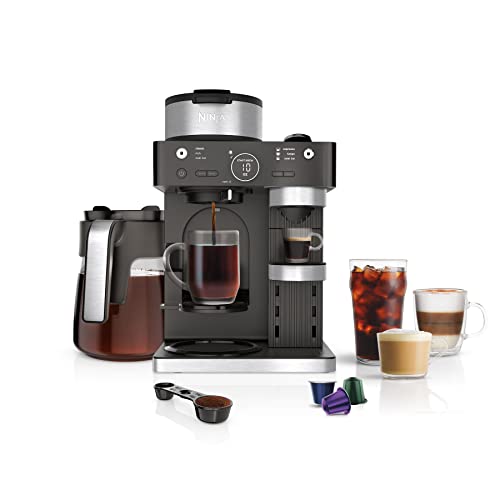
The CFN601 Barista System is Ninja’s answer to a different household question: not ‘how do we make espresso properly?’ but ‘how does everyone get their drink in under two minutes?’ The verified listing confirms the formula — Nespresso-compatible capsule espresso with three brew styles, alongside brewed coffee in single-serve sizes. There is no portafilter, no grinder and no tamping: the espresso side runs on capsules, and the coffee side runs on grounds, and both are ready before a kettle boils.
Strengths
- Zero-technique espresso: consistent capsule shots in three styles, every time
- Brewed coffee from grounds covers mugs and travel cups without a separate machine
- The fastest morning routine of any pick in this guide
Trade-offs
- Capsules set the flavour ceiling and the highest cost per drink here
- No path to fresh-ground espresso craft — the system is deliberately closed
- Capsule waste is a real consideration for environmentally minded households
| Format | Capsule espresso + brewed coffee system |
| Espresso | Nespresso compatible, 3 brew styles (per Amazon title) |
| Model | CFN601 Barista System (per Amazon title) |
There is a snobbery trap in coffee writing that this machine exposes: for a large share of households, the best espresso is the one that actually gets made at 6:40 a.m. by someone half asleep. The CFN601’s three brew styles give capsule drinkers a genuine choice of intensity, its brewed-coffee side handles the rest of the household, and the whole performance repeats identically every day — a virtue no manual machine can promise a tired beginner.
The costs are the honest mirror of the virtues: per-drink capsule pricing, a flavour ceiling set by the capsule catalogue, and packaging waste. Households that drink two coffees a day will barely notice; households drinking eight should do the arithmetic and may land on the portafilter combos instead. As a system for busy, varied, technique-free mornings, the CFN601 is the most coherent capsule combo we verified.
Best for: busy households wanting capsule espresso and brewed coffee with zero technique / Not suited for: high-volume drinkers watching cost per cup, or aspiring home baristas
Check the current price on Amazon
De’Longhi All-in-One with Dual Heating System (10-Cup) — Best for Entertaining
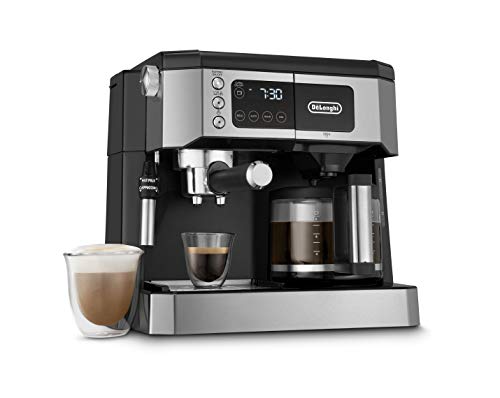
Most combos make drinks one system at a time. This one’s verified listing advertises the exception — a dual heating system behind a 10-cup pot and a milk-frothing espresso side — and that single specification rewrites the machine’s social life. It is the combo for people whose coffee is an event: weekend brunches where the pot goes on the table and individual espressos follow, dinner parties where coffee service is the finale rather than an afterthought.
Strengths
- Simultaneous brewing: the pot and the espresso side genuinely work at once
- 10-cup capacity matches real gathering sizes without a second brew
- Milk frother rounds out the after-dinner menu — cappuccinos and lattes on request
Trade-offs
- You pay for simultaneity whether or not your household ever needs it
- The largest appetite for counter space and descaling attention in the classic format
- No grinder included, as across the classic combos
| Format | All-in-one combo, dual heating (per Amazon title) |
| Coffee side | 10-cup pot (per Amazon title) |
| Milk | Frother (per Amazon title) |
Picture the machine’s defining scene: dessert is served, the pot of coffee lands in the middle of the table, and two guests who asked for espresso are drinking theirs while the pot is still being poured — not five minutes later, apologetically, from a machine that had to finish one job before starting another. Dual heating is a hospitality feature disguised as an engineering one, and hosts feel its value at exactly the moments guests remember.
Outside those moments it behaves as a well-sorted De’Longhi combo: honest drip brewing, real pump espresso, milk on demand. If your entertaining is rare, the COM530M gives you the same drinks for less commitment. If your table seats eight most weekends, this is the combo that keeps the host out of the kitchen and in the conversation — which is, in the end, the entire point of having people over.
Best for: hosts and big households whose coffee service happens all at once / Not suited for: quiet households whose drinks arrive one at a time
Check the current price on Amazon

Ninja DualBrew Prestige (CFN801) — Best Premium Hybrid
The DualBrew Prestige is the premium expression of the hybrid idea. Its verified listing confirms a 2-in-1 system spanning espresso and grounds, Nespresso compatibility, three espresso brew styles and single-serve coffee. Where the CFN601 is the efficient version of the concept, the Prestige is the finished one — the machine for households that have decided capsules are their espresso and want the best-executed version of that decision, with a brewed-coffee side flexible enough to replace a standalone maker entirely.
Strengths
- The most polished hybrid execution: broad size range on the coffee side, three espresso styles on the other
- Single-serve grounds brewing removes the pod brewer from the counter too
- Premium build and interface suit kitchens where the machine is on permanent display
Trade-offs
- Premium pricing for a capsule-ceiling espresso experience
- Running costs follow the capsule model — count your weekly drinks first
- Purists will always choose the portafilter route at this spend
| Format | 2-in-1 hybrid: grounds + capsule espresso (per Amazon title) |
| Espresso | Nespresso compatible, 3 brew styles (per Amazon title) |
| Model | DualBrew Prestige CFN801 (per Amazon title) |
The Prestige’s argument is consolidation depth. A classic combo replaces two machines; this one credibly replaces three — drip maker, single-serve brewer and espresso gadget — because its coffee side is not a carafe-only afterthought but a flexible grounds brewer in its own right. For the apartment or the minimalist kitchen, that third replacement is the difference between a clear counter and a crowded one.
As with its sibling, the trade is stated plainly: capsule espresso will never be a hobby, and its per-drink cost is the system’s subscription. The Prestige buyer is paying for design, breadth and effortlessness, and getting all three in the best measure this category offers. Households that recognise themselves in that sentence will not be disappointed; households that dream of dialling in a single-origin shot should take the same money to the classic combos above.
Best for: minimalist households wanting one premium system for every coffee format / Not suited for: espresso hobbyists or high-volume drinkers minimising cost per cup
Check the current price on Amazon

De’Longhi COM630BK All-In-One Combination Machine — Best for Milk Drinks
In most combo households, the espresso side lives or dies by its milk drinks — and milk is where beginners struggle. The COM630BK’s verified listing names its solution: an Advanced Cappuccino System on De’Longhi’s all-in-one platform, in a black finish. The system’s promise is consistency without technique: cappuccinos and lattes that come out right on a weekday, made by whoever is standing at the machine, rather than depending on one person’s hard-won wand skills.
Strengths
- Advanced Cappuccino System makes milk drinks repeatable for every user in the house
- Full classic combo underneath: carafe coffee plus true pump espresso
- Black flagship finish suits modern kitchens and hides coffee splashes gracefully
Trade-offs
- The premium is concentrated in the milk system — straight-espresso households gain little
- Automatic milk components demand rinsing after every session, without exception
- No integrated grinder; the espresso ceiling still depends on yours
| Format | All-in-one combo |
| Milk | Advanced Cappuccino System (per Amazon title) |
| Finish | Black |
There is a particular disappointment familiar to combo owners: the espresso side falls silent after a month because the cappuccinos were inconsistent and the wand was a faff, and the machine becomes an expensive drip maker. The COM630BK is engineered against that exact failure. When milk drinks are easy, they get made; when they get made daily, the combo earns its counter. That behavioural logic, more than any specification, is why this machine carries the milk badge.
The discipline it asks in return is cleaning: automatic milk systems concentrate residue in small passages, and a rinse skipped twice becomes a flavour problem and then a function problem. Households happy to build the thirty-second rinse into the ritual get the best milk-drink combo in this guide. Households who know they will not should choose the manual-wand BCO430 and accept the learning curve instead — an honest trade this guide is happy to endorse.
Best for: latte and cappuccino households wanting consistent milk drinks without technique / Not suited for: black-coffee households, or anyone who will skip the milk-system rinsing
Check the current price on Amazon
Comparison Table
| Pick | Badge | Key spec | Best for |
|---|---|---|---|
| De’Longhi COM530M All-In-One Combination Coffee and Espresso Machine | Best Overall Combo | Classic combo, 47 oz drip + pump espresso | the classic split household: daily drip drinkers plus daily espresso drinkers |
| De’Longhi Combi BCO430 Coffee and Espresso Machine | Best Budget Combo | Classic combi, manual steam wand | budget buyers, second homes and first-time combo owners learning real technique |
| Ninja Espresso & Coffee Barista System (CFN601) | Best Capsule Combo | Capsule espresso (3 styles) + brewed coffee | busy households wanting capsule espresso and brewed coffee with zero technique |
| De’Longhi All-in-One with Dual Heating System (10-Cup) | Best for Entertaining | Dual heating, 10-cup + espresso together | hosts and big households whose coffee service happens all at once |
| Ninja DualBrew Prestige (CFN801) | Best Premium Hybrid | Premium hybrid, grounds + capsules | minimalist households wanting one premium system for every coffee format |
| De’Longhi COM630BK All-In-One Combination Machine | Best for Milk Drinks | Combo + Advanced Cappuccino System | latte and cappuccino households wanting consistent milk drinks without technique |
How to Choose the Best Coffee Espresso Combo Machine
Choose your espresso species first
Portafilter combos brew real espresso from grounds: highest ceiling, most skill, a grinder required. Capsule combos brew consistent espresso-style drinks instantly: lowest effort, highest cost per cup, a fixed flavour ceiling. This single decision organises the entire guide — De’Longhi’s machines on one side, Ninja’s systems on the other — and no feature downstream can compensate for choosing the wrong species for your household’s temperament.
Then size the drip side honestly
Carafe sizes in this guide run from flexible single-serve systems to a 47-ounce side and a 10-cup pot. Match the coffee side to your largest regular occasion, not your largest imaginable one: an oversized carafe brews small weekday amounts badly, while an undersized one turns brunch into two brewing sessions. Households that mostly drink single cups should look hard at the hybrid systems, whose coffee sides were designed for exactly that pattern.
Simultaneity: luxury or necessity?
Dual heating is the classic combo’s one true luxury feature. It matters when drinks coincide — family breakfasts, dinner parties, office peaks — and is invisible money wasted when they do not. Be honest about your household’s rhythm before paying for it; the same money buys the grinder a portafilter combo needs, which improves every single espresso rather than the simultaneous few.
Milk: manual, advanced or none
Manual wands reward practice with control and cost nothing extra. Advanced systems cost more and demand rigorous rinsing, but deliver weekday-proof consistency. Capsule systems sidestep milk technique almost entirely. The right answer is the one matched to who actually makes the drinks in your house at 7 a.m. — including the days when the household’s one skilled barista is travelling.
Water: the ingredient combos are thirstiest for
Two brewing systems drink more water than one, and water quality governs both taste and descaling frequency. Hard water scales an espresso boiler relentlessly; heavily chlorinated water flattens drip coffee. If your tap water is extreme in either direction, filtered water is the cheapest performance upgrade available to any machine in this guide, and the combo format doubles its return. Check how each shortlisted model handles filtration — in-tank filters, filter reminders — and factor the habit into your choice, because a combo on bad water underperforms two separate machines on good water every single morning.
Count the routines, not just the features
Every combo carries two maintenance lives: descaling schedules, a drip side that wants daily rinsing, an espresso side that punishes neglect faster. Before buying, read the cleaning summary of your shortlisted model as if it were a job description — because it is, twice over. The best combo is the one whose routines your household will actually keep.
A Brief History of the Combo Machine, and Why It Endures
The combination machine is older than the current coffee boom: Italian makers were bolting drip brewers to pump espresso machines decades ago, when the two drinks first began sharing households. The category has survived every wave since — pod revolutions, the third-wave espresso movement, the smart-kitchen era — because the problem it solves never changes: two beloved drinks, one finite counter. Each era improves the execution rather than the idea, which is why today’s flagships add dual heating, advanced milk systems and capsule hybrids to a formula that was already right in outline.
That endurance is itself buying information. A category that has held its place for decades, across every fashion in coffee, is not a gimmick cycle; it is a stable answer to a stable household fact. Buyers choosing a combo are joining one of the longest-running arrangements in the kitchen — and the machines in this guide are its current best expression.
Combo vs Combination: Is There a Difference?
None worth your money. ‘Combo’ and ‘combination’ are used interchangeably by brands and retailers for the same category — a drip brewer and an espresso maker sharing a body — which is why this site covers the idea across both searches with guides tuned to each. What does differ, and what your money should follow, is the format inside the name: portafilter or capsule, single or dual heating, manual or advanced milk. Shop the format, not the wording, and use the model code as the machine’s true name at every step from shortlist to checkout.
Can a Combo Machine Replace a Cafe Habit?
For most households, financially, yes — and the maths is not close. A combo plus a grinder, run on decent beans, produces drinks at a small fraction of cafe prices, and the machine pays for itself in a matter of months at one bought drink a day. The honest caveats are craft and occasion: a cafe sells you a room, a ritual and a barista’s decade of skill alongside the drink, and a combo replaces only the liquid. Households that understand they are buying the liquid back — at excellent quality, in their own kitchen, in pyjamas — are the ones who report the highest satisfaction with this category year after year.
Capsule combos change the arithmetic without breaking it: the per-drink cost is higher, the payback slower, but still comfortably ahead of a daily cafe habit, with zero skill required. Run your own household’s numbers before choosing a species; the guide’s badges assume you have.
Where Should a Combo Machine Live?
Combos are tall, deep and busy machines: they need clearance for carafes and lids, access to a water tank, and room to work a portafilter or load capsules. The best home is a stretch of counter near the sink (for rinsing and filling) and near the cups and beans, forming a coffee station rather than an appliance parking spot. Under-cabinet height is the classic trap — measure it with the lid open, not closed. Households that give the machine a proper station use both halves more; the combo that must be dragged out of a cupboard becomes, within a month, a drip machine with an interesting ornament.
What to Buy Alongside a Combo Machine
For portafilter combos, the grinder is not an accessory but a co-purchase: a burr grinder sized for espresso transforms the drinks more than any other spend. Add a knock box, a milk jug for wand users, and a simple scale if you enjoy repeatability. For capsule systems, the co-purchase is a capsule organiser and a descaling habit. For every combo: a spare carafe is cheap insurance against the category’s most common accident, and a water filter routine suited to your supply will repay itself in descaling intervals alone. None of this is upsell — it is the difference between a machine that performs at its design level and one that quietly underdelivers for years.
Combo Machines in Small Apartments: Making the Maths Work
The apartment case for a combo is arithmetic: a drip maker plus an espresso machine plus, often, a pod brewer consume a metre of counter that a small kitchen does not have. A single combo returns most of that metre to food preparation, which in a small kitchen is worth more than any single feature in this guide. The constraint to respect is vertical and operational rather than horizontal — combos are tall, their lids and carafes need swing room, and a machine wedged under a low cabinet with its tank inaccessible will be hated by June.
Apartment buyers should also weigh noise and routine: capsule systems are the quietest and fastest for early starts in thin-walled buildings, while portafilter combos ask for grinding, which carries. None of this disqualifies any pick here; it simply means the small-kitchen buyer should choose with the whole living situation in mind, not the drinks alone. Chosen that way, a combo is often the single best appliance decision an apartment coffee drinker makes.
Used, Refurbished and Open-Box Combos: A Cautious Word
Combo machines appear on the used market constantly, usually because a household’s habits changed, and the savings can be real. The risks are specific to the format: two systems means two unknown maintenance histories, and the espresso side hides neglect — scale, tired seals, a milk system with a past — better than the drip side does. If you buy used, buy a model from a maker with available parts (the De’Longhi platforms in this guide qualify), descale both systems immediately, replace the water-contact consumables you can, and test the espresso side under pressure before the return window closes.
For most buyers, though, the honest recommendation is new: the price gap between a used combo of unknown history and a new value pick like the BCO430 is smaller than the cost of one espresso-side repair. The used market rewards the handy and the patient; everyone else should take the warranty and the clean start.
How Combo Machines Handle Decaf, Tea Drinkers and Other Household Rebels
Real households contain multitudes: the decaf-only drinker, the tea devotee, the teenager who wants iced coffee. A good combo quietly serves them all. The drip side brews a small decaf pot without contaminating the main event if you sequence it first and rinse the basket; capsule systems make decaf a one-capsule decision with zero cross-contact, which is an underrated argument for the hybrid format in mixed households. Hot water for tea comes from a kettle in most homes, though the drip side run empty is a workable stand-in.
Iced coffee deserves a mention because combos serve it well: a strong drip brew over ice from the coffee side, or a double capsule shot over ice from the espresso side, covers both schools. The point is that a combo is not a two-drink machine but a platform — and households that treat it as one find it quietly absorbs preferences that would otherwise demand a third and fourth appliance.
How to Get the Best From a Combo Machine: A Starter Routine
Combos reward owners who build small rituals early. This routine covers the first month and the habits that should outlive it.
- Commission the drip side on day one. Flush it, brew your normal pot, and adjust the coffee-to-water ratio before touching the espresso side.
- Give espresso three focused sessions. Short, deliberate practice — grind, dose, tamp, time the shot, taste — teaches faster than a month of random attempts.
- Standardise your milk method. Cold milk, cold jug, wand purged before and after. Write down what worked; repeat it exactly for a week.
- Rinse as you go. Carafe and basket rinsed daily, portafilter knocked out and wiped after every shot, milk system rinsed after every session.
- Descale by the calendar, not by symptoms. Note the interval for your water hardness in your phone the day the machine arrives.
- Review at one month. Which half do you use less, and why? Adjust the routine — beans, capsule stock, timer settings — while habits are still young.
Owners who run this starter month end up with a machine tuned to their household. Owners who skip it end up with a machine tuned to nobody, which is how good combos get bad reputations. If other people use the machine — a partner, teenagers, office colleagues — teach the two non-negotiables in week one rather than month six: rinse the milk system, and never force a control that resists. Combo machines are shared infrastructure, and shared infrastructure survives on shared habits, briefly taught and often repeated.
Common Buying Mistakes
Treating “combo” as a single category. Portafilter, capsule and dual-heating machines are different products wearing one label. Choose the format first; compare models second.
Starving a portafilter combo of a grinder. Pre-ground coffee makes the espresso side a shadow of itself. If the budget will not stretch to a burr grinder, a capsule system is the honest alternative.
Paying for simultaneity you will never use. Dual heating is for households whose drinks coincide. Everyone else should spend the difference on beans or a grinder.
Letting the milk system set the cleaning agenda by failing. Rinse after every use, or the first sign of trouble will be flavour, then blockage. Thirty seconds now or a service call later.
Hiding the machine in a cupboard. A combo that must be fetched will be fetched less each month. Give it a station with water and cups nearby, or do not buy one.
Ignoring the household’s second drinker. Combos are bought by one person and used by a household. A machine chosen for one drinker’s taste — capsule when the partner wants craft, manual wand when the partner wants push-button — breeds a second appliance purchase within the year.
Skipping the first-week flush and dial-in. Both systems ship with manufacturing residues and factory settings. A rushed first week produces bad drinks that get blamed on the machine for months.
Final Recommendation
The COM530M is the best coffee espresso combo machine for most households: the classic format in perfect balance. The BCO430 brings the same idea to its friendliest tier and teaches real skills along the way, the dual-heating De’Longhi serves hosts whose drinks arrive all at once, and the COM630BK is the milk-drink specialist. On the hybrid side, the Ninja CFN601 and DualBrew Prestige serve households that have traded ritual for speed — a legitimate trade, made with open eyes.
Whichever species you choose, confirm the model code on the listing, measure the counter with the machine in working position, and keep both halves clean and descaled. A combo maintained like two machines and used like one is among the best-value appliances a coffee household can own.
One final piece of advice, offered from watching where combo purchases go wrong: buy for the household you have this year, not the one you imagine in five. The couple that will ‘definitely entertain more’ should not pay for dual heating today; the solo drinker who might take up espresso craft should not buy the portafilter flagship on spec. Every machine in this guide will serve its true audience for years — the only failures we see are mismatches, and they are all avoidable with the honest counting this guide has asked of you. Count well, and the combo will take care of the mornings.
Keep exploring the rest of our coverage in this category: Best Coffee Espresso Combination Machines Best Coffee Espresso Machines Home Best Espresso Machines Best Coffee Makers Best Budget Espresso Machines
Frequently Asked Questions
What is the difference between a combo and a combination espresso machine?
None — the terms are interchangeable. What matters is the format inside: portafilter or capsule espresso, single or dual heating, manual or automatic milk.
Do combo machines make real espresso?
Portafilter combos do — genuine pump extraction from ground coffee. Capsule models make a consistent espresso-style drink with a lower ceiling and zero technique. This guide labels each clearly.
Which combo is best for a small kitchen?
Measure first: combos save space versus two machines but are not small in absolute terms. The hybrid Ninja systems consolidate the most functions per footprint for tight counters.
Can both sides of a combo run at once?
Only dual-heating models, like the De’Longhi pick in this guide. Standard combos alternate between systems, which is fine for staggered household routines.
How long do combo machines last?
With descaling and cleaning kept up on both systems, the proven platforms here serve for years. Neglect, not the format, is what shortens a combo’s life.
Is a combo cheaper than two separate machines?
Usually, yes — one body, one purchase, one footprint. The exception is the hobbyist path, where separate machines allow staged upgrades that a combo cannot.
What beans should I use in a portafilter combo?
Fresh, medium-to-dark roasts are the forgiving starting point: they extract generously and suit milk drinks. Grind just before brewing, and buy in quantities you will finish within a few weeks.
Can a combo machine make iced coffee?
Yes, both ways: strong drip coffee brewed over ice, or a double espresso — portafilter or capsule — poured over ice with cold milk. Combos are quietly excellent summer machines.


