Disclosure: airfryerkitchensupply.com is reader-supported. When you buy through links on our site, we may earn an affiliate commission at no extra cost to you.
Where to buy
Every pick in this guide to the best coffee drip makers for coffee shop was cross-checked against Amazon’s own catalog data before it earned a place here. Use the links below to check price on Amazon for the current listing, confirm the exact model variant, and read the manufacturer’s own description before you order:
- BUNN CWTF15-APS Automatic Airpot Brewer — Best Overall: check price on Amazon
- BUNN VPR APS Pour Over Air Pot Brewer — Best Without Plumbing: check price on Amazon
- BUNN CW15 APS Commercial Brewer — Best Value Commercial: check price on Amazon
- Hamilton Beach Commercial 60 Cup Coffee Urn D50065 — Best Coffee Urn: check price on Amazon
- West Bend 100-Cup Commercial Coffee Urn, NSF — Best for Very Large Events: check price on Amazon
- NUPANT Auto-Filling Airpot Coffee Brewer — Best Auto-Fill Airpot System: check price on Amazon
The best coffee drip makers for a coffee shop are not bigger home machines — they are a different class of equipment, built around three professional facts. First, drip coffee in a shop is brewed in batches and held, so the holding system (thermal airpots, not warming plates) decides the quality of most cups you serve. Second, the machine will cycle all day, every day, so parts availability and serviceability matter more than any feature. Third, your peak hour, not your average hour, is the specification: a brewer that keeps up at 8 a.m. on a Saturday is the only kind worth buying.
This guide covers the two professional formats honestly. Plumbed and pour-over airpot brewers — the BUNN machines and the NUPANT — are what cafés build drip programs on. Large urns — the Hamilton Beach and West Bend — are what events, hotels, and self-service stations run on, with percolation’s own technique and trade-offs, which the reviews state plainly rather than papering over. Every pick was verified against Amazon’s catalog data, and every one is genuinely commercial equipment, not a home machine with ‘commercial’ in its title.
Size your purchase from your peak, buy the holding system with the brewer rather than after it, and keep the maintenance discipline in this guide — a commercial drip station run well is the highest-margin, lowest-drama program in a coffee shop.
In this guide
Quick Picks
If you only read one section, make it this one. These are the six best coffee drip makers for coffee shop we would point a friend to, each chosen for a different kind of buyer:
- Best Overall: BUNN CWTF15-APS Automatic Airpot Brewer — plumbed automatic brewer that fills thermal airpots — the classic small-café drip station. Check the current price on Amazon.
- Best Without Plumbing: BUNN VPR APS Pour Over Air Pot Brewer — pour-over commercial brewer — no water line needed, brews into airpots anywhere with an outlet. Check the current price on Amazon.
- Best Value Commercial: BUNN CW15 APS Commercial Brewer — entry point to BUNN’s plumbed automatic airpot line — commercial fundamentals without flagship pricing. Check the current price on Amazon.
- Best Coffee Urn: Hamilton Beach Commercial 60 Cup Coffee Urn D50065 — 60-cup commercial urn in polished stainless — brews and serves from one vessel for events and self-service. Check the current price on Amazon.
- Best for Very Large Events: West Bend 100-Cup Commercial Coffee Urn, NSF — 100-cup NSF-approved commercial urn in polished aluminum — maximum volume for banquets and institutions. Check the current price on Amazon.
- Best Auto-Fill Airpot System: NUPANT Auto-Filling Airpot Coffee Brewer — auto-filling airpot brewer that keeps the server topped and the station hands-free. Check the current price on Amazon.
How These Picks Were Chosen
Candidates had to be true commercial equipment: plumbed or pour-over batch brewers and urns from makers with a commercial service ecosystem, verified in Amazon’s catalog with model and format matched to the manufacturer’s specification. Home machines with commercial-sounding names were excluded, as were brewers without a credible parts supply — in a shop, an unrepairable machine is a liability with a power cord.
The six picks map to the six real buying situations: the standard café station, the unplumbed or mobile service, the small shop on a budget, the event and self-serve urn, the very large venue, and the unattended utility station. Prices are not printed because commercial equipment pricing moves with promotions and configuration; check price on Amazon for each listing, and budget for airpots, filters, and a water filter alongside any brewer — the system, not the box, is the purchase.
The 6 Best Coffee Drip Makers for Coffee Shop Service, Reviewed

BUNN CWTF15-APS Automatic Airpot Brewer — Best Overall
Ask what actually brews the drip coffee in most independent cafés and the answer, overwhelmingly, is a BUNN automatic brewer filling airpots — and the CWTF15-APS is the archetype. It plumbs into the water line, brews a full airpot of coffee at commercial temperature and speed, and does it again all day without a recovery pause. For a coffee shop whose drip program matters, this is the machine the category is built around, and it earns Best Overall without a serious contest.
Strengths
- The café-standard drip workflow: fast batches into airpots
- Commercial build with decades of parts support
- Hot water faucet serves tea and Americanos from the same unit
Trade-offs
- Requires a plumbed water connection
- Airpots are a separate purchase
- Commercial footprint and utility needs exceed home machines
| Format | Automatic airpot brewer, plumbed |
| Serving | Brews into thermal airpots (sold separately) |
| Class | Commercial |
The airpot system is the professional insight the home market borrows slowly: brew into vacuum-insulated servers, and the coffee holds its quality for hours without a burner cooking it, while the brewer is immediately free to make the next batch. A café can stage airpots of regular, decaf, and a rotating single origin, each brewed fresh in sequence and each holding through its service window. No glass carafe on a warmer survives comparison with that workflow.
Commercial BUNNs are built for the duty cycle the name implies: stainless construction, a hot water faucet for tea and Americanos drawn from the same tank, and parts availability measured in decades. Shops keep these machines for years because every wear part — spray heads, gaskets, solenoids — is a stocked item with a service network behind it, which is the difference between equipment and appliance.
The requirements are a water line, a drain-friendly spot, and airpots themselves, which are a separate purchase this guide’s sixth pick complements. For a shop opening its first real drip station, the total system — brewer plus two or three airpots — is the correct first investment, ahead of any decorative upgrade to the espresso bar.
Best for: coffee shops, bakeries, and offices that serve drip coffee all day / Not suited for: pop-ups without plumbing or home users
Check the current price on Amazon for the BUNN CWTF15-APS Automatic Airpot Brewer.
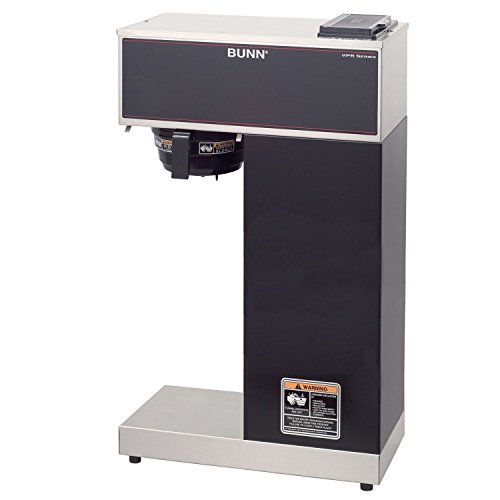
BUNN VPR APS Pour Over Air Pot Brewer — Best Without Plumbing
Not every coffee service has a water line where the coffee needs to be: food trucks, market stalls, church halls, catering stations, offices, and pop-up cafés all share the constraint. The VPR APS is BUNN’s answer — the same airpot-brewing architecture as the plumbed machines, fed by pouring water in the top. It trades a measure of speed for total placement freedom, and for mobile and temporary service it is the professional standard.
Strengths
- Professional airpot brewing with no water line
- Same BUNN build and parts ecosystem as plumbed models
- Ideal second station, events brewer, or backup
Trade-offs
- Manual refills cap back-to-back volume
- Slightly slower rhythm than an automatic plumbed brewer
- Airpots still a separate purchase
| Format | Pour-over commercial brewer, manual fill |
| Serving | Brews into airpots |
| Class | Commercial, no plumbing required |
The pour-over format’s rhythm is simple: fill the reservoir, brew into the airpot, refill when the next batch is needed. The tank keeps water at brewing temperature between batches, so the quality penalty versus a plumbed machine is small — what you lose is the ability to brew back-to-back indefinitely without someone owning the refill task. For service under a few dozen cups an hour, that trade is invisible; for a rush-hour café line, it is the reason the CWTF exists.
Because it needs only an outlet, the VPR APS is also the natural second station: the decaf brewer beside a plumbed regular machine, the events brewer that travels, the backup that keeps a shop serving when the main brewer is down for service. Commercial kitchens think in redundancy, and this is the cheapest professional redundancy in the drip category.
Build and parts mirror the plumbed BUNNs — stainless, serviceable, stocked. Buy it when the location, not the budget, rules out plumbing, and you give up remarkably little coffee quality for the freedom.
Best for: food trucks, markets, catering, offices, and any service without plumbing / Not suited for: high-volume cafés with a rush-hour line
Check the current price on Amazon for the BUNN VPR APS Pour Over Air Pot Brewer.
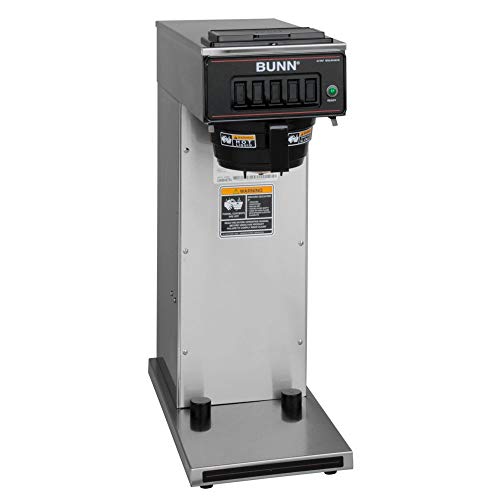
BUNN CW15 APS Commercial Brewer — Best Value Commercial
The CW15 APS is the value door into BUNN’s plumbed automatic line: the same essential proposition as the CWTF — water line in, hot coffee out, batch after batch into airpots — at the friendlier end of the commercial range. For a small shop, bakery, salon, or office whose drip volume is real but not relentless, it delivers the professional workflow without paying for flagship capacity it will never use.
Strengths
- BUNN reliability and parts support at the line’s entry tier
- True plumbed automatic airpot workflow
- Right-sized for small shops and offices
Trade-offs
- Throughput ceiling below the CWTF for rush service
- Still requires plumbing and separate airpots
- Commercial utility footprint
| Format | Automatic commercial brewer, plumbed |
| Serving | Airpot brewing (APS format) |
| Class | Commercial |
Value in commercial equipment is a different calculation than value at home: the currency is uptime. A cheap no-name commercial brewer that fails during a Saturday rush costs more in one morning than the price difference to a BUNN, whose parts and service network exist precisely to prevent that morning. The CW15’s proposition is that insurance at the line’s entry price, with brew quality set by the same temperature discipline as its bigger siblings.
What the step up to the CWTF buys is throughput and refinement for genuinely high-volume service; what it does not buy is a different category of coffee. A shop brewing an airpot every half hour will never feel the CW15’s ceiling; a shop brewing continuously through a morning rush should buy the bigger machine first rather than the smaller one twice.
Size the purchase to your honest peak hour, keep the spray head clean and the descaling on schedule — commercial water is still water — and the CW15 will do the unglamorous thing commercial buyers actually want: disappear into the background of a working shop for years.
Best for: small cafés, bakeries, salons, and offices with steady moderate volume / Not suited for: high-volume shops brewing continuously at peak
Check the current price on Amazon for the BUNN CW15 APS Commercial Brewer.

Hamilton Beach Commercial 60 Cup Coffee Urn D50065 — Best Coffee Urn
The urn is the other professional answer to coffee volume: instead of brewing into servers, it brews and holds in one large vessel and dispenses by the cup. Hamilton Beach’s commercial 60-cup urn is the format’s benchmark for events, breakfast services, conference rooms, and self-serve stations — polished stainless, a proper commercial build, and a capacity that covers a room without a refill.
Strengths
- 60 cups brewed and served from one vessel
- Commercial build stocked across the rental and catering trade
- Perfect for self-service stations and events
Trade-offs
- Percolation character differs from drip — dose and grind matter
- Quality fades across very long holding; manage the window
- One vessel means one coffee — no variety without a second urn
| Capacity | 60 cups |
| Format | Commercial coffee urn and hot beverage dispenser |
| Finish | Polished stainless steel |
Urn coffee has a reputation problem it only partly deserves. The urn itself brews by percolation, and a well-run urn — correct coarse grind, correct dose, coffee served within its holding window — produces a crowd-pleasing cup that has fueled a century of meetings and weddings. Where urns fail is management: coffee held for many hours, or a vessel half-emptied and topped up with fresh brew over old, and those are operator errors this guide’s how-to section addresses directly.
The commercial designation matters in the details: a dispensing tap built for thousands of cycles, a body that survives transport and stacking chairs, and a heating system that holds serving temperature without scorching the coffee against the base. Hamilton Beach’s commercial line is the standard rental companies and caterers stock, which means parts and replacements are never a research project.
Choose the urn when the service is self-serve and stationary — a lobby, a breakfast bar, a banquet — and choose the airpot brewers when coffee must travel between stations or hold its quality across a long, slow day. The two formats are complements in a full operation, and this is the urn to buy when an urn is the answer.
Best for: events, hotels, conference service, and self-serve stations / Not suited for: cafés building a multi-variety drip program
Check the current price on Amazon for the Hamilton Beach Commercial 60 Cup Coffee Urn D50065.

West Bend 100-Cup Commercial Coffee Urn, NSF — Best for Very Large Events
When the event is measured in hundreds of guests — banquets, conventions, institutional breakfasts, festival service — the 100-cup urn is the unit of currency, and West Bend’s NSF-approved aluminum model is the category’s long-standing workhorse. NSF approval is the detail that matters professionally: it certifies the urn for commercial food service, which venues, caterers, and health inspectors actually check.
Strengths
- 100-cup capacity for the largest services
- NSF approved for commercial food service
- Fleet-standard model across the catering trade
Trade-offs
- Aluminum finish shows wear sooner than stainless
- Oversized for small venues
- Percolation management matters even more at this scale
| Capacity | 100 cups |
| Certification | NSF approved |
| Material | Highly-polished aluminum |
| Class | Commercial urn |
Scale changes technique. A 100-cup urn percolates a large bed of coffee, and dosing it correctly — enough coffee, coarsely ground, spread evenly — is the difference between a banquet cup people finish and one they abandon. The how-to section’s urn routine is written for exactly this scale. Aluminum construction keeps a vessel this size liftable when full and heats evenly, at the cost of a softer finish than stainless that shows its working life sooner.
The professional context is fleets: caterers own these in multiples, venues keep them in store rooms, and their interchangeability across decades of production is the point. An NSF West Bend bought today works beside one bought years ago, with the same taps, lids, and baskets — the unglamorous standardization that event work runs on.
For a single small venue it is likely more urn than you need — the 60-cup Hamilton Beach above is the saner single purchase — but for anyone whose coffee service is genuinely counted in hundreds of cups, this is the correct, certifiable tool.
Best for: banquet halls, caterers, conventions, and institutional service / Not suited for: small cafés or offices — see the 60-cup and airpot picks
Check the current price on Amazon for the West Bend 100-Cup Commercial Coffee Urn, NSF.
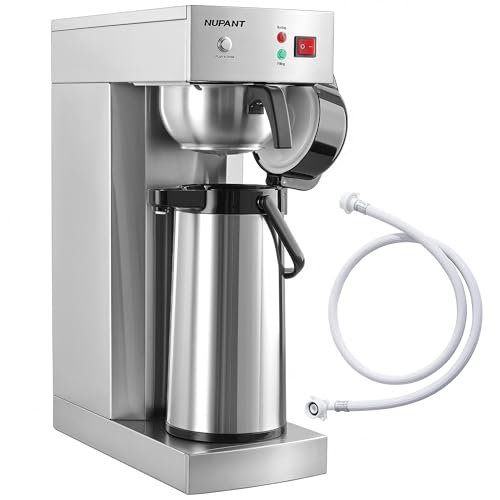
NUPANT Auto-Filling Airpot Coffee Brewer — Best Auto-Fill Airpot System
The NUPANT auto-filling brewer takes the airpot workflow one step further toward set-and-forget: plumbed and self-filling, it keeps the brewing cycle ready without an attendant watching tank levels, feeding a thermal airpot that holds the finished coffee at serving quality. For offices, convenience settings, and service stations where coffee is a utility rather than a craft program, that automation is precisely the product.
Strengths
- Auto-filling convenience for unattended stations
- Airpot holding protects coffee quality across the day
- Friendlier tier than the flagship commercial names
Trade-offs
- Younger brand — parts ecosystem still developing
- Less suited to a craft café program than BUNN
- Requires plumbing for the auto-fill function
| Format | Auto-filling airpot coffee brewer |
| Serving | Brews into airpot servers |
| Class | Commercial / high-volume office |
The buyer for this machine is managing a station, not a menu: a workplace floor, a dealership lounge, a clinic waiting area, a small hotel’s breakfast corner. In those settings the enemies are an empty pot at 9 a.m. and a burnt one at 3 p.m., and the combination of auto-fill brewing plus vacuum airpot holding addresses both — fresh batches brewed as needed, held without a warming plate’s slow damage.
As a newer name beside BUNN and West Bend, NUPANT asks the commercial buyer a fair question about long-term parts support, and the honest answer is that its ecosystem is younger. The counterweight is value and the specific auto-fill convenience; for a flagship café program we steer you to BUNN above, while for a utility station where the machine’s job is invisible reliability at a friendlier tier, this is a rational, verified option.
Whichever badge a station wears, the disciplines in this guide decide its coffee: fresh grounds in sensible rotation, airpots rinsed and occasionally deep-cleaned, descaling on a calendar. Automation removes the watching; it does not remove the caring, and the stations that understand that serve good coffee for years.
Best for: offices, lounges, and service stations needing hands-free coffee / Not suited for: flagship café drip programs
Check the current price on Amazon for the NUPANT Auto-Filling Airpot Coffee Brewer.
Comparison Table
| Pick | Badge | Key spec | Best for |
|---|---|---|---|
| BUNN CWTF15-APS Automatic Airpot Brewer | Best Overall | plumbed automatic brewer that fills thermal airpots — the classic small-café drip station | coffee shops, bakeries, and offices that serve drip coffee all day |
| BUNN VPR APS Pour Over Air Pot Brewer | Best Without Plumbing | pour-over commercial brewer — no water line needed, brews into airpots anywhere with an outlet | food trucks, markets, catering, offices, and any service without plumbing |
| BUNN CW15 APS Commercial Brewer | Best Value Commercial | entry point to BUNN’s plumbed automatic airpot line — commercial fundamentals without flagship pricing | small cafés, bakeries, salons, and offices with steady moderate volume |
| Hamilton Beach Commercial 60 Cup Coffee Urn D50065 | Best Coffee Urn | 60-cup commercial urn in polished stainless — brews and serves from one vessel for events and self-service | events, hotels, conference service, and self-serve stations |
| West Bend 100-Cup Commercial Coffee Urn, NSF | Best for Very Large Events | 100-cup NSF-approved commercial urn in polished aluminum — maximum volume for banquets and institutions | banquet halls, caterers, conventions, and institutional service |
| NUPANT Auto-Filling Airpot Coffee Brewer | Best Auto-Fill Airpot System | auto-filling airpot brewer that keeps the server topped and the station hands-free | offices, lounges, and service stations needing hands-free coffee |
Airpot brewer or urn: which format does your shop actually need?
The airpot brewer is the café format because it separates brewing from serving. The brewer makes batch after batch at full quality; the airpots — vacuum-insulated servers — hold each batch at serving temperature for hours and travel to wherever the coffee is poured: the counter, a self-serve station, a catering table. Variety is free: regular in one airpot, decaf in a second, a featured roast in a third, each brewed at its own moment and each holding its own quality. If your shop sells drip coffee by the cup across a day, this is your format, full stop.
The urn merges brewing and serving into one vessel, which is its virtue and its limit. It is perfect where one coffee, served in volume, in one place, is the whole job: banquets, breakfast services, conference breaks, lobby stations. It cannot do variety without a second vessel, and its percolation character — richer, heavier, less nuanced than drip — suits crowd service better than a specialty menu.
Many full operations run both: airpot brewers for the café program, an urn for the weekend event contract. The mistake is buying either to do the other’s job — a café line forming behind a percolating urn, or a banquet hall juggling airpots — and it is an expensive mistake to reverse, so decide from your service pattern before you decide from prices.
How much brewer capacity does your peak hour demand?
Count cups at your busiest thirty minutes, then buy headroom above it. A shop whose peak is twenty cups in a half hour is served comfortably by the CW15 class; a shop pulling a continuous line through the morning needs the CWTF’s recovery speed or a second station. Airpot size is part of the same math: a standard airpot holds roughly a dozen cups, so your staging — how many full airpots you can hold at the rush’s start — is as important as brew speed. Brew ahead into airpots before the peak; that is what they are for.
Urns invert the calculation: capacity is the vessel, and the question is whether one brew cycle covers the event’s first hour, after which a second cycle can run during service. A 60-cup urn covers most room-sized events; the 100-cup West Bend exists for services where a refill cycle would mean a coffee gap in front of two hundred guests.
Whatever the format, buy one size above your honest estimate. Coffee programs grow into their equipment — a shop that can serve a rush without a queue discovers it has more rush — and the price step between adjacent commercial sizes is small against a season of turned-away customers.
What else does a commercial drip station need? Water, filters, and parts
Water is the commercial variable home guides can ignore and shops cannot. Municipal water varies, and at commercial volumes, scale builds in weeks rather than months: a filtration system on the brewer’s line is not an accessory but the machine’s life insurance, and it pays again in flavor consistency. Budget for the filter and its scheduled replacements in the purchase, and descale on the calendar the water demands rather than the one the manual hopes for.
Consumables are the second system: paper filters by the case in the brewer’s exact size, airpot lids and gaskets as spares, a spare spray head on the shelf. The professional habit is that anything that can stop service exists twice in the building. BUNN’s ecosystem makes this easy — which is a large part of why the brand anchors this guide — and any commercial purchase should be interrogated the same way: name the three parts most likely to fail, and confirm each is a stocked, orderable item before you buy.
Finally, plan the station’s physical life: a plumbed brewer wants a water line, drainage access, and a counter position where airpots can be staged and swapped without crossing the espresso workflow. Ten minutes of layout thought before installation saves a year of small daily frictions — and in a shop, small daily frictions are the whole game.
How to run an urn without making ‘urn coffee’ — the percolation technique
Urn coffee’s poor reputation is a technique problem wearing an equipment costume. Percolation cycles brewed coffee back over the grounds, so the two operator sins are over-extraction — too fine a grind, too long a cycle, coffee held at a rolling heat for hours — and the topping-up sin, where fresh brew is poured over old and the vessel never truly starts fresh. Avoid both and an urn makes a full, honest, crowd-pleasing cup, which is why the format has survived a century of banquets.
The routine: rinse the urn, add fresh water, use a coarse, even grind at a full drip-strength dose — urn coffee dosed weakly percolates into dishwater — and let the cycle complete fully before serving. Serve the batch within a couple of hours; when it is gone, it is gone, and the next batch starts from a rinsed vessel and fresh water. At event scale, two urns alternating beat one urn stretched, every time.
Between services, the urn’s basket, stem, and tap need the cleaning the coffee oils demand — a urn that smells of old coffee will make new coffee that tastes of it. The commercial picks in this guide are built to be stripped and washed daily without drama; use that design as intended and the format will serve you the way it has served caterers for generations.
The economics of a shop drip program: why the brewer is the cheap part
Drip coffee is the quiet profit center of a coffee shop: the ingredient cost per cup is a small fraction of the menu price, the labor per cup is seconds, and the equipment — even the flagship BUNN in this guide — amortizes across tens of thousands of cups. The economics fail in only two places: waste and downtime. Waste is brewed coffee poured away, and it is managed by batch sizing — brew in airpot quantities matched to the hour, not in heroic volumes matched to optimism. Downtime is the failed brewer on a Saturday, managed by buying serviceable equipment and keeping the shelf of spares this guide insists on.
Batch discipline deserves its own sentence, because it is where good shops separate from average ones: track what each hour actually sells for two weeks, then set the brew schedule — which airpots, of what, at which times — from the data rather than from habit. Most shops discover one batch a day that should never have been brewed and one rush that was under-brewered, and fixing those two lines is worth more than any equipment upgrade.
Seen this way, the purchase advice in this guide is really operations advice: buy the brewer whose parts exist, the holding system that protects quality, and the capacity your peak demands — then run it with fresh coffee, clean water, and a schedule. The machine is the cheap part; the discipline is the business.
Setting up a drip station in a small shop: layout, workflow, and the second station
Counter space in a small shop is a zero-sum negotiation between the espresso bar, the register, and the drip station, and the drip station usually loses — to its cost, because drip is the fastest transaction in the building and should live where it can be poured without crossing anyone’s path. The classic layout puts the brewer at the end of the counter nearest the register, airpots staged in a row the cashier can reach, and the self-serve option — if you offer one — positioned so its queue never blocks the espresso line.
The second station is the small shop’s growth move, and this guide’s pour-over BUNN is built for it: no plumbing means the decaf or featured-roast station can live wherever a shelf and an outlet exist — a retail corner, a seasonal patio point, a catering kit that travels. Shops routinely discover that the second, flexible station earns out of proportion to its cost because it serves the occasions the main station cannot reach.
Build the station’s daily rituals into the layout from day one: where the filters live, where the spent grounds go, where the airpots are rinsed, where the spare spray head sleeps. A station whose supplies are within arm’s reach gets maintained; a station whose supplies are across the kitchen gets neglected, and neglected commercial equipment announces itself at the worst possible moment — usually Saturday, usually in front of a line.
Training staff on a drip station: the thirty-minute investment that protects the whole program
Commercial coffee quality is a staffing outcome before it is an equipment outcome. The brewer will make the same coffee for the owner at 7 a.m. and for the newest hire at 3 p.m. only if both were taught the same recipe, the same rotation, and the same cleaning rhythm — and ‘taught’ means demonstrated and checked, not mentioned. Thirty minutes per hire, with the recipe card in hand and a full batch brewed together, is the entire training technology required, and shops that skip it spend the savings on inconsistency forever.
The three failure modes to train against are specific: the under-dosed batch scooped by eye on a busy morning, the airpot served past its window because nobody checked the label, and the brew basket left un-rinsed at close so tomorrow’s first batch tastes of yesterday. Each maps to one line on the station’s checklist, and checklists — laminated, at the station, initialed — are how small shops achieve the consistency that chains buy with supervision.
Close the loop with tasting. Staff who taste the drip coffee daily notice drift before customers do: the new bag that needs a dose adjustment, the water filter approaching its change, the spray head asking for its clean. A shop where the team drinks its own drip coffee is a shop whose drip program self-corrects — and that, more than any single machine in this guide, is the professional standard worth buying your way toward.
How to Set Up and Run a Commercial Drip Station, Step by Step
This is the commissioning and daily routine for the airpot brewers in this guide; the urn variation follows in the final step:
- Commission the water first. Install the brewer on a filtered water line, flush the filter and the machine per the manufacturer’s instructions, and run two full water-only brews. Commercial machines ship with manufacturing residues, and your first customers should never taste them.
- Dial in the batch recipe. Set your standard batch: the airpot’s volume, a drip-strength dose of medium-ground coffee weighed rather than scooped, and the brewer’s spray time as delivered. Brew, taste, adjust the dose once — then write the recipe on a card at the station so every staff member brews the same coffee.
- Stage airpots ahead of the peak. Brew the morning’s regular and decaf into airpots before the rush, label each with its brew time, and serve in rotation — oldest first, and nothing held past its quality window. The airpot system only works if the staging discipline does.
- Keep the brewer clean on a daily rhythm. Dump and rinse the brew basket, wipe the spray head area, and rinse airpots at close. Coffee oils go rancid on commercial surfaces exactly as on home ones — volume does not exempt you, it multiplies the surface.
- Descale and service on a calendar. With filtered water, descale on the schedule your water hardness dictates and inspect gaskets, spray head, and faucet seals monthly. Log it. The log is what turns maintenance from a memory into a system, and systems are what keep a shop’s coffee consistent across staff changes.
- For urns: brew full, serve promptly, start fresh. Fill the urn fully, dose it at full strength with a coarse grind, let the cycle complete before serving, and never top up an old batch with new. When the batch is done, rinse and start clean — the format rewards decisiveness.
Train every staff member on the recipe card and the rotation, not just the opener. A drip program’s quality is set by its least-trained shift, and the entire system in this guide — measured doses, labeled airpots, logged maintenance — exists to make the right thing the easy thing on every shift.
Common Buying Mistakes
Buying a home machine for commercial duty. Home brewers are not built for all-day cycling and carry no commercial parts support. One busy month ends them, usually mid-service.
Holding coffee on warming plates. The airpot exists because plate-held coffee degrades within the hour. Shops that skip airpots serve their oldest coffee to their latest customers.
Sizing for the average hour instead of the peak. A brewer that keeps up on Tuesday and drowns on Saturday is the wrong brewer. Peak demand is the specification.
Skipping water filtration. At commercial volume, scale is a monthly problem, not a yearly one. Unfiltered water shortens the machine’s life and wanders its flavor.
Topping up urns and airpots. Fresh coffee over old coffee is old coffee. Brew in batches, serve them in their window, and start the next batch clean.
No spares on the shelf. A gasket, a spray head, a spare airpot lid — the parts that can stop service should exist twice in the building. Downtime costs more than shelves do.
Final Recommendation
Build the standard station first: the BUNN CWTF15-APS if your volume is a real café’s, the CW15 APS if it is a small shop’s, plumbed, filtered, and staged with airpots. Add the VPR APS where plumbing cannot go — trucks, markets, events, the decaf corner — and reach for the urns when the job is one coffee for a room: the 60-cup Hamilton Beach for most services, the 100-cup West Bend when the room is a hall. The NUPANT covers the unattended station where coffee is a utility.
Every pick was verified against Amazon’s catalog data as genuine commercial equipment. Check price on Amazon for each configuration, budget the airpots, filters, and water filtration as part of the same purchase, and run the station by the disciplines in this guide — in a coffee shop, the drip program is where steady quality and steady margin meet, day after day, year after year.
Keep exploring the rest of our coffee coverage: Best Coffee Drip Makers For Coffee Shop Best Coffee Brew Makers Best 12 Cup Coffee Makers Best Coffee Dual Brew Makers Best Cheapest Coffee Makers
Frequently Asked Questions
What coffee maker do most coffee shops use for drip coffee?
Plumbed automatic batch brewers filling thermal airpots — the BUNN CWTF pattern in this guide. The format brews at commercial temperature and speed, and the airpots hold each batch at serving quality without a warming plate while the brewer makes the next one.
Can a coffee shop use a large home coffee maker instead?
Not for real service. Home machines are not built for all-day duty cycles, brew too slowly for a rush, hold coffee on quality-killing warming plates, and lack commercial parts support. The price difference is repaid by the first month of uptime.
How long does coffee stay good in an airpot?
A quality vacuum airpot holds coffee at serving temperature and good flavor for roughly two to three hours — long enough for a service window, short enough that rotation discipline matters. Label each airpot with its brew time and serve oldest first.
Is an urn or an airpot brewer better for events?
For a single stationary service point with one coffee, the urn is simpler and cheaper per cup — the 60 and 100-cup picks here. For events needing variety, portability between stations, or top quality across hours, airpot brewers win.
Does a commercial brewer need a water filter?
Effectively, yes. At commercial volumes, scale accumulates fast enough to change flavor and kill heating elements within a season on hard water. A line filter plus scheduled descaling is the machine’s life insurance.
How much coffee does a shop brewer use per batch?
A full airpot batch uses a drip-strength dose scaled to its volume — weighed, not scooped, and written on a recipe card at the station so every shift brews identically. Consistency across staff is the entire point of the recipe card.
What is the difference between the CWTF15-APS and the CW15 APS?
Both are plumbed BUNN airpot brewers; the CWTF is the higher-throughput flagship for continuous rush service, while the CW15 is the line’s value entry for steady moderate volume. Small shops rarely feel the CW15’s ceiling; busy cafés should buy the CWTF first.
How many airpots does a coffee shop need?
At minimum two per coffee you serve — one in service, one staged or in reserve — and three for your main regular coffee across a long day. Airpots are the holding system the whole format depends on; a brewer without enough servers is a queue with extra steps.


