Disclosure: airfryerkitchensupply.com is reader-supported. When you buy through links on our site, we may earn an affiliate commission at no extra cost to you.
Where to buy
Comparing the best choice standup mixers? Start with the verified shortlist below. Standup mixers live upright on your counter full time, so the listing details that matter — height, footprint, bowl size and what is in the box — are exactly what each verified link below takes you to. Every linked model was confirmed before it was included; check price on Amazon on the live listing, because finish and bundle change the number too often for a guide to print honestly.
- KitchenAid 5.5-Qt Bowl-Lift Stand Mixer KSM55, Porcelain White — check price on Amazon
- KitchenAid Artisan 5-Qt Tilt-Head Stand Mixer KSM150PS, Contour Silver — check price on Amazon
- Bosch Universal Plus Stand Mixer, 6.5 Quarts, Bundle — check price on Amazon
- Cuisinart Stand Mixer SM-50, 5.5 Quart, White Linen — check price on Amazon
- Hamilton Beach 4 Qt Electric Stand Mixer, Black — check price on Amazon
- Ankarsrum Original Stand Mixer AKM6230, Jubilee Silver — check price on Amazon
Every linked pick in this guide was verified against Amazon’s catalog, so the model name you click is the model you land on. Prices move with finish, bundle and season, which is why this guide never prints a fixed price: use the links to check price on Amazon at the moment you are ready to buy.
Shoppers searching for the best choice standup mixers usually mean one thing: a stand mixer that stands up on the counter, stays there, and is ready the moment baking starts. That sounds simple, but the standup brief quietly changes the buying math. A machine that lives out permanently has to earn its footprint every day — it must be tall enough to work under your cabinets or slim enough to slide beneath them, handsome enough that you do not mind looking at it, and stable enough that a dough cycle does not turn into a countertop rodeo.
This guide treats ‘standup’ as a practical category rather than a separate species. The six picks are stand mixers chosen and re-ranked through the standup lens: permanent-counter ergonomics first. That means bowl-lift stability for the machine that never moves, tilt-head convenience for the busiest all-round counter, a low, wide bottom-drive design for kitchens where vertical clearance is the binding constraint, and a light budget machine for counters that must be shared with everything else.
As with every guide in this program, no fixed prices appear here. A standup mixer is a long-term counter resident, and the right way to buy one is to decide the model on fit and function, then check price on Amazon for the exact finish you want on the day you buy. The reviews below give you the fit and function layer in full — including the measurements mindset you need before any box arrives at your door.
In this guide
Quick Picks
Ranked for life on the counter: stability, clearance and daily ergonomics first, raw mixing talent a close second. Find your counter situation in the badges, then read that review closely.
- Best Overall Standup — KitchenAid 5.5-Qt Bowl-Lift Stand Mixer KSM55, Porcelain White: A fixed-head, bowl-lift machine that is happiest exactly where standup buyers want it: parked permanently on the counter, stable under dough, and ready in seconds.
- Best Standup All-Rounder — KitchenAid Artisan 5-Qt Tilt-Head Stand Mixer KSM150PS, Contour Silver: The classic counter resident: friendly tilt-head access, ten speeds and the deepest accessory ecosystem — provided its open-head height fits your cabinets.
- Best Low-Profile Standup — Bosch Universal Plus Stand Mixer, 6.5 Quarts, Bundle: Wide and low instead of tall: a bottom-drive standup that slides under cabinets that defeat conventional mixers, with a 6.5-quart bowl for big dough days.
- Best Value Standup — Cuisinart Stand Mixer SM-50, 5.5 Quart, White Linen: Twelve speeds, a 5.5-quart bowl and a splash guard in the box — the standup with the most working features per unit of commitment.
- Best Standup for Small Counters — Hamilton Beach 4 Qt Electric Stand Mixer, Black: A light, compact stand mixer with planetary action and a carry handle — the resident for small counters, or the standup you can still move when you must.
- Best Premium Standup — Ankarsrum Original Stand Mixer AKM6230, Jubilee Silver: The rotating-bowl Swedish design: a calm, open, counter-worthy machine for dough bakers who want their resident mixer to be the best tool they own.
How These Picks Were Chosen
Selection started from verified stand mixers in this category’s Amazon listing data cache — each linked pick was searched by brand and model and its ASIN taken from the listed title — and then re-judged against standup criteria that a general guide underweights. Cabinet clearance came first: a mixer that cannot open, lift or be fed under your wall cabinets fails the standup brief no matter how well it mixes. Footprint shape came second, because wide-and-low and narrow-and-tall machines suit completely different counters.
Stability under load came third. A standup mixer works where it lives, often near a counter edge, and a machine that walks during kneading is a genuine hazard as well as an annoyance; the frame designs that resist walking earned their badges honestly. Finally, we judged daily ergonomics: how you add ingredients, swap tools and clean up when the machine never goes back in a cupboard — because with a standup mixer, those small frictions are the ownership experience.
The 6 Best Choice Standup Mixers, Reviewed in Detail

KitchenAid 5.5-Qt Bowl-Lift Stand Mixer KSM55, Porcelain White — Best Overall Standup
A bowl-lift mixer is the natural standup machine. The head never moves, so the silhouette you measure on day one is the silhouette forever; the bowl cranks up to meet the beater on a lift arm and locks rigidly, and the whole unit works from a single parked position with no tilting, swinging or repositioning. For a permanent counter resident, that fixed geometry is worth more than almost any feature on a spec sheet.
The 11-speed range includes a half-speed fold setting, which standup bakers use constantly for the first flour incorporation of the day, and the 5.5-quart stainless bowl, flat beater, dough hook and wire whip cover the full home repertoire. Under a dense dough load the two-point bowl lock and column frame keep the machine composed — no walking toward the counter edge, no rhythmic head nod — which matters doubly when the machine works unattended a metre from the floor.
Plan its parking spot with care. This is a tall, heavy machine: confirm the lift has room to operate under your cabinets, expect to slide it rather than carry it, and accept that adding ingredients mid-mix is a pour-and-scrape routine rather than the open access of a tilt-head. In exchange you get the most counter-stable conventional mixer in this guide — the one that feels less like an appliance you fetch and more like a workstation you use.
Strengths
- Fixed head and rigid bowl lift: the most stable parked design here
- 11 speeds with a half-speed fold for gentle starts
- 5.5-Qt bowl covers family batches without dominating the counter
Trade-offs
- Tall profile must be checked against cabinet clearance
- Heavy; plan to slide, not lift
- Mid-mix additions are less open than a tilt-head
| Design | Bowl-lift (Amazon title) |
| Bowl | 5.5-Qt stainless steel bowl (Amazon title) |
| Speeds | 11 mixing speeds (Amazon title) |
| Included | Flat beater, dough hook, wire whip (Amazon title) |
Best for: Bakers who will park a mixer permanently and knead regularly / Not suited for: Anyone whose cabinet clearance cannot fit a tall bowl-lift
Check the current price on Amazon for the KitchenAid 5.5-Qt Bowl-Lift Stand Mixer KSM55, Porcelain White. You can also see the full listing here to confirm finish, dimensions and what is in the box before you order.

KitchenAid Artisan 5-Qt Tilt-Head Stand Mixer KSM150PS, Contour Silver — Best Standup All-Rounder
More stand mixers living on counters wear this silhouette than any other, and the reason is daily friendliness. The Artisan’s head tilts back for total access — scrape, swap, add — and its 5-quart bowl matches the rhythm of cakes, cookies and everyday baking better than any other size. As a standup machine its one homework item is vertical: measure the head’s open height against your cabinets before it takes up residence, because a tilt-head that cannot open where it stands is a standup mixer in name only.
Ten speeds with a gentle low end handle the standup workload — the quick frosting, the weeknight dough, the whipped cream at serving time — without ceremony, and the pouring shield in the box keeps the first flour addition of a bake from dusting the counter it lives on. The attachment hub extends the parked machine’s usefulness further than any rival: a pasta roller or grinder stored in a drawer turns counter space into a small workstation.
Its limits are the familiar ones. Under very stiff, full-bowl dough the hinged head can flex, and serious daily bread bakers should look at the bowl-lift pick above. It is also substantial enough that ‘standup’ should be a commitment, not a hope — if it will actually live in a cupboard, the lighter budget pick serves that life better. Judged as the all-round counter resident for mixed baking, though, nothing here is easier to recommend.
Strengths
- Tilt-head access is the friendliest for daily stop-start baking
- Ten speeds and a 5-Qt bowl matched to everyday batches
- Attachment hub multiplies what one parked machine can do
Trade-offs
- Open-head height must clear your cabinets
- Head flex under very stiff full-bowl dough
- Too substantial to enjoy being cupboard-stored
| Design | Tilt-head (Amazon title) |
| Bowl | 5-Qt (Amazon title) |
| Speeds | 10 speed settings (Amazon title) |
| Included note | Pouring shield included (Amazon title) |
Best for: Mixed bakers who want one friendly machine living on the counter / Not suited for: Daily heavy-dough bakers, who should choose the bowl-lift design
Check the current price on Amazon for the KitchenAid Artisan 5-Qt Tilt-Head Stand Mixer KSM150PS, Contour Silver. You can also see the full listing here to confirm finish, dimensions and what is in the box before you order.
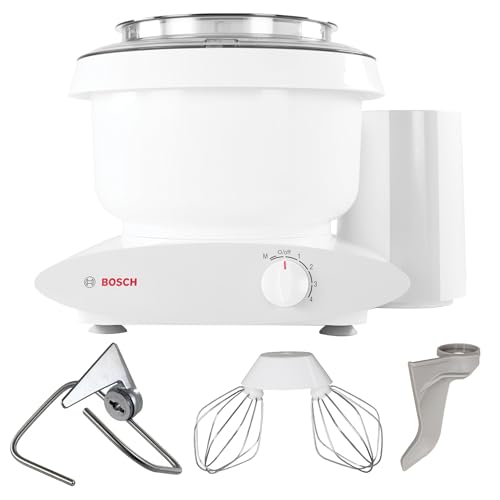
Bosch Universal Plus Stand Mixer, 6.5 Quarts, Bundle — Best Low-Profile Standup
Cabinet clearance kills more standup plans than any other factor, and the Bosch is the design that routes around it. With the motor in the base and the drive at the bottom of the bowl, the machine’s profile is low and wide; there is no head to tilt and nothing to crank upward, so it works happily in kitchens where a bowl-lift cannot stand and a tilt-head cannot open. If your counter has a low cabinet run, this shape is not a compromise — it is the solution.
The open 6.5-quart bowl is the other standup virtue: from its parked position you can pour flour into a working dough without stopping, reaching past a head or threading a pouring shield. The included wire whips, dough hook and the bundle’s dough hook extender cover batter through big bread batches, and the drive’s reputation among high-volume bakers is built on exactly the unattended, parked-machine kneading that standup life involves.
Expect an adjustment period. The whip system and bottom-drive feel are different from the beater-in-bowl technique most bakers learned, the footprint is wide enough to claim real counter territory, and the styling is functional rather than decorative. Kitchens with the width to spare and the height constraint to solve get a machine that turns a problem counter into a dough station.
Strengths
- Low profile fits counters where tall mixers cannot stand or open
- Open bowl allows feeding ingredients while it works
- 6.5-Qt capacity with a dough-first drive
Trade-offs
- Wide footprint claims substantial counter width
- Bottom-drive technique differs from conventional mixers
- Utilitarian looks for a machine that lives in view
| Power | 500 Watt (Amazon title) |
| Bowl | 6.5 Quarts (Amazon title) |
| Included | Wire whips, dough hook, NutriMill dough hook extender (Amazon title) |
Best for: Kitchens with low cabinets and bakers who knead in volume / Not suited for: Narrow counters where width is scarcer than height
Check the current price on Amazon for the Bosch Universal Plus Stand Mixer, 6.5 Quarts, Bundle. You can also see the full listing here to confirm finish, dimensions and what is in the box before you order.

Cuisinart Stand Mixer SM-50, 5.5 Quart, White Linen — Best Value Standup
A standup mixer earns its counter space by being used constantly, and the SM-50’s value case is about removing excuses not to use it. Twelve speeds cover delicate folding to firm whipping, the 5.5-quart bowl swallows double batches that smaller residents cannot, and the splash guard with pour spout — included, not an accessory — means flour goes in without a countertop cleanup tax on every bake.
The tilt-head format gives the open access that daily baking rewards, and the included chef’s whisk, mixing paddle and dough hook mean the parked machine is complete on day one with nothing else to buy. In standup terms it occupies the sensible middle: substantial enough to feel planted during a dough cycle, ordinary enough in size to fit the standard counter-and-cabinet arrangement most kitchens have.
What it does not bring is the flagship ecosystem or the flagship finish story. Attachment choice beyond the core is thinner than the category leader’s, and bakers who want their counter resident to double as a design object have prettier options at higher tiers. As a working standup — the machine that is simply always ready and always capable — it is the value benchmark of this guide.
Strengths
- 12 speeds, the widest range here, for one parked machine
- Splash guard with pour spout included for cleaner daily use
- 5.5-Qt bowl handles doubles without upsizing the footprint class
Trade-offs
- Thinner attachment catalog than the category leader
- Styling is plain for a permanent counter resident
- Less planted than bowl-lift designs under the stiffest dough
| Speeds | 12 speed (Amazon title) |
| Bowl | 5.5 Quart stainless steel bowl (Amazon title) |
| Included | Chef’s whisk, mixing paddle, dough hook, splash guard with pour spout (Amazon title) |
Best for: Busy home bakers who want a full-featured resident without flagship pricing / Not suited for: Attachment collectors who need the deepest accessory catalog
Check the current price on Amazon for the Cuisinart Stand Mixer SM-50, 5.5 Quart, White Linen. You can also see the full listing here to confirm finish, dimensions and what is in the box before you order.

Hamilton Beach 4 Qt Electric Stand Mixer, Black — Best Standup for Small Counters
Small kitchens face a standup dilemma: the machines worth parking are big, and the counter is not. The Hamilton Beach threads it. Its 4-quart format is the most compact here, its body is light with an easy-carry handle, and yet it keeps the feature that makes a stand mixer a stand mixer — planetary mixing for full bowl coverage — plus a splash guard, whisk, flat beater and dough hook in the box.
As a resident it suits the small-batch rhythm of compact kitchens: a single cake, a dozen cookies, frosting, a small dough. Seven speeds and a 300-watt motor cover that brief without strain, and when the counter must be cleared for a big cooking day, this is the one standup here you can relocate with one hand and no regret. For apartments, studios and shared counters, that movability is not a weakness of the standup idea — it is the version of it that fits.
Its ceiling is equally clear. Large and stiff doughs are outside the brief, the bowl will not take double batches, and the build is lighter than machines costing several times more. Buy it as the right-sized resident for small work and it satisfies; buy it hoping to grow into weekly bread production and you will replace it. Size honesty is the whole game at this tier.
Strengths
- Most compact footprint of the six picks
- Planetary action and full tool set at a budget tier
- Light with a carry handle when the counter must be cleared
Trade-offs
- 4-Qt bowl excludes double batches
- 300-watt motor is for small, softer work
- Light build is less planted under load
| Bowl | 4 Qt (Amazon title) |
| Speeds | 7 speeds (Amazon title) |
| Power | 300 Watts (Amazon title) |
| Included | Whisk, flat beater, dough hook, splash guard (Amazon title) |
Best for: Small kitchens, apartments and small-batch bakers / Not suited for: Anyone planning large batches or regular stiff dough
Check the current price on Amazon for the Hamilton Beach 4 Qt Electric Stand Mixer, Black. You can also see the full listing here to confirm finish, dimensions and what is in the box before you order.
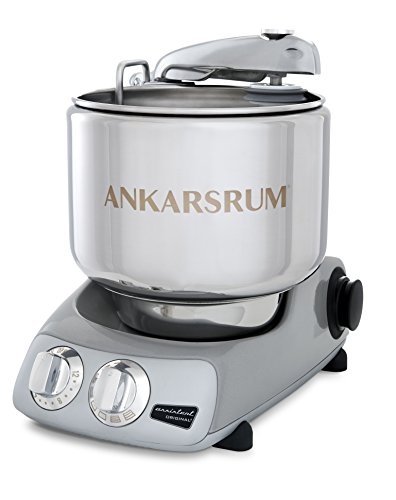
Ankarsrum Original Stand Mixer AKM6230, Jubilee Silver — Best Premium Standup
Some standup mixers earn their place by being useful; the Ankarsrum earns it by being a pleasure to watch work. The bowl rotates on the base while a roller and scraper work the dough from a fixed arm, an arrangement that kneads large quantities with a calm, controlled motion and leaves the bowl completely open — as a parked workstation, it is the easiest machine here to feed, inspect and scrape without stopping.
For the dough-centered kitchen, that openness changes daily practice. You stand at the counter, add flour by the scoopful into a turning bowl, watch gluten develop, and adjust hydration on the fly — the workflow feels like a baker’s bench, not an appliance cycle. The build quality supports the standup commitment: this is a machine bought to be seen and used for a very long time, and its accessory system can extend the same parked footprint into other prep work.
The apprenticeship is real: roller positioning and dough technique differ from every beater-based habit, and the first sessions reward manual-reading patience. It is also the premium tier of this guide, a price class (check price on Amazon) that only dough volume justifies. For the baker whose counter exists to make bread, it is the standup endgame; for everyone else, it is a beautiful answer to a question they are not asking.
Strengths
- Rotating bowl kneads large doughs calmly and openly
- Completely open bowl is the easiest to feed and check mid-mix
- Premium build intended for very long service
Trade-offs
- Technique must be learned; habits from beater mixers do not transfer
- Premium price tier needs dough volume to justify it
- Small whipping jobs are not its specialty
| Model | AKM6230 (Amazon title) |
| Finish | Jubilee Silver (Amazon title) |
| Design | Rotating bowl, fixed arm (manufacturer design) |
Best for: Dough-centered bakers who want a premium permanent workstation / Not suited for: Beginners who want familiar technique from day one
Check the current price on Amazon for the Ankarsrum Original Stand Mixer AKM6230, Jubilee Silver. You can also see the full listing here to confirm finish, dimensions and what is in the box before you order.
Comparison Table
Compare the standup essentials side by side: design, the verified key specification, and the counter situation each machine suits. Then confirm your cabinet clearance against the design you choose — that single measurement decides more standup purchases than any other fact.
| Pick | Badge | Key spec | Best for |
|---|---|---|---|
| KitchenAid 5.5-Qt Bowl-Lift Stand Mixer KSM55, Porcelain White | Best Overall Standup | 5.5-Qt bowl-lift, 11 speeds | Permanent-counter bakers who knead |
| KitchenAid Artisan 5-Qt Tilt-Head Stand Mixer KSM150PS, Contour Silver | Best Standup All-Rounder | 5-Qt tilt-head, 10 speeds | Everyday mixed baking on the counter |
| Bosch Universal Plus Stand Mixer, 6.5 Quarts, Bundle | Best Low-Profile Standup | 6.5-Qt, 500W bottom-drive | Low-clearance counters, big dough |
| Cuisinart Stand Mixer SM-50, 5.5 Quart, White Linen | Best Value Standup | 5.5-Qt, 12 speeds | Full-featured daily value |
| Hamilton Beach 4 Qt Electric Stand Mixer, Black | Best Standup for Small Counters | 4-Qt, 7 speeds, 300W | Small counters, small batches |
| Ankarsrum Original Stand Mixer AKM6230, Jubilee Silver | Best Premium Standup | Rotating bowl design | Premium dough workstation |
How to Choose the Best Choice Standup Mixers for Your Counter?
Measure first, shop second. The standup decision begins with a tape measure, not a shortlist: record the height from counter to the underside of your wall cabinets, the depth of the counter, and the width of the run where the mixer will live. Then match designs to the space — a bowl-lift needs its full standing height plus feeding room, a tilt-head needs its open height, and bottom-drive or rotating-bowl machines need width instead of height. A mixer that fits only by being dragged forward for every use is not a standup mixer; it is a storage problem with a motor.
After space, rank your work. Standup machines get used for what they are good at and avoided for what they are not, so the gap between a machine’s badge job and your actual baking widens with every month of ownership. Daily dough points to the stable frames and dough designs; daily variety points to friendly tilt-head access; small daily jobs point to the compact pick. Choose the machine whose strengths you will use weekly, not the one whose strengths impress you once.
- Measure cabinet height, counter depth and run width first
- Match design geometry to the space you measured
- Rank by the baking you do weekly
- Plan the parking spot near an outlet and your prep zone
- Confirm sliding room if the machine must move to be fed
What Height and Footprint Do Standup Mixers Need?
Conventional stand mixers are tall appliances, and wall cabinets are their natural enemy. Bowl-lift models stand tallest and cannot shrink; tilt-heads stand shorter but grow when opened; both need additional imagined space for you — hands, a bowl of flour, a spatula — above and in front of the machine. The low, wide designs exist precisely for kitchens that fail those measurements, trading counter width for the vertical freedom to work under almost any cabinet run.
Depth matters more than buyers expect. A mixer parked against the backsplash with its bowl under a cabinet overhang may fit physically yet be miserable to feed; the practical test is whether you can add a cup of flour to a running bowl from a natural standing position. If the answer is no, plan a parking spot with slide-forward room on a smooth counter, or choose a design whose open bowl works in place. Standup success is an ergonomics verdict, not a tape-measure technicality.
How Do You Keep a Parked Mixer Stable and Safe?
Stability comes from frame design first and habits second. Fixed-head bowl-lift frames and base-drive designs resist walking because their mass and drive geometry keep forces low and centered; hinged tilt-heads rely on weight and footing and can flex under stiff loads. Whatever you park, give it a clean, dry, level patch of counter, keep its feet free of flour dust that turns to paste, and never let a kneading machine work unattended at a counter edge — ‘standup’ describes where it lives, not a promise it cannot move.
Electrical common sense completes the picture. Park within easy reach of an outlet so the cord is never stretched across a sink or hob, keep the cord’s path dry, and switch off at the machine before changing tools. These habits sound basic because they are — and they are also the entire difference between a counter resident that feels like infrastructure and one that feels like a hazard.
Standup or Store-Away: Which Life Suits You?
Be honest about the counter you have, not the kitchen you photograph. If counter space is genuinely plentiful and baking is weekly or more, standup life pays its rent: the machine gets used for small jobs a stored mixer would never be fetched for, and cost-per-use collapses. If the counter is contested territory, a light machine you store happily — or the compact pick that parks in a small footprint — will serve you better than a flagship exiled to a cupboard it is too heavy to leave.
There is also a middle path many households land on: park the mixer during your baking seasons and store it during others. That pattern favors machines at the lighter end of substantial — heavy enough to be stable, light enough that a seasonal move is a shrug rather than a project. The standup question is ultimately about friction: choose the arrangement with the least friction between you and the next bake.
How Do You Feed a Standup Mixer Gracefully?
Feeding — adding ingredients to a working bowl — is the standup skill nobody mentions and everybody uses. The graceful pattern is the same across designs: start dry ingredients at the lowest speed, add them in a slow stream at the bowl’s edge rather than a dump at its center, and let each addition incorporate before the next. Splash guards and pouring shields exist because this is genuinely hard to do neatly around a fixed head or under a cabinet overhang, and the picks that include one in the box are quietly saving their owners a daily annoyance.
Position helps more than equipment. If your station forces you to reach up and over to feed the bowl, move the machine’s parking spot before you blame your technique — a few inches forward, or a station on a lower run of counter, transforms feeding from a stretch into a pour. Standup ergonomics are designed once and enjoyed daily; spend the thought at setup, not the apology at every bake.
What Should Stand Beside a Standup Mixer?
A station is a small system. Within arm’s reach of a well-planned standup mixer you will find its tools in a crock or drawer, a bench scraper, a kitchen scale — because stand mixers reward weighed ingredients with consistent dough — and a towel that lives there permanently. Flour and sugar storage nearby shortens every recipe’s setup, and a small mat or board under the machine can help it slide for feeding while protecting the counter beneath.
What should not stand beside it is clutter that forces the mixer into a corner it cannot work from. Defend the station’s working envelope — the space in front for you, above for feeding, and beside for bowls coming and going — and the standup arrangement pays its rent. Let the envelope collapse and even the finest machine becomes the thing you shuffle around to reach the toaster, which is the moment standup ownership quietly fails.
Standup Mixers in Open-Plan and Small Homes: What Changes?
In open-plan homes the parked mixer is furniture: it is seen from the sofa, heard from the desk, and judged by guests as part of the room. That reality legitimately elevates finish and silhouette in the decision — a machine you enjoy looking at gets kept clean, used often and owned long — and it elevates noise discipline too. Working a calm, correctly loaded machine at a sociable hour is a different domestic proposition from straining an undersized one at full cry, which is one more argument for buying the design class your dough actually needs.
In small homes the calculus flips to footprint honesty. A standup machine in a small kitchen is a major territorial claim, and it must be the right one: compact where batches are small, low where cabinets are low, and movable where the counter moonlights as dining table and desk. The Hamilton Beach pick exists for exactly this honesty, and choosing it over a flagship that would dominate the room is not settling — it is the standup decision done properly.
How Does a Standup Mixer Change What You Bake?
The quiet promise of standup ownership is behavioral: a machine that is already out gets used for the two-minute jobs a stored machine never sees — the quick whipped cream, the small frosting, the single pizza dough on a weeknight. Owners consistently report that the parked mixer widens their repertoire not through power but through presence; recipes that once seemed like a production become a whim the kitchen can absorb. That is the return the footprint buys, and it is why choosing a standup you enjoy using — friendly access, easy feeding, calm manners — outranks choosing the one with the most impressive ceiling.
The effect has a shadow side worth naming: a parked mixer also invites neglect of the hand skills it replaces, and its permanent presence can crowd a small counter’s other work. Both are manageable — the first with occasional deliberate hand practice, the second with the station discipline described in this guide — but they complete the honest picture. Standup life is a trade of space for spontaneity, and for regular bakers it is one of the best trades a kitchen offers.
What Finish and Color Should a Counter Resident Be?
It sounds frivolous until the machine has sat in your sightline for a year: a standup mixer is the largest colored object in most kitchens, and its finish participates in the room. Neutral finishes — whites, silvers, blacks — age quietly and forgive the kitchen’s own changes of style; statement colors delight their owners daily and date faster. Neither is wrong, but the choice should be made as a design decision with a decade’s horizon, not as a checkout impulse, because this is the one appliance whose color you will see more often than its mixing.
Finish also has a practical face. Smooth light finishes show flour dust least and wipe fastest; dark matte finishes show every fingerprint and splash against the light. In a working station wiped daily, the difference is minutes a week; across a decade of standup life, minutes become hours, and the finish that suits your cleaning temperament earns its place beside capacity and power in the decision.
How Do You Clean a Mixer That Never Leaves the Counter?
A parked machine accumulates what a stored machine escapes: flour dust in seams, splashes that dry where they land, and a slow film on surfaces touched daily. The standup cleaning rhythm is little and often — a wipe of the body and station after flour work, tools washed and returned immediately, and a weekly pass under and behind the machine where dust migrates. Five unglamorous minutes a week is the entire maintenance secret of a counter resident that still looks like furniture in year five.
How to Set Up a Standup Mixer Station That Actually Works
A standup mixer deserves a station, not just a parking spot. Set it up once, properly, and every future bake starts thirty seconds faster: the machine positioned for feeding, its tools within reach, its clearances proven, and its first mix run as a deliberate shakedown rather than a hopeful guess.
- Measure counter-to-cabinet height and confirm your design’s standing or open height fits with feeding room to spare.
- Place the mixer near an outlet and your main prep zone, on a clean, level, dry surface, with slide room if it must move forward to be fed.
- Wash the bowl and tools, fit the bowl and flat beater, and verify beater-to-bowl clearance following the manual.
- Run the empty machine through its speeds to learn its sounds and confirm it sits planted without rocking.
- Store the whisk and dough hook in a drawer or crock within arm’s reach of the station, not across the kitchen.
- Run a first forgiving batter, adding flour at the lowest speed, and scrape once mid-mix to learn the machine’s pattern.
- Leave the machine parked with the bowl fitted and cord loosely managed; wipe the station down so the next bake starts clean.
Maintain the station like the workstation it is. A weekly wipe of the machine’s feet and the counter beneath prevents the flour-paste that undermines stability, and a monthly check that the bowl still locks crisply catches wear before it becomes wobble. Treat the parked mixer as part of the kitchen’s fixed equipment, and it will repay you in the currency standup buyers actually want: baking that starts the moment the idea strikes.
Common Buying Mistakes
Standup buying mistakes are mostly geometry mistakes — the machine was fine and the fit was not. These are the ones to avoid before your mixer takes up residence.
Ordering before measuring. Cabinet clearance is the number one standup killer. Measure standing height, open height and feeding room before you fall for a design.
Parking far from an outlet. A stretched cord across a sink or hob is a daily hazard. The station belongs within easy cord reach of power.
Choosing a flagship for a contested counter. If the counter is fought over, a heavy flagship becomes a resented obstacle. Match machine size to the space politics of your kitchen.
Assuming standup means immovable. Any mixer can walk under a hard dough load if its footing is dirty or uneven. Keep the station clean and never knead unattended at an edge.
Ignoring feeding ergonomics. Fitting under the cabinet is not enough; you must be able to add ingredients comfortably. Test the motion mentally before you buy.
Storing tools far from the station. A parked mixer with its whisk in another room adds friction to every small job. Keep the full tool set at the station.
Final Recommendation
For most permanent-counter buyers, the KitchenAid bowl-lift KSM55 is the standup to beat: fixed geometry, real stability, and a fold-friendly speed range in a machine designed to live where it works. Mixed bakers with the open height to spare will love the Artisan’s friendlier access; low-cabinet kitchens should go straight to the Bosch; value and small-counter buyers are honestly served by the Cuisinart and the Hamilton Beach respectively; and dough devotees with premium intent already know the Ankarsrum is calling them.
Measure your space, pick the design that fits both the counter and the baking, then confirm the exact configuration and check price on Amazon on the live listing. For neighboring categories in this program, start with Best Choice Stand Mixers and the related guides below.
If you want the short version: start with KitchenAid 5.5-Qt Bowl-Lift Stand Mixer KSM55, Porcelain White, KitchenAid Artisan 5-Qt Tilt-Head Stand Mixer KSM150PS, Contour Silver, Bosch Universal Plus Stand Mixer, 6.5 Quarts, Bundle. Each is one click away from its live listing, where you can check price on Amazon and confirm the exact configuration.
Best Choice Stand Mixers Best Compact Stand Mixers Best Cd Mixers Best Cookie Mixers Best Commercial Mixers For Kitchen
Frequently Asked Questions
What does ‘standup mixer’ actually mean?
It is everyday language for a stand mixer that stands up on the counter permanently rather than being stored away. The buying implications are practical: cabinet clearance, footprint, stability and feeding ergonomics matter as much as mixing power.
How much cabinet clearance does a standup mixer need?
Enough for the machine’s full standing height — plus, for tilt-head models, its greater open height — with comfortable room above to add ingredients. Measure your own counter-to-cabinet gap and compare it with the design you choose before ordering.
Which design is most stable parked on the counter?
Fixed-head bowl-lift designs are the most planted of the conventional formats, because the head never hinges and the bowl locks at two points. Base-drive designs like the Bosch are also very composed under load.
Can a standup mixer slide under cabinets instead?
Low-profile designs such as bottom-drive machines are made for exactly that. Conventional tall mixers should be parked where they can work in place, or on a counter section with room to slide forward for feeding.
Is it safe to leave a mixer plugged in on the counter?
Park it switched off, with the cord managed away from water and heat, and unplug it for tool changes on models whose manual advises it. A parked machine should feel like fixed equipment: stable, dry and never stretched across a hazard.
Why are there no prices in this guide?
Finishes and bundles change the price of the same model constantly. Each pick links to its verified live listing so you can check price on Amazon for the exact configuration, on the day you buy.
Can I put a standup mixer on a kitchen cart instead of a counter?
A sturdy, level, load-rated cart can work, especially for lighter machines, provided it does not roll or flex during kneading and power is safely reachable. Heavy bowl-lift and production-style machines belong on fixed counters; if the cart moves when you lean on it, it will move more when the mixer kneads.


