Disclosure: airfryerkitchensupply.com is reader-supported. When you buy through links on our site, we may earn an affiliate commission at no extra cost to you.
Where to buy
Comparing the best choice stand mixers? Start with the verified shortlist below. Every stand mixer below was matched to a live Amazon listing before it earned a link, so the model in each link is the model in the heading. Stand mixer lineups change by color and bundle more often than by engineering, which is why this guide links the exact verified configuration and asks you to check price on Amazon rather than printing a number that will drift.
- KitchenAid Artisan 5-Qt Tilt-Head Stand Mixer KSM150PS, Contour Silver — check price on Amazon
- KitchenAid 5.5-Qt Bowl-Lift Stand Mixer KSM55, Porcelain White — check price on Amazon
- Cuisinart Stand Mixer SM-50, 5.5 Quart, White Linen — check price on Amazon
- Hamilton Beach 4 Qt Electric Stand Mixer, Black — check price on Amazon
- Bosch Universal Plus Stand Mixer, 6.5 Quarts, Bundle — check price on Amazon
- Ankarsrum Original Stand Mixer AKM6230, Jubilee Silver — check price on Amazon
Every linked pick in this guide was verified against Amazon’s catalog, so the model name you click is the model you land on. Prices move with finish, bundle and season, which is why this guide never prints a fixed price: use the links to check price on Amazon at the moment you are ready to buy.
If you are shopping for the best choice stand mixers, the honest starting point is that there is no single winner for every kitchen — there is a best choice for the way you actually bake. A stand mixer is a ten-year appliance, and the differences that matter over that decade are not the ones on the front of the box. They are bowl capacity matched to your real batch sizes, a drive system that does not strain on the dough you make most, attachments you will genuinely use, and a footprint that fits the counter or cupboard it will live in.
This guide narrows the field to six machines that each earn their place for a different reason. At one end sits the classic tilt-head design most home bakers picture, refined over decades and supported by the deepest attachment ecosystem in the category. At the other end sit two European-style machines built around large, open bowls and serious dough capacity. Between them are a value pick with more speeds than its price suggests, a budget pick that covers the basics without pretending to be a bakery machine, and a bowl-lift model for bakers whose standard batch is two loaves, not one.
A quick note on how to read the picks: price is deliberately not printed anywhere in this guide. Finishes, seasonal bundles and included accessories move the number up and down constantly, so each pick links to its live listing where you can check price on Amazon at the moment you buy. What this guide gives you instead is the judgment layer — who each machine suits, where it strains, and which trade-offs are worth accepting — so the click at the end is a confirmation, not a leap of faith.
In this guide
Quick Picks
Six machines, six different answers to the same question. Read the badge first: it tells you the job each mixer is genuinely best at, and the detailed reviews below explain the limits behind each one.
- Best Overall — KitchenAid Artisan 5-Qt Tilt-Head Stand Mixer KSM150PS, Contour Silver: The default recommendation for most home bakers: a proven tilt-head design, a 5-quart bowl sized for real family batches, ten speeds, and the deepest attachment catalog in the category.
- Best for Bread Dough — KitchenAid 5.5-Qt Bowl-Lift Stand Mixer KSM55, Porcelain White: A bowl-lift design with 11 speeds including a half-speed fold setting, a larger stainless bowl, and the stability bread bakers need for denser doughs.
- Best Value — Cuisinart Stand Mixer SM-50, 5.5 Quart, White Linen: Twelve speeds, a 5.5-quart bowl, a full attachment set and a splash guard with pour spout — the strongest spec-per-money package among the verified picks.
- Best Budget — Hamilton Beach 4 Qt Electric Stand Mixer, Black: A 300-watt planetary stand mixer with seven speeds, a splash guard and an easy-carry handle — honest basics for occasional bakers at the lowest commitment.
- Best for Large Batches — Bosch Universal Plus Stand Mixer, 6.5 Quarts, Bundle: A bottom-drive design with a 6.5-quart bowl, wire whips and dough hook — built for big dough batches and famously durable kneading.
- Best Premium — Ankarsrum Original Stand Mixer AKM6230, Jubilee Silver: The Swedish rotating-bowl design: the bowl turns, the tools stay still, and large doughs are handled with a quiet competence nothing else here matches.
How These Picks Were Chosen
These picks were chosen the way a careful buyer would shortlist them in a store. First, every candidate had to be a current, verifiable model: each linked pick in this guide was searched by brand and model, and the ASIN used here comes from the title the listed — not from memory, not from a third-party roundup. Where a well-known model could not be pinned to a listing we trust, it was left out rather than linked on a guess.
Second, each machine had to win on a real-world criterion, not a spec-sheet contest. Bowl capacity was judged against honest batch sizes — how much flour a bowl handles before dough climbs the hook matters more than the quart number stamped on the box. Speed ranges were judged by their low end as much as their top end, because controlled folding and gentle stirring are where cheap motors usually fail. Attachment ecosystems counted, but only attachments a home baker plausibly buys: a pasta roller, a grain mill, a food grinder — not novelty add-ons.
Third, we weighed ownership, not just unboxing. That means weight and storage, how the bowl locks and unlocks with wet hands, how many parts go in the dishwasher, and whether the design has been stable long enough that replacement beaters and bowls are easy to find years later. A mixer that wins on day one and frustrates on day three hundred did not make this list.
The 6 Best Choice Stand Mixers, Reviewed in Detail

KitchenAid Artisan 5-Qt Tilt-Head Stand Mixer KSM150PS, Contour Silver — Best Overall
The Artisan is the mixer most buyers mean when they say they want a stand mixer, and after years of refinement it remains the safest single recommendation. The tilt-head design is the reason: press a lever, the head swings back, and the bowl and beater are fully exposed. Swapping a flat beater for a wire whip mid-recipe takes seconds, scraping the bowl needs no gymnastics, and adding ingredients while the machine runs is straightforward with the included pouring shield in place.
In daily use, the 5-quart stainless bowl is the right size for the batches home bakers actually make — a standard cake batter, a double batch of cookie dough, mashed potatoes for a crowd, or a single loaf of enriched dough. Ten speeds give you a genuinely gentle stir at the bottom of the range, which matters for folding flour into batter without developing gluten, and enough top-end pace for whipped cream and meringue. The planetary mixing action, where the beater shaft orbits the bowl while spinning, reaches the bowl walls well enough that most batters need only one scrape-down.
Where the Artisan asks for compromise is heavy, lean bread dough. A stiff bagel or pizza dough at full bowl capacity works the motor and can make the head nod slightly; it handles these doughs in sensible quantities, but a baker whose standard bake is two large lean loaves, several times a week, will be better served by the bowl-lift pick below. Treat the Artisan as the outstanding all-rounder it is, rather than a small commercial machine, and it rewards you with the widest choice of colors, bowls and attachments of any mixer on this list.
Strengths
- Tilt-head access makes beater swaps and bowl scraping effortless
- Ten speeds with a genuinely gentle low end for folding
- Largest attachment and accessory ecosystem in the category
Trade-offs
- Head can flex slightly under very stiff, full-capacity dough loads
- Tilt-head height when open needs generous cabinet clearance
- Glass and specialty bowls are separate purchases, not included
| Design | Tilt-head (Amazon title) |
| Bowl | 5-Qt (Amazon title) |
| Speeds | 10 speed settings (Amazon title) |
| Included note | Pouring shield included (Amazon title) |
Best for: Most home bakers who mix cakes, cookies and occasional bread in family-size batches / Not suited for: High-volume lean-dough bakers who regularly fill the bowl with stiff dough
Check the current price on Amazon for the KitchenAid Artisan 5-Qt Tilt-Head Stand Mixer KSM150PS, Contour Silver. You can also see the full listing here to confirm finish, dimensions and what is in the box before you order.
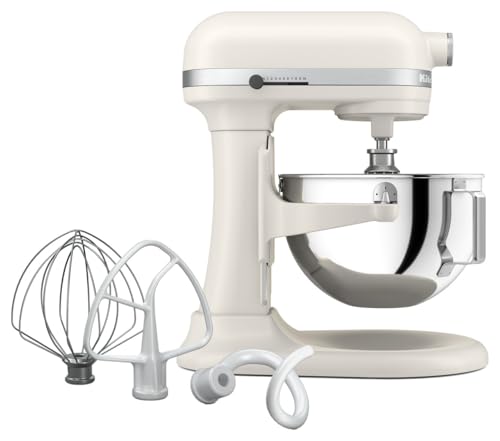
KitchenAid 5.5-Qt Bowl-Lift Stand Mixer KSM55, Porcelain White — Best for Bread Dough
The bowl-lift design exists for one reason: stability under load. Instead of tilting, the head stays fixed to a sturdy column and the bowl cranks up into working position on a lift arm, locking at two points. When a dough hook is pulling against a firm, developing dough, that rigid frame is the difference between a machine that walks and strains and one that simply gets on with it. For bakers whose weekly routine is sandwich loaves, pizza dough or bagels, this is the KitchenAid configuration to buy.
The 5.5-quart bowl gives useful headroom over the Artisan, and the 11-speed range includes a half-speed setting designed for folding — a thoughtful touch, because bowl-lift machines historically started too fast and threw flour. With the flat beater, dough hook and wire whip included, the machine covers the full home baking range out of the box, and the bowl-lift platform accepts the same broad family of hub attachments as its tilt-head sibling.
The compromises are ergonomic. Adding ingredients mid-mix is less graceful than with a tilt-head, because the head does not move out of your way; a pouring shield or a steady hand and a bench scraper become part of the routine. The machine is also tall and heavy, happiest living permanently on a counter under cabinets with enough clearance for the lift — measure before you buy, and plan on sliding rather than lifting it. Bakers who mostly make cakes and cookies pay for stability they will rarely use; bakers who live on dough get exactly the tool they need.
Strengths
- Rigid bowl-lift frame stays stable under dense dough loads
- 11 speeds including a half-speed fold setting
- Larger 5.5-Qt stainless bowl for bigger batches
Trade-offs
- Adding ingredients mid-mix is less convenient than a tilt-head
- Tall, heavy machine that wants a permanent counter spot
- Costs more than the tilt-head for stability light bakers may not need
| Design | Bowl-lift (Amazon title) |
| Bowl | 5.5-Qt stainless steel bowl (Amazon title) |
| Speeds | 11 mixing speeds (Amazon title) |
| Included | Flat beater, dough hook, wire whip (Amazon title) |
Best for: Regular bread bakers who want KitchenAid support with a sturdier frame / Not suited for: Small kitchens where the machine must be lifted in and out of a cupboard daily
Check the current price on Amazon for the KitchenAid 5.5-Qt Bowl-Lift Stand Mixer KSM55, Porcelain White. You can also see the full listing here to confirm finish, dimensions and what is in the box before you order.

Cuisinart Stand Mixer SM-50, 5.5 Quart, White Linen — Best Value
Cuisinart’s SM-50 is the pick for buyers who read spec sheets side by side and wonder why they would pay more. Twelve speeds is the widest range in this guide, the 5.5-quart stainless bowl matches the bowl-lift KitchenAid for capacity, and the box includes the three tools that matter — chef’s whisk, mixing paddle and dough hook — plus a splash guard with a pour spout that many rivals sell as an accessory or omit entirely.
In the kitchen, the SM-50 behaves like a machine designed by people who bake. The tilt-head gives the same easy access as the Artisan, the dial control is simple to read at a glance, and the low speeds are controlled enough for folding while the top end whips competently. For cakes, cookies, frostings, whipped toppings and moderate bread doughs, it covers the home repertoire without drama, and its die-cast build feels a clear step above the lightweight budget tier.
What you give up versus the leader is ecosystem depth and long-track refinement. Cuisinart offers attachments, but the catalog, the color range and the decades-deep pool of third-party bowls and beaters that surround the Artisan simply are not matched here. Resale and hand-me-down confidence follow the bigger name too. None of that changes what the SM-50 does on your counter today, which is why value-focused buyers should start their comparison with this machine and make the others justify the difference.
Strengths
- 12 speeds — the widest range among these picks
- Generous 5.5-Qt bowl with splash guard and pour spout included
- Complete core attachment set in the box
Trade-offs
- Smaller attachment ecosystem than the category leader
- Less refined feel than premium models at the extremes of load
- Fewer finish options and third-party accessories
| Speeds | 12 speed (Amazon title) |
| Bowl | 5.5 Quart stainless steel bowl (Amazon title) |
| Included | Chef’s whisk, mixing paddle, dough hook, splash guard with pour spout (Amazon title) |
Best for: Value-focused bakers who want full-size capacity and features without the premium badge / Not suited for: Collectors who want the widest possible attachment and bowl ecosystem
Check the current price on Amazon for the Cuisinart Stand Mixer SM-50, 5.5 Quart, White Linen. You can also see the full listing here to confirm finish, dimensions and what is in the box before you order.

Hamilton Beach 4 Qt Electric Stand Mixer, Black — Best Budget
Not every kitchen needs a flagship, and the Hamilton Beach is the honest answer for buyers who bake a few times a month and would rather spend the difference on ingredients. You get the features that make a stand mixer worth owning over a hand mixer — planetary mixing action for full bowl coverage, a splash guard, a whisk, flat beater and dough hook, and seven speeds — in a machine light enough to carry by its handle from cupboard to counter without a second thought.
The 4-quart bowl suits the scale of occasional baking: a single cake, a batch of cookies, frosting, whipped cream, a small pizza dough. The 300-watt motor handles those jobs willingly. Where the budget shows is at the extremes — large, stiff doughs are beyond its brief, the build uses more plastic than the premium picks, and the speed range, while adequate, lacks the finesse at the very bottom end that delicate folding rewards.
Judge this mixer by its intended job and it succeeds. It is the machine for a first apartment, a vacation home, a dorm-adjacent kitchen, or a household deciding whether stand-mixer baking is even their hobby before committing flagship money. If you later graduate, it remains a useful second mixer for frostings and small jobs. If you already know you bake weekly bread, skip this tier entirely and put the money toward the bowl-lift pick — the cheapest mixer is only a bargain if it does the work you actually do.
Strengths
- Planetary mixing action at a budget tier
- Light body with easy-carry handle for cupboard storage
- Whisk, flat beater, dough hook and splash guard included
Trade-offs
- 300-watt motor is not built for large, stiff dough batches
- 4-Qt bowl limits double batches
- More plastic in the build than premium picks
| Bowl | 4 Qt (Amazon title) |
| Speeds | 7 speeds (Amazon title) |
| Power | 300 Watts (Amazon title) |
| Included | Whisk, flat beater, dough hook, splash guard (Amazon title) |
Best for: Occasional bakers, first kitchens and anyone testing whether stand mixing suits them / Not suited for: Weekly bread bakers or anyone planning large double batches
Check the current price on Amazon for the Hamilton Beach 4 Qt Electric Stand Mixer, Black. You can also see the full listing here to confirm finish, dimensions and what is in the box before you order.
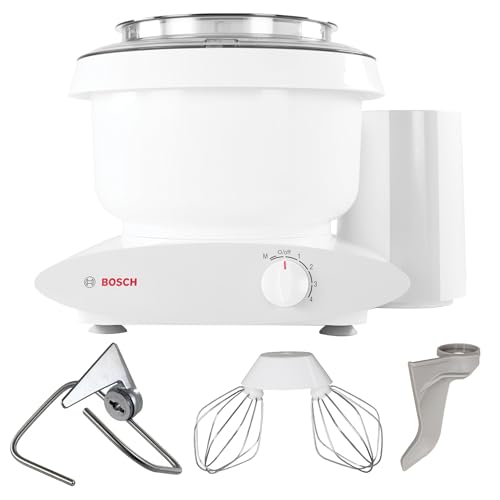
Bosch Universal Plus Stand Mixer, 6.5 Quarts, Bundle — Best for Large Batches
The Bosch Universal Plus looks nothing like the other picks because it works differently: the motor sits in the base and drives attachments from the bottom of an open bowl. That design produces two practical advantages. The bowl is wide and unobstructed, so adding flour while the dough hook works is easy and mess is minimal, and the capacity is genuinely large — 6.5 quarts with a dough system that has built its reputation on kneading multiple loaves’ worth of dough in one session.
Bread bakers who think in kilograms of flour tend to end up here. The included wire whips handle batters and creams, the dough hook does the heavy work, and this bundle adds a dough hook extender from NutriMill aimed at helping smaller dough batches engage properly. The machine’s following among whole-grain and high-volume home bakers is long-standing, and its drive system is known for shrugging off loads that would make a tilt-head nod.
The trade-offs are real. The aesthetic is utilitarian, the footprint is wide rather than tall, and the whip-and-bowl system takes a session or two to learn if you are used to a beater orbiting a bowl. For cakes, the results are good, but bakers whose repertoire is mostly delicate batters may prefer the familiar control of a conventional design. As a dough-first, volume-first machine, though, the Bosch earns its place as the large-batch pick.
Strengths
- 6.5-Qt open bowl makes adding ingredients during kneading easy
- Bottom-drive system renowned for heavy dough work
- Bundle includes dough hook extender for smaller batches
Trade-offs
- Utilitarian styling and wide footprint
- Whip system has a learning curve for conventional bakers
- Less tailored to delicate, small-batch batter work
| Power | 500 Watt (Amazon title) |
| Bowl | 6.5 Quarts (Amazon title) |
| Included | Wire whips, dough hook, NutriMill dough hook extender (Amazon title) |
Best for: High-volume and whole-grain bread bakers working with large dough batches / Not suited for: Bakers who mostly make small, delicate cake batters
Check the current price on Amazon for the Bosch Universal Plus Stand Mixer, 6.5 Quarts, Bundle. You can also see the full listing here to confirm finish, dimensions and what is in the box before you order.
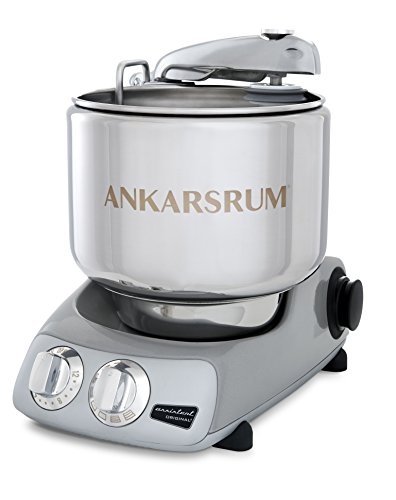
Ankarsrum Original Stand Mixer AKM6230, Jubilee Silver — Best Premium
The Ankarsrum inverts the stand mixer idea. Instead of a beater orbiting inside a fixed bowl, the bowl itself rotates on the base while a roller and scraper, or a dough hook, work the contents from a fixed arm. The result with bread dough is distinctive: the action mimics hand kneading, developing gluten efficiently in large, wet or enriched doughs, and the open bowl design makes it trivially easy to add ingredients, check consistency and scrape down without stopping the machine.
Capacity and calm are the calling cards. This is a machine for bakers who make dough in quantity and want the process to feel controlled rather than violent — no walking across the counter, no head flex, just a steadily turning bowl. The build quality and design longevity are part of the premium proposition: this is a buy-once appliance with a devoted long-term ownership culture, and its accessory system extends it toward pasta, grinding and other kitchen tasks.
Premium means premium compromises too. The learning curve is the steepest here — your first dough will involve reading the manual and watching the roller find its rhythm, and techniques from tilt-head baking do not transfer directly. Whipping small quantities is not its party trick, and the price tier (check price on Amazon; it sits firmly at the top of this guide) only makes sense if dough is central to your baking life. For that baker, it is not an extravagance; it is the right tool, bought once.
Strengths
- Rotating-bowl action kneads large doughs gently and effectively
- Open bowl allows adding and checking ingredients mid-mix
- Exceptional build quality aimed at decades of use
Trade-offs
- Steepest learning curve of any pick here
- Top-tier pricing only justified for dough-centered bakers
- Small-quantity whipping is not its strength
| Model | AKM6230 (Amazon title) |
| Finish | Jubilee Silver (Amazon title) |
| Design | Rotating bowl, fixed arm (manufacturer design) |
Best for: Serious dough bakers who want a buy-once premium machine / Not suited for: Beginners who want familiar technique and the lowest learning curve
Check the current price on Amazon for the Ankarsrum Original Stand Mixer AKM6230, Jubilee Silver. You can also see the full listing here to confirm finish, dimensions and what is in the box before you order.
Comparison Table
The table below compresses the six picks into the four facts most buyers compare first. Use it to shortlist two machines, then read their full reviews — the trade-offs behind each row are where the right decision actually lives.
| Pick | Badge | Key spec | Best for |
|---|---|---|---|
| KitchenAid Artisan 5-Qt Tilt-Head Stand Mixer KSM150PS, Contour Silver | Best Overall | 5-Qt tilt-head, 10 speeds | Most home bakers wanting one proven all-rounder |
| KitchenAid 5.5-Qt Bowl-Lift Stand Mixer KSM55, Porcelain White | Best for Bread Dough | 5.5-Qt bowl-lift, 11 speeds | Bread and pizza dough bakers |
| Cuisinart Stand Mixer SM-50, 5.5 Quart, White Linen | Best Value | 5.5-Qt, 12 speeds | Value seekers wanting full-size features |
| Hamilton Beach 4 Qt Electric Stand Mixer, Black | Best Budget | 4-Qt, 7 speeds, 300W | Occasional bakers on a budget |
| Bosch Universal Plus Stand Mixer, 6.5 Quarts, Bundle | Best for Large Batches | 6.5-Qt, 500W bottom-drive | Large-batch dough bakers |
| Ankarsrum Original Stand Mixer AKM6230, Jubilee Silver | Best Premium | Rotating bowl design | Premium dough specialists |
How to Choose the Best Choice Stand Mixers for Your Baking?
Start with your most demanding regular recipe, not your average one. If the hardest thing you make is a birthday cake twice a year, almost any machine here will delight you, and the budget or value pick is the rational buy. If the hardest thing you make is a double batch of bagel dough every Sunday, that recipe should choose your mixer — it points you at the bowl-lift, the Bosch or the Ankarsrum, and buying anything else is false economy that ends in a second purchase.
Next, be honest about batch size. Bowl quart figures describe the bowl, not the working capacity: dough needs headroom to fold over itself, and batter needs headroom to not slop. As a working rule, a 4 to 5-quart bowl suits single standard batches, 5.5 quarts handles comfortable doubles of most batters, and the 6.5-quart class earns its keep when dough volume is the point. Bigger is not automatically better — an oversized bowl makes small quantities of whipped cream or two egg whites harder, because the whisk cannot reach a shallow pool.
- Choose by your hardest regular recipe, not your easiest
- Match bowl size to real batch size, including headroom
- Check the low speeds, not just the top speed
- Measure cabinet clearance for tilt-head and bowl-lift models
- Count only attachments you will actually buy and use
Tilt-Head, Bowl-Lift or Bottom-Drive: Which Design Fits Your Counter?
Tilt-head machines are the friendliest day to day. The head swings back, access is total, and the design suits the stop-start rhythm of cakes and cookies — add eggs, scrape, swap beater, continue. Their limit is mechanical: the hinge that makes access easy is also the joint that flexes under stiff dough. Bowl-lift machines fix the head to a column and raise the bowl instead, trading a little access convenience for a frame that stays composed under load; they are also the tallest machines here, and they assume a permanent home on the counter.
Bottom-drive and rotating-bowl designs — the Bosch and the Ankarsrum — move the work to the base. Their bowls are open and easy to feed, their dough handling is superb, and their silhouettes are wide and low rather than tall. The cost is familiarity: techniques, timings and even the sound of a job going well are different, and bakers with years of tilt-head muscle memory should expect a short apprenticeship. None of the three designs is objectively best; each is best at a different job, which is why this guide badges them by job rather than crowning a single design.
What Do Speeds, Watts and Planetary Action Actually Tell You?
Less than marketing suggests, but not nothing. Wattage figures are measured differently across brands and say little about torque at the beater, which is what dough actually tests; a well-geared lower-watt machine can out-knead a poorly geared higher-watt one. Treat watts as a rough class indicator only. Speeds matter at the bottom of the range: a true gentle stir folds flour without clouds and without toughening batter, and a half-speed fold setting, like the bowl-lift pick offers, is a real feature rather than a number on a dial.
Planetary action — the beater orbiting the bowl as it spins — is worth having in any conventional design because it reduces the unmixed ring at the bowl wall. Even so, plan on one scrape-down per batter with any machine; no home mixer eliminates it entirely, and any guide promising otherwise is selling you something. Judge a mixer’s power story by the dough it is badged for in this guide and by the honesty of its trade-offs, not by the biggest number on the box.
Which Attachments Are Worth Planning Around?
The powered hub on KitchenAid-style machines turns a mixer into a platform: pasta rollers, food grinders, grain mills and slicers all run from the same motor. If two or three of those jobs are genuinely in your future — fresh pasta monthly, sausage making, milling flour — ecosystem depth becomes a first-order buying criterion and the Artisan’s catalog is a decisive advantage. If your honest list is ‘maybe the pasta roller one day’, buy the mixer that mixes best for you and let the attachment question go.
Included tools matter more than optional ones. Every pick here includes the core trio or its equivalent — a flat beater or paddle for batters, a whisk or whips for aeration, and a dough hook — because those three cover ninety percent of home work. A splash guard with a pour spout sounds minor until your first flour addition at speed three; the Cuisinart and Hamilton Beach include one, and it is worth weighting in their favor if your baking is flour-heavy and your patience is not.
How Long Will Each Design Last, and What Wears First?
Stand mixers rarely die all at once; they wear at predictable points, and design choice influences which point arrives first. On tilt-head machines the hinge and head-lock take the long-term stress, which is why chronic overloading with stiff dough shows up years later as head play. On bowl-lift machines the lift mechanism and bowl-locking points carry the wear, and they tolerate the same years with less drama because the frame was designed around the load path. Base-drive machines move the wear to drive components in the base, a design with a long service record precisely because the forces stay low and centered.
The practical lesson is not to fear any design, but to match the wear pattern to your workload and to treat tools as consumables. Beaters, whisks and hooks bend and fatigue; bowls dent; splash guards cloud. Every pick in this guide comes from a maker with a real parts pipeline, and that — more than any single specification — is what ‘lasting ten years’ actually consists of. When you compare two finalists, ask which one’s replacement bowl you can have at your door this week. That answer predicts your ownership experience better than a wattage figure ever will.
What About Noise, Weight and the Daily-Living Details?
Spec sheets omit the qualities that decide whether a mixer gets used on a Tuesday night. Noise is the first: all stand mixers are audible, but gear-driven designs under load have a working voice that carries, and in open-plan homes that voice influences whether the machine gets run at children’s bedtime or not. There is no silent pick here; there are calmer ones, and the rotating-bowl and bottom-drive designs tend to work at a steadier, lower-drama pitch than a straining tilt-head — another reason to match design to load rather than overloading a smaller machine into its loudest register.
Weight cuts the other way. Heavier machines stay planted and feel substantial, but they punish every relocation; lighter machines invite use in small kitchens precisely because moving them is nothing. Decide where the mixer lives — permanently parked, or fetched per bake — and let that decision arbitrate the weight question before you shop. The best choice is always the machine whose daily friction is lowest for the life you actually lead in your kitchen.
Should You Buy for the Baker You Are or the Baker You Plan to Be?
Ambition is a legitimate buying input, but it should be priced like one. If a bread course starts next month and weekly loaves are genuinely on the calendar, buying the bowl-lift now is foresight. If the bread era is a someday feeling, buying for it today parks money in capacity that may never be used, while the all-rounder that suits your actual Tuesdays goes unbought. A useful test: name the last three things you baked. Buy for the pattern they reveal, and let the fourth thing — the new ambition — earn its machine after its third repetition, not before its first.
How to Set Up and Get the Best First Mix from a New Stand Mixer
A stand mixer’s first session sets habits that protect the machine for years. Before the first bake, wash the bowl and tools, run the empty machine briefly through its speeds to learn its sounds, and — on conventional designs — check beater-to-bowl clearance: the beater should sweep close to the bowl without striking it, and most models provide an adjustment described in the manual if it does not. Place the machine where it will live, confirm a tilt-head can open fully or a bowl-lift can crank without meeting a cabinet, and you are ready for a first, forgiving recipe.
- Wash the bowl, beater, whisk and dough hook in warm soapy water and dry them fully before first use.
- Position the mixer on a stable, level counter and check clearance: full head tilt or bowl lift, plus room to add ingredients.
- Fit the flat beater, lock the bowl in place, and run the empty machine from the lowest speed upward to learn its normal sounds.
- Check beater-to-bowl clearance per the manual and adjust if the beater strikes or clears by too wide a gap.
- For the first recipe, choose a forgiving batter; add flour in portions at the lowest speed to keep it in the bowl.
- Stop once mid-mix to scrape the bowl sides and bottom, and note how much unmixed material remains — this is your machine’s normal pattern.
- After mixing, unlock and wash the tools promptly; dough and batter are far easier to remove before they dry.
Two habits extend any stand mixer’s life more than any accessory. First, respect the dough ceiling: if the motor labors, the head flexes repeatedly, or the machine walks, split the batch — no home mixer is damaged by one hard session, but a pattern of them is what wears gears. Second, store the machine with the bowl fitted and the head or lift in its resting position, cord loosely coiled rather than yanked tight. Do that, and the mixer you buy from this guide should still be mixing when the recipes you are learning today are family traditions.
Common Buying Mistakes
Most stand mixer regret is not about brand; it is about a mismatch between the machine and the buyer’s real habits. These are the mistakes we see repeated, and each maps to a pick in this guide that avoids it.
Buying by wattage alone. Watt figures are not comparable across brands and say little about torque at low speed. Buy by design and badged job — dough machines for dough, all-rounders for variety — not by the biggest number.
Oversizing the bowl. A huge bowl makes small jobs worse: two egg whites in a 7-quart bowl barely meet the whisk. Match the bowl to your typical batch, not your biggest-ever batch.
Ignoring counter clearance. Tilt-heads need room to open and bowl-lifts need room to crank. Measure the space under your cabinets before ordering, not after delivery.
Filling the bowl with stiff dough to the brim. Dough needs room to fold. Overfilling strains the drive and produces worse kneading, not more bread. Split the batch or step up a design class.
Paying for an ecosystem you will never use. Attachments are only value if you buy them. If pasta rollers and grain mills are not honestly in your plans, do not let catalog size outrank mixing performance.
Skipping the scrape-down. No home mixer fully eliminates unmixed pockets at the bowl bottom. One deliberate scrape mid-mix is normal technique, not a defect in the machine.
Final Recommendation
The short answer: most buyers should buy the KitchenAid Artisan. It is the best choice stand mixer for the widest range of real kitchens — easy to live with, sized right, and supported like no rival. Dough-first bakers should step sideways rather than up: the KitchenAid bowl-lift KSM55 for conventional technique with a sturdier frame, the Bosch Universal Plus for volume, or the Ankarsrum for the premium rotating-bowl experience. Value hunters start and often finish at the Cuisinart SM-50, and occasional bakers lose nothing by choosing the Hamilton Beach and spending the savings on good ingredients.
Whichever you choose, buy it for the recipe you make hardest and most often, verify the exact configuration on the live listing, and check price on Amazon at the moment of purchase rather than trusting any number printed in a guide — including the absence of one here. For more comparisons in this category, see Best Cd Mixers and the related mixer guides linked below.
If you want the short version: start with KitchenAid Artisan 5-Qt Tilt-Head Stand Mixer KSM150PS, Contour Silver, KitchenAid 5.5-Qt Bowl-Lift Stand Mixer KSM55, Porcelain White, Cuisinart Stand Mixer SM-50, 5.5 Quart, White Linen. Each is one click away from its live listing, where you can check price on Amazon and confirm the exact configuration.
Best Cd Mixers Best Compact Stand Mixers Best Cookie Mixers Best Cakes Mixers Best Commercial Mixers For Kitchen
Frequently Asked Questions
What is the best choice stand mixer for a beginner?
The KitchenAid Artisan is the easiest recommendation for a beginner: tilt-head access is forgiving, speeds are intuitive, and the technique you learn transfers to almost any other machine. The Cuisinart SM-50 is the beginner alternative if value matters most, offering similar ease with more speeds and a larger bowl.
Is a 5-quart bowl big enough for most baking?
For most households, yes. A 5-quart bowl handles standard cake batters, double batches of most cookie doughs and single loaves comfortably. Move to 5.5 or 6.5 quarts if double batches are your default or bread dough volume is the main job.
Tilt-head or bowl-lift: which should I choose?
Choose tilt-head for convenience with cakes, cookies and mixed baking, and bowl-lift for stability with frequent, dense dough. The difference only matters at the extremes of load; for middle-ground baking both work well.
Can a stand mixer knead bread dough well?
Yes, with the right design class. Bowl-lift, bottom-drive and rotating-bowl machines knead large or lean doughs best. Tilt-head all-rounders knead standard enriched and sandwich doughs well in sensible quantities; split very stiff batches rather than forcing a full bowl.
Why does this guide not list prices?
Because stand mixer pricing shifts with finish, bundle and season, and a printed price would mislead within weeks. Each pick links to its live Amazon listing so you can check price on Amazon for the exact configuration you are buying.
How long should a good stand mixer last?
A well-chosen stand mixer is a decade-plus appliance when it is matched to its workload and not routinely overloaded. Stable designs with available replacement bowls and beaters — a strength of the established picks here — are the ones that reach that lifespan.
Do I need a second bowl for my stand mixer?
A second bowl is the highest-value accessory most bakers can buy: it lets a cake batter rest while you whip cream, or a second dough proof while the first is shaped, without a wash in between. It costs a fraction of any powered attachment and improves every multi-component bake. If your budget stretches to one extra after purchase, make it the bowl.


