Disclosure: airfryerkitchensupply.com is reader-supported. When you buy through links on our site, we may earn an affiliate commission at no extra cost to you.
Where to buy
The fastest way to compare the best charcoal smokers under 400 shortlisted below is Amazon, where every linked pick on this page was verified against the manufacturer listing before this guide was published. Prices move with seasons and promotions, so we do not print fixed prices here — use the links to check the current price on Amazon for the exact model, size and configuration you want.
- Weber Smokey Mountain Cooker 18-Inch — check price on Amazon
- Cuisinart 18-Inch Vertical Charcoal Smoker (COS-118) — check price on Amazon
- Pit Barrel Cooker Junior Premier Series 14-Inch Drum Smoker — check price on Amazon
- Oklahoma Joe’s Highland Offset Charcoal Smoker — check price on Amazon
- Char-Griller Smokin’ Pro Charcoal Grill and Offset Smoker — check price on Amazon
- Char-Griller AKORN 20-Inch Kamado Charcoal Grill and Smoker — check price on Amazon
The $300–$400 band is where brand-name build quality starts, so listings here are more stable than in the budget tier — but configurations still vary. Check whether the listing includes the cart, cover or side shelves shown in photos before assuming they are in the box.
The best charcoal smokers under 400 dollars live in the most interesting tier in smoking. This is where the thin, leaky barrels of the budget shelf give way to porcelain-enameled steel, proper dampers and cookers with decades-long parts support — without yet reaching the prices of ceramic kamados and heavy offsets. The Weber Smokey Mountain, the benchmark bullet smoker against which everything else is judged, sits in this tier in its 18-inch size. So do a serious drum, a real offset and an insulated steel kamado. If you can stretch to this budget, this is the tier we would buy in.
What the extra money actually purchases is consistency. A cooker that seals properly responds to its dampers instead of its leaks, so the temperature you set is the temperature you get, cook after cook. Enamel and heavier steel shrug off the rust that ends budget cookers’ lives. And the brands here — Weber, Oklahoma Joe’s, Char-Griller, Pit Barrel — all maintain parts catalogues, so a worn grate or gasket in year six is an order, not a funeral.
This guide spreads its six picks across the same four formats as our under-$300 roundup, deliberately: a bullet water smoker as the overall pick, a budget holdover for buyers stretching from below, a drum, an offset, a big grill-smoker for crowds, and an insulated kamado. Read the trade-offs as carefully as the strengths — at this price the differences between good picks are about cooking style, not quality corners.
In this guide
Quick Picks
If you only read one section, make it this one. These are the six best charcoal smokers under 400 we would point a friend toward, each with a clear job. Every badge used here is repeated at the top of that pick’s full review further down, so the shortlist and the deep dives always agree.
- Weber Smokey Mountain Cooker 18-Inch — Best Overall: the 18-inch porcelain-enameled bullet with dual grates and proper dampers — the benchmark water smoker, with the deepest owner knowledge base in charcoal smoking. — check price on Amazon
- Cuisinart 18-Inch Vertical Charcoal Smoker (COS-118) — Best Budget: the 18-inch vertical water smoker with water bowl, dual vents and integrated thermometer that anchors our under-$300 list — still the value pick for buyers stretching up. — check price on Amazon
- Pit Barrel Cooker Junior Premier Series 14-Inch Drum Smoker — Best Drum Smoker: the 14-inch Junior drum from Pit Barrel Cooker — hang-and-grate drum cooking from the brand that defined the category, in a compact, tailgate-friendly size. — check price on Amazon
- Oklahoma Joe’s Highland Offset Charcoal Smoker — Best Offset: a 900 sq. in. offset charcoal smoker from Oklahoma Joe’s — the entry point to a real, dedicated offset from a brand that specialises in them. — check price on Amazon
- Char-Griller Smokin’ Pro Charcoal Grill and Offset Smoker — Best for Crowds: 1,130 sq. in. of barrel grill with a side firebox, dual damper control and a warming rack — the biggest cooking surface in this guide. — check price on Amazon
- Char-Griller AKORN 20-Inch Kamado Charcoal Grill and Smoker — Best Insulated Kamado: a 20-inch triple-wall insulated steel kamado with cast iron grates — kamado efficiency and temperature range without ceramic weight or ceramic prices. — check price on Amazon
How These Picks Were Chosen
As with every guide in this series, each linked pick was verified against its live listing before writing — brand, model, size and format confirmed from the listing itself, with no ASIN used unless the returned title matched the product we intended to review. Models we could not verify, and brands without a visible parts trail, were excluded regardless of reputation.
The under-$400 tier was scored on a different balance than the budget tier. Build quality and sealing came first, because this is the price where they genuinely improve: enamel over paint, dampers that seal, steel that shrugs off a winter. Temperature stability came second — the practical thing the extra money buys — followed by honest capacity and parts support. Format diversity was the final filter: with six slots and four distinct styles of charcoal cooking in this tier, we saw no reason to spend two slots on near-duplicates.
We also sanity-checked each pick against the tier itself. Every model here is a product genuinely sold in the under-$400 band — where a well-known model is commonly found above it, we say so in its review rather than pretend otherwise. Street prices move with promotions, so use the links to check the current price on Amazon rather than trusting any roundup’s memory, including ours.
The 6 Best Charcoal Smokers Under $400
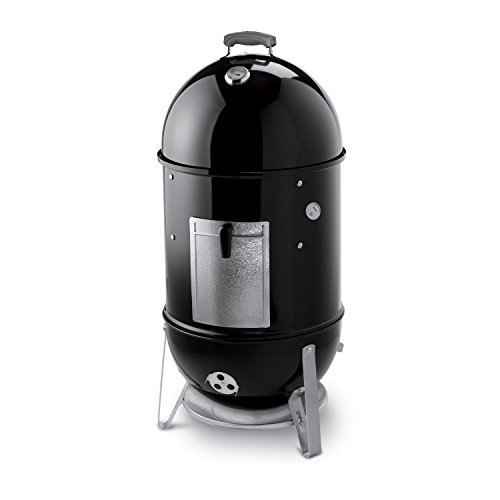
1. Weber Smokey Mountain Cooker 18-Inch — Best Overall
The Weber Smokey Mountain 18-inch is the smoker the rest of this list is measured against, and for most buyers it is simply the answer. The porcelain-enameled bullet stacks two cooking grates over a water pan and a charcoal ring, seals well enough that its dampers genuinely control the fire, and has been in production so long that every technique, mod and troubleshooting answer you will ever need is documented by its enormous owner community.
Strengths
- Porcelain-enameled steel resists rust and cleans up easily — built for a decade of service
- Sealed construction means the temperature control dampers actually control temperature
- Two full grates plus the water pan deliver the classic, forgiving bullet-smoker cook
Trade-offs
- The front door is the known weak point — many owners upgrade its latch or seal it with gasket
- No built-in hanging option; ribs lie flat or coil on the grates
- Capacity tops out at family-plus size — two butts and ribs, not a whole party at once
Key specs (from the verified listing)
- Size: 18-inch bullet (water) smoker
- Cooking grates: dual cooking grates
- Construction: porcelain-enameled kettle
- Air control: temperature control dampers
Run a Smokey Mountain once and the appeal is obvious: fill the ring, light a small amount of charcoal, set the bottom vents, and it settles into the smoking range and stays there with a calmness budget bullets cannot match. The water pan does part of that work, but the real difference is air discipline — the lid, sections and door fit tightly enough that the fire breathes only through the dampers you control. In wind, in cold, in month eleven of ownership, that fit is what you paid for.
The ownership case is just as strong. Grates, water pans, covers, gaskets, door upgrades — everything exists, from Weber and a healthy aftermarket, and the model’s long production run means it will keep existing. The honest limitations are capacity and the door: the 18-inch grates ask you to trim a long brisket or bend it over a block until it shrinks, and the stock door leaks a little smoke until sealed. Neither stops this being the default recommendation for anyone who wants one smoker to learn on and keep.
Best for: almost everyone — the learn-on-it, keep-it-for-years default charcoal smoker / Not suited for: cooks who regularly feed ten or more, who should look at the 22-inch size or the big Char-Griller below
Check on Amazon — check the current price on Amazon before you decide, and confirm the size and configuration on the listing match what you measured at home.

2. Cuisinart 18-Inch Vertical Charcoal Smoker (COS-118) — Best Budget
Not every under-$400 buyer needs to spend under-$400 money. The Cuisinart COS-118 stays in this guide because it delivers the same bullet water-smoker layout as the Weber — 18-inch stacked body, water bowl, two chrome-plated grates, dual vents — at a meaningfully lower price, leaving budget for the accessories that actually improve cooks: a probe thermometer, a chimney, a cover and good charcoal.
Strengths
- Same proven layout as the benchmark bullet, at a budget-tier price
- Water bowl and dual vents give beginners the forgiving setup that matters most
- Money saved versus the Weber funds the accessories that close most of the real-world gap
Trade-offs
- Thinner steel than the Weber — more charcoal in cold weather, more care against rust
- Chrome-plated grates are a maintenance item, not a lifetime part
- Fit and finish are a step behind; expect to add gasket tape for best results
Key specs (from the verified listing)
- Size: 18-inch vertical charcoal smoker
- Water bowl: included
- Vents: dual vents
- Grates: chrome-plated
- Thermometer: integrated lid thermometer
The fair question is what the Weber’s premium buys that this does not. Three things: enamel that shrugs off neglect, a tighter factory fit, and a deeper parts and knowledge ecosystem. On a still summer day with both cookers sealed and run well, the food coming off them is far closer than the price gap suggests — the COS-118’s water bowl buffers heat the same way, and its dual vents give the same control vocabulary.
Where the gap shows is in year three, not cook three: in how the steel looks after winters, how the grates hold up, how easy a replacement part is to find. If you are the kind of owner who covers, cleans and stores a cooker properly, the Cuisinart rewards you with years of good service and money left over. If you know you will neglect it, the Weber’s enamel is genuinely worth paying for. That is an honest either/or, and it is why both are in this guide.
Best for: value-focused beginners who will care for their cooker and prefer to spend the difference on accessories / Not suited for: neglect-prone owners, for whom porcelain enamel is worth real money
Check on Amazon — check the current price on Amazon before you decide, and confirm the size and configuration on the listing match what you measured at home.

3. Pit Barrel Cooker Junior Premier Series 14-Inch Drum Smoker — Best Drum Smoker
Pit Barrel Cooker built its name on a simple idea: hang the meat in a drum over charcoal, let the drippings hit the coals, and let the drum’s convection do the rest. The Junior shrinks that formula to a 14-inch drum that still hangs ribs and chickens and takes a grate for flat cooks, while fitting in a car boot, a small patio or a storage cupboard. If the drum style appeals but the full-size barrel is too much cooker, this is the authentic version, not a copy.
Strengths
- Genuine Pit Barrel hanging system — ribs and poultry cook evenly with no flipping
- Compact 14-inch drum stores and travels where full barrels cannot
- Drum convection cooks faster than a water smoker at the same tenderness
Trade-offs
- 14-inch capacity is real but modest — plan on one or two items per cook, not a spread
- No water pan and minimal venting: the drum finds its temperature, you adapt to it
- Hanging hooks and rods are a system to learn; grate-only cooks use space less efficiently
Key specs (from the verified listing)
- Size: 14-inch drum smoker
- Style: drum (UDS) cooker, hang-and-grate cooking
Drum cooking divides people, and the Junior is the cheapest authentic way to find out which side you are on. Hung ribs are its signature: suspended vertically, they baste in rising heat, never sit in their own juices on a grate, and come out with an even cook from end to end that flat cooking struggles to match. Chickens hung by the hook are similarly excellent. The drum runs a little hotter than classic low-and-slow, which drum owners consider a feature — cooks finish sooner with no loss of tenderness.
The constraints are size and philosophy. Fourteen inches across means a full rack of ribs hangs fine, but a big brisket does not fit the programme — this is a ribs, chicken, sausages and small-butts cooker. And the Pit Barrel approach asks you to trust the drum’s designed airflow rather than chase a digital number. Cooks who love that simplicity keep these for years; cooks who want dial-it-in control should take the Weber above. Both reactions are correct.
Best for: ribs-and-chicken cooks who want authentic drum flavour in a compact, storable size / Not suited for: brisket-first cooks and anyone who wants precise, adjustable temperature control
Check on Amazon — check the current price on Amazon before you decide, and confirm the size and configuration on the listing match what you measured at home.

4. Oklahoma Joe’s Highland Offset Charcoal Smoker — Best Offset
The Highland is where offset smoking gets serious without getting expensive. Oklahoma Joe’s builds offsets as its core business, and the Highland shows it: a proper horizontal chamber with 900 square inches of cooking area, a dedicated firebox, and the layout — fire at one end, stack at the other — that defines traditional barbecue. Unlike the grill-with-firebox combos, this is a smoker that can also grill, not the other way around.
Strengths
- Purpose-built offset from a specialist brand, with 900 sq. in. of chamber space
- Steel and welds are a clear step up from budget grill-smoker combos
- Huge owner community — every sealing, tuning-plate and fire-management mod is documented
Trade-offs
- Still a consumer-grade offset: plan on gasket and latch mods to tame leaks and swings
- Offsets demand tending — expect to feed and check the fire roughly every 45–60 minutes
- Its size and weight claim real patio space and do not travel
Key specs (from the verified listing)
- Cooking area: 900 sq. in.
- Design: offset charcoal smoker and grill
Offsets reward and punish more than any other format. The Highland’s reward is flavour and theatre: a clean-burning wood-and-charcoal fire in the box, smoke drawn across a big chamber, bark and smoke ring that bullets work harder to match. The punishment is workload — an offset is a fire you manage, in splits and coals, for the whole cook. Buyers who find that relaxing call it the best seat in the garden. Buyers who wanted to watch a film should buy the Weber.
As with every consumer offset, the Highland improves dramatically with the standard mods: gasket on the chamber and firebox doors, latches to pull them tight, and a tuning plate or baffle to even out the hot spot near the firebox. Budget for those from day one and you have a cooker that performs well above its class. Capacity is genuine — multiple briskets or a crowd’s worth of ribs fit without stacking tricks — making this the pick for the committed learner with space and Saturdays to spend.
Best for: committed beginners and traditionalists who want a real offset and enjoy tending a fire / Not suited for: set-and-forget cooks, small patios, and anyone whose Saturdays are spoken for
Check on Amazon — check the current price on Amazon before you decide, and confirm the size and configuration on the listing match what you measured at home.

5. Char-Griller Smokin’ Pro Charcoal Grill and Offset Smoker — Best for Crowds
The Char-Griller Smokin’ Pro is the capacity pick: a full-size barrel grill with a side firebox for offset smoking, dual damper control, a chrome-plated warming rack, and 1,130 square inches of total cooking space. For the buyer whose real life is big family cookouts — burgers and steaks direct one weekend, ribs and chicken indirect the next — it is the one cooker here sized for the job without moving up a price tier.
Strengths
- 1,130 sq. in. total cooking area — the crowd cooker of this roundup
- Side firebox gives true offset smoking; main barrel grills direct at full size
- Dual damper control and a warming rack are genuinely useful, not decoration
Trade-offs
- As a smoker it shares budget-offset traits: leaks to seal and a firebox sized for medium-length cooks
- Big thin-steel barrel uses charcoal generously, especially in wind
- Cast-iron and steel parts need seasoning and oiling discipline to stay rust-free
Key specs (from the verified listing)
- Cooking area: 1,130 sq. in.
- Firebox: side fire box (offset)
- Air control: dual damper control
- Rack: chrome-plated steel warming rack
- Model: CG30044223
Judge the Smokin’ Pro as what it is: a grill first, and a very large one. Direct grilling for a dozen people is effortless, the warming rack keeps finished food hot while batches rotate, and the cast-iron cooking grates (a Char-Griller staple at this level) hold heat and mark food properly. Many households will use those strengths fifty weeks a year and smoke on it six — and for those households it is a better buy than a dedicated smoker.
Its smoking mode is honest mid-pack. The firebox is big enough for ribs, chickens and pork butts, the dual dampers give you intake and exhaust to work with, and with the usual gasket treatment it holds a working smoking range. What it will not do is match a sealed bullet for overnight stability or fuel economy — the chamber is simply too large and too thin. If smoking becomes your main event, you will outgrow it as a smoker while still loving it as a grill, which is a perfectly good ownership arc.
Best for: big households and party hosts who grill often and smoke sometimes, at full size / Not suited for: dedicated low-and-slow cooks who would rather have a smaller, tighter, dedicated smoker
Check on Amazon — check the current price on Amazon before you decide, and confirm the size and configuration on the listing match what you measured at home.

6. Char-Griller AKORN 20-Inch Kamado Charcoal Grill and Smoker — Best Insulated Kamado
The AKORN 20-inch brings the kamado concept to this tier in insulated steel instead of ceramic. The triple-wall body traps heat so effectively that it sips charcoal, holds low smoking temperatures through wind and cold that would defeat thin steel, and still climbs to steakhouse searing heat. The cast iron grates suit both jobs. For one cooker that must smoke in January and sear in July, this is the format to beat.
Strengths
- Insulated triple-wall steel — best fuel economy and cold-weather stability here
- Genuine temperature range: low-and-slow smoking to high-heat searing in one cooker
- Steel body is far lighter and more knock-resistant than ceramic kamados
Trade-offs
- Kamado capacity is modest for the footprint — the round grate fills up fast with ribs
- Steel insulation is not ceramic mass; very long cooks need a mid-cook charcoal top-up more often
- The ash and lower-body areas need rust vigilance that ceramic never asks for
Key specs (from the verified listing)
- Size: 20-inch kamado
- Construction: triple-wall insulated steel
- Grates: cast iron grates
The kamado bargain is efficiency. Because so little heat escapes, a modest load of lump charcoal runs for many hours, and the fire responds to small vent changes with a precision thin-steel cooks find startling the first time. In practical terms: the AKORN is the pick most likely to be lit on a weeknight, and the one whose running costs stay lowest over years of ownership. Its low-temperature stability in bad weather is the best in this guide.
The trade-offs are the kamado trade-offs. The cooking area suits a family — a brisket fits, a couple of chickens fit, four racks of ribs need a rib rack and some Tetris — but it is not a crowd cooker like the Smokin’ Pro. And while the steel body shrugs off the knocks that would crack ceramic, it asks for the usual painted-steel care: cover it, keep the ash drawer emptied, touch up chips before they rust. Cooks who accept that rhythm get the most versatile cooker in this price band.
Best for: year-round, all-weather cooks who want one efficient cooker for smoking and searing / Not suited for: crowd feeders, and owners who want the zero-maintenance indifference of porcelain or ceramic
Check on Amazon — check the current price on Amazon before you decide, and confirm the size and configuration on the listing match what you measured at home.
Comparison Table
| Pick | Badge | Key spec | Best for |
|---|---|---|---|
| Weber Smokey Mountain Cooker 18-Inch | Best Overall | Size: 18-inch bullet (water) smoker | almost everyone — the learn-on-it, keep-it-for-years default charcoal smoker |
| Cuisinart 18-Inch Vertical Charcoal Smoker (COS-118) | Best Budget | Size: 18-inch vertical charcoal smoker | value-focused beginners who will care for their cooker and prefer to spend the difference on accessories |
| Pit Barrel Cooker Junior Premier Series 14-Inch Drum Smoker | Best Drum Smoker | Size: 14-inch drum smoker | ribs-and-chicken cooks who want authentic drum flavour in a compact, storable size |
| Oklahoma Joe’s Highland Offset Charcoal Smoker | Best Offset | Cooking area: 900 sq. in. | committed beginners and traditionalists who want a real offset and enjoy tending a fire |
| Char-Griller Smokin’ Pro Charcoal Grill and Offset Smoker | Best for Crowds | Cooking area: 1,130 sq. in. | big households and party hosts who grill often and smoke sometimes, at full size |
| Char-Griller AKORN 20-Inch Kamado Charcoal Grill and Smoker | Best Insulated Kamado | Size: 20-inch kamado | year-round, all-weather cooks who want one efficient cooker for smoking and searing |
Note how the Key spec column changes meaning by format — diameter for the bullet and drum, chamber area for the offset and grill, grate area for the kamado. Cross-format capacity comparisons by headline numbers alone will mislead you; the reviews translate each into real food.
How to Choose a Charcoal Smoker Under $400
Decide first whether this is a five-year or a ten-year purchase. At this price you can buy either the best version of a simple format — the Smokey Mountain’s enamelled bullet is the classic ten-year buy — or the entry version of a demanding format, like the Highland offset. Both are legitimate; the mistake is buying the demanding format while expecting the simple one’s ownership experience. Offsets and big barrels ask for mods, tending and space. Bullets and kamados ask for almost nothing but charcoal.
Next, match the cooker to your weather and your calendar. Cold-climate and winter cooks should weight insulation heavily — the AKORN’s triple-wall body is not a luxury where you live, it is the difference between smoking year-round and smoking in summer. Time-poor cooks should weight stability the same way: a cooker that holds temperature unattended for an hour between checks fits a busy Saturday; an offset that wants attention every 45 minutes does not, however good its bark.
Is the 18-inch or a bigger cooker the right size?
For most households, 18 inches of bullet or a 20-inch kamado is the sweet spot: two butts, a brisket with minor trimming, ribs with a rack. Step up in size only if your typical cook — not your biggest — overflows that. Oversized cookers burn more charcoal to heat empty space, take longer to settle, and crowd a patio twelve months a year to serve one party.
Steel, enamel or insulated — which body material suits you?
Porcelain enamel (the Weber) is the low-maintenance champion: it resists rust, wipes clean and forgives neglect. Painted or coated steel (Oklahoma Joe’s, Char-Griller) is tougher against dents but needs covers and touch-ups. Insulated steel (the AKORN) trades a little of that indifference for a large gain in efficiency and cold-weather manners. None is wrong; choose for the owner you honestly are.
What Does the Extra Money Over $300 Actually Buy?
Three things, in order of importance. First, sealing: lids, doors and sections that fit, so dampers control the fire and temperatures repeat from cook to cook. Second, materials: enamel and heavier steel that convert directly into years of service life — the true cost of a smoker is its price divided by its seasons, and this tier wins that maths against both cheaper and much pricier cookers. Third, ecosystems: parts, covers, mods and a community that has already solved every problem you will meet.
What the extra money does not buy is a different category of food. A well-run $200 bullet and a well-run $400 bullet produce barbecue of the same ceiling; the $400 cooker gets there more easily, more repeatably, in worse weather, for more years. If that sentence sounds like exactly what you want, this is your tier. If it sounds like overkill, our under-$300 guide will serve you honestly — and if it sounds like not enough, the under-$500 and under-$800 guides are where gravity-fed and ceramic options begin.
Accessories Worth Buying With a Smoker in This Tier
A mid-range smoker deserves a short, deliberate accessories list — not a shopping spree. First, a dual-probe thermometer: one probe for the grate, one for the meat. It replaces the dome gauge’s guesses with the two numbers that actually decide your cook, and it will outlive the smoker and move to your next one. Second, a chimney starter sized to your cooker — it is how every technique in this guide lights charcoal cleanly and measurably. Third, a fitted cover: at this tier you are protecting enamel and steel you intend to keep for a decade, and weather is the main thing that shortens a smoker’s life.
After those three, buy for your format. Bullet owners: a rib rack multiplies capacity more cheaply than a bigger smoker, and a replacement door latch or gasket cures the Smokey Mountain’s one known leak. Offset owners: the gasket and latch kit first, then a tuning plate once you know your chamber’s hot spots, then a charcoal basket for the firebox, which turns refuelling into a tidy swap instead of a scattered rebuild. Kamado owners: a heat deflector is essential for true indirect smoking if your setup does not include one, and a good ash tool makes the kamado’s one regular chore — ash removal — a thirty-second job.
What not to buy yet: extra grates you have no cook planned for, elaborate rub collections before you have a house rub you can make blindfolded, and any gadget that promises to make a charcoal smoker ‘automatic’. The automatic controllers exist and some are excellent, but learn your cooker’s manual language first — the controller’s value is obvious only to a cook who already knows what the fire is doing without one.
How much should you budget beyond the smoker itself?
Plan on the thermometer, chimney and cover as part of the purchase — together they typically add a modest fraction to the cooker’s cost and protect the whole investment. Everything else can wait for a specific cook to justify it. The owners who regret accessory spending are the ones who bought for imaginary cooks; the ones who do not are the ones who bought for next Saturday’s.
Maintaining a Mid-Range Charcoal Smoker So It Lasts a Decade
The cookers in this tier are priced for long service, but longevity is a routine, not a material. After every cook: brush the grates while they are still warm, let the cooker cool fully, and empty the ash — ash holds moisture against steel and is the single most corrosive thing you can leave in a smoker. Wipe enamel and painted surfaces with a damp cloth once cool; grease left to bake on through a summer becomes both a flavour and a rust problem. Then cover the cooker, every time, even in a dry climate — dew is enough.
Once or twice a season, go further. Check dampers and hinges for stiffness and clear them of creosote build-up, which is normal in any well-used smoker but will eventually glue a vent shut. Inspect the fire bowl, charcoal grate and ash pan — the highest-heat, highest-wear parts — for thinning or rust-through, and order replacements while the cooker still works rather than during the cook that discovers the hole. On painted steel, sand and touch up chips with high-heat paint before rust gets under the surrounding finish. On the kamado, check the gasket for compression and replace it when the lid starts to leak smoke at the seam.
None of this is burdensome — it totals perhaps twenty minutes a cook plus an hour a season — but it is the entire difference between this tier’s promise and its disappointment. A Smokey Mountain or AKORN maintained this way is a ten-to-fifteen-year appliance. The same cooker left full of wet ash under no cover is a three-year one, and the warranty will not save it, because the failure will be neglect, not defect.
Keep a simple log while you are at it: date, weather, fuel load, vent settings and result. It takes a minute per cook, it turns maintenance visits into tune-ups informed by evidence, and after one season it becomes the most useful barbecue book you own — the one written about your cooker, your fuel and your climate.
The Short Version
Pressed for the one-paragraph version: this tier buys sealing, steel and support, and the Smokey Mountain is its safest expression — but the right pick is the one whose format matches your Saturdays, your weather and your guest list, which is why this guide spent as many words on trade-offs as on strengths.
How to Set Up and Run a Mid-Range Charcoal Smoker
Better cookers reward better routine. The sequence below is written for the bullet and kamado picks in this guide; offset owners should follow the same rhythm, substituting firebox management for the charcoal ring. The goal of your first three cooks is not great barbecue — it is a notebook page of vent settings you can trust.
- Before the first cook, wash grates, check every damper moves freely, and run a dry seasoning burn for 2–3 hours to cure coatings and learn the cooker’s natural settling point.
- Build the fire for the format: a full charcoal ring with wood chunks buried in it for a bullet; a modest pile of lump pushed to one side for a kamado; a coal bed in the firebox for an offset.
- Light less than you think — roughly a third to a half of a chimney — spread the lit coals, assemble the cooker, and let it climb slowly with vents open, then throttle back as it approaches your target.
- Stabilise for a full 30 minutes before food goes on. Note the vent positions that hold your target; this is the single most valuable habit in charcoal smoking.
- Cook to tenderness, not time: probe for tenderness in brisket and pork, and use a probe thermometer at grate level rather than trusting the dome gauge.
- Manage the fire in small moves — one vent change, then wait 15 minutes. If you must refuel, add lit charcoal from the chimney rather than cold coals onto the meat’s smoke.
- Rest all large cuts wrapped for at least an hour. Then clean grates while warm, empty ash when cool, and record what worked in your notebook.
Three cooks in, you will know your cooker’s personality: where it likes to cruise, how it answers a vent nudge, how it behaves in wind. That knowledge — not the hardware — is what separates the food this tier can produce from the budget tier’s.
Common Buying Mistakes
Skipping the sealing mods on an offset. A consumer offset out of the box leaks at the doors. Gasket, latches and a tuning plate are not optional extras for the Highland class of cooker — they are the second half of the purchase. Budget for them from day one.
Buying the biggest cooker for the biggest party. Your typical cook should size your smoker. An oversized chamber costs charcoal, stability and patio space on every ordinary Saturday to serve one extraordinary one.
Chasing temperature with both vents at once. Change one variable, wait, observe. New owners who work intake and exhaust simultaneously never learn which lever does what, and their temperatures oscillate for months.
Using briquettes in a kamado. Kamados are designed for lump charcoal: briquettes produce far more ash, which chokes the airflow that makes a kamado precise. The AKORN will run noticeably better on lump.
Neglecting enamel and steel care. Even at this tier, ash left damp in the cooker and a missing cover will rust steel and stain enamel. Ten minutes of cleanup per cook is the difference between a five-year and a fifteen-year smoker.
Final Recommendation
The short version: buy the Weber Smokey Mountain 18-inch unless you have a specific reason not to — it is the most complete charcoal smoker in this tier and the one we would hand to a friend without a caveat. The reasons not to are all in this guide: the Pit Barrel Junior if drum cooking is your calling, the Highland if you want the offset craft, the AKORN if your winters are cold and your cooks are small, the Smokin’ Pro if your garden fills with people, and the Cuisinart if you would rather spend the difference on accessories.
If you are still deciding between tiers, compare this shortlist against Best Charcoal Smokers Under $300 below and Best Charcoal Smokers Under $500 above — the honest differences are sealing, steel and stability, and only you know how much of each your cooking needs. Vertical specialists should also see Best Charcoal Vertical Smokers, and water-smoker purists Best Charcoal Water Smokers.
- Weber Smokey Mountain Cooker 18-Inch — check price on Amazon
- Cuisinart 18-Inch Vertical Charcoal Smoker (COS-118) — check price on Amazon
- Pit Barrel Cooker Junior Premier Series 14-Inch Drum Smoker — check price on Amazon
Best Charcoal Smokers Under $500 Dollars
Frequently Asked Questions
Is the Weber Smokey Mountain worth it over cheaper bullets?
For most owners, yes — the enamel, the fit and the parts ecosystem convert into years of extra service and calmer cooks. If you will care for a cheaper bullet diligently, the food gap is small; the Weber’s premium buys forgiveness for imperfect care and a decade-long parts trail.
Can I smoke through winter on a smoker under $400?
Yes, with the right pick. The insulated AKORN barely notices cold. A bullet like the Smokey Mountain handles winter with a windbreak and extra charcoal. Thin-steel offsets struggle most — their big chambers shed heat faster than a small firebox replaces it.
Offset or bullet — which makes better barbecue?
A well-run offset makes the most traditional bark and smoke flavour; a well-run bullet makes barbecue that is far closer than the effort gap suggests, with a fraction of the tending. Choose by how you want to spend the cook: managing a fire, or checking in on one.
How long do these smokers last?
The enamelled Weber and the kamado should run a decade or more with basic care; the painted-steel picks typically give many seasons before rust and wear parts need attention. In all cases the consumables — grates, gaskets, dampers — are replaceable on every pick in this guide.
Do I need to modify a new smoker?
Bullets and kamados here need nothing beyond, at most, a door gasket on the Weber. Offsets genuinely benefit from gasket and latch mods, and we flag that in their reviews rather than hiding it. No pick in this guide requires modification to cook well on day one.
Briquettes or lump charcoal?
Bullets and drums run happily on quality briquettes, which burn evenly and predictably. Kamados should use lump — less ash, better airflow. Offsets typically burn a charcoal base with wood splits for flavour. Match the fuel to the format and every pick here performs better.


