Disclosure: airfryerkitchensupply.com is reader-supported. When you buy through links on our site, we may earn an affiliate commission at no extra cost to you.
Where to buy
Shopping for the best cast iron hibachi grills? Start here. All six hibachis below are sold on Amazon through verified listings. Check the current price on Amazon for each model, and note the grate dimensions in the listing before ordering — hibachis are intentionally small, and a tape measure today prevents a disappointed unboxing on picnic day.
- Lodge Sportsman’s Pro Cast Iron Grill (Best Overall): Check on Amazon
- Giantex Portable Hibachi Grill (Best Classic Hibachi): Check on Amazon
- IronMaster Mini Cast Iron Hibachi Grill (Best for Two People): Check on Amazon
- IRONMAX Hibachi Grill with Coal Door (Best Air Control in a Mini): Check on Amazon
- IRONMAX Mini Hibachi Grill (11 x 6.7) (Best Compact Skillet-Style): Check on Amazon
- Sungmor Compact Cast Iron Charcoal Grill (Best with Adjustable Grate): Check on Amazon
The best cast iron hibachi grills are an argument that grilling does not need to be big to be serious. A hibachi is a small, open, charcoal-fired grill — traditionally a tabletop box of fire — and in cast iron it becomes something special: a fierce, steady little heat source that sears skewers, chops, and vegetables inches above the coals while the cook sits right there with it. No lid, no dials, no app. Just iron, charcoal, and attention.
This guide ranks six verified cast iron hibachis and hibachi-style grills, from Lodge’s larger Sportsman’s Pro — the hibachi format grown up — through classic tabletop models with air doors and adjustable grates, down to mini hibachis sized for two people and a yakitori session. We explain how hibachi cooking actually works, how the air-control details separate the good designs from the frustrating ones, and the honest limits of a grill with no lid. Every pick was verified through this site’s retailer verification system.
In this guide
Quick Picks
- Best Overall: Lodge Sportsman’s Pro Cast Iron Grill — best for couples and small groups wanting hibachi cooking at meal scale — Check on Amazon
- Best Classic Hibachi: Giantex Portable Hibachi Grill — best for picnickers, campers, and traditionalists who want real fire controls — Check on Amazon
- Best for Two People: IronMaster Mini Cast Iron Hibachi Grill — best for couples and solo cooks wanting an authentic two-person hibachi — Check on Amazon
- Best Air Control in a Mini: IRONMAX Hibachi Grill with Coal Door — best for attentive cooks who want precise control of a two-person hibachi — Check on Amazon
- Best Compact Skillet-Style: IRONMAX Mini Hibachi Grill (11 x 6.7) — best for campers and couples cooking small pieces and shared plates — Check on Amazon
- Best with Adjustable Grate: Sungmor Compact Cast Iron Charcoal Grill — best for balcony and campsite cooks wanting adjustable-grate control for one to three people — Check on Amazon
The Lodge Sportsman’s Pro is the most capable hibachi-style grill here. The Giantex is the classic hibachi with the best fire-management hardware. The IronMaster Mini and the two IRONMAX models are true two-person tabletop hibachis with different strengths, and the Sungmor adds wooden handles and an adjustable grate at the smallest scale.
How These Picks Were Chosen
Authenticity of construction was the first test: the verified listing title had to establish cast iron construction, because the hibachi market includes many steel and alloy imitations that share the shape but not the heat behavior. Iron is not a styling choice in a hibachi — the whole cooking method depends on a small mass of metal holding a small fire steady — so steel-bodied lookalikes were excluded from the picks.
Fire control was the second test, and it is where hibachi designs truly differ. With no lid and no burner dial, a hibachi is controlled by air: doors, vents, draft openings, and grate height. We credited designs that give the cook real levers — regulating doors, coal gates, adjustable grates — over sealed boxes that offer nothing but hope and a fan.
Size honesty was the third. Hibachis cook for one to four people in skewer-sized batches, and each review states its pick’s realistic headcount from its verified dimensions. A hibachi bought with family-of-six expectations will be resented; bought with two-person intentions, it may become the most-loved grill you own.
The 6 Best Cast Iron Hibachi Grills

Lodge Sportsman’s Pro Cast Iron Grill — Best Overall
The Sportsman’s Pro is the hibachi idea at full maturity: a cast iron open grill with a 9 by 16.75 inch surface, dual air vents, and a removable grate. It suits couples and small groups who want hibachi-style cooking with room for a real meal. It does not suit anyone needing a lid, and it is the heaviest pick here by design.
Strengths
- Largest cooking surface among the true hibachi-format picks
- Dual vents give the best fire control in this guide
- Lodge cast iron quality with a removable grate for easy coal work
Trade-offs
- Heavier and larger than a tabletop purist may want
- Open design only — no roasting or smoking
- Bare iron care routine applies
| Specification | Detail |
|---|---|
| Cooking surface | 9 x 16.75 inches per verified listing title |
| Construction | Cast iron |
| Air control | Dual air vents per verified listing title |
| Grate | Removable per verified listing title |
Where mini hibachis cook in courses, the Sportsman’s Pro cooks a meal: skewers on one end, chops in the middle, vegetables at the cooler edge, all over one bed of coals whose heat the iron keeps honest. The dual vents are the feature experienced hibachi cooks will appreciate most, because they turn fire management from fanning and prayer into adjustment.
It is also the hibachi most likely to serve as someone’s only grill. For a household of two to three that grills small cuts and skewers, it covers the menu completely, travels by car to campsites, and will outlast the vehicles that carry it. In a guide of specialists, it is the specialist with the widest competence.
Best for: couples and small groups wanting hibachi cooking at meal scale / Not suited for: solo tabletop purists wanting the smallest possible grill
Check the current price on Amazon

Giantex Portable Hibachi Grill — Best Classic Hibachi
The Giantex is the classic hibachi executed with unusual thoughtfulness: cast iron construction, a double-sided grate, an air regulating door, and a fire gate with a grate lifter. It suits picnickers, campers, and skewer cooks who want the traditional format with real controls. It does not suit cooks who want a lid or a family-size surface.
Strengths
- Air regulating door gives genuine temperature control
- Fire gate and grate lifter make mid-cook coal work safe and simple
- Double-sided grate offers two cooking surfaces in one piece of iron
Trade-offs
- Classic hibachi scale means batch cooking
- No lid for roasting techniques
- Iron needs seasoning care and dry storage
| Specification | Detail |
|---|---|
| Construction | Cast iron per verified listing title |
| Grate | Double-sided per verified listing title |
| Features | Air regulating door, fire gate, and grate lifter per verified listing title |
Most hibachis ask the cook to manage the fire by moving food and fanning coals. The Giantex provides machinery instead: a door that meters the air feeding the fire, and a gate that lets you tend coals without lifting a grate full of food. Those two features convert the hibachi from a charming antique into a controllable cooker, and they are why it leads the classic-format picks.
The double-sided grate extends the value — one face for general grilling, the other offering a different surface for smaller or more delicate items. For the camper or picnicker who wants the hibachi ritual with modern manners, this is the one to buy.
Best for: picnickers, campers, and traditionalists who want real fire controls / Not suited for: families needing capacity or cooks wanting a lid
Check the current price on Amazon
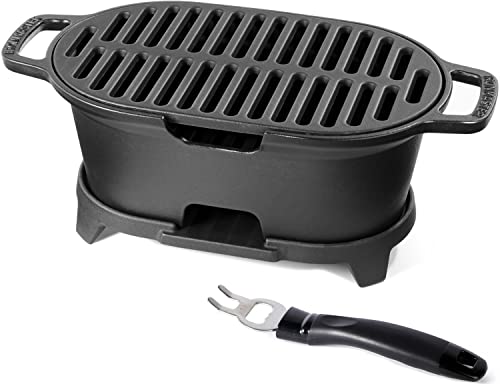
IronMaster Mini Cast Iron Hibachi Grill — Best for Two People
The IronMaster Mini is a 100% cast iron hibachi with an 11 by 6.7 inch grate, sized exactly for two people and the Japanese barbecue style it is named for. It suits couples, solo cooks, and yakitori fans. It does not suit anyone cooking for a family, and its small coal bed needs occasional topping up during long sessions.
Strengths
- Complete cast iron construction at a true tabletop scale
- Grate sized for skewers and small cuts for two
- Lights fast and uses very little charcoal per session
Trade-offs
- Two-person capacity is a hard limit
- Open fire only, no lid techniques
- Small fire fades faster than larger hibachis on long cooks
| Specification | Detail |
|---|---|
| Construction | 100% cast iron per verified listing title |
| Grate surface | 11 x 6.7 inches per verified listing title |
| Capacity | Ideal for 2 people per verified listing title |
The IronMaster understands its assignment completely. Two people, a table, a small fierce fire, and food cooked in the order it will be eaten — skewers first, then chops, then vegetables in the rendered fat. The iron mass makes the small fire behave like a bigger one, holding searing heat steady between batches instead of dying while you prep the next round.
For apartment balconies where charcoal is permitted, campsite tables, and picnic blankets, it is close to the perfect object: quick to light, quick to cool, and small enough to live in a cupboard. Buy it for two-person rituals and it will be used constantly.
Best for: couples and solo cooks wanting an authentic two-person hibachi / Not suited for: families or anyone cooking in volume
Check the current price on Amazon

IRONMAX Hibachi Grill with Coal Door — Best Air Control in a Mini
This IRONMAX model adds the two doors a mini hibachi usually lacks — a coal door for adding fuel and a draft door for air — to a 100% cast iron yakitori-format grill for two. It suits detail-oriented cooks who want to manage a small fire precisely through a long session. It does not suit cooks who want set-and-forget cooking, because a hibachi is attended cooking by definition.
Strengths
- Coal door lets you refuel without lifting the grate
- Draft door meters air for real temperature management
- Full cast iron construction in the yakitori format
Trade-offs
- Two-person scale only
- Doors and hinges are parts to keep clean and free-moving
- Open design excludes roasting and smoking
| Specification | Detail |
|---|---|
| Construction | 100% cast iron per verified listing title |
| Features | Coal door and draft door per verified listing title |
| Style | Mini Japanese yakitori tabletop per verified listing title |
| Capacity | Ideal for 2 people per verified listing title |
Refueling is the mini hibachi’s awkward moment — the grate is full of food exactly when the fire needs coal. The coal door abolishes that moment, and the draft door gives the cook a thermostat of sorts: open for searing heat, nearly closed to stretch the fire through a slow course of vegetables. Together they make this the most controllable of the true minis.
It rewards the cook who treats hibachi as a session rather than a task: courses arriving over an hour, the fire adjusted like a conversation. If that is your idea of a good evening, this is your hibachi.
Best for: attentive cooks who want precise control of a two-person hibachi / Not suited for: cooks wanting capacity or hands-off cooking
Check the current price on Amazon

IRONMAX Mini Hibachi Grill (11 x 6.7) — Best Compact Skillet-Style
The second IRONMAX takes a skillet-grill approach: a 100% cast iron mini hibachi whose cooking surface behaves partly like a skillet, for two people at a table. It suits campers and couples who cook small pieces — diced meats, vegetables, seafood — that would challenge an open grate. It does not suit cooks who want classic wide-open grate grilling for large cuts.
Strengths
- Skillet-style surface keeps small pieces and juices where they belong
- Full cast iron build holds heat for steady small-batch cooking
- Compact 11 by 6.7 inch footprint travels anywhere
Trade-offs
- Skillet character means less open-flame char than a bar grate
- Two-person capacity
- Bare iron care in full
| Specification | Detail |
|---|---|
| Construction | 100% cast iron per verified listing title |
| Grate | 11 x 6.7 inches per verified listing title |
| Capacity | For 2 people per verified listing title |
| Style | Tabletop cast iron skillet grill per verified listing title |
Not every hibachi meal is skewers. Cubed steak, garlic shrimp, mushrooms, and peppers-onions all cook better on a surface that catches juices instead of donating them to the fire, and this mini’s skillet-style top is built for exactly that menu. The iron holds a steady sear while the surface keeps the food’s own moisture in play — a different, delicious dialect of hibachi cooking.
Choose it when your tabletop cooking leans toward stir-fry-adjacent grilling and small shared plates. Choose a bar-grate model when char lines and open flame are the point. Both are hibachis; they simply speak to different menus.
Best for: campers and couples cooking small pieces and shared plates / Not suited for: purists wanting open-bar grate char
Check the current price on Amazon

Sungmor Compact Cast Iron Charcoal Grill — Best with Adjustable Grate
The Sungmor stretches the mini format slightly — 12 by 7 inches for one to three people — and adds the two features tabletop cooks ask for: an adjustable-height grate and wooden handles that let you move a hot iron grill. It suits balcony and campsite cooks who want heat control through distance. It does not suit family cooking, and the wooden handles deserve protection from direct flame.
Strengths
- Adjustable grate height is precise, immediate heat control
- Wooden handles make repositioning a hot grill practical
- Slightly larger surface stretches to three light eaters
Trade-offs
- Still a small grill with batch limits
- Handles and hardware need protection from flare-ups
- Full bare-iron care routine
| Specification | Detail |
|---|---|
| Size | 12 x 7 inches per verified listing title |
| Capacity | For 1–3 people per verified listing title |
| Handles | Wooden per verified listing title |
| Grate | Adjustable per verified listing title |
Grate height is the oldest thermostat in grilling, and on a small hibachi it is remarkably precise: drop the grate for a hard sear on a chop, raise it to gentle the heat under vegetables or to hold finished skewers warm at the edge of the fire’s reach. The Sungmor builds its whole design around that one good idea and executes it in full cast iron.
The wooden handles complete the tabletop logic — a grill this size gets moved: from wind, toward the cook, off the table at evening’s end while still warm. Handles that stay holdable make that normal instead of hazardous. For one to three people, it is the most adaptable mini here.
Best for: balcony and campsite cooks wanting adjustable-grate control for one to three people / Not suited for: families or lid-dependent cooks
Check the current price on Amazon
Comparison Table
| Pick | Badge | Key spec | Best for |
|---|---|---|---|
| Lodge Sportsman’s Pro Cast Iron Grill Check on Amazon | Best Overall | 9 x 16.75 inches per verified listing title | couples and small groups wanting hibachi cooking at meal scale |
| Giantex Portable Hibachi Grill Check on Amazon | Best Classic Hibachi | Cast iron per verified listing title | picnickers, campers, and traditionalists who want real fire controls |
| IronMaster Mini Cast Iron Hibachi Grill Check on Amazon | Best for Two People | 100% cast iron per verified listing title | couples and solo cooks wanting an authentic two-person hibachi |
| IRONMAX Hibachi Grill with Coal Door Check on Amazon | Best Air Control in a Mini | 100% cast iron per verified listing title | attentive cooks who want precise control of a two-person hibachi |
| IRONMAX Mini Hibachi Grill (11 x 6.7) Check on Amazon | Best Compact Skillet-Style | 100% cast iron per verified listing title | campers and couples cooking small pieces and shared plates |
| Sungmor Compact Cast Iron Charcoal Grill Check on Amazon | Best with Adjustable Grate | 12 x 7 inches per verified listing title | balcony and campsite cooks wanting adjustable-grate control for one to three people |
How to Choose the Best Cast Iron Hibachi Grills for Your Table
Begin with headcount, because hibachi sizing is unforgiving. The true minis in this guide cook for two. The Sungmor stretches to three light eaters. Only the Lodge Sportsman’s Pro cooks a full meal for three to four at once. Hibachi cooking is naturally coursed — food arrives in batches as it finishes — so a two-person hibachi can serve three patient people happily, but it cannot serve six hungry ones at all. Buy for the table you actually set.
Next, choose your control style. Air doors and draft doors, as on the Giantex and the IRONMAX coal-door model, manage heat at the fire. Adjustable grates, as on the Sungmor, manage heat at the food. Vents on the Lodge manage a larger fire across a larger surface. All three systems work; the question is which motion you want your hands to learn. Cooks who like tending fires choose doors; cooks who like moving food choose grate height.
Finally, consider where the hibachi will live. These are dense little objects that store beautifully in cupboards and bins, but bare iron must live dry. A hibachi kept seasoned on a kitchen shelf gets used on weeknights; one exiled to a damp garage becomes a restoration project. The best hibachi is the one within reach when the evening turns nice.
How Does Hibachi Cooking Actually Work?
A hibachi concentrates a small charcoal fire under a small grate, and the cooking is direct, fast, and attended. The traditional fuel arrangement is a compact bed of charcoal — binchotan in Japanese practice, quality lump charcoal in most home practice — brought to full ash-over heat. Food cooks inches above it in small pieces: skewers, thin cuts, shell-on shrimp, vegetables cut to cook quickly. The cook turns food frequently, moves it between the fierce center and the gentler edges, and serves in courses.
Because there is no lid, there is no roasting, baking, or smoking — and no apology for it. Hibachi is one technique done completely: radiant, direct grilling. Cast iron’s role is to steady the small fire’s heat at the grate, so the surface stays searing-hot between batches instead of cooling while you load the next skewers. That steadiness is the entire reason iron and hibachi belong together.
What Charcoal and Tools Does a Hibachi Need?
Small grills want small fuel management. Lump charcoal in modest pieces suits hibachis better than oversized chunks, and a small chimney starter lights exactly the amount a hibachi uses — which is little. A session for two may burn a few handfuls of charcoal, making hibachi the most fuel-efficient grilling format in existence. Avoid accelerant-soaked products; in an open grill this close to the cook, off-flavors and fumes have nowhere to hide.
The tool kit is short: long chopsticks or slim tongs for skewers, a small brush, a spray bottle for flare management, and heatproof gloves for grate and door work. Add a stable, heat-safe surface — a hibachi radiates serious heat downward, so wooden tables need a tile, board, or stand rated for the job. That is the complete infrastructure of the format, which is much of its charm.
Hibachi vs. Other Small Grills: What Makes the Format Different?
A hibachi is defined by what it refuses to have: no lid, no legs worth mentioning, no burner, no thermostat. Where a kettle grill encloses its fire and a gas grill mechanizes it, a hibachi presents its fire openly on a table and asks the cook to be the mechanism. That refusal is the format’s identity, and it produces a style of cooking — small pieces, fierce heat, constant attention, food served in courses — that enclosed grills genuinely cannot replicate.
Compared to a portable gas tabletop, a hibachi is slower to start and faster to thrill: the flavor of real charcoal and the theater of an open fire against the gas grill’s push-button calm. Compared to a kettle, it is more intimate and less capable: no roasting, no smoking, no whole birds, but also no twenty-minute wait to cook four skewers. Campers and couples often end up owning both a hibachi and something lidded, and using each for what it is.
Cast iron is what makes the hibachi more than a novelty. A steel hibachi’s thin walls let the small fire’s heat escape sideways; iron walls hold it and aim it upward, and an iron grate stays searing between batches. The material is not traditional decoration — it is the engineering that lets a grill the size of a shoebox cook like it means it.
What Do You Cook on a Hibachi? A Menu That Fits the Fire
Skewers are the native food: yakitori chicken with scallion, beef and pepper, mushrooms brushed with sauce in the final minute so it glazes instead of burning. The hibachi’s fierce, close heat caramelizes small pieces before they can dry, which is the entire technical secret of great skewer cooking. Sauces go on late, salt goes on early, and everything comes off the fire in the order it went on, eaten in the same order.
Beyond skewers, the format flatters anything small, quick, and better for char: shell-on shrimp, scallops, thin pork belly, lamb chops, corn segments, shishito peppers, onion petals, and halloumi or firm tofu for the vegetarians at the table. Breakfast works too — sausage links and a small iron pan of eggs on the grate turn a campsite hibachi into a diner for two.
What stays off the menu: anything thick, bone-in, and impatient. A hibachi can finish a thin chop beautifully and will punish a two-inch steak with a burnt exterior and a raw center unless the cook slices, rests, and manages zones with real skill. Play to the format and every course lands; fight it and dinner becomes a negotiation.
How Do You Care for a Hibachi So It Lasts Decades?
The hibachi care routine is the cast iron routine at its smallest scale, which makes it the easiest to keep: empty the ash when cool, brush the grate, wipe the iron with the thinnest film of oil, store dry. Ninety seconds. The enemies are the usual ones — moisture, old ash holding damp against the iron, and the damp garage corner — and a hibachi’s size makes the defense trivially easy, because it can live on a shelf indoors like the cookware it resembles.
Seasoning builds fast on a hibachi because the cooking is hot, fatty, and frequent. Within a dozen sessions a well-used hibachi grate develops the deep, slick surface that makes food release cleanly, and the firebox interior takes on the seasoned patina that shrugs off ash and weather. Owners who cook weekly watch their hibachi get better monthly, which is a rare and pleasant direction for a possession to travel.
Hardware deserves one annual minute: door hinges, draft slides, and grate-height mechanisms should move freely and get a drop of oil if they stiffen. That minute, plus the ninety-second routine, is the entire maintenance budget of an object that will otherwise happily outlive its owner. Few purchases in outdoor cooking offer that exchange rate.
What Is Binchotan, and Should You Use It?
Binchotan is the traditional Japanese white charcoal: extremely dense, nearly smokeless, and capable of fierce, long-lasting heat with almost no flame. In a hibachi it is the reference fuel — skewers cook over a clean, intense radiance that adds no flavor of its own, which is precisely what yakitori masters want. Its costs are real: it is expensive, harder to light than ordinary lump, and unforgiving of impatience during the lighting process.
Quality lump charcoal is the practical alternative for nearly everyone: it lights easily in a chimney, burns hot and clean enough for excellent hibachi cooking, and costs a fraction as much. The flavor difference is subtle and mostly matters at the highest level of skewer craft. Most home hibachi cooks should master lump first and treat binchotan as an occasional luxury for special sessions.
Whichever fuel you choose, size matters in a small firebox. Break oversized lumps down, keep pieces reasonably uniform so the bed burns evenly, and build the bed in a compact layer rather than a mound — a hibachi’s heat should be a floor, not a campfire. Fuel arrangement is half of hibachi technique, and it is learned in three sessions.
How Do You Set Up a Hibachi Table Safely and Comfortably?
The hibachi table is a small stage and should be set like one. The grill sits centered on a heat-proof base — a tile, a rated stand, or a thick wooden board made for the purpose — with clearance from anything flammable and nothing overhanging above it. Raw food waits on one side, a clean tray for finished food on the other, and the cook’s tools, water spray, and drink within reach, because once the fire is lit the cook does not leave the table.
Seating is part of the setup. Hibachi cooking is slow in the best way — courses over an hour or more — so chairs should be real chairs, the table at a height that lets the cook work seated, and the lighting warm enough to see doneness. Guests sit close; the hibachi is an intimate appliance and the table plan should admit it.
Ventilation is the final, non-negotiable element: outdoors, or a genuinely open-air space, always. A hibachi under a range hood is still a charcoal fire indoors and is never acceptable. Set the stage outside and the format is as safe as it is pleasurable.
What Are the Best First Foods to Learn Hibachi Cooking?
Start with foods that forgive: chicken thigh skewers, which stay juicy through a wide window of doneness; pork belly, which bastes itself; mushrooms and peppers, which announce their readiness visibly; and sausages, which are nearly impossible to ruin over a small fire. These teach the fire’s geography — its fierce center and gentle edges — without punishing the student.
Graduate to the quick and the delicate: shrimp that cook in two minutes and overcook in three, scallops that want a hard sear and a rare center, thin beef skewers that are done almost as they land. By this stage your hands will know the fire, and the timing that looked impossible in session one will feel conversational.
Save the showpieces — whole small fish, thick chops managed by slicing and resting, elaborate glazed skewers — for when the format is in your hands. The hibachi curriculum is short and delicious, and every lesson is dinner. That is the deepest charm of the smallest grill in this guide: mastery is measured in meals, not in equipment.
How Do You Manage a Hibachi Fire Through a Long Session?
A long hibachi session is a fuel story told in three acts. Act one burns a full, fierce bed for the opening courses that want maximum heat. Act two coasts on the same bed as it settles into its steady middle age — the best all-purpose cooking of the evening. Act three asks for a decision: add a small handful of fresh charcoal at the edges and let it catch gently for the final courses, or let the fire decline gracefully through the gentle foods — vegetables, breads, desserts — that suit its fading.
Air is the throttle throughout: draft doors and vents open to push a tiring fire, nearly closed to stretch a strong one. The cook’s error is impatience — adding fuel and air together, then chasing the spike for twenty minutes. One change, then a full minute of observation, is the hibachi rhythm.
Plan the menu to the fire’s biography and the session feels effortless: fierce foods early, gentle foods late, and the cook’s attention free for the table in between. The hibachi is small, but a well-run session on one has the arc of a much larger production.
What Is the Best Hibachi for Camping?
Camping hibachis are chosen on three campsite-specific tests. Transport: the grill must pack without shedding ash or grease, which favors latched or bagged minis and the removable-grate designs that empty completely. Cooling: a hibachi must be stone cold before it enters a vehicle, and small iron cools faster than large — one more argument for the mini formats at walk-in sites. Permission: charcoal is restricted at many campgrounds in dry seasons, so the camping hibachi owner checks rules with the same discipline as the charcoal kettle owner.
At drive-up sites where charcoal is welcome, the Giantex and the Lodge in this guide are the strongest campers — the Giantex for its fire hardware and portability, the Lodge for cooking a real meal for a small group. At picnic-and-go outings, the minis win on sheer carry-ability.
Whichever travels, pack its kit with it: a small bag of lump charcoal measured to the trip, a chimney or starter, tongs, and a metal tin for the fully cooled ash you pack out. Leave-no-trace applies to hibachis exactly as to fires, and the little grill’s ash is little — but it is still yours to carry home.
How Do You Choose Between Two Hibachis at the Same Size?
When dimensions and iron are equal, the decision moves to the fire hardware and the details of daily use. Compare the air path: doors and drafts that move smoothly and seal reasonably will control the fire better than decorative vents. Compare the grate: bar spacing that suits your food, a surface that lifts out easily, and — on double-sided designs — two genuinely different faces rather than a gimmick. Compare the feet and base: a hibachi sits on tables, and stable, heat-isolating feet protect both the table and the session.
Then weigh the maker’s footprint. Hibachis are simple, but grates crack, handles char, and hardware loosens over years; a maker with a real catalog and a name to protect — Lodge at the top of this guide being the standard — is likelier to support the object in year five. The cheapest hibachi that cannot be re-grated is a rental, not a purchase.
Finally, trust your hands. A hibachi is an attended, tactile tool, and the one whose doors, grate, and weight feel right in your hands at unboxing is the one you will cook on weekly. In a format this personal, ergonomics is not a soft criterion — it is the criterion that decides whether the grill becomes a ritual or a shelf ornament.
One Last Word From the Table
The hibachi asks something modern appliances never ask: your presence. It will not preheat itself, hold a temperature unattended, or finish dinner while you are elsewhere — and in exchange it gives back an hour in which cooking and eating and company are the same activity, around a small iron box of fire that humans have gathered beside for a very long time. Choose the hibachi in this guide whose size matches your table and whose fire hardware matches your hands, season it by cooking on it weekly, and store it dry on a shelf where evenings can reach it. Years from now it will be blacker, slicker, and better than the day it arrived, which is more than can be said for almost anything else you will buy this year.
How to Cook a Hibachi Session, Course by Course
A hibachi rewards sequencing. Cook in waves from the most delicate food to the richest, let the fire’s natural decline set the menu’s order, and eat as you go — the hibachi table is not a pass-through, it is the dining room.
- Set the hibachi on a stable, heat-safe surface with room for raw and cooked trays on either side. Fill the firebox with a compact layer of lump charcoal.
- Light with a small chimney or starter and wait for full ash-over — hibachi heat should be fierce and clean before food appears.
- Preheat the iron grate over the fire for several minutes, then brush it clean. Season the fire with the first fatty item if you like; many cooks start with chicken skin or a rich skewer.
- Cook in courses: vegetables and seafood that want gentle heat at the edges, skewers and thin cuts over the fierce center, turning frequently with tongs or chopsticks.
- Manage heat as you go — spread coals for less intensity, pile them for more; open draft doors for a surge, close them to stretch the fire; raise adjustable grates to gentle the cooking.
- Serve each course as it finishes. Hibachi food waits for no one, and eating in courses is the format’s pleasure, not its compromise.
- When the session ends, let the coals burn out or close all air paths and let the grill cool completely. Brush the grate, wipe the iron with a thin film of oil, and store it dry.
Keep a small notebook if you cook hibachi often: which foods liked the center, which wanted the edges, how long your coal load lasted. Two or three sessions of notes will make you startlingly good at a format that rewards memory over equipment.
Common Buying Mistakes
Overloading the grate is the first hibachi mistake. A crowded hibachi steams instead of searing, and the format’s whole promise is fierce direct heat on small batches. Cook less at once, more often — the courses are the point.
Using a hibachi on an unprotected wooden table is the second and most dangerous mistake. These grills radiate intense heat downward and shed the occasional coal spark. A rated heat-proof base is not an accessory; it is part of the grill.
Third, expecting lid-cooking from an open grill. Whole chickens, roasts, and smoked anything are not hibachi food, and forcing them produces raw centers and burnt exteriors. Let the hibachi do its one technique completely.
Finally, storing the little iron grill damp or ashy. Hibachis are small enough that rust feels personal, and ash left in the firebox holds moisture against the iron. Empty, brush, oil, and shelf it — ninety seconds that keep it immortal.
Final Recommendation
The Lodge Sportsman’s Pro is the best cast iron hibachi grill for most buyers: the most surface, the best vents, and Lodge’s iron. The Giantex is the classic tabletop with real fire hardware, the IRONMAX pair split the mini vote between door control and skillet style, the IronMaster is the pure two-person original format, and the Sungmor wins on adjustable-grate flexibility.
Check the current price on Amazon for your pick, measure your table while you are at it, and order lump charcoal and a heat-safe base in the same breath. Then invite exactly the right number of people — that number is small, and that is the joy of it.
Start here: Lodge Sportsman’s Pro Cast Iron Grill (Check on Amazon), Giantex Portable Hibachi Grill (Check on Amazon), Sungmor Compact Cast Iron Charcoal Grill (Check on Amazon).
Best Cast Iron Grills Best Cast Iron Charcoal Grills Best Cast Iron Bbq Grills Best Camping Portable Grills Best Cast Iron Gas Grills
Frequently Asked Questions
How many people can a cast iron hibachi feed?
Most tabletop hibachis cook comfortably for two, serving in courses. Slightly larger models stretch to three, and the Lodge Sportsman’s Pro handles three to four. Hibachis are not group grills; their pleasure is small, attended cooking.
What is the best charcoal for a hibachi?
Quality lump charcoal in modest pieces is the home standard; traditional binchotan burns hotter and cleaner at a premium. Avoid self-lighting charcoal, whose accelerant flavors are obvious in open hibachi cooking.
Can I use a hibachi indoors?
No. Charcoal produces carbon monoxide, so hibachis are outdoor-only, or for use in genuinely open-air spaces. Never use one in a garage, tent, or enclosed balcony.
Why cast iron for a hibachi instead of steel?
Iron holds the small fire’s heat steady at the grate, so batches sear consistently and the surface recovers between rounds. Steel hibachis spike and fade with the fire; iron smooths the ride, which is the whole cooking advantage of the format.
How do I control temperature without a lid or dials?
With air and distance: draft doors and vents feed or starve the fire, coal arrangement creates hot and gentle zones, and adjustable grates move food closer to or farther from the heat. Small adjustments and a minute of patience are the technique.
How do I keep a small cast iron hibachi from rusting?
Empty the ash once cool, brush the grate, wipe bare iron with a thin film of oil, and store it dry indoors. Its small size makes the routine take about a minute — and makes skipping it inexcusable.


