Disclosure: airfryerkitchensupply.com is reader-supported. When you buy through links on our site, we may earn an affiliate commission at no extra cost to you.
Where to buy
Shopping for the best campsite gas grills? Start here. Each grill below links to its verified Amazon listing, where you can check the current price on Amazon and confirm the exact configuration before ordering. Campsite grills sell in waves around spring and holiday weekends, so a model that shows limited stock in peak season is worth ordering ahead of a planned trip rather than on the way to it.
- Weber Traveler Portable Gas Grill (Best Overall): Check on Amazon
- Weber Q 2800N+ Portable Grill (Best for Searing): Check on Amazon
- Coleman RoadTrip 285 Portable Propane Grill (Best for Groups): Check on Amazon
- Weber Traveler Compact Portable Gas Grill (Best Compact Stand Grill): Check on Amazon
- Coleman RoadTrip 225 Portable Tabletop Grill (Best Two-Burner Tabletop): Check on Amazon
- Royal Gourmet GT1001 Stainless Portable Propane Gas Grill (Best Stainless Tabletop): Check on Amazon
The best campsite gas grills are the ones still being used on the fifth trip, not just admired on the first. A campsite is a specific cooking environment — a picnic table or a patch of gravel, a light breeze that never quite stops, no sink, no counter, and a cook who is also the trip’s organizer, navigator, and firewood department. Gas wins at campsites for simple reasons: it lights instantly, it shuts off instantly, it is permitted in many places where open flame is restricted, and it asks almost nothing of a tired cook at the end of a hiking day.
This guide ranks six verified gas grills chosen for campsite duty specifically: stand grills that free you from the picnic table, tabletops that use the table well, and compact models for sites where space is tight. We cover the campsite-specific questions other grill guides skip — wind, grease disposal where there is no sink, cooking for a group on a schedule, and packing a hot grill problem you should never actually have. Every pick was verified through this site’s retailer verification system, and only confirmed models carry links.
In this guide
Quick Picks
- Best Overall: Weber Traveler Portable Gas Grill — best for base campers and families on multi-night stays who cook most meals at the site — Check on Amazon
- Best for Searing: Weber Q 2800N+ Portable Grill — best for food-focused campers cooking for two to four who want real searing heat — Check on Amazon
- Best for Groups: Coleman RoadTrip 285 Portable Propane Grill — best for group campers and event cooks feeding six or more — Check on Amazon
- Best Compact Stand Grill: Weber Traveler Compact Portable Gas Grill — best for couples and small families wanting a compact standing grill — Check on Amazon
- Best Two-Burner Tabletop: Coleman RoadTrip 225 Portable Tabletop Grill — best for tabletop campers cooking full dinners for three to five — Check on Amazon
- Best Stainless Tabletop: Royal Gourmet GT1001 Stainless Portable Propane Gas Grill — best for families wanting maximum tabletop capacity and durable stainless construction — Check on Amazon
Short on time? Standing-height campers should compare the Weber Traveler and the Coleman RoadTrip 285. Tabletop campers should compare the Weber Q 2800N+ for searing power, the Coleman RoadTrip 225 for two-zone balance, and the Royal Gourmet GT1001 for stainless capacity. Tight-space campers should start with the Traveler Compact.
How These Picks Were Chosen
Campsite suitability drove this selection. We favored grills that manage their own grease in sealed or removable systems, ignite reliably without matches, and present a stable cooking platform on the surfaces campsites actually provide — tables, gravel pads, and their own folding stands. Grills that needed a level patio to behave, or that left grease handling to improvisation, were ranked down no matter how impressive their specifications looked.
Verification came next. Each model was matched through the retailer verification system used by this site, and the specifications in the mini spec boxes are drawn from the verified listing titles. That discipline matters in this category, where the same grill name can cover several model years with different burners and features; the listing title is the ground truth for what you would actually receive.
Finally, we ranked by campsite workload. A grill cooking one dinner per trip for two people lives an easier life than a grill cooking three meals a day for six, and the ranking gives the top spots to the grills that handle the heavier workload gracefully: more burners, more stable stands, easier cleanup. Lighter-duty picks are labeled as such rather than oversold.
The 6 Best Campsite Gas Grills

Weber Traveler Portable Gas Grill — Best Overall
The Traveler solves the campsite’s oldest annoyance — cooking hunched over a picnic table that is also needed for eating, cards, and everything else. It folds flat, rolls on wheels, then stands up as a full grill with its own prep surface. It suits base campers, families, and anyone staying multiple nights. It does not suit minimalist packers, because its folded package is still substantial.
Strengths
- Its own stand frees the picnic table for dining and camp life
- Wheeled folding transport makes site-to-site moves effortless
- Fifteen-burger capacity per the verified listing feeds a family in one batch
Trade-offs
- Takes meaningful trunk space even folded
- Heavier than tabletops, so it lives in the vehicle, not on a shelf you grab casually
- The folding mechanism needs occasional cleaning to stay smooth
| Specification | Detail |
|---|---|
| Format | Folding portable grill with wheels per verified listing title |
| Capacity | Fits 15 burgers per verified listing title |
| Fuel | Propane |
Multi-night camps are where the Traveler pulls away from tabletops. Breakfast, lunch, and dinner at standing height, with a side table holding trays and tongs, turns camp cooking from a crouched chore into the social center of the site. Other campers gather around a standing grill; they step around a tabletop. If your campsite style is a base camp you return to each evening, that difference compounds over a trip.
Performance matches the format. The grill preheats quickly, the lid handles family-sized loads, and the whole unit packs with a tidiness that makes departure morning faster. It is the campsite pick we would hand to a friend without a list of caveats.
Best for: base campers and families on multi-night stays who cook most meals at the site / Not suited for: solo campers and small-car packers minimizing bulk
Check the current price on Amazon

Weber Q 2800N+ Portable Grill — Best for Searing
The Q 2800N+ is the tabletop for campers who refuse to lower their cooking standards outdoors: a verified temperature range running to 700 degrees means genuine steakhouse searing at a campsite. It suits smaller groups who cook seriously — steaks, chops, and vegetables that need real heat. It does not suit campers feeding a crowd from one grate.
Strengths
- Verified 250 to 700 degree range covers low roasting through hard searing
- Weber Q-series build quality in a campsite-sized package
- Wide range makes it the most flexible single grill here for mixed menus
Trade-offs
- Premium tabletop size still batches for groups
- Tabletop format needs a suitable table and heat protection
- Serious heat uses fuel faster on long cooks
| Specification | Detail |
|---|---|
| Temperature range | 250–700°F per verified listing title |
| Fuel | Propane |
| Format | Portable tabletop |
Most portable grills top out at temperatures that brown food politely. The Q 2800N+ goes meaningfully further, and the difference is visible on the plate: crust on a steak, blister on peppers, char on corn. For campers whose trips are partly about the food — the trailhead steak dinner is a genre unto itself — this is the pick that protects that ritual.
The low end of its range matters too. Holding the mid-200s lets you roast a small chicken or finish thick cuts gently with the lid down, which most single-dial tabletops do clumsily. One grill that can sear at 700 and settle at 250 covers nearly the whole campsite menu for two to four people.
Best for: food-focused campers cooking for two to four who want real searing heat / Not suited for: large groups needing maximum grate area
Check the current price on Amazon
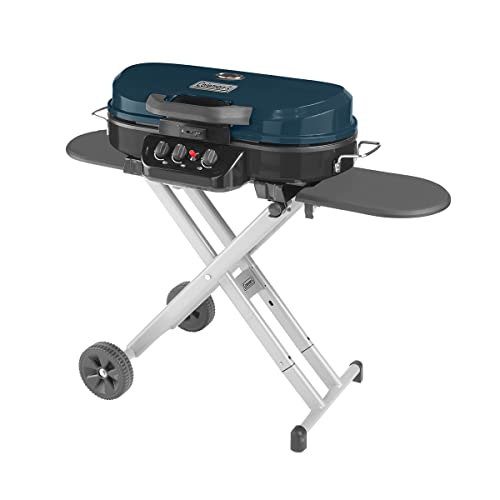
Coleman RoadTrip 285 Portable Propane Grill — Best for Groups
When the campsite headcount climbs, the RoadTrip 285 is the gas grill that keeps the cook sane: three burners, the strongest verified output in this guide, and a folding stand. It suits group camps, reunion weekends, and scout trips. It does not suit anyone traveling light, and couples will find it more grill than their trips need.
Strengths
- Three burners create hot, medium, and holding zones for crowd flow
- 20,000 BTUs preheats fast and recovers heat between batches
- Stand format keeps big cooking sessions at standing height
Trade-offs
- Largest packed size in this roundup
- More burners and surfaces to clean after group meals
- Fuel consumption rises with three burners running
| Specification | Detail |
|---|---|
| Burner output | 20,000 BTUs per verified listing title |
| Burners | 3 |
| Ignition | Instastart per verified listing title |
Group campsite cooking fails in the queue, not in the cooking: people wait, food cools, the cook frays. The 285 attacks the queue with zones. Finished food holds warm on the low burner while the next batch sears on the high one, so the whole group eats together. That single capability is worth more at a group site than any specification on the box.
Its stand and folding design keep that capability campsite-practical. It arrives as one rolling package, sets up without tools, and its grease management is designed for exactly the no-sink cleanup a campground imposes. For the designated cook of a big group, this is the kindest pick here.
Best for: group campers and event cooks feeding six or more / Not suited for: couples and solo campers
Check the current price on Amazon
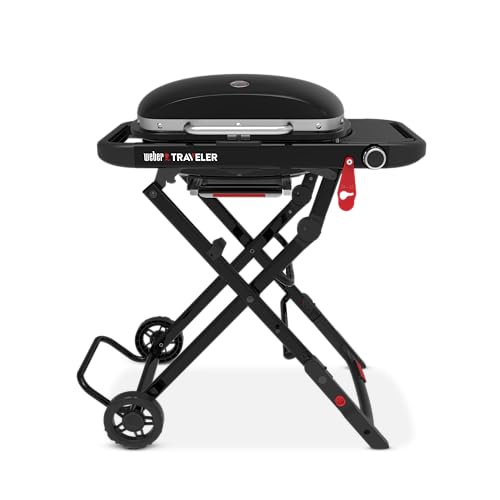
Weber Traveler Compact Portable Gas Grill — Best Compact Stand Grill
The Traveler Compact takes the standing-grill idea and shrinks the commitment: the same fold-and-roll logic in a smaller package for smaller groups and smaller vehicles. It suits couples and small families who want standing-height cooking without the full-size footprint. It does not suit big groups, whose batches will outgrow its grate.
Strengths
- Standing-height cooking in a compact folded package
- Wheels and easy open-close design keep setup to seconds
- Frees the picnic table like its larger sibling
Trade-offs
- Smaller grate batches for groups of five or more
- Still a stand grill, so it packs larger than any tabletop
- Best suited to vehicle-based camping rather than carry-in sites
| Specification | Detail |
|---|---|
| Format | Folding portable grill with wheels per verified listing title |
| Fuel | Propane |
| Design | Easy open and close per verified listing title |
Many couples camp in vehicles that cannot spare the full Traveler’s folded space, and many campsite tables are already crowded with gear. The Compact threads that needle: real stand, real wheels, real lid height, in a package that leaves room for the rest of the trip. For two to four people it cooks complete meals without the choreography tabletops demand.
It also shines at non-camping campsites: festival grounds, race weekends, and park pavilions where a standing grill that rolls in and out cleanly is the difference between cooking and catering to logistics. If your trips are frequent and your groups are small, this may be the sweet spot of the entire guide.
Best for: couples and small families wanting a compact standing grill / Not suited for: group cooks and campers wanting maximum grate size
Check the current price on Amazon
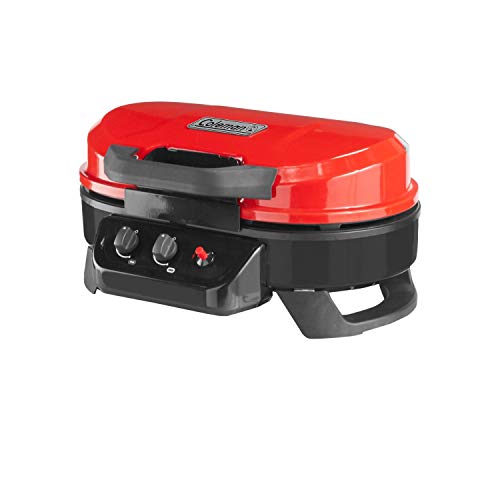
Coleman RoadTrip 225 Portable Tabletop Grill — Best Two-Burner Tabletop
The RoadTrip 225 is the balanced tabletop: two burners for two-zone cooking, a removable water pan for grease, and a size that still respects a trunk. It suits campsite cooks who use the picnic table and cook full dinners for three to five. It does not suit campers who need standing height or maximum searing power.
Strengths
- Two burners allow a sear zone and a gentle zone on a tabletop
- Removable water pan simplifies the no-sink grease problem
- Instastart ignition is dependable in campsite conditions
Trade-offs
- Output split across two burners means moderate peak heat per zone
- Tabletop use competes for the picnic table
- More cleanup parts than a single-burner grill
| Specification | Detail |
|---|---|
| Burner output | 11,000 BTUs total per verified listing title |
| Burners | 2 |
| Ignition | Instastart push-button per verified listing title |
Two-zone cooking is the campsite skill that separates adequate dinners from good ones, and the 225 is the most accessible way to get it in a tabletop. Chicken sears over one burner and finishes over the other without burning; vegetables hold while steaks rest. Once a cook has zones, going back to one feels like cooking with one hand.
The water pan deserves specific praise at campsites. Grease drips into water instead of a dry tray, which reduces flare and smoke, and at cleanup you dump and rinse rather than scraping congealed fat by lantern light. It is a small design decision that removes the worst minute of every campsite grill session.
Best for: tabletop campers cooking full dinners for three to five / Not suited for: campers wanting standing height or hard searing
Check the current price on Amazon

Royal Gourmet GT1001 Stainless Portable Propane Gas Grill — Best Stainless Tabletop
The GT1001 is the capacity pick among tabletops: stainless construction, folding legs, a lockable lid, and the largest verified cooking area in this guide’s tabletop class. It suits families at drive-up sites who cook one big batch per meal. It does not suit campers who need two heat zones, because one burner does all the work.
Strengths
- 285 square inches cooks a family batch in a single round
- Stainless body tolerates campsite weather and wipes clean
- Lockable lid and folding legs make transport tidy
Trade-offs
- Single burner across a wide grate means managing hot-center cooking
- Wide footprint needs a full-size table
- Stainless finish shows grease visibly between cleans
| Specification | Detail |
|---|---|
| Cooking area | 285 sq. in. |
| Burner output | 10,000 BTU |
| Body | Stainless steel |
| Lid | Lockable per verified listing title |
The GT1001’s cooking style is the wide single batch: a full load of burgers, a family’s worth of chicken thighs arranged by thickness, a grate covered in vegetables. The center runs hottest, so experienced users rotate food through zones they create by placement. It is a technique, not a flaw, and cooks who learn it get family-scale output from a trunk-friendly grill.
Stainless construction is the long-game argument. Campsite grills live in garages, get rained on at sites, and ride in trunks with wet gear; a stainless body shrugs off that life better than painted steel. For a family that camps monthly, durability across seasons is the feature that matters most after the first summer.
Best for: families wanting maximum tabletop capacity and durable stainless construction / Not suited for: cooks who want two independent heat zones
Check the current price on Amazon
Comparison Table
| Pick | Badge | Key spec | Best for |
|---|---|---|---|
| Weber Traveler Portable Gas Grill Check on Amazon | Best Overall | Folding portable grill with wheels per verified listing title | base campers and families on multi-night stays who cook most meals at the site |
| Weber Q 2800N+ Portable Grill Check on Amazon | Best for Searing | 250–700°F per verified listing title | food-focused campers cooking for two to four who want real searing heat |
| Coleman RoadTrip 285 Portable Propane Grill Check on Amazon | Best for Groups | 20,000 BTUs per verified listing title | group campers and event cooks feeding six or more |
| Weber Traveler Compact Portable Gas Grill Check on Amazon | Best Compact Stand Grill | Folding portable grill with wheels per verified listing title | couples and small families wanting a compact standing grill |
| Coleman RoadTrip 225 Portable Tabletop Grill Check on Amazon | Best Two-Burner Tabletop | 11,000 BTUs total per verified listing title | tabletop campers cooking full dinners for three to five |
| Royal Gourmet GT1001 Stainless Portable Propane Gas Grill Check on Amazon | Best Stainless Tabletop | 285 sq. in. | families wanting maximum tabletop capacity and durable stainless construction |
How to Choose the Best Campsite Gas Grills for Your Site and Group
Start with the site, not the grill. Drive-up sites with big tables suit tabletops; sites where the table is small, splintered, or reserved for dining suit stand grills. Walk-in sites, even short ones, punish stand grills and reward compact tabletops. If you mostly book the same kind of campground, the choice makes itself. If you roam, the folding stand format is the most forgiving across unknown sites, provided your vehicle can carry it.
Match burner count to your cooking pattern across a whole trip. One dinner of burgers per trip needs one burner. Three meals a day with mixed menus needs two zones minimum, and group trips need the throughput of three burners or a very disciplined batch plan. Be honest about breakfast: campsites where the grill cooks breakfast daily should prioritize griddle compatibility or wide, even heat, because pancakes forgive nothing.
Think about the last cook of the trip as much as the first. You will pack this grill, possibly in the rain, possibly in a hurry, with whatever grease the week produced inside it. Sealed grease systems, lockable lids, and folding designs that trap nothing loose are what separate a grill that ends trips gracefully from one that ends them with a stained trunk.
How Do You Handle Grease and Cleanup Where There Is No Sink?
Campground cleanup runs on a simple kit: paper towels, a spray bottle of water, a stiff brush, and a trash bag. The routine that works is to brush the grate while it is still warm, let the grill cool, then wipe surfaces and empty the grease system into the trash — never onto the ground, where grease attracts animals and violates leave-no-trace practice. Grills with removable pans, like the RoadTrip designs in this guide, turn that routine into minutes.
Plan grease disposal before the first cook. Know where the campground’s trash and dump facilities are, carry small bags for greasy towels, and keep a lidded container in the car for the trip home if facilities are limited. The cooks who enjoy campsite grilling for years are the ones who solved disposal once and stopped thinking about it.
What About Wind, Weather, and Fire Rules at Campsites?
Wind steals heat from every portable grill and punishes low burners most. Cook with the lid down, position the grill so wind strikes the back of the lid, and use the vehicle or a windbreak as shelter without ever crowding the grill against fabric or fuel. In sustained wind, expect longer cook times and favor thicker cuts that tolerate them over thin foods that go from raw to ruined in a gusty minute.
Gas grills enjoy the widest permission of any camp cooking method because the fuel shuts off instantly, and many fire-restriction stages that ban charcoal still allow gas appliances. But rules are local and seasonal, and extreme conditions can restrict everything. Check the managing agency’s current rules for your destination before every trip, and treat a gas grill as the most likely-to-be-allowed option rather than a guaranteed one.
How Do You Plan a Whole Weekend of Campsite Grill Meals?
Plan the grill’s weekend as a declining-heat story. Night one, when the grill is cleanest and the cook freshest, is the night for the ambitious cook: steaks, chops, the good marinade. Day two runs on versatility — burgers and chicken, foil-pack vegetables, a griddle breakfast if your grill supports it. The final meal before pack-out should be the simplest, because it shares the morning with breaking camp: sausages, leftovers reheated in foil, coffee on the stove while the grill cools for the drive.
Shop for the grill, not against it. Choose proteins that cook at similar thicknesses so batches finish together, buy vegetables that grill in their own packaging — corn in husks, peppers whole, onions in foil — and bring one sauce that works on everything rather than four that each work on one thing. A campsite grill rewards a tight menu executed calmly far more than an ambitious menu executed in panic.
Prep at home is the professional move. Marinades in bags, vegetables washed and portioned, cheese sliced, buns counted — every minute of home prep is a minute of campsite leisure, and it reduces the packaging waste you must pack out. The grill does the glamorous ten percent of camp cooking; the cooler and the prep bags do the rest, and a well-planned weekend makes the grill look brilliant.
What Size Propane Setup Does a Campsite Grill Need?
The one-pound cylinder is the campsite standard: light, universal, and sold everywhere from campground stores to gas stations. For a tabletop cooking a dinner or two, one cylinder is a weekend. For a stand grill cooking three meals a day for a group, plan on several, and weigh the honest alternative — an adapter hose to a refillable five- or twenty-pound tank, which cuts fuel cost dramatically and eliminates the small-cylinder waste stream entirely.
The tank route suits base camps and long stays: the tank lives beside the grill for the duration, the hose removes the per-meal cylinder ritual, and the grill runs for days. Its costs are transport bulk and one more thing to secure in the vehicle. Many experienced campsite cooks run both systems — cylinders for short trips, tank and hose for the annual week-long stay — because the grills in this guide accept either with the right hose.
Whatever you run, build the fuel check into your departure routine: cylinders counted, tank weighed or checked, spare confirmed. Fuel is the cheapest insurance in camp cooking and the most commonly forgotten, usually discovered missing at the exact moment the first dinner depends on it.
How Do Campsite Grills Handle Breakfast, Really?
Breakfast is the campsite grill’s hardest exam because the menu — eggs, pancakes, bacon — was designed for a flat top, not a grate. The honest answers are threefold. First, some grills in this category offer griddle surfaces or accessories, and for breakfast-heavy campers that feature should weigh heavily in the choice. Second, a cast iron skillet or griddle plate set on the grate converts any of these grills into a breakfast station, at the cost of one more item to pack and wash. Third, grate-friendly breakfasts exist and are excellent: sausage pattles, breakfast sandwiches assembled on toasted buns, foil-pack hash, and skewered breakfast kebabs.
Heat management is the skill that makes campsite breakfast work. Grills heat unevenly compared to a kitchen range, so preheat longer, find the calm zones, and cook eggs and pancakes on the gentlest area while bacon and sausage take the fierce spots. A cook who maps the grill’s heat during the first morning will cook the second morning like a professional.
And keep perspective: campsite breakfast standards are gloriously forgiving. Coffee tastes better outdoors, bacon tastes better outdoors, and slightly uneven pancakes eaten at a picnic table beat perfect ones eaten over a sink. The grill’s job at breakfast is participation, not perfection.
How Do You Cook Safely Around Kids and Dogs at a Campsite?
A campsite grill is a hot object in a shared, informal space, and the safety system is mostly placement. Set the grill outside the walking lines between tents, tables, and the cooler; give it a clear zone that children are taught to treat like a road; and keep the cook’s tools and raw food on the grill side of that line so nobody crosses it mid-service. Stand grills help by presenting an obvious, adult-height appliance rather than a tempting tabletop at toddler eye level.
Dogs require the simpler discipline of never leaving food or a greasy grill unattended. A latched, cooling grill with its grease emptied is uninteresting to animals; an open grill with resting burgers is a negotiation you will lose. Build the cleanup into the meal’s end rather than after dessert, when attention has wandered.
Burns at campsites are treated far from help, which argues for boring prevention: gloves for grate work, long tools, a headlamp so the cook can see at dusk, and a rule that the grill area is a one-cook space during service. None of this diminishes the fun; it protects it.
What Is the Best Campsite Grill for Long Stays?
A week at one site changes the grill’s job description. Throughput matters less than stamina: grease systems that do not fill in two days, ignition that never becomes a ritual, and a cooking surface that can be genuinely cleaned mid-stay rather than merely brushed. The stand picks in this guide — the Traveler and the RoadTrip 285 — suit long stays best because their size includes the margins long stays consume.
Fuel strategy becomes the other long-stay decision, and the answer is usually a refillable tank on an adapter hose. A week of three-meal days on disposable cylinders is a bag of empties and a mid-stay shopping trip; a tank is a single setup on arrival day. Long-stay campers also benefit from a real mid-week clean — grates out, grease path cleared — which resets the grill to day-one behavior.
Shade and shelter complete the long-stay station. A grill that lives under a canopy or awning edge (with safe clearance) cooks through passing showers and stays cleaner, and the cook stays with it. Set the station once, properly, and a long stay feels like a kitchen; improvise daily and it feels like a chore with scenery.
How Do Campsite Grills Compare With Camp Stoves?
They are complements pretending to be rivals. A camp stove boils, simmers, and sauciers with precision; a grill sears, chars, and smokes lightly with flavor. Trips that bring only a stove eat well but miss the grill marks; trips that bring only a grill drink their coffee cold and their pasta never happens. The mature campsite kitchen runs both, sized to the group: the grill as the protein and vegetable station, the stove as everything with a liquid in it.
Space forces a choice for some campers, and the deciding question is the menu’s center of gravity. Grill-led menus — meats, vegetables, breads, foil packs — justify the grill alone, with a kettle on the grate for coffee water in a pinch. Stove-led menus — pasta, soups, sauces, big breakfasts — justify the stove, with a grill basket over a fire ring for occasional char. Honest menus make honest packing lists.
Budget follows the same logic. A household building a camp kitchen from zero usually gets more meals from a good stove first and adds the grill second, which is precisely why this guide’s tabletop picks — modest in price and size — are the natural second purchase. The campsite gas grill is rarely the first tool bought and frequently the one that makes camp cooking feel finished.
How Do You Troubleshoot a Gas Grill That Will Not Light at Camp?
Work the chain in order: fuel, flow, spark, flame. Confirm the cylinder has fuel and is fully connected, and that the tank valve is open. Many modern regulators have a safety flow limiter that trips when valves open too fast — the fix is to close everything, disconnect, wait a minute, reconnect, and open the cylinder valve slowly before lighting. This single reset solves a surprising share of campsite no-light mysteries.
If fuel flows but nothing sparks, check the igniter: a click with no spark suggests a fouled or misaligned electrode, often cured by drying and gently cleaning the tip; no click suggests the button or battery where fitted. A long lighter or match through the lighting hole is the legitimate field backup — every grill kit should carry one for exactly this evening.
If it lights but burns weakly or unevenly, suspect spider webs or debris in the burner tubes — a classic after storage — and low fuel. Clean what you safely can, swap the cylinder, and cook simply that night; do the full burner service at home. Field troubleshooting ends at cleaning and swapping; disassembly belongs to the garage, not the picnic table.
How Do You Grill in the Rain at a Campsite?
Rain cooking is a shelter problem before it is a grill problem. A canopy or pavilion with generous clearance above the grill — never a tent awning, never a tarp at head height over the flame — keeps the cook and the food functional while the grill does its ordinary work. Gas grills tolerate rain on their lids without complaint; it is the cook, the trays, and the serving line that need the roof.
Adjust the menu to the weather. Foods that cook with the lid down and forgive timing — sausages, chicken pieces, foil packs, corn — thrive in rain sessions. Foods demanding constant open-lid attention suffer, and the cook suffers with them. A rainy-night menu planned around the lid is not a compromise; it is often the coziest meal of the trip.
After a wet cook, dry the grill before it sleeps. Wipe the exterior, run the burners for two minutes to drive moisture from the firebox, and latch the lid only once things are dry to the touch. Rain itself harms no grill in this guide; being stored wet afterward is the entire risk.
What Is the Best Way to Organize a Campsite Cooking Kit?
Build the kit around the grill’s actual routine: ignition, cooking, cleaning, storage. Ignition means a long lighter and a spare cylinder check. Cooking means tongs, a spatula, a brush, an instant-read thermometer, foil, and oil in a leak-proof bottle. Cleaning means paper towels, a spray bottle, trash bags, and gloves for the grease work. Storage means the heat mat rolled, the kit bagged, and everything returning to one bin that lives with the grill.
The bin system is the real advice. A single lidded bin that holds the grill’s whole supporting cast turns packing from a scavenger hunt into a grab, and unpacking at the site into a five-minute station build. Campers with a bin system cook more, because the activation energy of a grill night drops to nearly zero.
Audit the bin twice a year: replace the brush before it sheds, refresh the towels and bags, confirm the thermometer battery, and retire anything that has not earned its space in two seasons. A lean kit that is always ready beats a comprehensive kit that is always almost ready.
How Do You Read a Campsite Grill Listing Before You Buy?
Read the listing the way an inspector reads a house: structure first, cosmetics last. The structure of a campsite grill is its transport system — how it folds, latches, rolls, or packs — and its grease system, because those two decide every trip’s beginning and end. Burners, output, and cooking area come second; they decide the cooking, which matters greatly but only after the grill has survived being a piece of luggage.
Then read for the absences. A listing that never mentions how the grill packs is telling you it does not pack well. A listing silent on grease management has a tray you will discover the hard way. The verified titles used throughout this guide are a good model of what honest information looks like: format, fuel, ignition, and the features the maker is proud of, stated plainly.
Finally, picture the grill at your actual campsite, on your actual table or pad, in your actual vehicle. That ten-second visualization, done honestly, prevents more regret than any comparison chart — because campsite grilling is a physical routine before it is a culinary one, and the right grill is the one your routine welcomes.
How to Run a Campsite Grill Station From Arrival to Pack-Out
A repeatable station routine turns campsite grilling into the easiest meal of the trip. Set it up the same way every time and the whole group learns the system.
- On arrival, choose the grill spot first: level, away from tents and overhangs, out of foot traffic, with room for a tray and tongs beside the grill.
- Set up the grill before the rest of camp if dinner is near; a cold grill discovered at dusk is a morale problem, not a cooking problem.
- Connect fuel hand-tight, check for leaks by smell and sound, and do a two-minute test burn to confirm ignition and flame before food depends on it.
- Cook with the lid down in planned waves: high-heat items first while the grate is hottest, holding finished food on the low zone or a covered tray.
- Keep raw and cooked food on separate trays, and keep the cook’s tools in one place so nothing migrates to the dining table mid-service.
- After the meal, run the grill hot for a few minutes, brush the grate, and let it cool while the group eats dessert.
- Before bed, empty grease into the trash, wipe surfaces, and secure the grill against curious animals. Never leave a greasy grill open overnight.
- On departure, confirm the grill is cold, fuel is disconnected, and the lid is latched before it goes into the vehicle.
The station idea extends to a small kit: brush, tongs, spatula, spray bottle, paper towels, trash bags, and a headlamp for the cook. Packed as one bag, it makes any of the grills in this guide perform like a system instead of an appliance.
Common Buying Mistakes
Cooking every meal on the grill is a subtle campsite mistake. Grills are wonderful for dinners and strong at breakfast with the right surface, but a trip where every meal depends on one appliance makes that appliance a single point of failure. Carry a simple backup — a camp stove or no-cook meals — so a clogged regulator never becomes a hungry group.
Leaving grease for the morning is the second mistake. Overnight grease attracts animals, hardens into a scraping job, and perfumes the site. The five-minute evening cleanup in the steps above is the cheapest insurance in camp cooking.
Third, campers underestimate fuel on multi-night trips. Three meals a day on a stand grill consumes cylinders faster than weekend intuition suggests. Count planned grill-hours, carry a spare cylinder, and consider a tank adapter for long stays.
Finally, do not set a tabletop grill directly on a wooden table without protection and attention. Low tabletops radiate serious heat downward. A heat mat is a small, light purchase that protects both the table and your deposit at rental cabins and pavilions.
Final Recommendation
For most campsite cooks, the Weber Traveler is the complete answer: standing height, easy transport, family capacity. Serious searing points to the Q 2800N+, groups to the RoadTrip 285, compact standing cooking to the Traveler Compact, and tabletop cooks to the RoadTrip 225 for zones or the Royal Gourmet GT1001 for stainless capacity.
Check the current price on Amazon for your pick, confirm its packed size against your vehicle, and then think about the trip after this one. The best campsite gas grill is the one whose routine you will still be happy to perform on a rainy Sunday pack-out, months from now.
Start here: Weber Traveler Portable Gas Grill (Check on Amazon), Coleman RoadTrip 285 Portable Propane Grill (Check on Amazon), Coleman RoadTrip 225 Portable Tabletop Grill (Check on Amazon).
Best Camping Portable Grills Best Camping Grills Under $100 Gas Best Cast Iron Gas Grills Best Campsite Gas Grills Best Cast Iron Grills
Frequently Asked Questions
Are gas grills allowed at most campsites?
Gas grills are the most widely allowed cooking appliance at campsites because the fuel shuts off instantly. Many fire-restriction stages still permit them when charcoal is banned, but rules are local and change with conditions, so verify for each destination and season.
Stand grill or tabletop: which is better at a campsite?
Stand grills free the picnic table and cook at a comfortable height but pack larger. Tabletops pack smaller and use the table you already have. Base campers and families usually prefer stands; compact packers and short stays usually prefer tabletops.
How much propane does a campsite grill use on a weekend?
A tabletop cooking dinners for two days may use a single small cylinder, while a stand grill cooking three meals a day for a group can use several. Carry a spare cylinder on every trip and consider a refillable tank adapter for long stays.
Can I leave my grill outside at the campsite overnight?
Yes, once it is cold, cleaned, and latched. Clean it in the evening so grease does not attract animals, close the lid, and disconnect the cylinder if the site is unattended for long periods. In bear country, follow the campground’s food-storage rules for anything with food residue.
What is the easiest campsite grill to clean?
Models with removable grease pans or water pans, like the RoadTrip designs, clean fastest because the greasy part lifts out. Smooth stainless surfaces wipe down easily. The hardest grills to clean at camp are those with fixed, inaccessible grease trays.
Do I need a thermometer on a campsite grill?
A lid thermometer helps with roasting and baking-style cooks, and an instant-read thermometer is the most reliable tool for food safety at camp. For simple direct grilling, timing and touch are enough, but a small instant-read thermometer is worth its tiny pack space on every trip.


