Disclosure: airfryerkitchensupply.com is reader-supported. When you buy through links on our site, we may earn an affiliate commission at no extra cost to you.
Where to buy
The fastest way to buy any of the best camping grills under 100 in this guide is through Amazon, where stock, delivery options and current pricing are shown on each product page. We never print static prices in our guides because campsite-gear pricing moves with seasons and promotions, so use the links below to check price on Amazon before you commit.
- Weber Smokey Joe 14-Inch Portable Charcoal Grill — check price on Amazon
- Cuisinart Grillster Portable Gas Grill (CGG-059A) — check price on Amazon
- Coleman Fold N Go Portable Propane Grill — check price on Amazon
- Megamaster Tabletop 1-Burner Gas Grill — check price on Amazon
- Cuisinart 14-Inch Portable Charcoal Grill (CCG-190RB) — check price on Amazon
- ZipSeven Camping Bushcraft Backpacker Grill — check price on Amazon
The best camping grills under 100 dollars share a secret: at this tier, the winning move is not features — it is choosing the simple design a good maker executes well. The best camping grills under 100 include a miniature Weber kettle with real damper control, a folding Coleman gas grill, two honest compact gas tabletops, a 14-inch charcoal grill with a dual-vent lid, and a stainless fire grate that costs less than the steaks it will cook. Every one of them will still be grilling when the feature-stuffed budget grills have shed their parts.
A note on how this guide handles the budget itself: the under-$100 frame is the search’s own tier, so we discuss the tier freely — but we do not print individual product prices, because campsite gear pricing moves constantly and a printed price is wrong by the next sale. Treat every pick here as a budget-tier product positioned under that frame at the time of writing, and check price on Amazon before you buy to confirm it still sits where you expect.
Every linked product was verified against Amazon’s catalog data. At this tier that discipline matters most of all, because budget listings are where lookalike products and mismatched titles breed. What follows is six grills we could verify, reviewed for what they genuinely do well — and where the savings show.
Key Takeaways
- At this tier, simple beats featured: one job, executed well, from a maker with parts.
- Charcoal buys the most cooking per dollar; gas buys convenience; a fire grate buys almost nothing and asks for skill.
- Prices in this tier move constantly — the frame is a tier, so verify the current price before buying.
- Maintenance is the longevity strategy: brush, dry, store — budget steel has no corrosion allowance.
In this guide
Quick Picks
- Weber Smokey Joe 14-Inch Portable Charcoal Grill — Best Overall Under $100. The budget tier’s benchmark: a real Weber kettle in 14-inch form, with working dampers, a locking lid and parts support that outlives the price class. Check on Amazon
- Cuisinart Grillster Portable Gas Grill (CGG-059A) — Best Gas Grill Under $100. Budget gas done right: an 8,000 BTU burner, 146 square inches and a dishwasher-safe grate in a 13 lb package per its listing — push-button camping for small crews. Check on Amazon
- Coleman Fold N Go Portable Propane Grill — Best Folding Grill Under $100. Coleman’s flat-folding 6,000 BTU grill with Instastart ignition and a dishwasher-safe grate — the budget pick that disappears into a packed car. Check on Amazon
- Megamaster Tabletop 1-Burner Gas Grill — Best Tabletop Value. A one-burner tabletop the listing credits with 11,000 BTUs, a built-in thermometer and a warming rack, running on 1 lb propane — basecamp value with honest specs. Check on Amazon
- Cuisinart 14-Inch Portable Charcoal Grill (CCG-190RB) — Best Charcoal Alternative. A 14-inch charcoal grill with a dual-vent system, three lid locks and 196 square inches per its listing — the kettle alternative with the biggest grate at the tier. Check on Amazon
- ZipSeven Camping Bushcraft Backpacker Grill — Best Fire Grill Under $100. A welded stainless mesh fire grate with a carry bag — the cheapest verified way into real over-fire grilling, and the only pick here a hiker will carry. Check on Amazon
How These Picks Were Chosen
We chose these six by a budget-tier rule: the design must be simple enough to be built well at the tier. That means charcoal kettles with real dampers, single-burner gas grills with honest grates, and folding fire grates with nothing to break — and it excludes the multi-burner, feature-heavy budget grills whose igniters, hinges and thin fireboxes fail by the second season.
Verification followed the series standard: brand-and-model search, title match, ASIN from the listing response. Specifications in the spec boxes come from the verified listings only. Where a budget product’s listing made a claim we could not corroborate, we left it out rather than repeat it.
We also judged total cost of ownership, because under-100 grills are bought by people who count it: charcoal consumption per cook, canister usage, replacement grate availability, and whether the grill is worth storing for five years or is effectively disposable. The picks below are the keepers.
We applied one final filter that cut several candidates: the two-season test. For each pick we asked whether a typical owner, doing the basic maintenance in this guide, would still be cooking happily on it two full seasons later. Budget grills that failed that question on materials or parts grounds were removed, however attractive their first-season specifications looked.
The 6 Best Camping Grills Under 100 Dollars, Reviewed One by One
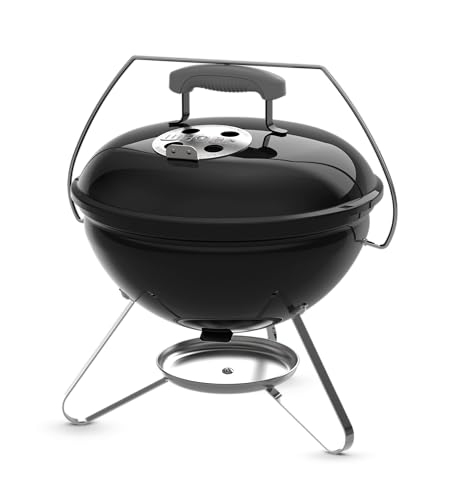
Weber Smokey Joe 14-Inch Portable Charcoal Grill — Best Overall Under $100
If one grill proves that under-100 does not mean disposable, it is the Smokey Joe. It is a true kettle — porcelain-enameled bowl and lid, plated grate, adjustable dampers — scaled to 14 inches, with the Tuck-N-Carry lid lock that secures it for transport. It cooks with the control and flavor of Weber’s full-size charcoal grills because it is one, in miniature.
Strengths
- Real damper control — rare at any budget tier
- Weber parts and support behind a budget product
- Uses very little charcoal per cook for two people
Trade-offs
- Charcoal time and ash are part of the deal
- 14-inch grate cooks for two or three per batch
- Fire restrictions can bench it — check your site
| Format | 14-inch portable charcoal kettle |
| Lid | Tuck-N-Carry lid lock |
| Fuel | Charcoal |
The Smokey Joe’s value is control per dollar. Dampers that work let you run it hot for steaks or choked down for sausages, and the kettle shape recirculates heat like its big relatives. For a couple, it is not the cheap option — it is simply the right-sized Weber, and its per-cook charcoal cost is pennies because the fire is small.
Ownership at this tier is usually a slow disappointment; here it is the opposite. Replacement grates exist, the enamel shrugs off seasons, and the design has been stable for decades. If your budget is firm and charcoal is legal where you camp, this is where the money goes.
One more Smokey Joe virtue for the budget-minded: it is the cheapest way to learn whether charcoal camping suits you at all. A season on the kettle teaches fire management that transfers to every charcoal grill you will ever own — tuition included in the lowest tuition in the category.
Best for: couples and solo campers who want real grilling at the tier / Not suited for: gas-only campers or fire-restricted trips
Check the current price on Amazon

Cuisinart Grillster Portable Gas Grill (CGG-059A) — Best Gas Grill Under $100
Gas under this tier usually means flimsy; the Grillster is the exception we could verify. Its listing quotes an 8,000 BTU burner reaching 600°F, 146 square inches of cooking space, push-button ignition and a dishwasher-safe grate, in a grill light enough to live in the car. For campers who want propane convenience without leaving the budget frame, this is the pick.
Strengths
- Push-button gas convenience inside the budget tier
- Dishwasher-safe grate — the easiest cleanup here
- Light and compact per its listing, ideal for small cars
Trade-offs
- Cooking area suits two, three at most
- Light build will not match cast rivals for longevity
- Single burner with modest output in wind
| Output (per listing) | 8,000 BTU burner, reaches 600°F |
| Cooking space (per listing) | 146 sq in |
| Weight (per listing) | 13 lbs |
The Grillster spends its budget where it shows: a burner that actually gets hot, an ignition that works, and a grate you can put in the dishwasher when the trip ends. Around those choices it is a simple, light tabletop — and simple and light is the correct specification for a grill that must justify its space in a small car on every trip.
Do not ask it to feed six. Ask it to make two people’s campsite dinners effortless for seasons, and it delivers the best gas value in this guide. Campers who need more area should save toward the next tier rather than buy a bigger, worse budget grill.
The Grillster makes an unusually good first gas grill for a teenager’s or student’s camping kit: light, simple, self-igniting, and cleanable in a dishwasher. Skills and confidence built on it transfer directly to the premium tabletops its owner may buy a decade later.
Best for: couples wanting gas convenience on a firm budget / Not suited for: groups or campers wanting cast-iron mass
Check the current price on Amazon

Coleman Fold N Go Portable Propane Grill — Best Folding Grill Under $100
The Fold N Go’s party trick is its packed shape: folded, it slides into the flat gaps of a loaded vehicle where no kettle or cast tabletop fits. Its verified listing confirms 6,000 BTUs, Instastart ignition, adjustable temperature control and a dishwasher-safe grate — a specification aimed at small cars, small groups and short trips.
Strengths
- Folds genuinely flat — unmatched packing at the tier
- Coleman parts support behind a budget grill
- Dishwasher-safe grate simplifies cleanup
Trade-offs
- Modest output demands full preheats and lid discipline
- Small area — small groups only
- Less thermal mass in wind than heavier rivals
| Output (per listing) | 6,000 BTU |
| Ignition | Instastart |
| Grate | Dishwasher-safe, per listing |
Judge this grill as a packing product that cooks, rather than a cooker that packs, and it wins its category. For the camper whose vehicle is a sedan and whose trips are overnighters, the Fold N Go is often the only real grill that fits — and a real grill that fits beats a better grill left at home, every trip, forever.
Cook within its nature: preheat fully, keep the lid down, shelter it from wind, and feed two or three people in relaxed batches. Coleman ownership at this tier also means a regulator or grate is a replaceable part, not a death sentence — a quiet advantage over no-name budget rivals.
Renters and apartment campers quietly rely on the Fold N Go because it stores in a kitchen cabinet or closet shelf, not a garage they do not have. Budget camping gear that respects small homes gets used; gear that demands storage gets sold.
Best for: sedan owners and minimalist overnight campers / Not suited for: groups or exposed windy sites
Check the current price on Amazon

Megamaster Tabletop 1-Burner Gas Grill — Best Tabletop Value
The Megamaster 1-burner is the basecamper’s budget gas grill: its verified listing quotes 11,000 BTUs, a built-in thermometer, push ignition, foldable legs with a warming rack, and operation on 1 lb propane canisters — the fuel format that keeps a grill like this simple to feed on any trip length.
Strengths
- Strong listed output for a budget single-burner
- Warming rack and thermometer included at the tier
- Runs on standard 1 lb canisters
Trade-offs
- Single zone — sequential cooking for mixed menus
- Budget materials want gentle handling and dry storage
- Tabletop format needs its stable surface
| Output (per listing) | 11,000 BTUs |
| Extras (per listing) | Built-in thermometer, warming rack, foldable legs |
| Fuel (per listing) | 1 lb propane |
What recommends the Megamaster is specification honesty at the tier: a listed output that gives it real preheat and sear ability, a warming rack that solves the holding problem single-burner grills usually ignore, and a thermometer to learn by. It is a working basecamp grill — the kind that lives at a seasonal site or in the RV and cooks nightly without ceremony.
Materials are the tier’s materials: handle it like the budget tool it is, store it dry, and it will serve seasons. Campers who want a decade of daily use should save for the premium tabletops in our gas guide; campers who want a lot of grill for the tier, tonight, are looking at it.
Seasonal-site campers — the leased-lot and summer-colony crowd — are this grill’s natural owners: it lives at the site, cooks nightly for months on cheap canisters or a tank, and its tier means a theft or a storm is an annoyance rather than a catastrophe.
Best for: basecampers and RV campers on a budget / Not suited for: campers wanting premium longevity
Check the current price on Amazon

Cuisinart 14-Inch Portable Charcoal Grill (CCG-190RB) — Best Charcoal Alternative
The Cuisinart CCG-190RB is the other way to build a budget 14-inch charcoal grill: where the Smokey Joe is a shrunken kettle, this is a purpose-built portable — its verified listing confirms a dual air vent system, three lid locks for one-handed carrying, and 196 square inches of chrome-plated cooking grate, the most area in this charcoal class.
Strengths
- 196 sq in per listing — roomiest budget charcoal grate
- Dual vents for fire control
- Three lid locks make carrying secure and simple
Trade-offs
- Chrome-plated grate needs care to avoid rust
- Charcoal rules, ash and lighting time apply
- Lighter construction than the Weber kettle
| Cooking area (per listing) | 196 sq in |
| Vents (per listing) | Dual air vent system |
| Transport (per listing) | 3 lid locks, one-handed carrying |
The Cuisinart’s argument is area and carry. That extra grate space over the kettle class means four burgers without crowding and a vegetables-alongside layout that small kettles force into batches. The three-lock lid is a genuinely thoughtful transport detail — the grill carries closed, by one hand, without the ash-anxiety of a two-part design.
Against the Smokey Joe it trades enamel-and-heritage for space-and-locks. The grate’s chrome plating wants a brush-and-dry habit the Weber’s enamel forgives. Choose by what you value; both are honest budget charcoal, which is rarer than it should be.
The CCG-190RB’s three-lock lid makes it the budget charcoal most likely to travel on a roof rack or in a boat, where a two-piece kettle design would need strapping gymnastics. Transport security is a feature, and at this tier it is a rare one.
Best for: small families wanting maximum budget charcoal area / Not suited for: campers who neglect grate care
Check the current price on Amazon

ZipSeven Camping Bushcraft Backpacker Grill — Best Fire Grill Under $100
The ZipSeven closes the guide with the simplest grill of all: a welded stainless steel mesh grate, per its verified listing, with a carrying bag, made to sit over a small fire’s coals at a campsite, a dispersed site or a backyard pit. There is nothing to assemble, nothing to break, and nothing between you and the oldest cooking method there is.
Strengths
- Lowest tier in the guide — true budget fire grilling
- Mesh surface keeps small foods out of the fire
- Stainless build with a carry bag for sooty transport
Trade-offs
- Needs a legal fire and your own support arrangement
- No legs, lid or controls — the fire is the appliance
- Duo-scale capacity
| Material (per listing) | Welded stainless steel mesh |
| Design (per listing) | Campfire cooking grate |
| Included (per listing) | Carrying bag |
As a budget proposition the ZipSeven is almost unfair: for the tier’s lowest spend you get stainless steel, a bag, and a cooking method — over real coals — that produces flavor the gas picks in this guide cannot. The mesh design is its quiet excellence, holding the asparagus, shrimp and sliced vegetables that bar grates sacrifice to the fire.
Its costs are the fire category’s costs: legality, patience and a support arrangement of stones or logs you stability-test yourself. For hikers, bushcraft campers and backyard fire-pit cooks, it is the easiest recommendation in this entire guide.
Keep a ZipSeven in the car even if you own better grills: it weighs nothing, costs nothing to store, and turns any legal fire pit — a rest stop’s, a friend’s backyard’s, a rental cabin’s — into your kitchen. It is the spare tire of camping grills, and like a spare tire, the day it saves is worth every day it waited.
Best for: hikers, bushcraft campers and fire-pit cooks / Not suited for: campers wanting a self-contained appliance
Check the current price on Amazon
Comparison Table
| Pick | Badge | Key spec | Best for |
|---|---|---|---|
| Weber Smokey Joe 14-Inch Portable Charcoal Grill | Best Overall Under $100 | 14-inch kettle, damper control, lid lock | couples and solo campers who want real grilling at the tier |
| Cuisinart Grillster Portable Gas Grill (CGG-059A) | Best Gas Grill Under $100 | 8,000 BTUs, 146 sq in, dishwasher-safe grate | couples wanting gas convenience on a firm budget |
| Coleman Fold N Go Portable Propane Grill | Best Folding Grill Under $100 | 6,000 BTUs, folds flat, Instastart | sedan owners and minimalist overnight campers |
| Megamaster Tabletop 1-Burner Gas Grill | Best Tabletop Value | 11,000 BTUs, warming rack, 1 lb propane | basecampers and RV campers on a budget |
| Cuisinart 14-Inch Portable Charcoal Grill (CCG-190RB) | Best Charcoal Alternative | 196 sq in, dual vents, 3 lid locks | small families wanting maximum budget charcoal area |
| ZipSeven Camping Bushcraft Backpacker Grill | Best Fire Grill Under $100 | Stainless mesh fire grate, carry bag | hikers, bushcraft campers and fire-pit cooks |
How to Shop the Under-$100 Tier Without Buying Twice
The budget tier punishes feature-chasing and rewards simplicity. Every added mechanism — a second burner, a fancy igniter, a thermometer, side shelves — is paid for with thinner steel somewhere you cannot see, usually the firebox that decides the grill’s lifespan. The picks in this guide share a pattern: one job, simple execution, a maker who sells replacement parts. That pattern is the whole shopping strategy at this tier.
Decide fuel first, because it decides your running costs. Charcoal at this tier buys the best cooking per dollar and the cheapest appliance; gas buys convenience and a slightly dearer unit; a fire grate buys almost nothing at all and asks for skill instead of money. All three are legitimate — what is not legitimate is a complicated grill at this price, whatever its box promises.
Finally, verify before you buy — prices in this tier move with sales and seasons, which is why this guide discusses the tier rather than printing per-product prices. Check price on Amazon on the day you buy, confirm the listing matches the model reviewed here, and your under-100 grill will be the rare budget purchase that ages well.
What You Give Up Under $100 — and What You Do Not
You give up: multiple heat zones, cast-iron thermal mass (mostly), thick steel, premium finishes, and the deep accessory ecosystems of the flagship lines. Group capacity shrinks too — this tier cooks for two to four, in batches beyond that.
You do not give up: real grilled flavor, working fire or heat control on the well-chosen models, portability — several picks here pack better than premium grills — or longevity, provided you choose simple designs from makers with parts support. The Smokey Joe in this guide will outlive many grills at three times its tier, because there is almost nothing on it to fail.
The honest summary: under-100 buys a narrower grill, not a worse one. Narrow it in the direction of your actual trips and the tier stops feeling like a compromise at all.
Stretching a Budget Grill: Accessories Worth It, and Wasted Money
Worth it: a chimney starter for charcoal models (faster, cleaner lighting with no fluid taste), a fitted cover or storage tote (budget steel lives longer dry), a spare propane canister, and a good brush. Each costs little and extends the grill’s life or its usefulness on every trip.
Wasted money: elaborate tool sets, novelty gadgets, and any accessory that costs a large fraction of the grill itself. At this tier the discipline is to let the grill be simple and spend the savings on ingredients — the meal is the luxury, not the equipment.
The True Cost of a Budget Grill: Fuel, Parts and Seasons
A budget grill’s purchase price is the down payment, not the cost. Run the seasons honestly: a small charcoal kettle burns a double handful of briquettes per cook, so a single bag carries a couple through much of a summer; a gas tabletop on disposable canisters spends more per cook, and the canister habit over five years can exceed the grill’s price — which is why the basecamp crowd migrates to refillable tanks. Neither is wrong; both should be chosen with eyes open.
Parts are the second ledger. A budget grill from Weber, Coleman or Cuisinart can be re-grated, re-regulated and re-latched for years at small cost; a no-name grill with a failed igniter is a total loss. When two budget grills look equal on the shelf, the one with a parts catalog is cheaper — it just collects the difference later, in your favor.
Budget Grills as Gifts, Spares and First Grills
The under-100 tier is where camping grills are given, and the picks in this guide are chosen to be given well. A Smokey Joe to a young camper is a decade-long companion that teaches real fire craft; a Grillster to a new car-camper removes every excuse to eat cold sandwiches; a ZipSeven in a stocking has started more fire-cooking hobbies than any premium grill ever will. Budget, chosen honestly, is not a lesser gift — it is the appropriate one.
They also serve as the household’s second grill: the one that lives in the car, the cabin or the emergency kit, so the main grill never has to travel. Many experienced campers own exactly this arrangement — a premium grill at home, a budget classic in the vehicle — and use the budget one more weekends a year. That is the tier’s final vindication: these are not starter grills to be discarded, but permanent tools with a permanent job.
When to Step Up: The Honest Limits of the Budget Tier
Budget grills are the right answer until the day they are not, and knowing that day in advance saves money in both directions. Step up when your headcount permanently grows past four and batch cooking stops being charming; when you camp monthly and the tier’s thinner materials start costing you parts and patience; or when a technique you love — two-zone roasting, serious searing for a crowd — simply exceeds what a small simple grill can do. Those are needs, and needs justify the next tier without apology.
Do not step up for novelty, for a sale, or because a feature list flattered you. The budget classics in this guide have fed decades of campers superbly, and the premium grill bought without a need tends to travel less, not more — too valuable to risk, too big to pack casually. The best camping grill at any price is the one that is with you at the campsite; protect that property first, and let genuine needs, when they arrive, write the upgrade check.
Budget Grill Myths, Retired One by One
Myth one: cheap grills cannot sear. The Smokey Joe and the Grillster in this guide sear perfectly well; searing is heat plus dry food plus patience, none of which is a price tier. Myth two: you need two burners to cook a real meal. Generations of campers have produced real meals on one burner and one coal bed, in sequence, which is how most home cooks use a four-burner stove anyway — one pan at a time. Myth three: budget grills are unsafe. The verified, established-maker models here follow the same designs and standards as their premium siblings; danger in grilling comes from misuse, which is free at every price.
Myth four is the expensive one: that a bigger budget will rescue bad technique. It will not — it will only make the same grey burgers on a larger grate. The campers who eat best at campsites are technicians, not spenders, and the under-100 tier is where that truth is easiest to learn, because the equipment refuses to do the work for you.
The Budget Camp Kitchen: Pairing a Cheap Grill With the Right Partners
A budget grill anchors a budget kitchen best when its partners cover its gaps cheaply. A single-burner camp stove — or the fire itself — handles pots, coffee and sides while the grill grills. A cast-iron skillet, the cheapest great cooking surface in existence, rides along for eggs, sauces and the rainy-day indoor-outdoor saves. A cooler that actually keeps ice does more for meal quality than any grill upgrade at this tier, because ingredients beat equipment in every blind tasting ever held at a picnic table.
Total that kitchen honestly and it lands where a single mid-tier grill does — while cooking a wider menu, with redundancy when something fails, and with every component replaceable at budget cost. That is not a consolation strategy. For most camping households it is simply the correct allocation, and the premium single appliance is the luxury choice. Buy the kitchen, not the trophy.
The Budget Grill Hall of Fame: Why Simple Designs Outlive Eras
Look at the budget grills that campers still use after twenty years and a pattern emerges that no marketing department invented: they are all simple, all repairable, and all made by companies that still sell their parts. The kettle pattern has been stable for generations because there is nothing left to remove and nothing that wears except a grate. The folding gas grills that survive are the ones whose regulators and latches were standard parts. Longevity in this tier is not luck; it is architecture.
The counterexamples fill garage sales: the feature-stuffed budget grills of every era, with their proprietary igniters, their hinged everything, their thin fireboxes rusted through by the third season. They were better bargains on the shelf and worse ones in every year after. The lesson the hall of fame teaches is the thesis of this whole guide: at under-100, you are not buying features or even, really, a grill — you are buying a design’s track record and a maker’s willingness to support it.
That is why this guide’s picks may look conservative. Conservatism, at this tier, is the radical position: it refuses the annual novelty cycle and buys the designs that have already survived the only test that matters. A camper who internalizes that once will make good equipment decisions at every tier for the rest of their camping life — which makes the humble budget grill, chosen well, the best teacher in the entire series.
Teaching the Next Camper on a Budget Grill
There is a reason the budget classics in this guide so often become the family teaching grill: their simplicity makes the fundamentals visible. On a Smokey Joe, a young cook can see the dampers change the fire. On a single-burner gas grill, they can learn preheat, zones-by-position and the lid’s power without a panel of knobs between them and the lesson. On a fire grate, they learn the oldest curriculum of all — patience, coals and care — at an age when it still feels like magic rather than work.
The safety frame is the same as in our portable guide: few rules, absolute ones, repeated every trip. Tongs are the only hands. The cook announces hot things. Nothing reaches across the grill. Within that frame, hand over real food early — a sausage they grilled themselves teaches more than a month of watching, and the budget tier’s forgiving economics mean a burned first attempt costs pennies and becomes a story instead of a loss. Many lifelong campers started exactly here, on a grill that cost less than the cooler beside it.
The Budget Tier’s Final Lesson: Spend on the Meal
Add up what this guide has actually recommended: a simple grill, chosen for its design’s track record; a short list of cheap, useful accessories; maintenance that costs minutes rather than money; and technique that costs nothing but attention. The remainder of any camping food budget — the part the premium tier would have taken — belongs where campers have always quietly known it belongs: in the cooler. Better steaks on a Smokey Joe beat ordinary steaks on a flagship, every single time, and it is not close.
That is the under-100 tier’s gift to a camper’s whole outdoor life: it teaches the correct order of spending once, cheaply, and the lesson transfers upward forever. Buy the simple grill. Learn it completely. Feed people well. The badge on the lid was never the point — the full table was.
How to Get Premium Results From a Budget Camping Grill
Technique closes most of the gap between a budget grill and a premium one. These steps are written for the grills in this guide — small kettles, single-burner gas tabletops and fire grates — and they cost nothing but attention.
- Preheat longer than the manual suggests. Small grills have little thermal mass, so a full preheat — ten minutes for gas, coals fully ashed for charcoal — is what stands between steamed food and seared food.
- Dry the food’s surface. Pat meat and vegetables dry before they meet the grate; surface moisture is the enemy of browning on any grill, and budget grills have no spare heat to waste boiling it off.
- Cook in smaller batches with space between items. An overcrowded small grate drops temperature and steams everything. Two quick batches beat one slow, grey one.
- Use the lid as a tool. Lid down to finish thick items and melt cheese; lid up for fast sears. On charcoal, the dampers are your thermostat — small adjustments, then wait a full minute before judging.
- Create a holding zone from nothing: the grate’s edge on gas, the coal-free side on charcoal, the mesh’s cool corner over fire. Resting food somewhere warm-but-gentle is the technique that makes small grills cook like big ones.
- Oil food, not the flood of the grate, and flip once. Budget grates release food when the sear is ready; forcing an early flip tears what patience would have released.
- Clean warm, every time: brush the grate, empty ash or grease when cool, and store the grill dry. At this tier, maintenance is not care — it is the entire longevity strategy.
Follow those steps and a campsite neighbor with a grill at three times the tier will ask what you are cooking on. The answer — a simple grill, run properly — is the most satisfying sentence in budget camping.
Common Buying Mistakes
Buying the feature-heavy budget grill
Five features on a sub-100 grill means five things built to a price and a firebox built thinner to pay for them. Simple designs from real makers outlive them every time.
Assuming the tier on the box is the price today
Budget gear pricing moves with every sale season. The search’s frame is a tier, not a quote — check the current price on the product page before you commit, and compare the exact model reviewed.
Overcrowding a small grate to feed everyone at once
One steamed, grey batch pleases nobody. Cook in two fast batches and keep the first warm at the grate’s edge — the food and the crowd both end up happier.
Skipping charcoal quality to save pennies
Bad briquettes light slowly, ash heavily and flavor food poorly. On a small grill that uses a handful per cook, decent charcoal costs almost nothing per meal — it is the worst place in camping to economize.
Storing a budget grill wet and dirty
Thin steel has no corrosion allowance. The brush-dry-store routine is what separates a five-year budget grill from a one-season one.
Judging the tier by its worst products
The under-100 shelf contains genuine junk and genuine classics side by side. Verification and simple design — the method of this guide — are how you tell them apart before money changes hands.
Final Recommendation
If your budget is firm, buy the Weber Smokey Joe and stop shopping — it is the best camping grill under this tier’s frame for most people, full stop. Gas campers should take the Cuisinart Grillster for convenience or the Coleman Fold N Go for packing; basecampers, the Megamaster. Charcoal campers wanting more grate should choose the Cuisinart CCG-190RB, and fire cooks should put the ZipSeven in the pack and spend the savings on better steaks.
That last trade is the tier’s philosophy in one line: under-100 grills reward campers who spend on the meal and the technique, not the badge. Choose simply, verify honestly, cook carefully — and this budget will feed you well for years.
- Weber Smokey Joe 14-Inch Portable Charcoal Grill (Best Overall Under $100) — check price on Amazon
- Cuisinart Grillster Portable Gas Grill (CGG-059A) (Best Gas Grill Under $100) — check price on Amazon
- Coleman Fold N Go Portable Propane Grill (Best Folding Grill Under $100) — check price on Amazon
- Megamaster Tabletop 1-Burner Gas Grill (Best Tabletop Value) — check price on Amazon
- Cuisinart 14-Inch Portable Charcoal Grill (CCG-190RB) (Best Charcoal Alternative) — check price on Amazon
- ZipSeven Camping Bushcraft Backpacker Grill (Best Fire Grill Under $100) — check price on Amazon
Best Camping Grills Best Camping Gas Grills Best Camping Grills Portable
Frequently Asked Questions
Can a camping grill under $100 actually be good?
Yes — if it is simple. A small kettle with working dampers, a single-burner gas grill with an honest burner, or a stainless fire grate can cook excellently and last for years. The bad budget grills are the complicated ones, where features are paid for with thin materials.
Gas or charcoal at this budget — which is better?
Charcoal buys more cooking quality per dollar and the cheapest upkeep; gas buys instant starts and no ash. If your sites allow charcoal and you cook for two or three, charcoal wins on flavor and value. If speed and cleanliness rule your trips, the gas picks in this guide are the honest exceptions to budget-gas disappointment.
Why does this guide not print each grill’s exact price?
Because campsite gear prices change constantly with sales and seasons, and a printed price becomes misinformation. The under-$100 frame is the tier these products were verified in; check the current price on Amazon before buying to confirm the model still sits in your budget.
How long will a budget camping grill last?
A simple design from a maker with parts support — the pattern of every pick here — lasts five years or more with the brush-dry-store routine. Feature-heavy budget grills with thin fireboxes often fail in one or two seasons. Longevity at this tier is chosen at purchase and kept by maintenance.
What size grill under $100 feeds a family of four?
Plan on batches. A 14-inch kettle or a compact gas tabletop cooks a family meal in two rounds without stress, especially with sides on a camp stove. If one-round family cooking is non-negotiable, the honest answer is to step above this tier to a folding stand-up grill.
Are cheap camping grills safe?
The verified models in this guide are standard designs from established makers, used with the same rules as any grill: stable surface, leak checks for gas, legal fires for charcoal and grates, and full cooldown before packing. Safety at this tier is about choosing real products and using them properly — both of which this guide is built around.
Is a used premium grill better than a new budget grill?
Often, yes — a used Weber kettle or Q-series in sound condition can outcook and outlast a new budget grill, and the camping classics hold their value for exactly that reason. Inspect before buying: grate condition, regulator and hose on gas models, and leg and lid integrity. Avoid used grills with rusted-through fireboxes at any price.
Best Camping Grills Coleman Best Camping Flat Top Grills Best Camping Fire Grills


