Disclosure: airfryerkitchensupply.com is reader-supported. When you buy through links on our site, we may earn an affiliate commission at no extra cost to you.
Where to buy
The fastest way to buy any of the best camping grills coleman in this guide is through Amazon, where stock, delivery options and current pricing are shown on each product page. We never print static prices in our guides because campsite-gear pricing moves with seasons and promotions, so use the links below to check price on Amazon before you commit.
- Coleman RoadTrip 285 Portable Stand-Up Propane Grill — check price on Amazon
- Coleman RoadTrip 225 Portable Tabletop Grill — check price on Amazon
- Coleman RoadTrip 225 Portable Propane Grill (Stand-Up Listing) — check price on Amazon
- Coleman Fold N Go Portable Propane Grill — check price on Amazon
- Coleman Tabletop 2-in-1 Grill & Stove — check price on Amazon
- Coleman Tripod Campfire Grill & Lantern Hanger — check price on Amazon
Campers searching for the best camping grills coleman makes are usually looking for one thing: the brand that furnished half the campsites of their childhood, in a grill that fits a modern car. The best camping grills coleman sells today cluster around the RoadTrip line — folding stand-up and tabletop propane grills with swappable cooktops — plus the ultra-simple Fold N Go and a couple of honest oddballs: a grill-stove combo for camp kitchens and a tripod for cooking over the fire itself.
This guide covers six Coleman grills verified against Amazon’s catalog data, and it is candid about the shape of the lineup. Coleman does not currently field a charcoal kettle or a flat top griddle line to rival Weber or Blackstone, so brand loyalists choosing Coleman are choosing propane convenience and the RoadTrip ecosystem. Within that ecosystem, though, there is a genuine choice to make — size, burners and format differ meaningfully between models.
One specification note, in the open: Coleman’s RoadTrip 225 appears in listings with different burner figures depending on configuration, so for that stand-up listing we have deliberately not printed a spec box rather than repeat a number we could not reconcile. Everything else quoted below comes straight from the verified listing for that exact product.
Key Takeaways
- Coleman’s camping strength is folding propane: the RoadTrip line is the brand’s center of gravity.
- Buy by format and burners — 285 for groups, 225 for small crews, Fold N Go for minimalists.
- The swappable cooktop system, especially the griddle, doubles what one Coleman can cook.
- Coleman does not currently field a verified charcoal kettle or flat top — use other guides for those.
In this guide
Quick Picks
- Coleman RoadTrip 285 Portable Stand-Up Propane Grill — Best Overall Coleman. Coleman’s flagship camp grill: three adjustable burners, 20,000 BTUs, Instastart ignition and a folding stand — the most capable grill Coleman makes for campsites. Check on Amazon
- Coleman RoadTrip 225 Portable Tabletop Grill — Best Coleman Tabletop. The RoadTrip formula on a tabletop: two burners, 11,000 BTUs per its listing, Instastart ignition and a removable water pan for grease. Check on Amazon
- Coleman RoadTrip 225 Portable Propane Grill (Stand-Up Listing) — Best Coleman for Small Groups. The 225-class RoadTrip in stand-up form — two-burner cooking at standing height for campers who want the frame without the 285’s bulk. Check on Amazon
- Coleman Fold N Go Portable Propane Grill — Best Lightweight Coleman. Coleman’s minimalist grill: 6,000 BTUs, Instastart ignition and a dishwasher-safe grate in a body that folds flat enough to forget it is in the car. Check on Amazon
- Coleman Tabletop 2-in-1 Grill & Stove — Best Coleman for Camp Kitchens. Half grill, half stove: two burners and 20,000 BTUs split between a 130 sq in grilling area and a burner that takes a pan — one unit for the whole camp kitchen. Check on Amazon
- Coleman Tripod Campfire Grill & Lantern Hanger — Best Coleman for Campfires. A steel tripod with an adjustable 17-inch grate that hangs over the fire — plus a lantern hanger — for campers whose grill fuel is wood. Check on Amazon
How These Picks Were Chosen
We limited this guide to grills Coleman actually sells and that we could verify — brand-and-model search, an exact title match, and the ASIN from the listing response. That discipline matters more in a single-brand guide than anywhere, because brand searches surface accessories, replacement grates and third-party lookalikes that are not Coleman grills at all. Every pick below is a grill, made by Coleman, with a verified listing.
The six picks span the real Coleman range: the three-burner RoadTrip 285 as the flagship, both RoadTrip 225 formats for smaller groups, the folding Fold N Go for minimalists, the 2-in-1 grill and stove for camp-kitchen builders, and the tripod campfire grill for campers who cook over wood. If your Coleman use case exists, one of these badges matches it.
We have been honest where the lineup is thin. There is no Coleman answer here to a dedicated flat top or a charcoal kettle, and pretending otherwise would waste your money. Where Coleman is strong — folding propane grills with interchangeable cooktops — it is genuinely strong, and the reviews say why.
A word on how we handled Coleman’s color and bundle variants: the RoadTrip models sell in multiple colors and retailer bundles that share ASIN families. We verified the core grill listings and reviewed the grills themselves; if a listing’s bundle includes cooktops or covers you want, that is a bonus — but buy the grill for the grill, and treat bundle contents as a listing detail to confirm at checkout.
The 6 Best Coleman Camping Grills, Reviewed One by One

Coleman RoadTrip 285 Portable Stand-Up Propane Grill — Best Overall Coleman
The RoadTrip 285 is the Coleman to buy if you are buying one Coleman. Its verified listing confirms three adjustable burners totaling 20,000 BTUs, Instastart push-button ignition, and the folding stand-up design the RoadTrip name is built on. It cooks at standing height for a crowd, then folds onto its wheels for the trip home.
Strengths
- Three burners — the most heat control in Coleman’s camp lineup
- Swappable cooktops expand it into griddle and stove duty
- Folding stand with wheels keeps a big grill one-person portable
Trade-offs
- Largest packed size of any Coleman here
- Water-pan grease system needs real cleaning after big cooks
- Premium of the Coleman range
| Burners | 3 adjustable |
| Output (per listing) | 20,000 BTUs |
| Ignition | Instastart push-button |
The 285’s case is versatility through zones and cooktops. Three burners let a group cook run a mixed menu in parallel, and the swappable cooktop system — grates, griddle, stove grate — means one packed unit covers meals that would otherwise need two appliances. For family campsites and tailgates, that consolidation is worth more than any single specification.
Its costs are the flagship costs: size in the vehicle and a proper wash after greasy cooks. Campers who mostly cook for two will find the same Coleman virtues in the 225 below, in a package their trunk will prefer. But as the best overall Coleman camping grill, the 285 is not a close call.
A practical note for 285 shoppers: because the model has sold for years in several colors and bundles, listings vary in what is included. Buy the grill itself with confidence, but read the exact listing for included cooktops and accessories rather than assuming the full ecosystem is in the box.
Best for: families and groups who want one Coleman for every trip / Not suited for: couples with small cars
Check the current price on Amazon
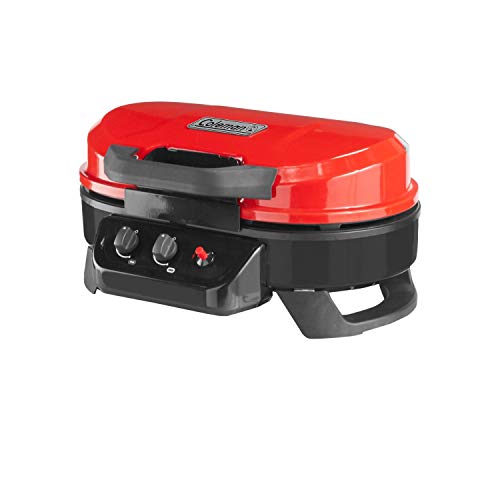
Coleman RoadTrip 225 Portable Tabletop Grill — Best Coleman Tabletop
The RoadTrip 225 tabletop brings the line’s signatures — two-burner control, push-button Instastart ignition, swappable cooktop compatibility — to a body that sits on the picnic table and stores in a bin. Its verified listing quotes 11,000 BTUs and a removable water pan, the grease-management detail that keeps tabletop grilling cleaner than rivals that let fat pool under the burner.
Strengths
- Two burners in a true tabletop body
- Removable water pan simplifies grease disposal
- Shares the RoadTrip swappable cooktop ecosystem
Trade-offs
- Needs a solid table at the site
- Cooking area sized for small families, cooked in batches for more
- Tabletop height is less comfortable for long cooks than a stand
| Burners | 2 |
| Output (per listing) | 11,000 BTUs |
| Extras | Instastart ignition, removable water pan |
This is the Coleman most couples and small families should actually buy. Two burners give the sear-and-hold rhythm that one-burner tabletops cannot, the water pan catches the grease that otherwise becomes a cleaning project, and the whole unit packs like luggage rather than furniture. In the RoadTrip ecosystem it also inherits the griddle option, which turns campsite breakfast from a compromise into a plan.
The tabletop format is the only real caveat: bring a camp table if your sites lack picnic tables, and expect batch cooking beyond four people. Within those honest limits, the 225 tabletop is Coleman’s sweet spot.
The 225 tabletop is the Coleman most likely to be handed down or resold rather than discarded — its size suits the widest range of households, and its parts are everywhere. If your camping life is entering a two-person phase after group years, this is the graceful step down that loses nothing essential.
Best for: couples and small families who camp at serviced sites / Not suited for: campers without a table at their sites
Check the current price on Amazon
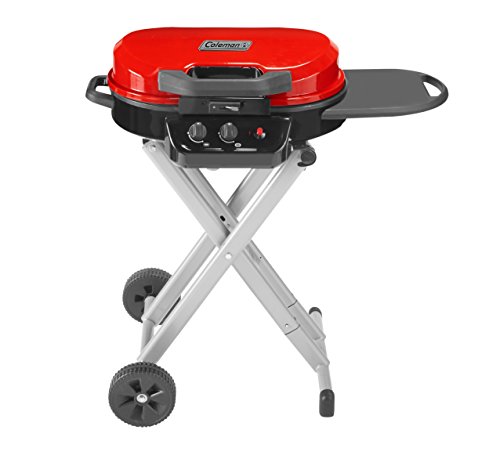
Coleman RoadTrip 225 Portable Propane Grill (Stand-Up Listing) — Best Coleman for Small Groups
This stand-up RoadTrip 225 listing answers a specific packing problem: you want to cook standing, not at a picnic table, but the three-burner 285 is more grill than your vehicle or your group needs. It keeps the RoadTrip pattern — two burners, Instastart matchless ignition, folding portability — in the smaller frame.
Strengths
- Standing-height cooking in the smaller RoadTrip size
- Two-burner control for sear-and-hold cooking
- Folds for transport like the rest of the line
Trade-offs
- Listing specifications vary by configuration — verify current details on the product page before buying
- Smaller grate than the 285 for group cooking
- Stand-up frame still packs longer than a tabletop
We have deliberately published this pick without a spec box. Coleman’s 225-class listings show different figures across configurations, and printing a number we could not reconcile would break this guide’s verification rule. What is consistent across the line — and what this pick is chosen for — is the format: two-burner RoadTrip cooking on a folding stand, sized between the tabletop 225 and the flagship 285.
For small groups who cook standing — tailgaters, festival campers, RV owners with a patio mat down — that format is the point, and this is its Coleman expression. Check the current product page for the exact configuration on offer, and buy the format with confidence.
Stand-up 225 owners often pair the grill with a simple folding side table, recreating a patio kitchen footprint at the site for the cost of one small accessory. It is the budget route to the 285’s working experience: less burner, same posture, same system.
Best for: small groups who prefer stand-up cooking / Not suited for: buyers who need the 285’s third burner
Check the current price on Amazon

Coleman Fold N Go Portable Propane Grill — Best Lightweight Coleman
The Fold N Go is the Coleman for campers who pack by jigsaw. Its verified listing describes a lightweight 6,000 BTU propane grill with Instastart ignition, adjustable temperature control and a dishwasher-safe grate — a specification set aimed squarely at small vehicles, small groups and short trips where a RoadTrip would be furniture overkill.
Strengths
- Folds flat — the easiest Coleman to store and transport
- Lightweight design suits small cars and short carries
- Dishwasher-safe grate makes home cleanup trivial
Trade-offs
- Modest output needs a full preheat and lid discipline
- Small cooking area — two to three people per batch
- Less wind resistance than heavier grills
| Output (per listing) | 6,000 BTU |
| Ignition | Instastart |
| Grate | Dishwasher-safe, per listing |
Every brand needs an honest small grill, and this is Coleman’s. It does not sear like a cast-iron Weber or feed a reunion like the 285; it grills a couple’s dinner cleanly, folds into a gap in the packing, and cleans up in the dishwasher when you get home. For weeknight-style camping — one night, two people, minimal kit — that is not a compromise, it is the correct tool.
Run it with respect for its size: preheat fully, cook with the lid down, and shelter it from wind. Campers who ask it to be a small grill will be pleased; campers who ask it to be a big one should buy the 225.
The Fold N Go rewards one small habit: a sheet of foil or a tray under it on wooden picnic tables, since its compact body sits low and radiates heat downward. Owners who adopt the tray keep both the table and the grill happier — the kind of two-dollar wisdom that long product histories accumulate.
Best for: solo campers, couples and minimalist packers / Not suited for: groups or windy exposed sites
Check the current price on Amazon

Coleman Tabletop 2-in-1 Grill & Stove — Best Coleman for Camp Kitchens
Most campsite meals are not grill-only: there are beans to heat, coffee to keep warm, vegetables to sauté while the meat grills. Coleman’s Tabletop 2-in-1 answers with two adjustable burners totaling 20,000 BTUs per its verified listing — one under a 130 square inch grilling area, one open for a pan — plus push-button ignition and wind guards for breezy sites.
Strengths
- Grill and stove in one packed unit — fewer appliances to carry
- Wind guards included for exposed sites
- Two independently adjustable burners for parallel cooking
Trade-offs
- 130 sq in of grill space is modest — grill in batches
- A compromise appliance: dedicated grills grill better, dedicated stoves boil faster
- Tabletop format needs its stable surface
| Output (per listing) | 20,000 BTUs across 2 burners |
| Grilling area (per listing) | 130 sq in |
| Extras | Push-button ignition, wind guards included |
The 2-in-1 is a packing argument. A separate grill and two-burner stove give you more of both; this unit gives you both in the footprint of one, which for small-car campers and minimalist camp kitchens is the difference between bringing a kitchen and bringing a cooler of sandwiches. The wind guards are a thoughtful inclusion — combination units live on exposed picnic tables, and Coleman knows it.
Judge it as a system, not a grill. The grilling half handles burgers, dogs, chops and vegetables for a small group in batches, while the stove half keeps the rest of the meal moving. Campers building a compact, complete outdoor kitchen around one propane unit will find this the most useful Coleman in the guide.
Treat the 2-in-1’s stove side as a true burner, not an afterthought: it boils, simmers sauces and runs a coffee percolator with the same authority as a dedicated camp stove. Campers who internalize that stop packing the separate stove entirely, which is the unit’s whole reason to exist.
Best for: small-car campers building a complete camp kitchen / Not suited for: purists who want maximum grill area
Check the current price on Amazon

Coleman Tripod Campfire Grill & Lantern Hanger — Best Coleman for Campfires
Not every Coleman grill burns propane. This tripod suspends an adjustable 17-inch grill grate over a campfire on a chain, so height — and therefore heat — is set by raising or lowering the grate, and the frame doubles as a lantern hanger when dinner is done. Its verified listing confirms durable steel legs and a compact storage profile for a full-size fire accessory.
Strengths
- Cooks over real wood fire with adjustable grate height
- Doubles as a lantern hanger after the meal
- Packs down compactly for a full-size tripod
Trade-offs
- Needs an established fire — no use under fire bans
- Heat control is manual: chain height and coal management
- Steel needs drying after use to stay rust-free
| Grate (per listing) | Adjustable 17-inch grill grate |
| Frame | Steel tripod with lantern hanger |
| Fuel | Campfire wood or charcoal |
The tripod is the oldest grill design in this entire series, and Coleman still sells it because at a fire-ring campsite it simply works: build the fire, let it burn to coals, hang the grate at the height the food wants. The chain adjustment is crude compared to a gas knob and completely effective — an inch of height is a meaningful temperature change over coals, and experienced fire cooks read it fluently.
It is also the only pick here that improves the campsite after dinner, holding the lantern over the table while the fire dies. For campers whose sites have fire rings and whose evenings center on the fire, this is Coleman’s most characterful grill — and its most affordable way into the brand.
The tripod’s lantern hanger deserves its second mention here because it changes camp layout: light hung over the table, fire in the ring, cook working between them in one lit triangle. It is a small systems pleasure that campers who try it tend to arrange every site around thereafter.
Best for: fire-ring campsites and traditional camp cooks / Not suited for: anyone camping under fire restrictions
Check the current price on Amazon
Comparison Table
| Pick | Badge | Key spec | Best for |
|---|---|---|---|
| Coleman RoadTrip 285 Portable Stand-Up Propane Grill | Best Overall Coleman | 3 burners, 20,000 BTUs, folding stand | families and groups who want one Coleman for every trip |
| Coleman RoadTrip 225 Portable Tabletop Grill | Best Coleman Tabletop | 2 burners, 11,000 BTUs, water pan | couples and small families who camp at serviced sites |
| Coleman RoadTrip 225 Portable Propane Grill (Stand-Up Listing) | Best Coleman for Small Groups | RoadTrip 225 class, stand-up format | small groups who prefer stand-up cooking |
| Coleman Fold N Go Portable Propane Grill | Best Lightweight Coleman | 6,000 BTUs, folds flat, lightweight | solo campers, couples and minimalist packers |
| Coleman Tabletop 2-in-1 Grill & Stove | Best Coleman for Camp Kitchens | Grill + stove, 20,000 BTUs, wind guards | small-car campers building a complete camp kitchen |
| Coleman Tripod Campfire Grill & Lantern Hanger | Best Coleman for Campfires | 17-inch adjustable grate, tripod + lantern hanger | fire-ring campsites and traditional camp cooks |
How to Choose the Best Camping Grills Coleman Makes for Your Trips
Start with format, because Coleman’s lineup is really three formats wearing one badge. Folding stand-up RoadTrips (285 and the stand-up 225) cook at standing height and pack like furniture. Tabletops (225 tabletop, Fold N Go, the 2-in-1) pack like luggage and borrow height from the picnic table. The tripod ignores propane entirely and cooks over the site’s fire. Your vehicle and your campsites choose the format; the model choice inside it is secondary.
Then count burners against your menu. Three burners on the 285 run a mixed group menu in parallel. Two burners — the 225s and the 2-in-1 — handle sear-and-hold cooking for small groups. One burner on the Fold N Go cooks in sequence for one to three people. Coleman loyalists sometimes buy up a size for the badge; buy for the menu instead and the grill will come on more trips.
Finally, consider the cooktop ecosystem. The RoadTrip line’s swappable grates and griddles mean a Coleman bought today can become a breakfast griddle next season with one accessory. If your camping cooking is expanding, that upgrade path is a genuine reason to choose the RoadTrip format over Coleman’s simpler models.
Coleman RoadTrip vs the Rest: An Honest Brand Assessment
Coleman’s strength is folding propane convenience at mid-range tiers, backed by parts availability that budget brands cannot match — regulators, grates and latches for RoadTrips are easy to source years later. Against Weber, Coleman generally trades some grate quality and thermal mass for lower tiers and the swappable cooktop system. Against Blackstone, Coleman simply does not compete: there is no Coleman flat top in this guide because we could not verify one as a current Coleman camping product.
The honest gaps matter. If you want charcoal, Coleman is not your brand — look at the kettle guides in this series. If you want a griddle, the flat-top guide is your next read. If you want a folding propane grill with a deep accessory bench and sensible tiers, Coleman is exactly your brand, and the RoadTrip 285 and 225 are why.
Getting the Most From a RoadTrip at the Campsite
The water pan is the feature owners underuse. Filled and in place, it catches grease before it reaches the burner area, steadies the cooking environment, and lifts out for disposal — three benefits for one habit. Empty it after every cook; a forgotten pan is the main reason RoadTrips develop flare-up reputations they do not deserve.
Preheat with the lid down and cook with it down whenever the food allows; these grills are designed around lidded cooking, and open-lid grilling in wind is where their modest burners get unfairly blamed. Add the griddle cooktop for breakfast and the RoadTrip becomes the two-meal anchor of the camp kitchen — the role it was designed for.
The RoadTrip Cooktop System: Grates, Griddles and Stove Tops Explained
The RoadTrip’s defining idea is that the cooking surface is an accessory, not a fixture. The standard grate grills; the swap-in griddle turns the same burners into a breakfast station for pancakes, eggs and bacon; a stove grate converts a burner zone for pots and kettles. One packed frame thereby covers the three cooking modes of a campsite weekend, which is why RoadTrip owners tend to describe their grill as a kitchen rather than an appliance.
Using the system well is mostly sequencing: griddle on for breakfast, grate on for dinner, and the water pan in place under both. Confirm any cooktop fits your exact model before ordering — the line spans years and sizes — and store cooktops with the grill so the system travels as a unit. Bought thoughtfully, the cooktops are the cheapest capability upgrade in this entire series of guides.
Coleman Generations: Why the Brand Keeps Winning Campsites
Coleman’s camping presence is older than most of its customers: the company has furnished American campsites for over a century, and that history shows up in the unglamorous places — distribution in every outdoor retailer, replacement parts for models long discontinued, and designs refined by decades of returns and warranty data. A RoadTrip is not the most exotic grill in this series; it is among the most debugged.
That maturity cuts both ways. Coleman rarely leads with novel materials or radical formats, and its lineup gaps — no charcoal kettle, no flat top line — are the gaps of a company that iterates its strengths rather than chasing every category. Buy Coleman for proven, supported, mid-tier excellence in folding propane, and it will not disappoint you. Ask it to be Weber or Blackstone and it will, which is a buying error, not a brand failure.
Keeping a Coleman Alive: Parts, Care and the Ten-Year RoadTrip
A Coleman grill’s lifespan is decided less by its burners than by its owner’s relationship with the parts catalog. Grates wear, regulators age, latches bend — and on a RoadTrip every one of those is a replaceable component rather than a death sentence, because Coleman supports its lines the way appliance makers used to. The ten-year RoadTrips you meet at campgrounds are not pampered; they are simply maintained, one small part at a time, by owners who never let a small failure become the grill’s last trip.
The care routine itself is five minutes per trip: water pan emptied and washed, grates brushed warm and washed at home monthly in season, the firebox wiped of grease before it bakes on, and the folded grill stored dry with its latch closed. Add an annual check of the regulator and hose and there is nothing else. Coleman ownership, done this way, is the closest camping comes to a buy-it-for-life category — which is precisely the reputation the brand’s century at campsites was built on.
Coleman vs Weber for Camping: The Honest Head-to-Head
Campers cross-shopping Coleman and Weber are choosing between two philosophies. Weber spends on materials and thermal mass — cast-iron grates, cast-aluminum bodies, lidded heat that feels like a small oven — and prices accordingly. Coleman spends on systems and access — folding mechanisms, swappable cooktops, distribution in every store in America — and undercuts accordingly. Neither is the other’s failure; they are different allocations of the same dollars, visible in this guide’s spec boxes if you read them side by side.
The deciding questions are personal: Do you sear steaks weekly or grill mixed family menus? Do you value a griddle swap or a heavier grate? Will you keep the grill a decade — where Weber’s build and Coleman’s parts both argue well — or a few seasons? Answer those and the brand chooses itself. What we can say as reviewers: a camper who buys either brand’s appropriate model, at the right size, will be happy; the unhappiness in this category lives almost entirely in wrong sizes and wrong formats, not wrong badges.
Coleman Camping Beyond the Grill: Building the Matching Kitchen
Coleman’s ecosystem logic extends past grills: the same design language — folding, latching, green-and-steel practicality — runs through its stoves, lanterns and coolers, and there is a real convenience in a camp kitchen whose parts share fuel, footprints and a maintenance style. The 2-in-1 grill and stove in this guide is the purest expression: one unit, one canister type, one learning curve for the whole kitchen.
The caution is the mirror of the virtue: an ecosystem is a gentle lock-in, and campers should enter it for the grill’s merits rather than the matching colors. Buy the RoadTrip because its burners and cooktops suit your cooking; let the lantern match because it may. Kitchens built tool by tool, on merit, age better than kitchens bought as sets — even very good sets from very old brands.
Coleman for Specific Campers: RV Life, Tailgates and Scout Troops
RV campers are Coleman’s natural constituency, and the fit is practical: RoadTrips fold into bays, run on the same propane logic as the rig itself, and their cooktop swaps consolidate the outdoor kitchen that RV life is built around. The 225 tabletop lives in a bay and deploys onto the picnic table in a minute; the 285 anchors the long-stay site where the awning is out and the mat is down. Parts availability matters doubly on the road — a regulator sourced in any town beats a proprietary part shipped to a campground.
Tailgaters want the same virtues pointed at a parking lot: fast setup, crowd capacity in bursts, and a grill that folds into the vehicle before kickoff without a grease incident. The 285 is the tailgate flagship for a reason, and the Fold N Go is the two-person version of the same idea. Scout troops, finally, are where Coleman’s century shows: leaders buy the brand because the parts exist, the designs are known quantities, and a troop grill is infrastructure, expected to serve a rotating cast of teenagers for a decade. The tripod, in that world, is not a product but a curriculum.
The pattern across all three: Coleman wins where camping is a system rather than an event — repeated, equipped, maintained. That is a narrower claim than ‘best brand,’ and a more useful one. Campers whose outdoor life is systematic should weight it heavily; campers buying for two trips a year can honestly weight price and size instead.
What Coleman Owners Know: Five Small Habits From the Faithful
Spend time around long-term RoadTrip owners and the same habits recur. They fill the water pan before they light, not after the first flare-up reminds them. They own the griddle cooktop and use it more than the grate. They keep a spare regulator in the kit because a ten-dollar part once saved a trip and the lesson stuck. They brush the grates while the grill is still warm from dinner, in the firelight, as part of the meal rather than as tomorrow’s penance. And they store the grill folded, latched and dry, in the same place every time, so packing for a trip starts with a grab rather than a search.
None of these habits is in any manual, and together they are the difference between the RoadTrip that serves a decade and the identical RoadTrip that disappoints in two seasons. Coleman builds a durable platform; the faithful build the routine on top of it. New owners who adopt the five habits at purchase skip the learning curve entirely — which is, in the end, what brand communities are for.
A Closing Word for the Brand Loyal
Brand loyalty in camping gear is often mocked as nostalgia, and sometimes it is. But the Coleman loyalist’s position, examined fairly, is a rational bet on support: a company that has stocked parts and honored designs across a century is a safer custodian of a ten-year purchase than a exciting newcomer with a two-year catalog. The grills in this guide earn their badges on their burners and frames — and then earn them again, quietly, every time a five-year-old RoadTrip needs a ten-dollar part that simply exists.
Buy the Coleman that fits your format and your headcount, run the water pan, adopt the faithful’s five habits, and let the seasons make the argument. That is how the brand built its century — one unremarkable, well-cooked campsite dinner at a time, repeated a few million times.
How to Set Up a Coleman Camping Grill at Your Site
Coleman’s folding and tabletop grills share a setup logic: stable surface or locked stand first, fuel second, ignition last. The routine below covers the RoadTrip and tabletop models, with the tripod’s fire routine at the end.
- Choose the cooking spot: a level picnic table for tabletops, or flat ground for stand-up models, away from tent fabric, awnings and dry grass, with the grill’s back to the wind.
- Unfold the stand or legs completely and confirm every lock is engaged before the grill’s weight goes on it. A half-locked RoadTrip leg is the classic first-trip wobble.
- Place the water pan and grates before connecting fuel — handling internals after the propane is connected invites knocked fittings.
- Connect the canister or hose with valves closed, open the supply slowly, and listen and smell for leaks at every joint. Re-seat any fitting that hisses before you go further.
- Light with the lid open using the Instastart ignition, then close the lid and preheat five to ten minutes. Fill the water pan per your manual’s guidance for longer cooks.
- Cook with zones: high side for searing, low side for holding. On the 2-in-1, put the pot on the stove burner as the grill preheats so the whole meal lands together.
- For the tripod: build the fire in the ring, let it burn down to a coal bed, set the tripod legs firmly outside the ring’s heat, and hang the grate at a height you can adjust as the fire fades.
- Shutdown: burners off, supply closed, cool with the lid open. Empty the water pan and grease into a sealed container for the trash, wipe grates, fold, latch, and pack only when fully cool.
Coleman grills reward this routine with years of service — the brand’s parts support means a worn grate or regulator is a replacement, not a funeral. Treat the grill as a long-term appliance and it will behave like one.
Common Buying Mistakes
Buying the 285 for two people
The flagship is a group grill. Couples who buy it for the badge get a grill that packs big and cooks oversized for their trips, and it starts staying home. The 225 exists precisely for you.
Ignoring the water pan
Running a RoadTrip dry invites flare-ups and bakes grease onto the firebox. The pan is part of the design — fill it, use it, empty it.
Assuming Coleman makes every format
There is no verified Coleman charcoal kettle or flat top in the current lineup we could confirm. Forcing the brand onto those jobs buys the wrong tool; use this series’ other guides for those formats.
Judging the 225 by one listing’s numbers
The 225 appears in multiple configurations with differing figures across listings. Check the exact configuration on the product page before buying, and buy the format — two-burner RoadTrip cooking — rather than a number.
Storing the grill with the pan full
A water pan left with grease water in a stored grill is a smell and corrosion project. Empty, wash and dry it the day you get home.
Skipping the griddle cooktop for breakfast
RoadTrip owners who never add the swappable griddle are using half the system they paid for. Breakfast is where the ecosystem earns its keep.
Final Recommendation
For most Coleman buyers, the RoadTrip 285 is the answer — three burners, the full cooktop ecosystem, and folding portability in one flagship. Couples and small families should save the space and take the RoadTrip 225 tabletop; stand-up traditionalists in small groups, the 225 stand-up. Minimalists get the Fold N Go, camp-kitchen builders get the 2-in-1, and fire cooks get the tripod.
Stay inside what Coleman does well — folding propane convenience with real parts support — and a Coleman grill will furnish your campsites for years, exactly as the brand has done for generations of campers before you.
- Coleman RoadTrip 285 Portable Stand-Up Propane Grill (Best Overall Coleman) — check price on Amazon
- Coleman RoadTrip 225 Portable Tabletop Grill (Best Coleman Tabletop) — check price on Amazon
- Coleman RoadTrip 225 Portable Propane Grill (Stand-Up Listing) (Best Coleman for Small Groups) — check price on Amazon
- Coleman Fold N Go Portable Propane Grill (Best Lightweight Coleman) — check price on Amazon
- Coleman Tabletop 2-in-1 Grill & Stove (Best Coleman for Camp Kitchens) — check price on Amazon
- Coleman Tripod Campfire Grill & Lantern Hanger (Best Coleman for Campfires) — check price on Amazon
Best Camping Grills Best Camping Gas Grills Best Camping Grills Portable
Frequently Asked Questions
Which Coleman camping grill is best overall?
The RoadTrip 285, for its three-burner control, folding stand and swappable cooktop system. It is the most capable camping grill Coleman makes. Smaller households get the same design virtues in the RoadTrip 225 with less bulk.
Does Coleman make a charcoal camping grill?
We could not verify a current Coleman charcoal kettle among the listings checked for this guide; Coleman’s camping grill lineup centers on propane RoadTrip and tabletop models, plus the tripod for cooking over a campfire. For charcoal kettles, see the portable and fire grill guides in this series.
What is the difference between the RoadTrip 285 and 225?
Size and burners. The 285 is the larger three-burner flagship for groups; the 225 is the smaller two-burner line, sold in tabletop and stand-up formats for couples and small families. Both share Instastart ignition and the swappable cooktop system.
Can I put a griddle on a Coleman RoadTrip?
Yes — the RoadTrip line’s swappable cooktop system is one of its main advantages, and griddle cooktops are the most popular addition, turning the grill into a breakfast station. Confirm the cooktop matches your exact model before ordering.
How do I clean a Coleman RoadTrip after camping?
Empty the water pan and grease into a sealed container for the trash, brush the grates warm, and wipe the firebox once cool. At home, wash grates and pan properly and dry everything before storage. The routine takes minutes and prevents the baked-on buildup that makes old RoadTrips flare.
Is the Coleman Fold N Go big enough for a family?
For a family of three or four cooking simple food in batches, it copes; for a family that wants everything on the grill at once, it does not. It is designed as a lightweight grill for one to three people, and it is best judged — and bought — as exactly that.
Are Coleman RoadTrip grills worth it compared with cheaper folding grills?
For campers who grill more than a few times a year, yes: the parts support, the cooktop ecosystem and the refined folding design repay the difference across seasons. Occasional campers who grill twice a summer can honestly buy cheaper — the RoadTrip’s advantages are the kind that compound with use.
Best Camping Grills Under $100 Best Camping Flat Top Grills Best Camping Fire Grills


