Disclosure: airfryerkitchensupply.com is reader-supported. When you buy through links on our site, we may earn an affiliate commission at no extra cost to you.
Where to buy
The fastest way to buy any of the best camping grills in this guide is through Amazon, where stock, delivery options and current pricing are shown on each product page. We never print static prices in our guides because campsite-gear pricing moves with seasons and promotions, so use the links below to check price on Amazon before you commit.
- Weber Traveler Portable Gas Grill — check price on Amazon
- Coleman RoadTrip 285 Portable Stand-Up Propane Grill — check price on Amazon
- Weber Q 1200N Portable Propane Gas Grill — check price on Amazon
- Blackstone 1813 Original 22-Inch Tabletop Griddle — check price on Amazon
- Weber Smokey Joe 14-Inch Portable Charcoal Grill — check price on Amazon
- Weber Go-Anywhere Portable Charcoal Grill — check price on Amazon
Finding the best camping grills sounds simple until you stand in front of the choice the market actually offers: folding propane grills that set up like camp furniture, tabletop gas grills that ride in a storage bin, kettle charcoal grills that cost very little and cook beautifully, and flat top griddles that turn a campsite into a breakfast diner. The best camping grills are not the biggest grills you can haul — they are the ones whose size, fuel and cleanup routine match the way you actually camp, trip after trip.
This guide compares six camping grills across the four formats that matter at a campsite: a folding stand-up gas grill, a high-output multi-burner gas grill, a compact tabletop gas grill, a flat top griddle, and two charcoal options for campers who cook over coals on principle. Every product below was verified against Amazon’s own catalog data before it earned a link, and where a format has a real weakness — wind sensitivity, ash management, packed weight — we say so plainly instead of glossing over it.
One honest note before the picks: there is no single camping grill that wins at everything. A grill that feeds eight people at a group site will annoy a solo camper who packs a hatchback, and the lightest charcoal kettle in this guide asks for patience that a push-button propane grill never will. Read the badges as jobs, not rankings, and match the job to your trips.
Key Takeaways
- Match the grill to your vehicle and usual headcount first; menu ambitions come second.
- Folding stand-up gas grills are the most versatile single purchase for car campers.
- Charcoal gives the best flavor per dollar; gas gives back your evenings; a flat top owns breakfast.
- Every pick in this guide was verified against Amazon’s catalog data before it earned a link.
In this guide
Quick Picks
- Weber Traveler Portable Gas Grill — Best Overall. A folding propane grill on wheels that sets up like a camp chair, cooks like a small backyard grill, and packs flat enough to live in a car trunk or RV bay between trips. Check on Amazon
- Coleman RoadTrip 285 Portable Stand-Up Propane Grill — Best for Groups. Three adjustable burners and 20,000 BTUs under a stand-up frame with folding legs — the group-site cook’s grill, with swappable cooktops for griddle breakfasts. Check on Amazon
- Weber Q 1200N Portable Propane Gas Grill — Best Tabletop Gas Grill. A compact 10,000 BTU tabletop grill with porcelain-enameled cast-iron grates and electronic ignition — small footprint, properly Weber cooking manners. Check on Amazon
- Blackstone 1813 Original 22-Inch Tabletop Griddle — Best Flat Top. A two-burner 22-inch flat top with a hood — the breakfast machine of the campsite, and just as happy frying smash burgers, fajitas and fried rice at dinner. Check on Amazon
- Weber Smokey Joe 14-Inch Portable Charcoal Grill — Best Budget. The classic 14-inch kettle in miniature — a budget-tier charcoal grill with a lid lock that doubles as a carry handle, and decades of replacement parts behind it. Check on Amazon
- Weber Go-Anywhere Portable Charcoal Grill — Best for Compact Packing. A rectangular charcoal grill whose legs fold up over the lid to lock it shut — the shape packs like a briefcase and wastes no corner of a packed car. Check on Amazon
How These Picks Were Chosen
We chose these picks by starting with the trips, not the products. Car campers with a picnic table need a different grill from RV campers with an outdoor kitchen, festival campers cooking for a crowd, and minimalist campers who carry everything in one tote. Each pick below owns one of those jobs outright, which is why the badges describe the job — Best Overall, Best for Groups, Best Flat Top — rather than pretending one grill tops a single league table.
Every linked product was cross-checked against the Amazon catalogue for this site: we searched by brand and model, matched the returned title to the product we intended to cover, and only then used the ASIN from the listing response. Specifications quoted in the mini spec boxes come from those verified listings. We excluded any grill we could not verify, any model with a known safety recall, and any product whose listing did not clearly match a real, currently sold camping grill.
We also weighed the unglamorous factors that decide whether a camping grill gets used on trip ten or stays in the garage: how the grease is managed, whether the grates survive a dishwasher or need seasoning, how the lid latches for transport, and whether replacement parts like regulators and grates are easy to find years later.
We also road-tested the shortlist logic against real packing: every pick here was checked for a plausible home in a normal vehicle alongside a tent, cooler and chairs. Two well-regarded grills failed that test — excellent cookers that simply do not travel — and were cut. A camping grill that stays home is a patio grill with delusions, and this guide refuses to recommend any.
The 6 Best Camping Grills, Reviewed One by One

Weber Traveler Portable Gas Grill — Best Overall
The Weber Traveler is the camping grill we would hand to the widest range of campers. It folds down to a slim profile, rolls on its own wheels, and opens into a stable stand-up grill with a cooking area the listing sizes at fifteen burgers — enough for a family site without borrowing the neighbor’s picnic table for staging space. It runs on small propane canisters for short trips and can be adapted to a larger tank for basecamp duty.
Strengths
- Folds flat and rolls on wheels, so one person moves it from car to site
- Stand-up cooking height is comfortable for long cooks, unlike tabletop grills
- Weber’s parts and accessory support is the deepest in this guide
Trade-offs
- Heavier than any tabletop grill here — minimalist packers will feel it
- Single-burner layout means one heat zone, so indirect cooking takes planning
- Costs more than the charcoal picks by a wide margin
| Format | Folding stand-up propane grill with wheels |
| Capacity (per listing) | Fits 15 burgers |
| Fuel | Propane (canister or adapted tank) |
What separates the Traveler from other folding grills is that nothing about the cooking experience feels like a compromise. The grate is porcelain-enameled cast iron in Weber’s usual style, the lid is tall enough for chicken pieces and corn, and the whole unit locks closed so it does not rattle itself apart in a cargo area. Campers upgrading from a disposable charcoal tray will notice the difference in the first cook: steadier heat, fewer flare-ups, and a grill that is still lit when the wind picks up off the lake.
The honest limitations are weight and zones. This is a car-camping and RV grill, not something you carry any distance, and with one burner you manage heat by moving food rather than by turning a second zone down. For campers who mostly grill directly — burgers, dogs, steaks, skewers — that trade is easy to accept, and it is why the Traveler takes Best Overall rather than a niche badge.
Owners consistently discover the Traveler’s second talent a few trips in: it is a superb tailgate and beach grill, anywhere a flat-ish surface and a breeze exist. The same folding frame that suits campsites suits parking lots, and the wheels that roll it across a campground roll it across asphalt better. Buy it as a camping grill and it quietly becomes your portable grill for everything.
Best for: car campers and RV campers who want one grill for nearly every trip / Not suited for: backpackers or anyone counting every pound
Check the current price on Amazon

Coleman RoadTrip 285 Portable Stand-Up Propane Grill — Best for Groups
When the campsite headcount climbs past six, the RoadTrip 285 is the grill that keeps the cook sane. Its three adjustable burners deliver a combined 20,000 BTUs, so one side can sear while another holds finished food warm, and the stand-up frame folds for transport while keeping the cooking surface at working height. Coleman’s Instastart push-button ignition means matches stay in the kitchen kit where they belong.
Strengths
- Three burners give real heat-zone control for mixed menus
- Swappable cooktops let you add a griddle or stove grate later
- Folding stand with wheels keeps a big grill genuinely portable
Trade-offs
- The largest packed footprint of any pick here
- More parts to clean after a greasy group cook
- Overkill for solo and couple camping
| Burners | 3 adjustable burners |
| Output (per listing) | 20,000 BTUs |
| Ignition | Instastart push-button |
The RoadTrip line has been the default group-camping grill for years for a practical reason: it behaves like a small patio grill that happens to fold. The 285’s burner layout matters more than the raw BTU figure — three zones let you run a genuinely mixed menu, sausages over medium, vegetables over low, burgers finishing over high, without the shuffle-and-pray routine a single-burner grill forces on you. The water pan under the grates catches grease and lifts out for disposal, which keeps the campsite cleaner and the car trunk less aromatic.
Size is the price of admission. Folded, the 285 still wants a wagon, SUV or RV bay rather than a compact sedan trunk shared with tents and coolers. Groups who camp together regularly will not care; couples should look at the RoadTrip 225 class or the Weber Q below instead. Within its job — feeding a crowd away from home — nothing else in this guide matches it.
The accessory that changes the 285’s life is the griddle cooktop. With it, the three-burner frame becomes a breakfast station that feeds a group in one pass, and the grill you bought for dinners starts owning mornings too. If your group camps more than a few times a year, budget for the griddle when you buy the grill — it is the difference between a tool and a system.
Best for: group campsites, tailgates and family reunions outdoors / Not suited for: solo campers or small-car packers
Check the current price on Amazon

Weber Q 1200N Portable Propane Gas Grill — Best Tabletop Gas Grill
The Q 1200N is the tabletop answer for campers who want gas convenience without giving up grate quality. Its single burner is rated at 10,000 BTUs in the verified listing, the cooking grates are porcelain-enameled cast iron — the material that actually holds sear heat — and electronic ignition replaces the click-and-hope piezo lighters on cheaper tabletops. It sits happily on a picnic table and stores in a bin or cabinet between trips.
Strengths
- Cast-iron grates sear like a full-size grill, not a camp stove
- Compact body stores in an RV bay or storage tote
- Electronic ignition is reliable in damp morning air
Trade-offs
- Single burner, single heat zone
- Tabletop format needs a stable, heat-safe surface at the site
- Cooking area suits two to four people, not a crowd
| Output (per listing) | 10,000 BTUs |
| Grates | Porcelain-enameled cast iron |
| Ignition | Electronic |
Most tabletop grills disappoint in the same place: thin stamped-steel grates that dump heat the moment cold food lands on them. The Q 1200N avoids that trap entirely, and it shows in the food — burgers get a crust instead of steaming in their own juice, and chicken skin renders instead of sticking. The cast-aluminum body shrugs off campsite knocks and will not rust out in a damp garage, which is more than many painted-steel rivals can promise after two seasons.
Plan around the single zone and the modest footprint. You cook in batches, and delicate food shares space with whatever is searing. For couples and small families that rhythm is fine — arguably it is the rhythm of campsite cooking anyway. Paired with a separate camp stove for pots and coffee, the Q 1200N covers the grilling half of a two-person outdoor kitchen better than anything else its size.
The Q 1200N pairs naturally with a folding stand for campers who split time between serviced sites with tables and open ground without them — but try it on picnic tables first. Many owners find the tabletop format so convenient that the stand stays home, which is the Q’s design intent: the smallest possible package around a genuinely serious grate.
Best for: couples and small families who camp from a car or RV / Not suited for: groups larger than four or offset-cooking fans
Check the current price on Amazon

Blackstone 1813 Original 22-Inch Tabletop Griddle — Best Flat Top
Not every camping meal wants grill marks. The Blackstone 1813 replaces grates with a 22-inch rolled-steel flat top run by two burners, so eggs, pancakes, bacon, hash browns and chopped vegetables all cook on one surface with no food lost to the fire below. The hood on this version protects the surface in transit, speeds preheating, and helps melt cheese and steam vegetables at the site.
Strengths
- Two burners create a hot zone and a holding zone on one surface
- Flat top cooks breakfast foods no grate grill can handle
- Hood protects the seasoned surface between trips
Trade-offs
- No open-flame char — food cooks on steel, not over fire
- Surface needs seasoning and light oiling to stay rust-free
- Grease management matters; the rear system must be emptied each trip
| Surface | 22″ flat top griddle |
| Burners | 2 |
| Extras | Built-in hood, stainless front plate |
The 1813 earns its place because campsite breakfasts are where griddles humiliate grate grills. A full breakfast for four — bacon first, eggs in the fat, pancakes on the cleared side — happens on one surface in one pass, and the same plate turns out smash burgers with lacy edges that a grate cannot produce. Two burners are the detail to insist on in this size: one zone ripping hot for searing, one low for holding, which is how restaurant flat tops are run and how you should run this one.
The ownership contract is different from a gas grill’s. The steel top is a seasoned surface, closer to a cast-iron pan than to a grate: dry it after cooking, oil it lightly, and store it dry, and it improves for years; neglect it wet and it will rust. Campers who accept that small ritual get the most versatile single cooking surface in this guide.
A word about the first cook: season the 1813 at home, not at the campsite. The seasoning process smokes, takes the better part of an hour, and deserves a relaxed afternoon rather than a hungry Friday evening with an audience. Arrive with a seasoned surface and the griddle’s first campsite breakfast will feel like a magic trick instead of a chemistry lesson.
Best for: breakfast-first campers and anyone who cooks for a table / Not suited for: campers who want open-flame flavor from their grill
Check the current price on Amazon
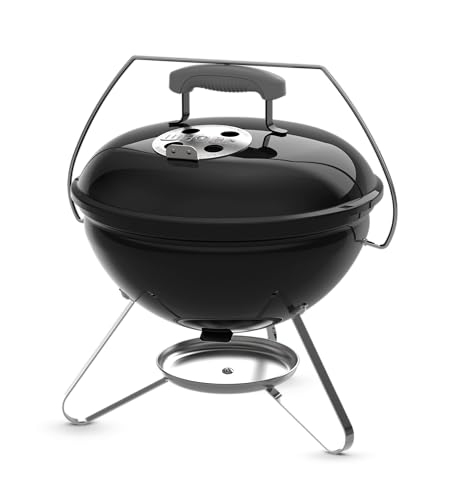
Weber Smokey Joe 14-Inch Portable Charcoal Grill — Best Budget
The Smokey Joe is the camping grill that proves how little you need to spend to eat well outdoors. It is a 14-inch kettle with the same DNA as Weber’s full-size charcoal grills — porcelain-enameled bowl and lid, plated steel grate, adjustable dampers — shrunk to a size that rides in a footwell. The Tuck-N-Carry lid lock holds everything together in transit and doubles as a lid holder at the site.
Strengths
- Budget tier pricing tier without disposable-grill build quality
- Real damper control for a grill this small
- Lid lock makes transport clean and one-handed
Trade-offs
- Charcoal means lighting time, ash and cooldown before packing
- 14-inch grate cooks for two, maybe three, in batches
- No ignition button — bring a chimney or starter cubes
| Format | 14-inch portable charcoal kettle |
| Lid | Tuck-N-Carry lid lock |
| Fuel | Charcoal briquettes or lump |
What you are buying here is control at the smallest sensible scale. The dampers actually work, so you can choke the fire down for sausages or open it up for a hard sear, and the kettle shape circulates heat the way Weber’s big grills do. For two people — a couple of steaks, four burgers, a skewer run — it is not a compromise at all; it is simply the right size, and it uses a fraction of the charcoal a full kettle burns for the same meal.
The limits are the format’s limits. Charcoal asks for twenty minutes of patience before cooking and a plan for ash and fully cold coals before you drive home, and in fire-restriction country it may not be legal to light at all — check before you pack it. Campers who accept those terms get genuine grilled flavor at the lowest tier in this guide, from a grill that will outlast several disposable alternatives.
The Smokey Joe’s party trick is economy: a double handful of briquettes cooks a couple’s dinner, where a full-size kettle burns three times the charcoal for the same meal. Over a season of small cooks that difference is real money and real packing space — one small bag of charcoal lasts a Smokey Joe owner most of a summer.
Best for: couples, solo campers and charcoal purists on a budget / Not suited for: campers in fire-restricted areas or anyone in a hurry
Check the current price on Amazon

Weber Go-Anywhere Portable Charcoal Grill — Best for Compact Packing
Round kettles waste space in square cars. The Go-Anywhere answers with a rectangular body, a two-piece cooking grate per the verified listing, and legs that pivot up over the lid to lock the whole unit into a tidy brick for transport. Inside, it cooks like a small Weber should: even charcoal heat, a lid for roasting, and dampers to steer the fire.
Strengths
- Rectangular packed shape uses cargo space efficiently
- Legs lock the lid for clean, rattle-free transport
- Two-piece grate makes adding charcoal mid-cook easier
Trade-offs
- Rectangular fire needs arranging for even zones
- Still charcoal — lighting, ash and fire rules apply
- Cooking area suits small groups cooked in batches
| Format | Rectangular portable charcoal grill |
| Grate | 2-piece cooking grate |
| Transport | Folding legs lock over lid |
The Go-Anywhere is the charcoal grill for people who pack by Tetris. In a sedan trunk or a crowded RV bay, its flat sides stack against coolers and totes instead of rolling around them, and the locked lid keeps ash where it belongs on the drive home. At the site, the rectangular grate is genuinely useful: push coals to one end and you have a sear zone and a cooler zone in a grill that fits on half a picnic table.
It shares the Smokey Joe’s charcoal caveats — time, ash, fire restrictions — and adds one of its own: the long, low fire bed rewards a few minutes spent spreading coals evenly. Do that and it cooks with the steadiness Weber owners expect. For campers whose packing space is the binding constraint, this is the charcoal pick.
The Go-Anywhere has a cult among apartment and small-space campers for a reason beyond packing: stored, it is a tidy brick that lives on a closet shelf or a balcony corner, asking nothing of your living space between trips. Few grills of any price are as easy to own when home is small — a virtue its campsite manners then match.
Best for: small-car campers and tidy packers who want charcoal flavor / Not suited for: campers who need push-button starts
Check the current price on Amazon
Comparison Table
| Pick | Badge | Key spec | Best for |
|---|---|---|---|
| Weber Traveler Portable Gas Grill | Best Overall | Folding stand-up design, fits 15 burgers | car campers and RV campers who want one grill for nearly every trip |
| Coleman RoadTrip 285 Portable Stand-Up Propane Grill | Best for Groups | 3 burners, 20,000 BTUs, folding stand | group campsites, tailgates and family reunions outdoors |
| Weber Q 1200N Portable Propane Gas Grill | Best Tabletop Gas Grill | 10,000 BTUs, cast-iron grates, tabletop | couples and small families who camp from a car or RV |
| Blackstone 1813 Original 22-Inch Tabletop Griddle | Best Flat Top | 22″ two-burner flat top with hood | breakfast-first campers and anyone who cooks for a table |
| Weber Smokey Joe 14-Inch Portable Charcoal Grill | Best Budget | 14-inch charcoal kettle, lid lock | couples, solo campers and charcoal purists on a budget |
| Weber Go-Anywhere Portable Charcoal Grill | Best for Compact Packing | Rectangular charcoal grill, locking legs | small-car campers and tidy packers who want charcoal flavor |
How to Choose the Right Camping Grill for Your Trips
Start with your vehicle, not your menu. Measure the space the grill can honestly occupy — a folding stand-up grill like the Traveler or RoadTrip 285 needs a cargo area that swallows a folded frame, while a tabletop grill or a Smokey Joe fits in the gaps between other gear. Campers who buy for the menu first and the trunk second end up leaving the grill at home, which is the most common failure mode in this whole category.
Next, count your usual headcount and be honest about the biggest group you cook for more than once a year. Two to four people is tabletop territory. Five to eight wants a folding stand-up grill or a 22-inch griddle. Beyond that, you are either cooking in disciplined batches or bringing two cooking devices — a grill plus a camp stove is the classic combination, and it is usually smarter than one enormous grill.
Finally, decide how the grill will live between trips. A grill stored in a damp garage needs corrosion-resistant materials — cast aluminum, porcelain enamel, stainless where it counts. A grill stored indoors can be painted steel. This unglamorous question predicts lifespan better than any feature list.
Gas, Charcoal or Flat Top: Which Fuel Fits Camping Best?
Propane is the convenience fuel: instant ignition, precise control, no ash, and legal in many places where open flame is restricted — though you must always check the specific rules of your campground, since some fire bans include gas appliances and some do not. Small canisters suit short trips; an adapter hose and a refillable tank make sense for week-long basecamps and RV camping. Every gas pick in this guide runs on that system.
Charcoal is the flavor fuel and the patience fuel. It asks for lighting time, rewards you with smoke and sear that gas cannot imitate, and leaves ash that must be fully cold and packed out. It is also the cheapest way into real grilling. Choose charcoal if the cooking is part of the entertainment; choose gas if cooking is a task between activities.
A flat top is the menu fuel. It does not replace a grill so much as cover the meals grills do badly — breakfast, stir-fries, cheesesteaks, fried rice, smash burgers. Many experienced campers end up owning a small grate grill and a tabletop griddle between them, which is why the flat-top lens gets its own full guide in this series.
What Size Cooking Surface Do You Actually Need?
Ignore the burger-count numbers on boxes except as rough comparisons — the verified listings in this guide use them, and they are useful for scale, but your real unit is your menu. A couple grilling two steaks and a foil pack of vegetables needs a 14-inch kettle or a compact tabletop. A family cooking burgers for six in one round needs the grate area of a folding stand-up grill or the patience to run two batches.
Batch cooking is not failure. Campsite meals are rarely timed to the minute, and a second batch of burgers takes four minutes, not forty. Buy for your usual trip, borrow or batch for the annual big weekend, and your grill stays small enough to bring every time — which is the whole point of a camping grill.
What About Camping Grill Accessories: Which Ones Earn Their Space?
A camping grill’s accessory kit should fit in one small tote, and every item in it should pass the same test as the grill: it comes on every trip or it stays home. The essentials are boring and transformative — long tongs that keep hands off the heat, a stiff brush that actually fits your grate, a chimney starter if you burn charcoal, a spare propane canister if you burn gas, and a headlamp, because campsite cooking always finishes later than planned and a grill lit by headlamp is a grill you can actually see.
The second tier is situational: a griddle plate for a gas grill if breakfast matters, a fitted cover if the grill lives in a garage, heat-resistant gloves for charcoal work. What does not earn space is the novelty layer — oversized tool sets in roll-up cases, single-purpose gadgets, and anything whose job a knife and tongs already do. Camping kits grow by accretion; audit yours each season and evict what did not get used.
How Long Will a Camping Grill Last, and What Kills Them Early?
A well-chosen camping grill should last five to ten seasons. The killers, in order, are corrosion from dirty storage, transport damage, and lost or broken small parts — regulators, latches, igniters — that owners never replace. Notice that none of the three is the burner or the firebox failing in normal use: camping grills die of neglect and gravity, not of cooking.
The countermeasures are the habits threaded through this guide: brush warm, empty grease and ash, store dry and latched, and buy from makers whose parts catalogs exist. Weber and Coleman score heavily here — a ten-year-old Smokey Joe or RoadTrip is a parts order away from new, while a no-name grill with a failed regulator is landfill. At purchase time, that support gap is worth more than any feature difference on the box.
Camping Grill Maintenance Calendar: The Season Done Right
A camping grill’s year has a rhythm, and campers who learn it stop having equipment surprises. Spring: inspect before the first trip — check gas hoses and connections for cracks, brush and oil charcoal grates, test the igniter with a fresh canister, and replace anything suspect while the shops are stocked and you are not standing in a campsite. Summer, during the season: the warm brush and the grease check after every trip, ash out of charcoal grills within a day of home, and a mid-season deep clean if the grill works weekly.
Autumn: the deep clean that decides whether the grill survives winter — grates washed, firebox scraped, grease system emptied and dried, cast iron oiled, everything stored dry and latched, with gas canisters removed and stored separately in a ventilated space. Winter: leave it alone, dry and covered, and resist the damp garage corner. None of this is elaborate; all of it together is the difference between a grill that starts its fifth season like its first and one that becomes a cautionary tale at the curb.
Cooking for Different Campsite Styles: Serviced, Dispersed and Festival
Serviced campgrounds — hookups, water, picnic tables, neighbors — reward the gas formats in this guide: a folding Traveler or RoadTrip on the pad, or a Q on the table, cooking cleanly without ash or fire management in a dense social setting. The etiquette is part of the equipment choice: contained propane cooking respects quiet hours, fire rules and the family ten feet away in a way a smoky charcoal fire at midnight does not.
Dispersed camping inverts every priority: no table, no ring, no water, and a duty to leave the site untouched. Compactness and self-containment rule — a kettle, a latching tabletop, or a fire grate where legal — and the menu simplifies to what one surface can do. Festival camping is its own discipline: dust, crowds, long walks from the car and communal cooking, where the grill that survives is the one that latches, locks and feeds a rotating cast. Match the grill to the camping you actually do most, and the rare other style can borrow or batch.
A Word on Grill Weight, Honestly
Manufacturers quote grill weights the way airlines quote legroom, so this guide has judged portability by design rather than by repeating listing figures we could not verify across models. The honest hierarchy is physical: titanium grates weigh almost nothing; small kettles and folding gas grills are one-hand carries; tabletops run from genuinely light to deceptively dense in cast iron; folding stand-up grills are not carried at all — they are rolled, which is a different and better answer to the same problem.
What matters is the total system: grill plus fuel plus tools, carried the actual distance, by the actual person, at the end of an actual day. Campers consistently overestimate their enthusiasm for hauling and underestimate the walk from the far parking lot. When torn between two picks in this guide, choose the one whose transport story — wheels, handle, case, folded shape — matches your weakest moment, not your strongest intention.
How to Set Up and Cook on a Camping Grill, Step by Step
A campsite grill rewards a calm setup routine. Whether your grill burns propane or charcoal, the sequence below prevents the three classic campsite failures: a grill that will not stay lit, food that cooks unevenly, and a greasy mess packed into the car for the drive home.
- Pick the spot first: a level, stable surface away from tent walls, dry grass and overhanging branches, with the grill downwind of where people will sit. Tabletop grills go on a sturdy table, never on a plastic surface that heat can warp.
- For propane: connect the canister or hose with the valves closed, open the valve slowly, and check connections by listening and smelling for leaks before you light anything. If you smell gas after connecting, close everything and re-seat the fitting.
- For charcoal: light with a chimney starter where possible — it needs no lighter fluid, so food never tastes of it — and wait until coals are ashed over before spreading them. Arrange a two-zone fire whenever the grate allows it.
- Preheat with the lid closed. Gas grills need five to ten minutes; charcoal is ready when you can hold your hand above the grate for only a few seconds. Preheat time is when you oil the grate lightly and stage your food.
- Cook with the lid down for thick items and up for fast sears. Use the cooler zone as your holding area instead of a plate — food stays hot without drying on a cold tray.
- Rest meat on a clean plate, not the raw-food plate. Campsite hygiene is the same as kitchen hygiene; the only difference is you have to plan the second plate in advance.
- While the grill is still warm, brush the grate clean, let it cool fully, empty grease pans and ash into a sealed container for disposal, and latch the lid before the grill goes back in the vehicle.
That last step is the one that decides whether your next trip starts well. A grill cleaned warm at the site needs two minutes; the same grill cleaned cold at home next month needs twenty and a bad mood. Build the cleanup into the meal, not after it.
Common Buying Mistakes
Buying for the biggest group you ever camp with
A grill sized for the annual twelve-person reunion will be left behind on the ten trips a year you camp as four. Size for your usual headcount and cook in batches on the rare big weekend.
Ignoring fire restrictions until you arrive
Charcoal and even gas rules change with fire conditions, and a grill you cannot legally light is dead weight. Check the campground’s current rules before packing, and keep a no-cook backup meal in the cooler.
Packing a dirty grill
Grease and ash in a closed car on a warm drive home is a smell that lives in upholstery. Clean warm, cool fully, latch the lid, and carry ash and grease out in sealed containers.
Trusting the lid thermometer as gospel
Lid thermometers read the air near the lid, not the grate. Learn your grill’s hot spots with a cheap test — slices of white bread toasted across the grate map the heat better than any gauge.
Running a tabletop grill on an unstable surface
A tabletop grill full of hot food on a wobbly camp table is an accident with a date. If the site has no solid table, a folding stand-up grill or a ground-stable kettle is the safer buy.
Forgetting the small consumables
A spare propane canister, a lighter that works, a brush, tongs long enough to keep hands off the heat — the grill is the system, not the box. Pack the kit with the grill, every time.
Final Recommendation
If you buy one grill from this guide, buy the Weber Traveler — it is the rare camping grill that asks for no apologies about cooking quality, packing or setup. Groups should step up to the Coleman RoadTrip 285 and its three burners; couples and small families should look hard at the Weber Q 1200N’s cast-iron grates. Breakfast campers belong on the Blackstone 1813, and charcoal loyalists should choose between the Smokey Joe’s simplicity and the Go-Anywhere’s packable shape.
Whichever you choose, match it to your vehicle and your usual headcount first, your menu second. A camping grill that comes on every trip beats a perfect grill that stays home.
- Weber Traveler Portable Gas Grill (Best Overall) — check price on Amazon
- Coleman RoadTrip 285 Portable Stand-Up Propane Grill (Best for Groups) — check price on Amazon
- Weber Q 1200N Portable Propane Gas Grill (Best Tabletop Gas Grill) — check price on Amazon
- Blackstone 1813 Original 22-Inch Tabletop Griddle (Best Flat Top) — check price on Amazon
- Weber Smokey Joe 14-Inch Portable Charcoal Grill (Best Budget) — check price on Amazon
- Weber Go-Anywhere Portable Charcoal Grill (Best for Compact Packing) — check price on Amazon
Best Camping Gas Grills Best Camping Grills Portable Best Camping Flat Top Grills
Frequently Asked Questions
What is the best type of grill for camping?
For most car campers, a portable propane grill is the best type: it lights instantly, controls heat precisely, leaves no ash, and packs cleanly. Charcoal suits campers who prioritize flavor and do not mind lighting time, and a flat top griddle is best if breakfast and diner-style meals dominate your menu. The right answer depends on your vehicle space and headcount more than on any single product.
Can I use a regular backyard grill for camping?
You can, and people do, but full-size grills are heavy, awkward to secure in a vehicle, and prone to damage in transit. Portable camping grills fold, latch and lock specifically for transport. If you camp more than twice a year, a purpose-built portable pays for itself in hassle saved.
Are charcoal grills allowed at campgrounds?
Often yes, sometimes no — rules vary by campground and tighten during fire season. Many sites require charcoal to be used in provided fire rings or grills only, and some ban it entirely during high fire danger. Always check the current rules for your specific site before packing a charcoal grill.
How do I clean a camping grill at a campsite?
Brush the grate while it is still warm, wipe surfaces once cool, empty the grease pan or ash into a sealed container, and dispose of it in the site’s trash — never in the fire ring’s surroundings or the woods. A full deep clean can wait for home; the campsite routine is about leaving no trace and packing a grill that will not soil the car.
What size camping grill do I need for a family of four?
A tabletop grill or compact folding grill with roughly two hundred square inches of cooking space handles a family of four comfortably if you cook vegetables or sides on a camp stove alongside. If everything for the meal must happen on the grill at once, step up to a folding stand-up model.
Can camping grills run on a large propane tank?
Most portable propane grills are designed for small disposable canisters but accept an adapter hose for a refillable tank, which is cheaper per cook and better for long trips. Check your model’s manual for the approved hose and always leak-check the connection before lighting.
What should I cook first on a new camping grill?
Something forgiving that teaches you the grill: sausages, burgers or vegetables, which tolerate temperature surprises and reveal hot spots without punishing them. Save the expensive steaks and the timing-critical dishes for the second cook, when you know where your grill runs hot and how its lid behaves in a breeze.
Best Camping Grills Under $100 Best Camping Fire Grills Best Camping Grills Coleman


