Disclosure: airfryerkitchensupply.com is reader-supported. When you buy through links on our site, we may earn an affiliate commission at no extra cost to you.
Where to buy
Every linked pick in this guide to the best bread toasters was verified against Amazon catalog data for this storefront before writing, and each link goes straight to that model’s Amazon product page. Check the live listing for the exact finish, size, and configuration you want, and check price on Amazon at checkout rather than trusting any number printed in a review, because prices shift with promotions too often for a printed figure to stay honest. Bread toasters are bought on slot fit and browning behavior, so check the listing for slot dimensions and functions against the bread you actually eat — and confirm whether the finish in the listing title is the finish that ships.
- Cuisinart CPT-160P1 2-Slice Metal Classic Toaster — Check the current price on Amazon
- Breville BTA720XL ‘A Bit More’ Toaster, 2 Slice — Check the current price on Amazon
- Hamilton Beach 2 Slice Toaster (22794) — Check the current price on Amazon
- GE 2 Slice Stainless Steel Toaster — Check the current price on Amazon
- Cuisinart CPT-180P1 4-Slice Stainless Steel Toaster — Check the current price on Amazon
- Amazon Basics 2 Slice Toaster — Check the current price on Amazon
The best bread toasters do one job — turning sliced bread into even, crisp, golden toast — and do it so reliably that you stop thinking about them entirely. That sounds simple until you count the ways ordinary toasters fail at it: one face dark and the other pale, edges scorched while the center stays soft, the second round mysteriously darker than the first, and small slices that vanish into the slot and must be fished out with whatever is nearby. A bread toaster earns its place by eliminating those failures for the bread you actually eat, every single morning.
This guide picks six verified machines across the honest range of bread-toasting needs. There is a best overall for the standard loaf, a premium control pick for people who notice half a shade, a budget pick that still browns honestly, a bagel-and-thick-slice specialist, a four-slice family machine, and a basic value model for second kitchens and first apartments. Every review judges the same core evidence: slot fit, browning evenness, repeatability across rounds, and retrieval of small items.
A word on what ‘bread’ means here, because it decides the purchase. Thin sandwich bread, thick-cut bakery slices, bagels, English muffins, and frozen waffles all toast differently, and no single setting serves them all. The right toaster is the one whose slots fit your thickest regular item and whose controls handle your full rotation — the guide’s buying section walks through that matching process before you spend anything.
In this guide
Quick Picks
Cuisinart CPT-160P1 2-Slice Metal Classic Toaster — Best Overall. The benchmark everyday bread toaster: 1.5-inch slots that take real slices, a simple six-setting dial, and metal build that has made this format the default recommendation for years. Check price on Amazon.
Breville BTA720XL ‘A Bit More’ Toaster, 2 Slice — Best for Precise Browning. Wide slots for thick and artisanal bread plus Lift & Look and A Bit More controls — the bread toaster for people who treat browning as a craft, not a coin toss. Check price on Amazon.
Hamilton Beach 2 Slice Toaster (22794) — Best Budget. Extra-wide slots, a bagel setting, Toast Boost for small items, and defrost — the full everyday feature set at a budget tier, in stainless steel. Check price on Amazon.
GE 2 Slice Stainless Steel Toaster — Best for Bagels and Thick Slices. A stated 1,500 watts and published slot dimensions — 1.38 by 5.50 inches — with seven shades: the power-and-fit pick for bagels, waffles, and thick slices. Check price on Amazon.
Cuisinart CPT-180P1 4-Slice Stainless Steel Toaster — Best for Families. Four extra-wide slots with dual independent controls — two breads, two shades, one cycle — the family bread toaster that ends the breakfast queue. Check price on Amazon.
Amazon Basics 2 Slice Toaster — Best Basic Value. Extra-wide slots, six browning settings, bagel/defrost/cancel buttons, and a cord wrap at a stated 900W — the honest basic for guest rooms, offices, and first kitchens. Check price on Amazon.
How These Picks Were Chosen
Picks were chosen on the core evidence of bread toasting: stated slot dimensions where listings publish them, power where listings state it, controls that manage real rotations (bagel, defrost, lift-and-look, dual independent dials), and retrieval of small items. Every linked model was verified against Amazon catalog data for this storefront before writing, and no prices or rating figures are printed because both change too often to stay honest.
Toaster ovens were excluded — this guide is about pop-up bread toasters — as were models whose listings gave no verifiable slot or function story. Within the six, each pick owns a distinct job, from the benchmark everyday machine to the basic second-location value model, so the right choice is a matter of matching your household, not ranking brands.
The 6 Best Bread Toasters

Cuisinart CPT-160P1 2-Slice Metal Classic Toaster — Best Overall
The CPT-160P1 is what a bread toaster is supposed to be. Its slots are a stated 1.5 inches — wide enough for thick-cut slices and bagel halves without squeezing — its six-setting dial covers the useful browning range without fussy granularity, and its brushed stainless metal body feels and ages like a kitchen tool rather than a plastic gadget.
It suits the majority of households: one or two people, a standard-to-thick sliced loaf, and a morning routine that values a toaster which simply works the same way every day.
Strengths
- Stated 1.5-inch slots fit thick slices and bagels without squeezing
- Simple six-setting dial is easy to learn and repeat
- Metal classic build suits permanent counter duty
Trade-offs
- Two-slice throughput means rounds for larger households
- No countdown or lift-and-look feedback for perfectionists
- Standard slot length limits very long artisan slices
| Spec | Detail |
|---|---|
| Format | 2-slice metal classic |
| Slot width | 1.5 inches (per listing) |
| Controls | 6-setting browning dial |
| Build | Brushed stainless steel |
Consistency is this machine’s argument. The dial settings map to repeatable results, the wide slots center a standard slice properly so both faces see the elements fairly, and the second round behaves predictably once you learn the one-shade-less habit every toaster asks for. It does not offer the Breville’s mid-cycle peeking or increments, but for a known loaf at a known setting, it does not need them — it just produces the toast you set it for.
It is also the easiest ownership story in this guide: a long-running model format, straightforward cleaning, and no electronics beyond the essentials to age badly. If your brief is ‘a bread toaster, done properly,’ this is the one the rest of the list is measured against.
Best for: Most households wanting a dependable everyday bread toaster / Not suited for: Four-slice families or long-loaf artisan specialists
Check the current price on Amazon

Breville BTA720XL ‘A Bit More’ Toaster, 2 Slice — Best for Precise Browning
The BTA720XL is the precision instrument of this list. Its wide slots take thick and artisanal bread evenly, per the listing, and its controls attack the two moments ordinary toasters fumble: checking progress, solved by Lift & Look, which raises the slice without canceling the cycle; and the almost-right slice, solved by A Bit More, which adds a short browning increment instead of a full second cycle that dries the crumb.
It suits discerning toast eaters and home bakers whose loaves vary — people who would rather manage browning actively for ten seconds than accept whatever a timer decided.
Strengths
- Lift & Look checks browning mid-cycle without canceling
- A Bit More adds a short increment instead of a drying second cycle
- Wide slots handle thick and artisanal bread, per the listing
Trade-offs
- Premium-leaning tier for a two-slice machine
- Two-slice capacity still queues family breakfasts
- More controls to learn than a basic dial toaster
| Spec | Detail |
|---|---|
| Format | 2-slice, wide slots |
| Controls | Lift & Look, A Bit More, defrost |
| Build | Brushed stainless steel |
| Bread fit | Thick and artisanal bread (per listing) |
The value of these controls compounds with variable bread. A bakery loaf changes across its life — fresher and moister at the start, drier by the end of the week — and a fixed setting cannot track that. Lifting to look and nudging with a short increment can, in seconds, without drama. Across a month of real loaves, that feedback loop produces noticeably more slices at exactly your color than any set-and-forget machine.
If your household eats one uniform sandwich loaf and likes one uniform shade, this precision is surplus — the Cuisinart above will make you just as happy for less. The Breville is for the eater who knows their shade the way coffee drinkers know their grind, and it respects that knowledge.
Best for: Perfectionists and home bakers with variable, thick loaves / Not suited for: Set-and-forget households on a tight budget
Check the current price on Amazon

Hamilton Beach 2 Slice Toaster (22794) — Best Budget
Budget toasters usually cut the features that matter; this one keeps them. The listing confirms extra-wide slots, a dedicated bagel setting, defrost, auto-shutoff and cancel, and Toast Boost — the high-lift function that raises small items like English muffins and crumpets into safe reach instead of leaving you fishing near hot elements.
It suits budget-conscious households, students, and first apartments that still toast a real rotation — bread, bagels, muffins, frozen waffles — and refuse to accept a flimsy machine as the price of saving money.
Strengths
- Extra-wide slots plus bagel setting cover a full breakfast rotation
- Toast Boost retrieves small items safely and easily
- Defrost, cancel, and auto-shutoff included at a budget tier
Trade-offs
- Budget-tier materials and feel compared with metal classics
- Browning precision is good, not Breville-grade
- Two-slice format still limits family throughput
| Spec | Detail |
|---|---|
| Format | 2-slice, extra-wide slots |
| Functions | Bagel setting, defrost, cancel, auto-shutoff |
| Retrieval | Toast Boost high lift |
| Cleaning | Slide-out crumb tray |
Toast Boost deserves its headline. The most common small-toaster injury and annoyance is retrieving short items from deep slots, and budget machines are usually the worst offenders. A boost that presents the muffin to you is a daily quality-of-life feature, not a gimmick. Pair it with genuine bagel and defrost modes and this machine covers a student’s or a small family’s entire rotation without excuses.
Set the tier expectation honestly: dial feel, finish, and decade-long durability are where the saving shows, not in the toast itself on any given morning. For the buyer who needs good toast now at a gentle price — and may upgrade in a few years — this is the smart spend in the guide.
Best for: Budget buyers who still want bagel, defrost, and easy retrieval / Not suited for: Buyers prioritizing heirloom build and finish
Check the current price on Amazon
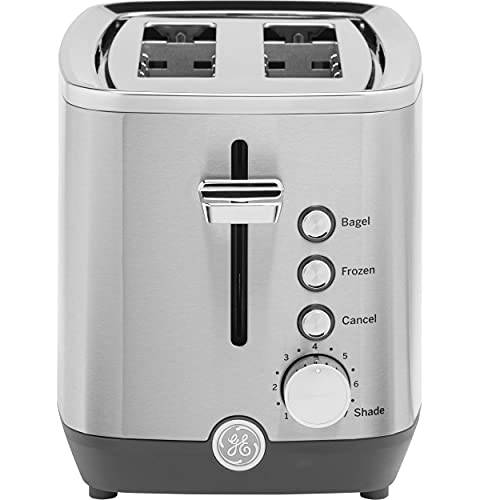
GE 2 Slice Stainless Steel Toaster — Best for Bagels and Thick Slices
The GE earns its badge on two published numbers most toasters hide: 1,500 watts of power and exact slot dimensions of 1.38 by 5.50 inches, per the listing. Power is what browns a thick, cold bagel half decisively instead of warming it apologetically, and published dimensions let you verify — before buying — that your slices actually fit.
It suits bagel-first households and thick-slice eaters who have been burned by underpowered toasters, and anyone who appreciates a manufacturer that prints its measurements.
Strengths
- Stated 1,500W for decisive browning of thick and frozen items
- Published slot dimensions (1.38 x 5.50 in) let you verify fit first
- Seven shade settings give finer control than six-step dials
Trade-offs
- Two-slice capacity, like the other specialists here
- Powerful elements reward learning your shade — start lighter
- Stainless finish needs wiping to stay smudge-free
| Spec | Detail |
|---|---|
| Format | 2-slice stainless steel |
| Power | 1,500 watts (per listing) |
| Slot size | 1.38 x 5.50 inches (per listing) |
| Controls | 7 shade settings, defrost function |
Wattage is the most under-discussed toaster specification and one of the most consequential. Higher power, well controlled, means the elements reach working temperature fast, recover between rounds quickly, and drive heat into dense or frozen items instead of merely drying their surfaces. Bagels are the test that exposes weak machines — a dense, thick half that needs real energy — and this GE is specified for exactly that test.
The seven-shade range pairs sensibly with the power: more steps to land a strong toaster’s output precisely on your color. Spend the first week calibrating per item — bread, bagel, waffle — and write the settings down. A powerful toaster calibrated is a joy; a powerful toaster guessed at will scorch while you learn.
Best for: Bagel and thick-slice households that want real power and verified fit / Not suited for: Buyers who never toast anything thicker than sandwich bread
Check the current price on Amazon
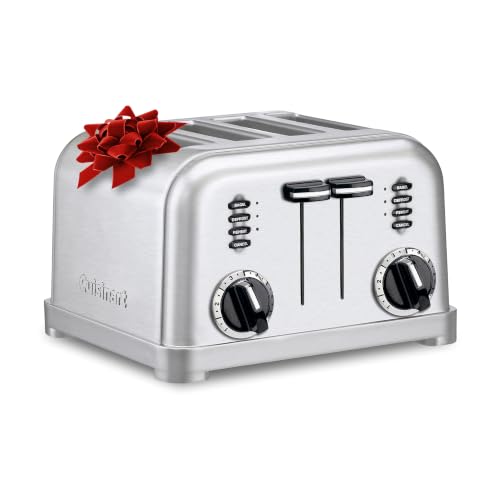
Cuisinart CPT-180P1 4-Slice Stainless Steel Toaster — Best for Families
Families do not need a more exotic toaster; they need this one. Four extra-wide slots toast the whole household’s bread in a single cycle, and dual independent controls — each side with its own six-setting dial, per the listing — mean the dark-toast parent and the pale-toast child are served simultaneously, correctly, without negotiation or a second round.
It suits households of three to five, shared kitchens, and anyone whose current two-slice machine creates a morning line for the most basic food in the house.
Strengths
- Four slices per cycle ends the family breakfast queue
- Dual independent controls serve two shades or breads at once
- Extra-wide slots take bagels and thick slices across all four slots
Trade-offs
- Larger counter footprint than two-slice picks
- Dial-only control, without countdown feedback
- Long artisan slices still exceed standard slot length
| Spec | Detail |
|---|---|
| Format | 4-slice, extra-wide slots |
| Controls | Dual independent, 6-setting browning dials |
| Build | Brushed stainless steel |
| Model | CPT-180P1 (per listing) |
The family case for dual controls is stronger than the case for raw capacity, and this machine offers both. In real kitchens the queue is rarely four identical slices — it is two bagels at one shade and two bread slices at another, wanted at the same moment. Independent sides collapse that into one cycle, which is the entire quality-of-life argument for a four-slice machine, delivered without premium pricing or commercial bulk.
As the household workhorse here, it also inherits the Cuisinart classic line’s ownership virtues: familiar controls, durable metal build, and behavior that stays consistent across the back-to-back rounds family mornings demand. If your bread toaster serves a household rather than a person, start your shortlist here.
Best for: Families and shared kitchens needing four slices, two ways, at once / Not suited for: Solo users or very small counters
Check the current price on Amazon
Amazon Basics 2 Slice Toaster — Best Basic Value
Sometimes the correct toaster is simply a competent one at the lowest sensible tier, and the Amazon Basics is that machine: extra-wide slots that fit bagels, six browning settings, dedicated defrost, cancel, and bagel buttons, a removable crumb tray, and a cord wrap for tidy storage, at a stated 900 watts in a black and silver finish.
It suits second locations and simple needs — a guest house, an office kitchenette, a rental, a dorm-adjacent first apartment — where toast should be easy and the machine should cost little enough that nobody thinks about it.
Strengths
- Full basic function set: bagel, defrost, cancel, six settings
- Extra-wide slots fit bagels, unlike many basic models
- Cord wrap and compact format suit stored or second-location use
Trade-offs
- Stated 900W is modest — slower browning and recovery
- Basic build and finish, as the tier promises
- Not the pick for daily heavy family service
| Spec | Detail |
|---|---|
| Format | 2-slice, extra-wide slots |
| Power | 900W (per listing) |
| Controls | 6 browning settings; defrost/cancel/bagel buttons |
| Extras | Removable crumb tray, cord wrap |
The honest way to judge a basic toaster is against basic failures, and this one avoids them: the slots are wide enough for real food, the controls include the three buttons a basic rotation actually uses, and the crumb tray removes for cleaning instead of sealing crumbs inside forever. The 900W figure sets the pace — toast takes a little longer and back-to-back rounds drift a little more — which is an acceptable trade where the machine toasts occasionally rather than constantly.
Buy it for the job it names. As a primary family toaster worked hard every day, the Hamilton Beach budget pick above is the stronger spend. As the second toaster in a household’s ecosystem — the guest, office, or starter machine — this is value done honestly.
Best for: Second locations, rentals, and simple low-volume toasting / Not suited for: Primary heavy-duty family service
Check the current price on Amazon
Comparison Table
| Pick | Badge | Key spec | Best for |
|---|---|---|---|
| Cuisinart CPT-160P1 2-Slice Metal Classic Toaster | Best Overall | 2-slice, 1.5-inch slots, 6-setting dial | Most households wanting a dependable everyday bread toaster |
| Breville BTA720XL ‘A Bit More’ Toaster, 2 Slice | Best for Precise Browning | Wide slots, Lift & Look, A Bit More | Perfectionists and home bakers with variable, thick loaves |
| Hamilton Beach 2 Slice Toaster (22794) | Best Budget | Extra-wide slots, Toast Boost, bagel setting | Budget buyers who still want bagel, defrost, and easy retrieval |
| GE 2 Slice Stainless Steel Toaster | Best for Bagels and Thick Slices | 1,500W, slots 1.38 x 5.50 in, 7 shades | Bagel and thick-slice households that want real power and verified fit |
| Cuisinart CPT-180P1 4-Slice Stainless Steel Toaster | Best for Families | 4-slice, dual independent controls | Families and shared kitchens needing four slices, two ways, at once |
| Amazon Basics 2 Slice Toaster | Best Basic Value | Extra-wide slots, 900W, bagel/defrost buttons | Second locations, rentals, and simple low-volume toasting |
How to Choose the Best Bread Toasters for Your Loaf and Your Household
Start with your bread, not with brands. Measure your thickest regular slice and your tallest, then shop slots: stated widths like the Cuisinart’s 1.5 inches or the GE’s published 1.38 by 5.50 inches are checkable facts, while ‘extra-wide’ without a number is a promise. Your thickest item must drop in without squeezing; your tallest must sit within the heated zone or you will toast in two passes forever.
Then size the machine to the household. One or two eaters belong in a two-slice; three to five belong in a four-slice with dual controls if shades differ; a second location belongs in a basic model. Finally, match controls to your rotation: bagel mode if bagels are weekly, a real defrost if you freeze bread sliced, a high-lift or boost if muffins and crumpets are regulars, and lift-and-look precision if your loaves vary because you bake them.
- Standard loaf, 1–2 people: Cuisinart CPT-160P1.
- Variable home-baked loaves: Breville BTA720XL for control.
- Bagels and thick slices first: GE 1500W with published slot size.
- Family of 3–5, mixed shades: Cuisinart CPT-180P1 dual-control four-slice.
- Tight budget, full rotation: Hamilton Beach 22794. Second location: Amazon Basics.
Why Does the Second Round of Toast Brown Faster?
Because the toaster is already hot. Elements, chamber walls, and the air inside start the second cycle at working temperature instead of room temperature, so the same dial setting delivers more browning. Every toaster in this guide does it; the only variable is how much. The fix is a habit, not a feature: drop one shade for consecutive rounds, or accept that round one is the calibration slice in a new machine until you learn its drift.
The same physics explains the pale-first-slice complaint on cold mornings and the scorched slice after a bagel cycle. Toasters are thermal systems with memory. Once you think of yours that way — hot machine, gentler setting; cold machine, patience — its behavior stops being mysterious and starts being a routine you control.
What Do Bagel Mode and Defrost Actually Do?
Bagel mode changes the heating balance: it toasts the cut face of a bagel half harder while treating the crust side more gently, so you get a crisp cut surface without a burnt crust. On machines without it, the workaround is a slightly lower shade and accepting a compromise. Defrost mode adds a gentle warming stage before full toasting power, thawing a frozen slice through so the browning stage works on thawed bread instead of charring the faces of a still-frozen center.
Both modes earn their buttons only if your rotation uses them. Weekly bagel eaters should treat bagel mode as required; households that freeze sliced loaves — the best way to keep good bread — should treat defrost the same way. If neither applies, a simpler machine serves you just as well and costs less.
Keeping a Bread Toaster Browning Evenly for Years
Most ‘worn-out’ toasters are dirty toasters. Crumbs accumulate around elements and insulate them unevenly, which reads as one side browning darker; sugary residues from waffles and pastries bake onto surfaces and smoke at high settings. Empty the crumb tray weekly in daily use — every pick here has a removable or slide-out tray — shake the machine over a bin monthly, and wipe the exterior while it is cool and unplugged. Never insert metal utensils into a plugged-in toaster, for retrieval or cleaning, ever.
Placement matters too. A toaster run in a steam-heavy corner near a kettle ages its controls faster, and one shoved against a wall vents its heat into the paint. Give it a dry, clear counter position and it will brown like itself for years; the machines in this guide are built to last exactly as long as their care allows.
The Bread Itself: How Loaf Choice Changes What ‘Best’ Means
A toaster can only be judged against a loaf, and loaves differ more than toasters do. Industrial sandwich bread is engineered for toasting — uniform slices, even moisture, predictable sugars — and every machine in this guide handles it well, which is why it is a poor test. The loaves that separate machines are the irregular ones: thick-cut farmhouse slices with dense centers, seeded breads whose surfaces brown in patches, enriched breads like brioche whose sugars race ahead of the crumb, and gluten-free loaves that toast pale, then suddenly, and dry out if you chase color.
Match the machine to your hardest regular loaf, not your easiest. Brioche households need fine shade granularity and the discipline to start light — the Breville’s increments serve them best. Seeded and farmhouse households need slot width and honest power — the GE’s published dimensions and wattage. Gluten-free households need defrost gentleness and patience, because that crumb punishes aggressive settings. The guide’s picks were chosen so each of those loaves has a home; find yours by loaf first and brand second.
And keep the loaf’s life in view. Bread toasts differently on day one and day four, and differently again from the freezer — a toaster that serves your household is one whose controls span that whole arc, not one that nails a single fresh slice in a showroom test.
Fresh, Day-Old, and Frozen: One Toaster, Three Jobs
Think of your toaster as working three distinct jobs. Fresh bread is the precision job: moist crumb, fast surface browning, and a narrow window between pale and scorched on enriched loaves. Day-old bread is the revival job: drier crumb that toasts faster and benefits from a shade less, emerging crisper than fresh toast ever is — many toast lovers quietly prefer it. Frozen bread is the engineering job: a thaw stage and a browning stage that must happen in sequence, which is what defrost functions automate and what manual two-pass technique imitates.
Households run these jobs in different proportions, and the proportions should steer the purchase. A bake-weekend household lives in jobs one and two and needs shade precision. A slice-and-freeze household lives in job three and needs a real defrost mode — it is their daily driver, not a bonus button. A buy-daily household barely meets job two. Rate your own proportions honestly and the shortlist in this guide sorts itself: precision picks for the bakers, defrost picks for the freezers, honest basics for everyone else.
Whichever proportion is yours, write the three settings down once you find them. Fresh 4, day-old 3, frozen on defrost at 4 — a card like that, stuck inside a cupboard door, is the difference between a toaster that performs and a toaster that gets blamed.
Toaster Versus Toaster Oven for Bread: The Honest Rematch
Every bread-toaster shopper eventually asks whether a toaster oven makes the pop-up redundant, and the honest answer is: for bread alone, no. A pop-up toaster heats both faces of a slice simultaneously, inches away, and finishes in a couple of minutes with a fraction of the energy. A toaster oven heats a cavity, toasts one face’s worth of radiation at a time in many designs, takes noticeably longer, and produces a drier, more baked result. For a household that toasts daily, the pop-up is not a compromise appliance — it is the specialist, and specialists beat generalists at their specialty.
The oven wins its own list: cheese toast and topped slices, reheating pizza, roasting small items, and the slice too misshapen for any slot. Kitchens with both appliances settle into a natural treaty — pop-up for plain toast and bagels, oven for everything topped, melted, or baked — and each machine lasts longer for not doing the other’s worst work. Kitchens choosing one should choose by the majority of their actual mornings, which for most households is plain toast, made fast, by a machine that lives for it.
If you do go oven-only, at least borrow this guide’s calibration habits: preheat awareness, per-item settings written down, and a crumb discipline. The physics of even browning does not change just because the box got bigger.
A Short History of Getting Toast Right at Home
Electric toasting began as a luxury of exposed glowing wires and bread turned by hand, one face at a time — which is why early toast was an attended dish, not an automatic one. The pop-up mechanism, the browning dial, and later the bagel setting and defrost staging each removed a layer of attendance, and the modern machines in this guide are the accumulated result: wide self-centering slots, controlled elements, and functions named for the exact items households actually toast. What has not changed in a century is the underlying negotiation — moisture leaving, sugars browning, a window of seconds between gold and gone — and the best toasters are simply the ones that give you the most control inside that window.
That history explains this guide’s recurring advice. Calibrate per loaf, because bread varies as it always has. Respect the second round’s heat, because thermal memory is physics, not a defect. Use the mode made for the item, because each function on a modern dial is a solved historical annoyance. The machines have absorbed a hundred years of breakfast mistakes so that yours does not have to repeat them — provided you meet them halfway with five minutes of calibration.
Breakfast Beyond the Slice: What Else a Bread Toaster Quietly Does
A bread toaster’s second career begins once a household trusts it. Frozen waffles for children on school mornings, reheated pizza slices crisped rather than microwaved into leather, pita halves warmed for sandwiches, tortillas blistered briefly for tacos, leftover naan revived, croissants split and toasted for breakfast sandwiches — a wide-slot machine with honest controls absorbs all of it, and most households discover these uses one accident at a time. The picks in this guide, with their extra-wide slots and bagel and defrost functions, are quietly the most versatile small appliances in many kitchens precisely because their owners experimented.
Two cautions keep the experimentation safe and the machine healthy. Anything filled, frosted, or likely to drip — pastries with jam fillings, buttered items, cheese-topped bread — belongs in a toaster oven, not in slots above open elements, where drips foul the chamber and can smoke or flare. And anything non-bread should be watched on its first run, because timings transfer poorly across food types; the settings card by your machine deserves a second column for the household’s discoveries, waffles and pita included.
Judged across that whole second career, the bread toaster’s value stops looking like a single-purpose luxury and starts looking like what it is: the fastest, cheapest way a kitchen owns to turn cold bread products into hot food, several times a day, for years. Buy the slots wide, the controls honest, and the tray removable — the rest of the menu will take care of itself.
Setting Up a Household Toast Station That Runs Itself
The kitchens where toast is effortless share a layout, and it takes ten minutes to copy. The toaster lives where it is used, with clearance above it and the bread — board, knife, and storage — within one step, so slicing and toasting form a single motion instead of a commute. The settings card lives inside the nearest cupboard door: bread type, state, and shade, in handwriting nobody has to decode at 7 a.m. Butter lives covered at room temperature within reach of where toast lands, and a small rack waits beside the machine so finished slices rest on air instead of steaming on a plate.
Household conventions finish the system. On dual-control machines, fix which side is whose — or which side is dark and which is light — and the machine’s independence stops causing its own confusion. Agree that the crumb tray belongs to whoever toasts last on a chosen day of the week, and the least-loved chore in the kitchen becomes a rota instead of a resentment. None of this costs anything, and together it is the difference between owning a good toaster and living in a kitchen where toast simply happens, correctly, every day — which was the point of every pick and every page in this guide.
Toast for One: Small Households and the Case for the Two-Slice
Much of this guide’s family logic reverses gracefully for the solo household, and the reversal deserves stating plainly. A two-slice machine heats faster, lives smaller, and matches a one-person rotation — a slice or two, a bagel half, a muffin — without the empty-chamber waste of running a four-slice for a single breakfast. Solo buyers should spend the size saving on control instead: the precision of the Breville or the power and published fit of the GE serves a single discerning eater better than capacity ever will.
The solo exception is the entertainer: the one-person household that hosts weekend brunches for six should buy for the brunch, not the weekday, because guests cannot be asked to queue in shifts the way a family tolerates. Know which solo household you are — the quiet weekday one or the weekend hub — and the two-slice versus four-slice question answers itself without a single specification being consulted.
How to Get Even Browning From Any Bread Toaster
Even browning is mostly technique. Run this routine with a new machine — or a new loaf — and record the results; five minutes of calibration pays back every morning.
- Start mid-dial with a single test slice of your actual bread, at its actual thickness. Judge it, then adjust one step at a time — never guess two steps at once.
- Center the slice in the slot. Wide slots brown a leaning slice unevenly; most self-center, but check yours does, especially with thin bread.
- Use the right mode for the item. Bagel mode for bagels, defrost for frozen, and plain toast for plain bread — modes exist because one setting cannot serve all three well.
- Drop one shade for the second consecutive round. The machine is hot; compensate for its memory instead of being surprised by it.
- Retrieve small items with the lever or boost, never a utensil. High-lift designs exist on several picks here precisely for muffins and crumpets.
- Rest toast briefly on a rack before buttering. Steam escaping for thirty seconds keeps crusts crisp instead of softening under the knife.
- Write your settings down. Bread type, thickness, fresh or frozen, shade number — a card by the toaster ends morning guesswork for the whole household.
Common Buying Mistakes
Buying slots by adjective instead of dimension. ‘Extra-wide’ without a stated measurement is marketing. Prefer listings that publish slot size, and measure your thickest slice before ordering.
Judging a toaster with one slice of thin bread. Thin sandwich bread is the easiest test there is. Judge on your thickest, densest, and frozen items — that is where machines separate.
Using one setting for everything. Bread, bagels, muffins, and frozen waffles each want their mode or shade. A household settings card beats a single heroic dial position.
Fishing for small items with a fork. Beyond the safety issue — never into a plugged-in toaster — metal near elements damages them. Choose high-lift or boost models if small items are your routine.
Neglecting the crumb tray. A full tray insulates, smokes, and eventually flavors toast with old crumbs. Weekly emptying is the cheapest performance upgrade in this entire guide.
Final Recommendation
For most kitchens, the Cuisinart CPT-160P1 is the bread toaster to buy: right-sized slots, honest controls, and a build that disappears into reliable routine. Precision lovers get the Breville BTA720XL; bagel-and-thick-slice households get the powerful, fully specified GE; families get the dual-control Cuisinart four-slice; tight budgets get the genuinely full-featured Hamilton Beach; and second locations get the Amazon Basics without apology. Match the slots to your loaf and the size to your household, calibrate once, and toast stops being a daily negotiation.
Keep exploring the cluster: Best Artisan Toasters Best Big Toasters Best Black And Decker Toasters Best Black Toasters 4 Slice Best 2 Slot Toasters Best Affordable Toasters
Frequently Asked Questions
What is the best slot width for bread toasters?
Enough to clear your thickest slice without squeezing — for most households that means a stated width around 1.5 inches, like the Cuisinart CPT-160P1 in this guide, or a published dimension you can verify, like the GE’s 1.38 by 5.50 inches. Measure your bread first; the right width is the one your loaf passes through freely.
Why does my toast brown unevenly on the two sides?
Usually centering or crumbs. A slice leaning in a wide slot presents one face closer to its element, and crumb buildup insulates elements unevenly over time. Center slices deliberately, empty the tray and shake the machine out regularly, and if one side still runs dark on every item, the element itself is aging — a replacement decision, not a settings one.
Is a 2-slice or 4-slice toaster better?
Neither — they serve different households. Two-slice machines suit one or two eaters and small counters; four-slice machines with dual controls suit families and mixed shades. The wrong size in either direction costs you daily: queues if too small, counter and slower heat-up if too big.
Do I need a bagel setting?
If bagels are a weekly food, yes — it crisps the cut face without burning the crust, which a single all-over setting cannot do. Occasional bagel eaters can manage with a lower shade and a watchful eye. The same logic applies to defrost if you freeze bread sliced.
How long should a bread toaster last?
Years of daily use for the metal-bodied machines in this guide, provided crumbs are kept out of the elements and levers are treated normally. The first signs of age are usually uneven browning from buildup — clean first, judge second — and a weakening spring or latch, which is a genuine end-of-life sign.
Can a bread toaster handle frozen waffles and pastries?
Frozen waffles, yes — defrost mode plus a moderate shade is exactly their routine, and extra-wide slots fit them. Filled pastries are riskier: leaking fillings foul elements and can smoke or flare, so follow the item’s own heating guidance and prefer a toaster oven for anything filled or frosted.


