Disclosure: airfryerkitchensupply.com is reader-supported. When you buy through links on our site, we may earn an affiliate commission at no extra cost to you.
Where to buy
Every linked pick in this guide to the best black and decker toasters was verified against Amazon catalog data for this storefront before writing, and each link goes straight to that model’s Amazon product page. Check the live listing for the exact finish, size, and configuration you want, and check price on Amazon at checkout rather than trusting any number printed in a review, because prices shift with promotions too often for a printed figure to stay honest. BLACK+DECKER sells several near-identical toaster variants, so confirm the exact model features in the listing title — slot count, shade settings, and finish — before ordering, because the same body appears in multiple configurations.
- BLACK+DECKER 4-Slice Toaster with Extra-Wide Slots (B00SMS3KZO) — Check the current price on Amazon
- BLACK+DECKER 4-Slice Toaster with Dual Shade Controls (B01MQK2DA6) — Check the current price on Amazon
- BLACK+DECKER 4-Slice Toaster with 7 Shade Settings (B0F11PKJDW) — Check the current price on Amazon
- BLACK+DECKER 2-Slice Toaster with Bagel Mode (B00V5VEYBE) — Check the current price on Amazon
- BLACK+DECKER 2-Slice Toaster, Stainless Steel (B0CB6Z43HD) — Check the current price on Amazon
- BLACK+DECKER 2-Slice Toaster with Extra-Wide Slots (B002CVTT4S) — Check the current price on Amazon
The best black and decker toasters share a philosophy that has kept the brand on counters for decades: extra-wide slots, straightforward controls, bagel and frozen functions where they matter, and prices that treat a toaster as a tool rather than a trophy. The challenge is not finding a BLACK+DECKER toaster — it is telling the variants apart, because the range runs from compact two-slice basics to four-slice dual-control family machines that share names, shapes, and finishes. This guide does that sorting with six verified models.
Each pick below was verified against Amazon catalog data for this storefront, and the listing titles themselves supply the distinguishing evidence: slot counts, seven versus six shade settings, dual shade controls, extra-lift levers, and finishes from classic black and silver to stainless steel and a Baked Stone colorway noted in the range. Where two models look interchangeable, the reviews say which one to buy and why — because in this range, the wrong twin is the most common purchasing mistake.
One scope note: this guide covers BLACK+DECKER pop-up toasters only. The brand’s toaster ovens and air-fry ovens are a different category with different strengths, and they appear in the catalog searches for this brand constantly — if you want an oven, you want a different guide. Here, it is slots, shades, and bagels, six ways.
In this guide
Quick Picks
BLACK+DECKER 4-Slice Toaster with Extra-Wide Slots (B00SMS3KZO) — Best Overall. The range’s center of gravity: four extra-wide slots, seven shade settings, and bagel mode — the family BLACK+DECKER that most buyers actually need. Check price on Amazon.
BLACK+DECKER 4-Slice Toaster with Dual Shade Controls (B01MQK2DA6) — Best for Mixed-Shade Households. Dual shade controls and extra-lift levers across four slots — two breakfasts at two shades in one cycle, with small items easy to retrieve on both sides. Check price on Amazon.
BLACK+DECKER 4-Slice Toaster with 7 Shade Settings (B0F11PKJDW) — Best Newer 4-Slice. The newer four-slice configuration: bagel, frozen, and cancel functions with a high-lift lever and seven shade settings — the function-complete alternative to the classic model. Check price on Amazon.
BLACK+DECKER 2-Slice Toaster with Bagel Mode (B00V5VEYBE) — Best 2-Slice for Bagels. The two-slice with the full bagel story: extra-wide slots, a dedicated bagel mode, seven shades, and an extra-lift lever — the small BLACK+DECKER done completely. Check price on Amazon.
BLACK+DECKER 2-Slice Toaster, Stainless Steel (B0CB6Z43HD) — Best Stainless 2-Slice. The stainless-steel two-slice: extra-wide slots and seven shade settings in the finish that matches modern kitchens and wipes clean in seconds. Check price on Amazon.
BLACK+DECKER 2-Slice Toaster with Extra-Wide Slots (B002CVTT4S) — Best Budget Classic. The long-running compact classic: extra-wide slots, six shade settings, and a removable crumb tray — the simplest honest BLACK+DECKER, and the budget floor of the range. Check price on Amazon.
How These Picks Were Chosen
Picks were chosen to map the BLACK+DECKER pop-up range honestly — by slot count, control layout, and function set — using the listing titles themselves as the evidence, because this brand’s variants are distinguished by exactly those details. Every linked model was verified against Amazon catalog data for this storefront on 2026-11-21; several additional variants appeared in the same verification search (including a Baked Stone finish two-slice and the brand’s toaster ovens), and the six chosen are the pop-up models that cover the range’s distinct jobs without duplication. No prices or rating figures are printed because both change too often to stay honest.
Toaster ovens from the same brand were deliberately excluded: they are a different appliance category. If your search for a BLACK+DECKER ‘toaster’ actually wants baking and air-frying in a countertop oven, that is a different guide and a different shortlist.
The 6 Best Black and Decker Toasters

BLACK+DECKER 4-Slice Toaster with Extra-Wide Slots (B00SMS3KZO) — Best Overall
This four-slice model is the BLACK+DECKER toaster in its most complete everyday form. The listing confirms the essentials that define the brand at its best: extra-wide slots that take bagels and thick slices without squeezing, seven shade settings for finer browning control than the six-step basics, a dedicated bagel mode, and a removable crumb tray for real cleaning.
It suits households of three to five who want one machine for the full rotation — bread, bagels, frozen items — with the brand’s value pricing intact and no feature that matters left on the table.
Strengths
- Four extra-wide slots cover family breakfast in one cycle
- Seven shade settings plus bagel mode for the full rotation
- Removable crumb tray keeps cleaning honest and simple
Trade-offs
- Single shade control across the machine, unlike the dual-control sibling
- Value-tier finish compared with premium stainless brands
- Standard slot length still limits very long artisan slices
| Spec | Detail |
|---|---|
| Format | 4-slice, extra-wide slots |
| Controls | 7 shade settings, bagel mode |
| Cleaning | Removable crumb tray |
| Brand line | BLACK+DECKER pop-up toaster range |
Within this brand, the overall pick is decided by completeness per dollar, and this model has no hole in its feature list for ordinary family use. The seven-step shade range matters more than it sounds: BLACK+DECKER’s browning curve is assertive, and the extra step gives you a landing spot between ‘almost’ and ‘too far’ that six-step owners sometimes miss. Bagel mode completes the rotation honestly rather than as a checkbox — cut sides get the attention, crusts stay intact.
The one upgrade worth considering is directly below: if your household splits into two shade camps every morning, the dual-control model’s independence beats this one’s simplicity. If you toast as a household unit, save the difference and buy this one — it is the range’s sweet spot.
Best for: Families wanting the complete BLACK+DECKER feature set in one machine / Not suited for: Households needing two different shades in the same cycle
Check the current price on Amazon
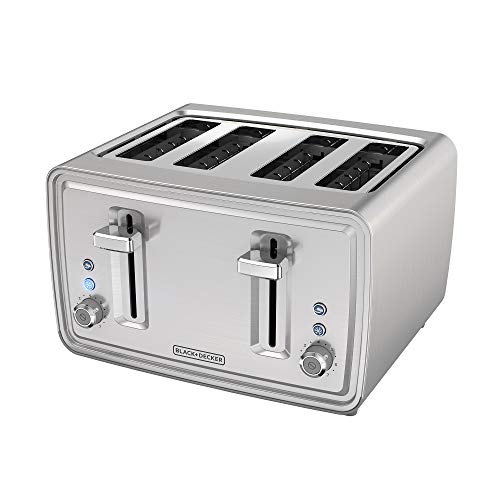
BLACK+DECKER 4-Slice Toaster with Dual Shade Controls (B01MQK2DA6) — Best for Mixed-Shade Households
The dual-control four-slice exists for the household argument nobody wins: one person eats toast pale, the other eats it dark, and both eat at 7 a.m. Its listing confirms dual shade controls — each side runs its own browning — plus extra-lift levers that raise small slices and muffins into reach, and pull-out crumb trays for cleanup.
It suits couples and families with split shade loyalties, and shared kitchens where a single-control machine creates a daily negotiation nobody enjoys.
Strengths
- Dual shade controls serve two preferences in one cycle
- Extra-lift levers retrieve muffins and small slices safely
- Pull-out crumb trays make the cleaning routine quick
Trade-offs
- Sits above the single-control four-slice in the range’s pricing
- Two control sets to learn and keep set correctly
- Still value-tier materials, as the brand promises
| Spec | Detail |
|---|---|
| Format | 4-slice |
| Controls | Dual shade controls (per listing) |
| Retrieval | Extra-lift levers |
| Cleaning | Pull-out crumb trays |
Judge this model against its own sibling, not against other brands. The premium over the single-control four-slice buys exactly one thing — independence — and in the right household that thing is worth more than any other feature in the range. Two shades at once also means two breakfasts finish together, which matters on school and work mornings when ‘together’ is the entire schedule.
The extra-lift levers are the supporting feature that proves its worth weekly. Four-slice machines sit deep, and the side toasting muffins is usually the side someone fishes in. A lever that presents the food ends that habit on both sides of the machine. If your household toasts as one, buy the simpler model; if it toasts as two, buy this one and end the argument permanently.
Best for: Couples and families split between light and dark toast / Not suited for: Single-shade households who gain nothing from dual controls
Check the current price on Amazon

BLACK+DECKER 4-Slice Toaster with 7 Shade Settings (B0F11PKJDW) — Best Newer 4-Slice
BLACK+DECKER’s range refresh shows in this four-slice: the listing pairs seven shade settings with the modern function trio — bagel, frozen, and cancel buttons — plus a high-lift lever and removable crumb tray. Against the classic four-slice above, it trades nothing essential and adds the frozen function as a named, dedicated control, which matters in households that toast straight from the freezer daily.
It suits freezer-first households and buyers who prefer the newer configuration’s button layout and high-lift retrieval over the classic model’s dial-first presentation.
Strengths
- Dedicated bagel, frozen, and cancel functions
- High-lift lever for safe retrieval of small items
- Seven shade settings for finer browning steps
Trade-offs
- Very close in purpose to the classic four-slice — choose once, carefully
- Single shade zone across all four slots
- Newer variant with a shorter track record than the classic line
| Spec | Detail |
|---|---|
| Format | 4-slice |
| Controls | 7 shade settings |
| Functions | Bagel, frozen, cancel (per listing) |
| Retrieval | High-lift lever; removable crumb tray |
Frozen function honesty is worth a paragraph, because it separates configurations in this range. A dedicated frozen setting stages the heat — thaw, then brown — so a slice from the freezer emerges toasted rather than scorched outside and cold inside. Households that freeze sliced bread as their storage method, which is the correct method for keeping good bread, use that function daily; for them this newer four-slice is the better twin.
For everyone else, the choice between this and the classic four-slice is genuinely close, and either serves a family well. Decide on the function list you will actually touch: frozen daily means this one; bagel daily and a preference for the established line means the classic. Do not buy both features’ worth of worry — the toast is good either way.
Best for: Freezer-first households wanting the newer function layout / Not suited for: Buyers who prefer the longest-established model in the range
Check the current price on Amazon
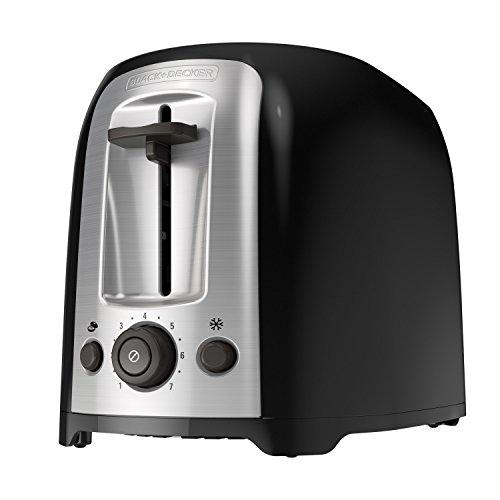
BLACK+DECKER 2-Slice Toaster with Bagel Mode (B00V5VEYBE) — Best 2-Slice for Bagels
Among the brand’s two-slice machines — and there are several near-twins — this is the complete one. The listing confirms extra-wide slots, bagel mode, seven shade settings, an extra-lift lever, and a removable crumb tray: every feature a two-slice rotation actually uses, with nothing stripped to hit a lower shelf price.
It suits one- and two-person households whose rotation leans bagel-heavy, and anyone downsizing from a four-slice who refuses to give up functions along with slots.
Strengths
- Dedicated bagel mode on a two-slice machine
- Extra-lift lever solves small-item retrieval
- Seven shade settings and extra-wide slots at two-slice size
Trade-offs
- Two slices at a time, with two-slice throughput
- Several similar two-slice siblings make careful model-checking essential
- Value-tier finish, consistent with the range
| Spec | Detail |
|---|---|
| Format | 2-slice, extra-wide slots |
| Controls | 7 shade settings, bagel mode |
| Retrieval | Extra-lift lever |
| Cleaning | Removable crumb tray |
Bagel mode is the feature that justifies choosing this twin over the others, and it is a real function, not a label: the heating balance shifts so the cut face crisps while the crust side is treated gently. On a two-slice machine in a bagel household, that difference shows up every single morning, which is more than can be said for most feature-list padding. The extra-lift lever is the second daily feature — bagel halves and muffins sit deep in wide slots, and retrieval should not be a utensil job.
If your rotation is plain bread only, the classic two-slice below saves a little and loses nothing you use. If bagels or muffins appear weekly, this is the two-slice BLACK+DECKER to buy, and the small premium over its plainer siblings is the best-spent money in the range.
Best for: Small households with a bagel-and-muffin rotation / Not suited for: Plain-bread-only buyers who can take the simpler twin
Check the current price on Amazon
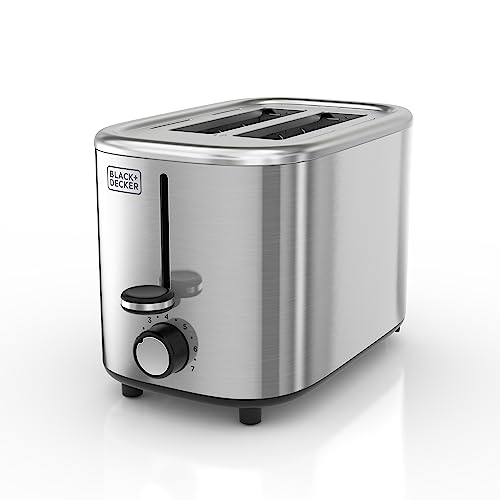
BLACK+DECKER 2-Slice Toaster, Stainless Steel (B0CB6Z43HD) — Best Stainless 2-Slice
Finish is a legitimate reason to choose within this range, and this is the stainless answer: a two-slice BLACK+DECKER in stainless steel, per the listing, with extra-wide slots, seven shade settings, and a crumb tray. In a kitchen of stainless appliances, it is the model that looks intentional rather than inherited.
It suits style-aware small households and anyone replacing a plastic-bodied basic with a machine that belongs on a modern counter — without leaving the brand’s value tier to do it.
Strengths
- Stainless steel finish matches modern appliance suites
- Extra-wide slots and seven shades cover the everyday rotation
- Crumb tray keeps the cleaning routine simple
Trade-offs
- No dedicated bagel mode named in its listing, unlike the sibling above
- Stainless shows fingerprints and needs a wipe-down habit
- Two-slice throughput, as with all compact picks
| Spec | Detail |
|---|---|
| Format | 2-slice, extra-wide slots |
| Finish | Stainless steel (per listing) |
| Controls | 7 shade settings |
| Cleaning | Crumb tray |
The honest comparison is with the bagel-mode two-slice directly above: same slot story and shade count, different priorities. This model spends its budget on the finish; the other spends it on functions. Neither is wrong — kitchens differ. If your counter is a stainless lineup and your rotation is bread-first, this is your twin. If bagels are weekly, functions beat finish and the model above wins.
Stainless ownership is a wiping habit, nothing more dramatic: a damp cloth weekly keeps it looking like the listing photo. In exchange, the body shrugs off the heat discoloration and staining that age plastic-bodied basics, which is why stainless two-slices tend to be the ones still on the counter in year five.
Best for: Stainless kitchens wanting a matching, capable two-slice / Not suited for: Bagel-mode devotees, who should take the sibling above
Check the current price on Amazon

BLACK+DECKER 2-Slice Toaster with Extra-Wide Slots (B002CVTT4S) — Best Budget Classic
Every range has a foundation model, and this is BLACK+DECKER’s: a compact two-slice with extra-wide slots, six shade settings, and a removable crumb tray, per the listing. It omits the bagel mode and extra-lift refinements of its siblings and keeps the two things a basic toaster must not omit — slots wide enough for real bread and a tray that actually comes out for cleaning.
It suits students, first apartments, offices, guest rooms, and anyone whose toasting is plain bread and the occasional bagel half, at the gentlest price point in the brand’s range.
Strengths
- Extra-wide slots even at the range’s budget floor
- Simple six-setting control anyone can use instantly
- Compact footprint suits small and shared spaces
Trade-offs
- No bagel mode or frozen function in its listed features
- Six shade steps give coarser control than seven-step siblings
- Basic build and finish, exactly as its tier intends
| Spec | Detail |
|---|---|
| Format | 2-slice compact, extra-wide slots |
| Controls | 6 shade settings |
| Cleaning | Removable crumb tray |
| Role | Entry model of the range |
The measure of a budget classic is what it refuses to cheapen, and slots are the correct refusal. A narrow-slot budget toaster fails at bread itself; this one takes thick slices and bagel halves from day one, which is why this model format has persisted in the range while fancier basics came and went. Its six settings cover the practical browning range for sandwich bread and standard slices without pretense.
Buy it with clear eyes: it is a plain-bread machine with wide slots, not a full-rotation machine missing a button or two. Households whose rotation grows — bagels weekly, frozen bread daily — should step directly to the bagel-mode two-slice above rather than upgrading in disappointment later. For the simple job, this remains the range’s honest floor.
Best for: Students, first kitchens, and plain-bread basics on a budget / Not suited for: Full-rotation households needing bagel and frozen functions
Check the current price on Amazon
Comparison Table
| Pick | Badge | Key spec | Best for |
|---|---|---|---|
| BLACK+DECKER 4-Slice Toaster with Extra-Wide Slots (B00SMS3KZO) | Best Overall | 4-slice extra-wide, 7 shades, bagel mode | Families wanting the complete BLACK+DECKER feature set in one machine |
| BLACK+DECKER 4-Slice Toaster with Dual Shade Controls (B01MQK2DA6) | Best for Mixed-Shade Households | 4-slice, dual shade controls, extra-lift levers | Couples and families split between light and dark toast |
| BLACK+DECKER 4-Slice Toaster with 7 Shade Settings (B0F11PKJDW) | Best Newer 4-Slice | 4-slice, bagel/frozen/cancel, high-lift lever | Freezer-first households wanting the newer function layout |
| BLACK+DECKER 2-Slice Toaster with Bagel Mode (B00V5VEYBE) | Best 2-Slice for Bagels | 2-slice extra-wide, bagel mode, extra-lift | Small households with a bagel-and-muffin rotation |
| BLACK+DECKER 2-Slice Toaster, Stainless Steel (B0CB6Z43HD) | Best Stainless 2-Slice | Stainless steel, extra-wide slots, 7 shades | Stainless kitchens wanting a matching, capable two-slice |
| BLACK+DECKER 2-Slice Toaster with Extra-Wide Slots (B002CVTT4S) | Best Budget Classic | Compact 2-slice, extra-wide slots, 6 shades | Students, first kitchens, and plain-bread basics on a budget |
How to Choose the Best Black and Decker Toasters: Telling the Twins Apart
Shop this range by configuration, not by name, because the names repeat. Decide three things in order. First, slots: two for one or two eaters, four for families. Second, controls: a single shade control for unified households, dual shade controls for split households — that one decision separates the two four-slice picks in this guide. Third, functions: bagel mode if bagels are weekly, a frozen function if bread lives in your freezer, an extra-lift or high-lift lever if muffins and crumpets are regulars.
Then, and only then, choose the finish — black, stainless, or a colorway — because finish is the one choice that does not change the toast. Buyers who shop finish-first in this range reliably end up with the wrong twin: a beautiful machine missing the one function their rotation needed.
- Family, one shade: 4-Slice Extra-Wide (Best Overall).
- Family, two shades: 4-Slice Dual Shade Controls.
- Freezer-first family: 4-Slice with frozen function and high-lift lever.
- Small household, bagel rotation: 2-Slice with Bagel Mode.
- Small household, stainless kitchen: 2-Slice Stainless Steel.
- Simplest budget basic: 2-Slice Classic with 6 shade settings.
What Do Shade Settings Really Change Between Models?
Six versus seven settings sounds trivial, and in most ranges it would be. In this one it matters at the margins that daily users notice: BLACK+DECKER’s browning runs assertive, and the seventh step inserts a landing place in the zone where many households live — between a six-step machine’s ‘nearly’ and ‘nearly too much.’ If your household argues about half-shades, take the seven-step models; if you eat toast at whatever the middle setting gives you, six steps will never trouble you.
Dual controls are a different axis entirely: not finer steps, but independent ones. Two sides, two settings, two breakfasts at once. Confusing ‘more settings’ with ‘independent settings’ is the range’s most common specification mistake — check which of the two a listing is actually promising before you buy.
Are BLACK+DECKER Toasters a Good Long-Term Buy?
The brand’s proposition is durability of the simple kind: mechanical levers, straightforward dials and buttons, wide slots that do not ask bread to change, and crumb trays that come out. There are no apps, no touchscreens, and little to become obsolete. Owners who empty trays, keep crumbs out of the elements, and avoid utensil fishing routinely get years of daily service from even the budget classic in this guide.
The honest limit is refinement, not reliability. If you want countdown displays, motorized carriages, or lift-and-look precision, other brands in this program’s toaster guides serve that want at higher tiers. BLACK+DECKER’s range is for buyers who want the toast right and the machine uncomplicated — a want it has served consistently for a very long time.
A Short Note on Finishes: Black, Stainless, and Colorways
The verification search for this guide surfaced the range’s finish spread, including stainless models and a Baked Stone colorway two-slice alongside the classic black bodies. Finishes change ownership, not toast: black hides crumbs and blends into most kitchens, stainless matches appliance suites and wipes to a shine but shows fingerprints, and light colorways brighten a counter while asking for a regular wipe near a busy stove. Choose the finish you will enjoy looking at daily, after the configuration is right — and confirm the finish in the listing title before ordering, because the same model body ships in more than one.
BLACK+DECKER Across the Day: One Range, Every Slot in the Kitchen
A useful way to understand this range is to watch it work a full day in the households it serves. Morning is the four-slice machines’ shift: family bread and bagels in one or two cycles, dual controls settling the shade split without a word. Midday belongs to the two-slices — a single sandwich toast, a muffin under the extra-lift lever, the office classic cycling through a shared kitchen’s lunches without anyone reading a manual. Evening is the quiet shift: a frozen slice through the newer four-slice’s frozen function for a late supper, the stainless two-slice wiping clean in a kitchen that hosts as much as it cooks.
The point of the day-in-the-life view is that no single model is the range’s hero. Each configuration owns a shift and a household shape, and the brand’s consistency — wide slots everywhere, trays that remove everywhere, controls a guest can operate — is what lets a household mix them across locations without relearning anything. Buy the configuration for the shift you actually run, and the range’s famous uncomplicatedness does the rest.
What Owners Usually Upgrade — and What They Keep
Long-term owners of this range tend to upgrade along a predictable path, and knowing it in advance saves a purchase. The first upgrade is almost always functions: the plain-bread classic gives way to the bagel-mode two-slice or the frozen-function four-slice when a household’s rotation outgrows plain bread — which is why this guide steers growing rotations to the fuller models immediately. The second upgrade is independence: dual controls arrive when a second person’s shade preference becomes a daily fact. The third, if it comes, is capacity itself, two slots becoming four when a household grows.
What owners keep is equally instructive. The wide slots are never the complaint; the simple levers and dials are never the complaint; the removable trays are quietly praised in every kitchen that has owned a sealed-bottom toaster before. The range’s weaknesses — value-tier finishes, assertive browning that needs calibration, standard slot length — are the known, priced-in kind. A buyer who understands that pattern buys once, at the right rung, instead of climbing the ladder one disappointment at a time.
If you are buying for a household in transition — a student becoming a professional, a couple becoming a family — buy one rung ahead of today. The price steps inside this range are small, and the machine you will need in eighteen months is the bargain when bought first.
Troubleshooting the Usual BLACK+DECKER Complaints
Three complaints follow this range around, and all three have household fixes. Uneven browning on one side is, in order of likelihood, a leaning slice in a wide slot, a crumb tray overdue for emptying with buildup insulating one element, or a genuinely aging element — check the first two, which cost nothing, before concluding the third. Toast darker than the dial suggests is the brand’s assertive browning meeting an uncalibrated user; drop a setting and record the new one rather than fighting the dial daily. A carriage that will not latch is usually crumb debris in the mechanism — unplug, cool, invert, shake gently — and only occasionally a worn latch.
The frozen complaint deserves its own line: slices toasted from frozen on a plain bread setting scorch outside and stay cold inside on any brand, and the fix is the frozen function where fitted, or a low thaw pass followed by a normal pass where it is not. Owners who learn that one sequence stop blaming the machine for a physics problem.
None of this requires a service visit, which is rather the point of the range. Keep crumbs out, calibrate once, use the lift instead of utensils, and the troubleshooting chapter of BLACK+DECKER ownership stays mercifully short.
Gifting and Second-Location Buying in This Range
Toasters are gifted constantly and chosen carelessly, and this range is where careful gifting is easiest. For a student or first apartment, the budget classic or the bagel-mode two-slice lands perfectly: wide slots forgive the bread quality of a starter kitchen, and the controls need no instruction. For a wedding or housewarming, the stainless two-slice or the dual-control four-slice reads as considered rather than default, because both match how couples actually discover their shade differences in the first year.
Second locations — the office, the guest suite, the rental, the workshop kitchen — reward the same logic in reverse: choose the model whose absence of features nobody will notice there. The classic’s six settings and wide slots cover a guest’s breakfast completely, and its simplicity means the machine works for every visitor without a briefing. Spend the refinement budget on the primary kitchen, where the rotation is real, and let the second location run the honest basic. That allocation, repeated across a household’s appliances, is how kitchens end up both well equipped and sensibly spent.
How This Range Compares With the Wider Toaster Market
Placed against the wider market, BLACK+DECKER’s range occupies the honest middle-bottom with unusual clarity about what it is. Above it sit the precision brands — the Brevilles of this program’s other guides — selling lift-and-look feedback, motorized carriages, and die-cast weight at multiples of these prices. Beside it sit the other value ranges, competing on novelty finishes and feature inflation. Below it sit the unbranded basics, where slot width and crumb trays start disappearing from the specification. The BLACK+DECKER proposition is to hold the line where it matters — wide slots, named functions, removable trays, simple controls — at prices that make a toaster a purchase rather than a project.
That clarity cuts both ways, and this guide has tried to keep both edges visible. A buyer whose mornings involve variable home-baked loaves will genuinely outgrow this range’s feedback-free controls, and should shop the precision tier directly rather than climbing here first. A buyer whose mornings involve a family, a rotation, and a schedule will find nothing in the precision tier that fixes a problem they actually have — their problems are slots, shades, independence, and throughput, and this range solves exactly those, cheaply and durably.
The comparison that matters least is the one most shoppers start with: brand prestige. Toast does not know what logo is on the box; it knows slot width, element behavior, and whether the person setting the dial had a way to get it right. Judge every range — this one included — on those three, and the market sorts itself with surprising speed.
Safety Habits for a High-Use Family Toaster
Toasters are among the hardest-working heating appliances in a home, and the safety habits around them are simple enough that a household can adopt all of them this week. Keep the machine clear of curtains, paper, and plastic storage while it runs — a four-slice at full load radiates real heat. Never leave a toaster running unattended with sugary or filled items, which can catch as they leak. Teach children the lever, the lift, and the absolute rule about utensils, in that order, and let them toast under supervision until the habits are theirs.
Electrical habits matter at family scale: plug directly into a wall outlet, keep the cord off hot surfaces and away from the sink’s splash zone, and unplug by the plug rather than the cord when the machine is moved for cleaning. Crumbs are a safety item, not just a quality one — a tray emptied weekly and a chamber shaken out monthly remove the fuel that causes smoking cycles and, left long enough, worse.
Finally, know a toaster’s retirement signs: a latch that will not hold, an element that glows in patches, a cord that is frayed or hot in use, or browning that swings wildly between identical cycles. This range is inexpensive to replace and built to be replaced rather than repaired at home — retiring a tired unit on time is part of owning the range well.
Replacement, Warranty Thinking, and Knowing When to Move On
Value appliances invite a practical question the premium tier avoids: repair or replace? For this range, the honest answer is almost always replace — the machines are priced so that a single service visit exceeds their worth, and their failure modes (latch wear, element fatigue, tired springs) arrive together after years rather than singly in youth. The ownership skill is recognizing the arrival: browning that swings between identical cycles, a carriage that latches only when persuaded, or an element glowing in patches are the range’s way of announcing a completed service life.
When replacement day comes, the configuration discipline in this guide pays off a second time. You no longer shop the whole market; you shop one rung — the same configuration, or the one rung your household has grown into — and the purchase takes five informed minutes. Keep the old machine’s settings card if you made one; browning preferences transfer between siblings in this range closely enough to save the calibration week. That continuity, across years and replacements, is the quiet long-term value of buying inside a coherent range at all.
One Last Check Before You Order
Before you order any model in this guide, run the sixty-second checklist that prevents the range’s classic mistakes. Read the listing title once more and confirm, in its own words: the slot count you intended, the control type you intended — single or dual — the functions your rotation actually uses, and the finish you meant to buy. Confirm the seller is shipping the configuration in that title, because variant listings in this range sometimes sit one click apart. That single minute, spent on the exact model rather than the brand, is the whole secret to buying well inside a range of near-twins — and it is the note this guide most wants to leave with you.
How to Set Up a BLACK+DECKER Toaster and Dial In Your Shade
Five minutes of calibration turns any model in this range from approximate to automatic. Run it once per bread type and write the results down.
- Burn off the new-machine smell. Run one or two empty cycles in a ventilated kitchen before the first slice — standard for any new toaster.
- Start at the middle setting with your actual bread. Judge the result honestly; this brand browns assertively, so your landing spot may be a step lighter than on other machines.
- Set each side separately on dual-control models. Calibrate the left and right zones independently and label the household convention if shades differ by person.
- Test the bagel mode with a real bagel. Cut side behavior is the point of the function; confirm your shade for bagels separately from bread.
- Test frozen from your freezer. If your model has a frozen function, calibrate it with your actual sliced loaf rather than assuming the bread setting plus time.
- Record the settings. A card near the machine — bread 3, bagel 4, frozen 4 with function — ends morning guesswork for every user.
- Empty the crumb tray after the first week, then weekly. These trays remove easily on every pick here; make the habit while the machine is new.
Common Buying Mistakes
Buying the wrong twin. This range’s models share bodies and names. Verify slot count, shade steps, dual versus single control, and functions in the listing title before ordering — not after unboxing.
Assuming every model has bagel mode. It does not — the budget classic’s listed features omit it. If bagels are weekly, choose a model whose listing names the function.
Confusing more settings with dual controls. Seven steps is finer control of one zone; dual controls are two independent zones. Split households need the second, not the first.
Skipping calibration because the machine is inexpensive. Value toasters brown assertively and vary by model. One test slice per bread type saves a week of scorched learning.
Fishing with utensils instead of using the lift. Several models here include extra-lift or high-lift levers for exactly this. Use them — and never insert metal into a plugged-in toaster.
Final Recommendation
Most BLACK+DECKER shoppers should buy the 4-Slice Extra-Wide overall pick and stop deliberating: it is the range’s complete family machine. Split-shade households step to the Dual Shade Controls model, freezer-first families to the newer four-slice with its frozen function, and small households choose between the bagel-mode two-slice, the stainless two-slice, and the budget classic according to rotation, finish, and spend — in that order. In a range built on near-twins, the winning move is simply choosing your configuration deliberately, and every machine above rewards that one careful minute.
Keep exploring the cluster: Best Bread Toasters Best Black Toasters 4 Slice Best Big Toasters Best Artisan Toasters Best 2 Slot Toasters Best Affordable Toasters
Frequently Asked Questions
Which BLACK+DECKER toaster is best for most people?
The 4-Slice with Extra-Wide Slots in this guide: four slices, seven shade settings, and bagel mode cover a family’s full rotation. Small households get the same logic in the 2-Slice with Bagel Mode. The brand’s range is a ladder of configurations, and ‘best’ is simply the rung that matches your household size and function list.
What is the difference between the BLACK+DECKER 4-slice models?
Controls and functions. One four-slice runs a single shade control with bagel mode; one adds dual shade controls and extra-lift levers; the newer one pairs seven settings with bagel, frozen, and cancel functions and a high-lift lever. Same family, three different answers to how your household toasts — the reviews above separate them in detail.
Do BLACK+DECKER toasters fit bagels and thick bread?
The extra-wide slot models — most of this guide — are designed for exactly that, and their listings say so. The caution is length, not width: very long artisan slices exceed standard slot length on any model here, which is a long-slot category’s job rather than this range’s.
Are BLACK+DECKER toasters the same as their toaster ovens?
No. The pop-up toasters in this guide toast sliced bread in slots; the brand’s toaster ovens and air-fry ovens bake, broil, and toast in a cavity. They appeared in the same catalog searches and confuse many shoppers — decide which appliance you want before comparing models, because they do different jobs.
How do I stop my toast browning too dark on the second round?
Drop one shade setting for consecutive rounds. The machine starts hot, so the same setting delivers more browning — true of every toaster, and easily managed once you expect it. If one side consistently runs darker across all rounds, empty the crumb tray and check for buildup before blaming the machine.
How long do BLACK+DECKER toasters last?
The range is built on simple mechanical controls with few failure fashions, and owners who keep crumbs out of the elements and use the lift levers rather than utensils routinely get years of daily service — including from the budget classic. Treat the lever gently, keep the tray empty, and the machine will outlast several kitchen trends.


