Disclosure: airfryerkitchensupply.com is reader-supported. When you buy through links on our site, we may earn an affiliate commission at no extra cost to you.
Where to buy
The best 12 volt electric fencer models are sold on Amazon by the brands and specialist sellers in this guide, and the listings state the two numbers that matter — stored joules and power source — in their titles. Start from the verified links in this box and confirm both details on the page, because the same brand sells AC, solar and battery versions that look alike. A fencer is livestock equipment, not a gadget: if a listing cannot tell you its joule rating, do not buy it.
- Cyclops Stallion Battery Fence Charger — 2.5 Joule, 12V — Check price on Amazon
- Cyclops Super Battery Fence Charger — 12 Joule, 12V — Check price on Amazon
- Fence Master Solar 12 Volt Battery Fence Charger — 6 Mile — Check price on Amazon
- Electric Fence Charger Energizer — 9 Joule, AC/DC 12V — Check price on Amazon
- Briidea Electric Fence Energizer — 3 Joule, 50-Mile, Battery or AC — Check price on Amazon
- VEVOR Electric Fence Charger — 3 Joule, AC/DC — Check price on Amazon
The best 12 volt electric fencer — the energizer that powers an electric fence from a 12 volt battery — is chosen on one number above all others: joules. Stored energy in joules is what pushes a pulse through vegetation, long fence lines and less-than-perfect grounding to deliver a memorable, harmless deterrent at the far end. The picks here span from a portable 2.5 joule unit to a 12 joule battery flagship, all verified against Amazon’s catalogue, all genuinely 12 volt or battery-capable.
Battery fencers exist for the places fences matter most and mains power does not reach: rotational grazing paddocks, remote pasture, temporary strip fencing, predator protection for poultry, and gardens defending against deer. Some picks here are pure 12 volt battery units, some add solar charging to stretch battery life, and some run on AC or DC so the same energizer works at the barn and in the back field. The reviews say plainly which is which.
A note on honesty: fence ‘mileage’ ratings are ideal-condition figures, and this guide treats them as such — joule output, fence condition and grounding decide real performance, as the buying guide explains. No fencer compensates for a badly built fence or a single short ground rod, and the how-to section gives the grounding and testing routine that makes any of these six perform to its specification.
In this guide
Quick Picks
Six verified energizers from portable battery units to a 12 joule flagship, plus solar and AC/DC flexible options. Badges match the full reviews — choose by joules and fence job first, brand second.
Cyclops Stallion Battery Fence Charger — 2.5 Joule, 12V — Best Portable Battery Fencer. A purpose-built 12 volt battery energizer at 2.5 joules — the portable pick for strip grazing, temporary paddocks and rotational systems. — Check price on Amazon
Cyclops Super Battery Fence Charger — 12 Joule, 12V — Best for Large and Difficult Fences. The battery flagship: 12 joules from 12 volts — serious stored energy for long lines, weeds and determined livestock, without any mains supply. — Check price on Amazon
Fence Master Solar 12 Volt Battery Fence Charger — 6 Mile — Best Solar Battery Fencer. Solar panel, battery included, six-mile ideal rating — the self-contained pick for a remote fence you do not want to visit with a charger every week. — Check price on Amazon
Electric Fence Charger Energizer — 9 Joule, AC/DC 12V — Best High-Output Flexible Power. Nine joules with a choice of AC mains or 12 volt DC, a voltage display and alarm features — the flexible powerhouse for predator pressure. — Check price on Amazon
Briidea Electric Fence Energizer — 3 Joule, 50-Mile, Battery or AC — Best Mid-Range All-Rounder. Three joules, battery or AC power and an LCD display at a mid position — the all-rounder for livestock, gardens and pasture in one unit. — Check price on Amazon
VEVOR Electric Fence Charger — 3 Joule, AC/DC — Best Value AC/DC Kit. A 3 joule AC/DC energizer kit at a value position — the practical starter for livestock, poultry and keeping wild animals out. — Check price on Amazon
How These Picks Were Chosen
Candidates were verified through the site’s Creators API catalogue, and the first filter was absolute: the energizer had to run from a 12 volt battery, solar-with-battery, or an AC/DC combination that includes 12 volt operation — pure AC plug-in fencers, however good, do not belong in this guide. Joule ratings were taken from the listings themselves and are quoted only where a listing states them.
The spread of picks mirrors how fences are actually run. Portable lower-joule units serve temporary and strip fencing, where the energizer moves with the herd. Mid-joule AC/DC and solar-assisted units serve permanent pasture without mains power. The high-joule Cyclops flagship serves the hardest duty in the category: long lines, heavy weed pressure and animals that test fences professionally. Each badge names its duty so a buyer can self-select without decoding marketing.
We also favoured listings that state their terms plainly — joules, miles under ideal conditions, power options — over listings that shout voltage alone. A fence pulse’s voltage impresses on paper; its joules do the work in the field. That standard, applied consistently, is why some famous AC-only names are absent here and why the six that remain can each defend their place.
The 6 Best 12 Volt Electric Fencers
Each review covers the fence duty the energizer suits, its verified headline figures from the listing, strengths and trade-offs. Check current prices through the links, and confirm the exact power configuration — battery, solar or AC/DC — on the listing before ordering.

Cyclops Stallion Battery Fence Charger — 2.5 Joule, 12V — Best Portable Battery Fencer
The Cyclops Stallion is built around the battery-fencer’s core job: move with the fence. Its listing states 2.5 joules from a 12 volt battery, a specification that suits temporary paddocks, strip grazing and rotational systems where the energizer is carried to a new line every few days and asked to keep cattle or horses respectful of a single strand or two. Cyclops is a specialist fence brand, and this unit’s focus shows it.
Strengths
- True 12V battery operation — no mains, no compromises
- 2.5 joules is honest power for temporary and medium fences
- Specialist brand with a fence-only reputation to protect
Trade-offs
- Battery is your responsibility — charge or swap on a routine
- Not the pick for miles of permanent, weed-heavy fence
- Solar must be added separately if you want charging in place
| Specification | Detail |
|---|---|
| Output | 2.5 joule (listing) |
| Power | 12V battery (listing) |
| Brand | Cyclops (listing) |
| Role | Portable / temporary fencing |
Portability changes what ‘best’ means. A rotational grazier does not need the biggest energizer; they need one light enough to move, tough enough to live outdoors on a post, and strong enough that a single hot strand is believed by animals that could walk through it if they chose. At 2.5 joules the Stallion sits in that sweet spot — well above the token output of novelty units, well below the weight and battery appetite of the big permanent-fence machines.
Battery management is the ownership contract. A deep-cycle 12 volt battery in good health, checked on a rhythm and recharged or swapped before it fades, keeps the pulse honest; a neglected battery turns any energizer into a decoration while the fence goes quietly dead. Pair the Stallion with a sound battery and a fence tester, test weekly as the how-to describes, and it will do the temporary-fencing job as well as anything in this guide.
The Stallion also teaches good fencing habits by its scale. Because its pulse is honest rather than enormous, the fence it runs must be built properly — clean line, sound insulators, real grounding — and those habits, once learned, make every future fence its owner builds better. Farmers who start on mid-power energizers and maintain their fences consistently outperform neighbours who buy a flagship and let the fence rot. The tool rewards the craft, and the craft outlasts the tool.
Best for: rotational grazing, strip fencing and temporary paddocks / Not suited for: long permanent fences under heavy weed pressure
Check the current price on Amazon

Cyclops Super Battery Fence Charger — 12 Joule, 12V — Best for Large and Difficult Fences
Twelve joules from a battery is a statement. The Cyclops Super is the high-power end of 12 volt fencing: long permanent lines far from a socket, fences that grow into vegetation between clippings, and stock — bulls, boars, determined goats — that test a fence’s resolve daily. Its listing states the figure plainly: 12 joule, battery 12V powered. This is the pick when a weaker pulse would simply be ignored.
Strengths
- 12 joules is flagship battery-fencer power
- Built for long lines and heavy weed load
- Pure 12V operation for genuinely remote fences
Trade-offs
- Serious power demands a serious battery bank and charging routine
- Overkill — in cost and pulse — for small or temporary fences
- High output raises the stakes on correct grounding and insulation
| Specification | Detail |
|---|---|
| Output | 12 joule (listing) |
| Power | 12V battery (listing) |
| Brand | Cyclops (listing) |
| Role | Large / difficult permanent fences |
Joules earn their keep at the far end of a hard fence. Every connection, every blade of wet grass touching the line, every metre of wire steals energy; a high-joule energizer is the one still delivering a deterrent pulse after those thefts, in August, at the fence’s furthest corner. That is the entire case for the Super, and for the right fence it is conclusive — underpowered energizers do not save money, they spend it on escaped stock and re-fencing.
The responsibilities scale with the power. A 12 joule appetite needs a healthy, adequately sized battery — often paired with solar charging in real installations — and the fence itself must be built to use the energy: sound insulators, tight connections and the multi-rod grounding the how-to section describes. Give it that system and this is the most capable battery fencer in the guide; put it on a neglected fence and it will simply find the faults faster.
Predator work deserves one more caution with a unit of this class: the fence is a system of wires, heights and grounding as much as an energizer, and determined predators exploit the weakest element, which is rarely the joule count. Use the Super’s power as the foundation of a properly designed multi-wire fence, test it at the far corners where a coyote would, and the combination — design plus power — is what ‘predator-proof’ actually means in practice.
Best for: long, weed-pressured permanent fences and hard-to-hold stock / Not suited for: small paddocks, gardens or temporary fencing
Check the current price on Amazon

Fence Master Solar 12 Volt Battery Fence Charger — 6 Mile — Best Solar Battery Fencer
The Fence Master answers the battery fencer’s main chore — recharging — by including the solar panel and the battery in one package. Its listing states a six-mile ideal-condition rating, low-impedance design and solar DC power with battery included. For a remote paddock, a poultry run or a garden fence far from the house, that self-containment is the feature: install it, face the panel to the sun, and the system maintains itself.
Strengths
- Solar panel and battery included — a complete power system
- Low-impedance design suits fences with some vegetation contact
- Six-mile ideal rating covers small-to-medium remote fences
Trade-offs
- Solar charging depends on placement and season — shade starves it
- Mileage is an ideal-condition figure, as with all fencers
- Output class suits small-to-medium duty, not the biggest fences
| Specification | Detail |
|---|---|
| Rating | 6 mile (listing, ideal conditions) |
| Design | Low impedance (listing) |
| Power | Solar panel DC, battery included (listing) |
| Output note | 12,000 volt class (listing) |
The honest way to value a solar fencer is in visits saved. A battery-only unit on a remote fence demands a charging pilgrimage on the battery’s schedule; a well-sited solar unit stretches that interval dramatically, and in sunny seasons can hold its own for long stretches. For fences whose whole problem is distance — the back paddock, the far garden, the rented grazing — that labour saving is worth more than a joule or two of headline power.
Siting is the skill. The panel needs unobstructed sun, angled sensibly, kept clean, and the battery’s health still deserves a check on the rounds you do make — solar slows the battery’s decline, it does not repeal it. Buyers who place it well get the closest thing in this guide to a fit-and-forget fence; buyers with a shaded, north-facing fence line should take the hint and choose a swappable-battery pick instead.
Panel placement is this unit’s whole maintenance contract, so it is worth one more paragraph. Face the panel toward the midday sun, tilt it for your latitude’s season, and site the energizer where that sun actually reaches — not where the fence corner happens to be, if the two differ by a tree’s shadow. A metre of compromise in siting costs more performance than any specification difference between the solar picks in this guide.
Best for: remote small-to-medium fences where charging visits are costly / Not suited for: shaded fence lines or the largest, hardest fences
Check the current price on Amazon
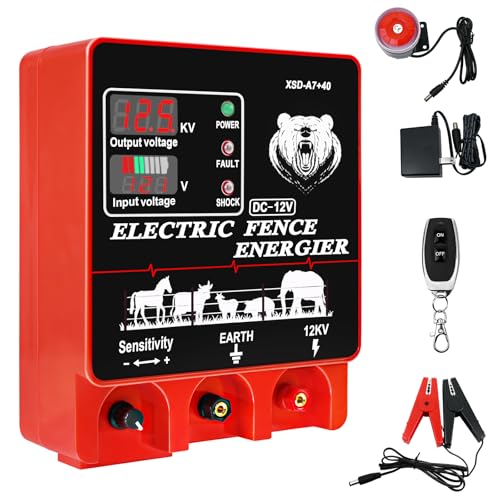
Electric Fence Charger Energizer — 9 Joule, AC/DC 12V — Best High-Output Flexible Power
This energizer’s listing reads like a checklist for a serious fence: 9 joules stored energy, a 20-mile ideal rating, and power from AC mains or 12 volt DC, so the same unit serves at the barn and out on battery. Add a voltage display and alarm functions aimed at predator deterrence, and it is the pick for buyers whose fence problem includes coyotes, dogs or other determined visitors, not just livestock staying in.
Strengths
- 9 joules is serious output for stubborn animals and predators
- AC or 12V DC power — one energizer for barn and field
- Voltage display and alarm features stated in the listing
Trade-offs
- Feature-rich units reward reading the manual once, properly
- 20-mile figure is ideal-condition, like all mileage claims
- High output demands correct grounding to perform as rated
| Specification | Detail |
|---|---|
| Output | 9 joules (listing) |
| Rating | 20 miles (listing, ideal conditions) |
| Power | AC 110-240V / DC 12V (listing) |
| Features | Voltage display, alarm, remote (listing) |
Predator fencing changes the design brief. The pulse must be believed the first time, every time, by an animal actively trying to get in — and the fence must tell you when it is not working, because a dead predator fence is worse than none: it teaches confidence. The display and alarm features in this listing serve exactly that need, turning fence checks from a walk with a tester into a glance, backed by the tester on your rounds.
The dual power is the practical masterstroke. Run it on mains at the home farm through winter, carry it to a battery on the remote lease for summer grazing — one energizer, one set of habits, no second purchase. At 9 joules it sits near the top of this guide’s power table while keeping that flexibility, which is why it takes the flexible-power badge over several respectable rivals.
The display changes behaviour in a way worth noticing: fences with a visible voltage reading get checked more often, because checking costs two seconds and a glance instead of a walk with a tester. Anything that increases the frequency of the fence check increases the fence’s real-world reliability more than a joule here or there — a dead fence discovered today is a fence fixed today, and stock learn from a live fence, not from a specification.
Best for: predator pressure, mixed barn-and-field use, serious pasture / Not suited for: buyers wanting the simplest possible portable unit
Check the current price on Amazon

Briidea Electric Fence Energizer — 3 Joule, 50-Mile, Battery or AC — Best Mid-Range All-Rounder
The Briidea occupies the sensible middle: its listing states 3 joules, battery or AC power, an LCD display and a 50-mile ideal-condition rating, aimed at livestock, garden and pasture animal control. That combination — moderate power, dual power sources, a display to confirm the fence’s state — matches the mixed reality of small farms and large gardens better than either extreme of this guide.
Strengths
- Battery or AC power covers field and farmyard with one unit
- LCD display makes fence checks quick and unambiguous
- 3 joules suits livestock, gardens and medium pasture
Trade-offs
- The 50-mile headline is an ideal-condition figure — trust the joules
- Mid power is not the answer for the worst weed pressure
- Display features add a little complexity over basic units
| Specification | Detail |
|---|---|
| Output | 3 joules (listing) |
| Rating | 50-mile (listing, ideal conditions) |
| Power | Battery or AC (listing) |
| Display | LCD (listing) |
This listing is a small lesson in reading fencer specifications. The joule figure — 3 — is the honest measure of its working strength, and it is a good, useful strength for cattle, horses, goats, poultry protection and garden defence. The mileage figure is the ideal-conditions headline every maker prints. Buyers who learn to shop by the first number and smile at the second will choose well in this category for life, and on the first number this Briidea is a properly specified mid-range energizer.
The display earns its place on a working farm. A fence’s state — live, weak, dead — is the single most useful fact in fencing, and an LCD that shows it at the energizer turns the morning check into seconds. Combined with dual power, the Briidea is the pick this guide would hand a smallholder with varied fencing and no desire to own three different energizers for three different jobs.
Smallholders should also note this unit’s garden credentials in its listing. The same pulse that respects a horse will educate a deer out of a vegetable garden and a dog out of a flower bed, and a mid-power dual-source energizer moves between those duties across a year — pasture in summer, garden in spring, poultry in winter. Versatility of that kind is what ‘all-rounder’ means on a real smallholding, where every tool must hold several jobs.
Best for: smallholders, mixed livestock and garden-plus-pasture fencing / Not suited for: the longest, weediest permanent fences
Check the current price on Amazon
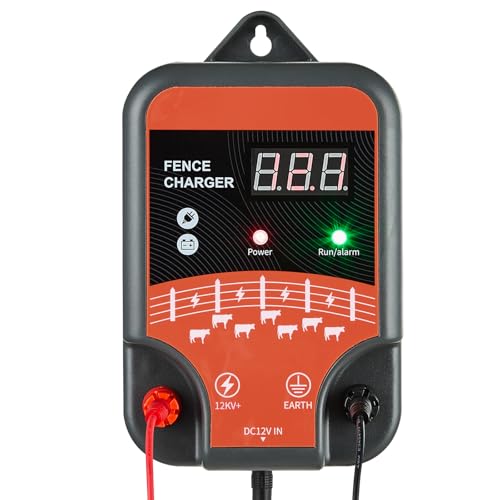
VEVOR Electric Fence Charger — 3 Joule, AC/DC — Best Value AC/DC Kit
VEVOR’s kit brings the mid-power formula — 3 joules, AC/DC flexibility — to a value position, and its listing frames the job plainly: livestock and poultry in, wild animals out. As a kit it suits the first-time fencer setting up a poultry run, a pig paddock or a garden perimeter, who needs a complete, comprehensible starting point rather than a flagship.
Strengths
- 3 joules with AC/DC power at a value position
- Kit format suits a first complete fence setup
- Positioned for both livestock containment and predator exclusion
Trade-offs
- Value tier — long-term support thinner than specialist brands
- 3 joules is mid power; hard fences want the Cyclops class
- Kit contents should be confirmed on the listing before ordering
| Specification | Detail |
|---|---|
| Output | 3 joules / 10kV class (listing) |
| Power | AC DC (listing) |
| Format | Energizer kit (listing) |
| Use | Livestock and poultry (listing) |
First fences teach the category’s lessons, and a kit at this level is a reasonable teacher: enough joules to be believed by poultry predators and ordinary livestock, power flexibility to learn on, and a price of entry that leaves budget for the things that actually decide success — wire, insulators, posts and proper ground rods. New fencers routinely overspend on the energizer and underspend on the fence; this pick helps correct that balance.
Its ceiling is the mid-power ceiling, stated without apology. A season of success with a kit like this is also the best education for the upgrade decision: if the fence grows, the weeds thicken or the stock gets bolder, the Cyclops picks above are waiting. As a starting point and a value all-rounder for modest fences, the VEVOR kit earns its place at the foot of this table.
First-time fencers should budget their learning as carefully as their money: this kit will work on the day it is installed, and then the fence will teach its lessons one fault at a time — a cracked insulator here, a grounding shortfall there. That education is the real product. Keep the tester in hand, walk the line weekly for the first season, and by the second season the fence will be running on habits that make any energizer look good.
Best for: first fences, poultry runs, pig paddocks and garden perimeters / Not suited for: large permanent fences or professional-scale stock work
Check the current price on Amazon
Comparison Table
| Pick | Badge | Key spec | Best for |
|---|---|---|---|
| Cyclops Stallion Battery Fence Charger — 2.5 Joule, 12V | Best Portable Battery Fencer | 2.5 J, 12V battery powered | rotational grazing, strip fencing and temporary paddocks |
| Cyclops Super Battery Fence Charger — 12 Joule, 12V | Best for Large and Difficult Fences | 12 J, 12V battery powered | long, weed-pressured permanent fences and hard-to-hold stock |
| Fence Master Solar 12 Volt Battery Fence Charger — 6 Mile | Best Solar Battery Fencer | Solar + battery included, 6 mile | remote small-to-medium fences where charging visits are costly |
| Electric Fence Charger Energizer — 9 Joule, AC/DC 12V | Best High-Output Flexible Power | 9 J, AC/DC 12V, display + alarm | predator pressure, mixed barn-and-field use, serious pasture |
| Briidea Electric Fence Energizer — 3 Joule, 50-Mile, Battery or AC | Best Mid-Range All-Rounder | 3 J, battery or AC, LCD display | smallholders, mixed livestock and garden-plus-pasture fencing |
| VEVOR Electric Fence Charger — 3 Joule, AC/DC | Best Value AC/DC Kit | 3 J AC/DC value kit | first fences, poultry runs, pig paddocks and garden perimeters |
Shop this table by the joule column. Mileage headlines are ideal-condition figures across the whole category; joules are the stored energy that survives contact with the real fence — and the power-source column then tells you how that energy will be fed in your field.
How many joules does an electric fence actually need?
Joules measure stored energy — the size of the pulse’s punch after the fence has taken its toll. Short, clean, temporary fences with trained animals need little: the 2.5 joule class handles strip grazing and small paddocks comfortably. Permanent pasture with some vegetation contact lives in the 3 joule class. Long lines, heavy weed growth, thick-coated or determined animals push you toward the 9 to 12 joule end, where the pulse still bites at the far end of a hard fence.
Two traps await. The first is voltage worship: listings shout kilovolts because the number is big, but voltage without energy collapses at the first wet weed — joules are the working figure. The second is mileage worship: a ‘50-mile’ rating assumes a perfect, single, weed-free wire that no farm possesses. Divide such claims generously in your head, shop by joules and fence condition, and the energizer you buy will match the fence you actually own.
- Temporary and clean fences: around 2.5 joules
- Permanent pasture, some weeds: around 3 joules and up
- Long, weedy, hard-stock fences: 9–12 joules
How do you power a fence far from mains — battery, solar, or both?
A 12 volt deep-cycle battery is the foundation of every off-grid fence in this guide. Sized generously and kept charged, it runs a mid-power energizer for weeks between charges; allowed to flatten repeatedly, it dies young and takes the fence’s credibility with it. The routine is the product: check the fence and battery on a rhythm, recharge or swap before the pulse fades, and never let ‘the animals haven’t tested it lately’ substitute for a tester reading.
Solar is the labour-saver layered on top. A panel matched to the energizer — or included, as with the Fence Master pick — feeds the battery on every bright day and stretches the charging interval enormously in sunny seasons. It does not abolish the routine: panels need sun, cleanliness and an occasional check, and winter at northern latitudes still shortens the leash. The proven serious setup for a big remote fence is the flagship energizer, a generous battery and solar keeping it topped — power treated as a system, not an accessory.
Why does grounding decide whether your fencer works?
An electric fence is a circuit the animal completes: pulse travels the wire, through the animal, into the soil, and back to the energizer through the ground rods. Weak grounding strangles that circuit no matter how many joules sit at the front end — the most common cause of ‘expensive fencer, useless fence’ is one short rod in dry soil. Proper grounding means multiple galvanised rods, driven deep, spaced apart, connected with sound clamps and kept in moist earth where possible.
Test the system, not the brochure. A fence tester at the far end tells you what the animals will feel; a check of the ground system — feeling for stray voltage on the ground wire itself — tells you whether energy is being wasted before it ever reaches the fence. Every energizer in this guide will perform to its specification on a well-grounded fence, and none of them can rescue a badly grounded one. The rods cost little; the difference is the whole fence.
Battery sizing and care for a 12 volt fence system
The battery is half the energizer, and it deserves half the buying thought. Choose a deep-cycle battery — designed for slow, repeated discharge — rather than a vehicle starting battery, which is built for brief cranking bursts and suffers under fence duty. Size it generously for the energizer’s appetite and your visiting rhythm: a bigger battery checked monthly beats a small one checked weekly, because the pulse stays honest for longer between charges and the battery itself lives years longer when it is never deeply flattened.
Care is a rhythm, not a project. Terminals clean and tight, charge topped up on schedule, the battery sheltered from the worst weather and never left flat over winter — those four habits are the difference between a fence that is live every day of the year and one that is live whenever someone last remembered it. Solar assistance, where fitted, stretches the rhythm but does not replace it. In fencing, as in most of farming, the routine is the technology.
Temporary versus permanent fencing — two philosophies, one energizer shelf
Temporary fencing is an argument made fresh each week: a strand or two, moved with the grazing, asking animals that are already trained to respect it for one more paddock. Its energizer can be modest and portable because the fence is short, clean and believed. Permanent fencing is an argument made once, in wire and posts, that must survive weather, weeds and animals with long memories and longer winters — and its energizer must still be winning that argument at the far end in August.
Most farms run both, which is why this guide’s shelf holds both philosophies rather than crowning one. The portable picks move with the herd; the flagship holds the boundary; the flexible units commute between the two worlds. Choosing well is less about finding the ‘best’ fencer than about being honest regarding which argument each of your fences is actually making — and powering it accordingly.
If you take one sentence from this guide to the supplier, take this one: match the joules to the fence’s worst week, not its best. The week of maximum weeds, maximum distance and maximum animal motivation is the week the fence exists for, and an energizer chosen for that week will never embarrass you in any other.
How to Set Up a 12 Volt Electric Fencer and Test the Fence
Installation is straightforward and unforgiving in equal measure: each step is simple, and skipping any one of them quietly disables the system. Work in order, with the energizer switched off until the final step.
- Mount and shelter the energizer. Fix it on a post or wall out of standing water and direct weather where possible, close to where the fence lead and ground rods will run.
- Install the grounding first. Drive at least the maker-recommended number of ground rods fully into moist soil, spaced apart, and connect them to the energizer’s ground terminal with sound wire and clamps.
- Connect the fence lead. Run the lead-out wire from the energizer’s fence terminal to the fence line with proper insulated cable, keeping connections tight and away from gates and tracks where they will be damaged.
- Connect the 12 volt battery. Attach the energizer’s leads to a healthy, charged deep-cycle battery — correct polarity, clean terminals — or connect the solar panel and battery if your unit is a solar system.
- Switch on and test at the energizer. Confirm the energizer pulses and, with a fence tester, check the voltage at the start of the line against the maker’s guidance.
- Test at the far end and walk the line. Measure again at the fence’s furthest point, then walk the fence removing vegetation contact, repairing insulators and tightening connections until the far-end reading is respectable.
After setup, the fence becomes a weekly two-minute habit: glance at any display, test one or two points, look at the battery’s state, walk a section. Electric fences fail gradually — a fallen branch, a cracked insulator, a fading battery — and the habit catches the gradual before the animals do. That routine, more than any specification, is what makes a fence trustworthy.
Keep a fence log, however rough: the date the battery was charged, the far-end tester reading, the faults found and fixed. It sounds like paperwork and behaves like memory — the second season’s decisions become obvious from the first season’s notes, and a failing battery announces itself in the readings weeks before it announces itself in escaped stock. The best-kept fences in any district belong to people with exactly this unglamorous habit.
Common Buying Mistakes
Shopping by voltage or mileage instead of joules. Kilovolts are the spark’s height; joules are its weight. Mileage is measured on a perfect fence that does not exist. Buy on stored joules matched to your fence’s length, weeds and stock — the only honest comparison in the category.
Skimping on ground rods. One short rod in dry ground can halve a system’s effectiveness. Grounding is cheap, permanent and decisive: multiple deep rods, good clamps, moist soil. It is the highest-value hour in any fence installation.
Letting the battery fade. A battery fencer is only as good as its battery. Deep discharges shorten battery life and weaken the pulse long before it stops entirely — by which time the animals have learned the fence is negotiable. Charge or swap on a schedule, not on a symptom.
Ignoring vegetation until the fence is dead. Weeds are a load the energizer must feed. A fence that was clean in spring can be grounded out by midsummer growth; regular clearing — or a joule margin bought in advance — keeps the pulse honest all season.
Never testing with a proper fence tester. The energizer’s click tells you it pulses; only a tester at the far end tells you the fence works. Testing by hand or by assumption is how dead fences stay undiscovered until the stock discovers them first.
Final Recommendation
Match joules to the fence and the choice makes itself. Temporary and rotational fencing belongs to the Cyclops Stallion; big, hard, permanent fences to the Cyclops Super. Remote fences that punish charging visits suit the solar Fence Master, predator pressure and mixed barn-field duty suit the 9 joule flexible unit, and the Briidea and VEVOR cover the broad middle — smallholdings, gardens, poultry and first fences — with dual power and honest mid-range output.
Whichever energizer you mount, spend as much care on the system around it: deep ground rods, a healthy battery, a clean fence line and a weekly test. A fencer is the heart of an electric fence, but the fence is the body — and the animals, as always, will grade the whole installation rather than the specification sheet.
Start your shortlist here:
- Cyclops Stallion Battery Fence Charger — 2.5 Joule, 12V — Check price on Amazon
- Cyclops Super Battery Fence Charger — 12 Joule, 12V — Check price on Amazon
- Fence Master Solar 12 Volt Battery Fence Charger — 6 Mile — Check price on Amazon
Keep exploring the rest of this cluster: Best 12 Volt Electric Fridge Best 12 Volt Elec Cooler Best 12 Volt Electric Blanket Best 12 Volt Electric Car Heater Best 12 Volt Electric Fencer
Frequently Asked Questions
Is an electric fence safe for animals and people?
Properly installed energizers deliver a short, sharp pulse designed to deter through surprise and discomfort, not to injure — that is the principle the whole category is built and regulated around. Respect it nonetheless: follow the maker’s installation instructions, keep energizers and wiring in good order, post warning signs where the public has access, and never modify an energizer or connect one to anything other than a fence.
How long will a 12 volt battery run an electric fencer?
It depends on the energizer’s draw, the battery’s capacity and health, and the fence’s condition — a leaky, weedy fence makes the energizer work harder. In practice, a sound deep-cycle battery runs a mid-power unit for weeks, which is why the routine is scheduled checking and recharging rather than waiting for failure. Solar assistance stretches the interval substantially in sunny weather.
What is the difference between low-impedance and older fencer designs?
Low-impedance energizers — the design all the picks here follow — maintain their pulse better when vegetation touches the fence, because they can deliver their stored energy into a heavier load. Older high-impedance designs lost most of their effect at the first weed contact and posed a greater fire risk in dry growth. For any fence that will meet vegetation, low impedance is the correct modern choice.
Can one fencer run both mains and battery power?
Yes — several picks here are AC/DC units, running on mains at the barn and on a 12 volt battery in the field. That flexibility suits farms with mixed infrastructure and buyers who want one energizer for present and future fences. Confirm the exact power options on the listing, since the same model families often include AC-only and solar variants that look similar.
Why is my fence weak at the far end?
Work the usual suspects in order: grounding first — add or improve rods and check connections; then vegetation and faults along the line; then the battery’s charge; then the energizer’s joule rating against the fence it is being asked to run. A fence tester turns the search into measurements instead of guesses, and most weak fences are cured by grounding and clearing rather than a bigger energizer.
Do I need a bigger fencer for goats, pigs or predators?
Generally, step up a class. Goats test fences intelligently, pigs root at the bottom wire, and predators arrive motivated — all three argue for more joules, more wires and meticulous grounding rather than a minimum-spec unit. The higher-output picks in this guide exist for exactly these duties; match them with fence design, because energizer power alone does not hold a determined animal.
Can I run an electric fencer from a vehicle battery?
In an emergency or for a short temporary fence, a healthy vehicle battery will run a 12 volt energizer — it is the same voltage the unit is built for. As a routine it is poor practice: fence duty deep-discharges batteries, starting batteries are not built for that, and the vehicle may not start when you need it. A dedicated deep-cycle battery is the correct foundation, with the vehicle battery reserved for genuine emergencies.


