Disclosure: airfryerkitchensupply.com is reader-supported. When you buy through links on our site, we may earn an affiliate commission at no extra cost to you.
Where to buy
Every pick in this guide to the best 12 volt cool box was verified against Amazon’s own catalog data before it earned a place here, and the capacities, power inputs and cooler/warmer functions quoted below come from the manufacturers’ own listings. The Koolatron 18 Quart Iceless Cooler is the pick for most people, the AooDen 26 Quart is the budget option, and the SubSun 27 Quart covers family day trips. Easy carrying is served by the TopAutoGear 26.5 Quart, while readers who need true refrigeration rather than chilling should step up to the compressor models: the Alpicool C20 or the compact Alpicool 10 Quart. Check the current price on Amazon for each, and confirm whether the AC power option is included or built in for the listing you choose — that detail decides whether the box can pre-chill at home or only run in the vehicle.
Introduction
The best 12 volt cool box does a specific, honest job: it keeps drinks cold and food fresh for a day on the road without ice, using a solid-state thermoelectric element that cools a set amount below the surrounding air. That last clause is the whole story of this category, and this guide will not hide it. A thermoelectric cool box is not a refrigerator — on a mild day it feels like one, and on a very hot day its interior can sit well above fridge temperature, which makes it superb for drinks, sandwiches and day-trip food, and the wrong tool for raw meat on a summer weekend. Buyers who understand that distinction love these boxes for decades; buyers who were never told it feel cheated by physics.
A word about the name itself: “cool box” is the term much of the world uses for what American listings call an electric cooler, and the products are the same. What matters is never the label but the two facts this guide checks on every pick — that it runs on 12 volt vehicle power, and which cooling technology does the work. Read any listing anywhere with those two questions in hand and the category becomes impossible to misread.
So this guide is organized around the distinction rather than around marketing. Four of the picks are thermoelectric cool boxes, chosen for capacity, carrying practicality and dual-power convenience, and reviewed with their limits stated plainly. Two are compressor models — true portable fridges — included honestly as the upgrade path for readers whose needs cross the line from chilling to refrigerating. Every pick was verified through Amazon’s catalog data, with its capacity and power inputs stated by its manufacturer. Choose by the weather you travel in and the food you carry, and every box here will do its stated job well, outing after outing, summer after summer, without a single bag of ice between them, which is precisely the future this category promised when it first plugged into a dashboard outlet and declared the ice bag optional for good.
In this guide
Quick Picks
- Best Overall: Koolatron 12V Iceless Cooler & Warmer (18 qt) — a hard-sided thermoelectric classic from the brand that pioneered the category.
- Best Budget: AooDen 26 Quart Electric Cooler and Warmer — thermoelectric chilling and warming on 12V DC and 120V AC.
- Best for Day Trips: SubSun 27 Quart Electric Cooler and Warmer — family picnic capacity on 12V DC and 110V AC.
- Best Carry Design: TopAutoGear 26.5 Quart Portable Cooler — a handled thermoelectric box on 110V AC and 12V DC.
- Best Compressor Upgrade: Alpicool C20 (21 Quart) — a true compressor fridge/freezer for when chilling is not enough.
- Best Compact Compressor: Alpicool 10 Quart — genuine refrigeration in the smallest box here, AC/DC powered.
How These Picks Were Chosen
We started from the keyword’s plain meaning: a cool box that runs on 12 volt power. Every candidate had to be an iceless electric box — thermoelectric or compressor — with its capacity and vehicle power stated in the manufacturer’s own Amazon listing, and every candidate had to be verifiable in that catalog data under its exact model name. Passive coolers, however excellent, were excluded because they answer a different keyword; novelty mini-fridges with no vehicle power were excluded for the same reason.
Within the thermoelectric field we weighted the practicalities of the form: hard-sided protection versus soft bulk, capacity in honest quarts, the presence of a warmer function (surprisingly useful for keeping takeaway food hot on the drive home), and dual power, because a box that also runs on household AC can pre-chill before a trip and serve at a picnic site with power. We deliberately included the category’s founding brand, Koolatron, alongside the current value names, because thermoelectric boxes are simple devices whose differences live in build, lids, cords and honesty of positioning rather than in exotic technology.
The two compressor picks were included under a strict rule: they had to be labeled as what they are — upgrades, not equivalents — and their reviews had to explain when the extra money and weight buy something a thermoelectric box cannot do at any price. A guide that pretends the two technologies are interchangeable misleads both audiences: the day-tripper overbuys, and the week-long camper underbuys and loses food. This guide would rather sell you the right box once.
The 6 Best 12 Volt Cool Boxes
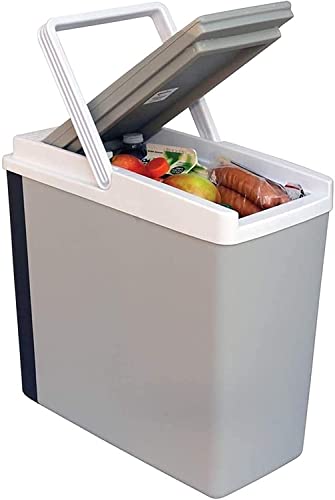
Koolatron 12V Iceless Cooler & Warmer (18 qt) — Best Overall
Koolatron effectively invented the 12V iceless cooler, and this 18-quart hard-sided box is the form in its classic shape: a portable electric cooler and warmer for car, truck, camper and boat, positioned by its maker for camping, picnics, travel, lunches and even office use. Eighteen quarts is the thoughtful size — a day’s drinks and food for a small crew, in a box one person carries without planning to.
Strengths
- The category’s founding brand, with decades of thermoelectric know-how.
- Hard-sided protection for contents and for the cooling element’s housing.
- Cooler and warmer functions in one box, sized for real day use.
Trade-offs
- Thermoelectric limits apply: chilling relative to ambient, not refrigeration.
- 18 quarts is a day box, not a week box.
- Premium-for-its-class positioning next to newer value brands.
Key specs: 18 qt capacity; 12V thermoelectric cooler and warmer; hard-sided; for car, truck, camper and boat.
The Koolatron’s appeal is that it is exactly what it claims to be, from a company that has had decades to be embarrassed by anything else. Its 18-quart size also hits a sweet spot in vehicle packaging: it rides on a seat, in a footwell or across a trunk without reorganizing the car around it, which is why so many owners describe it as living in the vehicle rather than being packed for trips. Equipment that lives where it is used gets used; equipment that must be fetched gets forgotten, and the Koolatron’s dimensions are a quiet argument for the former. It pre-chills drinks, keeps picnic food fresh through a day out, warms a takeaway on the way home, and asks only for a 12V outlet and a little pre-cooling discipline. Owners keep these boxes for years because there is so little to fail — no compressor, no refrigerant, just an element, a fan and a well-made box. For the day-trip heart of this category, it remains the reference pick.
Best for: day-trippers, picnickers and boaters wanting the classic iceless cool box. / Not suited for: multi-day food storage or guaranteed cold in extreme heat.
Check the current price on Amazon

AooDen 26 Quart Electric Cooler and Warmer — Best Budget
The AooDen delivers the thermoelectric formula at a friendlier price and a larger size: 26 quarts of iceless cooling and warming, running on 12V DC in the vehicle and 120V AC at home, in black and orange. That dual power is the feature to notice at this tier — it means the box can pre-chill on the kitchen counter overnight and arrive at the vehicle already cold, which is worth more real cold than any specification on the box.
Strengths
- 26 quarts of thermoelectric capacity at a budget-tier price.
- Dual power: 12V DC for travel, 120V AC for home pre-chilling.
- Cooler and warmer functions cover drinks out and takeaway home.
Trade-offs
- Thermoelectric physics: no freezing, no guaranteed fridge temperature in heat.
- Value-tier materials next to the Koolatron’s hard-sided polish.
- 26 quarts tempts overloading beyond a day trip’s sensible scope.
Key specs: 26 quart capacity; thermoelectric iceless cooler and warmer; 12V DC and 120V AC power.
Judged as a day-trip appliance, the AooDen is easy to recommend: it swallows a family picnic, keeps drinks properly cold through a beach day in normal summer weather, and warms the evening’s takeaway on the drive back. Its black-and-orange livery is a small practical gift, too — a box that is easy to spot in a crowded trunk or a dim garage is a box that gets packed instead of forgotten, and in this category the forgotten box is the only truly failed one. Judged as a refrigerator, it will disappoint exactly as its technology predicts — which is why this review insists on the distinction. Buy it for the days it is designed for and it is one of the best-value boxes in this guide.
Best for: budget-conscious families wanting a roomy day-trip cool box. / Not suited for: raw food storage over hot multi-day trips.
Check the current price on Amazon

SubSun 27 Quart Electric Cooler and Warmer — Best for Day Trips
SubSun’s 27-quart box — 25 liters in its listing’s other unit — is another dual-power thermoelectric, running 12V DC and 110V AC, positioned squarely for camping, travel and picnics. Its size is its argument: at the top of the day-trip class, it holds the whole outing — drinks for the group, the picnic, the snacks — in one plug-in box that never needs an ice run.
Strengths
- 27-quart capacity, the largest thermoelectric here.
- Dual 12V DC and 110V AC power for vehicle and home or campsite.
- Cooler and warmer functions for two-way trip utility.
Trade-offs
- Same thermoelectric ceiling: relative cooling only.
- Biggest box to carry among the thermoelectric picks.
- Newer brand without Koolatron’s long track record.
Key specs: 27 quart (25L) capacity; thermoelectric cooler and warmer; 12V DC and 110V AC power; for camping, travel and picnics.
The SubSun is the pick for the organizer of things: the parent whose car is the outing’s supply depot, the coach with drinks for after the game, the picnic anchor. Its dual-unit listing — quarts and liters both stated — is a small honesty worth copying when you compare any boxes: convert every capacity you meet into one unit before ranking, because the category’s sizes sound more different than they are when each brand picks its favorite ruler. Its capacity means one box instead of a cooler plus bags, and its dual power means it can be cold before it ever meets the car. Respect the thermoelectric contract — pre-chill, keep it closed, don’t ask it to be a fridge in a heatwave — and it will anchor a hundred day trips without a single bag of ice.
Best for: group day trips, picnics and team or family outings. / Not suited for: guaranteed refrigeration or solo minimalists.
Check the current price on Amazon
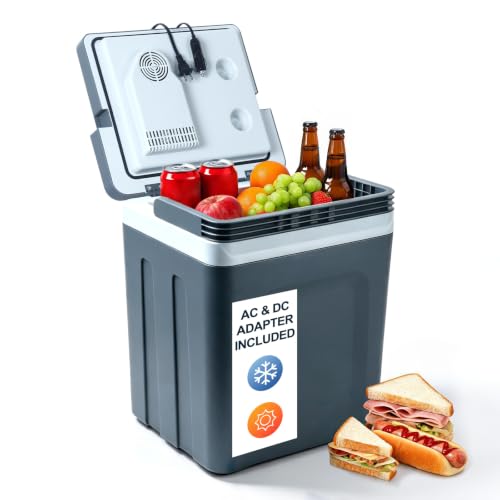
TopAutoGear 26.5 Quart Portable Cooler — Best Carry Design
The TopAutoGear entry distinguishes itself with the detail day-trippers actually feel: a proper handle on a 26.5-quart thermoelectric box, running 110V AC and 12V DC, for travel and picnics. Carrying is the unglamorous half of cool-box ownership — from kitchen to car, car to picnic table, table to boat — and a box designed to be carried, rather than merely lifted, gets used more and dropped less.
Strengths
- Carry handle design suits the kitchen-to-car-to-picnic journey.
- 26.5 quarts of thermoelectric cooling and warming.
- Dual 110V AC and 12V DC power for pre-chilling and travel.
Trade-offs
- Thermoelectric limits, as with every non-compressor pick.
- Handle-centric design trades some stackability for portability.
- Value-brand finish compared with the Koolatron.
Key specs: 26.5 quart capacity; thermoelectric cooler and warmer; 110V AC and 12V DC power; carry handle; for travel and picnics.
There is a temptation to dismiss the handle as trivial, and it is exactly wrong: the difference between a cool box that comes along and one that stays in the garage is usually the carry. Anyone who has crossed a hot parking lot with 26 quarts of drinks in a handle-less box, fingers hooked under a rim, understands that ergonomics is a specification. The TopAutoGear’s designers clearly made that walk themselves. The TopAutoGear also covers the category’s standard virtues — dual power, warmer function, family capacity — so the handle is a tiebreaker on top of a complete package rather than a substitute for one. If your outings involve distance between car and table, this is your box.
Best for: picnickers and travelers who carry their cool box any real distance. / Not suited for: refrigeration-grade needs or permanent vehicle installation.
Check the current price on Amazon

Alpicool C20 (21 Quart) — Best Compressor Upgrade
Here is where this guide changes technology on purpose. The C20 is a portable compressor fridge freezer — 21 quarts, 12/24V DC and 110V AC — which means it holds the temperature you set, freezes genuinely, and keeps food safe in any weather a vehicle can survive. It costs and weighs more than the thermoelectric boxes above because it is doing a categorically harder job.
Strengths
- True refrigeration and freezing, independent of ambient heat.
- Dual DC and AC power for vehicle, home and campsite.
- 21 quarts suits weekends, not just days.
Trade-offs
- Costs more than every thermoelectric pick.
- Heavier, with a compressor to protect from hard knocks.
- Overkill for drinks-only day trips.
Key specs: 21 quart (20 liter); compressor fridge freezer; 12/24V DC and 110V AC power.
Choose the C20 when your trips cross the lines thermoelectrics cannot: overnight and multi-day travel, hot climates, raw ingredients, medication, frozen goods. It also quietly upgrades the vehicle’s everyday life — the grocery run on a hot day stops being a race home, the farmstand stop can include the ice cream, and the dog’s raw food travels as safely as your own. Owners consistently report that the surprise is not how well it camps but how often it is used between camps. It converts the cool box from a day accessory into the vehicle’s refrigerator, and owners who make this step rarely go back. If none of those needs describes you, the honest advice is to save the money and buy the Koolatron — the upgrade is for a different job, not a better version of the same one.
Best for: multi-day travelers and anyone needing guaranteed cold or freezing. / Not suited for: casual day-trippers who only chill drinks.


Alpicool 10 Quart — Best Compact Compressor
The smallest box in this guide is also, quart for quart, the most capable: a 9-liter compressor refrigerator with AC/DC power and a -4°F to 68°F range, positioned for trucks, vans, RVs, campers, SUVs and boats. It refrigerates and freezes in a footprint the thermoelectric picks cannot match, for buyers whose space is tiny but whose need for real cold is not.
Strengths
- Genuine compressor freezing in a 10-quart footprint.
- AC/DC dual power for vehicle and home use.
- Fits footwells, cab corners and small boat lockers.
Trade-offs
- 10 quarts is drinks and essentials, not groceries.
- Highest cost per quart in this guide.
- Small interior limits container shapes and sizes.
Key specs: 10 quart (9 liter); temperature range -4°F to 68°F; AC/DC power; compressor car refrigerator.
The 10 Quart’s natural roles are precise ones: the solo driver’s complete cold store, the second box that keeps drinks out of the main fridge, the dedicated medication or baby-food fridge whose temperature is guaranteed rather than hoped for. It is also the box that fits the vehicles the others cannot — the two-seater, the compact hatch, the motorcycle-adjacent micro-camper — where the choice is between a small real fridge and no fridge at all, and small wins by default. In each role its smallness is the feature and its compressor is the guarantee. As a family’s only cool box it would be a category error — but judged as the compact refrigerator it is, nothing else in this guide does its job in its space.
Best for: solo travelers, small vehicles and dedicated second-fridge duty. / Not suited for: family day trips or bulk capacity.
Check the current price on Amazon
Comparison Table
| Pick | Badge | Key spec | Best for |
|---|---|---|---|
| Koolatron 18 qt | Best Overall | Thermoelectric, hard-sided, cooler + warmer | Classic day-trip box |
| AooDen 26 Quart | Best Budget | Thermoelectric, 12V DC + 120V AC | Budget family picnics |
| SubSun 27 Quart | Best for Day Trips | Thermoelectric, 12V DC + 110V AC | Group outings |
| TopAutoGear 26.5 Quart | Best Carry Design | Thermoelectric, carry handle, AC + DC | Picnics away from the car |
| Alpicool C20 | Best Compressor Upgrade | Compressor fridge/freezer, 21 qt | Multi-day, hot weather, real food |
| Alpicool 10 Quart | Best Compact Compressor | Compressor, -4°F to 68°F, 9L | Tiny spaces, guaranteed cold |
Cool Box, Passive Cooler or Compressor Fridge: Choosing Your Category
Three products compete for the same corner of your vehicle, and naming their differences cleanly is the fastest route to the right purchase. The passive cooler — insulated box plus ice or packs — is the cheapest cold there is, needs no power, and at its peak can be genuinely colder than a thermoelectric box. Its costs are logistics: ice to buy or freeze, capacity surrendered to that ice, meltwater to manage, and a temperature that begins surrendering the moment the lid first opens. For a single long day off-grid with no driving, it remains a rational champion.
The thermoelectric cool box trades peak cold for continuity and convenience. It never needs ice, never makes meltwater, holds its relative chill for as long as it is plugged in, and doubles as a warmer. Its ceiling is set by physics — relative cooling — and its floor is set by your technique: pre-chilled, shaded and closed, it performs like a fridge’s cheerful sibling; warm-loaded and sun-baked, it performs like an apology. The compressor fridge removes the ceiling entirely at the price of money, weight and mechanical complexity: set temperatures, real freezing, weather-proof performance, in exchange for being an appliance rather than a box.
The deciding variables are trip length, ambient heat, food risk and driving pattern, in that order. Notice that price is not among them — deliberately. Within each category the picks in this guide span the sensible price range, and the expensive mistake is never the twenty saved or spent inside a category; it is buying the wrong category entirely and replacing it within the season. Day trips with driving between stops: the cool box is in its element, sipping power while the alternator works. Static days off-grid: the passive cooler’s independence shines. Anything multi-day, hot or food-critical: the compressor earns its premium. Most households eventually own two of the three — and the owners who chose deliberately, in that order, are the ones who never write angry reviews about any of them.
Running a Cool Box Without Draining Your Battery
A thermoelectric element draws its power continuously, unlike a compressor that cycles, so the cool box asks for a slightly different electrical etiquette. The core rule is simple: the box runs while the vehicle runs. Driving time is charging time, and a day trip’s pattern — drive out, park for hours, drive home — suits the box perfectly if it starts cold, because a closed, pre-chilled box holds its temperature through a long parked afternoon without any power at all. The battery risk appears only when owners leave the box running on a parked vehicle for many hours, treating the starting battery like a power station. It is not one.
If your outings involve long parked running — tailgates, work sites, fishing from the bank with the box beside you — supply the box from something designed for the job: a portable power station, a second battery, or the vehicle’s own system with the engine run periodically. Solar maintainers and battery monitors exist precisely for this pattern, and a simple voltage-check habit before starting the drive home prevents the one bad ending this category can produce. Treat the box’s appetite with the same respect you would give a fridge’s, and the two of you will never have an argument. The good news hidden in the continuous draw is predictability: unlike many vehicle loads, the cool box’s appetite is steady and known, so a single trip’s experience calibrates every future one.
How to Choose a 12 Volt Cool Box
Start with the technology decision, because it outranks every other. Ask what the box must protect and in what weather. Drinks, sandwiches, fruit and picnic food for a day in ordinary summer: thermoelectric, and any of the first four picks will please you. Raw meat, dairy for days, frozen goods, medication, or any food in serious heat: compressor, and only the last two picks are honest answers. The cost of choosing wrong is asymmetric — a compressor bought for day trips is merely heavy, while a thermoelectric bought for a hot week is a food-safety failure — so when your needs straddle the line, buy across it.
Second, size by the outing, not the vehicle. Eighteen quarts is a couple’s day; the mid-20s quarts are a family’s day or a group’s drinks; beyond that you are provisioning trips, and trip provisioning belongs to compressor capacity anyway. Remember that a cool box’s quarts must hold the food and the cold source discipline — pre-chilled contents — rather than food plus melting ice, which is the iceless dividend: every quart is usable.
Third, value dual power more than any other convenience. A box that runs on household AC as well as 12V DC can be pre-chilled overnight — the single most effective performance upgrade available to a thermoelectric — and can serve at powered campsites, offices and home patios. All four thermoelectric picks here offer both inputs; confirm the arrangement in the listing you buy, because included-versus-optional adapters vary. Fourth, think about the carry: distance from kitchen to car to destination is where cool boxes are dropped, strained against and quietly resented, so handles, weight and shape are real specifications even when listings treat them as decoration. Fifth, check the lid and the seal with your hands if you can: in a category where the cooling element’s output is modest and fixed, insulation and sealing are where the performance differences actually live, and a lid that closes like it means it is worth more than any feature printed on the carton.
Thermoelectric Cooling, Explained Honestly
A thermoelectric element — a Peltier device — moves heat from one side to the other when powered, with a small fan to shed the hot side’s warmth. It has no refrigerant, no compressor and almost nothing to wear out, which is why these boxes are light, simple and durable. Its defining behavior is that it cools relative to ambient: the interior settles a limited number of degrees below the air outside the box. In a 75°F car that means genuinely cold drinks. In a 100°F car parked in the sun, it means an interior that may sit in the 60s — fine for soda, unsafe for the potato salad’s third hour, and incapable of freezing anything, ever.
There is one more variable owners control without noticing: where the box sits. A cool box on a sunlit seat is fighting the greenhouse effect through its own walls, while the same box in a shaded footwell or a covered truck bed starts the day several degrees ahead and keeps the lead. Placement is free performance — the only specification in this category that costs nothing and pays every single trip.
Three habits close most of the gap between expectation and physics. Pre-chill everything: the box, and the food and drinks going into it, because a thermoelectric’s job is maintaining cold, not creating it from warm. Keep the box closed and out of the sun; every opening and every sunbeam is paid for in degrees. And run it while driving rather than asking it to recover a warm load at the destination. Owners who adopt those habits report — accurately — that their cool box “works great.” Owners who load warm cans into a hot box at noon and open it hourly report the opposite, about the same box. The technology is honest; the technique decides. If you take one sentence from this entire guide to the picnic, take that one, because it will do more for your drinks than any purchase you are about to make.
The Warmer Function: The Feature Owners Underestimate
Every thermoelectric pick in this guide is a cooler and warmer, and the second half of that description is the one owners consistently report discovering late and loving early. The same element that chills in one direction warms in the other, turning the box into a food warmer for the trip home: the takeaway that stays a meal instead of becoming a lukewarm regret, the baked goods that arrive at the potluck at serving temperature, the hot towels or heated lunch that a work crew appreciates in January. In cold weather the function arguably out-earns the cooling side, because winter offers free refrigeration everywhere except inside a heated cab.
Used with its limits in mind, the warmer is safe and simple: food goes in already cooked and hot, the box holds it at serving warmth, and the meal is eaten the same day — it is a warmer, never a cooker, and raw food has no business in it. Boats deserve a footnote here: on the water, where a galley may be a single burner or none, a warming box that keeps the shore-bought dinner hot across the sail home is not a luxury but a menu plan, and more than one crew has bought the box for the cold side and kept it for this. Owners who build the habit find the box working twelve months a year instead of six, which quietly doubles the value of the purchase. If you are comparing two otherwise-equal boxes, the one whose warmer function is easiest to switch and whose lid seals best will be the one still in service when the novelty of the cold side has faded into routine.
How to Use a 12 Volt Cool Box for a Day Trip
- The night before, plug the box into household AC (or chill it in a cool room) and refrigerate everything that will go into it. Cold box plus cold contents is the whole secret.
- Load in order of use: last-needed items at the bottom, drinks and lunch on top, so the lid opens briefly and rarely during the day.
- In the vehicle, place the box out of direct sun, with its fan vent unobstructed — a thermoelectric that cannot shed heat cannot make cold.
- Plug into the 12V outlet and run it while driving; if your outlet is ignition-switched, the box simply holds its cold while parked, which it does well for hours if it started cold and stays closed.
- At the destination, keep it shaded and closed between servings. Treat the lid like a refrigerator door in a power cut: open with a plan, close with conviction.
- Use the warmer function deliberately: it keeps takeaway and cooked food pleasantly hot for the drive home, but it is a warmer, not a cooker — food should go in already hot and be eaten the same day.
- At home, empty, wipe and dry the box, and store it with the lid ajar so it greets the next trip fresh.
How to Clean and Store a Cool Box
Electric cool boxes are refreshingly washable appliances, with one rule: the water goes on the inside surfaces, not into the vents, fan or electrics. Empty the box, wipe the interior with a mild solution, rinse with a damp cloth, and dry it thoroughly — then store it with the lid ajar, because a sealed box that was put away damp will develop the stale smell that greets the next picnic like an uninvited guest who has also brought strong opinions about your sandwiches and intends to share them at great length. The lid-ajar habit is the whole storage program for the interior; for the exterior, a dust cover or a shelf out of the sun keeps the housing and cord supple.
Cords and fans deserve their seasonal minute. Check the 12V plug for corrosion and the cord for nicks where it has been pinched by seats and doors; clean the fan grille of the dust and pet hair that accumulate exactly where airflow matters; and run the box for ten minutes before the season’s first trip so any failure announces itself in the driveway. Thermoelectric boxes have almost nothing to wear out, which makes the failures that do occur — a tired fan, a damaged cord — both rare and cheap to forgive yourself for catching early.
Common Buying Mistakes
The first and costliest mistake is expecting refrigeration from a thermoelectric box — believing the word “cooler” on the listing over the physics in this guide. If your food must be at fridge temperature in summer heat, buy the compressor picks and do not negotiate with thermodynamics. The second mistake is the mirror image: buying a compressor fridge for drinks-only day trips and resenting its weight and price for a decade. The third is loading warm contents into an unchilled box and blaming the element for arithmetic.
The fourth mistake is blocking the fan vent with luggage, which silently converts any thermoelectric box into an insulated box with a warm motor attached. The fifth is ignoring the power question — discovering at the picnic that your vehicle’s only outlet is occupied, ignition-switched or nowhere near the box’s chosen seat. The sixth is sizing for the biggest outing of the year and carrying a half-empty hall of a box on the fifty ordinary ones; buy for your typical day and borrow capacity for the exceptional one.
Final Recommendation
For most day-trippers, the Koolatron 18 Quart is the buy: the classic hard-sided iceless box from the brand that invented it, with cooler and warmer functions in the size a day actually needs. Budget families should take the AooDen 26 Quart, group organizers the SubSun 27 Quart, and anyone carrying the box a distance the TopAutoGear with its proper handle. If your needs cross into real refrigeration — multi-day trips, heat, raw food — skip the thermoelectric class without regret and buy the Alpicool C20, or the Alpicool 10 Quart where space is tightest. Check the current price on Amazon, pre-chill before your first outing, and let the ice habit die a natural death — most owners find that the first trip without a single bag of ice is the one that converts them permanently.
One rehearsal makes the first real outing boring in the best way: run the box at home the day before, loaded with the drinks you plan to bring, and check on it at the intervals your trip will impose. You will learn its true chill, its fan’s sound, its cord’s reach in your vehicle and its lid’s manners — four small facts that convert a new purchase into familiar equipment before it ever leaves the driveway.
Building a fuller 12V setup for the vehicle? These companion guides cover the neighboring gear: Best 12 Volt Cooler, Best 12 Volt Compressor Fridge, Best 12 Volt Cooker, Best 12 Volt Compressor, and Best 12 Volt Compact Spotlight.
Frequently Asked Questions
How cold does a 12 volt thermoelectric cool box get?
A limited amount below the surrounding air temperature — that is the technology’s nature. In mild conditions the interior feels properly fridge-cold for drinks and picnic food; in a hot parked car it will be noticeably cooler than the car but may not reach safe refrigerator temperatures for perishables. Pre-chilling the box and contents, keeping it shaded and closed, gets the best from it. If you need a guaranteed temperature, you need the compressor picks. A small thermometer kept inside the box settles every argument about this in your own vehicle, in your own climate, within one trip — buy one with the box and let it be the referee.
Can a cool box keep food safe on a camping trip?
For a day trip with pre-chilled food, yes, comfortably. For multi-day camping — especially in heat, and especially with raw meat or dairy — a thermoelectric box is the wrong tool, and this guide says so in every relevant section: choose the Alpicool C20 compressor fridge, which holds a set temperature indefinitely. Food safety is the one area where “mostly cold” is not a passing grade. A hybrid pattern serves many campers honestly: the compressor fridge guards the perishables while the cool box handles drinks and produce, sparing the fridge’s lid a hundred openings a day — each box doing the job its physics suits.
What does the warmer function actually do?
It reverses the element to keep contents warm — useful for takeaway food on the drive home, hot towels in some work settings, or keeping a cooked dish at serving warmth for a picnic. It warms and holds; it does not cook raw food, and warmed food should be eaten the same day. Think of it as the box’s second shift rather than a second appliance. Drivers in cold climates rate it higher than the cooling side: a warm lunch in a January cab, from the same box that chilled July’s drinks, is the feature that turns a seasonal gadget into year-round equipment.
Will a 12V cool box drain my car battery?
Thermoelectric elements draw continuously while running, so hours of engine-off operation will tax a battery. The normal pattern — running while driving, resting while parked — is safe for a healthy battery over a day trip. For long parked sessions, run the box from a power station or accept the discipline of periodic engine runs, and never leave one running overnight on a lone starting battery. A simple voltage monitor or a battery with a reserve indicator turns this from a worry into a reading, and owners who park-run their boxes regularly consider it standard kit.
Is a cool box better than a regular cooler with ice?
For day trips, usually: no ice to buy, no meltwater, every quart usable, and cooling that continues as long as it is plugged in. A good passive cooler with ice can be colder at its peak and needs no power, which still wins for some uses. The cool box wins on convenience and consistency across a day; the compressor fridge beats both when the trip gets long or hot. There is also a tidiness argument that owners feel daily: sandwiches that never met meltwater, labels that stay on cans, and a vehicle interior that stays dry — small mercies that compound over a summer of outings.
What size cool box do I need?
Around 18 quarts covers a couple’s day out. The mid-20s quarts cover a family’s picnic or a group’s drinks. Beyond that, you are provisioning multi-day trips, where compressor fridges take over. Also weigh the carry: a box you can comfortably move from kitchen to car to picnic spot will be used more than a larger one you dread lifting. When torn between two sizes, choose by the load you carry monthly rather than the load you carry once — and remember that a slightly smaller box, packed completely with pre-chilled contents, often outperforms a larger one half-filled with warm air.


