Disclosure: airfryerkitchensupply.com is reader-supported. When you buy through links on our site, we may earn an affiliate commission at no extra cost to you.
Where to buy
Every pick in this guide to the best 12 volt cooker was verified against Amazon’s own catalog data before it earned a place here, and the capacities, power options and container details quoted below come from the manufacturers’ own listings. The RoadPro Lunchbox Stove RPSC-197 is the pick for most drivers, the RoadPro 1.5 Quart Slow Cooker RPSL-350 is the true-cooking option, and the Aotto Electric Lunch Box is the commuter’s choice. Bigger appetites are served by the DDHTSAL Portable Oven 1.8QT, soup lovers by the Travel Time 12V Cooking Pot, and meal preppers by the Genasmil 80W Lunch Box. Check the current price on Amazon for each, and confirm whether the listing’s power options match your life — some of these run on 12V only, while the 3-in-1 models also work on 24V and 110V, which decides whether the same box can heat lunch at a desk as well as in a cab.
Introduction
The best 12 volt cooker is not a kitchen appliance that happens to travel; it is a different class of tool built around a hard truth about vehicle power. A 12 volt outlet offers a modest wattage compared with a household socket, so these cookers win not by brute force but by design: small volumes, insulated boxes, and time. In exchange they offer something no kitchen can — a hot meal in a truck cab at a rest stop, in a work van between jobs, in a car on a long relocation drive, or at a campsite picnic table, made from your own food at your own cost. For truckers, tradespeople, road-trippers and anyone whose lunch options are a gas station or nothing, that trade is not a novelty. It is the difference between eating well and eating whatever is open.
The audience for these appliances is broader than the truck cab that made them famous. Tradespeople eat from them in site parking lots; delivery and service drivers use them to reclaim a lunch break that geography stole; parents heat real food at youth-sports tournaments an hour from the nearest decent meal; campers treat them as the no-flame kitchen that works inside a vehicle on a rainy night. If any of those days sounds like yours, the category was built for you, whatever you drive.
Honesty about limits belongs at the front of this guide. A 12V cooker warms and slow-cooks beautifully; it does not sear, it does not rush, and it will not reproduce a stovetop’s power. Most models in this category are at their best reheating prepared food to a steaming, safe temperature and holding it there, while the one true slow cooker here genuinely cooks raw ingredients given hours. Every pick below was verified through Amazon’s catalog data, and each review states plainly which of those jobs the unit does, how much it holds, and what powers it. Choose by the meal you actually plan to eat, on the roads you actually drive, and every cooker here will do its stated job well, trip after trip, season after season, without complaint.
In this guide
Quick Picks
- Best Overall: RoadPro Lunchbox Stove RPSC-197 — the classic 12V lunchbox oven for trucks and travel, from the brand that built this category.
- Best Slow Cooker: RoadPro Slow Cooker RPSL-350 — a genuine 1.5-quart 12V slow cooker that cooks raw food over a driving day.
- Best Capacity: DDHTSAL Portable Oven 1.8QT — a 3-in-1 (12V/24V/110V) mini oven with the largest capacity here.
- Best for Soups and Stews: Travel Time 12V Cooking Pot — a non-stick cooking pot with cover and stay-cool handle, universal for most vehicles.
- Best for Commuters: Aotto Electric Lunch Box 32 oz — a spill-free 3-in-1 food warmer for car, work and travel.
- Best for Meal Prep: Genasmil 80W Electric Lunch Box — dual 1.5L stainless steel containers, leak-proof, 110V/24V/12V.
How These Picks Were Chosen
We required every candidate to genuinely run on 12 volt vehicle power — not merely to be small or “portable” in the marketing sense — and to be a cooker or food warmer with a defined vessel: a lunchbox oven, a slow cooker, a cooking pot or a heated lunch box. Household slow cookers and rice cookers with no vehicle power option were excluded, however good they are at home. Every remaining candidate then had to be verifiable in Amazon’s catalog data under its exact model name, with its capacity and power options stated in the manufacturer’s own listing; models that failed that check were dropped.
Within the field we weighted the distinctions that decide real lunches. Heating role came first: units that primarily reheat and hold are labeled as such, and the one unit that slow-cooks raw food is labeled as that, because confusing the two is how buyers end up with warm sandwiches when they planned stew. Capacity came second — 32 ounces, 1.5 quarts and 1.8 quarts are different meals for different appetites. Power flexibility came third: 12V-only units serve the vehicle alone, while 3-in-1 units that also accept 24V and 110V can start at a desk or a home counter and finish in the cab. Finally we weighted spill behavior and container practicality, because a cooker that leaks gravy into a footwell will be used exactly once.
We also favored the category’s established name where the job called for it. RoadPro has supplied truck-stop cooking gear for decades, and its two picks anchor this guide the way house brands anchor a toolshed. The newer 3-in-1 lunch box designs earn their places on capacity, containers and power flexibility rather than pedigree. Between those poles, every common 12V eating pattern — the trucker’s hot dinner, the commuter’s warm lunch, the crew’s soup, the prepper’s two-dish box — has a named recommendation.
The 6 Best 12 Volt Cookers

RoadPro Lunchbox Stove RPSC-197 — Best Overall
The RPSC-197 is the appliance that defines this category in the minds of the people who use it most: a lunchbox-shaped 12V stove, black, built for trucks and travel, into which generations of drivers have put foil-wrapped burritos, leftover containers, canned meals and sandwiches, and from which they have eaten hot food in places with no kitchen for fifty miles. Its listing says “portable electric lunchbox stove” and that plain description is the whole review in miniature — it heats food, in a box, from your vehicle’s power, reliably.
Strengths
- The proven truck-stop design from the category’s defining brand.
- Lunchbox format takes standard containers and foil-wrapped meals.
- Simple 12V operation with nothing to configure or learn.
Trade-offs
- A heater-warmer at heart; raw cooking belongs to the slow cooker pick.
- 12V only — no desk or home-counter duty without an adapter.
- Capacity suits one person’s meal, not a crew’s.
Key specs: portable electric lunchbox stove; 12V food heating; for truck and travel; model RPSC-197.
Its supporting cast deserves a line: the lunchbox format accepts the containers drivers already own — the foil tray, the takeout box, the home meal-prep tub — so adopting it requires no new ecosystem of accessories. And because the design has been stable for years, replacement cords and kindred parts are the easiest in this guide to source, a virtue that only becomes visible in year three, when it becomes the whole ballgame.
What the RPSC-197 understands is the rhythm of a driving day. You load it at a stop, plug it in, and let the miles do the cooking; by the next stop the meal is hot through, held at temperature, and ready without a queue, a microwave line or a compromise. It is not fast and it is not fancy, and judging it by kitchen standards misses the point entirely — judged by rest-stop standards, it is close to perfect, which is why it remains the default recommendation a decade into the category’s life.
Best for: truckers, delivery drivers and road-trippers who want a hot meal waiting at the next stop. / Not suited for: cooking raw ingredients from scratch or feeding more than one person.
Check the current price on Amazon

RoadPro Slow Cooker RPSL-350 — Best Slow Cooker
Most 12V “cookers” reheat; this one cooks. The RPSL-350 is a genuine slow cooker in miniature — 1.5 quarts, white, built for auto travel on 12V — which means raw ingredients loaded in the morning become actual dinner by evening: stews, soups, chili, braised anything. That distinction makes it the most capable appliance in this guide and the one that rewards planning the most richly.
Strengths
- Genuine slow cooking of raw food, unique among these picks.
- 1.5-quart size is a real meal for one or a side for two.
- RoadPro’s travel-focused design for vehicle use.
Trade-offs
- Slow is the point: meals take hours, planned around driving time.
- A liquid-filled crock in a moving vehicle demands careful placement and securing.
- 12V-only power and one-cook-at-a-time capacity.
Key specs: 1.5 quart slow cooker; 12V; auto travel design; model RPSL-350.
The RPSL-350 changes what a driving day can taste like. Chili started at a morning fuel stop is dinner at the evening one; a soup begun at home and finished on the road bridges the gap between cooking and traveling. The discipline it requires is food-safety discipline: ingredients should start cold or properly prepped, the cooker should run continuously rather than in interrupted bursts, and the meal should be eaten when it is done rather than held indefinitely. Treat it like the real cooker it is — because it is one — and it returns real food, the kind with a smell that fills the cab at the evening stop and makes the whole day’s driving feel like it was leading somewhere.
Best for: long-haul drivers and travelers who want genuinely cooked meals from raw ingredients. / Not suited for: anyone needing a quick reheat or unwilling to plan meals hours ahead.
Check the current price on Amazon
DDHTSAL Portable Oven 1.8QT — Best Capacity
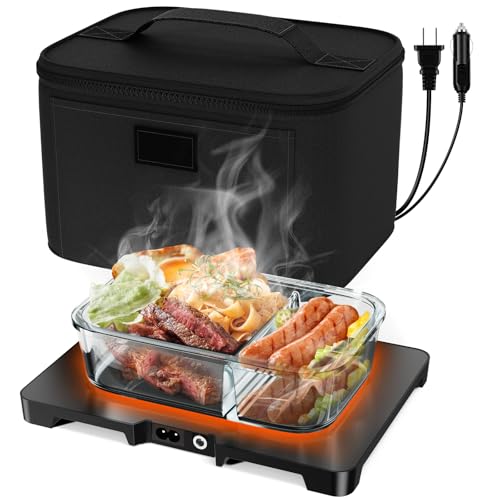
The DDHTSAL takes the lunchbox oven idea and scales it: 1.8 quarts of capacity — the largest in this guide — in a portable oven that runs 12V, 24V and 110V, positioned by its maker as a mini food warmer for car and truck and a microwave alternative for work, office and travel. That triple power supply is its signature: the same box that heats dinner in the cab can heat lunch at a desk.
Strengths
- 1.8QT capacity, the most generous here, for full meals.
- 3-in-1 power (12V/24V/110V) moves between vehicle, truck and desk.
- Oven format handles containers and dishes a lunch box cannot.
Trade-offs
- Largest box here; check your cab or footwell space.
- A warmer-reheater by design, not a raw-food cooker.
- Newer brand without RoadPro’s track record.
Key specs: portable oven / electric lunch box food heater; 1.8QT capacity; 12V/24V/110V 3-in-1 power; for car, truck, work, office and travel.
Capacity is a quality of life feature in this category because appetite does not shrink on the road. It also changes the social math: a 1.8-quart oven can warm two people’s picnic portions in sequence or one person’s feast at once, which makes it the pick most likely to be claimed by a partner for their own vehicle — buy with that negotiation in mind. A 1.8-quart oven takes the big meal-prep container, the leftover portion as served rather than decanted, the two-person picnic warm-up. Combined with the 110V option, it also becomes the office appliance that makes the vehicle’s appliance redundant — buy one box, heat food everywhere your day happens. If your meals are substantial and your day mixes desk and driving, this is the pick shaped like your life.
Best for: big appetites, meal-prep containers, and workers splitting time between desk and vehicle. / Not suited for: minimalists or raw-food cooking.
Check the current price on Amazon

Travel Time 12V Cooking Pot — Best for Soups and Stews
Where the lunchbox ovens heat containers, the Travel Time is a pot: a 12V cooking pot with a cover, a non-stick surface and a stay-cool handle, described as universal for most vehicles. That pot format opens a menu the boxes cannot — soups, stews, noodles, oatmeal, anything loose or liquid that wants a vessel rather than a tray — and the non-stick surface acknowledges the reality of washing up in a rest-stop sink.
Strengths
- True pot format for soups, stews and other loose dishes.
- Non-stick interior cleans up with minimal water and effort.
- Stay-cool handle and cover suit its on-the-go cooking role.
Trade-offs
- An open pot of liquid in a vehicle needs level, secure placement.
- Less suited to dry reheating than the lunchbox ovens.
- Specialist shape: one dish at a time, pot-style only.
Key specs: 12V cooking pot with cover; non-stick surface; stay-cool handle; universal for most vehicles.
The pot’s natural home is the longer stop: the campsite, the depot break, the tailgate, anywhere the vehicle is parked and a hot bowl of something is the difference between a meal and a snack. It also moonlights as the crew appliance: one pot of soup or chili at a site or a campsite feeds several bowls in a way no personal lunchbox can, which is why these pots so often end up owned by the group rather than the individual — bought by one driver, adopted by everyone. Ramen upgraded with an egg and vegetables, canned soup brought properly to temperature, oatmeal on a cold morning in a hunting camp — the pot does the bowl-food jobs that define comfort eating on the road. Park, level it, mind it like a stovetop, and it earns its shelf space.
Best for: campers, crews and soup lovers who cook at stops rather than in motion. / Not suited for: set-and-forget reheating of container meals while driving.
Check the current price on Amazon

Aotto Electric Lunch Box 32 oz — Best for Commuters
The Aotto is the 12V cooker reimagined as a lunch box in the literal sense: 32 ounces of capacity, a portable food warmer heater running 12V, 24V and 110V, spill-free design, positioned for work, office, car and travel. It assumes your meal was cooked at home, portioned into the box in the morning, and wants to be hot at noon — and it arranges its entire design around that single, extremely common day.
Strengths
- Spill-free design survives the commute without redecorating the car.
- 3-in-1 power heats at the desk or in the car, whichever the day demands.
- 32 oz is the honest single-lunch portion, neither snack nor banquet.
Trade-offs
- A warmer, not a cooker: raw food is outside its brief.
- 32 oz caps the meal; big appetites should size up to the DDHTSAL.
- Lunch-box format means one compartment’s worth of menu planning.
Key specs: electric lunch box food warmer; 32 oz capacity; 12V/24V/110V 3-in-1; spill-free; for work, office, car and travel.
Its shape teaches a useful lesson about this whole category: the winning appliances are the ones that fit an existing routine rather than demanding a new one. The Aotto asks for nothing you do not already do — cook at home, carry a lunch box, want it hot at noon — and simply upgrades the temperature of the outcome. Products that ask you to reorganize your day around them gather dust, whatever their specifications.
The economics of this little box are quietly dramatic. A home-cooked lunch heated at a desk or in a parked car replaces a bought lunch, day after day, and the box pays for itself in the first weeks of a commute while also improving what lunch is. Its spill-free promise matters more than any specification: the gravy that stays in the box is the reason the box is still being used in month six. For the commuter pattern — cook at home, heat at noon — it is the most precisely fitted pick in this guide.
Best for: commuters and office workers heating home-cooked lunches. / Not suited for: cooking from raw or feeding more than one.
Check the current price on Amazon

Genasmil 80W Electric Lunch Box — Best for Meal Prep
The Genasmil’s listing leads with the details meal preppers care about: 80W of heating, dual 1.5L stainless steel containers, leak-proof construction, and 110V/24V/12V 3-in-1 power for car, truck and office. Two separate containers mean a main and a side — rice and curry, pasta and salad’s warm half — heated together but served apart, in stainless steel rather than plastic.
Strengths
- Dual 1.5L stainless containers keep two dishes separate.
- Leak-proof design and stainless steel suit weekly meal-prep duty.
- 3-in-1 power covers home counter, desk and vehicle.
Trade-offs
- A reheating system, not a raw-food cooker.
- Two containers are two things to wash, daily.
- Meal-prep focus is wasted on buyers who eat out anyway.
Key specs: 80W electric lunch box food warmer; dual 1.5L stainless steel containers; leak-proof; 110V/24V/12V 3-in-1; for car, truck and office.
Meal prep lives or dies on the last step: the reheating. Food that was carefully portioned on Sunday deserves better than a communal microwave queue or a cold center, and the Genasmil’s dual stainless containers deliver the Sunday flavors on Thursday, separately and properly hot. The stainless choice also ages well — no staining, no lingering odors, no warped lids — which matters for a box used five days a week. If your eating system is prep-based, this is the pick built by someone who understood the assignment — and understood that the assignment repeats two hundred times a year, which is why its virtues are durability virtues rather than novelty ones.
Best for: meal preppers wanting two dishes heated separately, at desk or in vehicle. / Not suited for: raw cooking or single-container simplicity seekers.
Check the current price on Amazon
Comparison Table
| Pick | Badge | Key spec | Best for |
|---|---|---|---|
| RoadPro RPSC-197 | Best Overall | 12V lunchbox stove, truck/travel | Hot meals at rest stops |
| RoadPro RPSL-350 | Best Slow Cooker | 1.5 qt true slow cooker, 12V | Cooking raw food over a day |
| DDHTSAL Oven | Best Capacity | 1.8QT, 12V/24V/110V 3-in-1 | Big meals, desk + vehicle |
| Travel Time Pot | Best for Soups and Stews | Non-stick pot, cover, stay-cool handle | Bowl food at stops and camps |
| Aotto Lunch Box | Best for Commuters | 32 oz, spill-free, 3-in-1 power | Home-cooked work lunches |
| Genasmil Lunch Box | Best for Meal Prep | 80W, dual 1.5L stainless containers | Two-dish prepped meals |
How to Choose a 12 Volt Cooker
Decide first whether you are reheating or cooking, because the category contains both and they are not interchangeable. Reheating — taking prepared food from cold to steaming — is what five of these six picks do, and they do it well within the patience a drive provides. Cooking raw food is the slow cooker’s job alone, and it demands hours and planning in exchange for real meals. Buyers who confuse the two end up disappointed in a product that was never designed for their plan; buyers who choose honestly tend to become the category’s evangelists.
Second, size the vessel to the meal. Thirty-two ounces is a working lunch. A quart and a half is a generous solo dinner or a shared side. One-point-eight quarts is the big meal-prep container with room to spare. Consider also the shape of your food: foil-wrapped and container meals belong in the lunchbox ovens, loose and liquid meals belong in the pot, and two-part meals belong in the dual-container box. The menu you actually eat should choose the format, not the other way around.
Third, map the power. A 12V-only unit like the RoadPro picks lives in the vehicle, full stop. A 3-in-1 unit — 12V, 24V and 110V — follows you from home counter to truck cab to office desk, and for people whose day crosses those places, that flexibility is worth more than any other feature. Truckers in 24V cabs should note the distinction especially: a 12V-only appliance in a 24V system needs the right supply arrangement, while the 3-in-1 picks take it natively.
Fourth, consider where the unit will be cleaned and stored, because those two chores decide whether it is still in service in a year. A cooker whose vessel lifts out, wipes clean and dries fast fits a working life; one with fixed crevices and a cord that tangles with everything becomes a resentment with a plug. Read the listing for removable containers and surface materials — non-stick and stainless are the road-friendly answers — and picture your actual sink, or lack of one, before you buy.
Finally, think about the unglamorous physics of a meal in a moving vehicle. Liquids slosh; lids matter; a cooker needs a level, secure home where a sudden stop cannot redecorate the cab. Spill-free and leak-proof claims, latching lids, and your own placement discipline are all part of the product you are really buying. Choose the unit whose containment matches your roads, and place it like you mean it.
What 12 Volt Cooking Can and Cannot Do
A clear-eyed map of the territory prevents every disappointment this category can offer. What 12V cooking does superbly: reheating prepared meals to a thoroughly hot, steaming state; holding food at serving temperature across a driving shift; warming soups, stews and sauces in a pot; slow-cooking raw ingredients over hours; and doing all of it from a vehicle, a work van or a campsite without fuel, flame or a queue. For the working driver, that list is not a limitation — it is the entire menu of a better working life.
What it cannot do follows from wattage. It will not boil a large pot of water quickly, sear a steak, bake with a crust, or produce a meal in fifteen minutes from cold ingredients. Expecting stovetop performance from a vehicle outlet leads buyers to abandon good appliances for failing at jobs they never claimed. The correct mental model is the slow, insulated, patient end of cooking — the end that happens to include most comfort food. Plan meals that suit the tool — braises, stews, reheats, warm sandwiches, soups — and the tool will seem limitless; plan against it and nothing in this guide can help you.
Time is the ingredient to budget. A lunchbox oven wants the length of a driving leg to bring a cold meal fully and safely hot; the slow cooker wants the day. The drivers who love this category build that time into the rhythm they already have — load at departure, eat at the stop — and experience the waiting as no waiting at all. If your schedule has no such rhythm, be honest about it now rather than after the purchase.
Food Safety on the Road: Temperatures, Timing and the Danger Zone
Vehicle cooking obeys the same food-safety rules as any kitchen, with less margin for sloppiness, because the equipment is slower and the environment is warmer. The governing idea is the danger zone: perishable food held between refrigerator cold and properly hot is food that bacteria are enjoying. Your 12V cooker’s job is to move food through that zone and park it on the hot side — steaming throughout — and your job is to not leave it loitering in between. Practically, that means prepared food starts cold, goes into a running cooker promptly, and is eaten when it is hot rather than held warm-ish for hours of indecision.
Slow cooking raw food adds its own rules, and the RPSL-350 deserves the same respect as a countertop crock. Ingredients should be fresh or properly thawed — never frozen-solid meat dropped into a slow cooker, vehicle or otherwise — and the cooker should run continuously from loading to eating; a slow cooker interrupted by long unplugged stops is a danger-zone incubator, not a meal plan. Leftovers from any of these appliances follow kitchen rules too: cool them promptly into a fridge or cooler, and reheat them once, thoroughly. None of this is burdensome once it is habit, and the habit is precisely what separates the drivers who eat well from this category for years from the ones who learn a memorable lesson in week one.
A small thermometer is the cheapest safety upgrade available to a road cook. Displays and indicator lights describe the appliance; a thermometer describes the food, and the food is what matters. Check the center of the meal at serving, stir liquids so the reading is honest, and let temperature — not elapsed time alone — give the all-clear. The category’s slow rhythm rewards this patience: another fifteen minutes in a running cooker costs nothing and settles every doubt.
12 Volt Cooker or Inverter and a Household Appliance?
Sooner or later every road cook considers the alternative: fit an inverter and run ordinary household appliances — a small microwave, a countertop cooker — from the vehicle. The comparison deserves honesty in both directions. An inverter setup offers real kitchen power and real kitchen speed, and for large vehicles with serious battery banks it can be the right answer. But it costs more, draws far more heavily on the electrical system, wastes energy in conversion, and puts household appliances — designed for a stable counter — into a vibrating, tilting vehicle. For a single hot meal a day, it is usually engineering overkill wearing a convenience costume.
The native 12V appliances in this guide make the opposite trade on purpose: modest power, drawn directly, in vessels designed for vehicles — latching, insulated, sized to one meal, tolerant of the road. They are slower because they are frugal, and they are frugal because a vehicle’s electrical budget is not a household’s. The deciding question is how many hot meals, of what size, your days actually contain. One or two personal meals: the 12V cooker wins on simplicity, cost and electrical manners. Feeding a crew three cooked meals a day in a big rig with a house bank: the inverter conversation becomes legitimate. Most drivers live firmly in the first world, and this guide is written for them.
How to Cook a Hot Meal on the Road, Step by Step
- Start with food safety at loading: prepared food should go in cold from a fridge or cooler, and raw slow-cooker ingredients should be fresh, properly stored and combined in sane proportions for the vessel’s size.
- Choose the cooker’s home before you move: a level, secure spot where it cannot slide, tip or rest against upholstery, with its cord routed clear of pedals, seat rails and anything hot.
- Plug in and confirm operation before driving — a glowing indicator and a warming case now are better discoveries than a cold meal later.
- Let time do the work. Resist opening the unit to check; every opening spends the heat the meal was counting on. Trust the rhythm: load at departure, eat at the stop.
- At the stop, check that the food is steaming hot throughout — stir soups and stews, and let the meal’s temperature, not the clock alone, tell you it is ready. When in doubt, give it more time; a 12V cooker forgives patience and punishes haste.
- Eat, then unplug and let the unit cool before handling, cleaning or stowing it. Warm appliances and vehicle interiors are a poor combination.
- Wash up with minimal water — the non-stick and stainless surfaces in these picks were chosen for exactly this — dry the vessel, and stow the kit complete so the next meal starts without a scavenger hunt.
One rule overrides all others: never let cooking distract driving. Loading, checking and eating happen at stops, with the vehicle parked. The entire appeal of this category is that the cooking and the driving take turns — keep it that way.
How to Clean and Store a 12 Volt Cooker
Road cooking generates road washing-up: a sink if you are lucky, a bottle of water and a cloth if you are not. The picks in this guide were chosen partly for how gracefully they meet that reality — non-stick pot surfaces that release food with a wipe, stainless containers that shrug off scrubbing and odors, lunchbox interiors that take a damp cloth. Build the habit of cleaning at the stop where you eat, while residues are warm and willing; a cooker left sealed with the remains of lunch becomes a science project by the next meal, and its next meal will taste like the lesson.
Storage is the other half of longevity. Let the unit cool fully before it goes into a bag or a cabinet, keep its cord and any containers with it as one kit, and store it where road vibration cannot rattle it against hard cargo for ten thousand miles. A cooker that lives in a padded spot with its kit complete is a cooker that gets used; one that migrates around the vehicle shedding parts gets retired by neglect. Once a season, run it empty at home or in the driveway and confirm it heats evenly and its cord and plug are sound — five minutes of certainty before the trip that depends on it.
Common Buying Mistakes
The first mistake is expecting kitchen speed from vehicle power, then reviewing the category as broken when a meal takes a driving leg to heat. The second is buying a warmer for a cooking plan — raw chicken in a lunchbox oven is a food-safety problem, not a recipe. The third is the reverse snobbery: buying the slow cooker for a reheating life, and enduring hours of waiting for a job a lunchbox oven does in a fraction of the time.
The fourth mistake is ignoring containment: an unlatched container of stew in a braking vehicle is a detailing bill and a ruined day. The fifth is forgetting the battery — a cooker running for hours on a parked vehicle with the engine off is a real load, and the discipline is the same as for any 12V appliance: cook while driving or charging where you can, and know your battery’s state. The sixth is neglecting the wash-up plan; a cooker that is miserable to clean will be used twice, so favor the non-stick, stainless and dishwasher-friendly designs your routine can sustain. The seventh is buying for the fantasy meal instead of the real one — the elaborate three-course plan that survives contact with exactly one Tuesday — when the honest burrito, soup or leftover you eat weekly was the specification all along.
Final Recommendation
For most drivers, the RoadPro Lunchbox Stove RPSC-197 is the buy: the proven tool for a hot meal at the next stop, from the brand that invented the habit. If you want to cook rather than reheat, the RoadPro Slow Cooker RPSL-350 is the only pick that truly does, and it rewards planners richly. Big appetites and desk-and-cab days point to the DDHTSAL 1.8QT Oven; bowl food at stops belongs to the Travel Time Cooking Pot; commuters should take the spill-free Aotto; and meal preppers will get the most from the dual-container Genasmil. Check the current price on Amazon, confirm the power options match your vehicle and your desk, and load your first meal on a day when a cold sandwich remains an acceptable fallback — by the second trip, it will not be needed, and by the second month the sandwich will sound like a story from another driver’s life.
Rehearse the first meal at home or in the driveway, where a thermometer is handy and a fallback exists. Time how long your actual favorite meal takes from fridge-cold to steaming in your actual unit, and write that number down; road cooking runs on your numbers, not the category’s averages, and knowing yours converts the first trip from an experiment into a routine.
Outfitting the rest of your mobile kitchen and 12V kit? These companion guides cover the neighboring gear: Best 12 Volt Compressor Fridge, Best 12 Volt Cooler, Best 12 Volt Cool Box, Best 12 Volt Compressor, and Best 12 Volt Compact Spotlight.
Frequently Asked Questions
Can a 12 volt cooker actually cook raw food?
One type can: a true slow cooker like the RoadPro RPSL-350, given hours of continuous running, cooks raw ingredients the way any slow cooker does. Lunchbox ovens and heated lunch boxes are reheating appliances — they bring prepared food to a hot, safe serving temperature and hold it there, but they are not designed to cook raw food, and raw meat in particular should never be entrusted to them.
How long does a 12V lunchbox oven take to heat a meal?
Plan on the length of a driving leg rather than a microwave minute: a cold meal typically needs a substantial part of an hour or more to come fully and evenly hot, depending on its size, density and starting temperature. That timing is the category’s rhythm — load when you set off, eat when you stop — and dense, frozen or oversized portions need proportionally longer. When in doubt, start earlier; the unit holds temperature gracefully once there. Portioning with reheating in mind shortens the wait honestly: shallower containers heat through faster than deep ones, sauced dishes move heat better than dry blocks, and a meal loaded refrigerator-cold rather than frozen is ready a full stop sooner.
Will a 12 volt cooker drain my battery?
It is a real load, especially over hours, so the safe pattern is to run it while driving or while the engine or another charging source is active. Used that way — which is how the category is designed to be used — battery impact is a non-issue for a healthy vehicle. Running any cooker for hours on a parked, engine-off vehicle without monitoring the battery is asking for a jump start. Drivers who must cook while parked should treat the battery like a fuel gauge: know its age and state, keep sessions shorter, and consider a portable power station as the cooker’s supply so the vehicle’s starting battery is never part of the menu.
Is it safe to run a cooker while the vehicle is moving?
The appliances are designed for vehicle use, but the meal’s containment and the cooker’s placement are your responsibility: level, secured against sliding and tipping, cord routed safely, and all loading and checking done while parked. Liquids deserve extra respect — the pot pick in this guide is best used at stops. Never interact with the cooker while driving. Company drivers should also check their employer’s policy: some fleets welcome cab cooking gear and some restrict any appliance in the cab, and the policy, not this guide, governs your truck.
What foods work best in a 12 volt cooker?
Foods that love gentle, sustained heat: stews, chili, soups, curries, pulled meats, burritos, leftover pasta and rice dishes, warm sandwiches and anything you would happily reheat at home. Foods that need searing, crisping or precise timing — fried eggs, grilled cheese with a crust, anything battered — belong to a kitchen. Match the menu to the method and the results are genuinely good. A note for meal preppers: dense, saucy dishes reheat most evenly in these units, while large dry items heat best portioned smaller or turned once at a stop, so build your prep containers with the reheating in mind and Thursday’s lunch will taste like Sunday’s intention.
Can I use a 12 volt cooker at my desk or at home?
Only if it offers the power option: the 3-in-1 picks here — the DDHTSAL, Aotto and Genasmil — run on 110V as well as 12V/24V, so they move between counter, desk and cab freely. The 12V-only RoadPro units need the vehicle or a suitable 12V supply. Check the listing’s power options before assuming, because this single detail decides where the appliance can live. Desk users should also confirm their workplace’s appliance policy — some offices restrict personal heating appliances — since a lunch box that lives in the car by day and the desk by winter needs both homes to welcome it.


