Disclosure: airfryerkitchensupply.com is reader-supported. When you buy through links on our site, we may earn an affiliate commission at no extra cost to you.
Where to buy
Every machine in this best 12 volt coffee maker for truckers guide was verified against Amazon’s own catalog data before writing, so each linked model is a real, currently listed product, with voltage, battery, and format details taken from the listing itself. Use the links in this box, the reviews, and the comparison table to check live availability before ordering for the truck.
- Vagizm Portable Espresso Machine, Self-Heating, 15000mAh, 12V/24V Car Ready — Check the current price on Amazon
- CONQUECO Portable Coffee Machine Travel 12V Car Espresso Maker — Check the current price on Amazon
- Portable Single Serve 12V Car Coffee Maker for Pods & Ground Coffee — Check the current price on Amazon
- BougeRV 144Wh Portable Coffee Maker for K-Cup & Ground Coffee — Check the current price on Amazon
- Makita DCM501Z 18V LXT / 12V max CXT Cordless Coffee Maker (Tool Only) — Check the current price on Amazon
- Dometic PerfectCoffee MC 052 Five Cup Coffee Maker, 12 V — Check the current price on Amazon
The best 12 volt coffee maker for truckers is judged by standards no car driver would think to apply. It must work in a cab that may run 12 or 24 volts, survive vibration that never fully stops, fit in storage measured in inches, and make coffee during a ten-hour break without touching the batteries that must restart a loaded truck at dawn. The six verified machines in this guide each clear some of those bars better than others, and the badges are assigned by trucking reality, not by kitchen standards.
Professional drivers also buy coffee differently. A machine that fails in month two is not an inconvenience; it is a line item, multiplied by every truck-stop coffee bought instead. Durability signals, format availability along freight routes, and charging that fits a driving schedule matter more than any single brew-time figure. K-Cup earns a badge here not because it is the finest coffee but because it is the format sold at every stop on the interstate — logistics is a feature.
There is also a generational shift worth naming: the newest cabs arrive with factory inverters, USB-C outlets at the bunk, and battery monitoring that older trucks never had. That equipment widens your options, but it does not repeal the arithmetic of hot water, and fleet trucks in particular may limit what can draw from factory systems. The picks below were chosen to work in the older, simpler cab as well as the new one, because a driver rarely gets to choose which truck the week assigns.
The power question deserves its own warning up front. Modern trucks carry serious battery banks, but they also carry serious loads: bunk heaters, CPAP machines, fridges, inverters, and the starter’s non-negotiable reserve. Every pick below is framed around protecting that reserve — battery machines first, socket brewing while rolling, and the one drip pot in the list fenced behind shore power and APU conditions where it belongs.
In this guide
Quick Picks
Six verified machines, badged for cab life. If you only read one line per pick, read the badge and the first sentence; the full reviews carry the conditions, the power warnings, and the caveats that decide whether a pick survives contact with a real working week on the road.
- Vagizm Portable Espresso Machine, Self-Heating, 15000mAh, 12V/24V Car Ready — Best Overall for Truckers: A self-heating espresso machine with a 15000mAh battery, an LCD gauge you can read at a glance, USB-C charging, and explicit 12V/24V readiness for commercial cabs. Check the current price on Amazon
- CONQUECO Portable Coffee Machine Travel 12V Car Espresso Maker — Best for Solo Long-Haul: The compact self-heating CONQUECO brews from battery or socket and recharges by USB, fitting the one-driver, one-cup, every-morning rhythm of long-haul work. Check the current price on Amazon
- Portable Single Serve 12V Car Coffee Maker for Pods & Ground Coffee — Best for Pods and Fresh Grounds: Takes pods for 5 a.m. departures and ground coffee in its reusable filter for reset days, brewing a single serve in about six to eight minutes. Check the current price on Amazon
- BougeRV 144Wh Portable Coffee Maker for K-Cup & Ground Coffee — Best for K-Cup Cabs: A 144Wh cordless brewer for the K-Cup pods every truck stop sells, with grounds as backup and AC/DC charging for home time. Check the current price on Amazon
- Makita DCM501Z 18V LXT / 12V max CXT Cordless Coffee Maker (Tool Only) — Best for Owner-Operators on Makita Tools: Runs on the 18V LXT or 12V max CXT batteries already charging in the side box — no socket draw, no new ecosystem, tool-only purchase. Check the current price on Amazon
- Dometic PerfectCoffee MC 052 Five Cup Coffee Maker, 12 V — Best for Drip Drinkers with Shore Power: A true five-cup 12V drip pot for drivers whose routine includes shore power, an APU, or a healthy auxiliary battery — and who simply want filter coffee. Check the current price on Amazon
How These Picks Were Chosen
Verification followed the same discipline as every guide in this program: each machine was searched by brand and model through the Creators API on this site’s Amazon integration, the returned title was matched to the product, and only verified ASINs received links. Voltage claims, battery capacities, and format claims in this article come only from those listing titles — the Vagizm’s 12V/24V readiness and 15000mAh pack, the BougeRV’s 144Wh and K-Cup support, the Makita’s two battery platforms, and the Dometic’s five-cup 12V drip format are all stated in their verified listings.
Trucking criteria then took over. First, cab compatibility: does it work across the voltage and socket realities of commercial vehicles? Second, break-time independence: can it brew during a ten-hour break with zero starter-battery risk? Third, route logistics: can its coffee format be bought anywhere the truck goes, and does its charging fit a driving day? Fourth, cab manners: footprint, spill discipline, and whether it can live in a truck full-time rather than visit occasionally.
Excluded were household machines wearing a car adapter as an afterthought, kettles mislabeled as coffee makers, and any listing whose claims could not be verified. One famous style of road-catalog drip machine could not be confirmed in a current listing at verification time, so the drip slot is held by the verified Dometic under strict power conditions instead. Prices and popularity numbers were not selection criteria; use the check-price links for the live figure.
A note on idling: this guide never recommends idling a truck to brew coffee. Anti-idling rules, fuel cost, and simple courtesy all point the same way — the right machine makes idling unnecessary, which is precisely why battery-first picks lead this ranking.
The 6 Best 12 Volt Coffee Makers for Truckers, Reviewed
Badges match the Quick Picks exactly, from the first summary line to the verdict at the end of each review. Conditions matter as much as conclusions in a cab, so each review states plainly who should skip the pick as well as who should buy it, and what power arrangement the pick assumes.

Vagizm Portable Espresso Machine, Self-Heating, 15000mAh, 12V/24V Car Ready — Best Overall for Truckers
The Vagizm portable espresso machine pairs the largest battery in this verified set, at 15000mAh per its listing, with an LCD display and USB-C charging, and it is explicitly listed as 12V/24V car ready. That 24V compatibility matters for commercial trucks and some marine and RV systems that do not run a plain 12V accessory circuit.
Strengths
- 15000mAh battery is the largest reserve among these verified picks
- 12V/24V readiness covers cars, commercial trucks, and dual-voltage setups
- LCD display takes the guesswork out of battery state before a stop
Trade-offs
- Newer generic brand, so long-term spares and support are less proven
- Feature-rich design has more electronics to protect from knocks and spray
- Espresso servings remain small for drinkers who want a large mug
| Spec | Detail |
|---|---|
| Battery | 15000mAh (per API listing title) |
| Pressure | 20 bar (per API listing title) |
| Charging | USB-C; 12V/24V car ready (per API listing title) |
| Display | LCD (per API listing title) |
On paper the Vagizm is the spec-sheet leader: most battery, a display to manage it with, and dual-voltage vehicle support. In real use those advantages show up on long days — a driver can see exactly how many heated cups remain, and a 24V truck cab is not a dead end. The caution is brand depth rather than function: keep the purchase paperwork, treat the unit gently, and it is a strong value-forward alternative to the better-known names in this guide.
Trucking is where the Vagizm’s spec sheet stops being trivia. A 24V-capable machine does not care which cab it wakes up in, the LCD ends the guessing about whether a second cup exists, and the largest battery here survives the reality that a trucker’s ‘stop’ may be a dock queue, a rest area, or a sleeper berth at 3 a.m. Treat it gently, keep the paperwork, and it is the most cab-ready verified machine in this guide.
Best for: solo and team truckers who want battery freedom plus dual-voltage cab compatibility / Not suited for: drip drinkers who need a pot, or anyone wanting a long-established brand name
Check the current price on Amazon

CONQUECO Portable Coffee Machine Travel 12V Car Espresso Maker — Best for Solo Long-Haul
The CONQUECO is the pick that best matches what most people actually mean by a 12 volt coffee maker in 2026: a compact espresso machine that heats its own water from vehicle power or its built-in battery instead of asking you to boil water separately. It is a single-serve espresso-format machine, not a drip brewer, so it suits drivers and campers who want a real shot-style coffee at a rest stop rather than a full pot for a group.
Strengths
- Heats its own water, so no separate kettle or stove is needed at the stop
- Built-in battery means it can run away from the vehicle socket for a cup or two
- USB recharging makes topping it up from a power bank or laptop port straightforward
Trade-offs
- Espresso-format single servings are small if you are used to a large mug of drip coffee
- Battery capacity limits how many heated cups you get before recharging
- Uses espresso-style capsules or grounds formats rather than a big paper-filter basket
| Spec | Detail |
|---|---|
| Power source | 12V vehicle power plus built-in rechargeable battery (per API listing title) |
| Heating | Self-heating; about 3 minutes per the API listing title |
| Charging | USB rechargeable (per API listing title) |
| Format | Portable travel espresso maker |
In practice the CONQUECO earns its place on convenience math. A traditional 12V drip machine spends most of its long brew cycle fighting the limited wattage of a vehicle socket, while this design heats a small volume of water quickly and pushes it through coffee under pump pressure. The result is a short, strong cup in minutes, which matches how people actually stop on the road: fuel, restroom, coffee, gone. The battery also changes where you use it — a picnic table, a tailgate, or a tent vestibule instead of only the front seat. Keep expectations set on espresso-style drinks, keep the unit charged, and it is the most flexible verified 12V option in this guide.
Solo long-haul is a game of cab space and routine, and the smaller CONQUECO plays it well: one machine, one mug, coffee at the rest area picnic table or in the berth without idling the truck. USB charging lets it live off the same charging ecosystem as the phone and the ELD tablet, which in a modern cab is not a detail — it is the whole logistics of the thing.
Best for: solo long-haul drivers who want one dependable cup with minimal cab clutter / Not suited for: team drivers serving two, or pot drinkers
Check the current price on Amazon

Portable Single Serve 12V Car Coffee Maker for Pods & Ground Coffee — Best for Pods and Fresh Grounds
This single-serve 12V machine stands out for flexibility: the verified listing states it takes both pods and ground coffee, with a reusable filter included, and brews in about six to eight minutes. For drivers who already keep pods in the glovebox but also want the option of fresh grounds at camp, that dual format is the whole appeal.
Strengths
- Accepts both pods and ground coffee, so you are not locked into one format
- Reusable filter cuts ongoing pod cost and trash on long trips
- Stated 6–8 minute brew is quick by 12V drip standards
Trade-offs
- Single-serve output means passengers wait for their own cycle
- Generic-brand support and spares are less certain than the big mobile brands
- Pod and grounds results differ, so expect a short learning curve for strength
| Spec | Detail |
|---|---|
| Power source | 12V car power (per API listing title) |
| Formats | Pods and ground coffee, reusable filter included (per API listing title) |
| Brew time | 6–8 minutes per the API listing title |
| Format | Single serve |
Treat this machine as the flexible generalist of the 12V shelf. Pods win on a workday morning when you want zero cleanup; the reusable filter wins on a trip when you are brewing several cups a day and pod costs add up. The stated brew window is honest for 12V drip — heating water is the bottleneck, not the pump — and the cup it produces is a normal coffee rather than an espresso concentrate, which many drivers actually prefer. If your household is split between pod people and grounds people, this is the verified compromise.
A trucker’s week has two coffee modes: the pre-dawn departure where measuring grounds is unthinkable, and the 34-hour reset where there is time to do it properly. This is the only verified machine here that serves both modes in one footprint — pods on workdays, the reusable filter on reset days — and that duality is worth more in a cab than any single performance figure.
Best for: truckers who split their week between rushed mornings and slow resets / Not suited for: espresso purists, or anyone brewing for a co-driver queue
Check the current price on Amazon

BougeRV 144Wh Portable Coffee Maker for K-Cup & Ground Coffee — Best for K-Cup Cabs
BougeRV is best known for 12V vehicle fridges, and its portable coffee maker follows the same off-grid logic: a 144Wh battery platform, K-Cup and ground coffee compatibility, and AC/DC charging. For North American drivers, the K-Cup format is the headline — it is the pod system most gloveboxes and office kitchens already stock.
Strengths
- K-Cup compatibility matches the most common pod format in US vehicles and offices
- 144Wh capacity is a serious reserve for repeated brewing off-grid
- AC/DC charging lets it refill at home, at a site hookup, or from the vehicle
Trade-offs
- A 144Wh unit is camp-kit size, not cupholder size
- K-Cup convenience comes with per-cup cost and pod waste
- Heating still draws hard on the battery, so cup counts depend on water temperature habits
| Spec | Detail |
|---|---|
| Energy | 144Wh, 18V 8Ah battery powered (per API listing title) |
| Formats | K-Cup and ground coffee (per API listing title) |
| Power options | AC/DC (per API listing title) |
| Use cases in listing | Travel, camping, outdoor, jobsite, RV, home (per API listing title) |
The BougeRV fits the way many American road kits are already built: same brand family as the fridge in the back, pods from the same box as the office machine, and enough stored energy to run a small coffee ritual for a weekend. It is overkill for a commuter who only needs one cup at a rest stop, and exactly right for a camper, angler, or jobsite user who brews for a small crew. Charge it on AC before departure, top it from the vehicle between stops, and it behaves like a permanent part of the kit rather than a gadget.
The BougeRV’s trucking argument is supply chain: K-Cups are the one coffee format sold at effectively every stop a trucker will ever make, so the cab never runs dry. The 144Wh pack covers a couple of days of solo cups between charges, and home-time AC charging means the truck’s electrics are a backup, not the plan. Teams should still expect a queue; it is a single-serve machine wearing a big battery.
Best for: K-Cup loyalists and team drivers who want pod variety without a socket routine / Not suited for: minimalists watching cab space, or strict grounds-only drinkers
Check the current price on Amazon

Makita DCM501Z 18V LXT / 12V max CXT Cordless Coffee Maker (Tool Only) — Best for Owner-Operators on Makita Tools
The Makita DCM501Z takes a different route to vehicle coffee: it runs on the same 18V LXT or 12V max CXT tool batteries that contractors and serious DIYers already own, and it is sold as a tool-only unit. It does not plug into a 12V socket at all, which is exactly why it belongs in this guide as the alternative for readers whose ‘vehicle power system’ is really a charger full of tool batteries.
Strengths
- Uses tool batteries you may already own, so no new charging ecosystem
- Jobsite build quality from a major tool brand with real service support
- No socket draw, so the vehicle starter battery is never involved
Trade-offs
- Tool only: without Makita batteries and a charger it brews nothing
- Not a 12V socket machine, so it does not fit a pure vehicle-power setup
- Drip-style output and jobsite size suit crews more than solo espresso drinkers
| Spec | Detail |
|---|---|
| Battery platforms | Makita 18V LXT and 12V max CXT (per API listing title) |
| Configuration | Tool only — battery not included (per API listing title) |
| Format | Cordless jobsite coffee maker |
For a tradesperson, this is often the smartest ’12 volt coffee maker’ answer even though the power comes from a tool pack: the batteries are already charged, already in the truck, and already paid for. Brew a pot at the tailgate, swap a pack, and the vehicle electrics stay untouched. For anyone outside the Makita platform the math reverses — buying into batteries for one coffee maker is poor value next to a true 12V machine. Judge it entirely on whether the logo on your drill matches the logo on this brewer.
Plenty of vocational trucks — flatbeds, service bodies, hotshots — already run on tool batteries, and for those drivers the Makita is the zero-new-logistics coffee maker: the packs are charged, the charger is mounted, and the coffee rides the same system as the impact wrench. Company drivers and non-Makita owners should skip it entirely; the badge is honest about that, and so is this review.
Best for: owner-operators and vocational drivers already invested in Makita cordless tools / Not suited for: anyone outside the Makita battery platform
Check the current price on Amazon
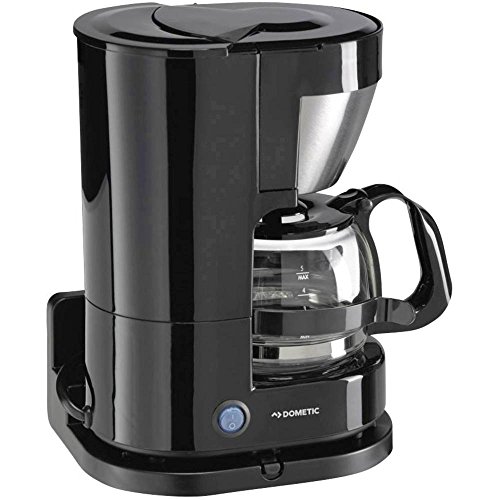
Dometic PerfectCoffee MC 052 Five Cup Coffee Maker, 12 V — Best for Drip Drinkers with Shore Power
The Dometic PerfectCoffee MC 052 is the traditionalist on this list: a genuine 12-volt drip coffee maker with a five-cup capacity, built by a brand whose main business is mobile and marine equipment. If your idea of vehicle coffee is a small pot of filter coffee rather than espresso shots, this is the verified listing that still does it the old way, straight from a 12V supply.
Strengths
- Real drip brewing for people who prefer filter coffee over espresso
- Five-cup pot serves two people properly instead of one small shot at a time
- Comes from a mobile-equipment brand with a long vehicle and marine catalog
Trade-offs
- Drip brewing from a 12V socket is slow compared with heating a small espresso volume
- A glass-style pot format needs careful stowing in a moving vehicle
- No built-in battery, so it only brews where vehicle power reaches
| Spec | Detail |
|---|---|
| Power source | 12 V vehicle power (per API listing title) |
| Capacity | Five cups (per API listing title) |
| Format | Drip coffee maker |
Choose the Dometic when the ritual matters: measuring grounds, hearing a pot brew, and pouring two normal mugs. The trade is time and power draw. Heating a pot of water on 12 volts is the hardest job in this category, so plan to brew while driving or while the engine runs rather than from a parked vehicle with a tired starter battery. Stow the pot padded and low, brew on a level surface, and the MC 052 delivers the closest thing to home drip coffee that a verified 12V listing currently offers.
Some truckers will read five espresso reviews and still want a pot of drip, and the Dometic is their verified option — with a condition this guide will not soften. A drip brew is the longest, heaviest draw in this category, so it belongs on shore power, an APU-supported system, or driving time. Parked for a ten-hour break on starter batteries alone, it is the wrong machine, and no badge here will pretend otherwise.
Best for: drip loyalists with APU, shore power, or generous auxiliary capacity / Not suited for: drivers relying on a lone starter battery during long parked stretches
Check the current price on Amazon
Comparison Table
Badge, key verified spec, and best-fit driver for each pick. Voltage and battery figures are quoted only where the listing states them, and the best-fit column is written for working drivers — operation type first, coffee preference second — because that is the order in which cab purchases succeed or fail.
| Pick | Badge | Key spec | Best for |
|---|---|---|---|
| Vagizm Portable Espresso Machine, Self-Heating, 15000mAh, 12V/24V Car Ready — Check the current price on Amazon | Best Overall for Truckers | Self-heating espresso, 15000mAh battery, LCD, USB-C, 12V/24V car ready (per API listing title) | solo and team truckers who want battery freedom plus dual-voltage cab compatibility |
| CONQUECO Portable Coffee Machine Travel 12V Car Espresso Maker — Check the current price on Amazon | Best for Solo Long-Haul | 12V car espresso maker with built-in battery, USB rechargeable, heats in about 3 minutes (per API listing title) | solo long-haul drivers who want one dependable cup with minimal cab clutter |
| Portable Single Serve 12V Car Coffee Maker for Pods & Ground Coffee — Check the current price on Amazon | Best for Pods and Fresh Grounds | 12V single serve for pods and ground coffee, reusable filter, 6–8 minute brew (per API listing title) | truckers who split their week between rushed mornings and slow resets |
| BougeRV 144Wh Portable Coffee Maker for K-Cup & Ground Coffee — Check the current price on Amazon | Best for K-Cup Cabs | 144Wh cordless coffee maker, K-Cup and ground coffee, AC/DC power (per API listing title) | K-Cup loyalists and team drivers who want pod variety without a socket routine |
| Makita DCM501Z 18V LXT / 12V max CXT Cordless Coffee Maker (Tool Only) — Check the current price on Amazon | Best for Owner-Operators on Makita Tools | Cordless coffee maker for Makita 18V LXT and 12V max CXT batteries, tool only (per API listing title) | owner-operators and vocational drivers already invested in Makita cordless tools |
| Dometic PerfectCoffee MC 052 Five Cup Coffee Maker, 12 V — Check the current price on Amazon | Best for Drip Drinkers with Shore Power | True 12V drip coffee maker, five-cup capacity (per API listing title) | drip loyalists with APU, shore power, or generous auxiliary capacity |
12 volts, 24 volts, and the modern truck cab
Many commercial cabs are not the simple 12V world of a passenger car. Accessory circuits, converters, and in some trucks a 24V architecture mean a machine’s voltage tolerance is a real buying criterion, not fine print. The Vagizm’s explicit 12V/24V readiness is why it leads this guide; battery machines sidestep the issue by charging from USB or AC and brewing from their own packs, which is the other robust answer.
Whatever the machine, know your cab before you order: which sockets are live during a break, which shut down with the key, and what the fuse ratings are. Trucks vary by make, model, and fleet specification more than cars do, and company drivers should also know their carrier’s policy on personal appliances in the cab — the finest machine in this guide is worthless if the fleet forbids it.
Protecting the start at dawn
The hierarchy is simple. Battery machines risk nothing. Socket machines belong to driving hours. Drip pots belong to shore power, APUs, or driving hours. A no-start at a receiver’s dock is a service failure, a late load, and possibly a tow bill; no cup of coffee is priced anywhere near that. Build the coffee system so the worst case is a weak cup, never a dead truck.
How to choose the best 12 volt coffee maker for truckers
Start with your operation type. Solo long-haul drivers live on routine and minimal cab clutter. Team drivers double every cup count and should size batteries and formats for two. Owner-operators can justify platform plays like the Makita if the tool ecosystem is already aboard. Regional and local drivers who sleep at home may need nothing more than a compact machine for the occasional early start — or nothing at all, and this guide respects that answer too.
Format is a supply decision
On the road, coffee format is logistics. K-Cup is sold everywhere trucks stop. NS capsules and specialty pods are not. Ground coffee is sold everywhere but asks for measuring, storage, and cleanup in a moving cab. Choose the format your routes can feed, not the format a kitchen would prefer — the machine will be fed at truck stops and distribution-center vending areas, not at a grocery store with a coffee aisle.
Cab storage and spill discipline
Measure the cabinet or side-box space the machine will actually occupy, including its mug and its coffee supply, because the system is the footprint, not the device. Favor machines that travel closed, brew into lidded mugs, and tolerate being stowed among straps and paperwork. A machine that needs counter space to operate needs a plan for where that counter is at a rest area at midnight.
The real economics of cab coffee
Truck-stop coffee is a small daily expense that compounds into a serious annual one at professional driving volumes, and it arrives with parking, queues, and whatever the urn has been doing since morning. A cab machine converts that into a modest equipment cost plus cheap consumables, and it returns something money phrases miss: coffee at the exact minute the break starts, in the berth, without dressing for the truck stop. Most drivers who make the switch describe the payback in weeks of mornings, not in accounting.
The honest costs on the other side are consumables discipline and machine lifespan. Pods bought at truck stops cost more than pods bought in bulk at home, so stock the cab during home time. And a machine that lives in a vibrating cab works harder than a kitchen appliance; buy the pick whose build and brand support match how many years you expect from it, and keep the purchase records with the truck’s paperwork.
Coffee and sleep: a professional driver’s note
Coffee is a tool of the trade, and like every tool it has a correct use. Caffeine late in a shift borrows alertness from the break that follows, and a driver who brews a strong cup two hours before a ten-hour break may spend the first hours of that break staring at the bunk ceiling. Experienced drivers front-load caffeine early in the driving day and taper it as the break approaches, and a cab machine actually helps that discipline: when coffee is available at the right times, there is less temptation to grab it at the wrong ones just because a truck stop appeared.
This guide makes no health claims and sets no personal limits — drivers know their own tolerances and their medical guidance — but the scheduling point is operational, not medical: plan the last cup the way you plan the last fuel stop, with the break in mind. The machine that serves you best is the one that makes the right cup easy at 5 a.m. and unnecessary at midnight.
How to run a cab coffee routine without risking your start
This routine assumes professional constraints: hours-of-service breaks, no idling to brew, and a starter reserve that is sacred. It works with every pick in this guide, with the power step adjusted to the machine type.
- Set up the coffee station while parked for the break: machine on the flattest surface the cab offers — a folded-down bunk surface or a stable tray — never on the dash or a seat.
- Decide the power source before the water. Battery machine: check the gauge. Socket machine while rolling only. Drip pot: shore power, APU support, or not at all.
- Load the format that matches the morning: pods staged for pre-dawn departures, grounds measured on reset days when time is not the enemy.
- Brew into a lidded, cab-rated travel mug that fits the truck’s cupholder. Open cups in a cab are a spill scheduled for the first pothole.
- If a co-driver is sleeping, use the quietest routine you have — battery machines at the table or outside the cab door at a rest area beat socket machines and cab movement at 3 a.m.
- Drink, then immediately stow: grounds or pods into the trash bag, machine wiped and closed, mug rinsed or sealed. A cab that smells of stale coffee by day three is a routine failure, not a machine failure.
- Recharge on the roll. The driving hours after the break are the charging hours; plug battery machines in as part of the pre-trip, not as an afterthought at the next stop.
- Weekly, wherever your reset falls, rinse the machine properly, check its cord and seals for vibration wear, and restock pods or grounds from bulk supplies rather than truck-stop singles.
Vibration deserves its own sentence in a trucking guide: check cords, plugs, and reservoir seals more often than you would at home, because a cab shakes its appliances for a living. A cord chafed through against a seat rail is a short circuit looking for a fuse, and a five-second weekly inspection during the reset prevents it.
Stock management closes the loop. Keep a simple count — pods or grounds for the days until home time, plus a two-day reserve — and replenish from bulk at home rather than piecemeal at travel plazas. The reserve matters because freight does not respect plans: a weather delay or a missed reload can add days to a tour, and the coffee system should be the last thing that runs out. Drivers who run dedicated routes often keep a sealed emergency sleeve of pods in the side box that is only opened when the main stock fails, and rotate it monthly so it never goes stale.
Finally, keep the system boring. The drivers who still love cab coffee in year two are the ones whose routine never changes: same machine position, same mug, same charging plug-in moment in the pre-trip. Novelty is for home kitchens; in a cab, reliability is a habit before it is a product.
Common Buying Mistakes
Idling to brew. Burning diesel and breaking anti-idling rules for a coffee cycle is the most expensive cup on the road. Battery machines exist precisely to make this unnecessary.
Running a drip pot through a ten-hour break on starter batteries. The longest draw in the category meets the longest parked stretch in trucking. Shore power, APU, or driving hours — there is no fourth option.
Buying a format your routes cannot feed. A cab full of the wrong pods is a museum. Match the machine to what truck stops and your home-time bulk shopping actually supply.
Ignoring fleet policy. Company drivers: confirm personal appliances are permitted in your cab before ordering. Policies vary by carrier and by device type.
Treating the cab like a kitchen counter. Unsecured machines, open mugs, and loose cords fail under vibration and braking. If it is not stowed for the road, it is not installed.
Final Recommendation
For most professional drivers, the Vagizm is the best 12 volt coffee maker for truckers to start with: dual-voltage readiness, the largest verified battery here, and a gauge that respects a sleepy driver’s need for instant information. Solo long-haul drivers who value compact routine should take the CONQUECO, K-Cup loyalists the BougeRV, and Makita-equipped owner-operators the DCM501Z. Drip loyalists get the Dometic — on shore power or while rolling, exactly as its full review above insists, without any exceptions whatsoever, ever, for any driver, on any route, in any season of the year.
The rest of the cluster covers the same verified category for other lives — the base guide for general drivers, the camping lens for off-duty weekends, and the boat guide for drivers whose other vehicle floats:
- Vagizm Portable Espresso Machine, Self-Heating, 15000mAh, 12V/24V Car Ready — Check the current price on Amazon
- CONQUECO Portable Coffee Machine Travel 12V Car Espresso Maker — Check the current price on Amazon
- Portable Single Serve 12V Car Coffee Maker for Pods & Ground Coffee — Check the current price on Amazon
Best 12 Volt Coffee Maker Best 12 Volt Coffee Maker For Camping Best 12 Volt Coffee Makers Best 12 Volt Coffee Makers For Boats Best 12 Volt Compact Car Vacuum
Frequently Asked Questions
Can I brew coffee during my ten-hour break without draining the truck’s batteries?
Yes — with a battery machine. Self-heating battery brewers draw nothing from the truck while they brew, and they recharge during your driving hours. Socket machines and especially drip pots should stay out of break-time use unless you have shore power or an APU supporting the load.
Do I need a 24V coffee maker for a commercial truck?
It depends on your cab’s accessory system, which varies by truck. Many cabs provide 12V accessory power even in larger electrical systems, but a machine explicitly rated 12V/24V — like the Vagizm in this guide — removes the question entirely. Check your cab’s sockets and your fleet’s guidance before ordering.
What coffee format is easiest to keep stocked on the road?
K-Cup, by a wide margin: it is the format sold at truck stops and travel plazas across the freight network. Ground coffee is the runner-up — available everywhere but messier in a cab — while specialty capsule formats may require stocking up during home time.
Will a coffee maker violate my company’s cab policy?
It might, and the answer differs by carrier, by terminal, and sometimes by truck assignment, which is why no buying guide can settle it for you. Carriers set their own rules for personal appliances, inverters, and anything drawing from the truck’s electrical system. Battery machines that charge by USB are the least likely to raise issues, but the only safe answer is your own fleet’s current policy, checked before you buy.
Is an inverter and a home coffee maker a better setup?
For a truck with a properly sized inverter and battery bank, it can work, and some owner-operators run exactly that. For most drivers it adds draw, heat, and policy questions that a purpose-built battery or 12V machine avoids. It also ties your coffee to the truck’s electrics in a way battery machines deliberately do not.
How do I keep the cab from smelling like old coffee?
Empty grounds or pods immediately, wipe the machine after the last cup of the day, rinse on your weekly reset, and never let a used filter sit in a closed warm cab. The smell problem is always a routine problem; ten seconds of discipline per cup prevents it entirely.
Can team drivers share one machine?
Yes, with expectations set: single-serve machines brew sequentially, so teams should choose the largest battery they can stow and a pod format both drivers like. The BougeRV and the big-battery CONQUECO in this guide are the team-friendliest picks; a five-cup pot only suits teams whose power setup supports it.


