Disclosure: airfryerkitchensupply.com is reader-supported. When you buy through links on our site, we may earn an affiliate commission at no extra cost to you.
Where to buy
Shopping for the best chemical toilets for camping? Every pick is a portable chemical toilet verified against Amazon’s catalogue data before linking — capacities, carry features and flush types below come from those listings. All of them need holding-tank treatment, sold separately; add a bottle to the same order and you are camp-ready.
- Kohree Portable RV Toilet 5.8 Gallon (Best for Family Basecamp) — Check the current price on Amazon
- Thetford Porta Potti Curve 565E (Best Comfort at Camp) — Check the current price on Amazon
- VINGLI Portable Toilet 5.3 Gallon with Carrying Bag (Best for Car Camping) — Check the current price on Amazon
- SereneLife Portable Camping Toilet 5.2 Gallon (Best Fresh-Water Efficiency) — Check the current price on Amazon
- Thetford Porta Potti 365 (Best All-Round Camp Toilet) — Check the current price on Amazon
- Dometic 970-Series Portable Toilet 2.6 Gallon (Best Compact for Small Cars) — Check the current price on Amazon
Finding the best chemical toilets for camping means solving a very specific equation: a real, seated, flushable toilet that travels in a car boot or a camper’s locker, seals completely against smells and spills on the road, and empties without drama at a campsite disposal point. Chemical — portable cassette — toilets are the format that solves it, which is why they have quietly become standard kit for family camping, festivals, campervans and overland rigs. The best ones share three traits: a tank sized to your trip length, a seal you would trust in a hot car, and a pour you can perform without wearing any of it.
Camping splits the category differently than home or marine use. Weight when full matters, because you carry the cassette across the campsite. Fresh-water efficiency matters, because every litre arrived in your vehicle. And pack size matters, because the toilet competes with tents, chairs and a weekend of food for the same cubic space. The six picks below are chosen on those camping terms — from a 5.8-gallon family basecamp model to the compact Thetford that disappears into a car boot.
A word on expectations: a chemical toilet will not make a festival field smell like a hotel, and it asks a small routine of dosing and rinsing in exchange for its service. What it replaces — the midnight walk to a distant toilet block, the bucket-and-bag improvisation, the queue at dawn — it replaces completely. For most family campers, that trade is the easiest yes in the gear list.
And a practical word about pitch politics: a chemical toilet changes how a family camps. It makes the far, quiet corner of the site usable, removes the dawn queue from the holiday’s emotional register, and — handled with the disposal discipline this guide teaches — leaves the pitch exactly as found. Sites increasingly welcome that self-containment; campers who abuse it, by emptying where they should not, are the reason restrictions exist. The picks below deserve better owners, and this guide assumes it has found them.
In this guide
Quick Picks
Kohree Portable RV Toilet 5.8 Gallon — Best for Family Basecamp. The biggest tank in this guide with a level indicator and leak-proof sealing — the family basecamp toilet that gets a long weekend done without a mid-trip empty. Check the current price on Amazon
Thetford Porta Potti Curve 565E — Best Comfort at Camp. The comfort pick: a taller, sculpted seat and push-button electric flush that make a tent’s toilet corner feel almost civilised — for campers who pitch long and live well. Check the current price on Amazon
VINGLI Portable Toilet 5.3 Gallon with Carrying Bag — Best for Car Camping. A 5.3-gallon toilet that ships with its own carrying bag — the detail that tells you it was designed by people who have actually packed a car for a campsite. Check the current price on Amazon
SereneLife Portable Camping Toilet 5.2 Gallon — Best Fresh-Water Efficiency. A maker-rated 100-plus flushes per fill, a level indicator and a sturdy rated capacity — the efficiency pick for campers who count litres and days between services. Check the current price on Amazon
Thetford Porta Potti 365 — Best All-Round Camp Toilet. The benchmark again — because for a campervan or a family tent, the rotating pour spout, piston flush and endless parts support are exactly what seasons of camping demand. Check the current price on Amazon
Dometic 970-Series Portable Toilet 2.6 Gallon — Best Compact for Small Cars. The small-car and solo-camper answer: a 2.6-gallon Dometic that packs into boots and lockers the family models cannot enter, and carries full without a struggle. Check the current price on Amazon
How These Picks Were Chosen
Each model was verified before earning a link — brand, capacity, flush type and carry features read from the catalogue titles. No prices or ratings appear in this article; both change too fast to print honestly, and the tier language in each review does the positioning work instead.
Camping criteria reordered the usual priorities. Seal confidence came first, because a cassette in a vehicle is a cassette at angles, in heat, over rough roads. Capacity-to-trip matching came second: the guide spans a long-weekend family tank down to a solo overnight compact, and each review states its trip length honestly. Fresh-water efficiency third — flushes per fill is range, in a vehicle. Pack size and full-tank carry weight ran through every judgement.
We deliberately kept the list to true chemical cassette toilets — no bucket toilets, no bag systems, no composting units — because the search promises a flushable chemical toilet, and campers comparing across formats will find those alternatives in this site’s other guides.
Camping reordered the general chemical-toilet criteria in one important way: transport behaviour outranked everything. A cassette at camp is carried further, tilted more and baked hotter than in any other duty, so seal confidence and carry design lead; capacity matched to trip length follows; fresh-water efficiency matters in proportion to the site’s distance from a tap; and pack size arbitrates between near-equals. Brand support still counts — a seal that fails in season three should be replaceable — but it yields to the realities of the boot and the disposal walk.
The 6 Best Chemical Toilets for Camping, Reviewed
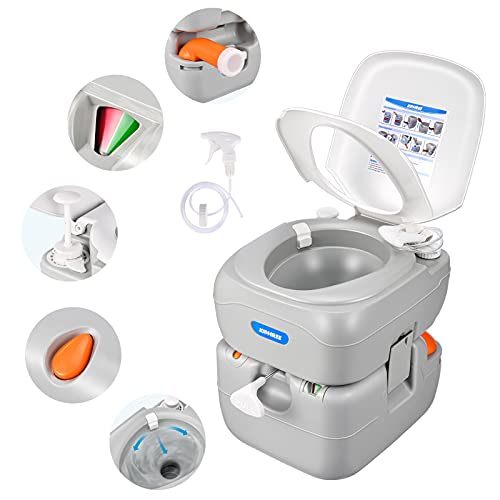
Kohree Portable RV Toilet 5.8 Gallon — Best for Family Basecamp
Family camping is a capacity problem before it is anything else: four people, three nights, one toilet, and a disposal point that may be a field away. The Kohree’s 5.8-gallon cassette is the largest in this guide, and paired with a level indicator it turns the family’s least favourite logistics question — ‘how full is it?’ — into a glance instead of an investigation.
Strengths
- Largest capacity here stretches a family long weekend
- Level indicator ends the guesswork before the drive home
- Leak-proof sealing suits transport in the family car
Trade-offs
- A full tank is a heavy carry across a big campsite
- Bulkiest pack size in this guide
- Overkill for solo overnight trips
| Waste tank | 5.8 gallons, detachable |
| Indicator | Level indicator |
| Sealing | Leak-proof design |
| Positioning per maker | Camping, RV travel, trips, indoor/outdoor |
The leak-proof sealing earns its mention for the drive: this toilet travels in the same vehicle as the family’s luggage and food, often at angles no brochure photographs. A cassette you trust in a hot car on a rough track is the entire product, and Kohree builds its pitch around exactly that trust.
Accept the two honest costs. It packs big, competing with the tent for boot space, and a full 5.8 gallons is a two-handed, walk-carefully carry. For a family basecamp that stays pitched for days, both costs buy the thing that matters: not thinking about the toilet again until pack-down.
Best for: families and groups camping several nights in one pitch / Not suited for: solo campers and small-car packers
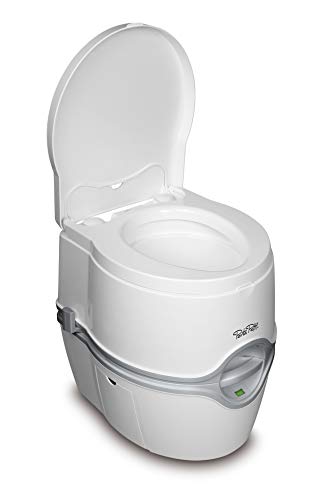
Thetford Porta Potti Curve 565E — Best Comfort at Camp
Some camps are expeditions; others are outdoor living rooms. The Curve is for the second kind — the week-long pitch, the glamping bell tent, the campervan awning where the toilet corner is a small room of its own. Its seat sits higher and more sculpted than any rival here, and the electric flush delivers a consistent rinse at a button press, which at 3 a.m. in the cold is a luxury you feel in your bones.
Strengths
- Most home-like seat and posture of any camp toilet here
- Electric flush is even, easy and kind to tired campers at night
- Thetford parts and seal support for years of seasons
Trade-offs
- Needs batteries — pack spares as seriously as tent pegs
- Large footprint in the tent or awning
- Premium tier for a camping toilet
| Model | Porta Potti Curve 565E |
| Flush | Battery-powered electric |
| Format | Large portable cassette toilet |
Thetford’s ecosystem travels with it: seals and spares are stocked items, so the Curve can serve season after season rather than a summer and a skip. Its size is the standing caveat — measure the awning corner or the van’s garage before committing — and its batteries are a consumable to manage like headtorch cells.
If your camping style is ‘pitch once, live well’, this is the toilet that matches it. If your style is a different field every night, the lighter picks below will suit the road better.
Best for: long-stay pitches, glamping and campervan awnings / Not suited for: fast-moving tourers and minimalist packers

VINGLI Portable Toilet 5.3 Gallon with Carrying Bag — Best for Car Camping
The carrying bag sounds like a gimmick until you have loaded a car at dawn: the toilet rides strapped among the bags, discreet from passengers, protected from knocks, and — after a muddy weekend — contained from everything else in the boot. VINGLI’s inclusion of the bag signals a product designed around car camping specifically, and the 5.3-gallon capacity underneath it is honestly family-sized.
Strengths
- Carrying bag keeps the toilet discreet and contained in the car
- Full family capacity without the largest footprint
- Bag doubles as storage protection between trips
Trade-offs
- Bag adds a cleaning duty of its own after muddy trips
- Brand support thinner than Thetford or Dometic
- Flush is functional rather than class-leading
| Capacity | 5.3 gallon class |
| Includes | Carrying bag |
| Positioning per maker | Camping, boat, truck |
In service it is a straightforward chemical toilet: sealed detachable tank, workmanlike flush, nothing exotic to fail in a field. That plainness is a camping virtue. The questions are the familiar value-brand ones — seal availability in five years, finish durability across seasons — and the sensible response is the usual one: buy a spare seal while the model is current.
For the classic family car-camping trip, where the toilet’s journey matters as much as its performance on site, this is the most thoughtfully packaged pick in the guide.
Best for: car campers who pack the toilet among the luggage / Not suited for: expedition users who need guaranteed decade-long parts

SereneLife Portable Camping Toilet 5.2 Gallon — Best Fresh-Water Efficiency
Off-grid camping runs on carried water, and a toilet’s flush appetite is a range figure like any other. SereneLife rates this model at over a hundred flushes per fill — a maker’s figure that depends on how each camper flushes, but which reflects a genuinely frugal flush design. On a site where the tap is a standpipe a field away, that efficiency is felt daily.
Strengths
- Frugal flush stretches fresh water on off-grid pitches
- Level indicator suits sites with distant disposal points
- Sturdy rated capacity for larger campers
Trade-offs
- Flush-count figure depends on user habits
- Value-brand parts support is a question mark
- Plastics feel budget-grade beside the legacy brands
| Waste tank | 5.2 gallons, detachable |
| Maker figure | 100+ flushes per fill |
| Indicator | Level indicator |
| Maker figure | 330 lb capacity |
The supporting spec is camping-sensible: a 5.2-gallon detachable tank, a level indicator for planning the disposal walk, leak-proof sealing for the drive, and a rated capacity that reassures larger campers — a group portable toilets too often forget.
The caveat is the value-brand one, stated once for the whole guide: long-term seals and parts are unproven, so buy the spare seal early. For trip-based camping rather than decade-long installation, the SereneLife’s efficiency case is strong and its tier is friendly.
Best for: off-grid and festival campers counting carried water / Not suited for: buyers wanting a legacy brand’s support network

Thetford Porta Potti 365 — Best All-Round Camp Toilet
It is no accident that the 365 appears in this site’s general chemical guide and its bus guide too: it is simply the portable chemical toilet that the most campers, sailors and van-lifers have stress-tested for the longest. For camping specifically, its virtues align perfectly — a piston flush that cannot run out of battery in a field, a pour spout that makes the disposal-point ritual as decent as it can be, and a seal ecosystem you can refresh from a caravan shop in any country.
Strengths
- Rotating pour spout makes campsite emptying controlled
- No batteries, no motors — nothing to fail in a field
- Parts support measured in decades, not seasons
Trade-offs
- Mid-size tank for a family’s longest trips
- Lower seat than the Curve
- Plain looks beside design-led rivals
| Line | Porta Potti 365 (model 92820) |
| Flush | Piston pump |
| Format | Mid-size detachable cassette |
Its mid-size tank is the one camping compromise: a family on a week-long pitch will empty it mid-trip, where the Kohree above might just last. In exchange you get a toilet that packs smaller, carries lighter, and will still be serviceable when the children who used it are packing it for their own children.
If the camping brief is ‘buy once, use for a decade of summers’, this is the answer the market has been giving for years, and this guide sees no reason to overrule it.
Best for: campervans and family tents wanting a decade-long companion / Not suited for: large families on week-long pitches needing maximum capacity
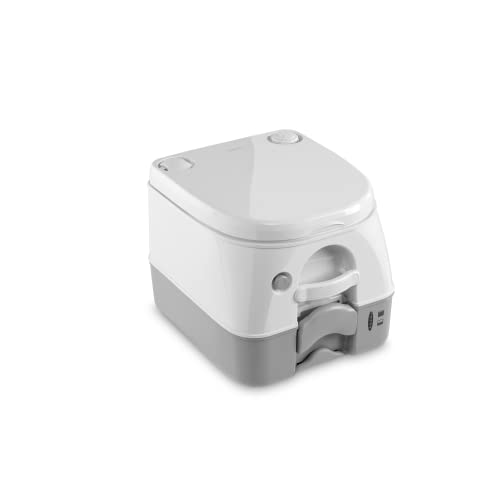
Dometic 970-Series Portable Toilet 2.6 Gallon — Best Compact for Small Cars
Not every camping toilet serves a family at a basecamp. The solo tourer, the couple in a small hatchback, the angler at a lake cabin — their constraint is cubic, and their trip rhythm is short. The Dometic 970’s 2.6-gallon format is built for them: a real chemical toilet with a real brand’s seals and support, in a body that disappears into the corner of a boot.
Strengths
- Packs where full-size toilets cannot — small boots, lockers, under-bunk
- Light full-tank carry for any camper
- Dometic build quality and seal support
Trade-offs
- Strictly solo or couple, short-trip capacity
- Compact seat is a compromise for larger users
- Frequent emptying on longer trips
| Holding tank | 2.6 gallons |
| Brand line | Dometic 970-series |
| Format | Compact two-piece portable |
Capacity honesty: this is a weekend-for-one or nights-for-two toilet, and on longer trips it asks for regular disposal walks. Its consolation is unique in this guide — a full tank that absolutely anyone can carry comfortably, which quietly removes the task campers postpone until it becomes a problem.
Choose it when the packing diagram, not the party size, is the binding constraint. In that life it is not the small compromise; it is the only pick that fits, from the brand you would choose anyway.
Best for: solo campers, small cars and overnight stops / Not suited for: families and long-stay basecamps
Comparison Table
| Pick | Badge | Key spec | Best for |
|---|---|---|---|
| Kohree Portable RV Toilet 5.8 Gallon | Best for Family Basecamp | 5.8 gallons, detachable | families and groups camping several nights in one pitch |
| Thetford Porta Potti Curve 565E | Best Comfort at Camp | Porta Potti Curve 565E | long-stay pitches, glamping and campervan awnings |
| VINGLI Portable Toilet 5.3 Gallon with Carrying Bag | Best for Car Camping | 5.3 gallon class | car campers who pack the toilet among the luggage |
| SereneLife Portable Camping Toilet 5.2 Gallon | Best Fresh-Water Efficiency | 5.2 gallons, detachable | off-grid and festival campers counting carried water |
| Thetford Porta Potti 365 | Best All-Round Camp Toilet | Porta Potti 365 (model 92820) | campervans and family tents wanting a decade-long companion |
| Dometic 970-Series Portable Toilet 2.6 Gallon | Best Compact for Small Cars | 2.6 gallons | solo campers, small cars and overnight stops |
Sizing a Camping Toilet to Your Trip
Start with people and nights, because capacity is arithmetic before it is shopping. In full use, plan roughly a gallon of waste capacity per person per day, discounted when the campsite’s own facilities take some of the load — as they honestly do on most family trips, where the chemical toilet is the night and morning solution rather than the all-day one. A couple on a long weekend lives comfortably in the mid-size class; a family of four on the same trip should start at the largest tanks in this guide; a solo tourer is free to go compact and pocket the pack space.
Then apply the two camping corrections. First, the carry: you will walk the full cassette to a disposal point, possibly across a large site, so weigh the full tank honestly against the person who will carry it. Second, the pitch: a toilet used inside a tent needs a footprint and a corner — measure the awning or toilet tent you actually own, not the one in the brochure photograph.
Finally, fresh water. Every flush spends the water you carried in. Efficient flushes and frugal habits stretch a pitch’s autonomy by days, which is why the efficiency pick in this guide matters to wild campers and festival-goers more than to serviced-site families.
The Campsite Routine: Dosing, Sealing and the Disposal Walk
A chemical toilet at camp runs on a small liturgy. Dose the cassette with treatment and a little water when you pitch, before its first use — chemistry works preventatively, not as a rescue. Keep the blade seal clean and closed between uses; an open or gritty seal is how smells escape a tank that is otherwise doing its job. In hot weather, treat the tank’s comfort as shorter than its capacity: heat accelerates everything, and an early empty beats a heroic one.
The disposal walk deserves its own respect. Close the valve, detach, carry upright, and at the chemical disposal point — every organised site has one, usually near the toilet block — pour through the spout with the vent open, rinse the cassette with the provided hose, and re-dose before you refit it. Gloves live in the toilet’s storage corner permanently. Never empty a cassette into a normal toilet block’s storm drains, a hedgerow or a watercourse: the treatment that is benign in a sewer is a pollutant in a stream.
Back at the pitch, the toilet returns to invisibility — which is the entire point. Campers who build the routine on day one stop thinking about the toilet by day two, and that amnesia is the product working as designed.
Chemical Toilets vs the Alternatives at Camp
Campers owe themselves one honest comparison before buying. The bucket-and-bag system is the cheapest seat in camping: near-zero pack cost, and a waste stream of sealed bags that many sites now restrict and no one enjoys at a festival’s end. It serves an emergency or a single night; it is not a family system. Composting camp toilets eliminate chemicals and dump points but cost a premium tier, need venting and media management, and suit long-term off-grid pitches better than a wet weekend in Wales.
The cassette chemical toilet sits where most campers actually live: a real flush, a sealed tank, a modest tier, and a disposal ritual every site supports. Its costs are the chemicals themselves — buy modern, environmentally gentler treatments and dose them properly — and the carrying, which this guide has priced into every pick. For car camping, campervans, festivals and family basecamps, it remains the default answer, and the six toilets above are its honest shortlist.
If your camping is ultralight and human-powered — backpacking, bike touring — none of this applies, and the correct product is a trowel and local regulations. Weight is a tyrant with its own rules, and chemical toilets are gloriously exempt from pretending otherwise.
The Toilet Tent and the Pitch Layout
Where the toilet lives at camp is a design decision disguised as an afterthought. The classic answer is a small utility or toilet tent: privacy, ventilation, a defined place that children can find in the dark, and a floor between the cassette and the grass. Pitch it a short, flat walk from the sleeping tent — near enough for the 3 a.m. journey, far enough for dignity — and on the disposal-point side of your pitch if the site allows, so the full cassette’s walk does not cross your own living space.
Inside the tent, level ground matters more than luxury: a rocking toilet works its seal and unnerves its users, so a groundsheet and a moment with a mallet are part of the installation. Keep the kit together in that corner — treatment, gloves, paper, a small torch — because a toilet corner that requires a scavenger hunt at midnight is a toilet corner that will be improvised around, and improvisation is what the appliance exists to prevent.
Campervan and awning setups follow the same logic in miniature: a defined corner, a level base, the carry route to the door kept clear. The toilet that has a place gets used properly; the toilet that floats around the pitch gets resented, and then gets left at home, and then everyone is back in the dawn queue.
Festival and Event Camping: The Hardest Duty
Festivals stress every part of the chemical-toilet proposition at once: maximum users, minimum water, distant disposal points and heat. The campers who thrive are the ones who plan like it. Size up — the largest tank in this guide is the festival pick, because a mid-festival empty across a crowded site is a logistical expedition. Dose generously within the maker’s directions and empty early rather than heroically; the last gallon in festival heat is nobody’s friend.
Water discipline becomes a group skill: the frugal-flush models in this guide earn their rating here, and a camp rule — full flush for solids, brief for liquids, where the model allows — stretches both tanks measurably. Keep a dedicated water container for the toilet so its supply is never raided for cooking, and gloves and sanitiser at the toilet corner as permanent fixtures, not afterthoughts.
Finally, festival etiquette is disposal etiquette doubled: the provided chemical points only, queues respected, spills cleaned by the spiller. Festivals that have banned private chemical toilets did so because of the minority who treated fields as facilities. Camp like the majority who want the invitation renewed.
Packing the Toilet: Transport Discipline for the Drive
More chemical toilets are damaged in transit than in use, and the drive deserves its own doctrine. Transport the unit empty of waste whenever the trip allows — pitch-empty is a preference, pack-down-empty is a rule — and when a cassette must travel charged, it travels upright, sealed, and secured against sliding, ideally in its bag or a crate that keeps it from becoming the boot’s loose cannon. A cassette is engineered to seal in a static vehicle life; a three-hour slide-and-thump across a boot is an abuse case, and restraints are cheap.
Separate the consumables from the unit in transit: treatment bottles upright in their own sealed bag, because a treatment leak in a hot boot perfumes the luggage for a season. Paper travels dry and high. The toilet itself rides best low and central in the load, where the vehicle’s motion is gentlest — the same place you would put anything heavy, full and trusted.
On arrival, the commissioning order matters: pitch the toilet corner first, charge the cassette while the tent rises, and the camp’s least glamorous system is working before the first meal is cooked. Campcraft is mostly this — the unglamorous systems installed early and correctly, so they never ask for attention again.
Cold-Weather and High-Altitude Camping Notes
Cold changes the chemistry’s tempo and the camper’s duties. Treatments work more slowly in the cold, which cuts both ways: odour develops slowly too, but waste breakdown lags, so the cassette fills with less-processed contents and the pour deserves extra care and a thorough rinse. Water discipline tightens — a cassette or flush tank left charged in a freezing night can crack, so in genuine sub-zero camping, drain the flush system at night and keep the cassette’s contents as low as the trip allows.
Altitude’s effect is subtler: sealed tanks equalise as you climb, and a cassette charged at sea level can sigh or weep a film at a mountain pass if its seal is marginal. The defences are the usual ones performed early — a clean, supple blade seal, a cap confirmed tight, the unit transported upright — plus one altitude habit: crack the flush mechanism’s pressure gently at the first stop after a big climb, rather than letting the first user discover the differential.
Neither climate disqualifies the format; generations of winter and mountain campers run chemical toilets as standard kit. They simply promote the maintenance virtues this guide already scores — seals, support, honest capacities — from preferences to requirements.
Teaching Children the Camp Toilet System
Families discover that children are the chemical toilet’s most enthusiastic constituency — it is private, it is theirs, and it removes the frightening dark walk entirely — provided the system is taught as a small ceremony rather than assumed. The rules fit on one breath: flush properly, close the lid, nothing but paper, tell a grown-up if anything seems wrong. Children enforce rules they have been ceremonially given with a rigour adults rarely match, and the camp toilet run by a deputised eight-year-old is a well-run facility.
Two child-specific provisions complete the setup. A small step or a lower compact model for the youngest, whose feet should reach something solid; and a night-light or torch that lives at the toilet corner, because the system’s only real failure mode with children is the dark. Set those, and the toilet becomes what it should be for the whole family — infrastructure, invisible and unthanked, which is the highest state sanitation achieves.
A Final Word on Trip Fit
Before the season starts, do one honest rehearsal at home: charge the cassette, run the routine, empty it at your own facilities, and learn the pour with water before the campsite teaches you with consequences. Ten minutes of rehearsal converts the first trip’s toilet from an experiment into infrastructure, and it is the cheapest confidence in the whole gear list. After that, the system runs itself — dose, seal, rinse, repeat — and camping gets back to being about the places, which was always the point of carrying a toilet to them in the first place.
How to Set Up and Empty a Camping Chemical Toilet
Ten minutes of setup at the pitch buys a trip without toilet logistics. The routine below is the whole skill; everything else is habit.
- Pitch the toilet on level ground in its corner — toilet tent, awning or van — where it will not be kicked, sat on by luggage, or baked in direct sun all day.
- Charge the cassette: fresh water plus the correct dose of holding-tank treatment, added before first use. Fill the flush tank with clean water.
- Brief the camp, especially children: flush fully each time, close the lid and the seal, and nothing goes in that did not pass through a person or come on a roll — no wipes, ever, even the ones that claim otherwise.
- Check the level daily in hot weather or heavy use. Plan the empty for a calm moment, not for the brim.
- At the disposal point: gloves on, valve closed, cassette detached and carried upright; pour through the spout with the vent pressed, rinse thoroughly, re-dose, refit.
- At pack-down, empty and rinse the cassette before the drive home, and store the toilet clean with the seal relaxed. A cassette stored dirty is a debt collected with interest at the next trip.
- At the first evening’s end, do a thirty-second commissioning check: seal seated, lid closed, supplies stocked, torch in its place. Camps are won on these small inspections — the toilet that is checked on day one is never the subject of a day-three emergency.
One driving note: transport the toilet upright and secured, ideally in its bag or a crate. A sealed cassette is trustworthy; a sealed cassette sliding around a boot for three hours is a trust fall you did not need to take.
Field troubleshooting, because campsites have no plumbers: a seal that weeps slightly can often be revived for the trip by cleaning the blade meticulously and reseating the cassette — grit is the usual culprit. A flush that weakens on a pump model is usually a low fresh tank or a kinked pickup, both visible on inspection. A cassette approaching full before the trip ends is a planning problem with one solution — the disposal walk, done early and cheerfully — and no chemical additive that changes it. Pack the spare seal if your model supports one; it weighs nothing and it is the difference between a repair and a ruined weekend.
A campsite-specific rescue: if the disposal point’s rinse hose is missing or frozen, a bucket of water and a patient swirl does the same work — rinse twice rather than once, and re-dose as usual. If the cassette’s cap is lost in transit, a securely taped, double-bagged seal improvises for the drive home only, and the replacement cap becomes the first purchase of the off-season. Improvisation has a hierarchy — protect the seal, protect the car, protect the schedule, in that order — and almost every field problem yields to it.
Common Buying Mistakes
Buying family capacity for a solo pack — or the reverse. Oversized toilets eat the boot; undersized ones eat the trip in disposal walks. Match tank to people and nights with the arithmetic in the guide above.
Skipping the treatment ‘because it’s only a weekend’. Odour does not respect trip length, and heat accelerates it. Dose from the first use, every trip, no exceptions — it is the cheapest comfort in camping.
Letting wipes anywhere near it. Even ‘flushable’ wipes do not break down like paper in a cassette; they clog pour spouts and wrap seals. Toilet paper only — ideally the fast-dissolving kind made for portable toilets.
Emptying into hedgerows, streams or storm drains. Illegal in most places, harmful everywhere, and the reason some sites restrict chemical toilets. The disposal point exists; the walk is part of the deal.
Storing it dirty between trips. A rinsed, dry-stored toilet is ready in minutes next season. A stored-dirty one needs a hazmat afternoon. The pack-down rinse is the cheapest maintenance in this entire guide.
Pitching the toilet downwind of nothing and uphill of everything. Site the toilet corner with the same care as the kitchen: level, drained ground that will not puddle in rain, and a route to it that does not cross the cooking area. A flooded toilet corner in a storm is a misery entirely chosen at pitch time.
Final Recommendation
Match the toilet to the trip and this category stops being a compromise. Families at a basecamp should start with the Kohree’s capacity or the Porta Potti 365’s decade-proof all-round game; comfort-led long pitches belong to the Curve; car campers get the VINGLI’s bagged practicality; water-counters get the SereneLife’s frugal flush; and small-car solo tourers get the Dometic 970, the compact that fits their actual life.
Dose it, seal it, rinse it, and the chemical toilet becomes what it should be at camp: unmemorable. The general chemical-toilet guide and the bus-living cassette guide below extend the same format to other lives.
Shortlist: Kohree Portable RV Toilet 5.8 Gallon (Best for Family Basecamp) · Thetford Porta Potti Curve 565E (Best Comfort at Camp) · VINGLI Portable Toilet 5.3 Gallon with Carrying Bag (Best for Car Camping)
Best Chemical Toilets Best Cassette Toilets For Bus Living Best Chair Height Toilets Best Caulk To Seal Around Tub And Toilets Best Caulk For Toilets
Frequently Asked Questions
How long does a camping chemical toilet last before it needs emptying?
Plan on roughly a gallon of waste capacity per person per day in full use, less when campsite facilities share the load. A five-gallon-class toilet therefore serves a couple for a long weekend comfortably, while a family of four should expect a mid-trip empty on a week-long pitch — or choose the largest tank in this guide.
Can you empty a chemical toilet at any campsite?
Organised campsites provide chemical disposal points, usually near the toilet blocks, and that is where cassettes belong. Never empty into storm drains, hedgerows or watercourses. If you are wild camping without facilities, the honest answer is to carry the cassette to the next proper disposal point — one more reason to size the tank generously.
Do chemical toilets smell in a tent or campervan?
A sealed, dosed and maintained one should not. Smell almost always means a gritty or worn blade seal, a missed treatment dose, or waste sitting in heat beyond its comfortable interval. The routine in this guide — dose early, keep the seal clean, empty before the brim — keeps the toilet as invisible as it is meant to be.
What toilet paper should you use in a camping chemical toilet?
Regular toilet paper in modest amounts works, and fast-dissolving paper made for portable and marine toilets works better, breaking down in the cassette instead of clogging the pour. Never put wipes in — including those labelled flushable — or anything else that did not come on a roll.
Are the chemicals safe for the environment?
Modern holding-tank treatments are far gentler than the formaldehyde formulas of the past, and enzyme-based options exist for the environmentally cautious. All of them belong in a sewer via a disposal point, not in soil or water. Dose correctly — more is not better — and dispose of the cassette only where facilities are provided.
Can children use a camping chemical toilet safely?
Yes, with the same supervision as any toilet: the seat heights are lower than home fixtures, which suits children well. Keep treatment bottles stored out of reach, as with any household chemical, and teach the flush-and-close routine early — children are usually its most reliable enforcers.
Can a chemical toilet be used inside a regular family tent?
It can, in a vestibule or a partitioned corner with ventilation, and many families do exactly that for young children’s night-time needs. A dedicated toilet tent is the better arrangement for a full-size unit — more privacy, better airflow, and a defined place — but the sealed cassette itself is designed to contain odour wherever it stands.
What should I do with the cassette when the trip ends mid-tank?
Empty it at the site’s disposal point before you leave — never travel home with a part-full cassette to ‘deal with later’, and never tip it anywhere unofficial. Rinse it, leave it dry for the drive, and store it clean. The pack-down empty takes five minutes and is the habit that keeps the whole system pleasant.
Can I use a camping chemical toilet in winter?
Yes, with water discipline: treatments work more slowly in the cold, and any water left in the flush system or a full cassette can freeze and crack the body in sub-zero nights. Drain the flush side, keep the cassette low, and in a heated campervan or a mild frost, normal use is fine.
How do I keep a camping chemical toilet from tipping in the tent?
Level ground first — a groundsheet over levelled earth or a board under the unit on soft ground. Guy lines are for tents, not toilets, but position helps: a corner placement against the toilet tent’s wall, away from the traffic path, with the kit stored beside rather than behind it. A toilet that is never bumped is a toilet that never tips.


