Disclosure: airfryerkitchensupply.com is reader-supported. When you buy through links on our site, we may earn an affiliate commission at no extra cost to you.
Where to buy
The fastest way to buy any faucet in this guide is through Amazon, where finish, hole configuration and included accessories are listed on each product page and stock changes daily. Start with our top pick for best ceramic disk kitchen faucets: Check on Amazon
- Kohler Simplice Pull-Down Kitchen Faucet K-596-BL — Check on Amazon
- Grohe Concetto Pull-Down Bar Faucet 31479001 — Check on Amazon
- Kraus Oletto Pull-Down Kitchen Faucet KPF-2820SFS — Check on Amazon
- OWOFAN Spring Pull-Down Kitchen Faucet (Brushed Nickel) — Check on Amazon
- FORIOUS Pull-Down Kitchen Faucet (Brushed Nickel) — Check on Amazon
- WEWE High-Arc Pull-Down Kitchen Faucet — Check on Amazon
The best ceramic disk kitchen faucets are chosen on a component most buyers never see: two ground ceramic discs inside the valve, pierced with ports, sliding over each other to meter and seal the water. Ceramic is harder than the sand, grit and mineral scale that destroy rubber washers and score plastic internals, which is why a ceramic disc valve can cycle for decades and still shut off with a clean, drip-free stop. If your faucet history is a trail of drips, this is the technology that ends it — and this guide ranks the faucets that implement it best.
A vocabulary caution first, because listings blur it deliberately: ‘ceramic disc’ and ‘ceramic cartridge’ describe the same family — a cartridge whose sealing element is a pair of ceramic discs — while some listings print ‘ceramic valve’ for anything from a true disc stack to a token ceramic washer. The picks below were verified and chosen where the maker’s own description names ceramic disc valves or a ceramic cartridge plainly: Kohler’s disc-valve Simplice, Grohe’s SilkMove ceramic valve, Kraus’s ceramic cartridge, and the ceramic-cartridge models from OWOFAN, FORIOUS and WEWE that bring the technology to working budgets.
Why devote a whole guide to one component? Because the valve is where faucets live and die. Finishes fade in importance, spray modes are preference, but the seal that opens and closes ten thousand times a year decides whether the faucet is a fixture or a recurring errand. The sections below explain how disc valves behave on hard water, what their genuine limits are — they dislike installation debris and thermal shock like any precision part — and how to install and feed them so their longevity is real rather than theoretical.
In this guide
Quick Picks
Six ceramic-sealed faucets across the tiers: Kohler’s ceramic-disc Simplice as the reference implementation, Grohe’s SilkMove valve in a compact bar format, Kraus’s ceramic-cartridge Oletto, OWOFAN’s spring pull-down, and FORIOUS and WEWE models proving ceramic cartridges now anchor even budget faucets.
- Best Overall Ceramic Disc: Kohler Simplice Pull-Down Kitchen Faucet K-596-BL — Kohler’s ceramic disc valves with DockNetik docking and a three-function sprayhead — the reference ceramic disc faucet. Check on Amazon
- Best Ceramic Valve, Compact: Grohe Concetto Pull-Down Bar Faucet 31479001 — Grohe’s SilkMove ceramic valve in a bar/prep-sized pull-down — European valve craft for smaller sinks. Check on Amazon
- Best Ceramic Cartridge, Full Size: Kraus Oletto Pull-Down Kitchen Faucet KPF-2820SFS — a ceramic cartridge inside a brass body — the disc-family valve with the strongest supporting construction. Check on Amazon
- Best Spring Faucet with Ceramic Cartridge: OWOFAN Spring Pull-Down Kitchen Faucet (Brushed Nickel) — a commercial-style spring pull-down whose ceramic cartridge is rated in the listing features at 500,000 cycles. Check on Amazon
- Best Budget Ceramic Cartridge: FORIOUS Pull-Down Kitchen Faucet (Brushed Nickel) — ceramic cartridge, stainless body, three modes and named certifications — ceramic sealing at the budget tier, verified. Check on Amazon
- Best Ceramic Value with Long Reach: WEWE High-Arc Pull-Down Kitchen Faucet — a ceramic-cartridge pull-down with a 20-inch pull-down reach — ceramic sealing plus the longest wand travel here. Check on Amazon
How These Picks Were Chosen
Verification used Amazon listing data in the standard way — brand-and-model search, title matched, link only on a confirmed ASIN — with an extra filter applied for this guide: the maker’s own returned description had to name the ceramic element. Listings that merely implied premium internals were passed over, because a guide about one component cannot be built on inference about that component.
Within the verified set, picks were judged on the disc valve’s supporting cast: the body it sits in (brass and stainless first), the spray and docking systems around it, and the maker’s record for stocking replacement cartridges — because even a ceramic valve should be replaceable in year fifteen, and the best makers treat the cartridge as a stocked part, not a trade secret. Tiers were spread so the technology’s price range is honestly represented, from Grohe and Kohler down to the budget brands whose ceramic cartridges are now their headline feature.
One exclusion deserves stating: faucets with diamond-embedded or other proprietary non-ceramic seals, however excellent, belong to the best-built guide rather than this one. This list is ceramic, verified, and nothing else.
One research note for transparency: dimensions and secondary specifications returned by the listing for some premium models — the Kohler Simplice among them — were internally inconsistent, and this guide prints no figure it could not stand behind. Where a spec box below is shorter than a rival’s, that restraint is the reason. A guide about the most precision-engineered component in the faucet should model the same precision in its own claims, and the valve verifications themselves — the subject of the guide — were unambiguous in every pick’s record.
The 6 Best Ceramic Disk Kitchen Faucets

Kohler Simplice Pull-Down Kitchen Faucet K-596-BL — Best Overall Ceramic Disc
Kohler has built its valve reputation on ceramic discs for decades, and the Simplice is that technology in a complete modern faucet: ceramic disc valves doing the sealing, a three-function sprayhead doing the work, and DockNetik magnetic docking keeping the wand honest. For a buyer whose first question is ‘will it still shut off cleanly in fifteen years’, this is the reference answer.
Strengths
- Ceramic disc valves from the maker most identified with them
- Sprayhead with Sweep and Boost modes that earn their complexity
- Cartridge support from a top-tier manufacturer
Trade-offs
- Confirm dimensions on the listing before ordering
- Matte black finish suits modern schemes and shows spots
- Premium pricing for the complete package
| Valve | Ceramic disc valves (API features) |
| Spray | 3-function: stream, Sweep, Boost (+30% flow) |
| Docking | DockNetik magnetic (API features) |
| Finish | Matte black |
The sprayhead deserves its share of the credit: Sweep pushes a blade of water across the sink that genuinely moves debris to the drain, and Boost raises flow by roughly a third for filling and blasting — so the faucet around the discs is as considered as the discs themselves. Kohler’s cartridge ecosystem is the other long-term argument: replacement disc cartridges for a maker of this scale are a stocked certainty. As noted in this guide’s research, the listed unreliable dimensions for this model, so verify measurements on the listing against your sink — the valve story needs no such caution.
Best for: buyers who want the definitive ceramic disc implementation / Not suited for: traditional kitchens or buyers on a tight budget Check on Amazon
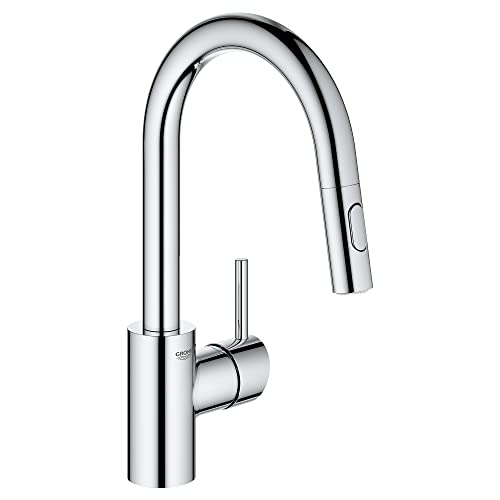
Grohe Concetto Pull-Down Bar Faucet 31479001 — Best Ceramic Valve, Compact
Grohe names its ceramic valve technology SilkMove, and the name is a fair description of what a good ceramic cartridge feels like: a lever that glides with hydraulic smoothness and lands exactly where you leave it, year after year. In the Concetto bar faucet that valve comes in a compact pull-down sized for prep and bar sinks — the pick for smaller basins, islands and second sinks where a full-size faucet would overwhelm.
Strengths
- SilkMove ceramic valve — benchmark lever feel and sealing
- Properly sized for bar, prep and island sinks
- Grohe engineering and finish quality (Starlight Chrome)
Trade-offs
- Compact scale is wrong for a main family sink
- Chrome only in this model — no brushed option listed
- European premium pricing for a small faucet
| Valve | SilkMove ceramic valve (Amazon title) |
| Flow | 1.75 GPM |
| Spray | Dual spray mode (Amazon title) |
| Swivel | 360° (Amazon title) |
| Finish | Starlight Chrome |
Bar faucets are a category where buyers often accept whatever is cheap, and then live with a gritty, vague lever on the sink they use for every drink and rinse. The Concetto argues the opposite allocation: the small sink is used constantly, its valve cycles as often as the main faucet’s, and a SilkMove cartridge makes every one of those cycles feel engineered. The 360-degree swivel and dual spray cover prep work properly. Size it honestly — this is a compact faucet for compact sinks, not a main-kitchen bargain — and it is the most refined small-faucet buy in this guide.
Best for: bar, prep and smaller sinks wanting a premium ceramic valve / Not suited for: main kitchens needing a full-size pull-down Check on Amazon

Kraus Oletto Pull-Down Kitchen Faucet KPF-2820SFS — Best Ceramic Cartridge, Full Size
If the Simplice is the disc purist’s pick, the Oletto is the systems pick: a ceramic cartridge — the same ceramic sealing family in cartridge form — housed in a solid brass body, with full 1.8 GPM flow and a spot-free finish. Buyers who think in assemblies rather than components will recognise the logic: the best valve deserves the best housing, and here both are named in the verified specification.
Strengths
- Ceramic cartridge seated in a solid brass body
- Full-size, full-flow specification
- Spot-free finish keeps upkeep minimal
Trade-offs
- Tall profile needs clearance checks
- Contemporary styling only
- Parts network smaller than Kohler’s or Delta’s
| Valve | Ceramic cartridge (API features) |
| Body | Brass body (API features) |
| Flow | 1.8 GPM |
| Height | 16.625 in |
| Spout | 8.75 in height, 8.875 in reach |
The pairing matters in practice because cartridges live or die by their housing: a ceramic cartridge in a body that flexes, corrodes or was threaded carelessly will not deliver its rated life, while the Oletto’s brass casting gives the cartridge a stable, permanent seat. Kraus’s hose geometry keeps the tall faucet’s wand working smoothly across the sink. As a full-size main-kitchen faucet with ceramic sealing, this is the most complete specification in the guide — the disc family’s technology with nothing around it downgraded.
Best for: main kitchens wanting ceramic sealing plus brass construction / Not suited for: low-clearance sinks or traditional schemes Check on Amazon

OWOFAN Spring Pull-Down Kitchen Faucet (Brushed Nickel) — Best Spring Faucet with Ceramic Cartridge
Spring faucets — the exposed-coil, commercial-style pattern — live hard lives: the wand is yanked around the sink constantly, and the valve cycles with every burst. OWOFAN’s version pairs that format with a ceramic cartridge whose API feature list cites 500,000-cycle testing, which is exactly the specification a spring faucet should headline: the format’s whole appeal is hard use, and the valve is rated for it in writing.
Strengths
- Ceramic cartridge with a stated 500,000-cycle rating
- Spring format gives commercial-style reach and flexibility
- Stainless construction and deck-plate flexibility
Trade-offs
- Value-tier support and finish consistency
- Spring silhouette is industrial — not for traditional schemes
- Dual modes only, versus three on some rivals
| Valve | Ceramic cartridge, 500,000-cycle testing (API features) |
| Body | SUS304 stainless (API features) |
| Height | 16 in |
| Dimensions | 1.85 x 1.85 x 16 in |
| Installation | 1 or 3 hole, deck plate |
The dual-mode spray (stream and high-pressure spray) and the SUS304 stainless construction complete a spec sheet that reads like it was written by someone who understood the assignment. The honest tier caveats apply — a value brand’s support and finish consistency are not Kohler’s — but the ceramic cartridge at the centre is the same technology family as the premium picks, and the cycle rating is the kind of number budget listings usually avoid printing. For a hard-working kitchen on a controlled budget, this is the rational spring-faucet buy.
Best for: cooks wanting spring-faucet reach with a cycle-rated ceramic valve / Not suited for: traditional kitchens or forever-home furnishing at any cost Check on Amazon

FORIOUS Pull-Down Kitchen Faucet (Brushed Nickel) — Best Budget Ceramic Cartridge
A generation ago, a budget faucet meant a washer valve and a two-year life. This FORIOUS model is the evidence that the floor has risen: a ceramic cartridge, stainless construction, three spray modes and named cUPC and NSF certifications, verified through the API feature list, at a genuinely budget tier. For a rental or first kitchen, ceramic sealing at this price changes the replacement maths entirely.
Strengths
- Verified ceramic cartridge at a budget tier
- Named certifications — unusual and welcome at this price
- Three spray modes including pause
Trade-offs
- Cosmetics and hose feel are tier-appropriate
- Parts are listing-matched rather than catalogue-stocked
- Support channels are thin compared with major brands
| Valve | Ceramic cartridge (API features) |
| Body | SUS304 stainless (API features) |
| Flow | 1.8 GPM |
| Height | 14.76 in |
| Certifications | cUPC and NSF/ANSI/CAN 61 (API features) |
The practical consequence of a ceramic cartridge at this tier is that the most common budget-faucet failure — the creeping drip — is engineered against from day one, leaving the tier’s remaining compromises where they belong: finish depth, hose refinement and parts logistics. The 14.76-inch height is sensibly standard, the deck plate covers one or three holes, and the three modes include a pause that many premium faucets omit. Record the model number, keep expectations tier-appropriate for the cosmetics, and the valve will likely outlast the kitchen’s next remodel.
Best for: budget kitchens that refuse to give up ceramic sealing / Not suited for: buyers wanting heritage-brand support depth Check on Amazon
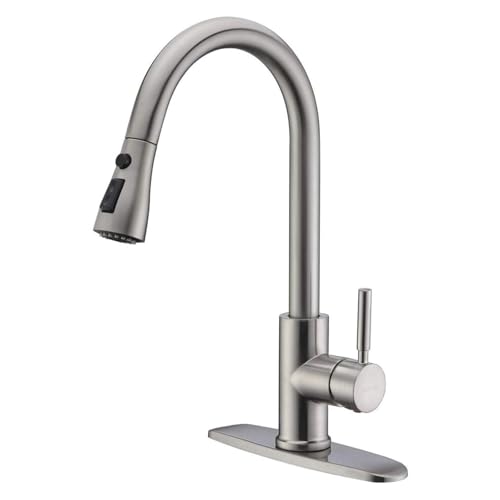
WEWE High-Arc Pull-Down Kitchen Faucet — Best Ceramic Value with Long Reach
WEWE’s high-arc pull-down pairs its ceramic cartridge with the specification wide-sink owners actually shop for: a 20-inch pull-down reach, per the Amazon title, which carries the spray head to the far corners of a big single-bowl or farmhouse basin and out to a pot sitting beside the sink. Ceramic sealing plus genuine reach, at a value tier, is a combination that did not exist in this market a few years ago.
Strengths
- 20-inch pull-down reach — the longest wand travel in this guide
- Ceramic cartridge keeps shut-off crisp under heavy use
- High arc suits deep and wide basins
Trade-offs
- Long hose demands careful under-sink routing
- Value-tier finish and support
- High arc can splash in shallow sinks
| Valve | Ceramic cartridge (Amazon title family) |
| Reach | 20 in pull-down reach (Amazon title) |
| Installation | 1 or 3 hole |
Reach is a double-edged specification — a longer hose needs a clean under-sink loop and a weight positioned to manage it — but in the wide sinks that need it, nothing else substitutes. The high-arc body suits deep basins, the one-or-three-hole fit covers most decks, and the ceramic cartridge keeps the shut-off crisp through the heavy cycling that a much-used wand implies. As with its budget peers, keep the paperwork and set cosmetic expectations by tier; the working specification — valve and reach — is the reason it is here, and on those two it delivers.
Best for: wide sinks needing maximum wand reach on a budget / Not suited for: small sinks or shallow basins Check on Amazon
Comparison Table
| Pick | Badge | Key spec | Best for |
|---|---|---|---|
| Kohler Simplice Pull-Down Kitchen Faucet K-596-BL | Best Overall Ceramic Disc | Ceramic disc valves, 3-function spray, DockNetik docking | buyers who want the definitive ceramic disc implementation |
| Grohe Concetto Pull-Down Bar Faucet 31479001 | Best Ceramic Valve, Compact | SilkMove ceramic valve, 1.75 GPM, dual spray, 360° swivel | bar, prep and smaller sinks wanting a premium ceramic valve |
| Kraus Oletto Pull-Down Kitchen Faucet KPF-2820SFS | Best Ceramic Cartridge, Full Size | Ceramic cartridge, brass body, 1.8 GPM, 16.625 in tall | main kitchens wanting ceramic sealing plus brass construction |
| OWOFAN Spring Pull-Down Kitchen Faucet (Brushed Nickel) | Best Spring Faucet with Ceramic Cartridge | Ceramic cartridge, SUS304, 16 in tall, 1 or 3-hole | cooks wanting spring-faucet reach with a cycle-rated ceramic valve |
| FORIOUS Pull-Down Kitchen Faucet (Brushed Nickel) | Best Budget Ceramic Cartridge | Ceramic cartridge, SUS304, 1.8 GPM, cUPC/NSF certified | budget kitchens that refuse to give up ceramic sealing |
| WEWE High-Arc Pull-Down Kitchen Faucet | Best Ceramic Value with Long Reach | Ceramic cartridge, 20 in pull-down reach, 1 or 3-hole | wide sinks needing maximum wand reach on a budget |
The table’s valve column is the point of the guide: every pick seals with ceramic, verified from the maker’s own description. The differences that remain — body material, size, spray systems, support depth — are the supporting cast, and they explain the price spread better than any finish story: you are paying for what surrounds the discs, because the discs themselves have become admirably democratic.
How to Choose Ceramic Disk Kitchen Faucets
Choosing among ceramic disc faucets means understanding what the technology does and does not promise, then matching the surrounding faucet to your sink and tier. The sections below cover the technology honestly first, because a disc valve bought on a myth will disappoint even when it performs exactly as designed.
How ceramic discs actually seal
Inside the cartridge, two ceramic discs sit face to face. The fixed disc has ports aligned with the inlets; the moving disc, turned by the handle, slides its ports into or out of alignment — full alignment is full flow, full offset is a shut-off sealed by the discs’ ground faces themselves. There is no washer to compress, perish or tear, and the ceramic faces are harder than anything the water carries, which is the whole secret: the seal is two stones sliding, and stones do not wear the way rubber does.
Hard water, grit and the disc’s real enemies
Ceramic discs shrug off the grit that scores lesser valves, but they are not invincible. Their genuine enemies are installation debris — a shard of solder or a slug of pipe scale flushed through a new cartridge can chip or jam a disc — and neglected mineral scale, which can stiffen the action over years in very hard water. The defences are simple: flush lines before the cartridge sees water, keep the aerator clean so back-pressure stays honest, and if the action ever stiffens, service or replace the cartridge rather than forcing the handle.
Disc versus cartridge versus diamond: placing the rivals
In modern listings, ‘ceramic disc’ and ‘ceramic cartridge’ are the same family — the cartridge is the replaceable unit that contains the discs. The main rival technology, Delta’s diamond-embedded seal, pursues the same drip-free longevity by a different route and is covered in the best-built guide. Traditional compression (washer) valves are the technology both replaced, and any new faucet still built on washers should be bought only as a deliberate period choice with a maintenance habit attached.
Cartridge replaceability is part of the spec
A ceramic valve should last a very long time — and should still be replaceable when ‘very long’ eventually ends. Before buying, check that the maker lists the cartridge as a part: Kohler, Grohe and Kraus publish theirs; value brands match by model listing, which works if you recorded the model at purchase. A faucet with a great valve and no obtainable cartridge is a sealed unit wearing a serviceable costume.
Size the faucet around the valve
With the valve settled, the ordinary geometry rules return with full force: height against cabinet clearance and sink depth, spout and wand reach against basin width, hole pattern against your deck. This guide’s picks run from a compact bar faucet to tall full-size pull-downs on the same technology — proof that the valve decision and the size decision are independent, and both deserve their own measurements.
Cartridge standards: why the maker’s ecosystem matters
Ceramic cartridges are not yet a universal standard part like a washer once was; each major maker runs its own cartridge dimensions across its lines. That is an argument not against ceramic but for ecosystem: a Kohler, Grohe or Kraus cartridge is a stocked, documented part, while an obscure brand’s ceramic cartridge may be ceramic in a faucet that is orphaned in five years. The disc will not wear out — but if the handle or hose fails first, you will want the maker to still exist. Buy the technology inside a company.
Temperature feel: what a good disc cartridge is like to use
A quality ceramic cartridge has a recognisable hand feel: the lever moves with hydraulic smoothness, holds any position without drift, and the flow responds proportionally through the travel. Gritty, notchy or vague action in a new faucet is a warning — either debris from an unflushed installation or a cartridge below the standard its listing claims. Exercise the handle through its full range at installation, while remedies are easy, and treat smoothness as a specification you are entitled to check.
Ceramic discs and instant-hot or filtered-water add-ons
Homes adding point-of-use extras — instant-hot tanks, filter taps, dishwasher air gaps — should plan the deck as a system with the main faucet: ceramic-disc models span the hole configurations those extras need, and several makers offer matching filter taps so the sink wall stays coherent. The valve choice and the extras choice are independent, but the hole census is shared, and counting it once, before ordering anything, is the discipline that keeps a ceramic upgrade from becoming a drilling project.
Do Ceramic Disc Faucets Really Last Longer? The Honest Evidence
The longevity claim for ceramic discs rests on materials science rather than marketing: alumina ceramic is dramatically harder than rubber, plastic and the mineral grit in household water, so the sealing faces do not abrade in service the way every softer seal does. Manufacturers’ cycle testing reflects this — ratings in the hundreds of thousands of cycles appear in this guide’s verified listings, figures no washer valve could survive. In a household cycling a faucet perhaps fifty times a day, such ratings translate to decades of theoretical valve life.
The honest caveats are about everything around the discs. Real faucets more often retire for finish wear, hose fatigue, a broken wand or a remodel than for a failed disc valve — the valve is frequently the last part standing. And a disc valve’s life assumes it was fed clean water from a flushed line at installation and not forced against scale by an owner stronger than the cartridge. None of this diminishes the technology; it locates its benefit precisely. A ceramic disc removes the drip from your future. The rest of the faucet still needs the ordinary care every machine does.
For buyers whose specific trauma is the 2 a.m. drip and the plumber’s bill that followed it, that precision is enough: ceramic discs are the correct, evidence-based answer, and the modest premium they once commanded has largely evaporated — as the budget picks in this guide demonstrate. The technology has won; the remaining decision is which faucet around it deserves your sink.
The economics of ceramic discs deserve the same honesty as their physics. A ceramic cartridge costs a maker modestly more than a washer assembly and meaningfully less than the warranty claims a washer generates, which is why the technology conquered every tier rather than remaining a luxury. For the buyer, the arithmetic is simpler: the price difference between a ceramic-disc faucet and its washer-built equivalent, where both still exist, is repaid by the first plumber visit that never happens. Few upgrades in the home have so lopsided a ledger, and none hides so completely inside a component the buyer will never see.
There is one household profile for whom ceramic discs matter most, and it is worth naming: the second-home, rental and inherited-house owner, whose faucets sit unused for weeks and then get used hard. Rubber washers perish in stillness — they dry, take a set and weep on the first use after a vacancy. Ceramic faces do not perish, do not take a set and do not care whether the house was empty for a season. For any property that is not lived in continuously, a ceramic-disc faucet is not an upgrade; it is the correct specification, and the picks above cover it at every tier from Grohe to the budget cartridges.
Ceramic discs also change the small hours of a kitchen’s life in ways owners notice only in retrospect. The washer faucet announced its age gradually — a drip at night, a handle that needed an extra quarter-turn, a stain of mineral where the drip landed. The ceramic faucet simply continues: the same clean stop in year nine as in week one, the same lever feel, the same silence. Reliability of this kind is invisible precisely because nothing happens, and it is why owners who have lived with a good disc valve rarely return to anything else — the absence of an annoyance, sustained for a decade, becomes a standard they refuse to give up.
The technology has one more frontier worth watching: as cartridges standardise within makers’ platforms, the cartridge is becoming the faucet’s true identity — bodies and finishes rotate as styling exercises around a stable ceramic core. For buyers this is good news disguised as trivia. It means the part of the faucet that decides its lifespan is increasingly the part its maker has refined longest and stocks deepest, and that a faucet bought today plugs into a maturing ecosystem rather than a dead end. The disc did not just fix the drip; it reorganised the industry around the component that matters.
If there is a single sentence to carry into the aisle, it is this: the discs are the faucet. Finishes are clothing, sprayheads are tools, silhouettes are furniture — but the two ceramic faces inside the cartridge are the machine itself, opening and closing against the full pressure of the house’s water, tens of thousands of times, asking nothing. Choose them from a maker who names them, seats them in a body worthy of them, and will sell you another cartridge in fifteen years. The rest of the purchase is taste.
Ceramic discs also simplify one neglected decision: the spare-parts drawer. A household running ceramic-cartridge faucets at kitchen and utility sinks can standardise its spares — an aerator, a cartridge for each platform, a set of O-rings — in a single small box, because the technology’s failure modes are few and known. Compare the washer era’s drawer of assorted rubbers, seats and springs, each faucet its own archaeology. Standardising on ceramic across a house is a quiet form of wealth: every future repair starts with the part already in the building.
A final installation-adjacent decision completes the ceramic picture: the shut-off valves beneath the sink. A ceramic cartridge can only be serviced as designed if the angle stops actually stop, and in older homes those valves are often the weakest part of the system — seized, weeping, or absent. When a ceramic-disc faucet goes into an older kitchen, testing and if necessary replacing the shut-offs during the same visit converts every future cartridge service from a whole-house shutdown into a ten-minute local job. It is unglamorous work that no photograph will ever show, and it is exactly the kind of completeness that separates a faucet installation from a faucet placement.
How to Install a Ceramic Disc Faucet (and Protect the Cartridge)
Ceramic cartridges have one installation rule that matters above all others: they must never be the first thing your water lines’ debris meets. The sequence below is the standard faucet installation with the flushing discipline a precision valve deserves — fifteen extra seconds that protect a twenty-year component.
- Shut off both supplies, drain and remove the old faucet, and clean the deck flat.
- Before connecting the new faucet, open each supply valve briefly into a bucket to flush the lines themselves — years of scale live in those pipes.
- Mount the faucet per its pattern, hand-starting every threaded connection before any wrench work, and tighten mounting hardware evenly.
- Route the pull-down hose in a clean loop with its weight correctly placed, where fitted.
- Connect the supplies, then — with the aerator removed — open the valves slowly and flush through the new faucet until the water runs perfectly clear.
- Refit the aerator, then exercise the handle slowly through its full range ten times; a new ceramic cartridge should feel uniformly smooth, with no gritty notch anywhere in its travel.
- Test all spray functions and check every joint with dry paper; re-check under the sink that evening.
If the handle ever feels gritty or the action stiffens months later, do not force it — that sensation is debris or scale asking for a cartridge service, and forcing a ceramic cartridge is how a cleanable situation becomes a replacement. Isolate the water, and the cartridge on every pick in this guide is a removable, replaceable unit by design.
A ceramic-specific habit for the first month: work the handle gently and fully once a day, through its whole range, rather than leaving the faucet parked at one position. New discs bed in against each other, and early full-range use polishes the faces into their smoothest working state — the faucet equivalent of running in an engine, and just as cheap.
Common Buying Mistakes
Skipping the line flush at installation. The single most damaging act for a new ceramic cartridge is feeding it the debris that installation stirs up. Flush the supplies into a bucket first, flush the faucet with the aerator off second, and the discs start life as clean as they were ground.
Believing ‘ceramic’ on any listing at face value. The word is used loosely across the marketplace. Buy where the maker’s own description names ceramic disc valves or a ceramic cartridge — as every pick in this guide was verified to do — rather than trusting a headline adjective.
Forcing a stiffening handle. Ceramic cartridges stiffen for a reason: scale or debris. Force cracks the argument and possibly the disc. Service or replace the cartridge — it is designed to come out — instead of muscling through.
Assuming the valve makes the whole faucet immortal. Hoses fatigue, finishes age, wands break. The disc removes the drip failure mode, not entropy. Choose the surrounding faucet — body, hose, parts support — with the same care as the valve.
Buying a great valve in the wrong size. A compact bar faucet on a family sink, or a tall pull-down under a low cabinet, disappoints daily regardless of its discs. Measure the sink’s geometry with the same rigour you applied to the valve choice.
Final Recommendation
The reference pick is the Kohler Simplice: ceramic discs from the maker most identified with them, in a complete modern faucet. Full-size alternatives with ceramic cartridges and brass construction point to the Kraus; small sinks to the Grohe; hard-working budgets to the OWOFAN, FORIOUS and WEWE, whose verified ceramic cartridges have quietly ended the era when a cheap faucet meant a dripping one.
Buy the valve on evidence, flush the lines like you mean it, and record the cartridge’s model with the house papers. Do those three things and the most failure-prone part of a kitchen faucet becomes the part you never think about again — which is the highest praise plumbing ever earns.
Let the last word be the practical one: flush the lines, record the cartridge, and then forget the valve exists. A ceramic disc faucet properly installed is the closest thing in the kitchen to a permanent appliance — and permanence, in plumbing, is the highest form of luxury.
- Best Overall Ceramic Disc — Kohler Simplice Pull-Down Kitchen Faucet K-596-BL: Check on Amazon
- Best Ceramic Valve, Compact — Grohe Concetto Pull-Down Bar Faucet 31479001: Check on Amazon
- Best Ceramic Cartridge, Full Size — Kraus Oletto Pull-Down Kitchen Faucet KPF-2820SFS: Check on Amazon
- Best Spring Faucet with Ceramic Cartridge — OWOFAN Spring Pull-Down Kitchen Faucet (Brushed Nickel): Check on Amazon
- Best Budget Ceramic Cartridge — FORIOUS Pull-Down Kitchen Faucet (Brushed Nickel): Check on Amazon
- Best Ceramic Value with Long Reach — WEWE High-Arc Pull-Down Kitchen Faucet: Check on Amazon
Related guides in this series: Best Ceramic Kitchen Faucets; Best Built Kitchen Faucets; Best Brushed Nickel Kitchen Faucets; Best Chrome Kitchen Faucets; Best Bridge Kitchen Faucets.
Frequently Asked Questions
What is a ceramic disc valve in a kitchen faucet?
It is a valve whose seal is formed by two ground ceramic discs sliding over each other. Ports in the discs align to let water flow and offset to shut it off, with the discs’ faces themselves making the seal — no rubber washer to wear out. Because ceramic is harder than waterborne grit and scale, the seal stays drip-free through far more cycles than traditional designs.
Are ceramic disc and ceramic cartridge the same thing?
In modern faucets, effectively yes: the cartridge is the replaceable unit, and inside it the sealing element is a pair of ceramic discs. Listings use both phrases for the same technology family. What matters is that the maker’s description names a ceramic disc or ceramic cartridge explicitly, as all the picks in this guide were verified to do.
Do ceramic disc faucets work with hard water?
They are among the best choices for hard water, because the hard ceramic faces resist the scoring that gritty, mineral-heavy water inflicts on softer seals. Mineral scale can still stiffen the action over years and will clog aerators, so keep the aerator clean and never force a stiff handle — service the cartridge instead.
How long does a ceramic disc cartridge last?
Cycle ratings in the hundreds of thousands are common — one pick in this guide cites 500,000-cycle testing — which translates to decades of household use in theory. In practice the cartridge often outlasts the faucet around it. When it eventually needs attention, it is a replaceable unit on every pick here.
Can a ceramic disc cartridge be replaced?
Yes — that is part of the design. Major makers publish their cartridges as stocked parts; value brands match replacements by model, so record the model number at purchase. Replacement is a water-off, basic-tools job, and it restores the faucet’s shut-off completely rather than patching it.
Why do some ceramic faucets cost so much more than others?
Mostly for what surrounds the discs: body material, spray and docking systems, finish, and the depth of the maker’s parts support. The ceramic technology itself has become inexpensive, which is why verified ceramic cartridges now appear in budget faucets. The premium buys the assembly and the ecosystem, not the discs alone.
Are ceramic disc faucets good for well water?
They are the best valve choice for well water, whose grit is exactly what destroys softer seals — the ceramic faces are harder than the grit. Fit a sediment filter if the supply is notably sandy, flush lines carefully at installation, and the discs will handle what would score a lesser valve in a season.
Why does my new ceramic faucet’s handle feel stiff?
On a new installation, stiffness usually means debris reached the cartridge — the lines were not flushed — or the cartridge nut was over-tightened at the factory or in fitting. Run the aerator-off flush first; if the feel does not clear, the cartridge should be inspected under warranty rather than forced, because forcing a gritty cartridge is what turns a cleanable issue into a scored disc.
Do ceramic disc faucets reduce water flow over time?
The discs themselves do not narrow with age — their ports are fixed geometry in a material that does not swell or perish. Any flow loss over the years comes from the aerator or spray face accumulating mineral scale, which is a two-minute cleaning job, or from supply-side changes. If flow falls, clean the aerator first; the valve is almost never the cause.
Can ceramic disc faucets be used with instant hot water tanks?
Yes — ceramic cartridges handle the temperature range of residential hot water systems, and their precise metering suits the controlled flow an instant-hot setup wants. Follow the tank maker’s flow requirements, keep the aerator appropriate to the system, and the disc valve will outlast the tank it feeds, probably twice over.


