Disclosure: airfryerkitchensupply.com is reader-supported. When you buy through links on our site, we may earn an affiliate commission at no extra cost to you.
Where to buy
If you are shopping for the best c stand for audio mixers, start with the shortlist below — and with one honest clarification this guide will not blur: a C-stand does not hold your mixer. A C-stand (century stand) is the grip world’s heavy-duty support column with a boom arm and grip heads, and in an audio setup its jobs are the ones around the mixer: booming a microphone overhead and out of frame, holding lights, flags and recorders, and keeping a small studio’s airspace organised while the mixer itself sits safely on the desk or cart where mixers belong. Every stand below is a current model sold through Amazon, with heights, arm lengths and capacities taken from the listings.
- Matthews 40-Inch C+ Stand with Turtle Base — check the current price on Amazon and confirm the exact variant on the listing before you order.
- Neewer Pro Stainless Steel C Stand with Boom Arm — check the current price on Amazon and confirm the exact variant on the listing before you order.
- Kupo 20-Inch C-Stand Turtle Base KS704211 — check the current price on Amazon and confirm the exact variant on the listing before you order.
- Neewer Basics SC320 Lite C Stand — check the current price on Amazon and confirm the exact variant on the listing before you order.
- K&F Concept Heavy Duty C Stand TL05 11.1 ft — check the current price on Amazon and confirm the exact variant on the listing before you order.
- LOMTAP C Stand with Boom Arm 10.8 ft — check the current price on Amazon and confirm the exact variant on the listing before you order.
Buy the stand for the load and the height you will actually boom — a microphone and a small light, not a console. Stainless for longevity, turtle bases for small rooms, sliding legs for uneven floors: the six below cover the realistic studio cases.
Search for the best c stand for audio mixers and you will find a keyword built on a reasonable confusion. Small studios — podcast rooms, video podcast sets, streaming corners, home recording spaces — are built around an audio mixer, and they are also built on C-stands. The two meet constantly in practice: the mixer takes the microphone’s signal, and the C-stand is very often what holds that microphone, boomed overhead so it captures a clean voice while staying out of the camera’s frame. Add the set’s key light, a flag to control spill, or a recorder mounted high, and the C-stand becomes the studio’s load-bearing furniture.
So this guide does the keyword the courtesy of taking its intent seriously and its physics literally. No stand here — no C-stand anywhere — should carry a mixing console: mixers belong on desks, racks and carts, within the operator’s reach, away from anything that can tip. What a C-stand should do in an audio-mixer studio is boom light loads safely and stay invisible doing it. Judged on that real job, stands differ in ways that matter: maximum height and arm length for overhead reach, rated capacity with a safety margin, base style for your floor space, and steel versus stainless construction for a decade of service.
All six picks were verified as current Amazon listings before writing, and their specifications come from those listings. The range runs from a compact 20-inch Kupo for low and tabletop-adjacent work to an 11.1-foot K&F Concept for high booms, with the professional Matthews standard, two Neewer stainless values and a complete LOMTAP kit between. Buy for your ceiling, your floor and your heaviest realistic boom load — in that order.
In this guide
Quick Picks
Six C-stands for the studio around your mixer, from compact to tallest. Badges match the full reviews below.
Best Overall Professional — Matthews 40-Inch C+ Stand with Turtle Base
Matthews is the name the design carries: the listing confirms a 40-inch C+ stand with turtle base, grip head and arm, a 22 lb load capacity and 126.5-inch maximum height, in black. This is the professional reference — the stand a working studio buys when a boomed microphone hangs over talent all day and ‘good enough’ is not the standard anyone wants to explain afterwards.
Best Value Professional — Neewer Pro Stainless Steel C Stand with Boom Arm
Neewer’s Pro is the stainless value benchmark: its listing confirms 100% stainless steel construction, a 10.5 ft / 320 cm maximum height, a 4.2 ft / 128 cm holding arm and two grip heads for monolights, softboxes and reflectors. For a home or project studio booming a microphone or an LED panel, it delivers the professional format — stainless, full height, complete grip kit — at the friendliest commitment in this guide’s upper half.
Best Compact and Low-Position — Kupo 20-Inch C-Stand Turtle Base KS704211
Not every studio job is overhead. Kupo’s 20-inch C-stand is the low specialist: a turtle-base professional grip stand with a detachable base and a two-riser, three-section design in heavy-duty steel, per its listing, in black. Low microphone positions, tabletop-adjacent product audio, a light skimming across a desk set — the short stand does the jobs a full-height column does clumsily, in a footprint that suits small rooms.
Best Budget Stainless — Neewer Basics SC320 Lite C Stand
The SC320 Lite is the budget door into stainless: its listing confirms a 100% stainless steel heavy-duty C-stand with a 10.5 ft / 320 cm height, a 4.2 ft / 128 cm holding arm and two grip heads, under Neewer’s Basics line. Same headline format as the Pro — full height, real arm, two heads, stainless — trimmed to an entry commitment for a first studio stand.
Best Tall for High Ceilings — K&F Concept Heavy Duty C Stand TL05 11.1 ft
When the room is tall, the stand must be taller. The K&F Concept TL05’s listing confirms an 11.1 ft stainless steel C-stand with a holding arm and two grip heads — the greatest reach in this guide. High ceilings, standing-height booms over a group around a table, or a light that must clear a tall set: this is the stand that still has riser left when the 10.5 ft models are at their limit.
Best Complete Kit — LOMTAP C Stand with Boom Arm 10.8 ft
The LOMTAP is the box that arrives ready: its listing confirms a 10.8 ft / 330 cm heavy-duty stand with a 4.2 ft / 128 cm boom arm, a water sandbag, two grip heads and three clips for softboxes and reflectors. The included sandbag is the detail that matters — boom work needs one from the first day, and this is the only pick here that puts it in the box.
If one stand must start a small studio, make it a full-height stainless model with a proper arm and two grip heads — the Neewer Pro or, at the professional standard, the Matthews.
How These Picks Were Chosen
Picks were chosen for the C-stand’s real jobs in an audio studio — overhead microphone booming, lighting support and accessory holding — and every model had to verify as a current Amazon listing with an exact title match, so heights, arm lengths, capacities and included grip hardware below are listing facts. Any stand we could not verify was excluded rather than described from memory.
We weighted safety and suitability over catalogue size. A stand for booming over people needs a rated capacity comfortably above the microphone or light it carries, a base that stays planted in the room’s actual footprint, and grip heads that lock without creeping. Construction material mattered next — stainless steel for stands that will be adjusted daily for years — followed by kit completeness, because a stand that arrives without the arm, heads or sandbag its job requires is not the saving it appears.
The six were spread across the realistic cases instead of ranked as clones: the professional reference, the value professional, a compact low stand, a budget stainless, the tallest option, and a complete accessories-included kit. Prices in grip equipment move less theatrically than electronics but still shift, so the guide uses check-price links throughout.
- Verified current Amazon listing, exact model match
- Rated for the real studio loads: microphones, small lights, flags and accessories — never a mixer console
- Height and arm length stated from the listing, matched to ceiling and boom needs
- Base style suited to the room: turtle base for tight spaces, sliding leg for uneven floors
- Grip heads and arm included as listed; sandbagging assumed for any boom load
- No fixed prices or ratings printed — check price on Amazon for the current figure
The 6 Best C Stand for Audio Mixers Studios, Reviewed
Each review covers the studio job the stand does best, its strengths, its honest trade-offs, and the listing-verified specifications. Throughout: boom microphones and lights, never the mixer itself.

Matthews 40-Inch C+ Stand with Turtle Base — Best Overall Professional
The Matthews 40-Inch C+ Stand is what the C in C-stand means when professionals say it. Matthews Studio Equipment effectively defined the modern century stand, and this verified listing confirms the full professional specification: a turtle base, grip head and arm included, a 22 lb load capacity and a maximum height of 126.5 inches, in a black finish with the line’s signature orange feet. In an audio studio, that capacity is the headline: a boomed microphone, shock mount and cable — or a modest LED light — sits far inside the rating, which is exactly where overhead loads over people belong.
Strengths
- 22 lb rated capacity keeps mic and light booms deep inside the safety margin
- Turtle base detaches for transport and tight floor footprints
- Professional Matthews build, parts and resale ecosystem
Trade-offs
- Premium professional pricing — the considered purchase in this guide
- Heavier than budget stands; a deliberate, planted piece of furniture
- Overkill for a single lightweight microphone on a desk-adjacent setup
Key specs (from the manufacturer’s Amazon listing title):
- Capacity: 22 lb load capacity, per listing title
- Max height: 126.5 inches, per listing title
- Base: Turtle base, detachable, per listing title
- Included: Grip head and arm, per listing title
- Finish: Black, per listing title
Studios standardise on Matthews for unglamorous reasons: the knuckles lock and stay locked, the risers move smoothly year after year, spare parts exist, and every grip in the building already knows the stand’s habits. For an audio-mixer room, that translates into trust in the one position where trust matters — overhead. A microphone boomed for a podcast or a vocal session hangs above a person and above expensive gear; the stand holding it should be the least interesting variable in the room, and this is the stand that achieves uninteresting. Its costs are money and mass. It is the heaviest kind of stand to move between rooms and the most expensive way to hold a microphone ever devised by this guide. Studios that record daily will call both worth it; occasional recorders should read the Neewer Pro review next and decide honestly how professional their overhead needs to be.
Best for: working studios booming microphones or lights overhead daily / Not suited for: occasional recorders or anyone who must carry the stand between locations often
Check the Matthews C+ Stand on Amazon — check price on Amazon and read the full listing details for the current configuration.
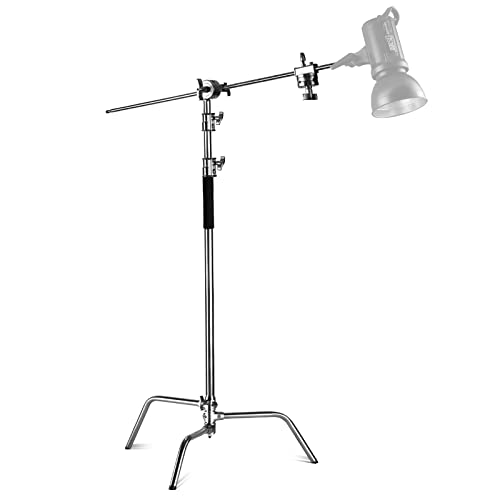
Neewer Pro Stainless Steel C Stand with Boom Arm — Best Value Professional
The Neewer Pro C Stand is the pick that made professional-format grip accessible to project studios, and its verified listing shows the format is complete: 100% stainless steel construction, a maximum height of 10.5 ft (320 cm), a 4.2 ft (128 cm) holding arm and two grip heads, specified for studio monolights, softboxes and reflectors. Stainless is the material decision that matters most at this level. A stand adjusted daily, in rooms that are not climate-controlled, shrugs off the corrosion and surface wear that slowly roughen painted steel, and the action of its risers and knuckles stays smooth for it.
Strengths
- 100% stainless steel for long, corrosion-resistant service
- Full 10.5 ft height with a proper 4.2 ft holding arm
- Two grip heads included — boom and accessory positions covered
Trade-offs
- Not the Matthews standard of knuckle refinement or parts support
- Stainless and full-size means a substantial stand to store and move
- Sandbag for boom work is on you — budget and use one every time
Key specs (from the manufacturer’s Amazon listing title):
- Construction: 100% stainless steel, per listing title
- Max height: 10.5 ft / 320 cm, per listing title
- Arm: 4.2 ft / 128 cm holding arm, per listing title
- Included: 2 grip heads, per listing title
In a mixer-centred studio, the Neewer Pro covers the two classic C-stand jobs without help: boom arm out over the desk or the talent position with a microphone in a shock mount at its end, and the second grip head holding a small flag, a reflector or a cable-managed light. Its height reaches a useful overhead position in a normal-ceiling room, and stainless construction means it can also live a second life on the occasional location shoot without complaint. The honest gap to the Matthews is refinement rather than function — knuckle feel, long-term parts, the last degree of rigidity at full extension with a heavy light. For a microphone, which is a light load, that gap is mostly theoretical. For a studio equipping itself from scratch, this is where the smart money starts, with the Matthews as the upgrade the room grows into.
Best for: home and project studios wanting the full professional format in stainless / Not suited for: studios standardising a multi-stand professional grip package
Check the Neewer Pro C Stand on Amazon — check price on Amazon and read the full listing details for the current configuration.
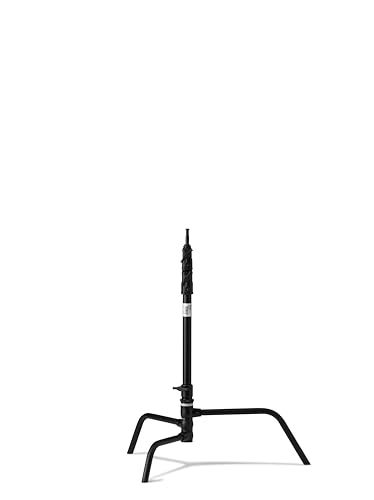
Kupo 20-Inch C-Stand Turtle Base KS704211 — Best Compact and Low-Position
The Kupo 20-Inch C-Stand exists because height is not always the requirement. Its verified listing describes a professional grip stand with a turtle base, a detachable base and a two-riser, three-section design in heavy-duty steel, finished in black — a short column for the low half of studio work. Kupo is a respected grip maker in its own right, and this stand brings that build standard to the jobs small audio studios actually have at knee height: a microphone low for an amplifier or a seated instrument, a small light raking across a desk set for a video podcast, a flag close to a surface.
Strengths
- Low, compact column for positions a full stand handles clumsily
- Detachable turtle base suits tight rooms and transport
- Kupo professional grip build in heavy-duty steel
Trade-offs
- 20-inch class height cannot boom overhead — it is a specialist, not a starter stand
- Steel rather than stainless construction
- Most studios need it as a second stand alongside a full-height model
Key specs (from the manufacturer’s Amazon listing title):
- Size: 20-inch C-stand, per listing title
- Base: Turtle base, detachable, per listing title
- Design: Two riser / three section, per listing title
- Construction: Heavy-duty steel, per listing title
- Finish: Black (KS704211), per listing title
Small studios underestimate low grip until they need it. A guitar amplifier miked at the cone, a cajón or a seated player’s instrument, a product narration recorded at a desk with the microphone just out of frame — each wants support that is low, rigid and close, and a full-height C-stand parked at its minimum is a clumsy, top-heavy answer. The Kupo parks its mass where the job is. Its turtle base also detaches, which lets the column travel or lets the base serve as a low floor mount in a pinch. Buy it as the second stand in a growing studio, or as the first if your recording life is genuinely seated and tabletop. Everyone else should start full-height and add this when the low jobs start recurring — they will, and this is the tidy way to meet them.
Best for: low microphone and light positions in small, seated or tabletop studios / Not suited for: anyone needing overhead booming from their only stand
Check the Kupo 20-Inch C-Stand on Amazon — check price on Amazon and read the full listing details for the current configuration.

Neewer Basics SC320 Lite C Stand — Best Budget Stainless
Every studio starts somewhere, and the Neewer Basics SC320 Lite is designed to be that start without being a false economy. The verified listing confirms the essentials survive the Basics badge: 100% stainless steel heavy-duty construction, a maximum height of 10.5 ft (320 cm), a 4.2 ft (128 cm) holding boom arm and two grip heads, aimed at studio monolights, softboxes and reflectors. On paper that is the same working format as the Pro above it, which is precisely the point — a first stand should teach the real system, not a toy version of it.
Strengths
- Stainless construction at the entry end of the category
- Full 10.5 ft height and 4.2 ft arm — no format compromise
- Two grip heads included for boom plus accessory work
Trade-offs
- Basics-line refinement: expect simpler finishing than the Pro and Matthews
- A first stand still needs a sandbag for safe boom work — not a headline feature here
- Heavier loads and daily professional abuse belong to the picks above
Key specs (from the manufacturer’s Amazon listing title):
- Construction: 100% stainless steel, heavy duty, per listing title
- Max height: 10.5 ft / 320 cm, per listing title
- Arm: 4.2 ft / 128 cm holding boom arm, per listing title
- Included: 2 grip heads, per listing title
- Model: SC320 Lite, per listing title
The Lite’s argument is about where a first studio’s money should go. Grip is infrastructure: a stainless full-format stand bought once serves a decade of microphones and lights, while the savings from a painted, undersized or incomplete stand evaporate at the first upgrade. With this stand, a beginner can learn proper booming — arm counterbalanced by a sandbag, grip heads locked in the correct orientation, cable strain-relieved down the column — on the same geometry professionals use. Its limits are the honest limits of a basics line: hardware finishing and long-term knuckle refinement sit a step below the Pro, and a studio that ends up booming heavy lights daily should graduate upward. As the first stand around a mixer-centred desk, though, it is the rare budget pick that does not need apologising for or replacing within the year.
Best for: first studios wanting a real stainless C-stand at an entry commitment / Not suited for: daily professional use with heavy lighting loads
Check the Neewer SC320 Lite on Amazon — check price on Amazon and read the full listing details for the current configuration.

K&F Concept Heavy Duty C Stand TL05 11.1 ft — Best Tall for High Ceilings
The K&F Concept TL05 answers the simplest specification question in this guide: what reaches highest? Its verified listing states an 11.1 ft heavy-duty C-stand in stainless steel, with a holding arm and two grip heads, for studio monolights, softboxes and reflectors. That extra height over the 10.5 ft class is not vanity. Booming a microphone over standing talent, clearing a tall video set, or placing a light high in a room with a proper ceiling all consume riser quickly, and a stand at its absolute maximum is a stand at its least rigid — working height in reserve is a working quality, not a luxury.
Strengths
- 11.1 ft maximum — the tallest reach in this guide
- Stainless steel construction with two grip heads included
- Height in reserve keeps booms off the stand’s least rigid extreme
Trade-offs
- The largest stand here to store, carry and park in a small room
- Tall booms demand disciplined sandbagging and cable management
- Standard rooms with low ceilings will never use its defining advantage
Key specs (from the manufacturer’s Amazon listing title):
- Max height: 11.1 ft, per listing title
- Construction: Stainless steel, per listing title
- Included: Holding arm, 2 grip heads, per listing title
- Model: TL05, per listing title
K&F Concept built its name on photographic accessories, and the TL05 brings that value engineering to full-size grip: stainless, tall, complete with arm and heads. In an audio studio its moment is the group recording — several people around a table or standing for a video podcast, one microphone boomed centrally and high enough to stay out of every frame, or a pair of stands carrying a stereo pair over an ensemble the mixer is recording. Those jobs fail quietly on shorter stands, which end up maxed, flexing and still not clear of the shot. The discipline the TL05 demands in return is respect for leverage: the higher and further a load booms, the more the base must be weighted and the cable dressed so it cannot tug the arm. Give it that discipline and it is the reach pick of the six; put it in a low-ceilinged bedroom studio and its virtue is simply wasted height.
Best for: tall rooms, standing group recording and high light placement / Not suited for: low-ceilinged small rooms or minimal-storage setups
Check the K&F Concept TL05 on Amazon — check price on Amazon and read the full listing details for the current configuration.
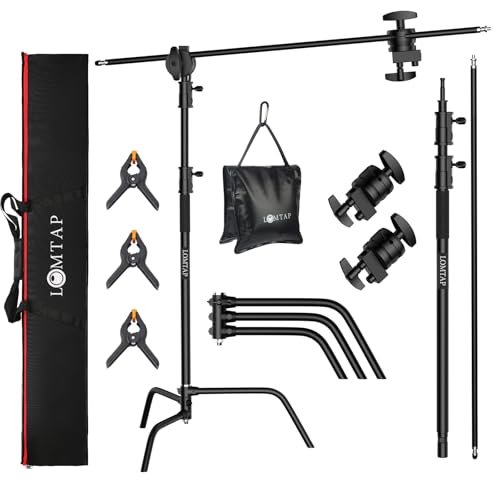
LOMTAP C Stand with Boom Arm 10.8 ft — Best Complete Kit
The LOMTAP C Stand competes on completeness, and for a first studio that is a genuinely strong argument. Its verified listing describes a heavy-duty stand with a 10.8 ft (330 cm) vertical pole and a 4.2 ft (128 cm) boom arm, supplied with a water sandbag, two grip heads and three clips, for softboxes and reflectors. Every other pick in this guide assumes you will source the sandbag that safe booming requires; the LOMTAP simply includes one, along with the clips that small studios use constantly for cables, gels, flags and backdrop edges.
Strengths
- Water sandbag included — safe booming from day one
- Full 10.8 ft height and 4.2 ft boom arm
- Clips and two grip heads complete a working small-studio kit
Trade-offs
- Kit-brand support and parts depth sit below Matthews, Kupo and Neewer
- Water sandbags need filling and occasional checking versus set-and-forget shot bags
- Daily professional punishment belongs to the heavier-duty picks above
Key specs (from the manufacturer’s Amazon listing title):
- Max height: 10.8 ft / 330 cm vertical pole, per listing title
- Arm: 4.2 ft / 128 cm boom arm, per listing title
- Included: Water sandbag, 2 grip heads, 3 clips, per listing title
Judge the LOMTAP as a system purchase. A new studio owner who buys a bare stand elsewhere still faces the accessory trail — sandbag, spare head, clips — each a small order, a small delay, and a small temptation to boom unsafely in the meantime. This kit closes that gap in one box, and its headline dimensions are fully competitive: 10.8 ft of pole is more reach than the 10.5 ft class, and the arm matches the standard length. Where it concedes ground is the long game of a working studio: brand support, spare-part depth and the knuckle refinement that daily professional use eventually tests. For a home or project studio equipping around a mixer desk, that trade is often the right one — complete, safe and working this week beats theoretically finer and incomplete. Add a second stand later from higher in this list and the LOMTAP remains useful for years as the kit that is always ready.
Best for: first studios wanting a complete, safe booming kit in one box / Not suited for: professional studios standardising on a single grip brand
Check the LOMTAP C Stand on Amazon — check price on Amazon and read the full listing details for the current configuration.
Comparison Table
Height, material and what is in the box separate these stands more than brand does. Note the capacity line on the Matthews — the only stand here whose listing states one, and the standard overhead work should be planned against.
| Pick | Badge | Key spec | Best for |
|---|---|---|---|
| Matthews 40-Inch C+ Stand with Turtle Base | Best Overall Professional | 22 lb capacity, 126.5-in max height, turtle base | working studios booming microphones or lights overhead daily |
| Neewer Pro Stainless Steel C Stand with Boom Arm | Best Value Professional | Stainless, 10.5 ft max, 4.2 ft arm, 2 grip heads | home and project studios wanting the full professional format in stainless |
| Kupo 20-Inch C-Stand Turtle Base KS704211 | Best Compact and Low-Position | 20-in compact, turtle base, 3-section steel | low microphone and light positions in small, seated or tabletop studios |
| Neewer Basics SC320 Lite C Stand | Best Budget Stainless | Stainless, 10.5 ft max, 4.2 ft arm, SC320 Lite | first studios wanting a real stainless C-stand at an entry commitment |
| K&F Concept Heavy Duty C Stand TL05 11.1 ft | Best Tall for High Ceilings | 11.1 ft max, stainless, holding arm, 2 grip heads | tall rooms, standing group recording and high light placement |
| LOMTAP C Stand with Boom Arm 10.8 ft | Best Complete Kit | 10.8 ft, 4.2 ft arm, sandbag + heads + clips included | first studios wanting a complete, safe booming kit in one box |
How to Choose a C-Stand for a Studio Built Around an Audio Mixer
Start by listing the stand’s actual jobs in your room, because the list is shorter and more specific than the marketing suggests. In a mixer-centred studio they are: booming a microphone overhead for a seated or standing voice; holding a key or fill light for video; flying a small flag or reflector to shape that light; and occasionally mounting a recorder, a camera or a cable run up high and out of the way. Every job is a light load measured in a few pounds. None of them is holding the mixer, which stays on the desk where its faders can be reached — a point worth repeating because the search implies otherwise, and a console on a grip arm would be both unreachable and unsafe.
Match height to your ceiling and your tallest subject, with reserve. A seated podcast boom in a normal room lives comfortably on a 10.5 ft stand; standing talent, group recording or high light placement pushes toward the 11 ft class. Then choose the base for your floor: turtle bases detach and park tightly in small rooms, standard legs spread wider for stability on open floors, and sliding legs level the stand on steps and uneven ground. Construction is the long-term decision — stainless for a stand adjusted daily for years, steel for lighter duty at lower cost.
Finally, buy the system, not the column. A working boom needs the arm, two grip heads, a sandbag and a plan for the microphone cable, which must be dressed down the stand so its weight never hangs from the arm. Kits that include those pieces, and stands whose makers sell spares, are worth more than a taller headline height with nothing in the box.
- List the real jobs: mic boom, light, flag — never the mixer itself
- Keep boom loads far inside the stand’s rated capacity
- Height with reserve beats height at the limit
- Turtle base for tight rooms, sliding leg for uneven floors
- Budget the sandbag and cable dressing with the stand, not after it
C-Stand Safety in a Recording Studio
Overhead loads over people deserve a short, non-negotiable routine. Always sandbag a boomed arm — the bag over the highest leg, on the side opposite the load’s pull — and keep the load as close to the column as the shot allows, because leverage, not weight, tips stands. Lock grip heads so the load’s weight tightens rather than loosens the head, a orientation detail every grip learns and every beginner should copy from the maker’s diagrams. Dress the microphone cable down the arm and column with slack at both ends, so a snagged cable pulls the stand’s base, not the microphone out of its mount.
Work the room like a set: no cables across walkways without a cover or tape, no stand legs where a chair rolls back, and a visual check of every lock before talent sits down. None of this is elaborate. It is the difference between grip as invisible infrastructure and grip as the story of the session, and studios that record people under booms owe their guests the invisible kind.
What Else the Mixer Studio Needs Besides the Stand
A C-stand earns its place inside a small system. The microphone it booms needs a shock mount to isolate it from stand-borne vibration, a boom-friendly cable of adequate length, and the mixer channel to receive it — with phantom power if the microphone is a condenser, which most overhead studio choices are. Video work adds the light itself and a flag or softbox, which the second grip head exists to hold. Keep a small grip kit with the stand: spare grip head, gaff tape, a few clips and a second sandbag, because the difference between a studio that flows and one that stalls is usually a two-dollar clip.
Treat the mixer desk and the stand as one layout problem. The operator must reach the faders, see the talent, and keep the stand’s legs out of both the camera frame and the walkway — a five-minute tape-marking session on the floor, marking leg and desk positions that work, will save those five minutes at every session for years.
- Shock mount for any boomed microphone
- Cable long enough to dress down the column with slack
- A second grip head in use for flag, light or cable control
- Floor tape marking proven desk and stand positions
- Phantom power confirmed on the mixer channel for condenser microphones
How to Boom a Microphone Over a Desk with a C-Stand
This is the core C-stand skill in a mixer studio: a microphone overhead, out of frame, close enough to sound intimate, on a stand that cannot creep or tip. Work slowly the first time; it becomes a three-minute routine.
- Place the stand beside and slightly behind the talent position, legs spread fully, with the longest leg pointing in the direction the arm will boom — that leg is the one the load will try to lift.
- Hang the sandbag over that high leg before any load goes on the arm. Weight first, load second, every time.
- Fit the boom arm in the grip head at the top of the column and lock it so the load’s weight tends to tighten the head, per the maker’s diagram. Extend only as much arm as the position needs.
- Mount the microphone in its shock mount at the arm’s end, angled down toward the speaker’s mouth position, roughly a hand’s span above head height and slightly in front — close enough for a strong, dry signal into the mixer.
- Dress the cable along the arm and down the column with a small service loop at the microphone and slack at the base, securing it with clips or ties so no cable weight hangs from the mic.
- Raise the column only as high as the position requires, lock every riser, and give the whole assembly a firm nudge test before anyone sits under it.
- At the mixer, set the channel gain with the talent speaking at real level from the actual seat, and check for stand-borne noise by tapping the desk — the shock mount, not the gain, is the fix.
- Mark the floor with tape at the stand’s feet and the chair position, so next session starts from a proven geometry.
To strike the setup, reverse the order: microphone off first, then arm, and the sandbag last — a stand is most likely to be mishandled when it is being hurriedly emptied. Coil the cable loosely and store the stand with its heads on, ready for the marked positions next time.
Common Buying Mistakes
C-stand accidents and frustrations in small studios are almost never equipment failures. They are these habits, each of them fixable in a day.
- Expecting a C-stand to hold the mixer itself — consoles belong on desks, racks and carts, never on grip arms
- Booming without a sandbag because the microphone is ‘only light’ — leverage tips stands, not just weight
- Hanging the microphone cable from the arm so its weight drags on the mount and the connector
- Locking a grip head in the orientation that the load’s weight loosens
- Extending every riser to maximum when the position needs half of it, trading rigidity for nothing
- Placing legs in walkways and chair paths, then blaming the stand when it gets clipped
Final Recommendation
If a studio buys one C-stand and holds it to a professional standard, it is the Matthews C+: the rated capacity, the turtle base and the build that overhead work deserves. Most home and project studios should start at the Neewer Pro for the same format in stainless at a friendlier commitment, or the SC320 Lite if the budget is genuinely tight, and add the Kupo 20-inch when low positions start recurring. Tall rooms belong to the K&F TL05, and first-time buyers who want everything in one box should take the LOMTAP kit and its included sandbag seriously.
Keep the roles straight and the system works: the mixer on the desk, the microphone on the boom, the light on the arm. The neighbouring guides in this programme cover the rest of the desk — start with Best Beginner Passive Mixers and Best Behringer Mixers for the console itself, compare the interview-specific stand choices in Best C Stand For Interviews Audio Mixers, and see the wider beginner field in Best Beginner Mixers.
Before you decide, re-check the shortlist leaders at their current listings: Matthews 40-Inch C+ Stand with Turtle Base, Neewer Pro Stainless Steel C Stand with Boom Arm, Kupo 20-Inch C-Stand Turtle Base KS704211 — check price on Amazon for each and confirm the exact variant.
- Best Beginner Passive Mixers
- Best Behringer Mixers
- Best C Stand For Interviews Audio Mixers
- Best Beginner Mixers
Frequently Asked Questions
Can a C-stand actually hold an audio mixer?
No — and it should not be asked to. A C-stand is a grip support for booming and holding relatively light equipment such as microphones, small lights, flags and reflectors, using grip heads and an arm. A mixing console needs to sit flat, stable and within the operator’s reach, on a desk, rack or cart. In a mixer-centred studio the C-stand’s job is everything around the mixer — most importantly booming the microphone overhead — and judged on that job it is close to indispensable.
Why boom a microphone on a C-stand instead of using a desk stand?
Height, reach and frame. A C-stand places a microphone above and in front of a speaker, angled down at the mouth — the position that captures a close, dry voice while keeping the microphone out of a video frame and away from desk thumps and keyboard noise. A desk stand puts the microphone lower, further from the mouth’s axis and in the shot. For seated interviews and video podcasts, the overhead boom is the professional default precisely because it solves the audio and the picture at once.
How much weight can I safely boom on a C-stand?
Stay far inside the stand’s rated capacity and respect leverage. The Matthews in this guide is listed at a 22 lb load capacity, and a typical overhead load — microphone, shock mount and cable, or a compact LED — is a small fraction of that. The real limits are how far the arm extends and whether the base is sandbagged: a modest load at full extension can tip an unweighted stand that would hold far more close to the column. Keep loads close, weight the base, and treat the rating as a ceiling for the whole geometry, not a target.
What is a turtle base and do I need one?
A turtle base is the detachable, low, three-legged base classic to C-stands: it unbolts from the column for transport and storage, parks the stand in a tight footprint, and can serve alone as a low floor mount. Small studios benefit most — the stand stores flat, moves through doorways easily and fits corners a fixed base cannot. Stands with standard or sliding legs trade that packability for one-piece simplicity or levelling on uneven ground. For a home or project studio, a turtle base is usually the right default.
Stainless steel or steel: does the material matter?
Over years, yes. Stainless stands resist the corrosion and surface wear that come from daily adjustment, humid rooms and occasional location work, and their risers and knuckles keep their smooth action longer. Painted or chrome steel stands cost less and serve lighter duty well, but their finishes chip at exactly the points hands and heads grip. A stand bought for a decade of studio service justifies stainless; a stand bought for occasional use can save the difference without apology.
How many C-stands does a small studio need?
One does the core job — the microphone boom — and most starter studios should buy one good stand rather than two cheap ones. Two unlock the classic interview and video layout: one booming the microphone, one carrying the key light or a flag, which is why the interview companion guide in this programme treats the pair as the working unit. A third, often a compact low stand like the Kupo in this guide, completes the common set. Grow in that order and every purchase has a job waiting for it.


